
Slow Jamz

I know this is classically "TCJ" of me, but "Will Eisner Week" seems silly. I like Eisner's work very much, particularly The Spirit and the near-hysterical melodrama (that's a good thing) of A Contract with God, the gauzy false history of The Dreamer, etc. But the ongoing deification of the man does his actual achievements a disservice. As Gary Groth has written many times (that it's never sunk in is a testament to the unique mix of self-love and self-hatred that is comic book culture for men over the age of 40. What my generation does with all this stuff is up for grabs. Maybe nothing. Maybe it'll be "Fletcher Hanks Hangover Day" in 30 years. Or "Rory Hayes Mondayz".) the best way to appreciate an artist is to be realistic about what he did. I'm all for appreciations and weeks and blah blah. Couldn't it just be Will Eisner Day: A guy who managed to make a buncha good comics and inspire people? Or Will Eisner Weekend: Read comics by his assistants! Or Will Eisner Hour: Read Hawks of the Seas!

 Eisner is neither the father of the "the graphic novel" nor is said "graphic novel" even a "uniquely American art form". He was a popularizer and an advocate. This has all been written about ad infinitum over the last decade or so. But! Writing this kind of thing is more or less pissing in the wind. This precise little blog post will not convince anyone. No argument can, actually. There's a kind of calcified fandom in place rooted in a striving emotional attachment to a father figure and the hopes for acceptance of the idols of one's youth. Kind of like the terrible "nerd culture" that's sprung up. It just won't budge. It's not disingenuous: I think that whoever wrote those taglines actually believes them, and all that takes is a certain passivity and (maybe) willful blindness. I suppose the irritation on my end is that obscures the facts and pushes what limited resources there are in this medium onto something both false and unnecessary. Telling someone to read a graphic novel is like saying "Watch some TV" or "Read a Poem". Why in the world would that matter? Well, anyway, another ranty aside down the hatch.

Well, speaking of Boss Groth, here he is with a sadly truncated interview with artist Jerry Moriarty.

GROTH: Do you think all the arts have essentially the same creative process: writing, painting, making music?

MORIARTY: I think that they share. I think collaborative arts are different. I recognize certain tricks when I see Actor’s Studio guys on TV talking about their process. Christopher Walken, on one of the shows, he said something about, they’d all get their scripts, and he would go through his script and take all the punctuation out, so he wouldn’t know if it was a question or whatever. And so he delivered a line without any knowledge of whether it’s a question or exclamation, so the actor he’s playing to would freak. And I just love that, because it’d make the other actor improvise, somewhat. Of course, he’s in the dark himself, because he took all the punctuation out. I think that’s nice.

Another actor said that, on the stage before an audience, if you got to the point in the part where he’s supposed to cry, he doesn’t cry, because he wants the audience to cry — because if he did cry, then the audience wouldn’t have to cry, because he fulfilled what the need was. I love that, so when I hear these things, I find connections.  But I think the real distinction is collaboration, because they have to work with someone else in that moment, whereas writers and artists generally don’t. So, it’s like a tightrope, there’s no support at all. No net at all. You survive the fall, but you know the fall exists. There’s no support structure for you. It could be a lifelong thing, like the Henry Darger life — I don’t know if he sensed that. I think there are differences. Jazz comes the closest to my sensibilities.

Elsewhere:

It's a Groth-a-palooza. Here he is on the other side of the mic with Tom Spurgeon.

Steven Heller writes about the new Al Capp bio over at The Atlantic. That book, which I just finished, is long on gnarly anecdotes about Capp (which I'm all for) and very short on any kind of aesthetic analysis or coverage of the process of making that strip. Kinda like author's bio of Will Eisner. If you're gonna write one of these books it seems odd to be disinterested in the visual aspect of what your subject did.

Two recent tributes to the late Spain Rodriguez. One from Artforum and another, an absolutely essential memoir by the great Ed Sanders. Don't miss it, at the very least for Sander's description and accompanying photos of an art show he mounted at his space, Peace Eye, in 1968. If this reaches Ed Sanders somehow: We'd love to see more of those photos! Was this the first gallery exhibition of underground comic art?

More underground: A little bit on a previous iteration of Robert Crumb's published sketchbooks. Click around for a nice cover gallery.

And finally, Gavin Lees reports on an Elfquest panel at this past weekend's Emerald City Comicon.

Enemies Old & New

After a short break, Tucker Stone is back with Comics of the Weak, along with his compatriot Abhay Khosla. Tucker takes on the latest big moves in superhero comics, and Abhay talks about Orson Scott Card.

Elsewhere:

—Robot 6 talks to First Second editor Calista Brill and designer Colleen AF Venable.

—Garry Wills names Doonesbury the best political writing of our time, and picks a Garry Trudeau title as the one book he wishes Obama would read.

—Have we mentioned yet that TCJ contributor Sean T. Collins is spotlighting different webcomics every Wednesday? He is.

—Max Allan Collins picks 11 "most controversial" comics of the Wertham era for the Huffington Post. He is also interviewed by Colin Smith.

—Linguist Neil Cohn continues his response to Eddie Campbell.

—Finally, a 1987-aired 20/20 interview with Gary Larson (via):

Long Days

Today on the site:

R.C. Harvey looks at the cartoonist Stan Lynde and finds a complicated artist behind decades of western comic strips.

He realized he had achieved most of those things, but he also found that as time went by, he had to work harder to maintain the image—“not only my public image, but my own image of myself. I found that I didn’t dare look back over my life too closely because I didn’t like what I saw there. The failures, the excesses, the broken marriages, the people I had hurt and disappointed—these were all swept under the rug, but that old rug was getting pretty lumpy, and I knew what was under there—and I didn’t like it.”

Although he didn’t actively consider doing another comic strip, he realized, deep down, he still wanted to do one, but didn’t quite know how to get there.

“My god had failed,” he wrote, “because my god was myself—and it was the only one I’d ever really known. This self-god, the Great Ego, the Almighty Me, had led me through divorce to booze, to attempted suicide, and to most of the known sins. I still couldn’t recite the Ten Commandments, but I had broken most of them at one time or another. And I had done a pretty thorough job of breaking myself, as well.

“I realize that all this doesn’t sound like anybody’s finest hour, but it was for me. I had encountered, at age 46, a brick wall, both personally and professionally; I stopped running, surrendered, and turned to Jesus. Like all those people I used to deride, I became Born Again. And Jesus did more than change my life: he restored it. He enhanced it. And He began the process of repairing the lifetime of damage I had done to it.”

Then in the late spring of 1978, Lynde’s agent phoned him and told him that Dick Sherry, president of Field Newspaper Syndicate, had expressed an interest in Lynde’s creating a new strip.

And we conclude our preview of TCJ 302 with an excerpt from Warren Bernard's look at Wertham and the 1950s Congressional Hearings.

Elsewhere:

The artist and DJ Magnus Johnstone has passed away. I know very little about his life and not much shows up online. I think Ben Jones or C.F. turned me onto to Johnstone's zines maybe 10 years back. Those zines are stirring collections of drawings, sometimes narrative, most often not, but certainly of a piece with what goes on in New England. Most recently I was pleasantly surprised to see his drawings in Alan Licht's book Will Oldham on Bonnie "Prince" Billy. Artists like Johnstone kind of hover on the periphery... I never quite knew where to place his work, but I liked it very much.

I asked Chris "Pshaw" Cammett to comment on his colleague:

One of the great misconceptions people had was to quickly judge the drawings of Magnus without thinking. If you didn't consider the intention Magnus wanted to express then you lost a key element in the greater realm his drawings could deliver. Maybe his work was harder to ingest because you had to think. His work had an eerily consistent motif that appeared as if Magnus was channeling a precisely and detailed vision of our primal future. Humans were reduced to infantile adults, surrounded by strange new toys, and entitlements of royalty with all the trappings of our base foundations revealed. Deciding not to apply a little scrutiny to his Manga zines would leave one lacking at seeing reoccurring themes of ironic humor, social psychology, erotic hypocrisy, and political protest evident, to name a few.

From my understanding, I think some artists were shocked by the honesty of his work, and maybe their offhand rejection of his value was more a scorn of their own artistic failing. The craft of his Manga drawings were as true as their expression, and exhibited small signs of any other recognizable inking style. His vision was always on point and well-conceived, delineated in fly-on-the-wall perspectives that were addictive to the eyeballs and the mind.

Here are a few drawings from his site:

There's a bit about Johnstone's role in Boston hip hop here. My condolences to his family.

Still elsewhere:

TCJ-contributor Sean T. Collins has the only thing you need to read about Grant Morrison and death.

Heidi MacDonald picks up on this rather brilliant idea for a company: A crowd funding fulfillment house.

Jesse Hamm contributes a detailed post about Alex Toth's linework.

And Brian Chippendale wins my very own video of the year with this use of his childhood flip books.

Back to the Present

R. Fiore helps February come to a close with a typically excellent end-of-2012 column that will gladden winter-hardened hearts. He apologizes for the tardiness, but speaking personally, I prefer reading these kind of things nearly any time besides December and early January, when my eyes are most likely to glaze over at the sight of a top-ten list. Here's a bit:

[Skippy's] full-scale revival had to wait until the Crosby estate got over its preoccupation a trademark infringement case against the makers of Skippy peanut butter. This was a real life Rocky story, in that it featured a dauntless but hopelessly overmatched underdog motivated by principles meaningful only to itself subjecting itself to round after round of merciless beating before succumbing to inevitable defeat. With this crusade lost beyond the hopes of the most determined Quixote, they have finally been prevailed upon to authorize a comprehensive reprint of the cartoonist's masterpiece.

The positive side of all this is that it held Skippy back until the comics publishing industry was ready for it, and the LOAC collection is absolutely gorgeous. However poorly they may have chosen their battles, the Crosby family proved to be admirable custodians of the archives. The lengthy introduction takes us through Crosby's 20-year apprenticeship, starting as a teenager, and illustrates how he took the tropes of early newspaper cartooning and developed them into something that was simultaneously completely conventional and completely original.

In other news:

—Chris "Achewood" Onstad is attempting to transition his well-loved strip into the world of TV animation.

—Reviews of Michael Schumacher and Denis Kitchen's biography of Al Capp are beginning to spring up. Here's one in the Boston Globe. The Al Capp story provides some pretty rich material for a great book if the right biographers get hold of it...

—Tom Tomorrow (aka Dan Perkins) has been named the winner of this year's Herblock Prize. (Perkins was the first cartoonist (& nearly the first person) I ever interviewed, a million years ago. I remember him being very gracious to a young and clueless idiot who didn't know the first thing about how to do the job.)

—MoCCA has announced the formation of a juried prize, picked by a panel including Karen Berger, Gary Groth, Nora Krug, David Mazzucchelli, and Paul Pope.

—Stephen Bissette makes an interesting comparison between the treatment of superhero comic-book artists of the past with the SFX artists behind the superhero movies of today.

—HiLobrow recently began publishing a serialized version of Philip Francis Nowlan's Armageddon—2419 A.D., more or less the dry run for Nowlan's Buck Rogers strip.

Hardy Hero

Joe McCulloch brings us the week's releases, as well as some thoughts on Richard Kyle and early fandom. Kyle is a fascinating figure whose magazine Graphic Story World remains a touchstone in early comic book history. He also famously commissioned Jack Kirby's "Street Code." I interviewed him a few years ago and have yet to transcribe it, but one of the days...

Still, from this excerpt, we can glimpse the true thesis of Kyle’s essay. He is fascinated by that most second-half-of-the-20th-century of all aesthetic preoccupations: the division between “art” and “trash,” which we might rephrase to ‘high’ and ‘low’ art. “Art,” to Kyle, appeals to the emotions and the intellect, while “trash” appeals only to one, yet because trash is embodied in “the spirit of the thing,” it can evade the scrutiny of art’s critical practice, and, sometimes, in its perennial success, prove itself more important. Specifically, “costume heroes” of the Golden Age disregard personal interest in favor of “idealistic beliefs of justice and right,” their dual identities emphasizing the capacity for the ordinary within the extraordinary, the simple humanity latent in the liberation of joyous power – “the hearts of these paper dolls.”

Thus, the “[e]ducation” of Victor Fox — “blue jeans gaping at the knees, being drummed out of kindergarten” — was that his eventual darkening of the superhero milieu in Blue Beetle, amping up sexualized peril for the heroines and stripping down the villainesses’ attire as the vogue for crime comics crept forward, only led to his rejection by a public given to “a mean streak of decency.” On first blush, this seems patently absurd – the (adolescent) public quite obviously loved pre-Code crime and horror comics; that’s why the Senate held hearings for a fast-crashing Bill Gaines to melt down over. But then, Kyle himself was a writer of adult-targeted crime novels, and perhaps saw a distinction between superhero comics and other types, the former appealing bang-on to impressionable children through the unique traits of the comics form, “where symbols can artistically replace representative realism more easily and convincingly than any other story-telling medium,” allowing idealism to flower.

Elsewhere:

David Lasky points us towards his earlier work.

A fine gallery of 3-D comic book imagery.

Stoner 70s fantasy over here.

OMG: A comic book character is dying this week, guys.

Some new Marvel editorial tips.

Not comics: Documenting the installation of Jay DeFao's The Rose at The Whitney.


Don’t Ask Me Why

This morning marks the return of Charles Hatfield and his column on children's comics. This time around, he writes about a frankly awful-sounding Fairy Quest: Outlaws, a title that has very representative flaws. Here's part of the column:

The premise leans hard in the direction of Fables, complete with a setting called Fablewood “where all of the stories that have ever been told live together” (compare Fables’s Fabletown—or, for that matter, Once Upon a Time’s Storybrooke, though, to be fair, work on Fairy Quest predates the launch of that show). The twist here, besides the fact that Fairy Quest aims to avoid the barefaced adultness of Fables, is that, instead of familiar characters being run out of their Homelands by an evil Adversary, this book has familiar characters trying to get out of their homeworld for freedom’s sake. Fablewood is a dystopia, suffering under the despotic bureaucracy of a “Mister Grimm,” a narrative traditionalist whose mantra is “Keep your story straight—do not deviate!” Grimm runs the storybook world like a police state, issuing penalties and punishments for every departure from the conventional narrative logic. As the oft-invoked words “straight” and “deviancy” suggest, there’s potential for social commentary here (recalling, perhaps, Pleasantville, with its conflict between “black and white” and “colored” citizens). The authors, however, don’t rise to their own bait, and the implications of the premise remain unexplored.

Perhaps I should be grateful for that, given the number of formulaically “dark,” dystopic takes on fairy tales and old storybooks that comics have offered up (lately we all seem to be living in a world designed by American McGee). But Fairy Quest is generic in the most tiring way. Reading it reminded me of Underwhere, another deluxe yet underwhelming fantasy comic Paul Jenkins was involved in some years ago: all the expected pieces are there, but nothing new leaps out. There is beautiful cartooning on display, but nothing makes extraordinary demands of authors or readers.

We also have a few more free samples of The Comics Journal #302 for you. Today, it's a short bit of Gavin Callaghan's piece on proto-cartoonists such as William Blake:

The writer-artist (or artist-writer) is a problematic figure for many reasons. A hybrid figure in either medium, literature or drawing, he or she is suspect. The literary world, for its part, often displays an almost aniconic idolatry in its repudiation of image in favor of language; while the visual world, compelled to reject figurative renderings as mere “illustration” in its promulgation of the extremes of abstraction, often dismisses out of hand the writer-artist, who actually dares to combine figurative images with the additional blasphemy of the written word. But whether they are called pictorial writings, as they were by Austin Osman Spare, or American hieroglyphics, as they were by Vachel Lindsay, or Illuminated Books or stereoscopic printing, as they were by William Blake, the time has come for us to finally recognize it as cartooning and be done with it, and allow the cartoonist to assume a proper place in literary and artistic history.

Elsewhere:

—Sam Sacks ventures into somewhat similar territory in his post on The New Yorker's blog praising the illustrated book.

—Neil Cohn offers a short academic response to Eddie Campbell's Rules of Comprehension.

—Julie Doucet still doesn't want to return to comics.

Richard Sala talks to the back-up-and-running Tom Spurgeon.

—Scott Edelman wonders about the differences between the covers of romance novels and romance comics.

—Stephen Bissette tries to resurrect Binder/Grandenetti 1960s-era For Monsters Only.

—Two looks at interesting shows: Art Spiegelman's CO-MIX in Vancouver, and The Art of Harvey Kurtzman in New York.

Things Are Happening

Good morning, friends. Today we have another sample of the 302nd print issue of The Comics Journal for you, Tim Kreider's consideration of Chester Brown's Paying for It. Here's a bit:

It’s some sort of testament to Brown’s fearless honesty in addressing such a taboo subject, about which there is apparently only one publicly acceptable opinion, that so many reviewers have gone out of their ways to make known their moral — and, in some cases, physical — revulsion. New York Times critic Dwight Garner, in describing a scene where Brown admits to being excited by the possibility that he’s hurting a prostitute he’s fucking, adds: “I cringe even to type that sentence.” Brown has said in an interview that he was disturbed by this incident, too, but he didn’t cringe at portraying it. And although I’m frankly made a little queasy by that scene too, I also admire Brown, as an artist, for showing it to us without the cover of some preemptive self-castigation. The unattractive truth is that men (and women) are sometimes aroused by things that are, in the light of day, creepy, disturbing, degrading or cruel. (Though I should also draw a distinction here between enjoying such things in fantasy or consensual play and actually doing them.) One of my female friends said the book “confirmed some of [her] suspicions about the male psyche.” The part of Paying for It that most resonates with me is (annoyingly) not in the book itself but elaborated in an endnote; Brown explains how, every time he used to see an attractive woman on the street, he’d imagine that there was some theoretical sequence of events that would result in her having sex with him and immediately condemn himself as a coward and a loser for failing to ask her out.

We also have another installment of Rob Clough's High-Low small-press column, this time gathering up ten recent minicomics of note. Here's a bit where he talks about relative newcomer Zejian Shen:

Shen is part of the Collective Stench group, a collective I was entirely unaware of until her comics showed up in my mailbox. To say that her style of drawing and sense of humor line up precisely with the sort of comics I like is an understatement. Each one of these comics is a sheer delight, reminiscent of two of my favorite cartoonists: Chris Cilla and Matthew Thurber. There's a touch of the grotesque and bizarre in her work, but she also mines the same kind of Dada absurdity that informs Thurber's comics so hilariously, as well as his surprisingly iron-clad command over both plot and character.

Upset Cats and Let's Do It are short, one-joke comics. The former is exactly what it sounds like: drawings of cats dramatically expressing their woes, with captions ranging from "a mystery" to "I hate peanuts" to (hilariously) "TETSUO!" The latter title initially seems to be about having sex in any number of locations, but as the comic is folded out, it turns out to be something far more grisly. Shen has a nasty streak in her work that pops up in unexpected ways at surprising times, and this is a good example of that tendency.

Elsewhere:

—Interviews We Missed: Richard Sala at CBR, Drew Friedman for the National Cartoonist Society newsletter, Colleen Doran at CBR, and Tom Kaczynski at Hooded Utilitarian.

—That Tom K interview was conducted by James Romberger, whose reissued 7 Miles a Second just made the NY Times bestseller list, a pretty heartening development. It's a pretty amazing book, and it would be a shame if it fell through the cracks.

—Cartoon Movement reports that one of their Palestinian cartoonists, Mohammad Saba'aneh, has been arrested and detained by Israeli authorities, for as-yet unspecified reasons.

—Glen Weldon at NPR responds to the recent Orson Scott Card/Superman controversy productively, by listing several recent comics and graphic novels with nuanced and compelling stories about gay or bisexual characters.

—I can't imagine anyone will agree with all of R. Crumb's casual assessments of cultural figures, but man are they fun. This time, he talks about a lot of writers (Kerouac, Miller, Roth, Sartre) and artists (Picasso, Peter Max). The must-read portion this time around is his discussion of Hugh Hefner, which includes an extended bit on Hefner's relationship with Harvey Kurtzman.

—Aspiring cartoonists, take note: WFMU has dug up a 1946 instructional record from Art Ross on How to Draw 1000 Funny Faces.

—Tom Spurgeon's review of All-New, All-Different X-Men #5 matches my thoughts almost exactly. (Wait, that isn't funny. Here's hoping Comics Reporter is back online soon, if only so's Dan and I can steal his links.) [UPDATE: Looks like CR's temporarily moved to Tumblr.]

Game Set

Today on the site: Eddie Campbell discusses his rules for comics comprehension:

Occasionally I see a well-regarded comic wander across the view of a regular person. It happened on my travels recently when I was a houseguest of a friend, a 70-year-old lady who makes her living as an artist. While I was there she was working on some etchings to go into a limited edition anthology of poetry on the subject of war. I mention this simply to show that this person understands pictures. The mail arrived and among it there was a volume of Bryan Talbot’s Grandville, which her husband had bought. She opened it and checked it, in order to let him know by phone that it had arrived. While idly looking at the pages she confessed to me, after putting down the phone, that she didn’t know how to read these graphic novel things. I took a quick look and said, “My first thought is that I can completely understand what you’re saying, because I can see that the author in this case has broken at least three of the basic rules of comprehension.”

Elsewhere:

-An appreciation of Ted White's Heavy Metal editorship.

-A preview of the upcoming psych-comic reprint, Jodelle.

-Hey, it's psychology for designers. I thought that was called advertising.

-C.F. has a four-page comic in the New York Times.

-And Marc Bell goes Prada.


Discomfort All Around

Today is Tuesday, which means it's Joe McCulloch alerting us to all the new comics day. As usual, he adds a mini-essay on some object of obscurity, which this week is basically European horror films from directors like Jean Rollin and the great Louis Feuillade (whose movies I strongly recommend to any fan of Richard Sala).

I should have spent the weekend reading comics, but instead I shut myself in with the book to your left, Kier-La Janisse's 2012 House of Psychotic Women, published by the happy sleaze merchants at Godalming's FAB Press, purveyors of heavily-illustrated, intensive studies of Eurohorror and world exploitation cinema, and, not coincidentally, one of the primary forces behind convincing me that writing about things to a potentially imaginary audience was something I'd be interested in doing.

I'll always have time for their wares, and Janisse's "Autobiographical Topography of Female Neurosis in Horror and Exploitation Films" is a worthy selection, being the sort of extended nonfiction essay that climaxes with a pill-addled vision of Argentine character actor Alberto de Mendoza appearing before the teenaged author in full costume from the 1972 Peter Cushing/Christopher Lee vehicle Horror Express and approaching her bed with glowing eyes. Textually, this occurs in the midst of a disquisition on the neurotic portrayals of director Andrzej Żuławski, which are later compared to those of Lars von Trier's Antichrist - my kind of book. Soon, I was poring over my own movie resources and making my own connections.

Elsewhere on the internet:

—Some interesting sales figures and analyses have been released over the weekend, including John Jackson Miller's post claiming that overall, around $715 million worth of comic books and graphic novels were sold in bookstores and comic stores last year. (Several sites have mentioned that this is the highest yearly comics sales figure since 1993, but as Miller updates his post to clarify, that due to inflation and higher per-unit costs, that comparison is somewhat misleading.) Also, retailer Brian Hibbs has put out his annual BookScan analysis.

—Tom Spurgeon gathers the latest developments in the ongoing Orson Scott Card controversy.

—The other kind of icky internet flame-up going on lately involves DragonCon's continued involvement with co-founder Ed Kramer, who has been accused of child molestation. DragonCon recently issued a statement explaining their present inability to resolve the situation as they would like.

—The CBLDF has an interview with Mike Diana of Boiled Angel. I probably haven't ready any Diana work in more than twenty years, but those images are burned into my brain.

—Dave Sim talks about his upcoming art auction through Heritage.

—Lynda Barry gave a convocation speech at Lawrence University this year:

Red Rover

Today:

My conversation with cartoonist Gabrielle Bell, whose The Voyeurs was one of my favorite books of 2012 and remains lodged in my brain. Gabrielle's matter-of-fact tone just burrows in deeper with each reading. Anyhow, here a bit where I berate her for how she spends her time:

NADEL: What have you been doing?

BELL: I don’t even know. [Laughter.] I’ve been doing portraits on the Internet.

NADEL: Right, the Skype portraits.

BELL: And that takes a lot of time. And that’s pretty much it.

NADEL: And that was just straight up, you needed rent?

BELL: Yeah. Also, I just wanted to try it. Seemed like I was broke, and I had this idea, and I saw that nobody else was doing this on the Internet, and I was like, “Maybe I can corner this market.”

NADEL: Why Skype?

BELL: Last year I did it from photographs. That just didn’t work for me. It was just — I worked too hard on each one, and they always came out feeling stiff and awkward. Maybe because I’m not formally trained as an artist. I just don’t know what I’m doing. And then it took so long, and then the same thing is happening with the Skype project, but I like them a little better.

NADEL: But what’s the difference between a Skype image and a photograph?

BELL: Well I guess, for one thing, everybody is in the same position. I like drawing people’s portraits. So I guess the idea is that I’m sitting on a street corner doing portraits, only it’s on the Internet, in the comfort of my own home. That was the idea.

NADEL: And it’s like 40 bucks a shot?

BELL: 35, but —

NADEL: That’s cheap!

BELL: I know.

NADEL: You’re not charging enough!

BELL: That’s what people say, but —

NADEL: You need a business manager.

BELL: [Laughs.] I need a lot of things. And a lot of people.

Also, here's another preview of TCJ 302, this time featuring the Toon Treasury Think Tank.

Elsewhere:

It's digital vs. print over at Tom's place.

Nick Abadzis names his desert island comics.

Neal Adams is doing an awesome job of being Neal Adams.

You can now download Reid Fleming comics and pay what you wish. That's a fine comic.

These days I hesitate to mention Jack Kirby on this blog since it inevitably leads to a deluge of bizarre outpourings/Tourrets-like symptoms/cries-for-help, but I can't resist. Here is the original art for 16 pages of a 1966 Thor story, and, yep, it's pretty great to look at. Just spend some time looking at all those scale shifts.

Finally, this is a good idea and an excellent online exhibition for a project commemorating the 100th anniversary of the 1913 Armory show, in which even some cartoonists exhibited.

Is There a Fly In Here?

We've got two things for you this morning. First, a rare interview with the underground legend Gilbert Shelton, creator of the Fabulous Furry Freak Brothers, providing something of a casual snapshot of his current Paris life. Here's a bit:

How long does it take you to do a page?

Oh, I don’t know. Forever.

One of the things I’d heard you say is that when you moved to France, you were able to finally tell people what you did. That there was a prestige afforded to comics that you didn’t find in America.

Yes. I used to tell people that I’m in the publishing business. But here I can probably say that I’m a cartoonist, or a "dessinateur de bande dessinée."

Did they know your stuff well here?

Yeah. It’s well known. It’s been around for a while. The problem is that the French comic book industry publishes around four thousand new comic books every year. That’s more than a hundred a week. And the bookstore owners can’t cope with that. They know the Freak Brothers and they know they can sell some, so they can order that.

We also have your usual Friday installment of Comics of the Weak. Somewhat disturbingly, Tucker Stone continues to mellow.

Elsewhere:

—The Orson Scott Card/Superman controversy continues, with an official response from DC, editorials and reports about the matter reaching The Guardian and The Huffington Post, and various comics figures holding forth on the subject.

—Drawn & Quarterly has a late but strong entry in the Angoulême festival report race.

—Ryan Sands announces a new book, and, very promisingly, a new quarterly comics zine and publishing house.

—William Mesner-Loebs needs help.

—Jeet Heer pointed to this short take-down of Watchmen from The American Conservative. There's some smart pushback in some of the comments.

—And here's a video essay on the Scott Pilgrim movie that talks about the formal challenges of adapting comics to film:

Mysterioso

Today Ken Parille looks at the "elegantly bleak, un-cinematic minimalism" of Harvey Comics:

In Casper the Friendly Ghost, for example, Casper’s repeated attempts at friendliness are thwarted by his ghostliness—he accidentally scares would-be companions. The company’s visual strategies are equally basic: this page from “Search Party” consists of sparsely-filled, same-sized panels all drawn as ‘wide shots’ (showing the full character and his environment) and colored with a limited flat palette. But we shouldn’t be fooled into thinking that Harvey’s reliance on a few narrative ‘blueprints’ guarantees an uninteresting comic or reflects an unexceptional design sensibility. The more we look (or at least the more I look) at this page, the more carefully organized and attractive it becomes.

And Rob Clough reviews Windowpane.

Elsewhere:

Only comics by way of baseline ideas: TCJ-contributor Naomi Fry on the power of teenage artifacts, Kurt Cobain, Courtney Love and other matters.

Here's a big and fun blog account of this year's Angouleme from Drawn & Quarterly.

Maurice Sendak will have a school named for him Park Slope, Brooklyn, just around the corner from me.

Here's a delightful cave-boy strip (cave-man culture is always a winner) by the man better known for lettering for Milton Caniff: Frank Engli.

TCJ-interviewee Ed Piskor on his upcoming residency in Ohio.

Cartoonist Marian Churchland buys an apartment, draws beautiful tree-dwelling.

And finally, TCJ-columnist R. Fiore needs a little visual aid assistance. He asks if you can locate this image on this here Internet: "there was a panel from a DC comics story that showed up on a number of blogs. It was the character Darkseid sitting in a chair in a hotel room or something like that, chatting with another character. I think it showed up repeatedly because it just looked so weird to have Darkseid sitting in a normal chair like a normal person, when he actually ought to be on a throne in a cave."

Print Condition

Today, we're keeping the Bob Levin train going with another preview from issue 302 of the print Comics Journal: an excerpt from his article on R. Crumb and the lawyer Albert Morse:

On Dec. 21, 2005, Robert Crumb filed suit in United States District Court, Western Division of Washington, against Amazon.com. The suit alleged that Amazon had infringed upon his copyright of his famed “Keep on Truckin’” cartoon by using it to encourage customers to continue searching when initial book searches failed. He wanted Amazon permanently enjoined from further infringements. And he wanted its profits from this one, plus compensatory damages, attorneys’ fees and costs.

The suit startled people in the comic-book world. (Presumably, it also startled Amazon, which yanked the cartoon from its website.) As far as these people knew, Crumb had lost the rights to “Keep on Truckin’” long before 2005. The source of this belief was Crumb himself. He had been strikingly clear about it. He had blamed that loss on his former lawyer, Albert Morse.

And out of the archives, we are bringing back Gary Groth's 1999 interview with Megan Kelso, from issue 216. Here's a bit from that, on Kelso's early years as a self-publisher:

GROTH: What kind of orders did you get? Do you remember?

KELSO: Well, I did six issues, and I never got more orders than 1,000. I don’t even think I got to 1,000. I was always hovering... orders for #1 were at 850, then they went down like they always do, then they went back up again. I was always hovering between 800 and 1,000.

GROTH: Well, that’s not bad.

KELSO: And then, you know, all hell broke loose. Capital and all the other distributors went away, the whole thing was so depressing... I think I self-published for longer than any of the other boys who got Xeric Grants...

GROTH: You probably did.

KELSO: But by the end I was just so over it.

GROTH: What did you find unpalatable about self-publishing?

KELSO: It makes me feel kind of schizophrenic: you have to be doing your comics and be all artistic on one hand, and then a hard-assed business person on the other, because they all want to fuck you. They don’t want to pay you, and you deal with printers who mess up your cover or whatever and they don’t want to admit it, you just have to be a hardass with everybody. Well, I’m sure you know that.

GROTH: Of course.

KELSO: And then you have to exert all this energy trying to promote yourself, which I never had any energy to do. I mean, I had all these great ideas, and I never did any of them, because I just didn’t have any energy left for it.

GROTH: Were you a good hardass?

KELSO: Yeah! I have a job where I have to be a hardass, but I actually think I learned to be a hardass from self-publishing.

GROTH: What is this job where you have to be a hardass?

KELSO: Well, it’s only recently, really, that I’ve had to be a hardass. They have an art collection that they exhibit at SeaTac airport, and for years I’ve been the maintenance person, cleaning the art, installing exhibits, stuff like that. Recently I’ve been scheduling, coordinating who’s going to be exhibiting, moving art around, so I’m not just the janitor any more. I’ve been there for about six years.

Elsewhere:

—I don't think we've mentioned it previously, but as many readers are probably aware, DC Comics recently announced that the science fiction writer Orson Scott Card was going to be writing for a new digital Superman comic, and after word spread of some of Card's past comments on homosexuality and gay marriage (among other things), a popular backlash began. There is currently an online petition against his hiring with over 7,000 signatures, and at least one Dallas retailer has announced they won't be carrying the print version of the comic.

The Guardian has a preview gallery from Maurice Sendak's last book.

—Nick Gazin's latest you-either-love-it-or-hate-it-or-both comics column at Vice includes a short interview with Gary Panter.

—Bob Temuka writes a blog post about being alternately fascinated and utterly exhausted with the online overhyped "feud" between Alan Moore and Grant Morrison, and having similar feelings after reading and following a bunch of arguments chronicled in old issues of the Comics Journal. I have a lot of thoughts about this, especially after the last couple years.

—And finally, via, here's Stan Lee on a 1971 episode of To Tell the Truth:

Squirrely

Joe McCulloch marks the start of the real comics week here.

Elsewhere:

Ng Suat Tong responds to Eddie Campbell's essay from last week.

Continuing a flurry of research into Frederic Wertham in recent years (including TCJ's Warren Bernard in issue 302), here is news that Wertham reportedly distorted his findings to suit his thesis, according to scholar Carol Tilley:

As she pored over his files, she began to recognize the case notes of children referred to in “Seduction,” and typing their quotes into her laptop computer. But when she returned to her hotel room and compared her notes to Wertham’s book, she found numerous inconsistencies. “I thought well maybe I’ve missed something, maybe I typed incorrectly,” Tilley said. So she began photocopying portions of Wertham’s files and comparing them closely to his book. “That’s when I realized the extent of the changes.”

Here's a lengthy series of remembrances of the late artist Yossarian.

Not comics, but why not: I don't buy the thesis that this artist is terribly revolutionary (market success is sometimes mistaken for innovation), but the ideas discussed here vis-a-vis e-book possibilities are applicable to comics.

Jim Rugg and co have launched a new podcast. First up is our own boss, Gary Groth.


You’ll Eat It & You’ll Like It

Big day here today. First, we complete our (unplanned) trilogy of articles on EC Comics with a new piece by the great Bob Levin, with the perhaps unexpected title, "Let Us Now Praise Al Feldstein". Here he goes:

I have no major disagreement with Gary Groth’s recent remarks. I applaud his formulation that a comic’s value is "intrinsically literary." I swallow, with only a slight gulp, his recognition that EC’s prose was often cliche-ed, formulaic, "overwrought and fatuously earnest." But as one who had his world rocked by – and sped to the newsstand each Tuesday and Thursday to skim the cream from its most recent deliveries – I take umbrage ("Take my umbrage... Please!") at his equating ECs to "decent" noir B-movies.

You think Lee Marvin tossing hot coffee in Gloria Graham’s kisser was something? You ought to see that ranch hand after its owner smote him with her branding iron. You consider "Kiss Me Deadly" perversely erotic? How about that cheating wife and her lover whose heads were transplanted onto each other’s body by her cuckolded husband?

Decency, as Mae West might have said, had nothing to do with it.

Sure, with ninety-minutes at their disposal, B-movies may have deepened and shaded characters more than EC could in a six-to-eight-page story. And maybe this time allowed movies to present more disturbing world views. (Or maybe not. EC damn well frequently disturbed me.) But in two areas critical to the interests of red-blooded American boys, EC kicked the ass of anything 1950 Hollywood films – A, B, C, or D – could offer.

I am talking SEX and VIOLENCE.

We also have another preview for issue 302 of the print edition of this magazine, available this month from fine stores everywhere. Today, it's another extract from Gary Groth's long talk with Maurice Sendak, the last major interview of Sendak's career:

SENDAK: ... It’s what you see as a child, it’s what you notice. It’s like when I was … the man who wrote a book that said Hauptmann was not the killer of the Lindbergh baby … and that’s bad. He made the terrible mistake of talking about his book at the Richfield Library. Richfield, this is the most right-wing, goyish a county that could ever be. And I went to the lecture, about eight people there — Who wants to hear about the Lindbergh kidnapping? — I kept raising my hand saying, “No, no you got that wrong, you got that wrong,” and afterward … he came over to me and said, “Can we have coffee? You seem to know an awful lot about his case.”

And I said, “I know when you made a mistake. You really haven’t done your homework carefully enough.”

So we went out for coffee and he said, “What is it about his case that … Why are you so involved in it, even now?”

And I said, “Because when I was child, and I was shopping with my mother and she was holding my hand because I was a very little boy, and I passed the newsstand, and I saw a picture of the baby dead in the woods with an arrow pointing down to show it had to be him, and I took my mother to see it. And apparently nobody but me saw it.” So I was convinced that I was crazy and that I saw a dead baby in the newspaper. And I said, “It’s only in the past few years that I realized Colonel Lindbergh was enraged that that picture was used and it was taken off the afternoon edition; I saw the morning edition.”

I spent my whole life believing I saw that picture. But that to me is why children are so important: they see these things.

And then you have a mother who says, “You didn’t see that, that’s disgusting! Why do you think of such things?”

And I told my father and he says the same thing, “I don’t want you to talk about that!”

But see, children see those things. And when you take away the truth from them, you take away everything from them. And one of the passions I have about children is, we don’t know what they see, we don’t know what they really hear. And occasionally they are polite enough to let us in.

And we also have a review from Chris Mautner, of Régis Hautière and Renaud Dillies's Abelard. He doesn't seem to have liked it much:

Seemingly bereft of parents and living in a bucolic, mostly female-free marsh, Abelard is astoundingly naïve. Seriously, no one over the age of ten is as clueless as this kid appears to be. How clueless is he? So clueless that, when he falls hopelessly in love with a young woman visiting the marsh, he decides to travel to America so he can hop in one of those new fangled flying machines (the story seems to be set in the early 20th century) and give her the moon. He does this after a passer-by suggests offering the girl the moon is the best way to win her love and Abelard is obviously a very literal-minded person (we’ve already been treated to a winsome sequence of him attempting to reach the moon via ladder).

Elsewhere:

—Don Rosa wrote a must-read essay on why he quit drawing his duck comics, which Disney did not allow to appear in its licensed editions of the complete Don Rosa.

—Conundrum Press provided the internet as a whole's favorite English-language Angoulême report.

—The never-ending Stan Lee authorship controversy has made its way into The New Republic.

—What curator just said this?: "The illustrator I chose to represent sequential art is Mort Drucker from MAD Magazine. He is hardly the flavor of the month, or even the flavor of last month, when it comes to sequential art such as graphic novels or internet comics. But there is an awful lot of lame artwork appearing in graphic novels today, no matter how moving or profound the text might be. If I knew of a current graphic novel artist who came anywhere close to the talent of Drucker, I would have used them. The interesting thing is, when you talk with a more fashionable artist in the show, Phil Hale, who does dark, obscure oil paintings 5 feet tall to illustrate psychologically complex Joseph Conrad novels, he'll tell you that his ambition in life was once to go work with Drucker at MAD."

—Johanna Draper Carlson explains why she's no longer serving as a Glyph awards judge.

—Seth, circa 1987.

—Paul Gravett on Frederik Peeters.

—Did Charles Schulz invent *sigh*?

History Beckons

Hey it's Tucker with some comic book reviews spanning the decades!

Elsewhere:

Your must read of the day is Joe McCulloch's piece on his online writing history, philosophy and practice. It was in response to something that erupted on Twitter, but which I entirely missed, in response to Eddie Campbell's essay here on Wednesday. Anyway, since this is so much in my house I ought to have some thoughts on it. I don't, really, except to agree and nod gratefully. Joe's point about writing about those things he wants to write about not implying that other things are less important is very important. If I can follow on his lead about Art Out of Time, the point was to broaden the discussion, not replace a canon or anything of the sort. I'd like to think ye ol' Comics Comics and now TCJ is in much the same spirit, though obviously nothing can be everything to everyone. I should follow what people are saying about us more closely -- I don't know the reputation of Comics Comics (I do know that we had fun, we ran some good work, PictureBox lost some money. The rest... whatever.) to which Joe refers, and it's hard for me to decipher what TCJ's rep is, either, except that we run too much on Chris Ware or not enough. Or too much on EC or not enough.

Anyhow, how about some more links?

-Dash Shaw takes a break from writing for TCJ long enough to produce a huge graphic novel that will blow your minds. That's my official blurb, from having read a chunk of it in draft form. See, I like young cartoonists. I even love some. Anyhow, here's a preview.

-Bart Beaty brings us his final report on Angouleme 2013. No spoilers! Blake & Mortimer reviewed.

-Related to comics in the 1980s sense: Dave Sim is auctioning off some original art. I see a trend developing here. Investor's tip: Wait a while and watch the prices get lower and lower.

-Related to comics in the 1940s sense: A profile of female pulp write C.L. Moore.

The Stuff

Today we present another excerpt from the latest issue of this magazine's print incarnation, Lew Sayre Schwartz's interview with Roy Crane! A snippet:

I was going to ask you what you thought was the reason that the circle has been completed, 360 degrees, and we’re back to the joke strip. I would assume, and you can comment on it for me, size and the television too, obviously the squeezing down of the comic, the dimensions of the television screen, are given as reasons for this decline in the adventure strip. And it’s probably quite true. But what are your feelings about this?

Well, I feel that continuity strips, at least my strip, Buz Sawyer, which I started during the war, that adventure strips were never stronger than they were during the war. And that certainly goes for [Milton] Caniff, who had his stories tied together and he got quite a lot of impact out of it. But now, the jokes that came after the war, the types of gags that were used in The New Yorker, changed the type of humor.

It became more sophisticated.

Yes. And, Chic Young certainly came out with a different way of telling a story, then. He would have his maybe four pictures and the third one would be his gag thing, and then in the fourth picture, he would give the reaction of the people, which is in [John] Gallishaw’s book on how to write a short story. Now that was picked up by a lot of people. I did it in Sunday pages and the like, where you maybe had humor and everybody else did.

Sean T. Collins is here this morning with a review of Johnny Ryan's fourth volume of Prison Pit:

Prison Pit has always been gross, but this volume, in which the unstoppable protagonist Cannibal Fuckface attempt to break free of the subterranean psychemechanical prison ship he was stranded in last time around, was the first that made even a seasoned hand at the rough stuff like me emit weary moans of repulsion and disgust with seemingly each new pustule-encrusted beast that appeared.

Elsewhere:

—News Dept.: Bill Schanes is stepping down as VP of Purchasing at Diamond distribution after 27 years. And the Billy Ireland Cartoon Library announced its new Guide to Multicultural Resources.

—Opinion & Gossip:
Paul Constant is a little skeeved out by Neil Gaiman's new campaign for BlackBerry; former Premiere editor Glenn Kenny gives the back story on how someone like David Mamet gets a cartooning gig at a major magazine.

—Interviews: Tom Kaczynski talks to Comics Bulletin, and James Kochalka talks to Panel to Panel.

—Education:
Somehow I missed that Lynda Barry is using her Tumblr to post resources and videos and notes for her ongoing class, "The Unthinkable Mind".

—Trivia:
Mark Evanier talks about "Alfred" Astaire; the Library of American Comics blog compares the size of a 1928 Gumps strip to an entire comics page from 2013. Also, a picture of Nicholas Ray, reading:

Mawkish

Today on the site, Eddie Campbell says some things I'm glad he's saying in: The Literaries. I look forward to the inevitable comments that ignore anything substantive and focus entirely on Stan Lee.

In the wake of the comics medium’s forty-year hike to serious acceptance, the chances are that now a person won’t get laughed out the room for putting them on a par with Literature. The flipside of the medium having gained this kind of recognition is that it has also acquired a new species of critic who demands that comics be held to the standards of LITERATURE. Since the invasion of these literaries, I have been observing a tendency to ask the question: if this weren’t a comic would it stand up? Would the story be any good if it were prose and in competition with the rest of the world’s prose? If we take away all these damn pictures, would the stuff that is left be worth a hoot?

And because TCJ 302 is hitting some contributor mailboxes now, here is a post you should refer to while reading the actual issue: Warren Bernard cites his sources for his Comics Journal #302 article, "Bloody Massacre: How Fredric Wertham Public Backlash and the 1954 Senate Delinquency Hearings Threw Comics on the Bonfire" and provides documents from the recently opened Frederic Wertham papers that shed new light on the Senate comic book Hearings of 1954.

With the opening of the Fredric Wertham papers at The Library of Congress, researchers finally have access to Wertham’s side of the affair, including Wertham’s hand-written notes of his telephone calls as they related to the Senate hearings.  The records of the Senate Subcommittee on Juvenile Delinquency held at the National Archives also held previously unseen documentation. Combined with the power of such newspaper search sites as Proquest Historical Newspapers and Newspaperarchive.com, both available at the Library of Congress, this allows us for the first time to understand the full story of how the Senate comic book hearings came to be.

Elsewhere:

This looks like an article on the "dirty" work of Angouleme Grand Prix winner Willem. Anal Symphonies, which I bought from the man himself some years ago at SPX (!) really is about as fine an anally-fixated comic as there's ever been. I mean, for consistency (and ruling out Ed the Happy Clown).

Here lies the LA Art Book Fair. Scroll down for some choice words from Ben Jones. For those of you interested in the boring old "Art vs. Comics" thing, Ben's kind of a good example, albeit somehow not often cited.

Hey it's an announcement of a new Shaky Kane/David Hine project.

And here's a preview of the classic French pop comic The Adventures of Jodelle.

Overload

It's Tuesday, which means that Joe McCulloch is here with another of his weekly guides to the best-sounding comics new to comics shops tomorrow, which this time around also includes a possibly NSFW closer look at a new Euro-softcoreporn anthology from Humanoids:

I don't know what the critical consensus is on this Argentinian stylist -- and yes, I'm starting the Eurocomics post with an American, ha ha -- but I do know that Heavy Metal once devoted an entire special issue (Spring '00) to his short erotic comics, probably because they bought the rights to one or more album compilations they had to blow out somehow, but also, I suspect, because Altuna's idealized 'realist' style evokes the enduringly popular Milo Manara to a considerable degree. All it takes is a good look at the curvature of his female forms to tell - and several generous looks are provided throughout his two contributions to Eros Gone Wild.

But I like Altuna in the ways he isn't Manara. The first of his stories here, Holiday Hostages, is a dreary bit of male fantasy, seeing a hopeless nerd approaching a glamorous, lonely actress for an autograph, only for a Black Street Thug to 'force' him to have sex with the woman at gunpoint. The racial dynamics are sour as can be, but while the experienced Manara reader can mentally insert the obsessive and vindictive qualities il maestro might project onto the scenario, Altuna hones in on the satisfaction all three parties derive from this little encounter. He's the light Manara. The 'comedy' Manara. This perhaps makes the gross aspects of his storytelling more risible for their purported sweetness, but I see it as an artist who can't quite commit, fundamentally, to nastiness.

The collection doesn't sound like my scene, at all, but Joe knows a lot so give him a listen.

Rob Clough knows a lot, too, as does Sam Henderson, whose most recent issue of Magic Whistle Rob reviews this morning. As Rob suggests, it's been too long.

Elsewhere, there is too much to link to and read, so bear with me.

—Awards News: The Eisner judges have announced the slate of nominated figures eligible for the Hall of Fame, and it's a very strong list, with some hard choices for voters to make. The judges have already made two of the easiest and best choices for us, by plugging Mort Meskin and Spain Rodriguez directly into the Hall of Fame themselves. Also, Slate has announced the shortlist of the ten graphic novels and webcomics eligible for their Cartoonist Studio Prize.

—New Journals Dept.:
Words Without Borders has released their February issue, which is devoted to graphic novels. It features a section on Oubapo comics, apparently edited or curated or at least translated by Matt Madden. Also, a new journal devoted to the work of women cartoonists, inkt|art, has launched with the seeming imprimatur of Nicole Hollander.

—Interviews:
Somehow I missed Evan Dorkin talking to Christopher Irving. Steve Bissette is on Inkstuds. And a rare 1987 French interview with Alan Moore has come to light.

—The Outside World: The CBLDF has more on the Missouri man imprisoned for the possession of comics deemed obscene. World War 3 Illustrated is highlighting a lot of work devoted to the late NYC mayor Ed Koch.

—Cyber-Mania!: CNN profiles The Oatmeal's Matthew Inman, comiXology goes to Europe, and Saturday's Doonesbury annoyed a lot of webcartoonists (who, as we all know, are notoriously thick-skinned).

—Theory Dept.: Andrei Molotiu continues his series of "Might As Well Be Abstract" comics posts.

Cactus Face

I'm on my way back from L.A., so this'll be short.

Today we begin our previews of TCJ #302, in stores very soon. So here's a snippet of Kim Thompson's Jacques Tardi interview.

THOMPSON: You haven’t worked with gray screens for a long time. You did a lot of it in the 1970s and ’80s, but in the last 15, 20 years much less so. You’ve either used simple black line-work, or color.

TARDI: Mmmm. Well, it’s necessary in this case, because I need to set the moods. Black-and-white drawings … I was going to say that after a certain point they end up being tedious, but that’s true of gray tones as well — I mean, it’s not exactly resplendent colors

There is a lot of text, so I worry that … Because it really is one guy’s impressions, day-to-day life, the showers, the food, the reveille, the work. He ended up working on a farm for a while, because he was hungry. At the time he was a junior officer, so in principle he wasn’t supposed to work, but he let them take him anyway because he thought he’d be able to find something to eat at the farm where he’d be sent to work, he figured he’d kill a chicken or find an egg somewhere. Which turned out not to be the case at all. So that’s what it’s about: Hunger, these guys’ daily problems, dreadful things that were done within the camp, even among people who are in the same straits … and then, afterwards, as the war wound on, the arrival of the Russians after the end of the German/Soviet [Non-Aggression] Treaty, because they were right next door, and then this departure at 30 below zero, in the snow. We were talking about movies earlier — imagine the cinematic possibilities inherent in that kind of situation!

And, of course, they’re the losers. They are not given a particularly warm welcome by the American soldiers. Things would get better later on, but initially they aren’t welcomed very well at all, and as he put it, that makes perfect sense! That makes sense: we were the losers, we were nothing, we hadn’t put up much of a fight.

THOMPSON: And Americans do have a fixation on winners and losers.

TARDI: Right. So my father was convinced they had far more respect for the Germans than for the camp’s prisoners. Also, during that return trip, led by the German soldiers, they kept a list of the towns they’d crossed through, along with the distances traveled, in a little notebook — along with the food problems, what they’d eaten, how long they’d stayed, etc. And tracing it on the map, you realize that the itinerary they pursued was totally disjointed, they went in circles, etc. At that time the Germans had gotten into their heads, or someone had put into their heads, that they would now be charging the Russians alongside the Americans. That idea didn’t last very long, but that explains why they didn’t turn themselves over as prisoners right away. And during that journey there were still guards, who were vicious. The war was over for them, but right up to the end they were beating the prisoners with rifle butts, and one day my father said, “OK, enough of that, we can’t take it any more,” and the prisoners took five German soldiers, disarmed them, and hanged them on the side of the road. [Pause.] That was probably just days before the end of the war. And again, why did they hang them? They’d disarmed them, why didn’t they just shoot them in the head, why hang them? It seems complicated. Maybe they wanted them to be seen, because he said that when they saw them, the other guards took off and were never heard from again.

When they linked up with the American soldiers, it happened in a town in Germany, and there was a field in which the weapons that had been seized from the Germans were stockpiled. Specifically cannons — small-caliber ones, of course — with matching ammunition, and right away, I don’t know whether it was the French, the Belgians, or who — maybe the Americans — they used those cannons to bombard, to raze part of the village and shoot at the column of Germans who were fleeing the combat zones. It was the end of the war, these were the horrors of war, there was nothing glorious about it, but you have to understand their state of mind. They weren’t exactly living a passionate love story with Germany right at that moment.

So there you go. I think all of these stories need to be told, because these people have not been talked about much. And when French cinema took on those subjects, it was always with a slightly comedic edge, portraying the Germans as big dopes, gluttons, sauerkraut- and potato-eaters, and the French of course were clever, etc.

Also, Craig Fischer is here with a column on nostalgia, change, and the challenges and beauties of serialized comics:

On Christmas Eve, we exchanged presents. I bought my parents a microwave, thinking that it would make it easier for my mom to cook one-armed, and she was ecstatic. Then mom and dad handed me my gift: the deluxe, polybagged version, complete with black armband, of Superman #75 (January 1993), the infamous “Death of Superman” issue. Of course, my parents knew that I read comics—though they didn’t realize that by 1992 my tastes had migrated to Eightball, Hate, and other black-and-white alternatives—and they saw and heard the publicity barrage surrounding Superman’s death. On the day the comic came out, my dad drove my sick, frail mom (who never had a driver’s license) to a local shop, where she stood in line for two hours (mostly with investors, I think) to get a copy.

Angouleme! It happened. Tom Spurgeon has the prize winners (Willem, the great cartoonist and master of scatological drawing, won the Grand Prix). And Paul Karasik has footage of artist Joost Swarte in performance.

Warren Ellis on the Instagramming of Books.

Not comics, but close enough because Peter Mendelsund has designed some excellent Tezuka covers. James Joyce.

Weird Week on the Ward

Tucker Stone closes out your comics week with a traditional up-and-down reviews column.

Elsewhere:

—Reviews: Illogical Volume on Eddie Campbell's Lovely Horrible Stuff, Richard Baez on Ruppert and Mulot's Barrel of Monkeys.

—Interviews: Hawkeye writer Matt Fraction talks to L.A.'s Hero Complex about the positive benefits of making comic books "less comic-y", and writer-of-everything Max Allan Collins talks to CBR about his crime novel set in the Wertham era of the comics industry (apparently the first in a trilogy).

—News: ICv2 reports that Missouri man Christjan Bee has been sentenced to three years in prison for the possession of obscenity in the form of comics; indie comics artist Ray Felix is in a legal dispute with DC/Marvel over the use of the term "superhero"; Art Spiegelman's In the Shadow of No Towers is being turned into a symphony. (The second link was stolen from CR.)

—Old News: Winsor McCay was once the target of an extortion sting. (via)

—I sometimes find it interesting to see the writing-about-comics that becomes popular outside the comics-blogosphere "walls", if only to compare and contrast concerns and approaches -- this week, it was Marie-Catherine Caillava's essay on "Magneto the Jew".

—Uncanny Comics: Josh Alan and Drew Friedman's comic from a 1983 issue of Weirdo (thanks, Jeet).

Relax, Don’t Care

Today on the site: R.O. Blechman remembers his friendship with Maurice Sendak. TCJ 302, which we'll preview next month, contains a lengthy interview with Sendak conducted by Gary Groth. Leading up to that, here's the great Blechman. We hope to publish more of Blechman's chronicles of his life and those of his colleagues and friends.

His [Sendak's] turf could not have been more different than what passed for style in 1950s New York. Back then, walls were stripped down to the raw brick, lamps were Noguchi parchment globes, candles were stuck in  wax-encrusted wine bottles, and  occasionally, for somebody in the graphics business, there was a floor-to-ceiling cork wall. That was how we escapees-from-home lived in the ’50s. But not Maurice. He lived in a 19th Century  duplex on West Ninth Street. Dark and redolent with age, the décor was Jamesian—appropriately. His polished mahogany bookcases were lined with volume after volume of  first edition Henry James. His collection was second only to that of Leon Edel, the  eminent James biographer.

And elsewhere... I'm in Los Angeles this week for the LA Art Book Fair. I landed at noon yesterday and picked up my customary tiny rental car, though I somehow missed my customary stop at Randy's Donuts.

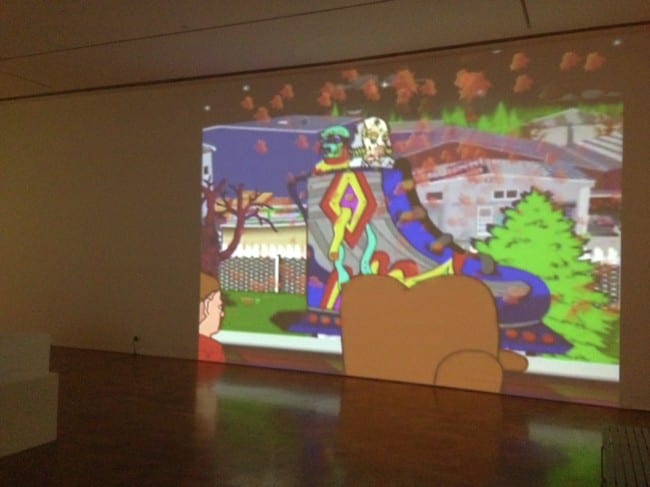
First stop was the Ben Jones exhibition, The Video, at MoCA. It is a doozy. Ben commanded the space by installing massive video paintings and projections. It's a meditative psychedelic experience.

Next stop was the Chateau Marmont for a meeting with the artist Wes Lang, who has taken up residence there for a spell. That's a good kind residency.

And finally I landed at Sammy Harkham's house, my home base in L.A. and favorite reading room. And so I'm here.

Now it's off the fair to set up. I'll be there the whole weekend. Booth S01. Ben Jones' book is debuting, with accompanying events (a conversation on Saturday at 1 pm), and I'll have plenty of other goodies. Come on by.

Under the Weather

A while back, bravest person alive Shaenon Garrity offered to review webcomics sent to her via e-mail. Now we have a second installment of her evaluations, and they're worth reading even if you never look at online comics:

One thing I love about webcomics is that there’s a comic for virtually every audience imaginable. Kickstand Comics, which started in 2008 and ended just recently, is a daily strip for cycling enthusiasts. And we’re talking serious enthusiasts, the kind of people who care about the ideological battles between classic bikes and road bikes, urban biking and “race and rec,” who hold strong opinions about bike lanes, and who, above all, despise cars. The central character, beardy bike shop worker Yehuda Moon (the strip also sometimes runs under the title Yehuda Moon), describes his job as “deploying ground troops in an unpopular war.”

We also have Sean Rogers' review of Tom Kaczynski's Beta Testing the Apocalypse:

But one of the pleasures of reading Beta Testing, as in other watershed collections like Caricature, Curses, or Everything Together, lies in watching a cartoonist become less mindful of his precursors, less rote in his treatment of subject matter, both freer and more assured. As the book progresses, Kaczynski sloughs off influence, just as his characters slip away from civilization. A breakthrough story like 2008’s “Million Year Boom” nearly brings the book to a halt halfway through with its impressive and authentic weirdness, yet still retains the stamp of millenarian systems novelists, still partakes of the old dead-eyed Clowesian aloofness. By the time we reach the concluding story, “The New”—at once an ode to modernist architecture and an allegory literalizing the decline of the west, created uniquely for this volume—Kaczynski’s layouts have exploded into space, cities and buildings splayed out on the page in startling and diagrammatic splashes.

I haven't been feeling well the past couple days, so I haven't spent much time online, and have only a few links for you.

—TCAF has announced another slew of impressive guests.

—Architecture critic Martin Filler has a lot of kind words at the New York Review of Books for Chip Kidd and Dave Taylor's Batman: Death by Design.

—Here's a report from the Zadie Smith and Chris Ware panel at the New York Public Library.

—And here is an online fundraiser for an interesting looking documentary about the late artist Jeffrey Catherine Jones.

Well all right, here we are again.

It's Joe McCulloch on the case of Shonen Jump. Also, new comics.

Chris Mautner on six under-appreciated anthologies. I still think Weirdo is underrated. I mean, the letter columns alone... so good.

Joe and Chris would also like it if you'd listen to them talk about comics. Reading is for dummies.

Ben Katchor's new book collects his vibrant and funny strips for the architecture magazine Metropolis. And the linked-to article drops the bomb that Katchor draws digitally now. That's funny and great for all the reasons you're thinking of right now.

Richard Sala has wound down a gorgeous series of drawings.

And in random Twitter news, William Gibson on Katushiro Otomo is a good thing: