Just kidding, I'm writing this before watching the new Gossip Girl, and it's a repeat anyway. But if demand warrants it I can try to convince Tim to let me run weekly recaps. If not, well, I'll just do so on my own time.
Well, well there is much to discuss, isn't there? For one thing, new to the site are full length interviews from the archive with Aline Kominsky-Crumb (from 1990, and by Peter Bagge) and Lynda Barry (from 1989 -- before many of you were born!). So go enjoy those, my friends. Spend the day, even.
Let's take a trip together around the internet, OK?
* Steven Heller calls our attention to a new traveling project from the great British pop artist Peter Blake.
* From WonderCon comes news that IDW will be releasing oversized editions of classic Marvel comics reproducing the original art. This is good news, I think, and points to a much-needed recognition by Marvel of the aesthetic value of this work and willingness to hand over material to a smaller publisher perhaps better equipped to handle this kind of project. The series begins with Walt Simonson's Thor. I'm curious where it'll go from there.
* Speaking of IDW, it's also releasing a deluxe edition of Darwyn Cooke's Parker material, to which I have a severe allergy. That said, This is a pretty wonderful memoir of hanging out with Donald Westlake, aka Richard Stark, complete with photos of men with beards.
* This new profile of Moebius alludes to problems with the artist's vision, as well as a booming business in privately commissioned paintings. I'd be curious to see some of those pieces.
* Speaking of Moebius, and those who love him, Inveterate phone-talker Sammy Harkham lays it down on tape over at Comix Claptrap.
Finally, for you Facebook fanatics:
* Here is a fabulous selection of Out Our Way panels by J.R. Williams. Even in the current strip boom, Williams remains overrated underrated. I love his natural, easy-does-it drawing style and acute regional observations. Here's a project that could keep Jeet busy: "Great Regional Cartoonists of the 1920s". And not "midwest" or anything too easy. Oh no, I wanna see it state-by-state. Get a WordPress account and get started, Jeet!
Over at HiLobrow, our own Matt Seneca uses a panel from Weird Mystery Tales to explore Jack Kirby's depiction of women. "He was never meant to draw the average action comic’s shrinking violet of a 'gal.'"
HiLobrow seems to be upping their comics coverage in general, actually, and today also sees the first post in a week-long collaboration with 4CP's John Hilgart.
Our header image is by Frank Robbins. His gestural inkwork in the 1970s looks better than ever these days. In its day, it couldn't have been a stranger fit, but now... now it looks like something I'd publish. Ha! Of course I love the 1950s and '60s work, but there's something about the wild line and off-kilter perspectives that just does it for me here.
On the site today: Brandon Graham Day 5! Thank you Brandon for an excellent week together. I feel we've become closer, learned things about each other, and bonded in unexpected yet pleasurable ways. Wait, that was my week with my puppy. What were we talking about? Brandon! Tim and I have been thrilled to host Brandon, as we both admire his work and vision. Follow him some more over at Royal Boiler.
Your links, madam:
• I enjoyed this piece on Bernard Baily by Ken Quattro. The more in-depth, "how they lived" style pieces on cartoonists that appear, the richer the general history becomes. Baily is someone whose early work on The Spectre stands out for me for it's hazy gloom.
* Daniel Best has multiple transcriptions of the parts of some of the depositions made public thus far in the ongoing Kirby v. Marvel case. These are text versions of the PDF documents available online at Justia. Following on that, Sean Howe focuses on the publication of Steve Gerber's 1977 contract with Marvel for Howard the Duck. If that's not enough Howard for you, click over to TCJ #40 and check out the Howard newspaper reprints from that issue.
New feature up today: Tara Sinn introduces (and interviews) the mysterious Japanese poster artist Aquirax Uno, and day four of Brandon Graham's diary.
"My inspiration for these stories simply comes from the strangeness of life and the the sense that there are invisible forces behind things, and things happen for reasons we can't fully understand." Am I the only person who missed this brief but very well done video interview with Jim Woodring?
This one-question interview with Johnny Ryan kills my lonely fantasy that Prison Pit's plot was maybe, kind of, sort of a loose remake of Robert Sheckley's The Status Civilization. I guess it was always kind of more obviously inspired by the story in the back of Real Deal #1, anyway. (Prison Pit fans who haven't read that issue better get on it.)
A nice, and surprisingly informed, short tribute to Captain Marvel artist and former Journal columnist C.C. Beck appeared on The New Yorker's website yesterday.
Do you know anything about 1940s cartoonist Ann Roy? If so, current Journal columnist Ken Parille needs your help.
Another current Journal columnist, Jeet Heer, turned in a solid review of two recently reissued (and near canonical) comic histories for Publishers Weekly. I haven't yet read the Jerry Robinson book, but I agree with Jeet about the value of Brian Walker's collection.
Offhand, I can't think of any epistolary comics, but it's a great idea, with a lot of unexplored potential. Aidan Koch and Jaakko Pallasvuo are giving it a try right now.
We will review Jacques Tardi's Arctic Marauder soon, I promise. In the meantime, Craig Fischer has a smart-as-always response to the book here.
Finally, Comics Alliance has gathered several videos from French television featuring the likes of Moebius, Hugo Pratt, and Joe Kubert in action.
That's right, I'm in Chicago for less than hours. Came out to see the Jim Nutt retrospective at the MCA, "Coming into Character." Scandalously, it is not traveling outside of the city -- through know fault of the show itself -- amazingly (or actually not, if you're familiar with recent programming decisions by other major museums), no other institution would take it. I'll keep it simple: If you can, go see this show. It's the best single-artist retrospective I've seen in a very very long time. Maybe since Dieter Roth at MoMA - PS1 in 2004. Watching Nutt tighten his focus to intensely rendered and detailed imagined portraits is riveting. These are paintings that can be looked at for hours -- worlds of brushwork exist within each area of these images. Every mark builds on the next, and the intersecting planes and surfaces build to multiple crescendos. Nutt is a real modern master, and one whose early language in the 1960s was highly involved with flat, comic-strip/advertising rendering. He's very far away from that now, though one can still see a bit of the diagramatic Gould grotesque in him if you squint just right.
Not that it's all culture here -- when I come to Chicago I roll with pal Ethan D'Ercole, who started me out with tacos, moved along to hot dogs, and finished off with deep dish pizza (the kind with the sauce on top, and, in a unique twist, a crust wrapped with carmelized cheese -- delightful).
Anyhow, it's a quick blog from me today, since I'm traveling and also in a food coma.
It is easy to pick a side in the long-running debate between Garfield Minus Garfield and the original Silent Garfield. The latter reveals a bleak hidden dimension to the original strip, and enlarges our understanding by offering a new way to read it. The former simply relies on a cheap gimmick that reveals nothing other than the banal observation that if you remove one character from a dialogue, the remaining figures will look foolish. Take Andre Gregory out of My Dinner with Andre and you'll make Wallace Shawn look weird, too. So what? (I'd like to call dibs on that YouTube edit, by the way.) After all, it's no surprise that Garfield Minus Garfield got official approval and a book, while Silent Garfield quietly disappeared.
These thoughts are prompted by the new popular "viral" comic-strip edit, 3eanuts. The idea here is simple, too. As the site says, "Charles Schulz's Peanuts comics often conceal the existential despair of their world with a closing joke at the characters' expense. With the last panel omitted, despair pervades all." You could perform this trick with most stories too—lop off the ending of anything from Psycho to Romeo & Juliet or Goodfellas, and you'll get a radically different tone and impression. So in a sense this is another facile experiment, but at least it illuminates something about how powerfully an artist's editing choices affect the reader. (via)
The comments thread after this typically terrific Glenn Kenny post on Taxi Driver sees various of his readers getting back into the old argument over whether the main character of Scorsese's Raging Bull is "identifiable" — a debate that always seems to flare up around Scorsese and Coen Bros. films, and which also brings to mind last year's back-and-forth on more or less the same topic regarding Daniel Clowes's Wilson. Both sides of the character debate are represented well on the Kenny thread.
Joanne Siegel's letter to the head of Time Warner from shortly before her death is a must read (Spurgeon explains), and very sad.
Earth people, send us your event listings. As you may have noticed, we are publishing event listings. We wish to fill them up. So, direct your listing news to: [email protected].
We have uploaded issues 37 and 39-41 of ye ol' TCJ. Only 260 more to go. Almost there! But these issues are chock full of goodness. Issue 40, for example, has an interview with a young-ish Jim Shooter, just a little while before he was branded "Our Nixon." Kim Thompson, meanwhile, contributed a piece about Tom Sutton, and the great John Benson has an early (and very prescient) overview of Art Spiegelman's work. TCJ and Tom Sutton: A long term love affair. Issue 39 has a long piece on the now-infamous 1978 DC Comics contraction, a lengthy report on the then-comatose underground comics scene, and in the reviews dept., we have Kim giving Marvel 1970s-era Kirby a tough talking to, while Groth takes on Superman vs Muhammed Ali. And then issue 41 breaks open the Steve Gerber controversy, with a report and an interview with the man himself. The archive is still free for a little longer.
And new content today and from the weekend. In his first piece (of many, we hope!) for us, Tom De Haven takes on the upcoming Gilbert Hernandez book; meanwhile Frank Santoro brings it for the third week in a row. His best layout piece yet. By the by, if, during the week you long for Frank, as Tim and I often do, you can click over to his Tumblr and check in on him.
And now, onto links.
Most of you have probably already seen this NY Times piece on Marvel's publishing program. A little more business-y than I would've expected, the takeaway here seems to be that, uh, Marvel is trying... something, and that something is directed from the editors through the writers. The visuals in this visual medium aren't mentioned much, and neither are any particular creative strategies. Me, I'm still waiting for that New Universe revival.
Via pal Dash Shaw we have two delights. First is this animated film by the great illustrator James McMullan, who taught Dash at SVA, along with a few other generations of other artists. His drawing lessons are actually online at the New York Times. His languid, elegant figures are just astonishingly well painted. More McMullan can be seen at Container List. Second, here's an online exhibition of the Art of Akira, along with commentary.
Contributor Chris Mautner takes us to Comic Book College in the area of Frank Miller. This is a good start in some choppy waters. I'm glad Chris recommends The Dark Knight Strikes Again, which is my favorite Miller work, post-1990 division. Also, he reminded me that Miller actually wrote Robocop vs. Terminator. I can't believe there's not a movie of that already. I'd go see that. Thrice! Dapper Dan's Movie Review would have a field day!
Finally, Harry Mendryk goes what we, around the "office" call "deep Santoro" with part one of an analysis of the Simon & Kirby colorists. And Joshua Glenn's HiLobrow continues to focus on Kirby with this fine piece by Adam McGovern.
As Jog noted in his column this week, the final issue of Neonomicon just came out, so now I have to figure out whether or not it's worth resurrecting the Comics Comics Comic-Book Club one more time, possibly in mutated form. Those of you who were reading along, stay tuned -- I'll figure something out.
Now, to the links:
Multiple birds killed with one stone in this brief review. A model of the short form.
Richard O'Connor digs up an old George Plimpton introduction to a Bill Plympton collection.
I suppose now that we've made the move to the Journal, I no longer am obligated to bring to your attention all news on Steve Gerber. But old habits die hard. Here's a Scott Edelman interview with the writer. The audio's a little poor, unfortunately, but Gerber is a good talker.
Carol Tyler is more charming when she gets purist about comics terminology than John Byrne is. Big claim, I know,
Speaking of Byrne, Roberto Batuel at the Comics Grid offers a short and perhaps slightly too reverential take on the infamous blank pages of Alpha Flight issue 6.
Normally I like to leave comic-book movie news to Dapper Dan, but just this once: the producers of the new live-action adaptation of Akira are reportedly hoping to cast white actors as the main characters (and change the location from "Neo Tokyo" to "New Manhattan"). Some are complaining, but they are probably forgetting how well Roland Emmerich's Godzilla came out.
You're probably seen word going around about the shirts Daniel Clowes designed for Stüssy. (Interview here.) They're beautiful, as were the ones the Hernandez Bros did a while back, but I have to wonder: Am I the only one who would have trouble wearing a shirt with a Stüssy logo that big? I guess I'm just getting old.
I'm here in St. Louis at Washington University on a fine spring day.
Naturally any trip to the Gateway City must include beers with Kevin Huizenga and Dan Zettwoch. Duh.
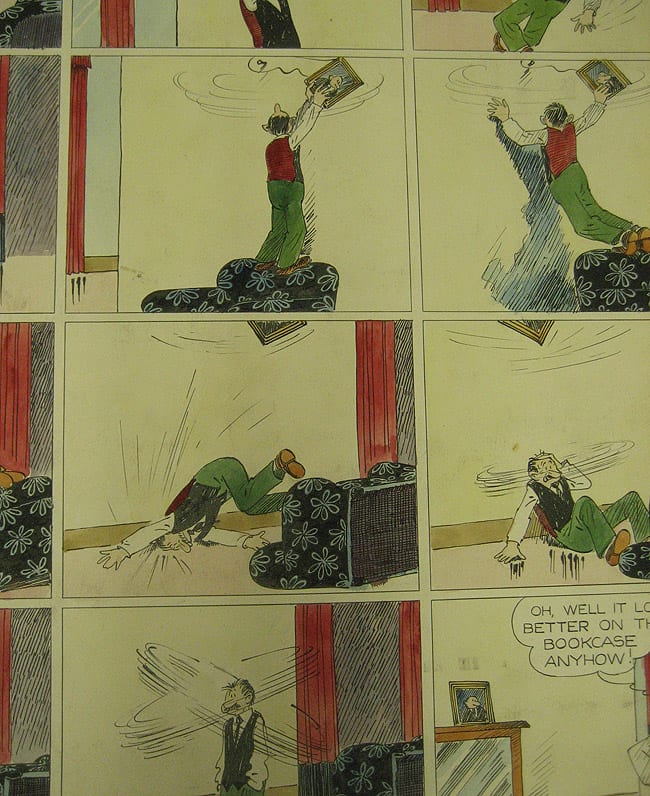
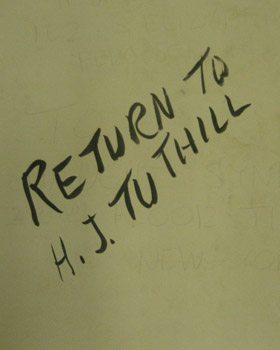
But the big news was a fine trip I took with Kevin to go see an archive of work by Harry Tuthill, of Bungle Family fame. And here is the thing, as evidenced in this archive, between 1924 and 1930 Tuthill hand-painted every single one of his Sunday pages. I don't mean color guides -- I mean fully painted pages. One after the other. The only thing we can figure is that he simply liked to do it, as stats couldn't have been shot from the painted pages. That would have caused too much line distortion. Plenty of cartoonists hand-colored their pages, but usually (or maybe only) to give as gifts. I can't think of anyone who did it seemingly just for themselves, with no obvious purpose in sight. If anyone knows different, please let me know.
Have a look:
And a close-up:
An excellent panel:
Here's another:
These pieces are just stunningly beautiful, and the attention Tuthill paid to fashion is remarkable. He had a loose, calligraphic line -- unfussy but in complete control. And, it turns out, a helluva way with color. Anyhow, more on this later. And yes, there'll be a book in it sometime.
Ah, ok, since you asked, here's one more:
And don't forget:
Meanwhile, just a couple of links today, as I'm on the run:
* Not comics, but highly relevant: Artist Richard Prince lost a lawsuit over an appropriated photograph -- the judge ruled that essentially the resultant artwork was not transformative, and thus not "fair use". Faire use is always a tricky thing, and these days, as so much artwork is based on the digital or photographic manipulation of extant imagery, it's getting trickier. And before I hear a word about Lichtenstein and Warhol, those works were obviously a whole other kettle of fish: painted and/or screened, significantly altered, and recontextualized in scale and production. The Prince case is a mildly manipulated photograph of a photograph. Anyhow, it's interesting and the article at the link is a thorough investigation.
Finally, hot new content today:
Ryan Holmberg digs in deep and comes up with revelatory ideas and facts about late 1960s manga. Get in there and read.
First of all, an announcement that may be of interest to those of you who live in the New York area, or who plan to visit the city during this year's MoCCA Festival. The Journal will be participating in an all-day event at the famous Strand bookstore on April 8th:
STRANDICON presents a Celebration of The Comics Journal: A Conversation with Gary Groth, Kim Deitch, Tim Hodler and Dan Nadel
April 8: 7:00PM – 8:00PM
The Comics Journal has been the leading voice in comics criticism for nearly four decades. It launched its first full-fledged website in March 2011, and in celebration its editors, Tim Hodler and Dan Nadel, will lead a discussion on the history of the magazine and the medium of comics criticism with founding editor Gary Groth and longtime cartoonist and TCJ interviewee Kim Deitch.
The bookstore will feature artist appearances and signings by throughout the day. More information here.
***
And now on to random links. The weird thing about doing this every other day is that it tends to mean that a portion of the links are a little out of date, at least in internet time. (What's that, you say? I should share links I find with Dan? I'm going to pretend I didn't hear that.) But maybe that's okay. These links may not be brand new, but they are tried and tested, each one worthy of clicking. Or at least that's the hope. Anyway...
*In Bible scholarship news, according to Discovery, new evidence has come to light supporting the idea that the Old Testament may have been edited to remove traces of a female god. Interesting in light of some of the similar scholarship Robert Crumb relied upon while creating his version of Genesis. (via)
*Here's a review I never expected to see: the often astonishing novelist William T. Vollmann writes about the Library of America's recent Lynd Ward collection in the latest Bookforum. Unlike the typical literary type slumming in the cartoon world, he even manages to take the form seriously enough to think out loud about how it works: "Graphic novels sometimes require of us the willingness to see and remember without comprehending right away."
*Luc Sante also wrote about the collection, in Harper's. I let my subscription to that magazine lapse, so I can't read it until I pick up a copy, but Sante's always worth reading.
*It's hard to believe that Chris Ware's daughter is already old enough to be writing record reviews—if you haven't clicked on the many links to Clara Ware's take on Tiny Tim for Roctober (complete with illustration and afterword from her father), you really should. (via)
*Eddie Campbell's one of the greatest talkers in comics -- and just might be interviewer-proof. Matthias Wivel's no slouch in his own right, and their resulting conversation is predictably solid.
*Journal columnist Sean T. Collins points us to an interview with Phoebe Gloeckner, which contains a lot of new information on just what she's up to in Mexico over the last several years.
*I remember seeing this once. I thought it was a dream.
*A short radio interview with New Yorker cartoonist Ed Koren. (Thanks, LP.)
*Finally, another story that's been going around, but that you might not have read yet. You have to, though. I won't ruin it by telling you anything beforehand. Just make sure you get far enough to understand about the frogs. (Thanks, ER.)
I will be on my way to St. Louis as your read this. I'm lecturing and doing critiques, etc., at my alma mater, Washington University, and also spending some time at The Modern Graphic History Library looking at Al Parker, Robert Weaver, and other greats of 20th century illustration. Plus, Kevin Huizenga and I will be embarking on a secret historical mission deep in the county. Exciting!
But you don't care about me. What you care about is that I remind you again (until we get our FAQ page online) about our spiffy new comments policy. We realize there is no right fit for everyone, but we're reading your comments and discussing it all -- we'd like to maintain what we have, with these rules in place, for a little while. If we need to make changes, we certainly will. Thank you all for your interest.
And you also care about links. Glorious, highlighted links!
At the top of my list is Tom Spurgeon's eloquent case for voting Bill Blackbeard into the Eisner Hall of Fame. Without Blackbeard, comic strip history as we know it would be greatly impoverished. He pioneered the collecting and archiving of newspaper strips by literally driving a truck around North America and grabbing newspapers before libraries threw them out. His holdings supplied the bulk of the material we all now write about (and as Spurgeon noted, his generosity was unparalleled). Plus, his Smithsonian Anthology remains a cornerstone not just of comic strip culture but of visual culture in general. So, this is one time when it really matters. Give the man his due.
Via Jeet comes this blog post about the discovery of a previously unknown George Herriman strip that may well be his very first.
Some historical treasures to imbibe courtesy of Ger Apeldoorn: Mort Meskin's Vigilante and the always amazing Italian cartoonist Jaccovetti.
Sean T. Collins reports on a good ol' fashioned DC vs. Marvel war of words.
Here's a semi-revealing post on Comets Comets from the fake CF twitter guy, recounting his travails somewhat obliquely. Ironically, this matches nicely with a New Yorker article this week on a guy named Dan Bejar who imitated the musician Dan Bejar. Fake CF didn't share CF's name, but... well, fakery and imitations -- always more enlightening for the imitator than the subject of the "experiment".
And finally, TCJ contributors Tucker Stone and Joe McCulloch present: Black Swan. Not comics, unless you count Darren Aranofsky's love of the medium and his killer collection of Hernandez Bros. art.
Well, our e-mailboxes are full, and the results are clear: No one is happy! It seems like for one reason or another, everybody is upset about the comments section these days. Some people want us to ban a few perennially controversial commenters, others want us to stop deleting their "entirely tame" comments, and still others want us to shut the whole thing down entirely, possibly to replace it with an edited letters column. That last option sounds potentially appealing, but if possible, we'd like to keep the comments around. Because when comments threads really work, they offer one of the few genuinely unique pleasures of the internet, a dynamic conversation that can't be replicated with overly edited content. However, the threads haven't really been working quite that well so far. Because of generally good experiences in the past, we've probably been a bit too lenient with our moderation here, and have erred on the side of inclusion even when it has allowed a few notable threads to descend into name-calling and blatant trolling. There is probably no way of avoiding annoying or useless comments altogether, but maybe putting a few policies into writing can help a bit with our signal-to-noise ratio.
So starting today, the following commenting rules are under effect:
1. Comments which include ad hominem or abusive attacks on writers, commenters, or figures featured on the site will be deleted.
2. Comments which are racist, sexist, or otherwise offensive will be deleted.
3. Comments which stray too far from the topic at hand (especially when of a promotional nature) have a very good chance of being deleted. If you want to share a link, send it to Dan or myself, and maybe we'll post it. Otherwise, it better have something to do with the post or resulting discussion.
4. Comments designed to start or prolong unnecessary, unpleasant, and/or just plain ugly arguments (i.e., trolling) will be deleted.
5. Commenters who repeatedly post comments that are deemed abusive in one of these ways will be warned via e-mail. If they continue to post comments of an unwelcome nature, they will be given a week's suspension. If a third warning is necessary, the commenter in question will be banned pending further review.
That's it for now, though we reserve the right to add new rules if and when they become necessary. Remember, debate and discussion are welcome, but is important that these arguments stay civil. If you have any questions, feel free to ask below or via e-mail.
As evidenced in my last post, when you're "in comics" there really is no escaping "comics." In "the biz," this is the phenomenon we call "Comics!" So who else resides on this tiny little island where I'm vacationing with my Rachel and her family? None other than Dean Mullaney, late of Eclipse Comics and now the man behind The Library of American Comics, who I met for lunch yesterday at Parrotdise, just down the road and around the corner. Anyhow, we're hoping to expansively feature some of Dean's upcoming books (his astounding Polly and Her Pals volume, complete with a killer essay by Jeet, was one of my top ten for 2010) in the very near future. Comics!
Speaking of which, as some of you know, Facebook is one my favorite places for off-the-cuff remarks by cartoonists young, old, and middle-aged. Facebook: It's a hole you must fill. You type and it appears. Facebook! Like going to the comic book store and talking to the shop owner, but without ever having to get dressed, go the comic store, and spend money. Jeet (Him again?! Oh Jeet!) tipped me off that on Facebook Joe Matt has had some words about Chester Brown's forthcoming book, Paying For It (hype alert: soon to to be the subject of major coverage here in May). Jolly Joe says:
In his latest book, my good friend Chester becomes a whore-monger...which is fine. My only problem (after reading an advance copy) was an inference that the only reason I don't follow him down the same whoring path is because I'm too cheap.... An implication that is unequivocally UNTRUE!! Yes, I'm cheap (rephrase: careful with my money), but I've also dropped somewhere between $15,000-$17,000 on a near complete collection of Frank King's fantastic comic strip, GASOLINE ALLEY, in the form of old newspaper clippings. (Sundays and dailies 1919-1951!) That being said, I'm also an extreme voyeur, lover of porn and compulsive masturbator. (Like I need to tell YOU!) I'm also (and I don't consider this a contradiction) a totally monogamous, hopeless romantic. (Just ask the ladies! Either of them!) I've never even ENTERTAINED the idea of frequenting prostitutes! I don't even want to meet or get near my favorite beloved porn stars!! No...just let me snuggle with my girlfriend, while reading Popeye and drinking an Americano, and I'm fine. ♥
Note that all of the people who commented on the post AND who have read the book (including the great Dylan Horrocks) disagree with Joe, which seems to have made him feel better.
Speaking of the oldest profession, comics, and Facebook, as you might know, the "great" Atlas/Seaboard properties are being brought back. Finally, more Wulf the Barbarian in stores. Phew. In honor of this ongoing occasion I bring you this choice quote from artist Alan Kupperberg, who worked in the Atlas/Seaboard office:
The publishers used to buy hookers for the distributors. One time, still at Marvel, Martin [Goodman] was down in Florida and Chip [Goodman] got ahold of Martin's little black book. He called a couple of the girls and said he wanted some freebies or the old man wouldn't employ them any more. The girls called Martin and finked out Chip. Who received a spanking when daddy returned home. A putz.
Like I said: Comics!
And now, a few links for your Friday:
National Lampoon has been on our minds again lately thanks for Rick Meyerowitz's excellent tome Drunk Stone Dead, and now comes news that the current owner of the franchise has been arrested for a 200 million-dollar ponzi scheme. Comics! I believe over at Comics Comics we once listed books we'd love to see from Nat Lamp. Top o' the list is Shary Flenniken. Well, Rick tells me that a Charles Rodrigues book may be in the offing from a publisher familiar to you and me. I would buy that. Twice! Also at the top of my personal list: A Bobby London Dirty Duck book, a Jeff Jones Idyll book (seriously, people, put aside your preconceptions -- that strip is rad), and a nice tidy collection of all the Russ Heath Lampoon work. (People: Remember Russ Heath. He's in tough shape. Think about buying a book or commissioning a drawing.) Sigh. Being a publisher and a historian and a blogger is a deadly combo for you, dear reader, since I spend a lot of time just dreaming up books. Luckily our patrons here at FB will be doing Nuts by Gahan Wilson, so that's good.
From Tim's comments yesterday I am stealing this link to a new Alan Moore interview. Alan Moore: The man you want to sit next to at a bar and talk about life with AND the man you want to talk about Ogden Whitney with (sorry Frank, it's true: at this stage I would rather talk to Alan Moore about Ogden Whitney. But you're still my man for Harry Lucey, Pete Morisi, and Marshall Rogers. Don't worry).
And that is all. I am now returning to my vacation. Please don't bother me. Unless it's you, Alan Moore, wanting to talk about Ogden Whitney.
First, a little cinematic/literary/comic-book mystery. Most of you will remember this scene from Quentin Tarantino's Kill Bill: Vol. 2:
As everybody "knows," this whole dialogue was stolen nearly beat for beat from Jules Feiffer's comics-crit classic, The Great Comic Book Heroes. (I said so myself, back in one of the very first posts I ever wrote for Comics Comics -- kinda embarrassing to re-read for multiple reasons, lo so many years later.)
Or so it always seemed. Now things aren't so clear. As old CC readers will remember (and as one light-hearted fan will be particularly delighted to recall), I've been reading a lot of Pynchon lately. This binge didn't end with Gravity's Rainbow, but has now continued into Slow Learner and Vineland. (After 1200+ pages, I'm ready to take a break, so don't worry about me sharing whatever comic-book references may be found in Mason & Dixon until at least 2012.) Though there are certain very broad similarities in the way they both re-use tropes taken from popular and pulp genres, Quentin Tarantino's never struck me as the Pynchon type (he seems more like a Leslie Charteris man). However, the resonance between certain sections of Vineland and Kill Bill is startling. Namely, there's Vineland's blonde female ninja assassin DL Chastain, who can end a man's life by using an esoteric technique called the Vibrating Palm, or Ninja Death Touch—the victim doesn't feel it, "but a year later they drop dead, right when you happen to be miles away eating ribs with the Chief of Police." I'm not the first to notice these similarities, but one particular superhero-related congruence seems to have gone unremarked. You see, after this very Blood-spattered Bride-like figure is sent on a mission to kill a man who wronged her (and many others) years ago, she decides (à la Uma) that she'd rather just drop out of the whole assassin biz and start a new, less glamorous life. As she does so, she remembers an old, and eerily familiar, conversation:
"Superman could change back into Clark Kent," she had once confided to Frenesi, "don't underestimate it. Workin' at the Daily Planet was the Man o' Steel's Hawaiian vacation, his Saturday night in town, his marijuana and his opium smoke, and oh what I wouldn't give...." An evening newspaper ... anyplace back in the Midwest ... she would leave work around press time, make a beeline for some walk-down lounge, near enough to the paper that she could feel vibrations from the presses through the wood of the bar. Drink rye, wipe her glasses on her tie, leave her hat on indoors, gossip in the dim light with the other regulars. In the winter it would already be dark outside the windows. The polished shoes would pick up highlights as the street lamps got brighter ... she wouldn't be waiting for anybody or anything to happen, because she'd only be Clark Kent. Lois Lane might not give her the time of day anymore, but that'd be OK, she'd be dating somebody from the secretarial pool. They'd go out for dinner sometimes to this cozy Neapolitan joint down by some lakefront, where the Mussels Posillipo couldn't be beat. "So instead of being able to fly everyplace," her friend had replied, "you'd have to climb into some car you're still making payments on, drive on out, you, Clark Kent, to the scene of some disaster, blood, corpses, flies, teen technicians wandering around stoned, eyewitnesses in shock.... Superman never has to get involved with any of that. Why should anybody want to be only mortal? Better to stay an angel, angel." DL, more generous in those days, only thought her friend had missed the point.
So it's tough to figure out, right? Did Tarantino steal the dialogue from Feiffer, or Pynchon, or both? Or is it all just a set of crazy coincidences? I mean, David Carradine's original monologue is very close to Feiffer's, but connecting the Clark Kent/Superman idea directly to a blonde female ninja assassin seems so, um, unintuitive that it's remarkable that both Pynchon and Tarantino did it. My current theory is that Tarantino must have read this part of Vineland, then remembered the somewhat different Feiffer/Superman riff, and combined them together, but -- that's kind of complicated and implausible, and alternate suggestions are welcome. Figuring this out would be a good use of your time.
On to Comics Journal news:
Yesterday, Dan reviewed David Collier's Chimo, and Rob Clough introduced the latest incarnation of his "High-Low" column by looking at two recent releases from Revival House Press.
Today, animator Richard O'Connor turns in a review of the new Bill Plympton book, Independently Animated.
Also, don't miss designer Eric Skillman's behind-the-scenes look at the upcoming issue 301, which will be out very soon.
Elsewhere:
Thomas Pynchon isn't the only novelist who takes inspiration from the comics. Ishmael Reed, author of the essential Mumbo Jumbo, has a new book coming out next month, which sounds interesting. As he puts it in a recent profile: "Since I don't like the modernist novel in which the omniscient narrator smothers his characters to death with psychoanalysis, they called my characters cartoonish. So I made this new character of mine a cartoonist. I've always been in a dialogue with my critics."
So, as is probably obvious to many of you, we aren't above a little light theft ourselves, an kind of stole the idea of "A Cartoonist's Diary" from a recurring feature on The Paris Review's website. Now they have cruelly snatched the idea back, and this week, they are featuring New Yorker cartoonist Zachary Kanin. (Day two is here.)
Yes, I'm STILL on vacation. Or supposed to be anyway.
First some housecleaning. TCJ print edition subscribers take note:
-Login/passwords: Currently your pre-3/7/11 login and password info is not in our new system; it will be moved over very shortly. If you wish to comment within the site, please login via your own wordpress or intensedebate account, or just use the "open login" option.
-What's my subscription get me? Well, at the moment, the print edition archives are open to all. But soon, very soon, they will be subscriber-only. At that point we'll post weekly updates about which issues are available. Presently issues 27-36 and 38 are available. If you want to see what's available for yourself, you can click over to the table of contents for each issue. If it has a link to the print layouts, then it's available. If not, then it doesn't. But we'll update you as it evolves.
That is that. On to more pressing matters. Comics culture is alive and well down here. The Miami Herald Tribune is currently offering this fantabulous umbrella, spotted Sunday at the "Marathon Seafood Festival".
Also at the festival: The Saddest Garfield I've Ever Seen.
Last night in Key West there were numerous Spider-Man sightings. It seems Broadway has taken its toll on our hero, and he's now soliciting for tips. Tips for what? Whatever you want, man...
Apparently Spidey will take a beating for money. This, I think might be related to a Harmony Korine/James Franco film now in development.
And finally, in an odd attempt to appeal to hippy culture, Spidey is now also playing the sitar. Brendan McCarthy, please take note.
Now, your daily links:
Doug Wright Award nominees announced. This is the best awards presentation I've ever attended. For anything. Worth the trip to Toronto alone. Never mind the awesomeness that is TCAF. Also, Marc Bell is a juror, which means that for a few hours, in one city, all is right with the world.
If I dropped out of publishing and moved into, um, I dunno, anything else, the first thing I would do is buy this Justin Green drawing for sale via one of the causes of my current poverty. Reminder: Justin Green has a motherfucking blog. Now featured are three of his New Yorker comic strips. Green (can you tell I think he's one of the greatest living cartoonists in the world? I do.) also has this new site, which appears to be serializing fresh work, and an older site recently updated with an appreciation of the late comedian Chris Farley. If Justin Green is an avid Tommy Boy fan, then, well, I would put him at the #1 slot. "Dapper Dan's Movie Madness" alert: Chris Farley always makes me remember that David Spade used to not be annoying. He's pretty irritating now, but you gotta hand it to him for still having a career after all these years.
In new TCJ content today, we have a double dose of Joe McCulloch—not just the latest installment of his "Week in Comics" column, but also a lengthy review of cult legend Alejandro Jodorowsky's latest (if not necessarily greatest) addition to the Incal universe: Weapons of the Metabaron.
Jeet Heer has been spending time trawling through our archives over the past week, and reports back: "The early issues are a bit dry and ad-heavy but there are some gems in their like Carter Scholz's essay on Harlan Ellison, which is simply the best criticism of Ellison I've ever seen, admiring but not blind to HE's faults." Remember, unless you're a subscriber, access to the archives won't last forever.
New (to me) academic comics site The Comics Grid continues to publish worthwhilecontent you wouldn't find elsewhere online.
A spy sends word (and evidence) of an unexpected comics-related media appearance.
Congratulations to Amy Lockhart for meeting her Kickstarter goal, and thanks to all of you who contributed. This means more Dizzler for the rest of us.
David Collier's Chimo (and a related exhibit) is discussed in the McGill Daily. (Thanks again, Jeet!)
For those who take it personally when they hear people make fun of movies like The Dark Knight: Lance Mannion admits that he knows nothing of current comic books, but explains why he's somewhat leery about them, particularly in relation to his kids. Interesting in a reading-the-tea-leaves of public sentiment way, but unlikely (and not really designed to) change minds.
This is everywhere, but well worth your time: Seth dissects a segment of Ben Katchor's Cardboard Valise (and reviews the whole thing).
Finally, in non-comics news, Richard Harland Smith provides a guided tour through some of the best-known work of virtuoso movie poster artist Frank McCarthy.
Chris Mautner brings our attention to the end DC's Plastic Man archives, and asks a damn good question: When will we see more Cole reprints? DC and Mavel's treatment of their respective legacies seems to be a topic of much discuss these days. Sometimes it appears better, as with July's Jack Kirby Omnibus Vol. 1 from DC, and sometimes worse, as with this announcement. I really wish they, like Disney, would hand over certain properties to smaller publishers who are focused on publishing the history in a considered fashion. I know it'll never happen, but a guy can dream of a "Mort Meskin's Vigilante" book, can't he?
Speaking of things not-well reprinted: Here's some John Severin work in the EC style for Atlas.
I am an unabashed fan of Dungeon Quest, so this interview at (conflict alert!) Flog, was a pleasure.
Jessica Ciocci, late of Paper Rad, has a blog now, as well as maybe the best Twitter feed in the world.
John Hilgart concludes a month's worth of Jack Kirby posts at Four Color Process with a short essay.
And on this very site:
Do not miss Jeet Heer's debut of his column Comics Chronicles. And also, everyone should really be reading Jeet's introductions to the one trillion reprint books he writes for. Most recently, his Buz Sawyer intro explored the business behind Roy Crane's 1940s decisions. His quality actually manages to outstrip his quantity. It's scary. Put this man in a glass box for observation!
You missed him, didn't you? Admit it. So did we. He's back. Frank Santoro's Riff Raff began yesterday with a deep look at paper sizes, including demos from the man himself. Actually, put Frank in a glass box next to Jeet's for further observation. They can communicate with each other via 1930s Captain Easy Sunday pages.
Finally, Naomi Fry takes a look at the latest volume of Peanuts. May I be so bold as to recommend Naomi's September 2010 essay on Brett Easton Ellis over at N+1? It's a knockout.
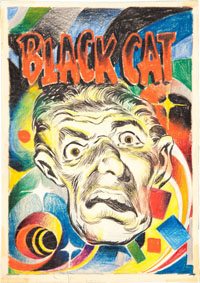
Black Cat Mystery #45 "Colorama" preliminary by Warren Kremer, 1953.
Herewith my attempt at something Tim tells me is called "link-blogging". Look for a lot more of this in the future. Don't all cheer at once.
My Wally Wood obsession knows no bounds. I might also note that the Wood catalog published in Spain really is worth the money.
Zom, of The Mindless Ones, who have been kind enough to lend us Amy Poodle, takes a look at The Killing Joke, with typically thought-provoking results.
Allan Holtz brings us Old Boy Binks, a deeply obscure 1915-16 strip by the great Ed Wheelan, whose strip Minute Movies is a favorite of mine for its intense compression and flippant drawing. In his 1940s less-than-salad days Wheelan also drew for comic books, and must've wondered how the hell he got there, amidst all those amateurs.
This link is old for the internet, but I only just saw it: Gill Fox cover roughs and color guides over at Comic Book Attic. Fox, along with Harvey's Warren Kremer, was a great golden age workhorse, who could produce a package from the inside out. His production is, in some ways, as impressive as his artwork. Also, this is more evidence of what we might call the "Heritage Effect", because the auction house continues to uncover deeply obscure items -- things otherwise left in filing cabinets and certainly not available to gaze at in deep digital detail -- everything from Kremer cover roughs to Dave Berg unpublished comic strips. I don't think it's rewriting history, but in providing a somewhat random resource of unseen ephemera, it's deepening it significantly. I have to say I sometimes forget it's an auction house in the business of selling art, not necessarily archiving it. Oh, and fun fact: Gill Fox drew the classic pizza box art of the 1970s and '80s.
Today's content:
R.C. Harvey's monthly column, Hare Tonic, make its debut with a profile of Dick Locher, whose final Dick Tracy will appear on Sunday. I'm fond of Harv's take on newspaper strip cartoonists -- he gets at the day-in, day-out grind of it, and in this piece manages some great Chester Gould anecdotes, to boot. Vanessa Davis' final diary entry. Thank you Vanessa: You have set the standard by which all cartoonists must now procrastinate productively. And finally, Matt Seneca reviews City Hunter by C.F. Two in one week from the Seneca. We hope he never grows old and tired like the rest of us.
And this weekend: Watch out for Frank Santoro's TCJ debut!
This could get old real quick. I am lucky, though, because Dan neglected to mention our most recent published items, which gives me a few more work-free links.
Columns:
First, R. Fiore continues his long-running "Funnybook Roulette", with an entry regarding Sylvain Chomet's recent animated film based on an unproduced Jacque Tati script.
The universally loved Joe "Jog" McCulloch turns in his first weekly report from the comic-shop front line.
And Vanessa Davis continues her week's worth of diaryentries.
Reviews:
Tucker Stone joins the Comics Journal team, and offers his take on the British war comic, Johnny Red: Falcons' First Flight.
Chris Mautner reviews the first three volumes of Tsugumi Ohba and Takeshi Obata’s Bakuman.
In other TCJ-related news, I forgot to link to possibly the most thorough take on the recent relaunch, from Sequential. (Thanks to Tom S. for the reminder.)
And Abstract Comics editor Andrei Molotiu posted a lengthy remembrance of his own experiences with this site's late (and apparently not entirely unlamented) message board.
Also, the RSS feed(s) should be working properly again, so subscribe away if that's your thing—and did you know that the Journal is on Twitter and Facebook? It is, and Dan and I are not exactly masters of the social media arts, so some of the more sadistic among you may enjoy "friending" and "following" and such, if only to watch us flounder.
In non-TCJ news, The Panelists has begun an interestingseries on Eddie Campbell and Daren White's The Playwright, featuring comments from the man himself.
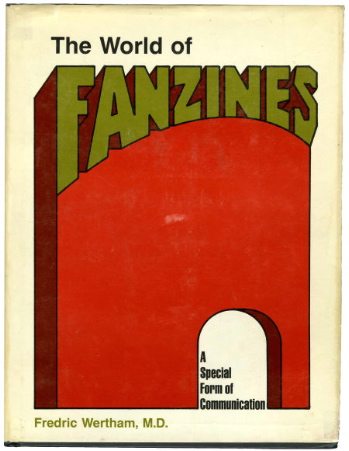
Blog 2 Comm digs up Fredric Wertham's forgotten paean to fandom, The World of Fanzines. (Ignore the weird Archie opinions up top.) This reminded me of Wertham's rebuffed letter of enthusiasm to Graphic Story Magazine — the Bad Doctor had an ironic and too-little-remembered third act.
The novelist Charles Baxter wrote a compelling recent essay on bad reviewers, with several passages that called to mind a lot of what currently passes for online comics criticism.
For example, "To say that something is 'boring' is not a statement about a book, although the speaker may think that it is; it’s a statement about the reader’s poverty of equipment."
And: "A reviewer is entitled to any opinion at all, but he or she earns that opinion based on a description and a judicious citation of evidence. Otherwise, the reviewer is the literary equivalent of Michelle Bachmann, making outrageous statements simply in order to become famous. Is it too much to ask of a reviewer that he should know what he’s talking about?"
Finally, a word of warning to any excitable cartoonists out there, before they react to a negative review that we run.
I've been quiet (read: frantic) these last couple days, but Tim tells me it's my turn on "The Blog." I hope everyone is enjoying the old advertisements in issues 27-38 of the Journal. Comics used to be cheap. What? There's other stuff on this site? No one told me.
House cleaning dept: We're having a little trouble with our RSS feeds, but these are the links.
As Tim mentioned, we'll be using this space for all kinds of things. But today I want to mention some things that have run across my desk.
Paul "Pops" Karasik sent me a link to this hot new game inspired by a certain cartoonist whose work he poured his heart and soul into. Missing the point doesn't even cover it. But it takes all kinds, I guess. Rumor has it that the Nancy book PK is working on with Mark Newgarden is quickly taking on the properties of a masterpiece of comics theory and history. My very first interview in this hoary field was with Paul (and edited by Tim, of "Tim Hodler" fame, along with pal Patrick Smith), and that split my brain in two. It was through Paul that I met Mark, who then turned my brain to dust, and thanks to Mark that I met Gary Panter, who gently released said brain dust over a field of aging newsprint. So, really, my present state of mind is basically Paul's fault. All this from a link he innocently sent to me. Well, he'll never do that again.
Speaking of Gary, he needs help identifying an artist. I'd asked him who I should write about next, and, well, I'll let him explain: "There was another artist, lost to time, whose work looked like Jack Davis combined with Don Martin. Very crude yet confident. Maybe it was one of them but I think not. His monster comics occasional appeared in early '60s monster mags like Castle of Frankenstein. Maybe a Spanish name. Never saw the work again." He has me stumped, but I bet someone out there knows the answer. Have at it, people.
Anyhow, onwards: Did you know that Ben Katchor has a blog and a Twitter account? The blog is of particular interest because he seems to be posting his research into 19th and early 20th century picture stories. He's kind of publicly charting his own literary/aesthetic history. More, please, Ben!
In the credit-where-credit-is-due dept., Doug Harvey takes a look at a new claim on the origins of the iconic Rat Fink character, which, according to a recent book, was not, in fact, first drawn by Ed "Big Daddy" Roth. The Rat Fink is one of the earliest icons of commercial cartoon grotesque -- right up there with Basil Wolverton's Lena Hyena cover for Mad.
I won't insult your intelligence by suggesting you're not following the excellent series of Jack Kirby panel examinations over at HiLobrow, but Glen David Gold's installment on Journey into Mystery #72 looks at a rare bit of comedic absurdity on a Kirby monster page.
Be aware dept: Maira Kalman is opening a retrospective at the Jewish Museum on Friday. Kalman being the wry and funny New Yorker cover artist, children's book author and rather brilliant picture story maker. I kinda think she figured out web comics pretty damn well. As Tom Spurgeon might say, everyone claims Maira Kalman except for comics.
And finally, conflict of interest alert (I publish Ben's work, but I'm not involved in this property): The Ben Jones animated TV show, Problem Solverz, will debut on the Cartoon Network in April. Here's a fresh trailer for it. I mention this because Jones is probably the first "underground" cartoonist of my generation to make this transition: A full fledged season of his own show.
Welcome back! As you can see, the site is continuing to grow—check in frequently to see what's new. Now that introductions are out of the way, let's look into things a little deeper.
For example, this blog: it's a work in progress. The current plan is for Dan and I to switch off days, usually highlighting content from the site at large, and linking to various posts of interest at other sites. Also, from time to time, guest bloggers will show up to post items that don't fit comfortably in any of the site's more formal categories. It should be fun. Let's find out.
First of all, don't miss Tom Spurgeon's lengthy interview with Dan and myself—it covers a lot of ground, in typical Spurgeon fashion.
For those of you who can't enough TCJ talk, more reaction on the site's makeover can be found here, here, here, here, here, and here.
In regard to that last link: We appreciate the feedback we've received as to the perceived dearth of female contributors to the new TCJ.com. We're sensitive to these concerns, and simply ask that our readers not rush to judgment. We are still in the confirmation process with many great potential writers. Over the following weeks and months we will be publishing lots of content about female and male artists, written by both female and male contributors. As we said in our interview with the Comics Reporter, one of our stated goals for TCJ.com is to make the site "a place for a plurality of real, idiosyncratic, and conflicting voices." Obviously we can't have that without diversity in the genders of those voices. (By the way, if you have a suggestion for a contributor you'd like to see here, of any gender, please feel free to contact us at [email protected]. The e-mailbox is always open.)
Okay, time for a tour of the site's new content. (Some of this is repeated from yesterday, but none of it should be missed.)
Hi there, and welcome to the new online Comics Journal.
So, what’s the deal here, anyway? First, let’s be clear: We’re editing the online incarnation of this magazine only. Gary Groth is the editor of the annual print edition (issue 301 in stores soon!), and Kristy Valenti is our editorial coordinator at the Fantagraphics home office. Michael Dean will be contributing to the site, and helping Gary with the print magazine. Our goal is to produce an online magazine about comics as a living medium. And yes, we’re closing Comics Comics. Or rather, we're putting it into cryogenic storage. It still lives where it always lived. The Comics Journal was a huge influence on both of us, and when Gary offered the opportunity to help shape it, the challenge was too good to pass up. So here we are.
This site is divided into several sections which will continue to grow over the days and weeks and months to come: Feature articles, including lengthy interviews, investigative journalism, and long-form critical and historical essays; regular columns on a variety of subjects; a steady stream of book reviews; thorough and easily navigated event listings; an ever-growing archive of The Comics Journal's thirty-plus years as a print magazine (by the end of 2011, each and every issue will be online)—this will be available in full to magazine subscribers only; and of course this daily blog, which will be a catch-all for short items, selective link-blogging, and a forum for guest voices and bad jokes.
We’re happy to announce all of our Comics Comics cohorts have come along with us. Frank Santoro’s regular column, Riff Raff, will debut this weekend; Jeet Heer’s Comics Chronicles later this week. Joe "Jog" McCulloch will continue covering This Week in Comics in his own inimitable style, and Nicole Rudick, Dash Shaw, and Jason T. Miles will also be contributing content in the coming months.
Our other columns include Grid by Ken Parille; What Was Alternative Manga? by Ryan Holmberg (first installment up now); Say Hello, by Sean T. Collins; High-Low by Rob Clough; Know Your New Yorker Cartoonists by Richard Gehr (also up now, and featuring a tremendous Sam Gross interview); Hare Tonic by R.C. Harvey; Funnybook Roulette by R. Fiore; and finally, A Cartoonist’s Diary, in each installment of which a guest cartoonist will invite readers in to observe five days in a working artist's life. (Vanessa Davis is up first.) We’re thrilled we are able to launch with such a talented bunch. Upcoming contributors to the site include Andrew Leland, Naomi Fry, Jesse Pearson, Tom De Haven, Shaenon Garrity, Matt Seneca, Chris Mautner, Tucker Stone, and Hillary Chute, with more to come.
As you can see, we already have some lengthy articles online (such as Bob Levin on Frank Frazetta, and Patrick Rosenkranz on the story of autobiographical comics), an exclusive preview of Seth's upcoming graphic novel, a batch of book reviews, and a ton of archival features, such as a selection of the magazine's greatest hits (which will continue to grow in the weeks and months ahead), and, for a limited time only, free access to scans of the magazine's very earliest issues—don't miss the new introduction Gary has written for the first issue. There's a lot more than that here, so … look around for yourself!
Not to be too obvious about our ambitions, but we want TCJ to be the best source for tough-minded writing and thinking about the medium and we think we’ve assembled a team that can make that happen.
We’d like to thank Gary, Kristy, Michael Dean, Jacq Cohen, and everyone at Fantagraphics for taking this leap with us. Keep reading.
Dan and Tim
P.S. The old TCJ.com's content is safe and sound, and will be up and available again in the very near future.
UPDATE: You can find all the old TCJ.com material at classic.tcj.com.



 Just kidding, I'm writing this before watching the new Gossip Girl, and it's a repeat anyway. But if demand warrants it I can try to convince Tim to let me run weekly recaps. If not, well, I'll just do so on my own time.















 This could get old real quick. I am lucky, though, because Dan neglected to mention our most recent published items, which gives me a few more work-free links.