Trash Fun

Today on the site Tom Scioli rejoins us with a close look at Silver Surfer #1 (1968):

Silver Surfer #1 is a comic worth examining closely. It has a lot of things colliding at once. It’s the straw that broke the camel’s back in Jack Kirby and Stan Lee’s working relationship. The Silver Surfer series is possibly John Buscema’s finest moment. It’s Stan Lee’s first big self-conscious stab at creating something ambitious and meaningful. It’s also a good example of what Lee’s writing is like when you subtract Kirby or Ditko from the equation. There are some interesting narrative flourishes, but also a leaden storytelling instinct and deep misunderstanding of his own co-creations.

This isn’t the first time I read this comic. It’s the second. My copy is coverless and was previously owned by David Hazelwood who signed it. I wasn’t about to shell out big bucks for the comic that made Jack Kirby leave Marvel.

And elsewhere... four links that will take you places to look at things. And that should hold you over if nothing else.

Early 1970s Bill Everett inky depths.

Johnny Ryan's latest masterpiece.

Sister Corita Kent gets a new monograph.

Providence newspaper Mother's News goes the archive.org route with its, uh, archive.

Travel Time

First thing this morning, take an astral trip to tomorrow's comic shop new-releases shelf with Joe McCulloch, who will point out the most intriguing titles and tell you a little about them. Before that, he will try to buttonhole you with a mini-essay on webcomics. Your call on whether or not to listen (no one can see you through your computer -- or at least we can't), but I've found it's almost always a rewarding experience.

After that, you're going to want to get some place comfortable and block out some time to read, because Jeff Trexler is here with a massively informative article, "Taking Back the Kirby Case", which not only recaps the recent Marvel v. Kirby ruling, but takes you through the whole judicial history of work-for-hire and explores a long-shot legal strategy that might get the Kirbys their copyrights. This is highly recommended:

[As] I re-read last week's opinion affirming that Jack Kirby's Marvel material was work made for hire, I started noticing certain aspects of the three-judge panel's reasoning that made me wonder if there were more to this case than just another reason for creators to feel discouraged. For example, in her 2011 summary judgment opinion against the Kirbys, Judge Colleen McMahon began with a most unusual disclaimer, all but apologizing for the fact that her ruling was grounded in law, not fairness. The appellate court made no such distinction. Instead, its Marvel v. Kirby opinion sent the clear message that its ruling was fair and just.

This face-off over fairness was both a challenge and a clue. Could it be that the case has exposed fundamental problems not merely with how Marvel treated Kirby, but with the law itself?

The answer to this question could determine whether the Kirby family has any chance of having the appellate court ruling reversed. Unlike the U.S. Court of Appeals, the Supreme Court does not have to rule on every case submitted for review. Instead, it grants certiorari to — that is to say, it accepts — only a small percentage of the thousands of petitions it receives every year. Its basis for choosing a particular case typically goes beyond a factual dispute, such as whether Jack Kirby, Stan Lee, or Steve Ditko deserves the most credit for creating Spider-Man. Instead, the Court looks for a legal issue on which appellate courts disagree or that raises important constitutional concerns.

The following analysis is one possible approach.

Elsewhere:

—There are a of UK-based links right now, probably due to the Edinburgh International Book Festival. The Guardian has a profile of Anders Nilsen, and samples from the sketchbooks of Kate Beaton, Jeffrey Brown, Rutu Modan, and Chris Ware.

There are also videos from Ware and Joe Sacco's appearances at the festival, which I found via FP.

—Also from across the Atlantic, the Glasgow Herald-Scotland has a list of the "50 greatest graphic novels of all time". It's a weird but solid list, in that I don't think many would pick these fifty books in this particular order as their own top 50, but the books are worth reading, so it is more useful than a lot of these lists.

—Also in list news, Spin has declared that two of the worst cultural moments of the '90s were related to comics.

—The New Yorker blog has seven cartoons from Egypt.

—Graeme McMillan tells the readers of Time about Jack Kirby, and Douglas Wolk goes to Slate to tackle that old, old playground debate: who's better, Marvel or DC?

—The CBLDF has posted the speech Charles Brownstein gave on manga freedom in Tokyo.

—The L.A. Times reviewed the new Optic Nerve from Adrian Tomine.

—Joe McCulloch and Janean Patience have part three of their Marshal Law conversation.

—And finally, Chris Butcher talks a little bit more about DC's Villains Month cover promotion.

Rested?

I'm sort of back from a sort-of vacation. A vacation from this site, at least. So I welcome myself back with Eddie Campbell, here today reviewing Today is the Last Day of the Rest of Your Life.

The title I take to be a no-confidence vote in the concept of tomorrow, which might be ironic since the style is forever finding hope and a passing joy in details such as the way the author observes to her own healthy fleshiness. The back cover blurb helpfully leads us to believe it is a ‘coming of age novel.’ While this cannot be said to be untrue, the term always leaves me with the feeling that I just witnessed some ‘potted thinking.’ It implies a coming to terms with the expectations of the adult world. The whole project, again, is at odds with this. There’s a feeling that the protagonist would as soon set it, the conventional world, on fire, though the author may be more accommodating. There is a rejection of the organization of the world, from organized faith to organized crime. It is about the pursuit of nihilism as a route to integrity. Ulli Lust has the intelligence to look at her life and make a book of it.

Elsewhere:

Tim certainly has been thorough in my absence, and even attempted a mean-spirited rant. He's just too good a person.

Here's Rob Clough with an excellent analysis of New School, probably my vote for most-ambitious and rewarding comic of the year so far.

So I have a few things here... It's our friend Abhay on writing about (or, rather, not writing about) the art in superhero comics.

Dean Haspiel pens a tribute to Howard Chaykin.

The VQR on non-fiction comics.

Nice art.

I liked Simon Reynolds' book Retromania. Here's an application of it to geek culture.

Sell Your Brains

Today on the site Tucker Stone, who recently told me, “Everything’s coming up roses for Tucker Stone”, and then ordered some terrible vegetable fries he soon regretted, is sticking to his critical vibe, reviewing a new edition of Lone Wolf and Cub, Paul Pope, Adrian Tomine, Prophet, and Kick-Ass 3.

And now, instead of a buncha links, I have to get something off my chest. I am irritated by this Ignatz nomination for a Garo tribute book called SP7: Alt. Comics Tribute to GARO Manga, edited by Ian Harker and Box Brown. Here’s why…

No. I don't care one way or the other about that. I would really like to recreate Dan's "sell your boots" moment, and even asked around to try and find appropriate targets for a rant—I received suggestions ranging from Craig Yoe's reprinting of John K's Comic Book to a recent Steve Geppi Facebook posting—and for a while I even considered just writing a terribly inflammatory essay and posting it as if it was written by Dan, but I think it's better not to force it right now. I will deliver my "surprise" at a moment when it isn't expected...

No, wait. I am pissed off about something completely inconsequential: that stupid Peanuts/Smiths mashup Tumblr that so many soul-dead people are linking to and reblogging and acting like they are actually amused by instead of admitting that it's the most obvious and tired concept possible. In fact, the internet in general and the comics internet in particular is filled with worthless trivia and vaguely clever amusements to distract cubicle slaves from their empty existences, and they aren't working any more. The worst thing about this particular example is that it isn't actually that terrible; its biggest offense is just the vague feeling it inspires of Didn't somebody do this already? Far worse are all the people linking to it and praising it to the skies and just the general culture these days of everything being utterly wonderful or totally worthless. Obligatory two-minute hate followed by obligatory two-minute adoration, followed by the predictable backlash and then the backlash against the backlash. The internet age was supposed to deliver the publishing means of production to the masses and allow a billion different voices to flourish, but it sometimes feels like North American culture is more conformist than ever.

If this is getting incoherent—"these people like something I don't" doesn't match well with "everyone is exactly the same"—then so in some ways was my model. But it occurs to me that this rant still isn't going to work, because I didn't pick an appropriately polarizing target. I will try again a bit later. In the meantime, here's a buncha links.

—News. As alluded to above, the nominations for the Ignatz Awards have been announced. Many people have already noted the fact that all five nominees in the Outstanding Graphic Novel category were created by women--notable on top of that is how natural-looking a list it is; of the four books I've read, not one is a token.

Archie artist/writer Dan Parent has revealed that a story involving Archie characters taking a trip to Russia has been rewritten in protest against recent anti-LGBT actions in that country.

—Interviews & Profiles. NEA Arts magazine interviews Dan Clowes. Laura Sneddon recaps panels featuring Chris Ware and Joe Sacco at the Edinburgh book festival.

Here's a couple things I never thought I'd see: Molly Crabapple interviewing Warren Ellis for The Paris Review, and an interview with Crabapple herself at Talking Points Memo. (Actually the second one doesn't seem so strange, considering her recent politically oriented work.)

—Reviews & Criticism. Matthew Wolf-Meyer reviews the Avengers: West Coast Avengers Omnibus for the Los Angeles Review of Books, Chris Mautner reviews John Lewis, Andrew Aydin, and Nate Powell's March for Robot 6, and J. Caleb Mozzocco reviews http://robot6.comicbookresources.com/2013/08/robot-reviews-march-book-one/">Shigeru Mizuki's Kitaro for the same site.

—A category allowing me to perpetuate the same kind of bullshit I was ranting about earlier. This newspaper mix-up of Far Side and Dennis the Menace captions has been going around for years—I think I first saw it over a decade ago—but it's going around again for some reason, and it's still funny to me.

I had zero interest in seeing the R.I.P.D. movie until I learned that Jeff Bridges based his character on Jim Woodring's Frank! Now I would like to see the three-minute YouTube video showing evidence of this that gets made about a month or two from now.

Adrian Tomine went to the White House.

Orson Scott Card rants
aren't as much fun now that the whole world knows about them. Apparently I'm now so old that the only thing I can be a hipster about is weird political creeps. I have to admit that Card's kept the quality up.


Rewards Points

Today we have a double-shot of columns for you. First comes the long-awaited return of our European correspondent, Matthias Wivel, who writes about the winners of the main categories at this year's Angoulême festival—Christophe Blain and Willem—and what their respective books say about the current state of French cartooning and satire:

Blain is no doubt one of the most talented draftsmen in comics today, his line and color always exquisitely tasteful on the page. Eye candy. But he convinces less as a cartoonist. His facility seems to affect his panel-to-panel storytelling, in that it comes so easy that he never appears to think much about the choices he makes. It reads clearly enough, but the narration is gassy and distended—it seems as if he lets one panel follow the next without much premeditation, an easy overflow. This results in endless sequences of talking heads, with each panel showing only limited invention in terms of carrying the dialogue (some of which could easily have been cut in the first place). And although his dashing interpretation of de Villepin has iconic qualities, his limits as a caricaturist are revealed in his more true-to-life approximations of such central players as George W. Bush and Colin Powell, who are stilted and jarring in the company of their eloquently rendered co-stars.

Look, the French are justified in being proud of their government’s stand on the disastrous war in Iraq, but does it need any more vindication? Ultimately, Quai d’Orsay is little else than an attractive-looking stroke book for the French national ego. A cinch to get rave reviews, sell out print runs, and win the award for best comic at the biggest French comics festival, but hardly worth the attention of anyone genuinely interested in the politics it claims to lampoon.

Then comes Frank Santoro with a Riff Raff riff on comics made by fine artists—Katherine Bernhardt, Gary Panter, and Matt Leines, to be precise. A sample:

Matt Leines can draw his ass off. He can fill a gallery full of drawings and paintings and make solid artist's books: zines, mini-comics, the usual. That's fairly uncommon, I think. To be able to do both so well. I don't know many mini-comics or zine makers who can scale up and present their work in a gallery setting. A few. But not many.

This untitled booklet of drawings is essentially a comic because the images unfold in sequence. Each spread is one drawing. It moves forward similarly to, say, Moebius's 40 Days in the Desert. If you've seen that book then you know that the images sort of repeat and change as they fade into each other as we, the reader, turn each spread. A familiar but fairly uncommon way of doing comics.

Elsewhere:

—Interviews. Alex Dueben talks to Dash Shaw, Zack Smith talks to Eric Reynolds and Philip Nel about Barnaby, and Robin McConnell talks to Sam Henderson. Also, Dan Casey talks to Brian Michael Bendis and Josh Fialkov, with Bendis revealing he's now an Adrian Tomine and Michael DeForge fan.

—Reviews.
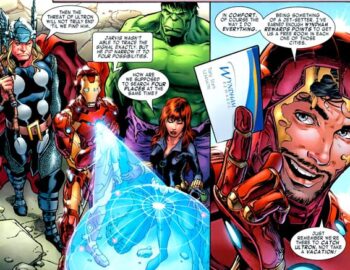
Sean T. Collins writes about Boulet's The Long Journey. Bully undertakes a too-rare bit of extended analysis comparing the recent Age of Ultron Marvel "event" unfavorably to a promotional Avengers comic given away at Wyndham hotels. And then Alison Hallett at Slate reviewed Ryan North's To Be or Not To Be, the Choose-Your-Own-Adventure-style Hamlet adaptation that raised more than $580,000 on Kickstarter. (Warning: that last review is very Slate-y.)

—News. New Republic pinup Mark Millar is shutting down Clint magazine. Ahmad Akkari, one of the leading critics of the Danish newspaper Jyllands-Posten's decision to publish caricatures of the prophet Muhammad seven years ago, now says he was wrong. As he's also apparently no longer a fundamentalist, and his former colleagues are unrepentant, this is perhaps more of a personal story than a sign of anything large, but it seems worth noting.

—Miscellaneous. The just-announced deluxe edition of Junot Diaz's This Is How You Lose Her features illustrations from Jaime Hernandez. Some chain of links I no longer remember led me to a June Bookforum interview with the Norwegian author Karl Ove Knausgaard. In it, Knausgaard compares his acclaimed autobiographical novel series My Struggle (Mit Kamp) in both theme and approach to feminist women writers from the 1970s. Which reminded me of this Gabrielle Bell strip from just a week earlier, which references Knausgaard. The two dovetail together nicely.

One Man War

“At first,” Lynde said when I interviewed him in 1992, “the strip [Rick O'Shay] was something of an anachronism. It dealt with the twentieth century intruding upon this sleepy little Montana town. But the readers tended to want their West to be the Old West. And I kept hearing that, and finally, I thought to myself, that’s what I want too. So in the late sixties I adopted a centennial theme: if it was 1969, it was 1869 in the strip. And I kept that going. Once we were in the Old West,” he continued, “I felt I had to be authentic about it. Charlie Russell sort of set the standard.”

Montana’s Charles M. Russell, the cowboy artist, is celebrated for the fidelity of his portraits of the Old West. “Painters of the West today are locked into doing it very authentically;” Lynde said, “—you don’t find much successful impressionism of Western subjects.”

Through his art, Russell “has achieved the status of sainthood in Montana," Lynde went on. "No politician can succeed in Montana unless he's for Charlie Russell and against gun control," he added with a grin.

That's R.C. Harvey, in his fine obituary for the late Western cartoonist and novelist Stan Lynde, who passed away last week. The piece is packed with information, but those who want to know more should refer to Harvey's last piece on Lynde, published on this site in February.

Elsewhere:

—Reviews of All Kinds. Dominic Umile writes in the Chicago Reader about John Lewis and Nate Powell's March. Douglas Wolk writes in the Washington Post about Jason's Lost Cat. Cara Ellison writes in the New Statesman about Brandon Graham's Prophet. Tom Scioli writes in Comics Alliance about four semi-random superhero back issues. Joe McCulloch talks with "Janeane Patience" at length about Kevin O'Neill and Pat Mills's Marshal Law. (Part one of that conversation can be found here.)

Koyama Press has announced its spring 2014 lineup.

I'm interested to see how the Matt Bors/BuzzFeed dispute pans out.

This kind of social science study is notoriously tricky, but it matches up with my own experience (but then I would think that) and could be applied to comics and so...

—The Comics Undressed documentary fundraiser from Ladydrawers has four days left, if that's a project you'd like to support.

Touching Up Iron Man

My therapist insists that my desire to 'read' comics in a language I cannot understand is indicative of a conflict-adverse pattern: if I can never *completely* read something, I can evade the disagreements that arise from adopting a firm position on matters of taste, thus avoiding pain. Likewise, the act of composing a dubious metaphoric 'response' to the week's Mark Millar controversy allows me to benefit from the cheap heat generated by a goofy-ass New Republic profile -- one not concerned with (or cognizant of) Millar's forebears enough to note that a SIICKKKK idea like "What if the U.S. government started giving away superpowers as a recruitment tool?" was straight-lifted from the likes of Marshal Law -- while foreclosing on the complexities of direct confrontation with touchy emotional and political issues, thus avoiding pain.

That's Joe McCulloch talking, and his therapist sounds pretty smart. This week, before offering his customary roundup of the highlights of the Week in Comics, follows his neuroses while providing a tour of unusual manga and comics moments which Mark Millar's recent New Republic profile, like a nibble of Proust's Madeleine, has conjured in Joe's mind.

As the more astute readers among you will have noticed by now, Dan is on holiday, and so you'll have to bear with me on the blog all week. Last summer, when I took a vacation, Dan seized the opportunity to crack the internet in half by way of an unexpected rant, coining a minor catchphrase in the process. I don't have any similar plans, but it would be nice to have some kind of surprise waiting for Dan when he returns, so I'm open to suggestions...

Elsewhere:

—Jillian Kirby, Jack Kirby's granddaughter, takes to the L.A. Times to launch and explain a new Kirby4Heroes fundraising campaign for the Hero Initiative:

One example of my grandfather Jack’s charitable nature can be seen in an anecdote my father shared with me on many occasions. It took place during the Bar Mitzvah of my grandfather’s nephew in a Lower East Side Manhattan synagogue in the early 1960s. After the service, his nephew’s family, being of modest means, had just a simple buffet served in the large entrance foyer of the synagogue. Noticing a homeless man standing in the open doorway, just looking in at the celebration, my grandfather Jack immediately walked over to the man, took him by the arm, led him into the room, sat him down at a table and served him a plate of food. Not a word was spoken between the two men.

My grandfather, himself having grown up in poverty, knew hunger. This act of kindness, typical of my grandfather, inspired me to raise money and awareness for the Hero Initiative, because a charity that helps others in the comic book community and gives aid to those in need exemplifies the devotion my grandfather Jack always had for his fellow man.

—The late, great Bill Blackbeard on Harry Tuthill's The Bungle Family:

As a work of narrative comic art, The Bungle Family effectively went unseen over its quarter-century span except on the daily and Sunday comic pages of American newspapers, with no shelvable record or cinematic adaptation of any kind. Yet the strip appeared in hundreds of papers with virtually no drops from its early years through the ’40s, when Tuthill closed it down to almost universal protests from readers and editors, yielding to their entreaties once for a revival run of a few years, then retiring it firmly in 1945 for good. (For two more decades, Tuthill lived quietly as the wealthy squire of tiny Ferguson, Mo., relishing his days away from drawing-board demands, never knowing the attention that still unborn comic-strip fandom would have brought him from the ’60s on—and perhaps not caring.)

—Sequential Highway interviews publisher Annie Koyama, and Paul Gravett talks to artist Gareth Brookes.

—Chris Randle writes about Suehiro Maruo's Strange Tale of Panorama Island for Hazlitt, and Rob Kirby rounds up recent-ish queer comics and zines of note at his blog.

—Frank Santoro told me to link to this Faith Erin Hicks comic, and I always follow Frank's advice (within reason).

—Finally, in this video, Richard Lea of The Guardian visits the 2000AD offices.

A Wise Bird Making a Change

Today brings the return of one of our most popular recurring features, Richard Gehr's "Know Your New Yorker Cartoonist" column. Today, he talks to George Booth, and here's a sample:

GEHR: Tell me how you came to work on Leatherneck while you were in the Marines.

DIONE BOOTH: I think you could title this piece, "Always Faithful."

BOOTH: Just like I wanted to please my folks with that clarinet, I worked at the print shop until I left Fairfax and went into the Marine Corps. My folks stood with me in June of ’44, when I volunteered. I’m signing the contract and staff Sergeant Harry K. Bottom…

GEHR: Unfortunate name.

BOOTH: I don’t have any trouble remembering it. Harry K. Bottom asked, "What do you want to do in the Marine Corps?" We were fighting Japan at the time, and I said, "I want to draw cartoons." Logical thing. And he wrote it down; he had to. Two years later, I’m out in Pearl Harbor waiting to go home after VJ Day, because every G.I. in the world is going home. I'm sitting in the Quonset hut, and a telegram came to headquarters saying that PFC Booth can come to Leatherneck magazine as staff cartoonist. They were losing all of their staff, and they'd looked in the file and saw that I wanted to draw cartoons. They said I could come to Washington provided I reenlist at the end of the war. Well, I could go back to Fairfax, too. But I knew what that was like: I would go back there and get a job in a printin’ office, operating a linotype, and probably never get out of there for the rest of my life. So I said I’d reenlist. And the other Marines would bring their buddies back, six and seven at a time, to look at the geek who was going to reenlist. They stared at me like they couldn't believe anybody would do that. They were so sick of the war. So I gambled and went to Leatherneck. I was recalled in December of ’50. I went to Camp Pendleton again, and Commandant Shepherd called me back to Leatherneck a second time. So it paid off for me. It was my education.

DIONE: It was a gamble, though.

Elsewhere:

—Tom Spurgeon remembers Stan Lynde.

—TCJ.com columnist and noted Kirby scholar Charles Hatfield writes about the latest Kirby/Marvel court decision:

Here is the basic, bare-knuckle truth, not to be parsed out of existence by legal hair-splitting or the revisionist application of a law that postdates the works at issue: there is nothing in work-for-hire law that can account adequately for the facts of Jack Kirby’s foundational, indispensable, and still generative contributions to Marvel.

—I don't follow retailer issues as closely as I should, but it seems noteworthy that prominent retailer Brian Hibbs, in the comments to the angry-at-DC post I linked to last week, has announced his resignation from ComicsPRO, related directly to their handling of "recent DC moves". Another retailer with a popular online presence , Michael Sterling, has a note on his experiences with the DC 3D-cover allocation here.

—Tom De Haven writes about the 75th anniversary of Action Comics #1:

In the early years, in the years when Jerry Siegel and Joe Shuster shaped his adventures, Superman contended with, and blocked, corrupt politicians and lobbyists, venal munitions dealers, cynical manufacturers of unsafe automobiles, greedy exploiters of mine workers and factory workers, and the tormentors of ordinary working men and women driven to the brink of despair and suicide by the seemingly untouchable forces of Big Money. But even though his social activism was toned down later, by corporate fiat, Superman has continued to practice philanthropy, not for the tax deduction but for the satisfaction of helping others in need. Period. And I feel sure he’d be mortified and embarrassed by any offers of a Lifetime Achievement Award.

—Siegel & Shuster biographer Brad Ricca offers evidence that Joe Siegel used at least one ghost writer to help in the early years of Superman.

—Gerry Conway clarified and expanded upon his recent panel comments about sexism in the comics industry.

—Rob Salkowitz comments on last week's somewhat unsettling profile of Mark Millar in The New Republic.

—Artist Tom Scioli reflects on the end of GØDLAND.

—J.J. Sedelmeier has a bunch of early Dr. Seuss work.

—Tom Spurgeon interviews Steven T. Seagle.

—Matt Haig at The Guardian reviews Ellen Forney's Marbles.

—Finally (via CW), Jean Giraud and Jijé:

http://www.youtube.com/watch?v=R2gBLj7H26w

Windy

Today on the site Rob Clough reviews The End Of The Fucking World.

Originally published as a series of short minicomics through his own Oily Comics micropublishing concern, Chuck Forsman’s The End Of The Fucking World (TEOTFW) is an incredibly assured debut for an artist who’s been making huge strides since graduating from the Center for Cartoon Studies. Given how many excellent minicomics he’s made (especially in his Snake Oil series), I hesitate to call this book a “debut”, yet for many it will be their first exposure to Forsman’s work. Forsman’s main storytelling interests revolve around the aimless, most especially teenagers as they react to their parents. He has a knack for giving voice to a certain sense of ennui and desperation for connection and meaning, yet manages to do so in a way that avoids navel-gazing and static storytelling.

Elsewhere:

Marvel won a summary judgement against the Jack Kirby heirs.

This article is a depressing reminder of a vastly popular corner of comics, and its attendant opinions.

And in better news, musician and really great, overlooked cartoonist Michael Hurley is getting  voluminous coverage in the new issue of Arthur. It's good to see something like this happen, and a reminder that there are still "discoveries" to be made.

Have a good weekend.

Color Blind

It feels good to have Frank Santoro back on the case. Today he continues to cover comics that have fallen through the cracks, and finding valuable material about the technical aspects of comics production even for those who might not be interested in these particular comics on their own. He also takes a look at early, indie-era Ed Brubaker:

I think the Beto and Chester influence in Brubaker's early work is cool. I'm not trying to make a joke here. Have you ever read Lowlife? It's interesting to see Brubaker change as he was making this early work. It's like you saw the writer in there but weren't sure how all that was going to come out. Brubaker seemed to work through his influences and then found his own voice on the other side - he didn't try and sidestep them.

Elsewhere:

Rick O'Shay creator and Western cartoonist Stan Lynde has passed away. The Washington Post has an obituary. We should have more coverage soon.

—Lots of DC-based discussion out there right now. J. Caleb Mozzocco gathers up recent reviews and think-pieces on the company's current creative direction. Robot 6 picked out the perfect quote ("We publish comics for 45-year-olds" -- so that's why I'm not into them lately -- I thought I grew out of them, but they outgrew me!) from Paul Pope's appearance at San Diego. Retailer Brian Hibbs is angry, and goes on at length, about the "staggering incompetence" of DC's cover promotion for their upcoming "Villains Month". For more vintage DC talk, see Marc Nobleman's just-posted 2006 interview with the late Batman artist Lew Sayre Schwartz.

—In non-DC superhero news, The New Republic has an informed profile of the you-say-provocateur-I-say-troll comics writer and Kick-Ass creator Mark Millar. Noah Berlatsky comes around to at least one of Daniel Clowes's comics: The Death-Ray. And Sarah Horrocks writes about how the state of the industry has affected professional colorists for the worse.

—I missed Hillary Chute's essay comparing comics to poetry in Poetry magazine.

—Deb Aoki flagged a video of Osamu Tezuka biographer Helen McCarthy giving an 8-minute lecture on the history of manga.

—Chester Brown's Paying for It features pixilated genitalia in the Indian version, and Devika Bakshi explains why in Open magazine.

—Jeffrey Gustafson writes about the ambitious "Time" webcomic from Randall Munroe.

—Columbia librarian Karen Green talks about her experience teaching a comics-as-literature class.

—And academic Paddy Johnston has a video slideshow examining the digital comics of Chris Ware (via):

Abiding

Today Paul Tumey continues his deep dive into the Lost Comics of Jack Cole.

As he was making his regular rounds in 1937 to the offices of various New York magazine publishers, selling a few cartoons here and there, Jack Cole may have begun to realize he needed to widen his scope in order to make it as a cartoonist. Fortunately for Cole, he was in the right place at the right time. A massive new market for cartoonists was opening up – the comic book. Originally a re-formatted book-like pamphlet reprinting of Sunday newspaper comics, the success of the idea generated such a growing demand that savvy entrepreneurs began to supply comic book publishers with original material.

One of these entrepreneurs was Harry “A” Chesler. His quirky, quotation-framed middle initial was an affectation, designed to make him sound more important. It’s said that Chelser sometimes told people the “A” stood for “Anything.” In 1935 or 1936, Chelser began congregating artists and writers into rented studio spaces and paying them small amounts of money to create material that he could then sell to comic book publishers, including Centaur, MLJ (later known as Archie Comics), Street and Smith, Fox and Fawcett. Some of the writers and artists who worked in the Chelser shops at one time or another went on to become legends in comics: Jack Binder (who later opened up his own shop), Otto BinderCharles BiroCarl BurgosLou Fine, Creig Flessel,Gill FoxFred GuardineerPaul Gustavson,Carmine InfantinoJoe Kubert,  Roy Krenkel,  Mort MeskinMac RaboyGeorge TuskaBob Wood, and – of course – Jack Cole.

Elsewhere, many things at once:

I liked this post about the perpetually underrated Chris Reynolds.

Paul Karasik's graphic reporting has been very rewarding, like this one.

Don Simpson covers our own Frank Santoro.

Benjamin Marra has announced a new, very fun looking comic.

And Mick McMahon is my favorite 2000 AD artist, in case anyone asks.


Beneath His Powdered Wig

Today it's time for Joe McCulloch's helpful guide to the Week in Comics. As usual, before he gets to the service-oriented portion of his column, Joe takes the time to examine one of the more esoteric byways of comics history, and this time, he goes even deeper into the weeds than usual:

Published in 2007 by the Arbor vitae in association with art agency Taktika Muzika -- an exhibition of the 322 photographs taken for the book toured at the same time -- Cecil's Quest is a very lovely 10.5" x 8" landscape-format hardcover, probably conceived as an art book as much as a comic, though it is certainly not a mere catalog of photographs. I am unaware of any prior comics works by Skála, though he has illustrated some children's books, and is doubtless aware of the storytelling capacity of images arranged in a sequential manner. He appears to have done basically everything involved with the creation of the book alone, from the building of models to the shooting of photographs, probably including the English-language lettering, although a translator (Robert Russell) is credited, as well as a lithography studio which aided in the graphic design and (presumably) the physical development of the photographs.

Elsewhere, there are ten million links:

—Interviews. Alex Deuben interviews Kim Deitch, Inkstuds interviews Dash Shaw, Hero Complex interviews Wolverine co-creator Len Wein about the new movie, the New York Times asks New Yorker cartoon editor Bob Mankoff about his cultural interests, Houstonia magazine talks to Terry Moore, Benoit Peeters and François Schuiten talk to Naoki Urasawa (!), and the Paris Review blog talks to Lisa Hanawalt. Whew.

—News. The Billy Ireland Library has announced a potentially major new comics show, and the Sequential comics app from the UK has now launched in the U.S. and elsewhere.

—Uncategorizable. Faith Erin Hicks draws a diary strip from her time as a guest at Comic-Con, noted garbologist Tom Devlin digs through Michael DeForge's trash, Tom Scioli revisits the work of Barry Windsor-Smith, Sam Henderson relaunches his website, Chris Mautner reviews the latest Mickey Mouse collection, and Frank Zappa collaborates with Robin, the Boy Wonder.

Slow Speed

Today on the site: Ryan Holmberg on a comics cafe in Mumbai:

“It’s in the suburbs,” I was told. But what this means in Mumbai is not what it means in the States. Despite the unpleasant realities of sprawl in America, there is still a lingering notion that the ‘burbs are between town and country, combining the best of both: convenience without crime and congestion, green and fresh air while still being plugged into the grid. Not so in Mumbai, where suburbs means, simply, at the fringe of municipal limits and, more importantly, relatively affordable real estate. It does not mean freedom from big city troubles, for while things might be more spread out in the Mumbai suburbs, with more big leafy green tropical trees, the traffic is worse than in town and the roads are a permanent wreck.

I begin with this to preemptively dissuade readers from thinking of Leaping Windows – India’s first comics café, located in Versova, near-ish the sea just northwest of the large and tangled “suburb” of Andheri – through the clichéd American lens of “comics in the suburbs.” Leaping Windows is very much an urban institution. Were it not, it could not exist. Despite being geographically inconvenient for most of Mumbai’s population, Leaping Windows has done well enough to inspire a second outlet in Bangalore. This is thanks to a diversified business model. It not only has a café with a full menu, free wi-fi, and a quietish place for locals to come and chat or work. It also has a library with a collection of some 2,000 comic books (counting only the trade paperbacks and graphic novels) that you can use for 30 INR an hour (that’s 50 cents in your Richie Rich dollar). It also has a membership program through which comics can be borrowed, delivered straight to your door (4500 INR for a one year, approximately 75 USD).

Elsewhere:

A chunk of Jeet Heer's forthcoming book about Francoise Mouly is now online.

Also from Jeet, "a precursor to Steinberg?".

This is an amazing set of Jack Kirby photos.

And Tom Spurgeon has some stats on young cartoonists.


A Great Topic For a Panel Discussion

It's Thursday, which means it's Frank Santoro Riff-Raff day. This time, he reviews two new releases (Mare Odomo and Lala Albert) from Sacred Prism, and recaps last weekend's Philly Alt Comic Con, which apparently included a lot of moments like the following:

Long, involved, raging conversations about Tony Wong were applauded, wait—that was just me talking loudly to no one in particular, I believe. The sound of one hand clapping.

We also have audio from Mark Waid's interview of Russ Heath at San Diego.

Elsewhere, I only have three links, but they're all good ones:

—First, Nat Gertler has an excellent historical post on the how and why behind Charles Schulz's introduction of the character Franklin to Peanuts.

—Then, ICv2 has a two-part interview with DC co-publishers Jim Lee and Dan DiDio. Turns out that despite what you may have heard about battles between editors and creators, fleeing creators, imploding Vertigo, etc., everything there is totally great right now.

—And finally, a half-hour interview of the great caricaturist Al Hirschfeld, conducted by Art Spiegelman in 2001 (via):

The Opposite of What You’d Expect

Good morning, everyone. Today, we are republishing "50 Years of Mediocrity", a controversial 1998 article written by the cartoonist Sam Henderson, about his disappointment as a student at School of Visual Arts in New York, prompted by a celebratory issue of the alumni magazine:

Now we get to the work of students past and present. “A Day in the Night of a Comic Book Artist” is a portfolio of the best from Joe Orlando’s class. Orlando asked his students to show themselves at their drawing board, and his example can be seen. A young man looks in a mirror above his drafting table trying to get the right face for the page he works on. He is surrounded by tools, and in the background are visions of superheroes, aliens, and spaceships. The results are basically other versions of the same drawing. Most students draw the same lamp and chair but add slight variations like different angles or the ultimate SVA cartooning major’s wish-fulfillment fantasy— a bed nearby with a girl sleeping in it.

Fifteen years later, Henderson has a few regrets about how that story panned out, and so we also have a new article from him talking about how his attitude towards SVA has changed. Here's a bit:

I heard secondhand how pissed off some people were about the piece. One faculty member (whom I didn't know) apparently told his students not to read it. I trashed one artist who supposedly told someone at the comic store he worked at that he'd kill me if he ever met me. I knew a couple teachers socially who thought I was throwing them under a bus.

Elsewhere:

—Interviews with Superhero Creators. Grant Morrison talks at length with USA Today about the end of his Batman run and the beginning of his work on Wonder Woman. Also, longtime X-Men writer Chris Claremont talks to Sean Howe about the new Wolverine movie, and not getting a mention in the credits.

—The Funny Pages.
Derf wrote a longer update about his previously mentioned firing by the Cleveland Plain-Dealer, and the end of his long-running strip, The City. Which led to a truly inspired rant on the Comic Strip of the Day site about the current state of newspaper publishing. Matt Bor continues his doom-'n-gloom tour, talking to Truthout about what he believes is the dying art of editorial cartooning.

—Money. Jim Keefe, artist on the Sally Forth and Flash Gordon strips, talks about how cartoonists should price their work. Gary Tyrrell talks about the latest Kickstarter controversies.

—Heidi Macdonald does a end-of-show recap of the winners and losers of Comic-Con, and catches the welcome and imminent re-publication of Katherine Collins's Neil the Horse.

—Tim Kreider writes about designing book covers.

—A South Carolina Christian advocacy group has attacked the College of Charleston's choice of Fun Home as one of several books recommended for incoming freshmen, calling it "pornographic."

—Ben Towle enthuses about the French cartoonist Chaval.

—Tom Spurgeon has a very strong short review of Geneviève Castrée's Susceptible.

—Jason T. Miles writes about the origins of his upcoming horror anthology Insect Bath (and has set up a preview Tumblr for it, as well).

—The Los Angeles Review of Books has a video interview with Sammy Harkham.

Daytime

Today on the site, the incomparable Jog discusses new comics and Jae Lee:

Deservedly or not, Lee is infamous for his slow production of pages, and like the similarly-drubbed Frank Quitely, his emphasis on placing bodies in relation to one another in sparse environments — and Lee is very much a stronger communicator of spatial relations than physical contact — can easily be read as handing over a bunch of work to the colorist; I don’t expect the original pencils for this one consisted of much more than the panel borders and a pair of Bat-smears of varying distinction. That said, I am not reading Jae Lee’s original art, but instead laboring under a helpful fiction that when I refer to “Jae Lee” I am hopefully restricting myself to considerations of his drawings and layouts, with the understanding that the wholeness of the page is attributable in large part to June Chung.

Elsewhere:

The New York Times on the "creator participation" model of comics-to-movie biz.

Tom Spurgeon on Before Watchmen.

I missed this Ronald Searle exhibition fundraiser. Seems worthy.

Inflected Lines

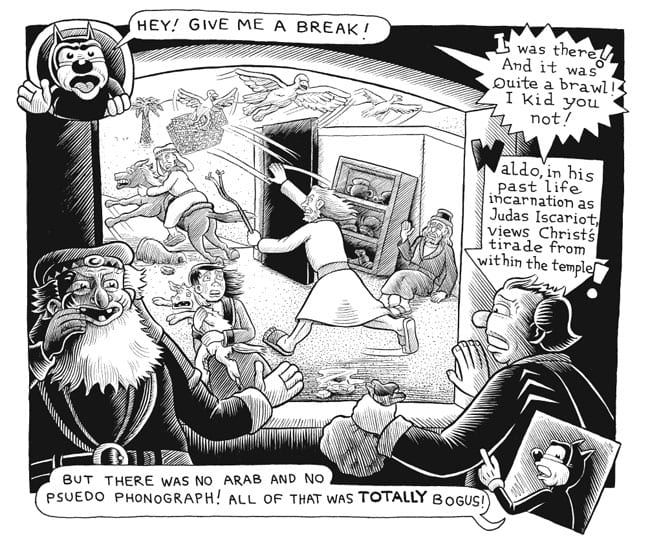
Today, we bring you the Comics Journal writing debut of a mysterious character named Waldo, who volunteered to review Kim Deitch's new book, The Amazing, Enlightening, and Absolutely True Adventures of Katherine Whaley. It's an unusual review for many reasons, and here's a sample:

Deitch-TCJ-11

Elsewhere:

—There are several noteworthy comics notices out there, including Rookie founder Tavi Gevenson's review of The Daniel Clowes Reader for the Chicago Tribune, Roctober magazine's short but intense review of comics by Mickey Z and Michael DeForge, Daniel Kalder's review of Igor Baranko's Jihad, Noah Berlatsky's look at a zen strip from John Porcellino, and three recommendations from Jeff Smith.

—Portland's crowd-funded comics convention, The Projects, is in the final days of its Kickstarter drive, and hasn't made its goal yet.

—Tom Spurgeon has a nice, long interview with Charles Forsman.

Gary Groth as a young fan.

—For Comics Forum, Andrei Molotiu gathers a list of terms useful for comics studies, from action-to-action transition to word/image irony, and provides illustrations here.

Weather Report

Tucker returns today with a full dose couldn't make it today, but we have two reviews for you. First, Robert Kirby on Graham Chaffee's Good Dog:

I confess unfamiliarity with Graham Chaffee’s prior work. According to his bio he authored a 2003 comics collection, The Most Important Thing and Other Stories, then took a detour into tattoo art before completing this comeback effort. His drawings are appealing throughout Good Dog. He may not have the instantly recognizable, idiosyncratic style of a Theo Ellsworth or a Michael DeForge, being more of a solid craftsman along the lines of say, Dean Haspiel or Josh Neufeld, but his skills are undeniable. His dog drawings particularly shine. He deftly captures their body language and emotional states without undue anthropomorphizing; dog-loving readers will recognize that he clearly gets the whole dog thing—from the scratching of an itch to the quizzical cock of an ear, to the forlorn, tentative quality of a stray meeting a seemingly kind stranger. His human characters are also finely rendered, especially his more stylized drawings of the pool hall owners. Chaffee is also adept at using the art of comics to create some beautiful scene transitions and character arcs; at the peak of the story, one character greets his destiny in a grandly executed, poetic sequence that left me with a lump in my throat.

And Daniel Kalder on Alejandro Jodorowsky and Olivier Boiscommun's Pietrolino:

Pietrolino abounds in things that Jodorowsky loves. But the book is radically different from all his other comics in its unprecedented levels of restraint and even good taste. There is hardly any violence, precious little sex, no taboo breaking, barely any mystic-religious stuff, the plot is straightforward, and Jodorowsky dials down the symbolism. The tone is wistful, reflective, nostalgic, gentle, and melancholy. Pietrolino suffers, but his suffering is depicted without Jodorowsky’s tendency to abrupt tonal subversion; there are no sudden beheadings or wisecracks, there is no explicit parent-child sex. It’s the kind of Jodorowsky book you could show your mother, or a priest, or even a little girl, his equivalent of The Straight Story, David Lynch’s gentle yarn about an old codger riding a lawn mower to see his estranged brother one last time. And yet as with all—or nearly all—of Jodorowsky’s works, Pietrolino is at its core the tale of a wounded individual seeking healing, so it nevertheless fits neatly into his oeuvre.

Elsewhere:

Glen David Gold on corporations and Comic-Con. Always fun: D&Q at Comic-Con.

Robin McConnell interviews Phil McAndrew, while Laura Hudson profiles Neil Gaiman and looks at his upcoming return to comics.

Finally, it looks like Desert Island is putting on a comic book festival on November 9th, with Paul Karasik as programming director. Good news.

The Wind That Shakes the Blogosphere

It's great to have Frank Santoro back, writing his Riff Raff column. This week, he writes about Chris Ware's Building Stories in his inimitably specific style:

I appreciate the way Ware is using the center of the page and sometimes the spread to focus the eye. Again, this is something that he's been doing forever — it's just that he is expanding his use of it and because of the assembly of Building Stories, the contrasting use of the center in each format really came through. The "all at once" reading of the spread feels more approachable within the framework of the whole. Meaning some issues of Acme start with "all at once" reading or start with "traditional" reading; there have always been different approaches to reading in his work. Yet with the structure of Building Stories I often found myself starting in the center of the spread or page, depending on where my eye took me, and would just go with it instead of stopping myself and starting in the upper left hand corner. Even if I was fast forwarding the story it didn't feel "wrong" like I was reading the last lines of a novel first & spoiling the ending.

One sequence that comes to mind is when our hero is drawing the landscape out her window. ...


Elsewhere:

—Comics & Politics. I missed it, but Matt Bors was interviewed about the state of political cartooning on CNN:

www.youtube.com/watch?v=yASoV-ncExY

Derf Backderf, who isn't precisely a political cartoonist but often tackles politics in his work, announced via Twitter that he's been laid off from the Cleveland Plain Dealer.

And Hayao Miyazaki has been criticized in Japan because his new film has been deemed by some to be insufficiently patriotic.

—Reviews.
Gabriel Winslow-Yost writes about CF's new Mere for the New York Review of Books. Nicky Tiso writes about Lisa Pearson's It Is Almost That> at HTMLGiant.

—Conventions. The New York Times came back from Comic-Con with a report on the rise of digital publishing companies like comiXology. Rob Salkowitz, who wrote a book on Comic-Con, comes back from this year's show believing its cultural impact may have plateaued. Gabe Fowler's Desert Island Tumblr page is hosting an announcement.

—Interviews. Michael Cavna at the Washington Post interviewed Joe Sinnott after he entered the Eisner Hall of Fame. Marc Singer reports on a Grant Morrison public appearance in Scotland he helped host.

—Culture. Domingos Isabelinho writes about a special comics-focused 1971 issue of the Journal of Popular Culture. Scott Esposito writes about the recent rediscovery of John Williams's novel Stoner in a way that will likely resonate to many comics fans.

It’s a Gas

Today on the site: Listen closely to the SDCC panel on music and comics with David Lasky and William Stout.

Elsewhere:

I've completely missed this very funny Tumblr site by Zohar Lazar: Ignatz is Unfunny.

The Forward on Bob Fingerman's opening at MoCCA.

Here's a review of a book I'm looking forward to reading: The Strange Tale of Panorama Island.

I like this gallery of images from the last day of Comic-Con. And here are Tom Spurgeon's final thoughts on SDCC 2013.

And Doug Aitken interviews Raymond Pettibon.

Challenging the Concept of Free Content

It's the time of the week when Joe McCulloch tells us about all the newest, most interesting comics coming out in stores tomorrow.

Elsewhere:

—Deb Aoki, formerly of manga.about.com, has launched a brand-new site this morning, Manga Comics Manga.

Here are the winners of the 2013 Eisner Awards. Building Stories and Saga did especially well.

—I'm probably not going to link to a lot of Comic-Con reports this year, but I liked this one from Philip Nel.

—If your interest was at all piqued by the announcement of new S. Clay Wilson books on the way, please go to Justin Green's blog entry passing a message from Wilson's wife Lorraine Chamberlain about Wilson's current health and financial situation (you may remember he received a traumatic brain injury a few years ago), and information about how you can help (Green's offering an incentive of his own for doing so).

—This sounds interesting. Starting this August, Tom Hart's SAW will be offering an online comics history course.

—Tom Spurgeon interviewed Chris Roberson and Allison Baker on the one-year anniversary of Monkeybrain Comics.

—Sarrah Horrocks writes about Red Sonja.

Jim Rugg inks John Buscema.

Street

Today on the site:

R.C. Harvey profiles Helen Hockinson:

Parker and Hokinson shared an admiration for the redoubtable editor of The New Yorker. “We set great store by the judgment of Harold Ross,” Parker wrote, adding Hoky’s opinion: “When he pencils ‘Not funny’ in the margin of a drawing and I look at it later, I generally realize to my horror that it isn’t,” she said.

Although her relationship with the magazine and its editor was, for the most part, “extremely happy,” as Parker reported, there was an occasion of unhappiness when she discovered that Peter Arno was being paid more for his cartoons than she was for hers. This discrepancy doubtless arose because of Ross’s labyrinthian pay scale that resulted in higher pay for full-page cartoons—and Arno was diligent in opting for full-page ideas every time. But Hoky, put out by the perceived inequity, refused to send in any more drawings until the playing field was leveled. Ross promptly did the right thing.

Hokinson kept her pocket-sized sketchpad with her at all times, and once, at least, after her celebrity as the creator of the Hokinson Woman was established, her habit of drawing wherever she was gave her a chuckle. She was sketching at a flower show when she overheard a broad-beamed woman saying to her friends, “Watch out. I understand Helen Hokinson comes here for material.” Hoky, who was at that very moment unobtrusively drawing the speaker, giggled to herself but didn’t miss a stroke of the pencil.


Elsewhere:

That enormo Comic-Con over on the other coast generated some news. Tom Spurgeon kept a good running commentary. The Beat already has some panel summaries.

The New Yorker on Rube Goldberg.

And Harlan Ellison profiled by New York magazine.

The Influence of Slander

Today, we bring you Craig Fischer's review of Michel Rabagliati's latest graphic novel, Paul Joins the Scouts. This piece of course acts as something of a pendant to the larger essay Craig wrote about Rabagliati's work recently, which he summarizes briefly within the new review:

Here on TCJ a few weeks ago, I wrote an essay about Rabagliati’s work before Scouts, arguing that readers can assemble a rough but consistent chronology for Rabagliati/Paul’s life from the events presented and alluded to in such “stand-alone” books as Paul Has a Summer Job (2002) and The Song of Roland (2009/English translation 2012). Scouts fills out the chronology further, showing us much more of Paul’s childhood than we’ve previously seen. I also mentioned that Paul’s father typically gets a lot more narrative attention from Rabagliati than Paul’s mother, but that too is corrected in Scouts, where Paul’s mother Aline is portrayed as a vivacious young wife frustrated by living in an apartment next door to two nosy relatives, one of whom is Paul’s great-aunt Janette, “seamstress, hat-maker and old maid” (17), who we’ve seen previously (as a much older person) in Paul Moves Out (2004/2005). The pleasures of the Paul series are two-fold: each individual graphic novel has a proper beginning, middle and end, and can be read on its own, but those who read the entire series notice reoccurring characters and motifs and can assemble a broader picture of Paul’s life.

Elsewhere:

—There's some kind of convention going on today, but I have no idea how to find out any information about it. It's really important to me that I know every bit of information about the big sfx movies I'm not going to see in two years, though. Truly at a loss here...

—Toronto developer David Mirvish is selling the "Mirvish Village" plot of land, which means that local comics institution The Beguiling will probably be needing a new location soon. The Toronto Star has the story.

—John Adcock & Huib van Opstal have teamed up with a post gathering two rare articles written about the mysterious Herbert Edmund Crowley in 1911 and 1915.

—Ng Suat Tong deploys Walter Benjamin's conception of kitsch while looking at the work of Frank King, George Herriman, Kevin Huizenga, and Jack T. Chick.

—Betsy Gomes at the CBLDF site has an interesting story about how a 1940 anti-comic-book law is being used today to prosecute the owner of a website that posted an alleged snuff video.

Buster Keaton, Ed "Big Daddy" Roth fan