Youthful Pages

I this last week of summer it's probably best if you stay inside and read comic books. Joe McCulloch is here to help you do that. And MariNaomi continues our most far-flung TCJ Diary in Ecuador.

And I've decided that today is British links day. That's right, my paltry handful of links will all relate to the land of the Queen. So:

-Remember the time Modesty Blaise was almost drawn by Handsome Frank Hampson? Me neither! In fact I have two unread Modest Blaise books on my shelf. Is it a good strip? I may never know.

-Whoah, I think Warren Ellis knows what I'm talking about.

-It's a profile of fans of the other Frank of British comics: Bellamy. Complete with some very nice, typically photo-realistic visuals.

-I love this "Stuff From Under the Stairs" Tumblr. Great British zines and comics magazines. It's just the kind of stuff I like sifting through, offering a enough of a glimpse to feel substantial but random enough to feel manageable. Here's a nice Hunt Emerson cover.

-And more buried 1980s: Some very handsome Paul Grist work for "girl's comic".

And that concludes this event. I hope to return to the kingdom soon.

Little Boy

Dan Nadel weighs in on the Dave Mazzucchelli Daredevil: Born Again Artist's Edition. It is frustrating how many great-looking but incredibly expensive comics are coming out these days.

MariNaomi is the latest artist to sit in our Cartoonist's Diary chair, and begins her week with a flight to Ecuador.

Frank Santoro has David Hockney on the brain, and is willing to share his thoughts.

Elsewhere:

—This weekend marked one of those rare occasions when a news event briefly captures the attention of the entire world, as they remember one of the greatest spectacles the world has ever known. I am talking of course of Rob Liefeld's Twitter feed. (I was away from the internet all weekend myself, actually, but this seems to be the only thing people are talking about now that I've returned.)

—Sadder news came with the announcement on the Cerebus Kickstarter page that a fire has destroyed many of the negatives for Dave Sim's High Society, delaying the digital edition of that book. It's been bad news for Sim fans all around considering that last week saw the final issue of Glamourpuss.

You may remember me linking to the Dave Sim fanblog A Moment of Cerebus a while back, when they first launched a rolling question-a-day interview with Sim they are calling "HARDtalk". Now they are looking for more questions to ask Sim, and requested that I pass along their desire to TCJ readers. If you have questions you'd like to ask him, feel free to leave your questions in the comments. Details are here.

—Robert Crumb continues to give short-take impressions of various public figures. This time around, he discusses Woody Allen, Charles Burns ("I'm not crazy about his stories, but I really like the art."), Philip K. Dick, Ward Kimball ("Kimball came to see me because he liked my work, he liked what I was doing."), Lincoln, Darwin, Hergé ("I much prefer Barks"), and Chris Ware ("You know, you kind of need to get a magnifying lens to read some of it, but that's okay, it's worth it."), among others.

—Finally, I've really been digging Simon Hanselmann's Truth Zone comics.

No Xomics

Welcome back. Tucker Stone has granted himself a vacation, so you'll have to live without his sweet, sweet kisses for another week. Instead we bring an interview with Bianca Stone by Alex Dueben. Stone occupied a niche in the small but growing area of poetry comics, which she explains as:

Sequential art that uses poetry as the text. But there are so many variations. Some examples are very abstract, some more traditional and more obvious they comic strips/graphic novel, with text that is clearly poetry (sometimes well-known published poetry). I use that term because it fits the best with what I’m doing. An artist named Dave Morris has been doing them for a long time, and actually published a book “Poetry Comics.” I was excited to find that, but it’s a much different thing than I was doing. I like how everyone who does it is very different. I use the term Poetry Comics for a much broader sense. I’m very interested in pushing against the limits of what a comic can be. There are so many aspects of the comic book, and the comic strip, that offers itself so readily to poetry. Things like panels, gutters, lettering; the conscious choices made regarding empty space on the page vs. the text; timing, line breaks, condensed language, etc. There’s so much to play with.

Elsewhere:

-Bart Beaty talks about his new book, Art vs. Comics. I'm betting on art.

-An unpublished 1970 interview with the late Joe Kubert.

-TCJ Diary all-star Pascal Girard is teaching a course about comics.

-A New Yorker post in which we learn things about the sacred origins of New Yorker cartoons from deep within the New Yorker.

-More cartoon secrets! This time about John Stanley's comics within comics.

-I can't take it anymore, there are so many secrets: Rob Liefeld is revealing his hidden thoughts about DC Entertainment. More entertainment in these tweets than in those comics.

And the most horrible secret of all: The time Stan Lee got naked. Warning: This photo will fuck you up for life.


Talking ‘Bout

Today, Rob Clough's High-Low column returns in an installment about Stanford University's Graphic Novel Project. An excerpt:

The noticeable rise of comics as a viable field of instruction at art schools, as well as the rise of comics-only art schools, has been well-documented over the past decade. What has been less discussed is the pedagogy of comics at traditional four-year colleges, though there have been a few schools here and there who have made the study and/or creation of comics a priority. Ohio State's Billy Ireland Cartoon Library & Museum has made the school a center of comics research. The University of Florida has held symposiums about comics for some time now. Duke's extensive collection is notable for its focus on zines and the small press as well as mainstream comics. The University of Cincinnati has Carol Tyler on their faculty in the fine arts department. However, I've yet to see any school with such a particular and exhaustive focus as Stanford, with its Graphic Novel Project.

Elsewhere:

—Department of Interviews with Guys Named Matt. Editor & Publisher talks to Life in Hell creator Matt Groening, The Beat talks to Boy's Club creator Matt Furie.

—Department of Manga-related Interviews. Anime News Network interviews both the man behind Pluto and Monster, Naoki Urasawa, and hentai pioneer (he's often called the creator of tentacle porn) Toshio Maeda.

—Department of Comics Academic Interviews. Comics Grid talks to former Comics Journal columnist Bart Beaty on the release of his new, much-anticipated book, Comics vs. Art. I haven't read it yet, but anticipate that this book is going to spark a fair amount of debate during the rest of 2012.

—Department of Your Regular Check-in with Alison Bechdel. The Burlington Free Press has you covered this time around. It's a good one, though.

—Department of Sorta Comics-Related. Frederik Pohl remembers his longtime friend Harry Harrison, and his own role in convincing Harrison to leave his art career behind for prose.

—Department of Barely Comics-Related At All. Am I the only one who didn't know that Whit Stillman started out as an agent for cartoonists? And why does that blow my mind so much? It seems exactly the kind of job one of his characters might have.

Choking Hazard

Today on the site:

RC Harvey profiles Richard Thompson in light of last week's news.

Like all cartoonists—and everyone who draws—Thompson is forever engaged, drawing by drawing, in a continual search for the perfect line. Says he: “The perfect line would be some combination of Ronald Searle and George Herriman. But then, that line would be so perfect, it wouldn’t be human.”

In the age of the emerging stick figure, it is refreshing—invigorating—to see actual drawing skill lauded so loudly. But Thompson’s talent doesn’t end with his drawing ability: his lines, interesting and sublime in their simplicity and complexity, merely visualize the world he has created in Cul de Sac, which Cavna describes as “a sly, whimsical skip through suburban life with Alice Otterloop, her friends Beni and Dill, elder brother Petey and her classmates at Blisshaven Academy preschool. It’s all about sidewalk discoveries, childhood invention, parents and other authority figures who are one step behind the children’s antics. At summoning our early years, Watterson says, ‘The strip depicts all kinds of moments than ring true.’”

-The Italian cartoonist and illustrator Sergio Toppi has died. He was renowned for his sense of design and his precise, electric line. Lambiek has the best English-language summary of his career.

-Here's news of a newly discovered run of Jack Kirby daily comic strips.

-A nice local story about cartoonists Joe Giella and Al Plastino.

-Really good shapes in these old Beetle Bailey strips.

-It's Ed Piskor on the Gweek podcast.


Loose Change

It's Tuesday, which means it's time for Joe McCulloch to guide you through the new releases at your local comic shop. It's the only weekly consumer guide worth reading even if you don't plan on buying any comics.

Elsewhere:

—Last Friday of course brought the heartbreaking announcement that Richard Thompson plans to shut down his much-loved comic strip Cul de Sac, due primarily to Parkinson's related medical issues. Michael Cavna at the Washington Post has whole story. Our own Craig Fischer has posted an appreciation of the strip and Thompson. Stacy Curtis, the artist who took over inking duties on the strip this spring, talks about his experience working with Thompson.

—As you probably remember, last week also brought news that long-running British comics weekly The Dandy will be shutting down its print operation. Charlie Brooker, not a fan, thinks the decision was long overdue. (His analysis of what's going to happen with the digital edition seems a bit unlikely to me.)

—I usually don't like to run too much coverage of movies based on comic books, but when one of the filmmakers is the actual original cartoonist, I'll make an exception. Marjane Satrapi talks to NPR about Chicken with Plums.

—At least two new Joe Kubert appreciations deserve your attention: Rick Veitch remembers working with Kubert on Sgt. Rock backups, and analysis from our own Matthias Wivel.

—Mike Lynch has posted a nice collection of Bill Mauldin photos.

Chasing Waterfalls

Here's what we have for you today: Ryan Holmberg has left Japan, but luckily Japan has not left him. Here is his latest column, written as he was leaving Tokyo -- a look at his favorite place in all of Manga Land: The Aomushi Showa Manga Library.

Housed in a former wood frame church, Aomushi is a spacious and atmospheric treasure house of manga from the postwar 1940s, 50s, and 60s. It is a pain to get to, but the returns for the manga lover – and even more for the researcher – far exceed all the museums combined. Mandarake might have more manga, but not as many gems, and besides you have to buy them to browse their insides. The museums might have fetish objects like Tezuka’s beret or Fujiko Fujio’s pipe, but since we are not talking about the Shroud of Turin, who really cares about relics. Only at Aomushi can you read old and rare manga freely (though not for free) and voluminously, since unlike at the Diet Library you can pull the books off the shelf yourself and unlike at the Naiki Library in Tokyo (a.k.a. Gendai Manga Toshokan) you do not have to pay for each and every book. And even more, you can take photographs (within limits), whereas everywhere else Xerox copying is not cheap and what you can copy is limited.

And Rob Clough reviews Joseph Lambert's Annie Sullivan and the Trials of Helen Keller. This is a really remarkable book -- Lambert's cartooning actually takes you inside the sensory experiences in a concise and subtle way.

Elsewhere online:

-Tom Spurgeon has a pair of interviews with Richard Thompson: one from 2008 and one from 2010.

-Jeet Heer reviews Joe Sacco's Journalism.

-A look at Shirato Sampei.

-Here's a fine appreciation of Brandon Graham's Prophet comic book series.

-And a couple of posts about newspapers... one about the slow disintegration of The Village Voice and another about the purported very last handwritten paper.


Waddaya Know

It's Friday, which means it's Comics of the Weak day, which means that Tucker Stone is reviewing comics, Nate Bulmer is drawing one, and Abhay Khosla is reporting on the recent news involving them. In this case, that's mostly DC's unfortunate initial statement regarding the death of Joe Kubert.

We also have the fifth and final day of Noah Van Sciver's Cartoonist's Diary for you, in which our own Fearless Leader makes a cameo. Thanks for doing this, Noah!

Elsewhere, the comics internet (or at least that part of it I pay closest attention to) seems to be in a lull right now, the kind that if life was a bad movie, would make someone say that it seems "quiet, too quiet." Since life isn't a bad movie, the more sensible reaction should be that it's August. But there are a few things worth noting.

—Kevin Melrose at Robot 6 caught a recent report in Variety announcing that a federal judge can be expected to make a ruling on the Shuster/Superman rights case at any day now.

—Dept. of Notable Interviews.: Paul Gravett talks to Shaun Tan, Paste magazine talks to Jeff Smith, and Newsarama talks to Thomas Herpich.

—If you know Danish, Matthias Wivel has written notes on the early, controversial Tintin albums that I'm sure are worth reading (if only because the notes he writes in English are).

—And, as those of you who follow the world of Reg'lar Book reviewing know, there's been another of those perennially recurring "debates" going on about whether or not it reviewers are too nice, or too mean, and the general value or lack thereof of negative reviews. Dwight Garner's piece in the Times is the most recent entry in the back-and-forth, though this has been going on via Twitter, Facebook, and a thousand webzines and blog posts for a few weeks now. Anyway, I only bring it up so as to point out that the comics world may seem particularly tiny, insular, and thin-skinned about criticism, but really all kinds of people participating in and following all kinds of media like to complain about bad reviews -- at least when the reviews are targeting their own pet projects.

It’s a Riot

It's a busy day here at TCJ HQ. First up we have Sean T. Collins' interview with Uno Moralez, a Russian artist whose web presence has generated a tremendous amount of interest and admirers (myself among them). Here's a bit:

CollinsSince you’re drawing digitally and publishing primarily through the digital medium of the web, I find your work more frightening than I would if it were in print. It feels like the horrors you depict in your illustrations and comics are a part of the web itself — like they’ve infected the page on which they are hosted. Do you feel publishing on the web gives your work any advantages it would not have in print?

Moralez: It’s an interesting point of view. If you start to think, “What is the Internet?”, pretty horrible thoughts can get into your head. I see the Web as an electronic prosthesis which replaces the mental link between people on the planet. But the thought of the Internet having an autonomous mind warms my imagination.

Actually, I publish my work on the web because it looks like it was planned and created there—in its original form, in other words. Furthermore, it’s available for maximum number of people.

Those are just my thoughts. Maybe the Internet Mind will just laugh at me.

Also, Noah Van Sciver marches forward into Day 4 of his diary. And, as we attempt to polish off our SDCC videos, heeeeeere's Archie!

Elsewhere online:

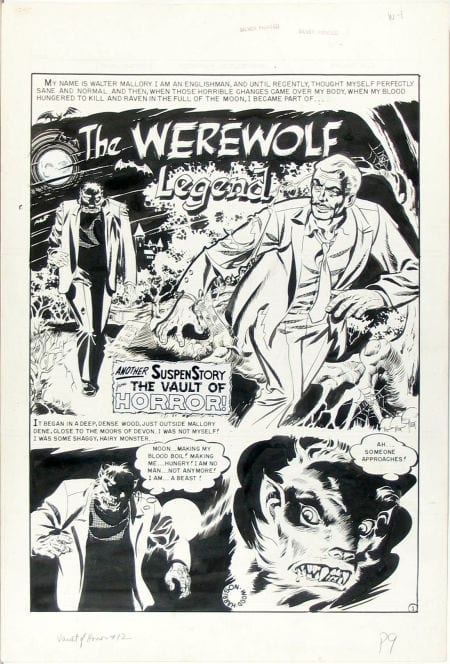
Harry Harrison, longtime SF writer and editor, has passed away. He was known in comics circles for his EC work and his early partnership with Wally Wood. I've always loved his freewheeling 1972/3 interview with Bill Spicer, which covers much of his comics years. Here's an appreciation at i09, and Tom Spurgeon has a solid obituary.

Harry Harrison and Wally Wood, Vault of Horror #12, 1950

Also of interest is this lengthy and very personal essay on autobiographical comics at The Awl. I'm intrigued by Alison Bechdel being the central subject here (5 years ago that would not have been the case), and the recent University of Chicago gathering being such an important touchstone. I suspect that booth will loom large for some time, which is a good thing.

And finally, I've been hearing about versions of this TV show for years, so I'm glad to see it alive and (almost) happening. Ron Rege fans rejoice.


Allowances

As you may have already noticed, yesterday we reposted Gary Groth's career-spanning interview with the late Joe Kubert, from a 1994 issue of this magazine. Here's an excerpt:

GROTH: Now, during the ’40s when you were doing this, I’m curious as to what the general attitude of all the artists was. I mean, the attitude today, even among artists who work on the same kinds of comic characters you worked on, is that they regard themselves as Artists, with a capital A. They have the sense that they are producing “art.” Now, did you have that sense, that you were involved in a burgeoning art form?

KUBERT: I never even thought about it. I know that I loved and enjoyed what I was doing. I got a thrill out of seeing a good piece of artwork. When I saw stuff that Lou Fine or Will Eisner did, it would raise the hair on the back of my neck. I kept saying to myself, “If these guys can do this kind of work, then maybe I’ll be able to be that good — or better.”

It never intimidated me — just the opposite. It gave me more incentive to go ahead and do my own stuff. But an art form, or a lower form of art? I never thought of that. I just loved to do it.

GROTH: You didn’t sit around and theorize about it.


KUBERT:
No. And neither did the guys I knew.

GROTH: Was that a generally held —


KUBERT:
I think that it was a generally held feeling. Where questions as to art quality came up was when someone gained an opportunity to make more bucks. When someone had the chance to go into advertising or illustration, he’d take it. Most didn’t do it because of the art. In fact, I think most would have stayed with comic books if they could make an equal amount of money.

GROTH: Because it was more enjoyable.

KUBERT: Right. Because comic books is rather singular in that it allows you to take chances. It allows you to make mistakes. In a 16-page story, all of it doesn’t have to be perfect. You can really go out on a limb and take chances. And, sometimes, those chances work great! And that makes you feel good. If it fails, fine. The majority of the effort does work OK. So it encourages you to take more chances and a lot of guys were able to do exceptionally good work in that way. Comic books also gives you a bigger canvas upon which to work. ’Cause when you’re doing syndication or advertising, there are six guys sitting on your back giving their suggestions. “Turn this a half an inch,” or, “Move this figure to the-left about three inches.” That’s what they’ re getting paid for and that’s what they’re gonna do. But there isn’t enough time for those small changes in comic books. So you had more freedom. To let your imagination run. I find that there is no other area in commercial art that allows you this kind of freedom. To design pages. To design complete books. To generate emotion into a story.

And you find out later that somebody read that story and actually felt the thing that you drew. When I first came into this business, I never dreamed that my work was read beyond the next block. I was doing it because I loved to do it. I really like to see the characters in my head appear in graphic and pictorial form. And when I learned that people around the world get the same effects, it was like having whipped cream put on top of the cake.

We've also begun to resume posting video from this year's San Diego Comic-Con, today featuring a panel called "Graphic Novels: The Bookstore Crowd", moderated by Tom Spurgeon and including participation from Kate Beaton, Alison Bechdel, Jason Shiga, Brecht Evens, Jennifer & Matthew Holm, and Nate Powell.

Also, Noah Van Sciver's week of Denver-style Cartoonist's Diaries continue.

Elsewhere:

—People continue to remember the late aforementioned Joe Kubert. Some worth reading if haven't already seen them include the New York Times obituary, longtime Vertigo editor Karen Berger's reminiscence, and further thoughts from Stephen Bissette, posted on the Schulz Library blog.

—James Romberger interviewed Gabrielle Bell for Publishers Weekly in anticipation of her new book.

—According to a report in The Guardian, the UK's oldest children's comic, The Dandy, may finally be shutting down after 75 years, due mostly to declining circulation.

—Ng Suat Tong and Robert Boyd, among others, discuss the original comics art market and museum acquisitions of same.

—And finally, in your scholarly link of the day, Janine Utell looks at the use of James Joyce in father-daughter graphic memoirs from Alison Bechdel and Mary Talbot.

Gaining

Today on the site:

Joe McCulloch has his weekly words of wisdom;Noah Van Sciver joins us for Day 2 of his diary; and Sean T. Collins reviews Sophie Yanow's In Situ.

Elsewhere:

More on Joe Kubert today: Tom Spurgeon has a lengthy obituary and a still growing link round-up. And here's a great romance comic from 1949.

-The Ignatz Awards nominees were announced.

-Josh Simmons made a movie. It will scare you.

-I didn't know about this upcoming Kyle Baker/Image project. Via.

-And Paul Tumey has a typically excellent post up about Milt Gross.

Sad Day

We have sad news for you this morning, as the seemingly universally well-liked cartoonist Joe Kubert has passed away. Kubert's biographer Bill Schelly has written the artist and Kubert School founder's obituary for us. An excerpt:

Born Yosaif Kubert on September 18, 1926, in what was then southern Poland (now Ukraine), his family emigrated to America when he was an infant. The Kuberts settled in a Jewish ghetto in Brooklyn known as East New York. Inspired by the colorful Sunday newspaper strips, Kubert decided at an early age that he wanted to be a cartoonist, and by 1939 he was working in the comic book production shop of Harry “A” Chesler in Manhattan.

Kubert received his only formal art training at the High School of Music and Art in New York City, a school for artistically gifted youths. Most of his training was “on the job” from such legendary comic book artists as Mort Meskin, Charles Biro, Irv Novick and others. At 14, Kubert was assisting on “The Spirit” in Will Eisner’s studio in Stamford, Connecticut.

There are many memorials to the man already posted, and more to come. Mark Evanier and Stephen Bissette have two of the more substantial up right now, and Tom Spurgeon has collected just about everything in his usual "Collective Memory" feature.

This is also the first day on the site for our latest Cartoon Diarist, Noah Van Sciver. Entry one is here.

And Sean Michael Robinson reviews Shigeru Mizuki's NonNonBa.

Elsewhere:

—I know I promised to weigh in on Dan's controversial Kickstarter/SP7 blog post, but it seems to me that at this point, more or less everything to be said on the matter has been said. I finally did find a comic that more or less perfectly encapsulates my views on the whole thing, though.

(I actually do have an opinion, but it's a boring one: Dan's thoughts on the historical problems evident in that Kickstarter pitch were right on, but it would have been a more effective example if he could point to the finished product. Some of the rhetoric was over the top, but obviously so, because it was meant to be funny. The "comix" paragraph should have been cut. That people often "look like schmucks" in their Kickstarter pitches shouldn't be a controversial position. Otherwise, I have no real problem with crowdfunding other than to think it's worth exploring options before starting one, and it does seem like it's become a bit overdone. I don't feel so strongly enough to write a rant about it, though. And I think that's it.)

Finally, Matt Bors discovers a crowdfunding campaign bound to give anyone pause.

—Curator Sara Duke gives a short online tour of the Library of Congress's I'm sure amazing cartoon collection.

—Marc Tyler Nobleman appeared on the NPR radio show All Things Considered to discuss his new book arguing that Bill Finger deserves more credit as Batman's co-creator.

—Abhay Khosla has one of his typically insane comics reviews up, this time of Brandon Graham's Prophet.

—Paul Gravett looks at the under-loved comics publisher, ACG. Its most popular character, Herbie, of course deserves all the attention he gets, but there are lots of little-known gems in that company's back catalog, and man are they easy to get cheap in back issues. Wait, what am I complaining about?

Accent Fingers

It's Friday morning, so why not dive into the weekend arm in arm with Tucker Stone and friends? This week it's new comics (natch) and the excellent duo of Garfield and Rob Liefeld.

Elsewhere online:

I didn't know that the band The Teardrop Explodes took its name from a line of dialogue in a Daredevil comic. Here the band, the Daredevil team and others remember how it all happened.

Another new one -- a Tumblr devoted to comics Australia and New Zealand -- great Stanley Pitt work here.

Sean Witzke and Matt Seneca continue their duet on the series Solo, this time it's Paul Pope's turn.

Should you need more Tucker in your life, along with Jog and Mautner, here's the latest Comic Books Are Burning in Hell. It's mostly about Garth Ennis, so you can expect a high degree of passion.

Hey, Gilbert and Jaime Hernandez are going on a proper tour in September. Good news.

Finally, as proof of my continued cliquishness and editorial malfeasance, I present you with the news that erstwhile columnist Frank Santoro is having yet another comic book sale tomorrow, this time with sales assistants Ben Marra, Jonny Negron, Lala Albert and Aidan Koch.

Enjoy the break.

Moving Forward

Today, we bring you Michael Dean's report on the Society of Illustration's recent purchase of MoCCA. An excerpt:

Asked who approached whom, [MoCCA President Ellen] Abramowitz told the Journal, “They approached us about eight months ago just about shared memberships and things like that and we had a few friendly meetings. Then, our lease was coming due for renewal at the end of July. I thought, 'MoCCA needs to go to the next level. If these are our goals and I don’t see them happening and I can’t do this with one person, do we really want to sign a new lease at this location?' Our debt wasn’t high. What hurt us was we had rent. I called them [in late June] and proposed the transfer and they very quickly said yes. They agreed to everything we wanted and even things we didn’t ask for. Some [MoCCA] trustees were initially upset, but it was a unanimous vote by the board.”

And my wife forgot to buy new coffee yesterday, and I'm not about to try and address anything more complicated than that without caffeine.

Here are a few links:

—Tom Spurgeon is trying to start a conversation about crowdfunding, and Anne Hambrock compares Kickstarter to Indiegogo from a practical standpoint (without getting into the more controversial areas).

—Matt Madden drew a much-linked-to six-panel history of American comics to illustrate an essay on the same by academic Paul Lopes. The article is a more-or-less solid bit of history, though little of it will be new to Journal readers, and he makes a few questionable assertions (such as his claim that manga saved the American graphic novel in the 2000s).

—Cecil Adams at the Straight Dope tracked down the first person to use the letter "Z" to indicate snoring during sleep—it was a cartoonist, as you might expect, considering the fact that I'm mentioning it here. (via)

—Steven Heller briefly interviews Blab editor Monte Beauchamp.

—And Noah Van Sciver provides a "Directors Commentary" to the Forbidden Planet blog.

High Noon

Today on the site Craig Fischer returns to excellent column, Monsters Eat Critics, and an examination of Jonah Hex, which includes meditations on Westerns generally, plot structures and torture porn. Here's a bit:

My biggest problem with All Star Western, however, is Gray and Palmiotti’s recalibration of the Western’s civilization/wilderness dialectic. In Hex #63, Jonah Hex is untamed, yet still bound by a personal code of honor, and he’s also the character we connect with the most. Hex appears in almost every scene of the comic; we are given access to his intimate memories of Aaron’s death, and we share his desire to stop Loco. I don’t think our identification with Hex is total; he brutally slits the throats of Loco’s men, he follows his father’s example by torturing Loco (and cutting out his eyes), and at moments like these some readers might put up some psychic barriers between Hex and their own emotions and sensibilities. We do have a strong sense of Hex’s status as a loner, however, and over the course of Gray and Palmiotti’s original series we come to know Hex as a character whose allegiances to both wilderness and civilization are mercurial and complex. Hex emulates the elegiac, conflicted gunslingers in earlier Western fiction and film, and Hex benefits from its dialogue with these predecessors.

And Rob Clough reviews Leela Corman's graphic novel, Unterzakhn:

If there’s a villain to be found in Leela Corman’s return to comics, Unterzakhn, it’s hypocrisy. While this story of twin Jewish girls growing up in New York’s Lower East Side in the early 20th century is also about the art of survival and the arbitrary nature of what determines who lives and who dies, it’s really a celebration of human kindness in the face of the abyss and a condemnation of arbitrary, rules-based ethics systems. Corman jumps forward and back in time to tell the story of Esther and Fanya Feinberg, their father Isaac, and their mother Minna.

Elsewhere online:

One of my all-time favorite comic strips, Zissy and Rita, now has a web site featuring all their adventures. Zissy and Rita, how do I love thee? This is one of those hilarious masterpieces that scratches an itch (or a whole rash) that you didn't know you had.

Illogical Volume has a post up on Mindless Ones about the recent Sean Rogers/Flex Mentallo piece over here.

Daniel Best has posted a fascinating article about Jerry Siegel's life as an enlisted man in WWII.

And Tom Spurgeon has some thoughts on the late critic Robert Hughes.


Did I Miss Anything?

Looks like I picked a good week to go on vacation—have the last ten days been the most contentious in the site's history during our tenure or does it just appear that way when you return only half-aware and see all the comments and cross-talk at once? (I don't have enough patience or curiosity to find out whatever was going on on Twitter and Facebook a week ago, or I'm sure it would seem even more overwhelming.) Anyway, I didn't have time to do much more than skim Dan's post on SP7/Kickstarter shortly before my departure, and I spent my flight wondering what kind of reaction it might stir up. Now I know. On one level, the whole thing seems like a classic molehill-sized mountain, but the issues involved (and the discussion it spawned) deserve more than a day's reflection before comment from me, especially considering just how much talk from other thinkers, both smart and dumb, has already been offered. Other than in the comments of this site (ha), some of the most even-keeled commentary on the controversy has come from Sean T. Collins, Secret Acres, and Tom Spurgeon. I will probably have more to say on this (and maybe on subsequent dustups on the site) in the near future, but those are good places to go in the meantime.

Other than that elephant in the room, the main topic of today is, of course, Joe McCulloch's usual Tuesday column on the Week in Comics.

Link-wise, I'm a bit out of date, obviously, and will try not to be too redundant, but here's what I've got for you so far:

—Drew Friedman recounts every kid's dream, an adolescent visit to the offices of MAD magazine in 1974.

—Gary Groth talks to Chris Mautner at Robot 6 about this magazine's recently announced partnership with Alexander Street Press.

—The University of Chicago has finally begun posting video of some of the panels from its acclaimed Hillary Chute-organized "Comics: Philosophy & Practice" conference. Links to the videos will be posted here, and so far include Art Spiegelman's talk with the great academic W.J.T. Mitchell and a group panel featuring Aline Kominsky-Crumb, Justin Green, Carol Tyler, and Phoebe Gloeckner.

The Wall Street Journal has a report on the MoCCA/Society of Illustrators move.

—Leela Corman is interviewed at The Millions.

—Domingos Isabelhino writes on Marco Mendes.

Muddy Colors has video of the late, great Moebius drawing in 2010. (via)

Pants Optional

Welcome to the new week.

Today on the site:

The great Richard Gehr returns with a brand new Know Your New Yorker Cartoonist, this time featuring the most excellent Arnie Levin. Here's a choice morsel:

GEHR: Did you have any relationship with your father?

LEVIN: When I went to get a passport, they ask me, “What’s your father’s name?” I said, “Ernest.” And the gal said to me, “No, it’s not.” I said, “Yes, it is!” She said, “No. That’s not what’s here.” So I called my mother and aunt to ask if Dad had any other names. Nothing. We were there all day calling people. I was getting desperate because we were gonna take a trip and I needed a passport. Then the gal asked me, “What borough did you live in?” I said the Bronx, She said no. I said, “This is impossible!” and asked her what she had down for his name. She said, “E.” [Laughter] I said, “E?” “Yes. E. Lawrence Levin.” She suddenly wants to get literary!

And of course, if you follow the site 24/7 you'd know that Frank Santoro posted a column yesterday detailing some of his current obsessions:

  currently obsessed with old issues of Optic Nerve. They look really really good and the stories hold up. The graphic design of the individual comics is great. And I really like Adrian’s “stage blocking” when he composes scenes. There is a very real sense of space in his comics. People in the landscape, in chairs, cars – all feel real and drawn and observed. Very hard to do without relying on photo refs. Tomine has a super developed sense of timing. I also like how he uses the “set” of the room or landscape to show physical as well as emotional distance from each other. Like a good cinematographer.

That should really quench your comics thirst, but if you're like me, and you find yourself parched for comics, here's a little more:

-Paul Gravett on comics history books.

-An entire Tumblr devoted to absurd images of Lupin III.

-Al Williamson and Joe Simon do a collaborative dance.

-A fine new Kate Beaton comic.

-More New Yorker cartooning: Bruce Eric Kaplan, who wrote the Seinfeld New Yorker cartoon bit, interviewed on that very subject.

-And not comics, but surely picture stories: The late Chris Marker once made a really excellent CD-ROM, which is now online. (via Jog)


It’s a Hit

Another week done gone, huh? And into the weekend for all of us. I'm feeling a little jaunty about it. But not to worry, Tucker Stone and co. are here to leave you with some feelings about the medium you love and cherish.

Elsewhere, the big, rumored-about news is that MoCCA has announced via press release that it will "transfer its assets" to the Society of Illustrators. This apparently includes "its permanent art collection and the MoCCA Fest name". Also, from the PR:

The Society will continue and expand MoCCA’s mission in a number of ways: staging MoCCA Fest in its current location, dedicating a gallery in the Society building to MoCCA’s Permanent Collection, continuing MoCCA programming, and curating a special exhibition of works from MoCCA’s Permanent Collection in their Hall of Fame Gallery (on display March 5-May 4), which will run in conjunction with a major exhibit, “The Comic Art of Harvey Kurtzman,” curated by graphic designer and comics-anthology editor Monte Beauchamp. There will be extensive arts programming around both of these exhibits, including lectures, workshops, film and music series. Current MoCCA memberships will be honored at the Society of Illustrators.

I think it's a bit of shame to place comics under the umbrella of illustration (though I love the latter), if only because it only just recently crawled out from under said umbrella and I prefer the medium stand on its own. Then again, as above, their histories are well intermingled, so a smart curator could do some interesting shows working deep in the Society stacks. I'll be very curious how the Society handles comics, and also how it handles the current (very controversial) MoCCA board/staff. I'll refrain from reading too much into the PR. We'll have full coverage early next week.

And in other places online: It's TCJ-contributors run amuck, writing for other publications like they haven't a care in the world, throwing words hither and yon with great flair.

Here's our Northern friend Jeet Heer on Blown Covers: New Yorker Covers You Were Never Meant to See for the LA Review of Books:

Mouly’s new collection Blown Covers: New Yorker Covers You Were Never Meant to See, documents the Brown era and beyond, and shows how she gave the public face of The New Yorker a make-over, turning out covers that are much livelier and more timely while also skirting at the edge of good taste, and occasionally getting reined in by the magazine’s governing code of propriety. What does a cultural agitator do when she’s put in charge of the covers of a venerable publication, one that, in recent decades, has had a tropism towards stuffiness? One predictable innovation was recruiting a cohort of artists from Raw, including Burns, Richard McGuire, Robert Crumb, and Jacques de Loustal. Eventually, Mouly also brought on a wider array of cartoonists from outside the Raw orbit, like Daniel Clowes, Adrian Tomine, and Seth. These artists brought the inventiveness and élan of contemporary narrative cartooning to The New Yorker.

Here's that Tucker Stone again, co-opting Joe McCulloch (patron saint of the unreadable-yet-intriguing), Matt (handsome man) Seneca, and Chris (wise & stable) Mautner with their gold darned podcast.

Oh heavens, here's Sean T. Collins telling you about Batman books for Rolling Stone!

And, beneath that handsome cover there will be some comics in this year's Best American Comics. Here is a list of them.

Finally, despite my intense love for his work, I did not know that Seymour (my fantasy football league illustrator/designer of choice for my life) Chwast had a column over at Print. Now you know, too.

Up to the Majors

Well the internet has arrived to my dwelling here in Copake, New York. It's a nice internet, though replete with strange angry vibes that my dog, Mr. Fatty Pants, wisely tells me to ignore. Fatty Pants says: "Hey man, just chill." And so I do.

But my chilling should have no bearing on your comics reading habits.

Today on the site we have Ron Goulart continuing his correspondence column, this time with Basil Wolverton. If I haven't mentioned this before, I should note that Ron is an absolute living treasure of a comics historian. He was the first to document and explain Jack Cole's life and work, and his artist-centric approach to the medium has yielded numerous essential books, including both volumes of The Great Comic Book Artists, and my personal favorite, The Encyclopedia of American Comics. Anyhow, here's a bit from Wolverton:

After Wolverton replied, I learned that he didn’t labor in the New York area but in the Pacific Northwest. He resided in Vancouver, Washington and contributed by mail. The Funnies, Inc. shop handled much of his comic book. His letterhead contained the bottom line “Producer of Preposterous Pictures of Peculiar People.” He sent me a small original drawing of Powerhouse, which I immediately tacked to my bedroom wall to add to my growing collection. In a later letter Wolverton enclosed a snapshot of himself holding his dog. He looked unlike Spacehawk or Powerhouse Pepper. But was a chubby fellow with curly hair. In the letter he explained, “the one with the coat is me.” He was always polite and helpful and upbeat.

And elsewhere online, a diverse selection of reading material with which to wile away your summer day...

Brokelyn talks to Leslie Stein, Lisa Hanawalt, and Brendan Leach about how they make a living (or don't) in comics.

Howard Chaykin has resurrected his erotic comic book series, Black Kiss, and talks about it here. Chaykin is one of those artists I'm perpetually interested in, for the arc of his career as much as the work itself.

Sean Howe, whose forthcoming Marvel Comics: The Untold Story, is a miracle of research and storytelling, has a classic bit of correspondence from Steve Ditko.

Warren Ellis writes about British adventure comic strips. I've only just gotten on to Modesty Blaise, and am enjoying the strip a lot.

Michael Dooley's two part interview with Susie Cagle, with a guest appearance by Ted Rall, is here and here.

And finally, not comics, but this is an excellent and stylistically diverse career in book cover design.


Liberation Now!

Well it's a new day here. Tim is still on vacation, my internet situation remains iffy, but we must soldier on.

Though I'm not going to get into the comments on my little screed last week,  I want to take a minute (despite my better instincts) and clarify a couple things for the record. First, it should be evident that the piece references the use of Kickstarter for one particular project, which, to me, represents a species of projects, by one kind of entity. It was not covering Kickstarter in general, or individual artists using Kickstarter, etc.  I'm glad it lead to discussion, but I certainly wasn't, as has been intimated, taking a position on Kickstarter in general. And second, I noticed some confusion about my role in the Brooklyn Comics and Graphics Festival vis-a-vis what I wrote. BCGF is run by three people. It is not dictated by my tastes. It's run with the goal of making the best and most diverse festival possible, and in all cases the majority rules, not any one person's ideas. And that's it. Now on to important comic book business.

Today on the site we bring you Sean Rogers on Flex Mentallo and Grant Morrison's writing tropes. Here's a taste:

...So far, so good, right? Scope, complexity, ambition—all the hallmarks of a potentially expansive SF experience. But despite the abstract appeal of Morrison’s ideas and approach, there is very little enjoyment to be had in their execution, not least because he assails his readers with verbiage at once high-flown and ham-fisted. The Morrison touch—deployed everywhere, endlessly—is to crowd one high concept after another, reverently leaving each alone, never to return to any one idea again.

And finally, hey, all of TCJ will now also be available via Alexander Street Press, which provides digital archives to subscribing institutions.

Once again it must be a short post. More soon!

Why Fuss?

Sorry to miss you yesterday. Tim is on vacation and I found myself both without and far away from the Internet. Currently an iPad and 3G are it so this will be a minimal post. But it sure looks like things have been busy around here.

If you're just tuning in, there's a ton of new material on the site.

-Nicole Rudick on one of the all-time great comics, Gloriana, by Kevin Huizenga.

-Joe Daly, whose Dungeon Quest series is one of the best and strangest surprises in recent years, was interviewed by Eric Buckler.

-Here's everyone's face European, Brecht Evens, live from SDCC.

-Frank Santoro reporting on his one-man comic-con.

-And finally, no week would be complete without Joe McCulloch's "Week."

Enjoy.

There Has to be a Rational X-Planation

Tim and Dan are "separately geographically indisposed and will return Tuesday."

I dunno if my belated thoughts about SDCC12 or my critical evaluation of the Dark Knight Rises is of any real interest, but I'm unable to refrain from sharing a comic-con fantasy come true: I said "there should be an X-Files episode about the Fantagraphics dishwasher," and lo, but esteemed colleague and TCJ contributor Shaenon Garrity made it so.


No Good Reason

Today on the site Tucker Stone, who recently told me "Everything's coming up roses for Tucker Stone", and then sold me some Punisher comics, is sticking to his "positivity" vibe, and also ropes in Tim O'Neil to tell us more.

And our fearless leader, Gary Groth, interviews Gilbert Shelton in this video straight from the streets and alleys of SDCC.

And now, instead of a buncha links, I have to get something off my chest. I am irritated by this Kickstarter project for a Garo tribute book called SP7: Alt. Comics Tribute to GARO Manga, edited by Ian Harker and Box Brown. Here's why...

This is some of the pitch:

The concept behind SP7 is to contextualize the post-manga wave in western art-comix within the broader history of manga itself by paying tribute to the ground-breaking publication GARO. In short, we feel as though the GARO phenomenon of personal, idiosyncratic, and experimental manga is re-manifesting itself within contemporary art-comix due to the residual influence of the 2000’s manga boom in America.

-It's deeply stupid about history. Yes, Garo contained plenty of avant-garde work, but, as anyone who has read any of the work therein would know, that was more than equally balanced with genre historical fiction; sentimental memoirs; literary fiction, etc, etc. The editors would also know that if they'd actually stopped to consider the material they're claiming as their own, or, hey dipped into any random hundred words written on this web site over the past year by Ryan Holmberg. He also wrote a book on the subject! It amazes me that even now, in 2012, with all the resources available, that people supposedly engaged in the medium aren't actually curious about it. They're far more entrenched in making it reflect themselves than in actually learning something. It's just a lot easier to just grab something (Rob Liefeld! Garo!) and make it your "thing" than to actually carve out an identity or do some research.

This passage is particularly silly:

What EC was to the Undergrounds of the late-60’s/early 70’s, Manga is to today’s most interesting underground cartoonists.

Here manga suddenly comes to mean the same as Garo, and Garo the same as manga. That would mean that the less-than-a-dozen books in the US containing Garo-related material somehow equals all of manga. Manga has been an influence on a generation of cartoonists, from Bryan Lee O'Malley (Underground? Art? I have no idea) to Brandon Graham to Dash Shaw to C.F., but it's not primarily Garo so much as the overwhelming mass of manga that hit these shores over the last decade.

And what the fuck is "underground comics" in 2012? I literally have no idea. I mean, not so underground that it's not being promoted on an Amazon.com-administered web site? Worse yet, the writers don't even know their US-comics history/theory. EC was a comic book company. Manga is the Japanese term for comics. Garo was an anthology. Three very different things. But let's just follow this windy logic -- Sure, EC was important  to 1960s-70s underground comics as a liberating influence, but was equally a weight to get out from under. Just ask Bill Griffith, who decried its pervasiveness. Many of the best of those cartoonists (Crumb, Spiegelman, Green, Kominsky, Noomin, Wilson, et al) show no influence by EC at all.

By featuring the works of these western artists together in a traditional right-to-left/newsprint/pulp-manga format we hope to engender discussion about the trans-national influence of manga on the broader world of art-comix.

-Ok, we're back to manga again. From Garo to manga. How does a format engender a discussion? You know what engenders discussion? Intelligent writing or informed art on the subject. And if you want to make a groovy anthology just make it -- don't latch onto something you don't understand (in the slightest) to make your point. It's sleazy. Stand on your own. Then again, maybe it's time I got around to my "Metal Hurlant Tribute Anthology". Wait a minute...

-And what the fuck does art-comix even mean? People call what I publish "art-comix" and I  look over my shoulder as though someone called me "Mr. Nadel". I don't understand. What is art-comix? Different than regular comics? I like comics. I also liked the zine I Like Comics. But I don't think I like "comix". Garo contained comics, right? Was there an "x" involved? I doubt it. Was Winsor McCay "art comix"? If you make comics, make comics.

-And finally, Kickstarter. Guess what? You don't get to call yourself underground if you're on Kickstarter. Guess what else? You don't get to call yourself a publisher either; you're just someone who pays a printing bill. Take pre-orders on your site. Sell your boots. Do what you have to do. But don't go begging for money so that you can then give 5% of it to Amazon.com, which is actively trying to put you (!), and the stores you hope to shove this shit into, out of business. I'm all for raising money for art, but it would be nice if there was some sense of proportion. No one needs this anthology but it might do fine "in the market". I'm so sick of seeing perfectly viable (viable, but not smart or interesting; viable) comic book projects on there. People can do what they want, but when you're out there hustling dough for your movie-ready zombie-baseball graphic novel, or fucking Cyberforce, or your poorly thought through Garo book, you just look like a schmuck.

I realize there are seemingly bigger problems in the comics world, but I guess I'm thinking locally.

Ok, have a great weekend!

p.s.: Frank Santoro is having another big back issue sale this weekend in NYC!

Overload

Today we bring you Chris Mautner's lengthy interview with Jessica Abel and Matt Madden about everything from their new book, Mastering Comics, to navigating collaboration as a married couple to the vagaries of style to moving to France to the difficulties inherent in teaching cartooning:

ABEL: Talking about writing, it’s a thing that’s really difficult in the context of the process that we teach. It’s really difficult to teach explicitly.

MAUTNER: Why is that?

ABEL: There isn’t time. We’re trying to get through all of this stuff, all of the basics of cartooning – how to write a page, how to do lettering, how to make a thumbnail, how to whatever – and a lot of this stuff, we teach it somewhat Socratically. It happens in the context of critiques and so on. But we’re not drawing out and talking explicitly about principles of writing.

MADDEN: To interject, at SVA, we teach a fifteen-week semester of three-hour studio classes. Which sounds like a lot of time but it goes by really quickly and it’s usually barely enough. You take attendance, collect homework, and all of a sudden the class is halfway over. It’s very hard to get in-depth, especially when you’ve got a class of fifteen kids or more.

ABEL: Often our classes are in the twenty-student range and if you’re going to be critiquing a comic for each of those students, it’s gonna take the whole class period.

MADDEN:
Jessica and I teach a full-year class together called “Storytelling” where a lot of the activities and ideas in the book either come from or are test-run there. But even in that class we never do a lesson on composition and things like that. That’s all stuff that has to come out inductively through the teaching process, where we can observe the individual panels. It’s another reason we wanted to have the book handy — so you can have all this stuff written down and read it separately. That was one of our practical reasons for doing the book in the first place, for teachers to have all this extra stuff, all the real stuff there that in practice most of us don’t really get around to teaching in class.

Elsewhere:

—Kiel Phegley at Comic Book Resources has a new interview with Grant Morrison that's been linked to pretty much everywhere this week. In it, Morrison reveals that he is going to stop writing DC superhero comics for a while (Phegley unfortunately never pressed Morrison on his feelings about recent creators' rights controversies around the company). [UPDATE: I've been told the issues are raised in a later, not yet published part of the discussion.]

—The cult cultural critic Erik Davis (Techgnosis) delivers a two-part examination of underground pioneer Rick Griffin at HiLobrow.

—An old BBC interview with a seven-year-old Neil Gaiman has recently surfaced and been republished at the Village Voice. I'm personally less interested in the fact that Gaiman was talking about Scientology than I am in how assured he is as a seven-year-old.

—At Comics Grid, Kathleen Dunley interviews Seth about his philosophy of book design and the use of computers, among other things.

—There's a new online issue of the academic journal ImageTexT up, with an article from David Kunzle about Carl Barks, along with a John Porcellino illustration and lots of interesting looking reviews. Worth checking out for the more scholarly among you.

—Paul Slade has a massive article up devoted to Reg Smythe and Andy Capp.

—Heidi MacDonald at Publishers Weekly reports that Alternative Comics is relaunching, under the new leadership of Marc Arsenault (Wow Cool), and will be publishing work by Sam Henderson, James Kochalka, Ted May, and Karl Stevens, among others.

—Old school comics blogger Alan David Doane has relaunched his old site, Comic Book Galaxy.

—Michael Kurfeld interviews Robert Crumb for the Los Angeles Review of Books:

—Maira Kalman talks about the meaning of art and life:

—And finally, via Milo George, someone has unearthed and reposted the old Fort Thunder website.