Wake Up, Wake Up

Hayley Campbell starts the week off with a review of David Hahn's All Nighter.

Even when Frank's taking it easy with his column, he manages to drop some knowledge about Gray Morrow and Carl Barks you couldn't get from anyone else.

Sean T. Collins returned with the second installment of his "Say Hello" column on Friday, this time featuring the popular illustrator and web cartoonist Emily Carroll.

And Rob Clough reviewed the latest anthology in the Sunday series, which grew out of its editors' time at the Center for Cartoon Studies.

Recent Journal interview subject Jim Woodring gives a young aspiring cartoonist some advice in a letter from 1993. (via)

So far, July has been a very good month for reading Gabrielle Bell's comics online. (She's going for one a day all month.)

Jeet Heer, take note: The Panelists dig up a fascinating quote from Walt Kelly regarding the use of racial caricature by cartoonists of his time.

Some people have trouble understanding the humor in New Yorker cartoons, others, well ... have you ever had trouble getting the jokes in Beetle Bailey? Mort Walker explains what's funny about selected strips in a series of videos.

The New York Times talks to Jules Feiffer and others regarding The Dancer Films, an adaptation of selected strips from Feiffer's long-running strip in the Voice. Will this movie break the Green Lantern box office curse, and make the world safe for comic book movies again?

And finally, one of the CEOs of Archie has made the news on the seedier side of the internet.

Finally, Drew Friedman art pirated by Chinese snake-oil peddlers! Would you buy a sex aide with this man's face on it?

TG, etc.

Well ok, it's Friday. So here we are

Kim Deitch weighs in with Part 4 of his memoir, this one focusing on rock 'n roll.

And elsewhere:

-Pal Mike Reddy is posting nifty daily drawings on Annals of Americus. The link will take you to the index -- click on each entry to read a short story based on one of Mike's humorous dystopian images.

-Eddie Campbell continues his explorations into definitions and Spanish comics.

-It's always good to see new work from Frank Young and David Lasky -- they've announced a new graphic novel called Oregon Trail: The Road of Destiny, coming out this Fall.

-And TCJ-contributor Matt Seneca has a fun link dump, including scans of a rare English-language interview with Liberatore.

July Continues

R. Fiore's Funnybook Roulette returns, with a classic-style roundup of reviews of recent-ish comics by Winshluss, Jean-Claude Carrierre, Pascal Girard, Jason Shiga, and Jeffrey Brown, among others. A sample:

No fair observer would deny that it takes more than one book to fully explore the absurdity of the Transformers concept.

We also bring you Katie Haegele's review of It Is Almost That, an anthology of text-driven artworks (& art-driven texts) created by female artists. It begins:

It Is Almost That is not an anthology of comics. In fact, most of the work in the collection has no narrative in any traditional sense. But the 26 works collected here all use words and visual art and combine them, in some way, to tell a story. As editor Lisa Pearson writes in her afterword, “…texts do not always appear on pristine white fields; images are not illustrative and language does not explain; stories do not unfold in predictable ways—and yet every page is meant to be read.”

Elsewhere:

Hairy Green Eyeball brings jpegs of Wally Wood parodies of comic strips from Mad.

Finally, Darryl Ayo voices a frequently heard complaint about the unsatisfactory nature of many comics when read as individual issues. It's difficult not to sympathize.

Two things come to mind in reaction to this. 1: DC recently (sort of) announced that they were going to start addressing the issue, by no longer padding out stories with filler to bring them up to collection-length. We'll see if that actually happens. Padding may be a hard habit to break.

And 2: In an interview conducted by Matt Zoller Seitz, David Simon (co-creator of The Wire and Treme) responds to similar complaints about the perceived unsatisfactoriness of Treme episodes, and how that show's writing staff writes with the eventual DVD set in mind, not weekly viewers:

The measure that I care about is not the episodic. I just don't care about evaluating these things by episodes. It's like I'm building a house, and you're telling me, "I really like the stairwell, but I don't like the balustrade." Well, great, thanks, y'know? What do you think of the house? When you get to the end [of a season], did it feel like she got where she was supposed to go, and that she really experienced these eight months as an ordinary human being would? That's the real challenge, because film is a shorthand for everything.

[...] I don't care about the thrills you get in every episode. I want it to be resonant at the end, in a cumulative way. Eric feels the same way. We feel we're writing a singular, elemental thing.

[...]

[We're] writing the show for people who have a complete season DVD set in front of them, or who are watching the show via HBO On Demand, or who can otherwise absorb it all as a piece, and watch [the episodes] all in a row.

That being said, every Treme episode I've seen contains an enormous amount of narrative detail in comparison to your average issue of Flashpoint, so keep in mind that by bringing these two together, I'm comparing apples to ham sandwiches.

Summer Heat

Today on the site:

Mike Dawson's TCJ Talkies with Bob Fingerman.

-Chris Mautner reviews Lucille.

And around the spinning internet globe:

-Hayley Campbell wrote in to note that the great London comic book store Gosh! is moving after 25 years in the same spot, and too a bigger location, to boot, which the store is celebrating with some killer sounding events.

-Cartoonist Tim Hensley is putting elderly videos and music on his Tumblr. This is a must.

-Evan Dorkin discusses the process of securing a film version of his and Jill Thompson's Beasts of Burden.

-I'm not sure what this is, but it seems intriguing.

Back to Work

We're salving our fireworks wounds and recovering from a very long day in traffic this morning, so time is tight, but we've got some new content for you, too.

Chris Randle interviews the illustrator and Skim artist, Jillian Tamaki.

Frank Santoro gets a bit more informal in his latest column on color.

Joe McCulloch delivers his always invaluable column on the week in new comics.

Elsewhere:

Chris Mautner's written another solid entry in his recurring Comics College feature, this time on the most essential cartoonist of them all, George Herriman. I endorse Mautner's recommendations on this one.

The New York Times came up with the bright idea of commissioning the famous activist and former sex worker Annie Sprinkles to review Paying for It. It's a fun, short read, but more interesting for sociological reasons than as a piece of criticism.

And finally, the nominations for this year's Harvey Awards have been announced.

The Longest Weekend

Okay, just like most of you, our pick-up trucks are all loaded with watermelon, Weber grills, and illegal fireworks, and we're ready to head out to parts unknown to celebrate the birth of a nation, but we've got a few more items for you to read first. Independence Day means that we won't be publishing on Monday, but that's good news really, because if you didn't notice, this week was really packed with great reading material. Use the extra day to catch up on whatever you missed. (And tune in to WKCR's annual all-day Armstrong festival for a soundtrack.)

This morning, our columnist R.C. Harvey offers a retort to the video re his Milton Caniff book that I posted a while back. Whatever controversy may still linger over its funniness or lack thereof, I can now feel confident that publicizing that video had at least one positive result. By the way, Dan wants to report that for the record, he has read the entire book: "It is very long, yet also very awesome."

Dan wrote the other piece we have for you today, a review of one of the most anticipated books of the year, Peter Maresca's latest oversize reprint anthology, Forgotten Fantasy: Sunday Comics 1900-1915. I can not wait to see this one.

On a sadder note, Thierry Martens, comics historian and former editor of Spirou, has passed away at the age of 69. Kim Thompson offers tribute.

Elsewhere:

The Asterix/brain injury controversy isn't going anywhere! Jeff Albertson goes into great detail on the subject over at the Comics Grid. Actually, he provides some valuable context, and a needed reminder that whenever the media hypes up a scientific or academic study, there's a very good chance there's some serious misrepresentation going on.

Apparently, the Favorites zine, edited by the great Craig Fischer, and intended to raise money for Parkinson's research on behalf of Team Cul De Sac, is now available for sale. Among its authors are several Journal favorites, including Rob Clough, Jeet Heer, Chris Mautner, Joe McCulloch, Frank Santoro, and Matthias Wivel.

And finally, Johanna Draper Carlson reports that Friends of Lulu is no more.

Thierry Martens, R.I.P.

Fellow cartoonist Tibet borrowed Thierry Martens's distinctive look (and physique) for the villain in this "Ric Hochet" adventure.

I just read that Thierry Martens has died, at far too early an age: 69.

Martens was the first comics professional who was nice to me. He was the editor-in-chief of Spirou magazine during the time when I was reading it, and more than once he replied to my long, rambling, fannishly opinionated letters to the editor with long, friendly letters of his own. (Which was more than Stan Lee ever did. Or Roy Thomas, even.) I'm pretty sure I still have them somewhere. Perhaps he was intrigued by the oddness of an American Spirou reader who wrote him in flawless French. Or maybe he realized he was dealing with a kindred spirit. Little did he know that 40 years later I'd be publishing some of "his" cartoonists, such as Tillieux and Macherot.

No one would claim that Martens's reign over Spirou (1968-1978) represented the magazine's true peak -- that distinction would belong to Yvan Delporte, who preceded him and oversaw Spirou's genuine Golden Age -- but as a teenager with a choice among Spirou and the other Franco-Belgian weeklies, Spirou is the one I stuck with... so that ought to count for something. I think that within the limitations of that decade, as Spirou's great first-generation cartoonists tuckered out or moved on, to be replaced by inevitably lesser later generations, and as the Asterix-driven Pilote magazine became the standard-bearer in the field, and as weekly comics magazines in general began their irrevocable spiral into irrelevancy, Martens did about as good a job as anyone could have. And he clearly cared, and worked his ass off. Those are not bad qualities to be remembered for, especially if you get to add in "nice guy."

Cementing his status as one of the good guys, Martens was also a tireless comics historian and archivist, and Spirou's frequent forays into classic reprints and cartoonist biographies (which certainly fueled my own early passion for such things) can all be directly credited to him.

Rest in peace, Monsieur Martens.

Carny

In our ongoing attempt to shut down your brains with the sheer force of our content, we bring you yet more STUFF.

*Kim Deitch checks in with Part 3 of his memoir, this time covering the advent of television, some of his favorite programs, and a bit about music. If you aren't reading this you are seriously missing out. Living legend, this guy.

*And Rob Clough delivers a thoughtful take on the work of Dave Kiersh.

On a personal note, kind readers, thanks to Tim (thanks meaning he once sold me the book for a buck) I have begun reading Michael Moorcock's Elric saga in the order Moorcock arranged the stories a decade ago. I'm into it, people. I feel I might be going in deep on this one. The quantity of ideas and images he's tossing out is pretty wonderful, as is the implicit meta-narrative of satire and the decline of the 20th century. I hit upon the stuff after years of reading it referenced by Moore, Simonson, etc. And it's been a total treat. Reading it after my recent Moebius jag is also satisfying, as Moebius has a similarly fevered psychedelic imagination rooted in late 1960s counterculture and straight-up pulps.

Also: A no-prize to anyone who can actually describe what's in (like "all drawings, no text" or "super long comic in French" or "a retelling of the Gospel of Mark") the Moebius books Jog mentioned on Tuesday. Help us try to understand!

And, as we say, "elsewhere":

-I am bummed that Tom Spurgeon is taking some time off from The Comics Reporter, but wish him a happy and relaxing time away from the world of the comics internet.

-Craig Fischer has an excellent piece up at The Panelists about his own shifting views of Gene Colan's artwork.

-For Frank: The story of one man's Trevor Von Eeden commission.

-And from pal Joshua Glenn comes this announcement:

HiLobrow is running a five-part series by Rob Steibel (who writes the Kirby Dynamics blog for the Jack Kirby Museum and Research Center). The series takes a close look at the original artwork — and the margin notes by Kirby and Lee — from a single June 1967 Fantastic Four page. It's a lot of fun to read these panels over Rob's shoulder, and to compare them with the published panels. This exercise offers deep insights into the Kirby-Lee collaboration, and Rob is scrupulously fair to both parties.

The series thus far has been excellent. Go check it out.

Not That Far From Paradise

Today, we present our final preview for the upcoming issue 301 of The Comics Journal, a brief excerpt from Gary Groth's interview with Robert Crumb, mostly concerned with his Genesis.

We also have Sean Michael Robinson's review of Shigeru Mizuki's Onward to Our Noble Deaths. I really liked this book.

Elsewhere:

Jeet Heer reviews Ben Katchor's latest for the new Los Angeles Review of Books. Recommended all around.

In lieu of Dapper Dan's missing Green Lantern review, I point you towards another critique of the film written by our own Joe McCulloch—and, uh, he seems less than impressed!

Two creator podcast interviews possibly worth noting: one with the inimitable Eddie Cambpell, and the other with Grant Morrison. I haven't listened to either of these yet, but plan to do so over the holiday weekend. Campbell is on any thinking person's short list of great comics talkers, and would probably be fun to listen to even if interviewed about his thoughts on dog grooming. Grant Morrison, on the other hand, is not entirely my cup of Kool-Aid, but in this one, he's interviewed by the Mindless Ones, whose enthusiasm for the man and his work is dangerously contagious.

We don't comment too often on DC and Marvel scheduling mishaps in this space (mostly because 95% of the rest of the comics internet seems devoted to nothing else), but every once in a while one of them makes a mistake so funny it's impossible to look away. Chris Butcher explains.

Douglas Wolk has launched a new blog in which he promises to review every Judge Dredd book ever released. That's too much Dredd for me.

Missed it: On Sunday, The New York Times ran an editorial by Brent Staples supporting Jack Kirby in his family's ongoing copyright case with Marvel. Very little information in it will be new to readers of this site, but the fact that awareness of Kirby's contributions has finally spread as far as the Times is somewhat heartening.

Teen Me

I spent my weekend editing articles about Garfield, Gene Colan, and the Reuben Awards. That's right, I work for The Comics Journal. I'm in comics. Teen me would have been excited. Adult me whines.

You know who else is? R.C. Harvey. Today we bring you a lengthy profile by the Harv of Garf's owner, Jim Davis. Not something you see so often, and I'm pleased to have it.

We also have Jog reporting on this week's comic book store offerings, with a special focus on some recent and upcoming Moebius releases...

And the redoubtable Rob Clough brings in a review of a new book I also enjoyed, and which I hope gets a foothold in this crowded marketplace, The Next Day.

Elsewhere:

-Eddie Campbell writes on, and takes issue with parts of, the Spanish Wiki definition of the graphic novel.

-Tucker Stone reads a stack of comics so you don't have to! Well, I kinda want to read Green Arrow now, but I'll use my imagination.

-Dan Zettwoch can diagram anything, including how to grill a filet. He's the ideal artist-dinner guest: cooking, drawing, and inevitably, telling a very good joke.

-And finally, in random but kinda awesome news, Ione Skye has made a short film called David Goldberg, based on a slice of Dan Clowes' Ice Haven.

Whew

Okay, there's a lot to go through this morning.

First, you are no doubt aware of the sad news that the great comic book artist Gene Colan passed away last week. Yesterday, we posted a comprehensive obituary for Colan, written for the site by Tom Field, and covering all stages of his seven-decade career in comics:

Gene Colan never would be mistaken for anything less than what he was: One of comics’ unique stylists. He wielded his pencil like a brush to capture the toned subtleties of action, emotion and lighting. He brought a cinematographer’s vision to comics storytelling, and his stories were instantly recognized by fans, treasured by scholars and appreciated enviously by even his most accomplished peers.

We have also republished a 2001 interview with Colan, conducted by Larry Rodman. If you read nothing else on the site this week, those two articles are still well worth your attention.

In his column this weekend, Frank Santoro takes a break from his explorations of color to recap his recent involvement in the Pittsburgh Biennial.

New to the site this morning, ace interlocutor Nicole Rudick delivers one of the best interviews I have ever encountered with one of comics' most unique and essential creators, Jim Woodring.

When I was real little, I did drawings of the things I saw that scared me. I must have seen a mouse that got its head clawed off by a cat or something, because I had this recurring image of a headless animal, sometimes it was a big animal, like a bison. If I saw a bird or a bison I would imagine it with its head missing. Sometimes I would more than imagine it—I would see it and I would draw those things. I drew this little man made of electricity who was my persecutor. I would try to draw him in such a way that the drawing would have the intensity he had when I saw him. It was in his eyes. He had these blank eyes that scared me so much that I was almost sorry I when I captured them in a drawing. But then, at the same time, I was glad I did it, because it I felt like it showed that I was in control of the situation. I would just draw things that scared me. It upset my parents to no end. They really thought I was nuts, and it was the days before children were routinely sent off to psychologists or given drugs.. I’m sure if Ritalin and that stuff had been around, my folks would have gotten me on drugs as quickly as possible. Instead, they just despaired and withdrew from me.

Come to think of it, this is a must-read, too.

Finally, we have the second installment of Jeffrey Trexler's ongoing look at what happened to the Comics Code. Okay, it's all necessary material today. And we're just getting started, so set aside from reading time this week. You're going to need it.

Elsewhere on the internet:

The CBLDF has formed a coalition for the defense of an American comics reader facing criminal charges in Canada, because of various manga images found in the man's computer files. Chris Butcher has more.

Blake Bell and Bryan Munn have both posted nice tributes to the aforementioned Gene Colan. (Bell takes slight issue with Field's obituary, and it's worth reading him for an alternative view.)

Gary Panter salutes the Japanese poster artist Tadanori Yokoo on his seventy-fifth birthday.

The A.V. Club takes you inside Fantagraphics headquarters in Seattle.

And finally, our own sometime reviewer Chris Mautner selects six pop songs about comic-book characters.

Gene Colan 1926-2011

The great cartoonist Gene Colan passed away last night. To read his 2001 conversation with Larry Rodman from The Comics Journal #231, click here. We'll have a full obituary online over the weekend. Robert Boyd has written a smart appreciation.


Slowing Down

Do you feel the summer sun burning your neck? I do. It's burning my brain, too. That said, this is a quick one, folks, because... my lord, isn't there enough to read on this site already? C'mon!

Today we have A Dan Clowes Notebook by Mr. Jeet Heer:

From Lloyd Llewellyn to Mr. and Mrs. Ames, Clowes has often featured detectives in his stories, not to mention many amateur clue-hunters such as Clay Loudermilk  and David Boring. Another variation of this are the characters who are not quite detectives or clue-hunters but like to spy on other people: Random Walker, Violet, and Charles in Ice Haven are good examples.

And on the other end of the spectrum (well, sort of: A no-prize to the reader who can guess the link between Mike Allred and Dan Clowes without clicking through!) we have Nicholas Gazin on Mike Allred's latest effort.

Elsewhere in the universe, here's a nice profile of the great Canadian graphic artist Martin Vaughn-James.

And that's all. Go outside!

Beginnings & Endings

Good morning. First, Kim Deitch's amazing memoir-through-music continues today. If you skipped last week's because the name Dorsey scared you, you're missing out on something majorly entertaining, and enlightening. This time, he talks about his father (Gene Deitch), Alan Lomax, Jelly Roll Morton, and cowboy records.

My father’s interest in art had been long standing. He’d been a huge fan of Mickey Mouse growing up. By the time he was a teenager, he was putting out an amazing magazine called The Hollywood Star News. When I say amazing, I’m not kidding. It was produced on a hand cranked mimeograph machine. What’s that? Well, before photocopiers people could make cheap copies by typing onto wax sheets. Then you’d put the typed sheet onto a rotary mechanism filled with ink. Turn the barrel one revolution as you feed a piece of paper under it and you’d have a copy, in ink, of what was on the typed wax sheet. Keep turning as you feed more paper under the barrel and you’d get more copies. You could do at least quite a few hundred copies this way. You could also draw on the stencils and have crude illustrations, or not so crude in my father’s case. My old man, genius that he is, came up with a way to do four-color illustrations with good registration in The Hollywood Star News.

Elsewhere:

Eddie Campbell has republished an introductory essay he wrote about Batman and the Lew Sayre Schwartz on his blog, and added another afterthought here. (He of course wrote another tribute to Schwartz for this site earlier this week.)

Rob Clough has reposted his 2008 review of Bill Mauldin's Willie & Joe: The WWII Years. It's worth reading in conjunction with his recent piece on this site about that book's sequel.

Tom Spurgeon reports on Bud Plant's announced retirement. Above and beyond the many hours I am sure lots of readers of this site have spent browsing through his catalogs, Plant has had a major impact on the evolution of the comics business. Spurgeon talks about some of those reasons at his post. Also, I believe—and hope to be corrected if I am wrong—that by ordering large numbers of this magazine in its early days, Plant gave the Journal some important assistance when it was much needed.

I've been waiting for Charles Hatfield to weigh in on Chester Brown's Paying for It. And now he finally has. A must-read even if you've had your fill of prostitution talk.

Finally, occasional comics writer Paul Di Filippo has tracked down what he believes may be the very first review of a science fiction book in the New York Times, from 1943. It is fascinating for how closely the reviewer ties the genre to comic books (the best stories are "a good deal more than True Comics for adults", and the worst are "gibberish" which "may deserve a place in a volume like this as signs of an age that produced Superman").

Lumpin Day

Well. It's Wednesday and Dapper Dan still hasn't seen Green Lantern. It's not looking good, and Tim thus far has refused refused Dapper Dan's requests for a "man date" to go see it together, even though I've promised to buy him nachos. So, you readers may have to live without a Dapper Dan special on this one.

On the site:

Today we present part one of Jeff Trexler's investigation into what exactly became of the record of the Comics Magazine Association of America:

Understanding how the CMAA worked–and why it failed–can provide vital clues for helping today’s comics business adapt.

And Mike Dawson brings us TCJ Talkies focusing on four graduates from The Center for Cartoon StudiesLucy KnisleyMelissa MendesJoe Lambert, and Steve Seck. Here's an aside: True story -- I've had to cancel three different trips to CCA for various stupid reasons, entirely my fault, but James Sturm still talks to me. That's what a nice man he is.

In the "man, they just don't get it" department: One Robert Greenberger cold lifted Eddie Campbell's heartfelt obituary yesterday, changed around a few words, added a quote, some sloppy analysis, and slapped his name in it. He even used the same art. There's no excuse for swiping, Robert! We're watching. Not all of you (we have limited resources). But some of you.

Anyhow, elsewhere:

Our fearless leader, Gary Groth, is interviewed over at CBR. He's very kind to us, and has fine things to say, like this, about the DC renumbering, which pretty much explains why we can't be bothered to cover it, though perversely I'd like to lock someone in a room and make them read it all and explain it to me:

I'm not even sure what that's supposed to accomplish. It seems like a pitiful attempt to con more people into buying the same old shit. I probably shouldn't be so cynical. I'm sure that some brilliant talent could breathe some life into this stuff. Like I said, I'm not one to talk. I haven't read this stuff, but it just seems so completely uninteresting to me, and in a way, it's idiomatically alien to me.

Over at the Mindless Ones, the, uh, ones are beginning a discussion of bullshit and John Constantine. So far, so good. This I can read.

Speaking of reading, I'm currently immersed in Stephen Bissette's Teen Angels and New Mutants. It's a phenomenal read. Really great, and the kind of book I always hope will be written about comics. Bissette wisely does not separate art and commerce, and is no bullshit about the complicated life of a comic book. Grant Morrison's Supergods, on the other hand... let's just say it takes a very uncomplicated view. Time permitting I hope to write about the two books in a single essay. Why? Because the culture is still interesting, even if the product is not.

Incidentally, back 'round to that complicated view. Many have linked to Brian Chippendale's latest text, but my favorite bit is Brian questioning, via Twitter, various comics writers about the renumbering of X-Men. Jason Aaron, who Chippendale goes on to praise, says it's the contents that count, not the number. And that's fair, but I think Brian made a good point that the number does count -- that it signifies both a reader-publisher bond and a chain link back through history. It's also a kind of sign that the publisher doesn't think you're an idiot. Commerce and content are really inseparable, is one thing I think Brian drives home. That's comics for you -- and renumbering sends a signal to readers clear as day: Fuck you.

The Ghost Artist

Lew Sayre Schwartz, most well-known in comics circles for the many pages of Batman he drew as a ghost artist in the "golden age," has passed away at the age of 84. In a tribute to his friend, Eddie Campbell writes: "Lew was my rainbow-bridge connection to the great age of American cartoonists, a world full of larger than life characters, who all seem much further away now that Lew has gone."

Also new to the site, another excerpt from the long awaited (and nearly mythical at this point) issue 301, this time Tim Kreider's essay on Dave Sim's Cerebus. That's right. Gary made him read the whole thing. This is really great stuff. Here's a taste:

Dave Sim is the single most passionate and outspoken advocate of his own work, and also its most reductive and unreliable interpreter. Having finished his magnum opus, he seems unable to let go of it, and continues to hand down authoritative misreadings of the work that do it a serious disservice. He tries to rationalize the kinds of inconsistencies and contradictions that are only inevitable in a work that was written month by month over 30 years; he issues contemptuous dismissals of (female) characters who might have seemed to the reader to have had some depth and complexity; and he sometimes makes assertions that are clearly contradicted by the text. It raises the troubling possibility that what seemed like Cerebus’s literary quality may only have been so much projection on the part of its readers. What’s more likely is that Sim, like a lot of artists, is less than fully conscious of what he’s doing and is the last person who should be consulted about the meaning of his own work.

And of course, Joe McCulloch is here with the latest installment of This Week in Comics—this time taking a detour to study José Ortiz and Bruce Bezaire (I've never heard of him either).

Elsewhere:

After a year's hiatus, Brian Chippendale returns with superhero comics analysis. This time, he's mostly worried about renumbering, and the X-Men.

Douglas Wolk writes about the iPad's possible threat to the print comics market's bottom line for Wired.

Journal reviewer Tucker Stone, Abhay Khosla, and a bunch of the other writers at the Savage Critics are discussing the big "summer events" at Marvel and DC.

Somewhere in your internet browsing recently, you probably came across the story about medical researchers counting the number of head injuries found in Asterix. And then, if you're anything like me, you probably thought, that's kind of a stupid thing to count for a medical study... could there possibly be a legitimate scientific reason to do that? Then you started thinking about what you'd get for lunch. Anyway, it turns out that me and you aren't the only ones to doubt that medical paper's importance. One guy's even angry about it.

The Greatest!

Welcome back. It's summer, things are slow. My sleeping patterns are changing. And thus we bring you some fresh content.

We lead off today with Warren Bernard's epic tale of a 1917 baseball game played in Chicago by some of the world's greatest cartoonists:

The “home team” for this game was deemed to be the Chicago Herald. Pitching for the home team was a young, raw talent (both baseball and cartoon-wise), 22-year-old Elsie Crisler Segar. Segar joined the Herald staff a few years prior to the game, following an introduction by the famed Richard Outcault. In March 1916, he began his run as the cartoonist for Charlie Chaplin’s Comic Capers, the strip by which the audience at the game would have recognized his name. In 1917, he was two years away from starting Thimble Theater and a dozen years out from creating his character masterpiece, Popeye.

There are a trillion amazing things about Warren's discovery (and, as far as we know, it really is his discovery -- this game has gone unmentioned): First, cartoonists once played baseball. Second, it says a lot about the lives these guys led in relation to the public -- they were actually celebrities in a sense. Third: Holy shit, Frank King and E.C. Segar played baseball together. Anyhow, besides this amazing bit of archeology, Warren is the co-author of the upcoming book Drawing Power: A Compendium of Cartoon Advertising, and Mail Order Geniuses, covering the old correspondence courses. He's also the executive director of SPX. That Warren: A man of many talents.

And Frank Santoro manages to squeeze in his third color workbook between traveling and exhibiting and everything else.

And elsewhere:

I, like everyone else, love these short self-interviews by Kim Thompson. Here's one on an upcoming Tardi book.

Finally, Myron Fass, the much maligned maniac behind some of our goriest, gnarliest horror comics, also made some pretty good ones himself.

From Page to Screen

First off, no Dapper Dan this morning. Sorry folks. I know a lot of you were hoping he would tell you whether or not the new cinematic superhero extravaganza was worth watching, but somehow the publicity department neglected to send him screening information. (I wonder why?) So you'll have to make up your own mind.

But here's another comics related film worth watching. I'd seen links to it going around all week, but didn't think the concept (Ken Burns meets the history of comics) sounded very promising—or at least I thought what it promised was not the kind of humor I'm interested in. But after Jeet e-mailed it to me last night, I finally took the plunge and watched it, and it's pretty funny. (TCJ.com columnist R.C. Harvey is a prominent figure.)

Today on the website, Kristy Valenti reviews Jess Fink's Chester 5000 XYV. It's an, um, erotic robot comic book.

Frank Santoro rules.

Jeet Heer reminded me of a quite nice short profile he wrote in 2004 about John Gallant, Seth's late father.

Not comics: For the Walrus, Jeet has also written an appreciation of media theorist Marshall McLuhan, with a special emphasis on the man's Catholicism.

I never would have guessed that Marjane Satrapi was such a big Sin City fan!

Patricia Mainardi writes about the transition between popular prints and early comics here. (via)

The New York Times is apparently planning to start publishing comics again soon.

And an argument that cartoonists write the best culture diaries. (Don't say it.)

Haircut Day

Oh well, ok, it's Thursday.

On the site today:

The third and final part of Amy Poodle's epic study, Hauntology and the Invisibles. A taste:

Over the course of these essays I've talked about how The Invisibles returns time and time again to the metaphor of things lurking on the outside as a stand in for the denied and forgotten in our own lives and how these things, while alarming in the first instance, can't be ignored because they give shape to our world.

And elsewhere, internet fiends:

-In case you somehow missed it, Life Magazine has a photo history of Mad on its site. Awfully fun stuff.

-Here's a fine, slightly, but lovably, awkward Atom-age SF British comic strip. Those elements can only add up to something worth viewing.

-Over on my own PictureBox, Beth Kleber has posted a fine appreciation of West covers by the great James McMullan, an illustrator who, while not in comics, has taught many a cartoonist, and whose evocative sense of line and color should be an inspiration to anyone drawing.

-Can I ever have too much Steranko? No, I cannot.

-I don't entirely understand this, but this blog will chronicle one man's recreations of Miller/Janson Daredevil comics, along with commentary. I will check that out again for the sheer obsessiveness of it.

-I love reading comics gossip of bygone days and Greg Theakston's new blog is no exception.

-And finally, fans of Jacky's Diary (featured in Art Out of Time) should be sure to check out the new Alter Ego, which has the first part of an interview with Jack Mendelsohn, whose comics career has run the gamut from anonymous funny animal work to his own strip to... much more.

Smorgasbord

Today we introduce a new column, Mad About Music: My Life in Records, which is more or less what it sounds like. The surprising part is its author, one of the greatest working cartoonists alive, Kim Deitch. This should take some unexpected twists... First installment here.

Also, we have a review of Sam Kieth's Arkham Asylum: Madness, written by a new reviewer, Nicholas Gazin. You may know him from his regular comics column in Vice.

We have missed sending you to many, many links lately. Here are a few of them.

The Paris Review stole our concept! (Don't say it.)

Rob Clough supplements his TCJ 301 article on the Center for Cartoon Studies with a couple of online spinoff pieces on visiting artist Eddie Campbell, and some of the school's more offbeat advisors.

Marc Sobel makes a case for Emmanuel Guibert's The Photographer.

James Romberger makes a case for the really late Jack Kirby stuff. I love the man's late work, but this is around when I start to lose interest.

If you follow all the links in a typical Mindless Ones blog post, you can lose days of your life. So beware this one on Mark Millar.

They also have an interview with Chris Burnham, a new superhero artist whose work is actually worth seeking out.

Michel Fiffe is an under-appreciated comics blogger. This is funny.

I haven't read this whole Chris Claremont interview yet, but I like anecdotes that include Al Jaffee and Stan Lee.

We've barely begun to get good critical work done on Harvey Pekar.

The skeptic PZ Myers recaps a recent Alan Moore appearance at the Cheltenham Science Festival, in which Moore explained his views on magic to a group of scientists. Essential for Moorologists. (via)

Finally, two convention reports from this year's HeroesCon, one from Shannon Smith, and another from former organizer Dustin Harbin. I've only been to one of the HeroesCons, but it was one of my favorites, and I like keeping up with the event's evolution.

Finally, this doesn't sound like a good idea, but somehow I doubt it will happen. Dapper Dan is already contacting publicists.

Know Your…

Today on the site:

Richard Gehr returns with his third installment of Know Your New Yorker Cartoonists, this time with the great Roz Chast. If you haven't been following Richard's journeys into New Yorker country, you better catch up! It's best ride. Next up is Lee Lorenz.

And elsewhere, in case you missed it:

-Over on Daniel Best's blog he has the filing papers for a since-closed 2004 lawsuit by Carmine Infantino, claiming ownership over some characters. The most interesting aspect in the post is a letter from fellow old pro (and now deceased) Mike Esposito. All these lawsuits, all these claims. All the hoopla around the relaunched DC, in all its silliness, just makes me think about lawsuits.

-Speaking of which, Tom Spurgeon interviewed Archie's Jon Goldwater on Sunday about the publishing company's new initiatives.

-And finally, David Apatoff asks if it's OK to like pulp art. I'm going to give this one an enthusiastic yes.


The Pandemonium Shadow Show

Welcome to the working week. The rolling wave of previews from our long-awaited issue 301 continue this morning, with an excerpt from a conversation between the legendary Mad and Humbug artist Al Jaffee and the Tales to Thrizzle cartoonist and funniest man on Twitter Michael Kupperman. Gary Groth moderates.

Also on tap this morning, TCJ.com's Star Reporter Sean Rogers reviews the new Jim Woodring graphic novel, Congress of the Animals. Here's the first paragraph:

Have we ever been asked to actually root for Frank before? As the star attraction in Jim Woodring’s oddball menagerie, the purple-furred, minstrel-gloved naïf is usually just a little shit. Whether he’s stabbing the craven Manhog in the ear or apprenticing himself to the diabolical Whim, Frank is often little more than a dastard, a rogue, a loafer with a blank stare. Despite the occasional glimmer of fellow-feeling, Frank pursues his desires and exacts his revenge with few pangs of conscience and little concern for the future. Strange, then, that with Congress of the Animals, Frank has for once become our hero, our champion, our semblable.

If you were on the site this weekend, then you already saw Frank Santoro turned in one of his inimitable and highly entertaining travel reports, this time documenting his time visiting Kevin Huizenga, Dan Zettwoch, Ted May, and Sacha Mardou in St. Louis. As is Frank's wont, the piece also includes an elegy to the pre-internet minicomics world, a behind-the-scenes glimpse at art methods behind Huizenga's new Ganges issue, and a seemingly unending stream of recommendations for comics and art tools. In other words, it's a good one.

Last Friday, we invited 4CP's John "The Scan Master" Hilgart to provide our daily blog post—you read that, right?—and so it falls to me to make sure you didn't miss the fifth entry of Michael DeForge's Cartoonist's Diary, this time with Risograph images. Thanks, Michael!

Also on Friday, in easily one of the best essays I've read on Chester Brown's Paying for It written thus far—well worth checking out even if you're sick of hearing about that book—Ken Parille splits himself into three and argues amongst himselves. You kind of have to read it to understand.

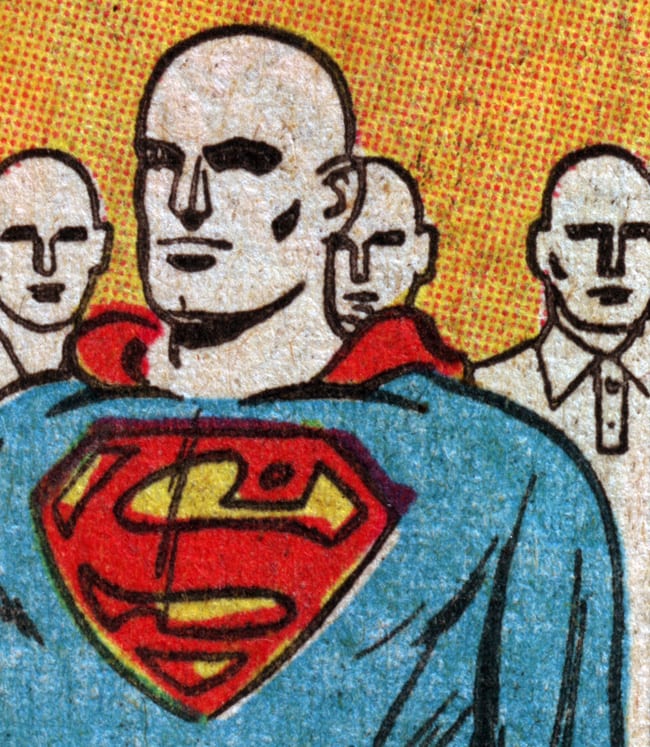
Superman’s Face

Superman’s problem is that no one can see him. Trapped in the premise of secret identity without a disguise, he becomes by necessity the invisible man, unrecognizable to his closest friends, all of whom he has held close on countless occasions as both Superman and Clark. He is the world’s most generic man, unidentifiable as himself.

It’s no wonder he’s fought so hard, for so long, to foil plots aimed at discovering him. He’s waiting for Lois or Lana or Jimmy or Lex to look into his eyes one day and say, “Jesus, Superman, you’re Clark,” or vice versa.
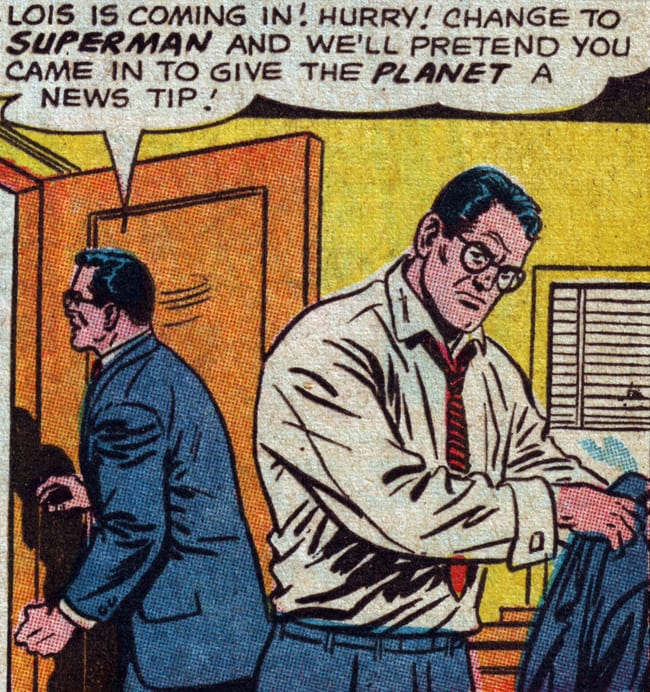
The Superman comic book is the visual paradox of Magritte’s “ceci n’est pas une pipe” turned into an identity crisis that never ends. Throughout the Fifties and Sixties, the problem metastasizes into narrative fixation, with countless panels containing both Clark and Superman, or two Supermen, or two Clarks, or a dozen identical Superman robots.

Like a Warhol series out of control, Superman’s face is a single photograph iterated into infinity, until it is no longer individual or even iconic, but instead a cipher that is wholly without visual interest. Lois Lane can’t really see that face, and neither do we, except perhaps when it is defaced.
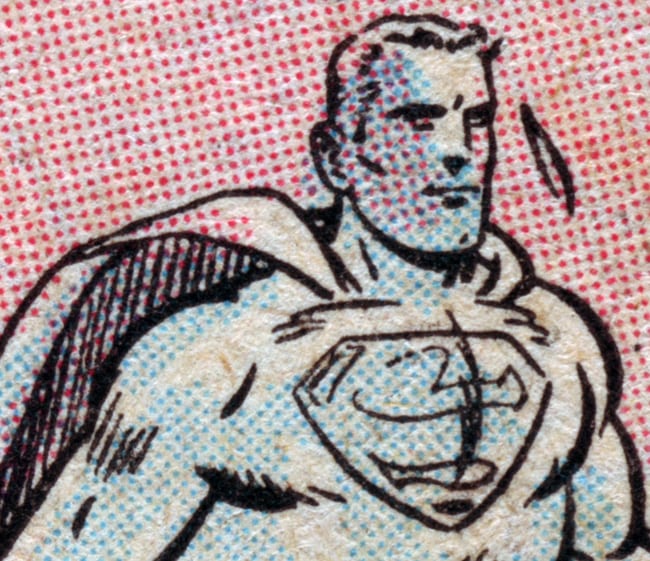
Superman was a perfect superhero for exactly as long as he was the only superhero. He created the category - it's named after him - and in doing so, he rendered himself generic, redundant: He's the super superhero man. He went from being unique, to being the Platonic form, to being the boring one. Batman is a super man, but with more bat. The purity of Superman's conception meant that every subsequent superhero was Superman with an interesting twist, or at least some additional visual interest.

And then there are the things that could only be learned after 100 stories and the birth of 100 more superheroes. Masks are really cool, and very handy in a secret identity scenario that is going to continue for 70 years, especially if it’s going to revolve around a love triangle in which the superhero plays two of the three roles.

It’s an Archie scenario in a superhero comic, a whole world that springs from and depends almost completely on a single, absurd suspension of disbelief. Archie can’t decide. Clark and Superman are different people. Archie’s version burns with the power of a million yellow suns; I can buy his comics in my grocery store checkout line. Superman, however, lost his struggle against the narrative kryptonite inherent in his original conception.

Having your superhero's head look less interesting than that of his boring civilian alter-ego probably isn't the best idea. Creatively and conceptually, undressing to become a superhero is brilliant. It’s sexy, for one thing, but putting on a different face has proved to be the most convincing way to “change an identity” – in both the reader’s and the character’s minds. Imagine Batman without a mask, or The Hulk with Bruce Banner’s face. Batbruce (The Dark Playboy) is a joke, whereas Superclark is an apt summary of the problem around which Superman revolves. You can see it written all over his face.

And this is why Superman actually remains unique. He is the unfinished and irresolvable superhero. There have been debates about which of his aspects is the ego, and which is the alter ego, but really it’s a chicken and egg scenario; neither had priority. He arrived as an infant, tabula rasa, and the very first time his adoptive parents concealed his super-baby traits, he was split in two by a super-secret concerning his identity. He was always both Superman and Clark, or he is forever neither of them, two possibilities that are equally chilling.

As an adult reading those mid-century comic books, I am torn between campy amusement and a horrified sympathy for the poor guy. When I encounter all those stories that turn out to be “what ifs,” dreams, imaginary weddings, and events that might actually have happened in an alternate reality, I should see generations of comic book writers struggling to overcome the inherent narrative kryptonite. Instead, I like to imagine that these stories are Superclarkmankent’s desperate, blissful, and surely inevitable fantasies of a self who can finally come to rest.


A Pack of Them!

Michael DeForge is back again this morning (or the Michael DeForge from March is, anyway), this time with a look at a Toronto-based psychoanalytic group, the kind they don't make 'em like anymore.

Also, the indefatigable Rob Clough reviews the latest volume of Joann Sfar and Louis Trondheim's Dungeon Monstres.

Elsewhere:

*When I saw who was involved with the Paying for It critical roundtable over at the Savage Critics (part one, part two), I got pretty excited. Up to this point, it's been a lot more dismissive of Brown's work than most reviews have been, and the participants are perhaps just a bit too in sync in their views (at least so far) for this to be quite as much fun as roundtables sometimes can be.

Based solely on the subject matter, I expected there to be a lot more angry denunciations of this book than have appeared so far. Responses have been unusually measured in general. I also expected at least a few reviews to be entirely positive, extolling Brown's politics as obviously correct, and so far I haven't read any at all. They've got to be somewhere right? On a libertarian blog somewhere, or a prostitution website?

*Seth's father, who wrote the memoir Bannock, Beans, and Black Tea, has passed away, and the cartoonist wrote a tribute to him on the D&Q site.

*You should really look at these excerpts from Roy Crane's scrapbook, which also includes working notes and layouts for a strip he was developing in 1977.

*The great Arnold Roth has started a blog.

*Kim Thompson and translator Jenna Allen talk Gil Jordan, Private Detective. I am very interested in reading this book.

*Via Tom Spurgeon, a pretty great message-board appearance from Walt Simonson, who shows up to respond to a poster's complaints about his Thor run.

*Matt Thorn does some tour-guide work regarding Takako Shimura’s new web comic.

*For lettering and design obsessives: D. B. Dowd talks wordmarks.