Gifts for the General

Today on the site:

Frank comes back with his Riso journey, this time talking to Ryan Sands, publisher at Youth in Decline.

I really think it is interesting that riso and the “art book fairs” of Printed Matter have run concurrent – meaning we are seeing more “zine” people at comics shows and vice versa – can you speak to this loose crossover? I feel like your label sort of runs in that corridor…

Whenever there’s a tool that has lots of funky ways you can mess with it AND a fairly low cost to experiment and make mistakes, this sort of machine is good for folks that care about all the details of physical book production. I get super bored by books that are simply “risograph-themed” anthologies, but I love seeing “art book” folks use it in unexpected ways – like the thermography technique of Colour Code Printing to create elevated inks and push the envelope with the machine. That said – at its heart, the machine was intended to be a blue collar workhorse for schools and churches and offices to churn out hundreds of pages a minute for cheap, so I bristle a bit at the trend of high-end “risograph prints” in limited editions. I saw a gallery show in SF recently that had a 3-color risograph print for $40!!! Are you kidding me? That shit cost like $0.90 to print and you could make 1000 prints in an afternoon (including drying times!).

On a less cranky note, some of my favorite risograph books are actually not comics at all, but text-heavy magazines and journals. When I visited Motto in Berlin back in 2011, I saw a bunch of poetry zines and literary journals published on risograph – my favorite in this vein is the queer film journal Little Joe Magazine. Their embrace of a limited spot color palette feels vintage without being slavishly retro or lame. So nice.

Elsewhere:

-Tomorrow night the great Brian Chippendale is opening a show of his new paintings at one of my favorite galleries, Safe Gallery in Williamsburg. Go check it out. 

-TCJ-contributor Philip Nel discusses children's books that address the ideas and realities of refugees. 

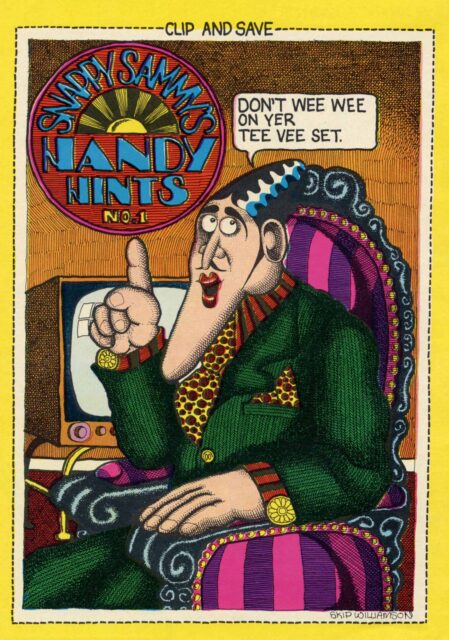
-The NY Times has a lengthy obituary of Skip Williamson.

-Tributes to the illustrator Jack Unruh.

-I always enjoy an interview with Daniel Clowes, and here he is talking Wilson.

Maybe next Spring?

Today on the site:

Frank Young interviews the Tumblr phenom Samplerman.

Do you consider yourself a cartoonist? What led you to creating your “Samplerman” persona?

I am a 46-year-old cartoonist. I’ve been writing and drawing comics for more than 25 years, without any popular success, I have to admit—perhaps because of a lack of self-confidence, not harassing publishers enough, taking no answer for a “no thanks,” and no longer posting my pages (lots of improvised and unfinished stories) on my obscure blogs.

I have always chosen the DIY way to make my fanzines and minicomics: it is affordable and it mostly requires commitment and time. Due to lack of feedback, I’ve felt discouraged from time to time. Sometimes I can’t believe that I’ve kept doing this for so long instead of finding a real job…

I’ve been obsessed with comics all my life. I would have liked to be a comic strip cartoonist, but that career doesn’t exist in France. The conventional formats here are the hardcover, annual 44-page book or the black and white, 300-page one-shot graphic novel. I’ve always been attracted to arts of all kinds: poetry, radio, cinema, animation, the avant-garde, experimentation and the borders of communication. I’m also drawn to abstraction, distortion, destruction, surrealism, sociology and politics. Most of my past comics are kind of absurd and meaningless (nonsensical, to say it nicely). At the end of the day, whatever I am doing, the path from a panel to another has become for me the ordinary way to explore this alternate reality (comics) where I feel at home. So yes, I think am a cartoonist; a weird cartoonist.

Hence the question could be: “Are the Samplerman pieces strictly comics?” I would answer: “Depends on how restrictive your definition of comics is.” If the reader considers certain of my “stories” just as a sequence of panels without any logical connection, I am fine with that, but my works are at least a failed attempt at doing a story from a cartoonist’s neurasthenic brain.

 Elsewhere:

Our friends Sean T. Collins and Julia Gfrörer talk about their upcoming anthology, Mirror Mirror II

And Michel Dooley remembers Jay Lynch and Skip Williamson with an image-heavy post.

Taking All the Lox

Today on the site we have Gary Groth's lengthy 1985 interview with Bernie Wrightson. It's a great read.

GROTH: Again, about the Frankenstein book, what I’m interested in finding out is what is the intent of the illustrations? Are you intent upon adding another dimension to the novel?

WRIGHTSON: Not really. I started this in 1976. All this time, and all this work, all this effort and aggravation and what not have gone into this simply to embellish this old book. Which, when I started out, I thought was a terrific book. Now, six years have gone by, and I don’t think it’s such a terrific book, anymore. Okay, we’ve got some good drawings to go in there, some of them are spectacular. And for anybody who does like the book, this is going to be a real good edition of it. My personal feelings have nothing to do with that at all. You should just buy the book because you want it, and enjoy it, and don’t worry about how I feel. When I did the drawings, I was really involved with the book and my intentions were really good when I did them. They had to be or my drawings wouldn’t be that good. I really believe that an artist can’t communicate to a viewer unless he really pours himself into it and tries to do that. And I tried to do it with that, and they work. So, I’m not apologizing for that, I’m not apologizing for anything, I’m just saying that I’m glad I’m still not doing it, because my attitude has changed completely.

GROTH: It sounds like you think a little less of the book now than when you first started.

WRIGHTSON: Yeah, I guess I do.

GROTH: Who are some of your favorite authors?

WRIGHTSON: Stephen King.

GROTH: Poe, I guess? Or isn’t he one of your favorites?

WRIGHTSON: He was real good to start out with, but I don’t think I’d ever read him again. Wells, H.G. Wells, in limited doses.

GROTH: Lovecraft?

WRIGHTSON: Nah. He was always a little too ponderous. I have a hard time with the language. There are a few things that he’s done that I’ve really enjoyed, but for the most part I can’t take him.

GROTH: What do you like about King?

WRIGHTSON: What do I like about King? Damn near everything. The guy has an uncanny knack for creating characters who are people that you know, just really solid people. A storyteller par excellence. Absolutely riveting from the first page. A terrific command of the language and colloquialism and slang and bullshit and whatever. And on top of that, he can scare the fucking pants off me.

GROTH: That’s what friends tell me.

WRIGHTSON: Have you ever read him?

GROTH: No, I never have. And friends have told me that they’ve actually gotten frightened reading his books. And I can’t imagine that.

WRIGHTSON: If you’ve never experienced that, I envy you. Because I wish I could re-experience that feeling for the first time.

GROTH: I keep intending to read The Shining, but I’ve not gotten around to it.

WRIGHTSON: I think you ought to start out with Salem’s Lot.

WHITE: How about Firestarter?

WRIGHTSON: Firestarter and Salem’s Lot, I think, are the two best stories he’s written.


Elsewhere:

Robert Silvers, the truly legendary editor of the New York Review of Books, passed away on Monday. The New Yorker has a series of tributes.

Peter Bagge talks about his new graphic biography of Zora Neale Hurston over at CBR.

Comics culture: The Paris Review looks at bodybuilding and the old sand-kicking ads.


More is More

First up -- good news! I'm so happy to report that Tim Hodler and Lauren Weinstein welcomed a baby girl into the world yesterday. 

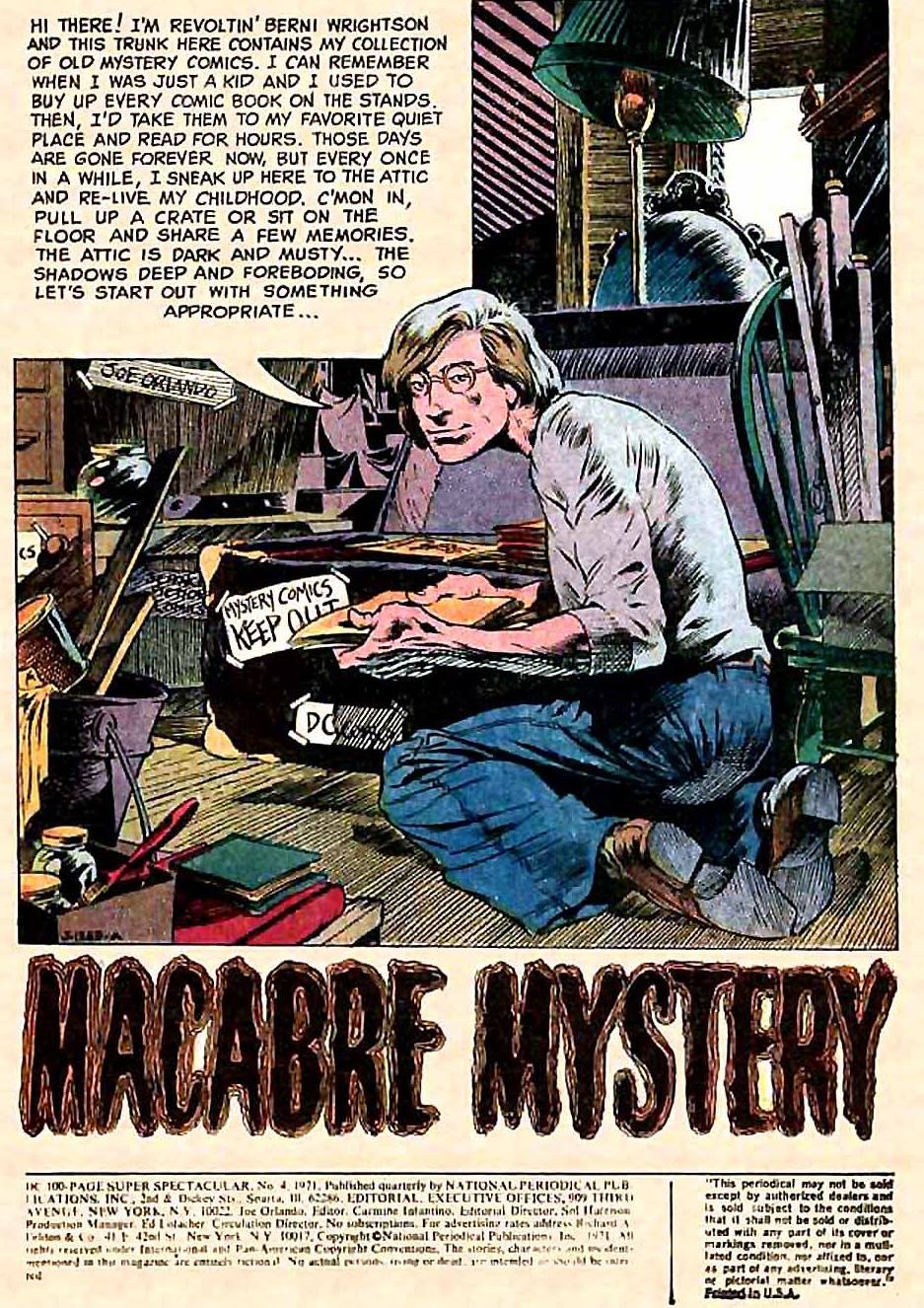
Today on the site we have an obituary for Bernie Wrightson by Steve Ringgenberg.

Born in 1948, to a working class Baltimore family, Wrightson didn’t recall receiving a great deal of encouragement for his early artistic endeavors from his parents, but as he observed in a 2015 interview in Comic Book Creator, “I’ve been drawing as long as I can remember.” Comic books and comic strips were early influences, with Wrightson citing Hal Foster’s Prince Valiant, Flash Gordon, drawn by Mac Raboy and Buz Sawyer by Roy Crane as his favorite comic strips. Wrightson was only five or six when he began reading EC Comics, the most visceral of which, as drawn by Graham Ingels or Frank Frazetta, had a profound influence on his aesthetic. Another big influence on Wrightson was horror films: He was fortunate to be in the “Monster Kids” generation, when Famous Monsters of Filmland began publishing, and Universal released its “Shock Theater” package of old horror films for syndication, spawning a host of local late night horror movie hosts like Baltimore’s own Dr. Lucifer, played by faded movie idol Richard Dix.

Popular interest in dinosaurs had a resurgence in the late 1950s, providing another piece of Wrightson’s influences. While he remembered loving Ray Harryhausen’s stop-motion Beast From 20,000 Fathoms, other, more cheaply done dinosaur films failed to impress him. As he recalled in the same Comic Book Creator interview, “I saw that Lost World remake with Claude Rains (1960), and that was a huge disappointment…you couldn’t fool me with plastic horns on a big lizard…” Another great early influence was the Ace Books editions of Edgar Rice Burroughs featuring covers and frontispiece illustrations by Frazetta, which Wrightson credits with getting him to start reading novels cover to cover.

And the great Joe McCulloch brings us his weekly dose, but with comics listing to follow later today.

Elsewhere:

A look at a mostly under-known aspect of Betty Boop.

Ben Schwartz on Michael Tisserand's George Herriman biography.

Bringing Wilson from page to screen over at The New Yorker.

Gone Masters

Today on the site, we have a 1984 interview with the late Skip Williamson.

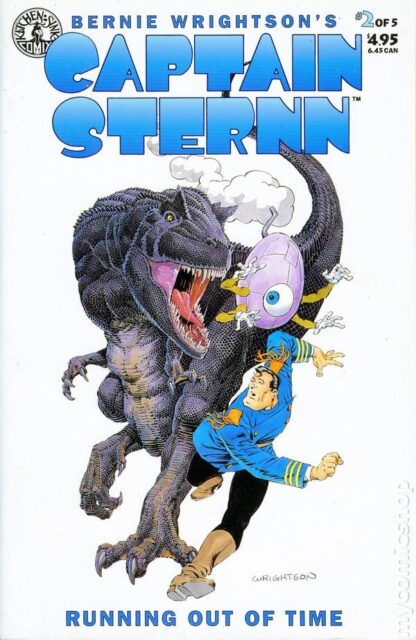
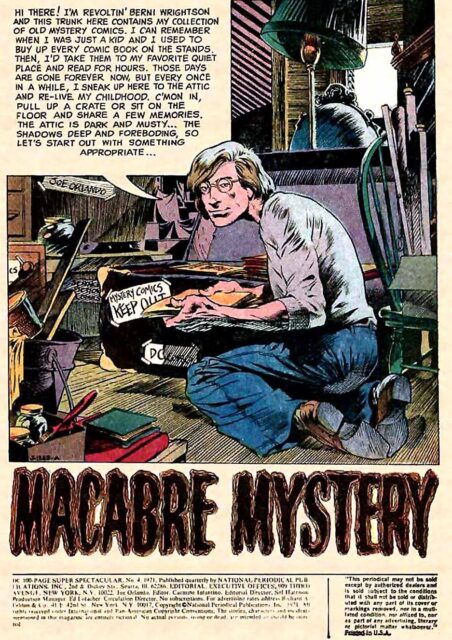
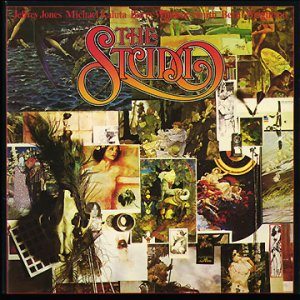
And it's another sad day for comics, as Bernie Wrightson, a beloved artist of numerous comics and books, has passed away after suffering from brain cancer.A fine summary of his life is on his own web site. Wrightson specialized in post-EC horror, emerging in the early 1970s to co-create Swamp Thing, draw covers and stories for DC, short stories for Warren, and co-found "The Studio", a space on Manhattan's Upper West Side where he, Barry Windsor Smith, Michael Kaluta and Jeffrey Jones worked, and about which an influential book was published. Wrightson is perhaps most acclaimed for his illustrations for Frankenstein, which were rendered in an elaborate pen and ink manner reminiscent of one of his heroes, Franklin Booth. He also collaborated with Stephen King, illustrating books including The Stand. Wrightson created his own character, Captain Sternn, who was featured in the print Heavy Metal and the anthology's film version. The artist went on to draw Batman, the Punisher, and in recent years returned to Frankenstein. There's more, of course, and we will have a full obituary soon, as well as an archival interview. I will say that, personally, Bernie Wrightson was the first artist I ever really studied. Starting when I was about 10 or 11 I ordered his posters out of the Bud Plant catalog and read and re-read his 1991 monograph, A Look Back, so many times that it fell apart. It was through Wrightson, and his old friend Joel Pollack (the founder of Big Planet Comics) that I learned about 19th and 20th century adventure illustration, to which I've returned in the last couple of years. Wrightson was the comic book heir to the EC horror line, and I suspect that if his influence on comics waned in the last couple of decades, it flourished in film via directors like Guillermo del Toro, who, like me, grew up on the stuff. I moved on from Wrightson somewhere just south of 18, but I have a a huge amount of appreciation for the work, in all its dedication and drama. He was at his best in Frankenstein, which I can still recommend, and whenever he moved into a his brushy horror mode, often in images for posters and portfolios. 

Wrightson, Jones, Kaluta, Smith.


Smoot

We are sad to report that another underground comic book great, Skip Williamson, has passed away. Patrick Rosenkranz has written his obituary.

Here's the trailer for the documentary on the artist:

and here is a 2012 interview with Williamson. 

We will have an archival TCJ interview shortly.

Daunting

Rachel Davies has interviewed R. Sikoryak, primarily about his strangest and most ambitious literary adaptation yet, a comics version of the iTunes users' agreement.

Because I try to adapt heavy, important works of literature, usually, like Crime and Punishment or Wuthering Heights, it sometimes gets daunting to struggle with a work that people are very familiar with, and that has characters that people really love. What was great about the Terms and Conditions for me was that there’s no narrative, and no one has an emotional attachment to it, at least not in the same way. I certainly don’t! It freed me up, it liberated me from having to worry about being faithful to it because there’s not a narrative to be faithful to. And it doesn’t lend itself to illustration in an overt way. I wasn’t interested in choosing a text that would be cinematic [laughs], I was interested in a text that didn’t have those concerns that I usually have when I’m doing a text. By choosing a text that had no narrative, it meant I could use the narratives of the comics that I was parodying to provide drama, or suspense, or humor. It was, in a way, a relief. I don’t know how I could do this again! [laughs] But for this project it was kind of a break from the way that I normally make comics.


Meanwhile, elsewhere:

—Interviews & Profiles. The Guardian interviewed Sikoryak too.

Sikoryak has been praised by some for making T&Cs more accessible, which he finds baffling. He just enjoys the challenge of making something dismissed as unreadable readable. In his eyes, convincing someone to read terms and conditions is just like getting someone to read “worthy” classics they feel guilty about skipping, from Camus to Beckett and beyond. “I like using texts that are perceived as important,” he says, “and that includes iTunes T&Cs. All my work is an attempt to bridge the gap between what we call high art and low art, what we think is important or serious, and what we see as frivolous and meaningless. Often, that boundary doesn’t exist.”

Raymond Briggs shares his writing day for the same paper.

Ho ho, those were the days! When one had a “writing day”. Before the advent of No 1: old age, and No 2: partner, wife, whoever, getting long-term incurable illnesses. These slightly disturb the cosy pattern of the working week. A whole day to yourself! When was that last experienced?

In 1958, I got my first 30 bob a week bedsit and was earning a living as a self-employed illustrator. This was what got me into writing. I was often amazed at how bad some of the stories I was given to illustrate were. Golly, I thought, I could do better myself! So I tried to write one and sent it to the editor for some advice. To my utter amazement, he said he would publish it. Just shows what the standard was. Me, a kid of 24.

And the most recent guest on Process Party was Eleanor Davis.

—Reviews & Commentary. It was Will Eisner's centenary last week, and many tributes were written (some we linked to already), including a piece by R.C. Baker in the Village Voice:

Packaged in a Sunday newspaper supplement, the self-contained seven-to-eight-page Spirit stories proved a hit with readers, and by 1941 the young artist/writer/entrepreneur had a busy studio employing a staff of ten. As with Rubens before him and Warhol later, Eisner's name was signed to artwork he never touched; many soon-to-be giants of the medium, including Batman creator Bob Kane and future Village Voice cartoonist Jules Feiffer, did apprenticeships in the Eisner studio. In a mark of his business savvy, Eisner insisted on owning the rights to his characters, and he even had the prescience, as war with Japan threatened, to buy a wholesale quantity of finely crafted Japanese ink brushes — which he preferred over domestic brands — fearing that imports might soon come to an end. Decades later he would joke that he was still using brushes from that stockpile.

And by Michael Dooley for Print:

Eisner’s graphic style was often balletic in its grace. One Contract tale opens with a full-page aerial perspective of Dropsie Avenue with its stoops, fire escapes, clotheslines strung from building to building, its elevated subway line in the distance, and many other minutely indicated details rendered with deft, casual brushstrokes. Then it’s followed spread of panels that indicates a swooping down onto tenants chatting from their windows, then a zoom through to settle in on a domestic scene. With spare use of captions and cartoon balloon dialogue, a bounty of exposition is compacted into three small pages with breathtaking fluidity.

Osvaldo Oyola echoes Barthes with an essay about the pleasures of reading serial comics.

At the time that I began regularly reading Marvel superhero serial comics, it was pretty much assumed that any series that began was meant to go on for as long as it sold well enough, regardless of changes to creative team, or even sometimes the very title of the book. When the martial arts craze that inspired the Iron Fist series started to die down, for example, it was combined with the also struggling Luke Cage, Power Man (which had already renamed from Luke Cage, Hero For Hire) to make Power Man & Iron Fist starting with issue #50. It would go on with the two characters teamed up for another 76 issues, cementing an iconic friendship that was essentially mandated by the market, but would become a defining aspect of both characters. I tried to be a regular reader of the series soon after I encountered the pair guest-starring in an issue of ROM Spaceknight, looking for the first part of the two-part story that crossed over between them—how novel such a thing seemed then!—I found other issues that drew my attention. I was taken by its premise and sense of exploring a seedier part of the Marvel Universe. Still, I was unable to read as many of the issues I would have liked, nor could I count on getting every issue each month (actually, it was bi-monthly which made finding it even harder before the days of the pull-list and the advent of the direct market). In reading the first volume of Power Man & Iron Fist (which lasted from 1978 to 1986), I was always engaging with fragments of a larger unknown (and some ways, unknowable) whole.

Ray Davis connects Cerebus to the alt-right.

Not so much Cerebus-the-character, who Jeet Heer picked as Trumpalike a year ago. More Cerebus-the-comic-book: a Shoah-slow train ride from geeky lulz to lunatic-fringe antifeminism through a series of cosmological mother-in-law jokes. Beginning with MAD parodies of teenage-boy-aimed comics, Sim took his hard-earned technique into realms in which it's a less, let's say, established bearer of light: the Flaming Carrot and Druckerized Lou Jacobi dropped wisdom on the moon; Druckerized Maggie Thatcher led execution-torture for the matriarchal dystopia; Druckerized Oscar Wilde and Ernest Hemingway rotated with Druckerized Marty Feldman and Mick Jagger and Batman/Wolverine/Punisher.

Jared Gardner wants people to start archiving webcomics.

It is always worth thinking about the history of earlier storage media when making predictions about the future. Film is as good an example as one could hope to find: a vastly popular medium with international reach and lots of industrial and institutional support. At only 120 years from its origins, one might imagine that the history of cinema is fully at our disposal. Sadly, this is not the case. Today, only about 20-25% of all silent films produced in the United States between the origins of cinema and the end of the silent era in 1927 still exist. In some part of the world, that proportion is considerably lower; for example, in Japan over 90% of all film made before 1945 is believed lost forever.

—Misc. Dangerous Minds has turned up an old Charles Mingus anti-bootlegging comic strip.

As one can see from the signature at the bottom left, the strip was executed by Gene Bilbrew, an African-American cartoonist whom some credit with creating the first black superhero, the Bronze Bomber. Bilbrew had once been an assistant to comics legend Will Eisner. Later on Bilbrew worked as a fetish artist at Irving Klaw’s bondage-oriented Movie Star News/Nutrix company; Klaw also discovered Bettie Page.

Finally, Clickhole gets some a-mazing quotes from Stan Lee. (I know.)

I knew I wanted to publish comics, but I was too lazy to learn how to draw, so I had to find an artist that was dumb enough to agree to make my ideas instead of their own. Jack Kirby was the perfect patsy, a dull-eyed rube with incredible artistic talent and no common sense. I paid a visit to his house while eating a big chicken parm and offered him half if he agreed to be my art slave for the rest of his life. He immediately accepted the deal and scarfed down the half-sandwich. I never paid Jack anything after that chicken parm, and he never fully understood how raw that deal was for him, though he suspected. When Jack passed, I felt some guilt, so I gave half of a Sprite Zero I had been drinking to his widow. I know that’s what he would have wanted.

Timeless

Today on the site:

Katie Skelly reviews Eleanor Davis's Libby's Dad.

Davis returns to her toolkit once again to explore the landscapes between language and reality, threat and violence. However, Libby’s Dad’s grasp doesn’t quite take the same hold as any of the How to Be pieces. A short story about a group of prepubescent neighborhood girlfriends, Libby’s Dad finds its tension in one of the girls spreading a rumor that Libby’s newly divorced father had threatened to shoot Libby’s mother as the result of some unknown argument. Libby’s father has also treated the girls with the utmost hospitality, ordering them KFC, allowing them to eat sweets after dark, letting them use the pool in his new midlife crisis pad. Philosophical questions rise up for the girls: how could someone be dangerous and generous at once? How could they possibly be close to someone who could also destroy all of them? And the eternal question: is it ever possible to really know someone? All of Davis’s usual pieces are in play: a child’s lack of grasp of nuance; an environment capable of enveloping its characters with its visually and psychically overwhelming elements; an ambiguous distance between truth and fiction; a paranoid whisper-down-the-alley; and an intrusion of imagined violence and mental illness — all diffused within pages of them reaching their greatest pitch. Why?

Elsewhere: 

Joe McCulloch talks Tatsumi over here.

Not much comics news, but comics-adjacent painting: R.B. Kitaj has a great retrospective in New York at Malborough, and here's a fine piece of writing on it.

Person in Charge

Anyhow, today on the site we have two of our great cartoonists in conversation: Phoebe Gloeckner and Julia Gfrörer. The two spoke on the occasion of the release of Gfrörer's recent book, Laid Waste. Here's a teaser:

PG: You just said that you’re working on the drawings; you have it all written. Is that your typical process? Do you write the whole thing out? Do you script it? What do you do?

JG: I thumbnail and script it at the same time. And then pencil it and ink it, so it’s all penciled now, and I’m just inking.

You generally do it in different passes. It general, you have the whole thing worked out, and then you return to the beginning, and start inking, and so on?

Yeah. Usually I’ll kind of jump around. I won’t do it straight from beginning to end, but I’ll do whatever part I feel like doing. If I’m feeling not super into it, I’ll ink a page or draw a page that I feel like is going to be fun or easy — when there’s not a lot happening in it. In this Flesh and Bone sequel, yesterday, I was feeling unmotivated, and there’s a page where the witch is spinning with a drop spindle. And then the thread gets tangled, it does that thing where it twists in on itself and makes a tangle. That was really easy to draw, it was just several panels of thread spinning and then tangling up. It went really quick, and I was like, this is really motivational. It was like: BAM, I finished a page.

You got into the swing of things.

Another question I had is about collaboration. Amongst your collaborations — and I don’t know all of them — I’m thinking of the work you did with Sean, and they were adaptations of Poe stories. That was just something I would just expect you to do on your own. I would totally trust whatever you would come up with, your interpretation. I’m wondering: why the collaboration, and how did that change your work?

The porn adaptations of Poe, that was Sean’s idea. He sent me the script for the first one before we really had a relationship, he just knew my work.

[Laughs.] That’s very seductive.

I know. [Laughter.] I read it, and when I realized what was going to happen in it — at first I was like, “Who does this guy think he is?” To try to improve on Poe seems like a gutsy move. When I finished reading it, I was like, “This is amazing.” I was really into it. I did end up drawing it. Then, it just became a thing we do for fun. I don’t usually collaborate with people. I drew some stuff for Anne Elizabeth Moore for a magazine but she hired me to do it. With Sean, I really like his writing, I think he as a good sense of what is going to be good for me to draw: what I’m going to enjoy drawing, and what’s going to look good drawn by me. We’ve done a couple Poe/porn books. We did a comic called Hiders, which was just a 4 page one about these two young women who turn into werewolves together. But they don’t talk about it when they’re both human.

Elsewhere:


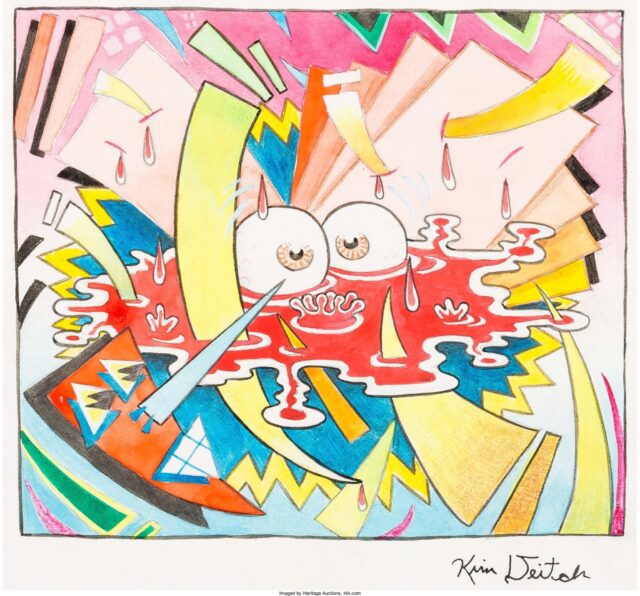
Hooo wee, look at that great Kim Deitch drawing from the 1970s in our little window.

Podcast updates: Tucker Stone (who hangs out with Tim much more than me, which makes me secretly sad but I'll get over it) talked Punisher over here. At Comic Books Are Burning in Hell, Joe McCulloch and Katie Skelly talk Insufficient Direction and then Joe and Chris Mautner discuss Pretending Is Lying.

Reminder: The Women in Illustration Tumblr is on quite a roll lately, especially with the always amazing Margaret Brundage.

Over at the New Yorker, Paul LaFarge details the true life of one of a character in his new novel about H.P. Lovecraft. Salient line: "Who keeps track of the lives of fans." One of my favorite things is to track certain strains of fandom... I love the fandom that seeded underground comics, the fandom that resulted in so much commerce in the 1970s and 80s and the fandom that birthed this magazine and Fantagraphics. And now the fandom that keeps a thousand zine and comics fairs in bloom. 

Home Plate

Today on the site, RJ Casey talks to the cartoonist Sophie Yanow about memoir, comics journalism, and translation, among many other things.

I am interested in architecture and economics and how those things affect livability. It seems to me that the obvious short term is that more and more people will be priced out of living in “major” cities. Seattle suffers from the same tech industry influx that San Francisco does, which for residents means so much energy spent on keeping your housing or just needing to move. The crazy capitalist endgame might be what we see in London, where entire neighborhoods are empty of people because the international super-rich have bought massive apartment buildings as places to park their capital rather than to house humans. While there are many great architects and urban planners out there, they can’t solve this stuff alone. Short term, people need to band together to strengthen things like rent control and renter protections. Long term... replace capitalism?

Also, Rob Kirby reviews the new book by Thi Bui, The Best We Could Do.

In her early twenties, Bui traveled back to Vietnam to meet her extended family. It was shortly afterward that she began to record the family’s history, hoping that “if I bridged the gap between past and present… I could fill the void between my parents and me.” Her narrative flashes back and forth in time, illustrating how larger events (war, dictatorship, immigration) shaped the family’s lives. She records her father's traumatic, uprooted childhood in the 1950s (she calls him “Bố,” or “daddy”) and how he endured periods of living as a refugee with his abusive, philandering father in a country wracked with sociopolitical turmoil and poverty. Meanwhile, Bui's mother (“Má”) grew up in privilege as a child of a civil engineer, shielded for many years from the dire conditions of much of the country. After marrying Bố, Má gives birth to multiple children, usually under extremely difficult conditions, including her daughter, Bích, right before the Tet Offensive in 1968; a stillborn child, Thảo, in Saigon in 1974; and her son Tâm in a UN refugee camp in Malaysia in 1978.

Meanwhile, elsewhere:

—Interviews & Profiles. The New York Times talks to outgoing New Yorker cartoon editor Bob Mankoff about some of his own favorite cartoons. I haven't seen much extensive commentary on this upcoming change yet, but Mankoff was a somewhat polarizing figure in some cartooning circles, for various reasons including the setup of the Cartoon Bank, the magazine's cartoon caption contest, and the fairly laborious submission process he oversaw.

While Mr. Mankoff, 72, may be leaving the magazine, he’s hardly retiring. He will be teaching a course about humor and communication at Fordham University. He’ll continue to consult on the Cartoon Bank, a licensing platform he founded in 1992. He’ll also be working on Botnik Studios, a company he’s creating with the comedy writer Jamie Brew that explores using artificial intelligence to augment creativity. (Mr. Mankoff, a former graduate student in experimental psychology, has already collaborated with a Microsoft researcher on an algorithm that can sort through the flood of entries to the magazine’s weekly cartoon caption contest.)

Newsarama talks to Ben Passmore.

I was reading some Frantz Fanon with a homie of mine, another black guy existing in the New Orleans punk scene, and comparing our experiences navigating various exchanges with our white friends and acquaintances. We were reading Black Skin, White Masks, which is largely about the psychological effects of colonization on black people. It wasn't the first time we'd had that type of conversation, it's the kind of thing black people that interact with some amount of white people on a regular basis have within five minutes of meeting each other. The only difference was that the context of the conversation was our sense of dysphoria, or how our social relationships with white people effected how we saw ourselves. Something about this particular conversation with my friend made me realize the extent we, black punks, live if a different world than our white friends.

The Beat talks to Maggie Umber.

I’m a cartoonist and the associate publisher at 2dcloud. This past year I had a 24 page comic in the anthology The Shirley Jackson Project edited by Rob Clough and published by Ninth Art Press. My first graphic novel, Time Capsule, was published by 2dcloud in 2015. My upcoming graphic novel, Sound of Snow Falling, is being kickstarted as a part of 2dcloud’s Spring 2017 collection.

—Misc. The New York Times gets R. Sikoryak to explain some of the thinking behind his pastiche-target choices in his comics adaptation of the iTunes users agreement.

Joe Cool, the Snoopy persona, is not that far from Steve Jobs. I had to use “Peanuts,” that’s why it’s in the first 10 pages or so, because that was one of the first things I knew I wanted to do. I’ve always been interested in pulling people into comics who might not even be that into comics, but are aware of them: “Oh yeah, I saw that Christmas special with the dog, right?” People might recognize the characters or the general notion of a strip and that sort of pulls them in.

Linda Medley, the creator of Castle Waiting, is in need of financial assistance.

Several years ago I was diagnosed with severe cervical spondylosis as well as carpal tunnel syndrome, and took some time off from creating artwork to rest, and adapt to new modes of working. Although my convalescence took longer than anticipated, I'm currently hard at work on Castle Waiting Volume 3 and hope to have the first 150-page installment ready for publication next year...but I'll need your financial help to be able to continue working on it.

Ticket Here

Today on the site, we bring you an interview with the late Jay Lynch by Gary Groth, conducted in the last few months of Lynch's life. It allows a glimpse into a life led in multiple areas of cultures and small publishing, and the kind of knowledge that only a certain kind of cartoonist of a certain generation has access to.

GG: Well, one thing you have said was that when you worked for The Seed, and by the way, was that an anarchist periodical?

JL: It started as such, but it kind of evolved into one of those permission-seeking “legalize marijuana” kind of papers. And that never interested me, that attitude.

GG: Why would that not interest you? I mean, would you not want to see marijuana legalized?

JL: I would. But the way to do it isn’t to beg for it. The way to do it is to just, everybody smoke marijuana and if that happens all of a sudden it will be legal.

GG: So you’re opposed to the strategy.

JL: Yeah. Well, it started as a … There were surrealist papers in Chicago, and it started off as a spinoff of those. But then it evolved into a political thing.

GG: Now I think you mentioned that you ran afoul of their political doctrine, where they rejected work by you because it was not politically pure. Did you experience a lot of that? You said at one point that hippies don’t have a sense of humor.

JL: With The Seed, yeah. Once I ran a cover with a man thinking of a woman wearing a brassiere, a pointy brassiere. And that was sexist to them. But it ran in the Madison-Milwaukee Bugle-Americanas the cover, they printed in. But The Seed lost all of my art and all of Crumb’s art, and when they printed it they’d print it in purple ink, so you couldn’t really reproduce from what they’d printed. It was kind of … If a free press and the free exchange of ideas is the goal, it wasn’t that. It was: “This is sexist. This is not good for the revolution.”

GG: Have you become more sympathetic to that point of view, sexism and racism as unpalatable sources of humor? How do you feel about that?

JL: Well I think what he did wasn’t really racist, but it was a mockery of racism. And I think it’s good what we did, because there was a reverse discrimination type thing going on. When I worked for Renewal [magazine], we ran a — Jerry Farber was the guy’s name — article called “Student as Nigger,” which compared college students protesting against the war to Negroes working within the system during protests in the ’50s. So for the illustration to that I drew a guy that was split in half, and one half was a student wearing a tweed jacket with patches and carrying schoolbooks and having a beard — all the clichés of what was a student then. The other half was a plantation Negro holding a watermelon, and that was the analogy that was in the article. But even the editor of Renewal at the time made me change the whole watermelon-carrying half to a Negro with a black suit on, like Sidney Poitier. So there was a taboo, but it meant that all black people had to be Sidney Poitier. Like there was a big outcry against Amos ’n’ Andy, but really Amos ’n’ Andy is just The Honeymooners but they’re black. It’s not like the janitor Lightnin’ represents all characters in the thing, any more than Ed Norton represents all white men. So as a reaction to the overly sensitive depiction of blacks in the liberal media, I think that’s what I did and that’s what Angelfood McSpade kind of was.

Elsewhere:

Here's more Jay Lynch.

Historian (and author of Lynch's TCJ obituary) Patrick Rosenkranz:

A lengthy clip related to his fanzine collaborator, Don Doehler:

Wham

As is usual on Tuesdays, Joe McCulloch is here with his usual indispensable guide to the Week in Comics, listing and commenting upon the best-sounding comics new to stores. This week's spotlight picks include new books by MariNaomi and Kazuto Tatsuta.

Meanwhile, elsewhere:

—Reviews & Commentary. Eleanor Davis writes about her recent experience with citizen lobbying.

Previously, citizen lobbying had felt impossible to me; but after making a hundred phone calls and speaking up at rallies and commission meetings, it didn’t seem like such a big deal. I realized that just because people who disagree with me might tell me I am wrong or confused, it doesn’t actually mean I am wrong or confused. I realized I don’t think it’s wrong to irritate people or waste their time when they are actively trying to dismantle or deport everything I love about my country. I realized that whenever I wasn’t busy fighting for what I believed in, I was busy feeling very, very bad.

Hazel Cills writes about the Raymond Pettibon exhibit up in NYC.

While many still see Pettibon as the unofficial creative director of hardcore, the irony is that even as he was creating this aesthetic back in the '70s, he was often simultaneously critiquing it. "I mean, what the fuck is a battle to punk rockers? Against long hair?" he later recalled in an interview with BOMB Magazine in 1999. "Jesus. It’s a really decadent mockery, when you think of it." A plaque at the New Museum exhibition inside a display case of Black Flag flyers assures visitors that "most of his actual illustrations of punks were less than flattering," and notes for the record that Pettibon's visuals were usually not made by collaborating with the musicians. At the time, hardcore punk was a hypermasculine scene; loud, angry at seemingly everything, and ready to pummel each other in the pit, its true believers were a direct counter to the long-haired, peace-and-love hippie culture of the previous decade. Yet Pettibon's cover art for Black Flag's 1981 Six Pack EP depicts a man cowering in the corner, blood all over the floor, as if to mysteriously warn fans about the dangers of attending one of their shows.

At Savage Critics, Abhay Khosla has a huge multi-part review of Marvel's Civil War II.

At this point, the question of whether or not Bendis has written a “good comic” is especially meaningless. They made a Netflix show of one of his comics that won a fucking Peabody, and he got to go to the Peabody’s (!). This life’s a game, and that dude’s played the game well, man. (And I think he’s deserved his success– he worked very hard for it, anyways.)

So now that he’s had this whole career, whether one comic is good or not doesn’t seem all that Life-or-Death. But what strikes me as interesting is you can now see this entire career of him exploring and reexploring particular themes and go “oh how does this fit into that“…

More specifically, Bendis’s career-long obsession is characters negotiating situations where the Old Systems don’t work anymore– characters either choosing to redefine themselves because of their exhaustion with the old status quo, or having new status quos thrust upon them.

Neil Gaiman writes about Will Eisner.

I bought my first copy of The Spirit in 1975, in a basement comics shop in south London. I saw it hanging on a wall and knew that, whatever it was, I wanted it. I would have been about 14. Reading it on the train home, I had no idea that the stories I was reading were 30 years old. They were fresher and smarter than anything I’d seen in comics – stories that somehow managed to leave out everything that wasn’t the story, while telling wonderful tales of beautiful women and unfortunate men, of human fallibility and of occasional redemption, stories through which the Spirit would wander, bemused and often beaten up, a McGuffin in a mask and hat. I loved The Spirit then. I loved the choices that Will made, the confidence, the way the art and the story meshed. I read those stories and I wanted to write comics, too.

—News. Vanessa Davis has won The Paris Review's Terry Southern Prize.

This year’s Southern Prize will be presented by the filmmaker Todd Solondz to Vanessa Davis for her series “Summer Hours,” a comic in eight parts that began last June on the Daily.

—Interviews. Betsy Gomez talks to Ariel Schrag about the recent school challenge to her Stuck in the Middle anthology.

I’ve read a lot of middle-grade and young adult prose fiction, and I know that Stuck in the Middle is fairly tame compared to much of what is currently available in school libraries. Many books written for middle school-aged kids tackle similar subjects and use realistic language and scenarios. Stuck in the Middle is targeted because, being a graphic novel, it’s visual and the content is more immediately recognized. For instance, if a parent has a problem with their child reading about someone being bullied, they would have to spend more time reading through the prose of a novel to find the objectionable section, whereas opening up a comic to a drawing of a kid calling another kid a name can be recognized instantly. Comics also have a history of being considered “low brow” or “corrupting,” so despite the high caliber of the artists and work in Stuck in the Middle, people sometimes bring this prejudice to the book.

The most recent guest on Process Party is Joe Decie.

—Misc. 2dcloud has launched a Kickstarter to crowdfund their spring 2017 lineup, which includes new work by Maggie Umber and Sarah Ferrick and the Sean T. Collins/Julia Gfrörer-edited issue of Mirror Mirror.

We've been using Kickstarter as a mechanism for pre-orders and curated book bundles since 2010. This is our 9th Kickstarter, and it's how we keep the lights on. We're selling these book at less than retail cost and giving you a closer connection with us as a label and with our authors. Which we think is cool. Help us bring these works into the world

Chester Brown and Dave Sim have been arguing about prostitution and misogyny and petitions again.

According to Dave [Sim, he never considered me his friend, and] this was his reason for hanging out with me regularly:

"I [thought] it was worth maintaining communication for the sake of Canadian Cartooning Posterity."

He wasn’t my friend, he was fraternizing with me for the sake of Canadian Cartooning Posterity? Perhaps that’s so, but I do remember Dave saying that he was my friend. Perhaps he was using the word ironically. At the time I assumed he was sincere because he certainly acted like a friend. I was sincere in being Dave's friend. I genuinely like the guy.

Kevin Huizenga higlights a disturbingly plausible passage about how comics conquered the world from Jarrett Kobek's I Hate the Internet.

—Not Comics. At Hyperallergic, Rob Colvin writes about "Like Art," and how art has been influenced by social media. It would be interesting to consider whether comics has been similarly affected.

It is art that looks very much like art you’ve already seen, that you know very well, and that you already like. [...] It’s “the look for less,” with no greater aesthetic aspirations. It lives for heart taps, thumbs-up clicks, and space on people’s walls — digital or brick-and-mortar.

Um Tut Sut

The pioneering cartoonist, historian, and satirist Jay Lynch has passed away. Aside from being an incredibly funny, dextrous cartoonist, he was, as a teenager, an important part of mimeograph fandom, as an adult, the crucial part of the underground press, and later still, a longtime contributor to Topps bubblegum cards. His was truly a career and life in art that will never exist again. 

Our coverage of Jay Lynch's life and times is in three parts:

-Patrick Rosenkranz has written an obituary.

-Gary Groth conducted the artist's final interview (this will run in the next couple of days).

-And we've republished his long out-of-print 1987 TCJ interview.

Rest in peace, Jay.

The Waiting

Today on the site, Bob Levin reviews Turkish Trilogy, a Serbian collection of comics describing and mocking low-budget Turkish cinematic remakes of Star Wars and other blockbuster Hollywood films.

As I understand it, in the early 2000s, the American blogger Seanbaby posted online reviews of bootleg videos of grab-the-bucks (or lira) unauthorized Turkish remakes of hit Hollywood movies, including Star Wars, The Wizard of Oz, and The Exorcist, which had been churned out at a level of excellence which made Plan 9 from Outer Space look like Citizen Kane. These reviews caught the eye of Wostok, a Serbian cartoonist/film maker, who had seen the same bootlegs. Unbeknownst to and unauthorized by Seanbaby, he then drafted comic book scripts based upon them and led workshops, from Macedonia to Slovenia, in which dozens of amateur cartoonists illustrated these scripts, which Wostok had printed in book form in Croatia, in runs of ten or twenty, ordering more each time he sold out his stock. One of these made its way, via the internet, to Berkeley and me.

Meanwhile, elsewhere:

—Interviews & Profiles. The Chicago Tribune profiles Emil Ferris.

Ferris boards the Purple Line "L" in Evanston, not far from her home, and glances around the train car and picks a seat that offers options, the widest, most expansive view of the largest variety of subjects. She places her cane against a railing. She drops her tote bag on the seat beside her and unfolds a sketchbook with her right hand and, in her left, grips a thicket of pens. She scans up and down the car, staring at her half-dozen fellow riders for a long second or two while simultaneously not quite gawking. She looks for interesting faces, for characters to insert into her work (after a tweak or two, for privacy).

The Fridge Door talks to Jessica Campbell.

I took a class in undergrad that used Janson’s History of Art (an edition that included women, thankfully) but countered it with essays like Linda Nochlin’s “Why Have There Been No Great Women Artists?” Frankly, most of the blatant sexism that I have encountered in art has been in the comics world, where even last year, the largest (or second largest?) comics festival in the world gave out a lifetime achievement award that, of 30 nominees, included not a single woman. And, similar to Janson’s text, about 10 years ago in comics there was a touring exhibition and catalogue called The Masters of American Comics that was intended by its curator/editor to solidify a comics canon and included not a single woman artist. I remember watching a panel discussion with him where he said that there’s “never been a female Milt Caniff,” which was essentially the same as Janson saying that there’s never been a female Rembrandt or whatever. Yeah, OK, but there is a female Mary Cassatt, Artemisia Gentileschi, Frida Kahlo, etc.

Inkstuds interviews Rich Tommaso.

—News. After a decades-long tenure, Bob Mankoff is stepping down from his position as cartoons editor at The New Yorker.

New Yorker editor David Remnick announced yesterday that Mankoff will step down and that the magazine’s Emma Allen will inherit the post. Mankoff says that he’ll continue to contribute cartoons to the publication, and that he’ll keep working on the forthcoming book “The New Yorker Encyclopedia of Cartoons.”

Crew of 15

Today it's part three of Frank Santoro's Risograph series. This time he interviewed Ryan Cecil Smith.

Tell me about your current set up. What kind of machine(s) do you have?

I don’t have my own risograph, thankfully! Basically since 2010 or so I’ve used a risograph print shop in Japan called Retro Jam for all my color prints, and then after leaving Japan I’ve continued to use them for everything I make. I love working with them and I don’t want to change my process if I can help it. The tricky part, honestly, is the logistics of paying them and getting everything shipped to me in the US. But they do such good work, and I like working with them so much, that I’d rather figure it out than start working with someone else. And…well, it *might* be a good investment to buy a risograph for myself… but I don’t really have the space for it. I like my deal now.

Personally, I am fascinated with how risograph printing has changed the landscape around making color comics. Before risograph, as you know, the choices were expensive offset or expensive print on demand. And often dealing with those printers was difficult. The riso printers I have engaged are not faceless sales reps on the phone who have no experience making comics. So riso printers and their enthusiasm for the materials has reinvigorated the small press scene – which has drifted into “book publishing” (like giant offset press books) – and I was hoping you could speak to that?

Well, my print shop Retro Jam is kinda a mix between those two things. They are a big commercial shop with an official process and are quite strict about how they do things. They’re very professional, clear, and fast. Actually it took awhile for me to get used to this. But now, I like it! And, I think that if you only worked with them over email, they would be basically faceless and get the job done. However, thankfully I have gotten to know everyone at my print shop (they have a staff of 25 or so) and am happy to be friends and know that many of them are artists and designers, too. Which, of course, is clearly reflected in all of their website, print material, their workshop space, etc.

Elsewhere:

Lauren Weinstein remains our foremost chronicler of the new... reality. Here's her latest.

Frank has announced the new semester of his correspondence course.

CF has announced the release of three new receipt-printer zines. Highly recommended. 

I didn't know about this art director, Harris Lewine. Worth looking at this typography. 


The Dreaded Final Exams

Today, we bring you a new episode of Greg Hunter's Comic Book Decalogue podcast, with the second half of his interview with Eddie Campbell, who discusses Jack Kirby's place in the canon, Mary Perkins On Stage, and the hazards of autobiography.

Meanwhile, elsewhere:

—Interviews & Profiles. The most recent guest on Process Party is Jason Latour.

—News. After a parental complaint, an Oklahoma middle school library has pulled the Ariel Schrag-edited YA comics anthology Stuck in the Middle.

An Oklahoma middle school last week pulled the comic anthology Stuck in the Middle: Seventeen Comics from an Unpleasant Age off of shelves after one parent called it “trash” and complained of vulgarities, sexual references, and drug use in some of the stories. Although one egregiously biased local news report suggested that the book is permanently banned, an equally biased report from a competing station indicates that Mid-Del School District is following its challenge policy by forming a review committee to decide its fate.

—Reviews & Commentary. Jonathan Shapiro is disappointed by Edward Sorel's graphic biography of Mary Astor.

Edward Sorel is the United States’s best political cartoonist. The proof is in his Richard Nixon.

A masterpiece of mordant wit and cruel accuracy, Sorel’s Nixon is less a human face than a poisonous pastry. It is a misshapen dough-face with beady eyes as dead as rancid prunes, a heavy black beard that could just as easily be poppy-seeds as rat turds, and a thrusting, penis-shaped batard of a nose. It not only looks like Nixon, but it also looks like Nixon’s unspeakable soul.

Alas, we don’t have Nixon to kick around anymore.

Apostolis Doxiadis (Logicomix) explains what comics has in common with Brecht.

The graphic novel has strengths its cousins lack. Aristotle, in his Poetics, established the tradition of searching for the characteristics of a medium through its masterpieces (and it is worth noting that graphic novels are best understood as a medium, and not as a genre. A genre is defined by its content, a medium by its physical form). By Aristotle’s lights, the proper focus of this discussion would be Art Spiegelman’s Maus and Alan Moore’s Watchmen, which are in my view­ – but also that of many other lovers of the medium – the two best graphic novels ever produced. I am certain that neither could be outdone by a novel or a film trying to do the same job (and I’m not thinking here of the largely disappointing cinematic adaptation of the latter). And yet, Aristotle notwithstanding, Maus and Watchmen do not form good cases for comparison with other media – both are simply too atypical.

Off the Menu

Today on the site it's Joe, still at the marathon, telling you about the new comics, including two pamphlets of, as we used to call them, the genre variety.


Tell Us Again About Monet, Grandpa

Today on the site, we have dueling review of the new Sunday Press collection, Dick Tracy: Colorful Cases of the 1930s. First up, Frank Young:

Peter Maresca's books celebrate what I call the art of looking. Their generous page size and crisp full-color presentation invite us to regard comics as more than a diversion—something to vacuum down in between checking Facebook and binge-watching Westworld.

Via these lavish books, we get a window into the original impact the newspaper comics had on their eager readership. In this tabloid format, details abound from panels that are at least 200% larger than their prior reprinting in the early (and smaller than the present size) volumes of IDW's ongoing Tracy reprint project, which shrunk Sunday strips shrunk to Kleenex size on a single 7” x 9” page. These dimensions hampered Dick Tracy. A magnifying glass is required to retrieve any information from these undersized images, and made me inclined to skip the Sunday strips altogether—a disservice to Chester Gould's fascinating, endlessly eccentric work.

And then comes Paul Tumey:

For me, the first thrilling sense I got that the strip had slipped into the dreamlike territory it would fully embrace in the 1940s and beyond, comes in the climax to the first of the four complete cases, with Boris Arson, described by Garyn G. Roberts as the “premier rogue” of the 1930s Dick Tracy comics. A secret hideout is shown, hidden in an elaborate cave that resembles the secret lairs of James Bond villains to come along thirty years later. The entrance, a giant hallway, is guarded by unreal vicious striped big cats oddly called “wildcats” instead of tigers. “Man-killing Ozark wildcats,” to be exact.  A long sliding cage can be moved through the entrance, protecting those inside it from the wildcats. In this moment, the strip become hyper-obsessed and fetishistic, although I doubt Gould, himself would have approved of those terms. I think he was reaching into his imagination to tell a good story, something he succeeded at dozens―if not hundreds―of times.

The Sunday Press volume also offers a section or extremely rare pages from 1931-32 when the Dick Tracy Sundays squeezed a whole crime story in a single Sunday episode. In these first pages, Gould’s style shifts and grows weekly. For a brief while, these pages ran another Chester Gould creation, the single-tier topper, Cigarette Sadie, a gag strip I quite like about a nightclub cigarette girl.

Meanwhile, elsewhere:

—News. Ruben Bolling (Tom the Dancing Bug) has won the Herblock Prize.

“I’m honored to win the award and so thankful to the Herblock Foundation,” the cartoonist told The Washington Post’s Comic Riffs. “I’m also sad that it’s pretty much an award for satirizing, lampooning, parodying and railing against Trump throughout his rise to power.”

—Reviews & Commentary. The great Roger Angell remembers New Yorker cartoonist James Stevenson.

The cartoons were deftly drawn, gestural and vigorous—a man bolting out of a Broadway theatre with his date says, “Getting the hell out of here is worth the price of admission.” The drawing of some frogs on a lily pad that accompanied his Times obituary the other day shows him at full range. One of a pair of young frogs addressing a large elder frog asks, “Tell us again about Monet, Grandpa.” Nothing is missing: the young frogs are damp and innocent, the geezer frog plump and a bit tired, and the water and lily pads Impressionist. Jim’s cartoons roam freely but return again and again to pompous businessmen, critically but affectionately presented. An old poop, sitting up in bed, is reading a book titled “The Riot Act.” Another boss, self-importantly erect in his office chair, is sporting bunny slippers under the desk.

And Lee Lorenz introduces a selection of Stevenson's cartoons.

Andrew Hickey writes about Judge Dredd.

I came across what may be the wrongest thing Grant Morrison (a man who I admire hugely as a writer, but who has made more than his share of wrong statements) has ever said:

at least Batman also has Bruce Wayne, giving him all of two dimensions. Dredd is just Dredd. I think the character is now as relevant to the new century as Dan Dare was to the 1970s.

Now, leaving aside the number of dimensions the characters have, and whether that makes them better or worse for stories (though I think Dredd, as written by John Wagner and a couple of other writers who get the character, a list which definitely doesn’t include Morrison, is a far more nuanced character than is usually believed), who could really believe that a fascist authoritarian police state which exercises seemingly unlimited violent power, in a world where the citizenry are regularly gripped by senseless, meaningless, obsessions which destroy thousands of lives for no good reason is irrelevant to the twenty-first century? Perhaps it’s the way in which the world is hugely overpopulated but humanity has destroyed most of it and clustered in crowded, angry, cities that is irrelevant?

Sheila Heti reviews Dominique Goblet's Pretending Is Lying.

Though Goblet has written five others, this is her first book translated into English (she relettered every page). She uses charcoal, pencil and ink to employ a range of styles; splotches of yellow oil saturate the opening pages, which depict a visit to her estranged, alcoholic father, as if to express the mess they’re in. She renders a televised racecar crash with the blurry precision of a Gerhard Richter black-and-white photorealist painting — gorgeous panels that are violently interrupted along the bottom by Dominique’s mother shouting in angry letters, “Little brat! I’m going to tie you up!!!” Later, it’s darkly funny when she draws the phrase “that said” with elaborate curlicues, as her father mockingly imitates her fancy “university language.” “Thaaaaaat said . . . you’re not gonna come here and get stuck up with me!!”

R. Orion Martin write about Dad's Weekend, from Pete Toms.

There’s a scene in the comic Dad’s Weekend, by Pete Toms, where the protagonist, Whitney, upon receiving a form to bail her mentally unsound father out of jail, says, “At least this will make a good cryptic Facebook post.” It’s a fitting encapsulation of the deep cynicism that runs through this bleak but funny comic, and of the ways this cynicism feels uniquely shaped by the internet.

In this 24-page comic, Whitney, a biracial woman in her twenties, visits her father, Manny, who has become obsessed with an Illuminati-tinged conspiracy about world domination by lizard people. During her visit, following the death of a close friend, Manny begins to spiral out of control.

Sophie Pinkham writes about Other Russias, the new collection by Victoria Lomasko.

In “Other Russias,” a new collection of graphic reportage by Victoria Lomasko, Russians from radically different walks of life come face to face for the first time. A stonemason and Orthodox activist named Sergei, shown with an icon hanging around his neck, announces, “The West wants to destroy the bold and beautiful Russian people.” On the opposite page sits Victor Mizin, a lecturer in political science at the Moscow State Institute of International Relations. With a shot glass and a half-empty carafe of vodka on the table in front of him, Mizin complains, “Russians are shit. But me, I’m seventh-generation intelligentsia.” In real life, Sergei and Victor would never sit down together for a conversation, and yet, in Lomasko’s view, they are voices that need to be heard together in order to be fully understood.

—Misc. The New York Times has a video of James Sturm drawing live.

Off/On, Lights/Noise

Today on the site, Frank is back with the second part of this Risograph Workbook: An interview with Jesjit Gill of Colour Code Printing

What is your risograph origin story? When did you first encounter risograph? I assume you were interested in printmaking before you discovered riso printing.

I studied printmaking, primarily screenprinting, at OCAD in Toronto. After graduating I did a residency at AS220 in Providence, RI, where I got to learn how to use a small offset press. While I was there I visited Mickey Zacchilli and saw a riso for the first time. I think I had a vague idea of what they were but when I saw one working for the first time it blew me away. At that time it perfectly encapsulated what I loved about screenprinting and what I wanted to get out of offset printing, but it was so much easier to handle in terms of costs, materials, and space. As soon as I got home from the residency, I was on the lookout for a used riso and soon after I went splits on one with Patrick Kyle and Michael Deforge.

I've noticed risograph printers have "meet ups", little fairs and conventions. I imagine it is like any other subculture - however this one interests me because of the direct connection to book making. It reminds me of zine culture and comics fandom in a way. Can you speak to how risograph printers are different than other printers beyond obvious differences in materials?

I think a large number of riso printers probably have some background in self publishing, printmaking, comics or whatever, experiences that give us an appreciation of the process and how accessible and easy it is to use. Riso is sometimes looked down on by other printers because of the way the ink dries, the resolution, the misregistration etc. but as artists and designers ourselves, we come to this medium with an understanding of it's limitations and are eager to explore and push those limits.

Elsewhere: 

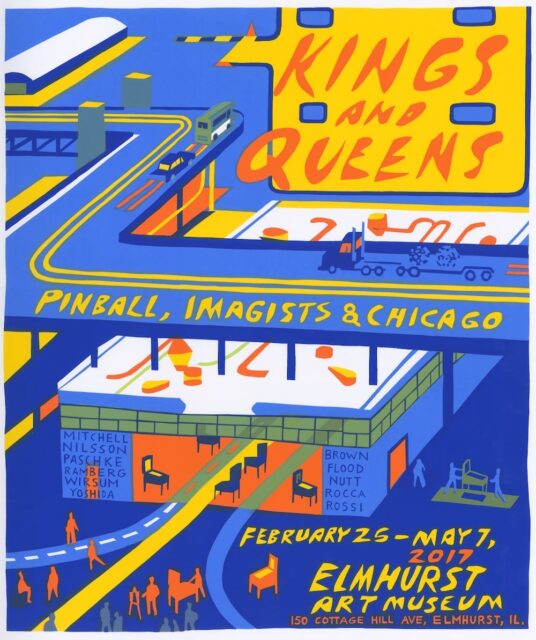
I'm opening a show tonight in Elmhurst, IL, just outside of Chicago. It's called Kings & Queens: Pinball, Imagists and Chicago.

Here's the blurb: 

Elmhurst Art Museum proudly presents Kings & Queens: Pinball, Imagists and Chicago, an examination of the intertwined histories of two of Chicago’s greatest exports: pinball and Imagist painting. Curated by Dan Nadel, this interactive exhibition invites guests to play pinball on Chicago-designed and built pinball machines from the 1960s, ‘70s and ‘80s—including machines manufactured by Elmhurst's Gottlieb family—alongside paintings, sculptures and prints also made in Chicago in the same period. Kings & Queens: Pinball, Imagists and Chicago will feature works by Roger Brown, Ed Flood, Gladys Nilsson, Jim Nutt, Ed Paschke, Christina Ramberg, Suellen Rocca, Barbara Rossi, Karl Wirsum and Ray Yoshida; pinball machines including Kings & Queens, Old Chicago, Fireball, Duotron, Gorgar, and Blackout, featuring art by the likes of Roy Parker, Gordon Morison, Dave Christensen, Doug Watson and Constantino Mitchell, who will also exhibit original pinball backglass paintings, some for games never produced. The exhibition will be on display from February 25 – May 7, 2017. 

Most of the world’s finest pinball machines were made in Chicago's North Side factories, and many of those were manufactured by Elmhurst residents, the Gottlieb family, and designed and illustrated by local Chicago artists. As those machines reached the apex of pictorial and engineering ingenuity, the artists now known as the Imagists were finding their unique visual style with inspiration from many vernacular sources including the arcades and Riverview Park. Pinball provided inspiration with its high contrast coloration, absurd juxtapositions and ultra-flat forms. Pinball was but one inspiration for these artists, along with the city’s many color storefronts and the enormously popular Riverview Park. This exhibition also contains photographs of Chicago in those years, as recorded by some of these same artists. Kings & Queens is inspired by Imagist painter Ed Paschke’s 1982 pinball exhibition, Flip! Flash! Pinball Art!, at the Chicago Cultural Center, which featured a wide selection of pinball machines from previous three decades.

A selection of the imagist pieces featured in Kings & Queens: Pinball, Imagists and Chicago are on loan courtesy of the Elmhurst College. The Elmhurst College Art Collection is a collection that focuses on artists working in Chicago between about 1950 and the present, with a special focus on the Imagists. The full collection is housed in the A.C. Buehler Library on the Elmhurst College campus.

Kings & Queens: Pinball, Imagists and Chicago reveals a new view of both the city and some of its finest exports with major works on loan courtesy of private collectors and institutions including the Illinois State Museum, Elmhurst  College and the Roger Brown Study Collection.

Design by Ethan D'Ercole.

The Groin Vaults of Branson

Today on the site, we have Alex Dueben's interview with French cartoonist Sandrine Revel.

What interested you in making a biography of Glenn Gould?

I’ve been dreaming of this for twenty years. I discovered Glenn Gould while learning to play the piano. What attracted me to him was his legend, his way of playing, his mystery, his need for solitude. He played for himself more than for others. A great personality for comics.

The first five pages of the book make it clear that this is not going to be a typical biography. I wonder if you could talk us through what you were thinking with those pages and why you wanted to start the book that way.

In these first few pages I wanted to set the tone. Embark the readers within the first few panels in the fantasy world of Gould. You discover the first panels like the first notes or measures of a prelude of Bach. We start the story inside the mind of Gould, which remains the thread of this graphic novel.

How do you typically work? When you’re writing, do you script the book out in detail? Did you work that way with this book?

When it’s just me, I don’t write a script. I know what I don’t want and what my intentions are. I write very little, the story is stashed in a corner of my mind. I draw a lot, I quickly put together the more important sequences and I compose adding links. Justifications, parallels. When in doubt, I try to redo a page, a sequence, I modulate a great deal before being sure of the result. My ideas come to me often while walking my dog in the forest. So as to be quick in execution, I work on a pen tablet. This tool allows me to be faster in the creation process.

Meanwhile, elsewhere:

—News. Publisher Annie Koyama has donated a large collection of original art to the Billy Ireland Cartoon Library in Ohio.

The L.A. Times Book Prize nominations have been announced, and the graphic novel category includes work by Nick Drnaso, Jason Shiga, Anna Haifish, Patrick Kyle, and Rokudenashiko. John Lewis, Andrew Aydin & Nate Powell's March was nominated in the young adult category.

—Interviews & Profiles. Sarah Moroz profiles Daniel Clowes for The Daily Beast.

His rich roster of characters double only vaguely as alter egos: “I don’t know that the events of their lives are necessarily mine,” he cautions. “They’re certainly not the wholeness of what I am. But there’s always some emotional resonance… I write out the things I’m thinking about all the time.” With Patience, released last year—billed as a science-fiction time-traveling love story—he wrestled with “my younger self and how I became myself now from this younger man.”

Max Morris talks to Matthew Thurber, and his controversial 2014 piece for this website comes up.

I feel more than ever that printed media contains autonomous power that is almost magical. All internet publication is embedded in and framed by another corporation. With print, as soon as it flies off the press it belongs, like the land, to “you and me”. The disturbing thing about social media is they change the terms of publication from one of total freedom, to one where you are being allowed to express yourself. Because they grant it… they can take it away. Social media echo chambers are destructive: look at what they have helped to do in terms of ripping our country in half, replacing everything with a simulation of reality. Is that what you mean by “a lot is changed”?

—Reviews & Commentary. Bill Boichel reviews Michael Tisserand's Krazy.

Tisserand broadens the context of Herriman’s life further, to encompass large swaths of American history, society and culture, and in the process places Herriman’s life not only at the center of the history of comics, but at the crossroads of America itself at the dawn of the 20th century. While it has long been known that Herriman was born in New Orleans of mixed “Creole” heritage, with African as well as European forebears, the specifics had always been murky, at best – but no more! Tisserand, much of whose earlier writing focused on New Orleans, and who evidently knows his way around a variety of New Orleans archives, leveraged his preexistent knowledge, rolled up his sleeves and dug deep, tracing Herriman’s roots back to the 18th century as well as outlining much of his extended family history.

Word for Word

Today on the site:

Paul Tumey presents part two of his interview with My Favorite Thing is Monsters author Emil Ferris. Part one is here.

Paul Tumey: I’ve worked out you averaged a page every three days. Does that sound about right?

Emil Ferris: Actually it was probably about a page every two days.

Paul Tumey: That is impressive, to say the least. Earlier, you mentioned the story of the making the book was “… catastrophes followed by what amount to windfalls and blessings.” Can you share a little of that story? I’d love to know more.

Emil Ferris: Yes, There were a lot of setbacks and challenges in the process of making the book. I’m glad to relate them; it might be instructive for people who also have a story to tell. During the production of the book I went broke, experienced some homelessness due to various catastrophes, lost important relationships and had myriad physical disability setbacks and obstacles. But I believed in the story and I narrowed my focus and just kept going.

Paul Tumey: Books One and Two together are about 600 pages? It’s an ambitious work. And, like Maus, Fun Home, etc. it’s got something different and new and, if you’ll pardon the word, strange, to offer. Was it hard to find a publisher?

Emil Ferris: The two books together are coming in at closer to 800 pages between the two. And yes! It was a challenge. I have a great agent who held with me throughout the trials of the thing. The book was noticed early on by Katie Adams and initially the book was slated to come out with the extremely wonderful publisher for whom she worked, but, when finally they had the book in hand the publisher felt that I would be best off to do it differently. (The head of this company, Judith Gurewich is a total mensch!) That publisher decided to ask nothing back from the support they gave me to complete the work. I was deeply grateful, utterly broke and completely lost when they decided not to publish it. So Holly Bemiss and myself, we hit the (publishing) street like two Depression Era sales dames carrying worn suitcases full of encyclopedias (my book, “the big monster”). We went from town to town and then were ‘taken in” by the kindly folks at Fantagraphics, Gary Groth and Eric Reynolds, who just threw everything behind the book they could.

Elsewhere:

The great graphic designer and illustrator Alan Aldridge has passed away. He was best known to comics readers as the co-editor of the Penguin Book of Comics, one of the earliest cross-genre anthologies of the medium. 


Not That It Really Matters

Welcome back from the Presidents' Day weekend. Joe McCulloch is here as usual this morning with his guide to the Week in Comics! This time, his spotlight picks include new books from Vanessa Davis and Elaine Lee & Michael Kaluta. He also writes at some length about a Slovenian funny-animal detective comic.

I will suggest that the first issue of Animal Noir is pretty much drenched in allegory - look at the hoodie on that zebra toward the bottom right... these are not uncharged symbols, and the creators are not unaware of that charge, suggesting an animal metropolis of upper-class lions (royalty of the animal kingdom, natch) who for some reason have managed to stem their predatory impulses into socially acceptable means of feeding on the less-advantaged classes of zebras and gazelles. Animals now behave as humans, complete with interracial (species) relationships; in fact, some of these relationships are strictly economic, as in the shadowy world of "hunt porn," where certain species simulate the process of being hunted and devoured by predators, for the gratification of those same predators flattering themselves as old-fashioned wild animals at home.

Joe doesn't mention it, but some of the potential problems he detects here are very close to the ones that marred Zootopia.

And we also present Cynthia Rose's appreciation for the late Andre Franquin.

Was Belgian Andre Franquin (1924-1997) comics' greatest draftsman? One colleague who certainly thought so was Hergé. "Franquin", he declared, "is a great artist. Next to him, I'm only a mediocre pen-pusher." Fantagraphics' Kim Thompson agreed with Tintin's creator. "In terms of ultra-classic greatness," he once wrote me, "Hergé has that abstract line but Franquin has something else. He created the most complete, the most alive, the most absolute cartooniness in comics history."

A current Paris retrospective, Gaston, shares their views. It also honours a landmark birthday – the sixtieth year of Gaston Lagaffe, Franquin's most well-known character. Gaston, whose last name means "the blunder", is an dedicated idler in jeans and espadrilles. While hardly the first antihero of European comics, Gaston was one of their first post-adolescents. Franquin made him into a prototype of subversion.

Over three decades the artist honed Gaston's interests, showing him to be an inventor, a music fan, a DIY fanatic and an amateur chef. But, if his character exudes a Sixties effervescence it also has the era's disillusions. As Renaud Defiebre-Muller notes in the show, "Gaston pits personal autonomy against social control: against manners, against respect, against everyday decorum". Elevated to stardom by Franquin's graphic brilliance, this rebellion-by-default changed the rules of the bande dessinée.


Meanwhile, elsewhere:

—Reviews & Commentary. For the Chronicle of Higher Education, Lee Konstantinou writes about recent developments in academic comics studies.

But this success has given rise to a new set of problems. If an earlier generation of scholars passionately argued that academics should study comics, scholars now arriving on the scene are asking how best to do so. That is the question Bart Beaty and Benjamin Woo attempt to answer in their slim but illuminating volume, The Greatest Comic Book of All Time. Beaty, a professor of English at the University of Calgary, and Woo, an assistant professor of communication studies at Canada’s Carleton University, run through a series of contenders for the "greatest comic book" title, including Spiegelman’s Maus, the short works of Robert Crumb, the superhero oeuvre of Jack Kirby, Marjane Satrapi’s Persepolis, and so on.

Bart Beaty writes about what he considers to be last year's best comic, Philippe de Pierpont and Êric Lambé's Paysage après la bataille.

De Pierpont and Lambé have been collaborators on and off for more than a decade now. They had previously published Alberto G., a quasi-biography of Giacometti, in 2003, as well as La Pluie and Un Voyage. Four years ago Lambé shocked the comics world with the graphically astonishing graphic novel, Le Fils du Roi (elaborately cross-hatched in ball point pen). Paysage saw a return to the simpler line art of his earlier work, now paired with breathtaking compositions. Framing and layout operate in this book at an incredibly high level to create meaning. It is a formal tour-de-force.

At Paste, Hilary Brown writes about Dominique Goblet's Pretending Is Lying.

Dominique Goblet started work on this loose memoir back in 1995, and it wasn’t published in her native Belgium until 2007. In the meantime, she reworked old pages, many of which had aged and yellowed. But rather than clean them up or redraw the images, she treated them like a palimpsest or a patina. Ten years after, New York Review Comics has released an English translation alongside translator Sophie Yanow with new lettering from Goblet. The book fits right in with the weird array of sequential art the relatively new imprint has released so far: a reissue of Mark Beyer’s Agony, a gorgeous English edition of Blutch’s Peplum (one of the most underappreciated books of last year), a compilation of Glen Baxter’s weird single-panel surrealistic gags, a giant volume of Norwegian cartoonist Hariton Pushwagner’s Soft City (dating from the late 1960s to early 1970s and interesting, but perhaps a little overappreciated). The publisher clearly likes mining hidden gems, polishing them and showing them off proudly to a public that is (probably) mystified by their contents. Pretending Is Lying falls right inside those lines.


—Interviews & Profiles.
Dana Jennings at The New York Times profiles Emil Ferris.

Now, about that bite. It came 15 years ago when Ms. Ferris, who is 55, contracted West Nile virus from a mosquito. “I woke up in a hospital room three weeks after being admitted,” she recalled in a phone interview. “I was paralyzed from the waist down. I couldn’t speak. And I’d lost the use of my right hand, so I couldn’t draw.”

At 40, she found herself in a wheelchair, with a 6-year-old daughter, Ruby, to raise. But Ms. Ferris, like her stubborn heroine, doesn’t give in. She taught herself to draw again, received an M.F.A. in creative writing from the School of the Art Institute of Chicago, and eventually plunged into “Monsters.” “The virus both impelled and scared me at the same time,” she said. “I honed my focus and determination, and the book saw me through.”

And Sam Thielman at The Guardian interviews her.

When I was a child I had this severe disability, so I was the kid in the playground who wasn’t running. I had a spinal curvature, some amount of hunchback, two different lengths of leg, but I learned – and this is what’s so interesting about the world – I learned the my story-telling [of] horror and ghost stories would get a crowd of ten kids around me. So I was not alone. I learned how not to be alone in the playground. They would all show up for the next installment – of course I would always leave it hanging anywhere I could, so I could be assured that the next installment would be something they were looking forward to, because I didn’t want to be alone.

Recode talks to Alison Bechdel.

[The "Bechdel test"] was just a lesbian feminist joke of the ’80s, the kind of stuff we were all saying to each other. And it, you know, it just disappeared. But then, 20 years later, these young feminists resurrected it. I think it started with women in film school who were being told the exact opposite. “If you want to sell a movie to Hollywood, don’t put more than two women in it.” Etc.

The LARB Radio Hour interviews Vanessa Davis.

—News. The longtime New Yorker cartoonist James Stephenson has died.

Mr. Stevenson, born in New York City in 1929, found his way to The New Yorker in 1947. “I was not hired on merit,” Mr. Stevenson wrote in The Life, Loves and Laughs of Frank Modell — “My mother was a friend of the Fiction Editor, William Maxwell.” He worked for that summer as an office boy, and a part-time supplier of cartoon ideas. Nine years later he was hired by the Art Editor, James Geraghty, as a full-time ideaman. Mr. Stevenson recalled that Mr. Geraghty turned to him after the hiring handshake and said, “You must not tell anybody at the office or anywhere else what you do.”


Summer House

Today on the site:

Paul Tumey is here with part one of a two-part interview with Emil Ferris, author of the much-anticipated and well-reviewed new graphic novel, My Favorite Thing is Monsters.

Paul Tumey: How long have you had that remarkable graphic style — how far back does it go?

Emil Ferris: I think I really started developing that style when I was about eight.

Paul Tumey: And I agree―a flashy style with substance isn’t worth much, I think―facing off with the difficult feelings is what gives the whole enterprise depth. I feel that when I read Monsters. That pulled me through the narrative as much as plot.

Paul Tumey: You can see artists getting into that space and producing work of remarkable depth and complexity, and then backing off from it, perhaps out of survival. It seems very intense and consuming … although the work that can come from that state can bring rewards.

Emil Ferris: I agree. I think that’s the sacred geometry, if you will, that makes theater cathartic. The capacity we have to feel an emotional state and move through it towards empathy and understanding and yet have it all be ‘fictional’ ‘play-acting’ and thereby safe. The artist is a willing servant to those altered states and a shamanic being taking us down a dark path, meanwhile punching holes into the tunnel to allow us light and hope and a view as we travel that dark passage. That view is sometimes a page, a scene, a moment of film or a painting, poetry, music, dance, vision.

Paul Tumey: That shamanic journey, the transformation of one’s self and life, is captured with sensitivity and vision at several key points in Book One of Monsters. I’m thinking of Karen’s shift into werewolf mode and later, her psychedelic trip in the graveyard at night.

Emil Ferris: As unlikely as it is, there is some truth to that graveyard tripping scene. When I was a kid I belonged to the Marble Cake Kids, a little theatrical troupe of children of many different races run by two counterculture mavens called Leo and Mila. The troupe had their base at Hull House on Beacon Street, only a stone’s throw from Chicago’s infamous Graceland Cemetery. So necessarily as a kid obsessed with monsters, I decided I needed to sneak into Graceland and wait for wonders. When I was finally able to get into the cemetery, the actual wonders were the graves of famous Chicagoans whose stories I researched as I got older. There was also a ghost child rumored to live in the cemetery who I desperately wanted (and still want) to appear to me and befriend me. As for the marijuana connection, that occurred after I was a bit older, when imbibing of the weed and going into cemeteries became a pastime of mine.

Elsewhere... a rogue's gallery of links.

TCJ-contributor Frank Young has some newly uncovered 1944 John Stanley material.

Michael Dooley pays tribute to Bernie Wrightson, who was probably the very first artist I was completely obsessed with. True story.

And here's a podcast with Benjamin Marra.