
Thanks, Tone!

Today on the site, Aug Stone interviews the Dutch comics legend Joost Swarte, who is launching his first magazine in 40 years at the Frankfurt Book Fair.

AUG STONE: Where did the idea for Scratches come from?

JOOST SWARTE: Well… (laughs) I must dig in my memories. I always have liked the idea of doing a magazine again. I started Modern Papier when I was 22. It was my first magazine, a small underground publication. We did a print run of about 1000-1500. Artist friends joined in, Peter Pontiac and people from the Dutch underground who were involved with the magazine Tante Leny Presenteert. And then in 1973 there was a publisher who wanted to reach a younger audience so I proposed to make Cocktail Comics, a magazine presenting the new generation of Dutch comics artists. It wasn’t too much of a commercial success although all the artists were paid a professional rate and that was already far better than with the smaller underground publications. And we had the same freedom as with the underground publications, so that was quite good. But then I got a lot of attention from friends and publishers to publish my work so I left the whole magazine idea aside. Until two years ago, when the new publishing house Scratch was founded in Amsterdam and they asked me to be an advisor.

At about the same time I heard of the Frankfurt Book Fair, which is the biggest in the world. The guests of honour at their 2016 Fair are the Low Countries, Holland and the Belgians, with whom we share our language. And I thought it’s a good idea to not only present the literature of our countries at the Book Fair but also the comics. So I started to talk with people from the literary funds in Holland and in Flanders. And they got interested and supported this idea. That was the start of the magazine. It’s intended to give an international podium to Dutch and Flemish comics artists. We’re doing it in English with the hope that they will also have future publishers abroad.

Meanwhile, elsewhere:

—Interviews & Profiles.
The NPR Illustration blog talks to Daniel Clowes.

LA: Your new book Patience deals with time travel as a way to fix your life. If you could travel back in time, what advice would you give 20 year old Daniel? Would you change anything?

DC: I thought about that a lot working on this book because this book really is about the dialogue between the older version of a person and the younger innocent naive version of that person. But I don’t know, I think things sort of fell into place in this miraculous way in my life, so I would hate to upset that. And anyway I would hate to say, “Don’t do that, that’s stupid!” because that might have been the fulcrum that everything hinged on that allowed me to be still drawing comics at 55 years old.

I just remember what an awful person I was, and everybody is, when they’re in their early twenties. They just don’t know how self focused they are. Maybe it’s just because I’m reflecting on how I was at that age, but I was so incredibly living in my own head, completely unaware of how much of an effect I have on other people. It was just all about my own tortured soul at that young age, and it’s hard to look back on your early work and not see that and think, “Oh come on man, get over that.”

For The New Yorker, Sarah Larson talks to Ward Sutton about the new collection from The Onion's great political cartoonist, Stan Kelly.

Articles have been written about how it’s hard to tell whether the Kelly cartoons are a parody or not. “There are people who take it at face value, even though it’s in the Onion, which always surprises me,” Sutton told me. “On Facebook, someone posted a Kelly cartoon that was saying that vegetarians were the inhumane ones, because they were stabbing cattle farmers in the back,” he said. “People were just indignant about it.”


—Reviews & Commentary.
For Time, Matt Furie writes about his attempt to reclaim Pepe.

I have a stack of Pepe fan art sent to me by school children. Moms write me to say how much their kid loves Pepe. Kids write me to ask how his name is pronounced (Peep? Pee-pee? Pep-pay?). As the copyright owner, I was licensing a bunch of things like indie video games, card games; making official clothes, a plush toy; and I was excited by my plans for the future. I was thinking, Memes rule!

—Misc. I always forget Chris Ware's Heavy Metal days.

Record Holding

Today on the site:

R.C. Harvey on Al Smith, of Mutt and Jeff anonymity:

Smith, like Jones, is a name so plentiful in English-speaking countries that it achieves virtual invisibility and thereby anonymity. And the only Al Smith who ever broke free of the amorphous mob of Smiths is the one that was a picturesque governor of New York: he attracted enough notice that he was able to run for President of the U.S. against Herbert Hoover in 1928 and lost because he was Catholic, voters of the day being provincial enough to believe that if a Catholic was in the White House, the Pope would be running the country.

Our Al Smith, the nearly unknown cartooning one, wasn’t even a Smith at first: he was born March 2, 1902 as Albert Schmidt in Brooklyn, New York, the son of Henry Schmidt and Josephine Dice. Eventually, he “Americanized” his name to Smith. We don’t know when he did this, but it was done by the time he was signing one of the most famous comic strips in the history of the medium, 52 years after he was born. He continued signing Mutt and Jeff  for 27 more years before retiring. By then, Al Smith had been producing the same daily comic strip for almost 50 years, at the time, a world record.

Supplying autobiographical information for the membership “album” of the National Cartoonists Society (NCS) in 1960, Smith wrote: “Born in Brooklyn, I became an orphan at age four. My boyhood was like an Horatio Alger story. Shoeshine boy after school, made 60 cents a week. Quit that to become butcherboy at $1 a week. Loved to draw and make people laugh. Could not afford lessons. Loved vaudeville. Might have tried acting career if I hadn’t married. … I was too young for the First World War and too old for the Second.”

Elsewhere:

It's a big weekend for comics festivals:

Cartoon Crossroads Columbus has begun... get your details over here. And The Lakes International Comics Festival is on now.

It Pays to Rent

Today on the site, Chris Mautner reviews the latest Fuzz & Pluck book from Ted Stearn, The Moolah Tree.

The world of Fuzz and Pluck is populated with deluded and frustrated characters and abounds in disturbing dreams and odd transformations. At one point in their quest to locate the tree, Fuzz and Pluck come across a swarm of angry bees, which ends with Fuzz covered in mud and Pluck swollen to twice his size in stings. There’s a frightening dream sequence early on where Pluck cuts off his legs in an attempt to make bait for fish and then Fuzz is torn by two stray threads asunder, until nothing is left of him but two eyeballs.

That Fuzz would have such an unsettling nightmare should should not be surprising to those who have read their previous adventures. Both Fuzz and Pluck and >Fuzz and Pluck: Splitsville had an element of horror to them, however slight. Think of their initial appearance with the cheesecake character that everyone ends up devouring. Or the creepy half-grapefruit villain in Splitsville. Or the little girl’s toys that tear off a duck’s wings in order to attach them to Fuzz (also from Splitsville).


Meanwhile, elsewhere:


—Interviews & Profiles.
Sam Thielman at The Guardian speaks to Ben Katchor.

I was looking at 17th-century draftspeople and not comics. [Nicolas] Poussin, and Rembrandt, and the whole other world of anything but commercial art. I grew up reading comics, but then I discovered a whole other world of picture-making. They didn’t all make comics, but they made heavily narrative pictures. Poussin was a philosopher-painter, he wasn’t just a painter, so there was a big literary angle to these images. So I looked at that. That’s what was always interesting work.

You can’t keep recycling what’s happening. The critique was that I didn’t like how most comics were drawn and I had to draw differently than they did. If you don’t have a critique of what you’re doing, you may as well not do it. Just go on and be an apprentice to somebody and do what they do. That’s a pretty deadly direction to go in. Robert Crumb was looking at Albrecht Dürer, and looking at Doré and these incredible draftsmen of the 19th century. He was looking at early newspaper comics.

The AV Club talks to Ed Brubaker about his comics and his work on the new HBO show, Westworld.

When I first came here, I had done a couple TV pilots, and a friend of mine wanted to leave comics and come work in Hollywood, and I said, “Well, you’ve got to understand that when you sell a TV pilot, imagine if you turned in the best issue of Batman ever, and DC was like, ‘Well we love this, but we can’t publish it because we have to publish this other thing by this other person.’ There’s always room for a great issue of Batman at DC Comics, but networks have a limited amount of shows they can put on. You could do a pilot that is everyone’s favorite pilot at the network and they all say, “Yeah, but who’s going to watch this?” They’re not just judging shows on, “Is this good?” They’re judging it based on how many people will want to see this in our estimation. The odds are really long on getting anything made, so if you come from comics and you’re still making a living in comics, that really helps because you’re not desperate for someone’s permission to write for a living.

Mike Dawson has put TCJ Talkies into hibernation and started a new podcast with fellow cartoonist Zack Soto called Process Party. The guest on the first episode is Vanessa Davis.

The RIYL podcast's latest guest is Dash Shaw.

Institutionalized

Today on the site:

We are lucky to have Ron Rege interview Dame Darcy on the occasion of her essential new book, Meat Cake Bible. It's a doozy.

Rege: This is not a graphic novel by any means. You’re a cartoonist from the pre-graphic novel era, which isn’t that long ago.

Darcy: Yeah, and all the kids do this manga thing now. Everyone does anime and this anime style. It’s fine, especially in my genre, Gothic Lolita. It’s all this anime goth. I’m Gothic Lolita too, but I have nothing to do with anime. All the millennials are super into anime and they need to expand on that, you know. 

Rege: I think eventually they’ll absorb it and do it in their own style or something like that.

Darcy: I hope so because I’m kind of getting sick of it. You know, you’re drawing really great, but you’re drawing just like anime. Come up with your own thing guys! I’m going to do a skill share video series teaching how to self-publish and do your own comics, and coming up with your own style is the main part of it! [laughter]. You’re not learning anything if you do that. You gotta go into your soul and come up with your own look!

I taught sequential art at the School of Visual Arts, and I’ve done lectures with PNCA and SCAD and Columbia and stuff like that, and one off things at public schools. I’ll volunteer. I did a little comics course for kids in the inner city schools in LA. I did it here for summer camp in Savannah. I’m all about it. One of the first things I say is, ‘Okay what’s you’re spirit animal? What’s your favourite stuff? What’s your favourite colour? What’s your favourite food? Combine it all in to a character, that’s where you’re going to get your style!’

Rege: That’s cool.

Darcy: Yeah, they come up with the cutest, hilarious stuff. I just love teaching people how to tap into their pathos. That’s what it’s really about. Just inspiring people with your work to be themselves, and to tap into their pathos. Like, be yourself so brazenly!

I love how when Obama became president he was like ‘yeah, I know there’s never been a black president before, but my reality and my confidence is so strong that I changed reality. I made it so there was a black president even though there’d never been one. In my world there could be one, and so now there is.’ I love that! That’s the key to manifestation and magic. Just alter reality so that it becomes your reality!

Rege: Oh my god.

Darcy: Seriously. I wanna be as big as Snoopy or as mainstream as Hello Kitty or some shit. Really I do.

Elsewhere:

Monday night I attended Dash Shaw's NYC premier of My Entire High School Sinking into the Sea, which I absolutely loved. It's beautiful to look at, funny, and suspenseful. I was blown away, really. There are visual effects in there that I've just never seen before. If it's playing anywhere near you, go see it.

I also wanted to mention, since I've gotten a few emails asking about it, that all the installation photos from the Ben Jones exhibition at The Hole are now online. Ben's new show was fascinating because it was a rare instance of a cartoonist making comics that function as narrative drawing in a contemporary gallery space. These are not enlarged images (e.g. Shrigley), murals, or groups of drawings (Pettibon), but rather straightforward canvases that take a new approach to the comic medium. The show consists of oil stick-on canvas 3 by 3 foot cartoon panels assembled into narrative blocks (or 6 by 9 foot “pages”). They manage to feel as intimate as his notebook-sized comic strips and yet take on a new, somewhat ominous meaning — their dumb subject and large size a visual equivalent to, say, the comedy of Eric Andre or Will Ferrell. On a technical level, the work functions because his line is distinctly warm, his cartoon forms basic, and his sense of space and scale adaptable to large spaces. 

There’s a strange and digressive history of how comic art has been shown in museums and galleries (this is leaving aside cartoonish art, like Peter Saul). Usually a cartoonist like Clowes or Barry or Crumb exhibits the original drawings for their publications. Every so often (particularly in the 1940s and 50s) a cartoonist will make paintings or, in the case of a young artist like Aidan Koch, sculpture.

But mostly it’s original pages on a wall. Even Jim Shaw generally shows his “dream" comic book pages as if they were made for publication. And of course there’s the legacy of Pop: It’s rote by now to discuss Roy Lichtenstein's use of comic book panels as material for paintings. Less well known is that contemporaneous cartoonists, notably Al Capp (Li’l Abner) made “pop art” prints of their own work, complete with enlarged ben-day dots and the like, as if to compete with the men they considered “thieves”: Lichtenstein, Mel Ramos, Erro, et al. And younger contemporary artists have toyed with the comic strip as a source for material, like Jayson Musson, who exhibited his own versions of Nancy-cartoonist Ernie Bushmiller’s renditions of modern art, circa mid-20th century. 

That's all. Just a few thoughts on this great show.

Still more:

Speaking of art and comics, here's a full look at the Mould Map show.

BK Munn sketches out a history of the Cartoonist's Guild, which I hope he expands on.

I always like to link to Leslie Stein's latest.

I may have posted this many years ago, but I ran across it again. The classic live cartoon/art film, Fat Feet.

Here's Jim Rugg over at Clocktower radio.

It looks like SPX has posted quite a few videos from last month's programming.

Here's Gilbert and Jaime Hernandez interviewed by Bill Boichel:


Gathered from Coincidence

This weekend marks the second annual Cartoon Crossroads Columbus, and festival director (and Comics Reporter editor) Tom Spurgeon talked to me about what people can expect at this year's show, about the process of putting together We Told You So, the long-awaited oral history of Fantagraphics coming out this December, and what it was like to work with Gary Groth and Kim Thompson in the 1990s.

I was probably one of the last employees who went to work for Fantagraphics in part because I wanted to be with people who got my jokes. I was pre-Internet, a solitary comics reader, and the thought of working on a magazine I enjoyed about a subject I loved was way more appealing than watching people sniff underwear at a Home Shopping Network warehouse. I was Gary's fifth choice.

It was really young, Tim. I showed up for work about two months after Kurt Cobain killed himself — not related — so the whole city still felt young, but not excitingly so, maybe. But the office, Jesus. Gary and Kim were the oldest and they were like 37 and 39. Conrad Groth was a baby. The vast majority of us were 26 or younger. It was a lot rattier, with loud music and a lot of smoking on both porches. We did not have full computer coverage — Roberta Gregory used to come in to cut Rubylith and what is now the marketing room was half Kim's office and half the stat camera room.

Joe McCulloch is here too with his usual guide to the Week in Comics!, spotlighting the most interesting-sounding books new to stores. His spotlight picks this week include new titles from Baudoin and Sarah Glidden, but it's a packed week, with comics from such major talents as Anya Davidson, Shigeru Mizuki, Ted Stearn, and Abner Dean, too.

Meanwhile, elsewhere:

—Commentary. Jeet Heer writes about the alt-right's appropriation of Matt Furie's Pepe the Frog character (and the history of funny animal racial politics) for The New Republic.

Mickey Mouse was in fact racially ambiguous, since he owed much to black culture but wasn’t seen as black by the audience, all the more so because as he became a corporate symbol Disney played down the black cultural references. By the 1950s, Mickey was a home-owning suburban rodent living in a white picket house. The 1927 Disney short Steamboat Willie, the first cartoon with sound, was inspired by Al Jolson’s The Jazz Singer—which is not surprising, since both Disney and Jolson (famous for his blackface) belong to the tradition of white artists who appropriated black culture and sold it to mass white audience. What got lost in the process was Herriman’s satirical intent. While Krazy Kat remains a powerful commentary on racism, one looks in vain for such commentary in most Disney cartoons.

The Melville House blog spoke about the situation with Furie's old editor at The Believer, Andrew Leland.

The Pepe knockoffs online are pixellated and shitty and have none of the charm of Furie’s achievement. They’re like the disenfranchised Bart Simpsons of the 90s, playing in the NBA or brandishing bongs and wearing dreads. But in reverse: Bart was born to be a schoolkid, but then got coopted into underground drug culture. Pepe, conversely, was born to get high, but now he’s been conscripted into a hateful subculture that has nothing to do with his true spirit.

I've heard several cartoonists describe Furie's situation as an artist's nightmare, and it's not hard to agree. I might add, though, that if Furie were inclined to take it, he has been handed a very rare opportunity to create a comic that will be read by an extremely large audience, one that might even be career-defining. I guess in a way that's kind of an artist's nightmare, too!

Over at The New York Review of Books, they have excerpted Chris Ware's introduction to the new Pushwanger translation, Soft City.

Soft City is something of a miracle. Not only for existing in the first place, but for surviving at all. Drawn between 1969 and 1975 by the Norwegian artist Hariton Pushwagner (now often just Pushwagner, though born Terje Brofos in 1940), it languished in obscurity for decades and was very nearly lost before finally being issued in book form by the Norwegian publishers No Comprendo in 2008, following a messy legal dispute involving the artist and his former dealer. Most pointedly, however, it is a miracle of its native medium—the comic strip—for its startling and disquieting vision in a form that had never before quite seen anything like it. Funny, or maybe not so funny, that it would take forty years for the rest of the world to realize it.

—Interviews & Profiles. SPX has posted videos from many of this year's panels on YouTube.

The latest guest on the Virtual Memories podcast is Glen Baxter.

Where Is Everyone

Today on the site, Bob Levin writes about Robusto!!!, a collection of subversive punk comics from Serbia, and interviews its main writer, who is known as Wostok (among other names).

Robusto!!! is set in 1993, but seems to have been published between 2001 and 2005. If this is correct, why did you wait until so long after the events that you depicted had occurred?

Robusto!!! started more like a joke, actually. I was teasing my friends Red and (Peki?) because they tried to sell a few pirate discs just to get out of some debt. Then I said, “Hey, guys, you are criminals now, hahaha! But don’t feel ashamed because you are only small time crooks and the real big criminals are employed in our government and on other important positions in our state! Then I started to remember everything that happened in previous years in our unhappy and fucked up society and than I decided to make a comic serial.

Meanwhile, elsewhere, a slow comics news day:

—News. John Lewis, Andrew Aydin and Nate Powell's March: Book Three is now a finalist for the National Book Award.

—Interviews & Profiles. The Comics Alternative podcast talks to Jason Shiga.

—Reviews & Commentary.
For the Village Voice, Mallika Rao writes about diversity at Marvel Comics.

But these characters can also front, deceptively, for a monochrome industry. [G. Willow] Wilson blames "a certain amount of gatekeeping" for sustaining this status quo. "Any time you get a new creator or writer or artist, there's this question of, well, how are they qualified, especially if this person is female or a person of color. The fact is, there is not such a thing as being qualified to write comics. A lot of the best comic writers don't have high school degrees. Now we have Ta-Nehisi Coates, and Roxane Gay [the writer, also black, tapped to write World of Wakanda as a companion to Black Panther]. If you look at their qualifications — he's a MacArthur 'genius.' Gay is a bestselling author, teaching at the college level. Margaret Atwood is another public intellectual [who's been recruited]. If you're a white dude, you can just write comics because you're good at it, but if you're a person of color or a woman, you have to be a MacArthur genius or have a Ph.D. or speak three languages."

Fear, Relief

On the site today: Greg Hunter's Comic Book Decalogue features an excellent discussion with Anders Nilsen about his new book, A Walk in Eden, comics, and art.

Elsewhere:

Tucker Stone went to SPX and reports back on some of what he brought home with him.

Here's a 2013 video tour of Un Regard Moderne.

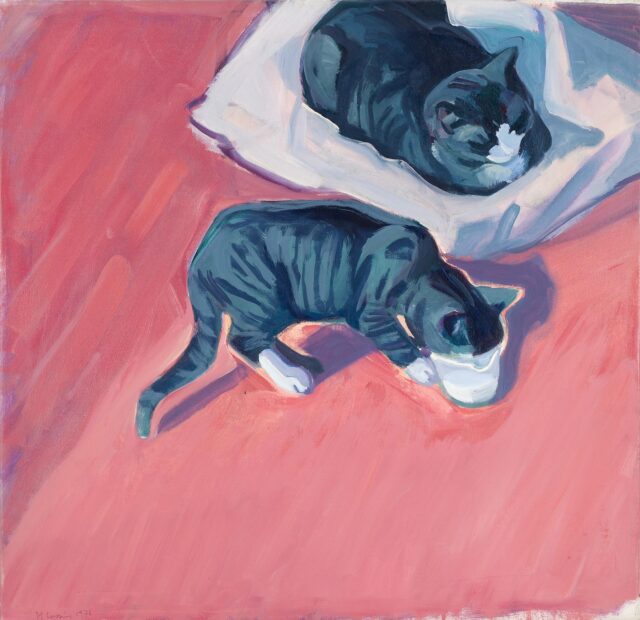
Not-comics but comics adjacent: A portfolio of early work by Austrian painter Maria Lassnig, whose expressive figuration and muted palette could teach cartoonists a lot.

It Follows

It's been a sad week for French comics. In her second memorial piece on the site this week, Cynthia Rose remembers the legendary bookseller Jacques Noël.

Under cover of night, as September faded into October, bookseller Jacques Noël of Un Regard Moderne departed this life. It was not the sort of loss that cranks Le Monde into hyperbole. But outside of Noël's Left Bank bookstore, the stream of passing mourners has yet to pause. A few leave notes or flowers but most stand in silence, remembering.

That's because there is really no other bookstore – possibly no other place – like Un Regard Moderne. A literal temple to the book, it is most frequently compared to a den, a grotto or a cavern. Here the wary customer has to browse carefully, weaving in between the shaky stalactites, mountainous piles and heaving shelves of barely-balanced volumes. Noël's tiny kingdom is layered, stacked and crammed with riches: bandes dessinees, fanzines, monographs on art, graphics and literature, Beat Generation rarities, Situationist tracts, self-published everything, graphzines, underground comics, leftist lit and erotica. It's a place where Guy Debord meets Gary Panter, the Marquis de Sade sits atop Nazi Knife and William Burroughs knocks elbows with L'Association. For almost two decades, the shop has functioned thusly – both a living sculpture and a natural resource for artists, writers and thinkers.

Meanwhile, elsewhere:

—Interviews & Profiles. Jillian Capewell at the Huffington Post interviews Sarah Glidden.

She’s still present in this second book, but more in a minor way. “I guess I’m coming from the school of journalism where you don’t really believe in objectivity,” Glidden said. “Part of the reason I like comics journalism is that, by drawing, you’re kind of showing with every single panel that it is subjective. Somebody not only witnessed all of this stuff, but somebody drew it. I hope that the medium of comics itself reinforces that idea, that, hey, remember, somebody is telling you this story. Somebody is choosing what’s important.”

And so does the podcast Comics Alternative.

CBR talks to Dave Sim, who has returned, in a way, to Cerebus—in webcomic form.

It is very much a branding exercise. When we started putting “Cerebus in Hell?” together, at first I was just using the image of Cerebus from the “Cerebus” trade paperback cover. This is the “Cerebus” trade paperback that sell the best and this is the one that all the retailers keep in stock, so let’s just have this be the only Cerebus that we use.

It’s a branding exercise, and it’s getting back to the humor that attracted a lot of people to “Cerebus,” that it was actually a funny comic book as opposed to in quotation marks “funny.” By the time the twentieth or thirtieth “MAD” imitator was coming out, it was like, “Yeah, yeah, we get it, but this is not particularly funny.” Funny isn’t something that you can fake. You either read it and laugh or you don’t read it and laugh.

J. Caleb Mozzocco talks to Tom Gauld.

I like the dated-ness of the idea of living on the moon. It seems to come from a time when we were more simply optimistic about science and technology’s ability to change our lives for the better. It seems amazing that the moon was there for millions of years and humans looked up in wonder, then we went there, and for a few years people were bouncing around, playing golf, driving a car etc. Now, again, it’s completely lifeless and has been for more than forty years.

Frank151 discusses how Matt Furie's Pepe the Frog character has been co-opted by online Trump supporters with Furie's editor at Fantagraphics Eric Reynolds.

At first I was watching it from a distance and not necessarily feeling like we had to do anything or should do anything. When it really first started to take a more disturbing turn, in my mind, was first when Hillary Clinton’s website had an explanation about Pepe being associated with white supremacists and there was no mention of the fact that, actually, he was this sort of innocent creation of this innocent cartoonist in Southern California who has had absolutely nothing to do with his character being associated with these groups. I’m a Hillary supporter and it sort of bummed me out that there was this only half-truth to the story.

But then the really disturbing turn was when the Anti-Defamation League felt the need to categorize Pepe in this way, and in their defense, they perfectly did their due diligence in terms of identifying Pepe as the creation of Matt and as this character that took on a life of its own, completely irrespective of Matt’s desires or wishes and didn’t reflect on him personally. But still, it’s just creepy. It’s definitely disturbing and it’s also just really frustrating to see the Trump family being heavily responsible for all this. I don’t know, the whole thing is very, very, fucking weird.

The Greatest

Lots to do today. Joe McCulloch bring us his weekly report.

Elsewhere:

Jacques Noël , the great founder and proprietor of the Paris bookstore where all good and bad forms of comics and illustration converged, Un Regard Moderne, passed away on Friday. The store was particularly renowned for championing the likes of Le Dernier Cri, ESDS, CBO, UDA, and other publishers of transgressive art. I was always honored to see one my books in the chaos. But that place (because calling it a store would be deceptive -- it was a place where you went and had an experience that sometimes resulted in maddening frustration and other times in walking out with a rare Pascal Doury edition) was just as likely to have a great stash of fiction, art monographs, pulp, and incredible reprints and archival material. Also, most of it was in head-high piles. What a place. I loved going there. It was a temple to print and it brought its owner few rewards, I suspect. I was just there in May and with a sly grin Jacques showed me a delightfully vicious Bruno Richard pamphlet. The vicious cannot be underestimated. I miss the vicious in art. RIP Jacques Noël.  Thank you.

1013651_402701963176966_48828589_n14485133_983133278475801_6576641402789910022_nMore prosaically, on to some links:

Gary Reed, founder of the classic 80s/90s company Caliber, passed away.

Yet another piece on Matt Furie's Pepe character., this time in the NY Times.

Want to wear Frank Santoro around your neck? Here's your chance.

I like cute little profiles of comic book collectors. Here's one, with a cameo from some excellent artworks.

Robert Crumb's parents: Bewildered!

Bein’ Green

Today on the site, Cynthia Rose has our official obituary for Ted Benoit.

La ligne claire has not made this much news in Europe for decades. On Wednesday, the Grand Palais opened an epic Hergé expo, which has received only raves from critics and the art world. Its curator, Jérome Neutres, calls it an ambition fulfilled. "Our whole aim is to show that Tintin's creator was, quite simply, a truly great artist. We want to put him on the same footing as a Vélasquez, a Helmut Newton or a Fantin-Latour."

Then two days after the opening, France discovered that Thierry "Ted" Benoit had died. Benoit, 69, may not have been the ligne claire's purest inheritor. But he was certainly one of its great innovators. As the obituaries and tributes to him proliferate, many have begun with similar sentiments. Benoit, they note, was more than just a wonderful draftsman. He was – quite simply – a truly great artist.

Meanwhile, elsewhere:

—Interviews & Profiles. Rachel Cooke profiles Sarah Glidden.

Glidden, the daughter of two doctors, studied painting at Boston University. “But then 9/11 happened. I was only 21 and I started to be interested in journalism. My reaction to it, besides feeling a sense of horror, was that if a war was going to happen immediately, there must be more to the story than I knew. So I started reading everything. I was drawn to photojournalism. I think I wanted to be Tyler Hicks [the Pulitzer prize-winning New York Times staff photographer], but I was also very shy. I didn’t have what it took to talk to people and take those kinds of pictures and nor did I have any training.”

Angelique Chrisafis talks to Riad Sattouf.

Sitting in his Paris publisher’s office, as the second volume of The Arab of the Future is released in English and the third volume comes out in French, Sattouf is hesitant about being seen as a voice of the Middle East. He views himself as stuck somewhere, neutrally, in the middle of his mixed French and Syrian roots and hates any kind of flag-waving or identity politics.

“I waited so long to tell this story partly because when I started to make comics I didn’t want to be the guy of Arab origin who makes comics about Arab people,” he says. “I didn’t want to be the official Arab comics artist. So I made a lot of comics in France which weren’t related to this part of me. I made a movie. But even during all that other work, I was thinking I have this good story, how could I tell it?”

The RIYL podcast talks to Matt Furie.

—Reviews & Commentary. Speaking of Furie, Chris Mautner explains what's happened to Pepe the Frog.

The character has been deemed an "online hate symbol" by the Anti-Defamation League.

How could a goofy-looking cartoon character be considered a symbol of anti-semitism? To explain that we'll have to take a quick spin through Pepe's brief history.

Pepe was created by cartoonist Matt Furie around 2005 as one of the characters in his comic book series Boys' Club, a surreal stoner comedy about a group of anthropomorphic buddies sharing an apartment. Most of the jokes involved bathroom humor, body fluids, or just plain goofy absurdism. It was about as far from political (or even topical) humor as you could get.

Christine Smallwood reviews Sarah Glidden's Rolling Blackouts for Harper's.

The book comes alive when the Americans recede from the frame. Glidden draws excellent grimaces, arched eyebrows, and narrowed eyes; her smiles are good, too, but she has less cause to use them.

For PEN America, Meg Lemke writes about Jillian and Mariko Tamaki's This One Summer.

This One Summer has been removed from schools and (K-12) school libraries, on the basis of “use of profanity,” and the sweeping charge of “vulgarity,” which covers allusions to a potential abortion—and a miscarriage—and one suspects the possible queerness of one of the main characters. It was also removed from shelves at some elementary schools where perhaps, as the Comic Book Legal Defense Fund wondered, teachers added any Caldecott short-listed title without researching its recommended age group (12+, in this case). In news footage that I admit cracked me up (with the kind of laughing that leads to tears), a coiffed local newscaster in Florida reports on the plea of the alarm-raising parent who just wanted other concerned mothers to “be aware of this ‘illustrated book,’ described as a graphic novel…” as she flips fast through the lushly drawn pages. A GRAPHIC graphic novel: Be afraid, be very afraid.=

Oxygen to the Dumb

Today on the site we bid Dash Shaw a fond farewell as he wraps up his Cartoonist's Diary at Fantastic Fest.

Elsewhere:

The great French master of the clear line, Ted Benoit, has passed away.

Matt Furie has had a shitty year, as his character Pepe was appropriated by right wing nut jobs and then declared a symbol of hate by the ADL. Herewith a summary of the events.

Adventure Time, the animated show that seems to employ a generation of post-Kramers cartoonists is calling it a day in 2018.

Longtime cartoonist Sparky Moore has passed away.

Here's a look at how actors rake in the cash at conventions. 


Frank Santoro and the young cartoonist Cameron Weston Nicholson were in conversation at SPX:

https://vimeo.com/184552852

Cave-In

Today on the site, Rob Clough reports on this year's SPX, which seems to have been a very successful one.

The tension that has marked some past shows was simply not in evidence this year. I attribute that to Bernard's decision to take over the entire ballroom at the Marriott hotel that serves as the show's headquarters. The show moved to its new location a decade ago, after outgrowing its old Holiday Inn location in Bethesda. That first show had about three hundred exhibitors; I attended, and was interested in about a quarter of them. The show this year had seven hundred exhibitors, and I was interested in about the same proportion, meaning that the actual number of interesting exhibitors has zoomed up to nearly two hundred people. Bernard solved the problem of turf by expanding it for everyone. This year more than ever, it was possible for fans of different interests to have completely different experiences, to never interact and still have a fully satisfying experience. Of course, some of the differences were less pronounced than one would think. For example, the crew behind Adventure Time is like a young alt-cartoonist all-star team, featuring the likes of Tom Herpich, Jesse Moynihan, Michael DeForge, Seo Kim, Sam Alden, Luke Pearson, Jillian Tamaki and more. An upcoming issue of Ryan Sands's cutting-edge anthology Frontier will feature Steven Universe creator Rebecca Sugar.

Also, Dash Shaw brings the fourth installment of his Cartoonist's Diary. This time, he describes the U.S. premiere of his new film at the Fantastic Fest in Austin, Texas.

The sensibility of Alamo Drafthouse reminds me of Spectacle Theater in Brooklyn, but on a way bigger scale. They play strange videos before movies and have a huge appreciation of exploitation movies and goofy humor and anything bizarre. Everyone working at the theater is having a blast. You can tell everyone wants to be here, which is (strangely) not the feeling you always get at film festivals. This feels like something in-between a film festival and a comic convention! I even wear a badge around my neck, and there are sword jugglers and snake handlers in the theater lobby.

Meanwhile, elsewhere:

—Interviews & Profiles. AMFM Magazine has a very nice interview with Dash, which I highly recommend.

BEARS: It seems like it’s a big risk for somebody working in animation to go the more abstract route, which I love that you did. I don’t see people making a lot of animated movies that are taking risks. Everything looks like everything else. Everything is either trying to look like Pixar, live-action, CGI thing, or it’s trying to look like a Studio Ghibli thing. I love that your cartoon can only be your cartoon. It has your voice just in the picture. I don’t feel like enough people take advantage of that.

Shaw: I think the reason for that is it’s a ton of work to make all of those drawings. Even though the tools now are very accessible— like I just made this with a scanner. Really, the same tools that I could make a comic book, I used to make this movie with. The tools are there to make a movie like this, a lot of people have those tools. But it’s a lot of drawing. My experience in comic books both helped me know how to do a lot of drawing because I would make books that were hundreds of pages long. I would have to draw the same character over and over and over. So that experience prepped me for this. Also, the alternative comic world, to me, is the most exciting and diverse place for graphic personalities and sensibilities. When I think of the visual storytellers that I like, it’s 99% comic book artists. I love Miyazaki but I think these comic book artists are the coolest.

At Vulture, Abraham Riesman profiles Karen Berger.

Berger chafed — first quietly, then publicly. In late 2012, it was announced that she’d be leaving DC. She stayed on to help with the transition, but made her dissatisfaction known in a May 2013 New York Times profile. In it, she called DC and its rival Marvel, “superhero companies owned by movie studios” — an increasingly true statement, but one tinged with obvious disdain. The next year, after she had left the company, she spoke to me for a feature about John Constantine and earned DC’s ire by being even more explicitly critical, saying, “They've taken the character and put him in a place that's Constantine-lite” and adding, “As far as I'm concerned, he's not the real Constantine."

At The Beat, Alex Dueben talks to Teri S. Wood of Wandering Star.

I was originally one of those 1990’s, Independent creators, inspired by Bone and Cerebus. That had been my plan, to stick with self-publishing, until the big, comic book crash of 1995 hit. So many stores and distributors went under, unable to pay for the books they’d ordered, and suddenly, I had no way to pay my print costs. I was thousands of dollars in debt. Wandering Star almost died right there. It was pretty scary.

—Reviews & Commentary. In a short burst of 24 tweets, Joe McCulloch critiques Chris Ware's recent New Yorker covers, and in the process puts the standard lazy, one-note, imaginatively cramped attacks on Chris Ware to shame. Hopefully he'll expand these thoughts into something longer.

Liam Baranauskas from n+1 visits Pogofest in Waycross, Georgia.

I came to Waycross because a friend told me that in the 1980s, the town had marketed itself as the home of Pogo Possum, which seemed like an absurd pitch, even to a fan of the strip like myself. By 1987, the year of Waycross’s first Pogofest, Pogo had been defunct for a decade and a half and was long past its pre-Flower-Power-era sell-by date. Fetishism and irony had not yet merged to resurrect every pop-cultural fad of the postwar era, and anyway, we’re talking about southern Georgia, not Brooklyn or Portland. Pogo’s winking political allegories—a parody of the Dixiecrat stance on school desegregation, a plotline about the John Birch Society (renamed “the Jack Acid Society”)—had targeted a political consensus widely held in Waycross at the time, so it was hard to imagine its residents responding with anything more enthusiastic than skepticism.

For The Guardian, David Barnett writes about various attempts to censor comics, checking in with Mike Diana, Denis Kitchen, and Neil Gaiman.

Diana was just 25 when he became the first person in the US to be convicted of “artistic obscenity”. The jury took 40 minutes to find him guilty on three counts: for publishing, distributing and advertising his comic series Boiled Angel.

Early Colors

Today on the site:

Katie Skelly reviews Gina Wynbrandt’s Someone Please Have Sex with Me.

Wynbrandt is an artist whose progression shows over the four years of work included in this volume, and it’s obvious this progression is hard-won: the draftsmanship improves, the gags hit faster and harder, and she grows more and more willing to plunge head first into totally pathetic depravity with each piece. The style of Someone focuses on the essential, with few details in the drawings that don’t suit the gags. The book also rides out the cresting wave of the Risograph aesthetic, with pink and blue coloring, for a pleasing, sometimes teenage diary-esque effect.

And Dash Shaw continues his Diary with a discussion of his writing process for his next animated feature. 

Elsewhere:

Molly Roth, who interned for PictureBox and worked hard on the construction of this very web site, has some funny cartoons over at the New Yorker. She done good!

Here's the best rundown I've seen of the Mould Map-as-exhibition event coming up.

I like these Anders Nilsen drawings.


The Fire of the Laws of Reason

Joe McCulloch is here with his usual indispensable guide to the Week in Comics, highlighting the best-sounding books coming to stores tomorrow. His spotlight picks this time include new comics by Miriam Libicki and William Cardini.

We also have day two of Dash Shaw's tenure creating A Cartoonist's Diary. Today he talks about receiving the French edition of Cosplayers: Perfect Collection.

I got the French edition of Cosplayers: Perfect Collection in the mail. This collection is maybe more "perfect" than the U.S. one because it has the Christmas Special in it, which will come out later this year as a separate pamphlet comic in the States. Apparently, Christmas Specials are not a thing in France, so it wouldn't make sense for it be a separate item. Seeing this French edition is cool for me a few different reasons... One is that the issues never came out in France. I redrew and corrected and added a bunch of things for the collection, so France will only see the better versions.

Meanwhile, elsewhere:

—Interviews & Profiles. Vice speaks to MariNaomi about her Cartoonists of Color database.

So you hear the question, "What people of color cartoonists?" a lot?

I’ve heard this so much over the years that’s it’s just rote. “There aren’t any black people in comics.” “You have to write for men, because women don’t read comics.” The people who say that shit aren’t doing their homework. Apparently we're doing their homework for them.

Michael Cavna talks to Keith Knight.

[My strips about police brutality] are getting more attention than they used to. Someone who worked at a museum in St. Louis said she first discovered my work because someone was posting my comics around St. Louis during the Ferguson protests. I thought that was really cool.

People aren’t nearly as naive or ignorant about it as they were even a few years ago. And it excites me that we seem to be entering into a new era of activism and active protest amongst the masses. Athletes, students and others are stepping up and speaking out.

And he also talks to Ed Piskor.

I think when I started getting significant birthday/Christmas money to spend is when I started thinking hard about how that cash could be invested in my career as a cartoonist. The money would go to comics, and not [to] little bags of weed or cigarettes like normal kids. It was really mind-blowing to see the credits on the splash pages of comics, because it let me know that actual human beings created them, and not just some computer program or something.

Dominic Wells has an epic-length interview with Alan Moore.

“Here it was,” Moore says, pointing to an unprepossessing stone wall underneath a bridge that’s so low that he has to stoop. “That’s where industry and free-market conservatism were born. It [the machinery] was driving three looms, these looms would work without anybody to look after them, they’d just employ a few children to sweep out the corners and unsnag the machines if they got snagged, and immediately of course all the local cottage industries collapsed.

“So a little while after that, Adam Smith came to visit and he saw these machines working with nobody to work them, and he said ‘oh that’s marvellous, it’s like there’s a hidden hand’, then ‘ooh, that would make a nice metaphor for freemarket capitalism’. And that’s why we have this completely mystical notion that doesn’t exist, this is why Ronald Reagan and Margaret Thatcher said that it was OK to deregulate the banks; we didn’t need market control because there was hidden hand! And now here we are.”

Steven Heller talks to Drew Friedman about his second Heroes of the Comics collection.

At this point, so much has been written in comics history books and comics magazine articles and online tribute groups that it’s rare you’ll find an unheralded genius from that era. Everyone seems to have a Facebook tribute book these days. But there are a few innovative cult comics artists who perhaps are not as well-known as they should be, maybe because their styles were a little more oddball than the norm. A few that come to mind include Ogden Whitney, who I included in the first book. He was a master of deadpan absurdity and his comic book adventures of the lollypop sucking Herbie, the “Fat Fury,” really jumped out at me. I also include in the new book the notorious publisher Myron Fass, actually two drawings of him in More Heroes of the Comics. He started out as a comic book artist, but he’s fascinating because his publishing career basically consisted of shamelessly and successfully ripping off what other publishers were having success with, like MAD, and Creepy & Eerie.

The latest guest on Virtual Memories is Tom Gauld.

On the latest episode of Inkstuds, Sean Ford interviews Tillie Walden.

Closed Off

Today on the site: Day One of Dash Shaw's Cartoonist Diary, in which Dash introduces us to his in-progress graphic novel, Discipline. 

And RJ Casey talks to Warren Craghead about the artist's remarkable daily Donald Trump drawing project.

Elsewhere:

The writer Nahed Hatter was murdered in Amman, Jordan, as he prepared to testify about a cartoon he posted online.

Kaitlyn Greenidge writes about the recent controversy over real or perceived cultural appropriation in fiction in the NY Times.

I wrote about Carroll Dunham's drawings over at Hyperallergic.

Rocket Science

Paul Buhle is here today with a review of Corrine Maier and Anne Simon's graphic biography, Einstein.

Since the distant days when Chomsky for Dummies sought to explain difficult ideas to popular audiences through an acute combination of art and text, comics have come to be a natural medium for scientific explanation. Indeed, Logicomix, the somewhat fictionalized biographical treatment of Bertrand Russell and his philosophical theories of math, proved a surprise bestseller a half dozen years ago. No others in the scientist-biographical category have been so successful, but as science, math, and the universe continue to get the comic treatment of various kinds, further experimentation is obviously ongoing.

This reviewer, an old-time historian of the Left, asks himself why Einstein is superior to Marx, the comics version of one famed Central European Jewish socialist over another. Most of Marx ended up treating his social life as radical exile, impoverished father and husband (very occasional adulterer), leader of the First International, and so on. The “Marxist” theories toward which he devoted his ardent energies got pretty short shrift. In fairness, such ponderous subjects as the Left Hegelianism of the young revolutionary romantic would prove daunting to any comics treatment.

Meanwhile, elsewhere:

—News. Two artists who work in the comics form, Gene Luen Yang and Lauren Redniss, were awarded MacArthur "genius" grants yesterday.

—Reviews & Commentary. Chris Mautner looks back at the work of Richard Thompson.

Once you start digging in, however, you realize this is no average four-panel sitcom. For one thing, there are those names. Blisshaven. Otterloop. Danders. Thompson had a deep gift/fondness for strange words and phrases and incorporated them in into the strip whenever possible (hence the pangolins and trebuchets), giving the strip a healthy sense of the absurd. Cul de Sac teemed with weird objects and concepts — a toy nobody knew how to play with, a compact car so tiny it tips over easily — that pushed the strip right up to the edge of the fantastic without ever truly crossing the line. And while it could be a very verbose strip at times, Cul de Sac never felt like it was drowning in dialogue.

At the Los Angeles Review of Books, Jackson Ayres writes about the way AIDS was depicted (through the metaphor of "the Legacy virus") in X-Men comics.

On one hand, the comics featuring Legacy tended to evince sentimental liberal humanist attitudes toward AIDS, at times even reinforcing homophobic reaction. Understood in the light of popular fantasy, on the other hand, the moments when X-Men was at its most outlandish, eschewing even the pretense of mimesis, provided opportunities for more daring, even radical, interrogations of the AIDS crisis.

Jonathan Guyer writes about the Egyptian cartoonist Andeel.

Broadly speaking, Andeel’s oeuvre falls into two categories: snap political commentary and social criticism. The former body of work—including caricatures of the president, mockery of the military—has garnered international acclaim. But in fact it’s in cartoons about the quotidian—relationships, technology, hipsters, vegetarianism—where Andeel often shines brightest.

Dirty Johnny

Today on the site, Robert Boyd writes about Bart Beaty and Benjamin Woo's new book, The Greatest Comic Book of All Time: Symbolic Capital and the Field of American Comic Books:

Bart Beaty and Benjamin Woo begin The Greatest Comic Book of All Time by acknowledging that fans love to make best-of lists. I instantly thought of pop music super-fan Rob in the novel and movie High Fidelity. He is constantly making lists, and the lists tend to be “top five” lists. The listing activity is always in service of naming the “greatest” of whatever is being listed. Beaty and Woo then discuss about several top 100 and top 500 lists from the world of comics, including Hero Illustrated (remember them? They were kind of a low-level Wizard knock-off) list, “The 100 Most Important Comics of All Time” from 1994 and The Comics Journal’s 1999 list “The Top 100 (English-Language) Comics of the Century” (note: both Bart Beaty and myself contributed to that list). The authors point out that Youngblood #1 by Rob Liefeld was on the Hero Illustrated list but not on The Comics Journal list. This book doesn’t express an opinion on whether Youngblood #1 deserved to be on either list. They write, “We have no intention of lecturing you about the comics that we think you should read. Rather, we want to examine the very process of list making and curating. We are not interested in what makes great works so great but how any work comes to be seen as great.”

The conceptual framework they use is “symbolic capital.” This is derived from the work of sociologist Pierre Bourdieu. They write, “Any given work or creator will have differing levels of economics (i.e., sales), social (i.e., buzz and connections), and cultural (i.e., prestige) capital, but symbolic capital represents an overall index of social capital.” For the most part, Beaty and Woo only look at economic capital and cultural capital. They have somewhat quantifiable ways of looking at each.

Elsewhere:

The 2016 MacArthur Fellows were announced today, and cartoonist Gene Luen Yang and picture-story artist Lauren Redniss are among the recipients. 

The great Kerry James Marshall writes on Black Panther at Artforum.

Fair round-up: Nick Gazin at the NY Art Book Fair, and here's Publishers Weekly on SPX.

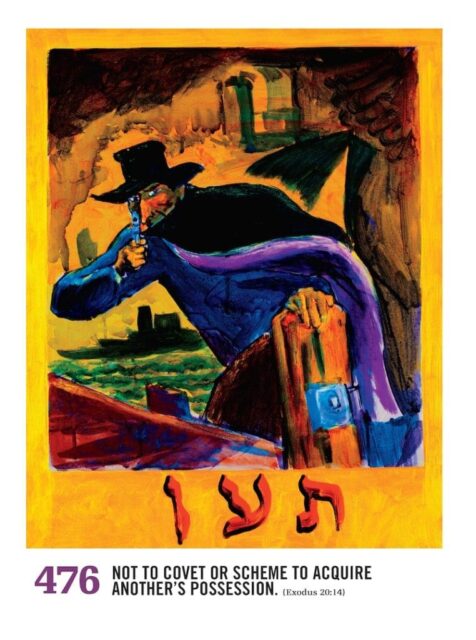
476

Rob Clough is here with a review of Caitlin Skaalrud's Houses of the Holy.

Houses of the Holy is Caitlin Skaalrud's journey into the deepest, darkest memories and emotions. Clinically discussing the events that led to a certain conclusion would have done little to actually convey the experience, so instead Skaalrud chose to invent a visual language to depict and a poetic language to describe the events of a lifetime that led her main character to her lowest ebb. The book's blurb describes the journey as Dantean, but there's no Virgil present to explain what we're seeing to either Skaalrud's presumed stand-in character or to readers. Instead of a straightforward narrative, there's an emotional narrative wrapped in symbols, fragments, and genuinely harrowing sequences.


Meanwhile, elsewhere:

—Reviews & Commentary. Tucker Stone is reviewing the comics he brought home from this year's SPX.

This collection is the most painful one Dustin [Harbin] has done, and considering the reputation that autobiographical work has for being lonely-worship solipsism, it's strangely courageous to see Dustin--one of the few people in comics that is funny in the sense that he makes you laugh, as opposed to being called funny because he makes you feel like you're safe--commit to the relative mundane topic of habitual exercise, middle-aged ennui and everything else that comes with break-up recovery.

Sean Rogers reviews new books from Tom Gauld, Jessica Campbell, and Riad Sattouf.

In this debut monograph by Jessica Campbell – whom the faux-scholarly preface deems “one of the world’s leading art critics” – the author serves as docent, guiding readers through the masterworks of 20th-century art. Emphasis on “master”: The dudes who ruled high modernism are the subject here, though it’s not their bodies of work that come under scrutiny so much as their bodies, full stop.

Andrew Hickey reviews Alan Moore's Jerusalem. (There are obviously a slew of reviews of this novel; I plan on mostly just linking to the most comics-familiar of them.)

If I were to attempt to summarise this utterly unsummarisable novel, the best way to put it would be that it’s plot is a history of Moore’s ancestry, both physical and literary, that its themes are those of From Hell (with a little of Promethea thrown in), and that its style is that of Voice of the Fire. It is, in short, a culmination of everything Moore has been working on throughout the last thirty years, and possibly his greatest work (though writing less than a week after the book’s release, it’s impossible to say for sure). It’s a book that not only resists criticism, it contains the obvious criticisms of itself in its last chapter—

—Interviews & Profiles. Robert Anthony Siegel profiles Archie Rand, painter and creator of the comics-adjacent art book, The 613.

Rand considers “The 613” a single painting, but it is in fact a series of canvases illustrating the 613 commandments of the Torah, the backbone of Jewish law. It is self-consciously religious art — and yet maybe it isn’t. Rand’s style is derived from the EC Comics of the 1940s and ’50s — think Tales from the Crypt and early Mad magazine — and his imagery stands at an odd slant to the ancient Hebrew text. Commandment Number 10, “Not to Test the Prophet,” pictures a man standing in the open mouth of a brontosaurus. Number 80, “To Bind Phylacteries so that the Laws will be as a Sign upon your Arms,” shows an Alfred E. Neuman–type goofball playing with a yo-yo.

The Comics Alternative podcast talks to Carol Tyler.

The Virtual Memories podcast talks to New Yorker cartoonist and Peter Arno biographer Michael Maslin.

—Misc. Alan Moore endorses Jeremy Corbyn.

As an anarchist I don’t vote, preferring direct political action and comment without an elected intermediary. If I did vote, however, I would try to vote with the way that viable human history appeared to be going rather than against it. The economic and political agendas imposed in the West over the last thirty or forty years clearly lead only to a ruined environment, to international austerity while the planet’s billionaires attempt to become trillionaires, to Donald Trump, and to a horrific abyss that threatens to make the English Civil War look like a Sunday-school outing.

Fun Times

Today, Greg Hunter returns with a review of Tom Gauld's stylish Mooncop.

Like so many much-loved science-fiction stories, Tom Gauld’s Mooncop seems to be about this, but it’s really about that. In the case of Gauld’s comic, the this is a cop on the moon, and the that includes isolation, monotony, and obsolescence. As with Mooncop’s predecessors, a reader helps create these deeper meanings; the story’s rewards increase with a person’s level of engagement. So, potentially, do the disappointments.

Gauld draws comics in a singular, instantly recognizable manner, with linework that’s borderline cutesy (Mooncop occasionally reads like it ought to have been crocheted rather than printed) but also elegant and the result of clear technical control. As a storyteller, his pacing is deliberate and his affect his flat by design. Wes Anderson is an easy comparison but a fitting one; both artists mix melancholy and knowing understatement, whimsy and compositional tightness. And as with Anderson, it’s not always obvious whether the artist’s carefully-rendered world contains real insights or merely signifies insightfulness.

Meanwhile, elsewhere:

—Interviews & Profiles. Tom Spurgeon talks to the very funny Jessica Campbell about her new book, Hot or Not: 20th-Century Male Artists.

Anyway, the idea for the book really came from two experiences. The first was that, when Cy Twombly died, I was still working at D+Q and Lynda Barry sent me an email that just said (facetiously) "Cy Twombly when he was my boyfriend" and included a picture of a handsome young Twombly. The second was that my former coworker in Chicago, a painter named Katherine Harvath, and I would gchat at work and at some point started asking each other to guess if certain male painters were hot and then would find images to prove/disprove each other's theory. There's a really nice nude pic of Frank Stella with one of his paintings that sort of kicked the whole thing off.

Michael Cavna talks to Matt Bors about The Nib.

We left Medium last summer and officially relaunched under First Look Media in July, but we’ve been working with them since January — on the building of the site and commissioning work in anticipation of the relaunch. Comics and websites both take some time to create, it seems.

—News. The Ignatz Awards were given out at SPX this weekend.

—Misc. The Chicago episode of PBS's Art21 features Chris Ware.

Hands Across Atlantic

Today on the site, Annie Mok reviews the wondrous Meat Cake Bible by Dame Darcy.

Fantagraphics has just released a collection of comics from Dame Darcy, the Mermaid-identified cartoonist and sometime reality show star, in the form of The Meat Cake Bible. Ornately designed by Keeli McCarthy, the die-cut hardcover opens to a scene of Dickensian magical realist debauchery, featuring some of Darcy’s core cast of characters, such as Strega Pez, Effluvia the mermaid, and Wax Wolf. They all live in Sobriety Straight, a Victorian hellscape/dreamscape, wherein the dozens of short stories from the Meat Cake comics took place, published by Fantagraphics from 1993-2008. The strips reflect the giddy viciousness of the best Riot Grrrl art and music from the early nineties, with a collection of mostly (white) women characters as cackling demonesses, taking up space and being loud.

We'll have Ron Rege's interview with Dame Darcy soon enough.

Elsewhere:

It's SPX weekend! You won't find me there (though I wish I was going). All your info is here. Instead you can find me at the New York Art Book Fair on Sunday at 1 pm, interviewing Suellen Rocca of Hairy Who fame.

SPX recommendation: Do yourself a favor and buy Anya Davidson's Band for Life. I'm in the middle of it now and it's incredibly warm, funny and brilliant cartooning.

Here's a cool-sounding event about underground press in Oregon.

The great store Quimby's gets the local legend treatment in the Chicago Tribune.

And here's our own Robert Boyd on Trenton Doyle Hancock.

It’s Not Easy

Today we have two pieces for you. First, R.C. Harvey on the late Alex Raymond and a new book on the Flash Gordon artist by Ron Goulart.

Among the achievements for which Alex Raymond is noted in histories of this oft-abused artform is that he drew three nationally syndicated comic strips simultaneously. Jungle Jim and Flash Gordon, both of which began January 7, 1934, and Secret Agent X-9, which began two weeks later on January 22. Given the high quality of the illustrative evidence available, Raymond’s achievement seems all the more remarkable. To do such good work on three comic strips at the same time attests, we are tempted to say, to Raymond’s towering graphic genius.

Before surrendering to the temptation, however, we might take a moment to reflect, and in that moment, remember that Secret Agent X-9 was a daily only comic strip and Jungle Jim and Flash Gordon appeared only on Sundays. Moreover, Jungle Jim was the “topper” for Flash Gordon—a one- or two-tier strip that filled out a single page, with Flash occupying the bottom two-thirds. The two Sunday-only strips made up a single page of the funnies, just as Bringing Up Father and Snookums or Blondie and Colonel Potterby and the Duchess did. Raymond may have drawn better (more illustratively, in greater detail), but he did no more strips in an average week than George McManus did with Jiggs and Maggie or Chic Young with Blondie and Dagwood. Six daily strips and one Sunday page.

And we also have Robert Boyd's review of Gilbert Hernandez's new Biblical adaptation, Garden of Flesh.

Can the Bible be made more interesting by the addition of huge amounts of explicit sex? Gilbert Hernandez’s Garden of the Flesh suggests that the answer is no. The first thing you notice is the beautiful package and design. The size of the book (6 x 4.75 inches), the lovely leatherette cover, the attractive debossed cover type—the title is surrounded by a beautiful garland of leaves—promises great things. The designer should be singled out for praise. His name is “J. Feeli Pecker.” Kudos Mr. Pecker!

It starts off promisingly enough. In the Garden of Eden, we see the primeval Earth disturbed, and on the 4th page Adam’s erect cock pierces through crust of the Earth as he is born into the world. The tumescent Adam announces his own existence and observes that he is alone, lacking “a companion like myself.” He lays on his back and jerks off, spewing splooge onto his ribcage, whence Eve is born. Regretfully, that’s the cleverest part of the book.

Meanwhile, elsewhere:

—Reviews & Commentary. A few days ago, a writer at Hillary Clinton's official website wrote a hilarious, inaccurate "explainer" about the origins of Matt Furie's Pepe character (without ever mentioning Furie's name), who has been unfortunately appropriated by some rightwing Twitter racists.

That cartoon frog is more sinister than you might realize.

Though that particular piece has still not been corrected, Furie has since given several interviews clarifying that Pepe is not a Trump supporter, including at the Daily Dot

It's just a phase, it's not the first time Pepe has been reclaimed for evil, and no one will care about it come November. I predict that his sly, lovable, and charming status will be intact as early as next week.

and at The Guardian:

Beyond Boy’s Club, I think it’s even more familiar as a meme for youth culture and teenagers. It’s weird that people are saying he’s been “a longtime white supremacist meme”. If anything he’d be part of the Green party. He’s a frog, why would he support white supremacists? That doesn’t make any sense.

At Loser City, RJ Casey writes about the National Lampoon comics of Claire Bretécher:

Bretécher explores a unique form of late ’70s arrested development in each of her one-page stories. Her characters aren’t afraid to grow up; in fact they’re fully embracive of this stage of their lives. The step from one phase to the next though, it’s a doozy. In one story, Bretécher has three zenned-out suburbanites argue about Christmas traditions at a Buddhist meditation camp. Another sees a woman unknowingly transition from counterculture hellion to helicopter mom. Bretécher’s characters, for our sake and amusement, seesaw between being uneasy and unself-aware. The only solution to their problems is to “talk it out.”

—Interviews & Profiles. Emily Buder interviews Dash Shaw about his new animated movie.

When I started making this movie, I thought that [my experience in comic books] would be more applicable than it was. I thought, well, I can draw and tell a story, and I've created a lot of characters. I can scan it just like I would scan my comics, only now it's going to go into After Effects. I thought it would be a much smoother transition. But when I was in it, I realized that there were so many things that I had no experience with.

The movie does have a dry humor that is like my books, but in film—in some kind of bizarre, magical way—you can have people say one thing but it means something completely different based on how they say it, which is obviously something that you don't get from just reading words. Things are more powerful when the literal words that [characters] are saying aren't what's being communicated.

And for The New Yorker, Sarah Larson writes about Raina Telgemeier.

Telgemeier’s realistic, sometimes autobiographical books have helped popularize graphic novels for middle-schoolers, in a big way. Her past three books, “Smile,” from 2010, “Drama,” from 2012, and “Sisters,” from 2014, were all No. 1 Times best-sellers. She has won two Eisner awards and many other distinctions. This morning, “Ghosts” was already No. 13, out of all books, on Amazon’s best-seller list.

Two Down

Today on the site:

Cartoonist Wren McDonald, author of Cyber Realm, began a diary for us but it went into another realm, so here we publish it as... a comic!

And Rob Clough reviews Fatherland by Nina Bunjevac.

The first thing one notices about Nina Bunjevac’s work is its density. Her cross-hatching and stippling pounds the reader, letting them know that these images are not going to let them go easily. Her skill as a draftsman is astounding, especially given the labor-intensive methods she chooses to employ. In her first book, Heartless, Bunjevac combined a heavy use of blacks with a cartoony line that was both whimsical and sinister. Her character design was cute, but her characters lived in a grim and unforgiving world. I noted in a review that her comics were a combination of Drew Friedman’s early pointillism, Kim Deitch’s oddly cartoony characters, and Phoebe Gloeckner’s hyperrealism. Her new book,Fatherland, is an expansion on one of the stories from Heartless titled “August, 1977”, about the accidental death of her father, who happened to be a Serbian royalist terrorist, and a letter her mother wrote her after she took two of their children with her when she left.


Elsewhere:

TCJ contributor John Kelly has been named Executive Director of the ToonSeum, a comic and cartoon art museum in Pittsburgh. Congrats to John.

Here's an interesting look at the inroads one studio is making with VR technology, something that seems very much at the forefront of various animators minds.

Skip Williamson documentary coming right up!

Fear of a Black Penis

Every Tuesday brings Joe McCulloch with his guide to the Week in Comics! This installment's highlights include new books by Moto Hagio and Maré Odomo.

Meanwhile, elsewhere:

—Reviews & Commentary. At Slate, Katy Waldman reviews Nadja Spiegelman's memoir, I'm Supposed to Protect You From All This, which is largely about her mother, Françoise Mouly.

Spiegelman has mapped not only her own inner landscape, with all the mom-shaped craters and streaks of ash, and not only Mouly’s, but also that of her maternal grandmother Josée—an equally fascinating, tempestuous figure. The book draws on hundreds of hours of interviews with both women. (After speaking to Françoise, Spiegelman flew to Paris to get Josée’s side of the story.) It shares DNA with Maus, the Pulitzer Prize–winning comic by Nadja’s father, Art Spiegelman, Part II of which is dedicated to then-baby Nadja. It is extremely similar to and extremely different from that work in the exact, vexing way that children are at once deeply like and deeply unlike their parents.

—News. March: Book 3, from John Lewis, Andrew Aydin, and Nate Powell, has been longlisted for the National Book Award.

IDW has signed a trade bookstore distribution deal with Penguin Random House.

With a client roster that now includes five of the top ten comic publishers in the direct market, plus book channel powerhouse Kodansha, PRHPS may now be the biggest graphic novel distributor to the book channel, if it wasn’t already. PRHPS graphic novel publisher clients include Archie Comics, Dark Horse Comics, DC, Kodansha, Legendary, Titan Books, and Vertical. Its last major client acquisition was Dark Horse Comics, three years ago.

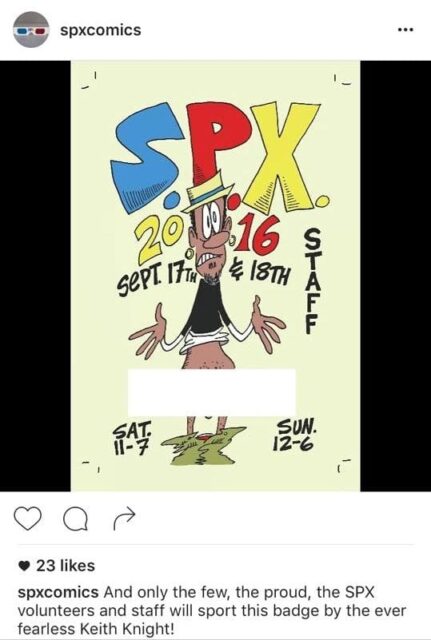
After receiving complaints on Twitter, SPX has withdrawn a proposed badge for convention staff and volunteers which had been drawn by Keith Knight. The offended parties said the image's implied male nudity was "triggering" and/or inappropriate for an all-ages show. Knight seems to be taking the controversy in stride.

keith

—Interviews & Profiles. Vulture interviews Alan Moore on the occasion of his long-awaited novel, Jerusalem, and asks him about the occasional criticisms he's received about the depictions of sexual violence in his work.

In V for Vendetta, there’s a part where the female character is saying she was going to be “ruh ruh” and she’s not even able to say the word “rape.” That was as close as you could get at the time to the subject. Having to do that made me think about the issue and ways in which I could actually improve. When we did Lost Girls, which is an erotic work, there was a point in the plot that one of the characters is raped. That happens completely offscreen because we didn’t want to confuse people. We didn’t want to suggest that we find rape erotic. As you progress through these different works, your thinking hopefully becomes more sensitive. I’m probably not where I should be on the subject yet.

—Misc. On Facebook, Sonny Liew opens up about the financial side of publishing The Art of Charlie Chan Hock Chye.

That translates into, over 24 months, about 2.5k/month
Which is not such a bad thing if you think of it in terms of “doing something you love”, but quite sobering when compared to other endeavours, from teaching to engineering or management, medicine etc etc.

Kevin Huizenga is teaching three comics courses at MCAD this semester, and promises to post content from them on Tumblr.

https://www.youtube.com/watch?v=vUWpovcGjQ0