The Issue of Value

Today at the Comics Journal, we've got a triplet, a power trio, a triumvirate. Things: there's three of them. The first is an interview--let's call it "The Interview"--with cartoonist Joe Infurnari. Full disclosure: I fucking love this guy.

There was a friend of mine when I was at Deep Six studios, this guy Nathan Schreiber. We were listening to Notorious B.I.G. and there's a line where he talks about eating canned sardines in one of his songs. Nathan made the joke to me, "I didn't know that Biggie was a cartoonist!" because I was living on canned sardines for a while. So this is our way of coping with the reality of eating sardines, and that's how we bridged the hope that one day we would be a Biggie of sorts. So in that environment of deprivation, it certainly is nice to not feel like you're penny-pinched and nickel-and-dimed up above you. And that's not a slight to any other publisher, because it's definitely the reality of a lot of publishers who aren't multi-million-dollar corporations. But in this case, thankfully, Skybound has the resources that it can afford to pay a healthy page rate. And they can have you work six issues in advance. So it kind of protects you a little bit from the knocks of the market. And everybody I've dealt with there has been really cool. It's kind of relaxed, not to say that other places are not. It's just been a good experience, personally.

 Then, we've got your review of a Neil Gaiman property--no, not that one. The other one. No, the Dark Horse one! It's called Only The End Of The World Again, and the review (which has chapters?) is by Keith Silva. Here's a taste.

The fact that such a benign piece of ephemera exists—and is on its third go round no less—says more about the power of Gaiman’s brand than perhaps anything else. To go further and devolve like an upstanding Innsmouth-ian into downright nihilism, readers are being asked to, once again, buy something they already love that’s been cobbled together from other stuff they also love too. Reprints gonna reprint!

So where does that leave the consumer reader? New work from Hollingsworth that’s easier got for far less filthy lucre in a recently published pamphlet? Yes and no. Only the End of the World Again represents a study in what it means to be a comics pro. Like some Ghost of Christmas Present, Gaiman et al. swish aside their Dickensian robe to reveal the sins of competency and consistency. Everyone wants to pose as punk and ragged—especially in the august ones and zeroes of ‘TCJ.’ Gaiman wanted the same thing when he was poolside in his black motorcycle jacket in the Florida heat. True Story. Whiter the professional, the ace, the old hand? When did professionalism turn uncool?

Finally, in the world of free comics, the Kilgore squad has set y'all up with a preview of Monkey Chef, by Mike Freiheit. It's an autobio comic set in another country, sure, but it's also about monkeys. So it'll win awards and sell based off the strength of the cover? I think that was how Marvel Apes was explained to me back in the day.

ELSEWHERE?

CHANGES: The guys who run Meltdown Comics are shutting down the physical edition of Meltdown Comics to run a "new business" that they've been working on for "four to five years". Here's a video that explains nothing. 

HISTORY: Matt Seneca mentioned this on Twitter, and it took me back--has there ever been a better panel than the one where Marko Djurdjevic pulled back the curtain so hard on what it's like to work at Marvel Comics? I would argue that there has not been one. I hope Hannah's professionalism crusade mentioned here doesn't mean more people will act like Johnathan Hickman did that day, because Jesus Christ, the man sounds like Human Nyquil. Let's leave the jokes to the professionals, spreadsheet guy.

Book of Life

Today on the site, Arthur Lortie and Michael Catron report on the life of the colorful comics writer Michael Fleisher, a well-known figure to longtime TCJ readers.

Michael Lawrence Fleisher, an often controversial and polarizing comic-book and comic-strip writer, died February 2, 2018, from complications of Alzheimer’s disease in Beaverton, Oregon, according to his half brother, Martin Fleisher. He was 75.

Fleisher is perhaps best remembered in comics for his groundbreaking work at DC Comics on The Spectre and Jonah Hex, the authorized encyclopedias he wrote on Superman, Batman, and Wonder Woman, and a libel case he doggedly pursued and lost against The Comics Journal (Fantagraphics, Inc.), Journal editor Gary Groth, and the science fiction writer Harlan Ellison.

Though comics would dominate the first part of his professional career, in later life Fleisher proved himself to be a dedicated researcher, scholar, and humanitarian.

Charles Hatfield is here, too, with a rave review of John Porcellino's latest King-Cat collection, From Lone Mountain.

John Porcellino, cartoonist, memoirist, poet, and zinester, is one of our greatest comics artists. Many know this; many more should. He remembers places and people beautifully—that is, he does a beautiful job of remembering through art. Increasingly, I find myself drawing an improbable sort of joy from Porcellino’s art, the more improbable because of what I used to think was a great gulf between his experiences and mine. His work has crossed that gulf, in fact persuaded me that it wasn’t there to begin with. That may sound facile—and why shouldn’t art be about the strange and unknown, as well as the worn comforts of the familiar? Actually, Porcellino offers both; he wonders at the world. I suppose that’s what we mean by art making the world larger.

From Lone Mountain, just out now, is Porcellino’s fifth book from Drawn & Quarterly, and the third in a D&Q series reprinting work from his near thirty-year-old, still-ongoing zine King-Cat Comics and Storiesfollowing King-Cat Classix (2007) and Map of My Heart (2009). I am most thankful for it: as good and beautiful a volume of comics as I hope to see this year.

Meanwhile, elsewhere:

—Commentary. Michael Kupperman writes about sentimental death-tribute cartoons for The New Statesman.

The death tribute cartoon is different from simple tribute art, in that it uses a visual format designed to amuse, but to be maudlin instead. As near a perfect description for the death tribute cartoon as I can find is German writer Winfried Menninghaus summary of the concept of kitsch: “A simple invitation to wallow in sentiment.”

Every celebrity’s death is treated as an occasion for cloying fantasy or impossibly awkward visual metaphor.

The most common death tribute cartoon trope shows the celebrity arriving in heaven, most often encountering St Peter. It doesn’t matter what religion the celebrity actually practised (as with Steve Jobs, a Buddhist, who was placed in this context at least ten times, including on the cover of The New Yorker).

Rob Salkowitz writes about the current market for digital comics.

If you’re a sharp-eyed shopper, you’ve probably noticed that Marvel has been running some crazy deals on digital trade collections for Kindle and comiXology, blowing out collections for 99 cents that are list-priced at $19.99. Other publishers run the same kind of doorbusters on a regular basis, and subscription programs like comiXology Unlimited or Marvel Unlimited offer access to thousands of titles for a single monthly fee.

All this discounting means the effective price of digital back issues has crashed way under the "magic number" of 99 cents, the price point that everyone in the industry seemed fixated on just a few years ago. [...]

New release digital issues have, for the most part, held the line at the cover price of print editions. But with so much cheap content floating around out there, including a lot of stuff from the last year or two that is still being talked about and is still relevant to continuity, how soon before we start seeing price cuts on new material that has to compete with the publisher’s own recent backstock?

And more fundamentally, is the current shape of the digital market a sign of health, maturity and evolution, or should we be concerned that the model is failing?

At Slate, Marissa Martinelli makes the case that new (and old) readers should follow the recently begun annotated republication of Meredith Gran's Octopus Pie.

If you’ve already read Octopus Pie, the re-launch isn’t just a chance to experience it all over again (although it is that, too). You could easily zip through the archives at your own pace if you wanted to, but the daily schedule offers a unique opportunity to watch Gran’s art and storytelling change, if not quite in real time, then at least spread out over the two-and-a-half years or so it’ll take to get from start to finish—ten years worth of Gran’s work condensed into about a quarter of that time. The most obvious shift is the evolution of Octopus Pie’s art, especially the gradual creep of color into the comic before taking the complete plunge, with help from colorist Sloane Leong and, later, a lush palette by Valerie Halla.

—Interviews. The most recent guest on the Process Party podcast is Box Brown.

Tengo Hambre

Today at the Journal, we've got Nate Patrin's excellent review of Blutch's Total Jazz, which was released by Fantagraphics last month. 

Total Jazz is a tonally wide-ranging if relatively slim volume collecting French cartoonist Blutch's strips and illustrations for the now-defunct '90s-'00s magazine Jazzman, which he drew between 2000 and 2004. Creating work for a jazz magazine that was founded when jazz's mainstream commercial impact was largely relegated to the record crates of hip-hop producers like Pete Rock and DJ Premier relies on the likelihood that the audience you're creating this work for is well familiar with the subject already, and wants to see something more reflected in that subject than just a simple joke or an easy reference. And Blutch's work here is dedicated to finding the answer to what makes not just listening to jazz but finding yourself in it, dedicating yourself to it, obsessing over it, actually worthwhile -- and finally getting lost in that connection between the music and the people who play it.

And that's not all! The crew at Kilgore are working on a Kickstarter campaign to set up there next list of titles, and they've set TCJ up with a some handy previews to let you know where the money is going. Today, we've got a look at Blammo #10, from Noah Van Sciver. 

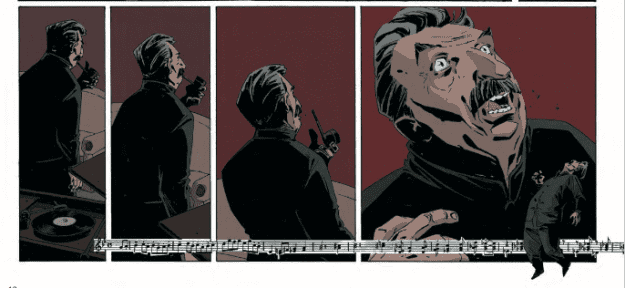
While I really liked watching Viggo Mortensen dismantle people in A History of Violence, I tend to roll my eyes whenever some throat-clearer tells you that his (it's always a he) favorite movie based on a comic book is Ghost World or American Splendor--I get it, guy who thinks he's 2 good for 2 Guns. And yet, like that backseat driver who still reps for Batman: Mark of the Phantasm, lemme tell you: The Death of Stalin will probably supplant Blade 2 in my estimation as the top of the heap of comic book related films. I just need to watch it a few more hundred times to see if its intensely, insanely acid-black comedy remains intact. It's a hostile movie, far crueler than I expected it to be, totally lacking in any sense that a better world is possible. In the world it depicts, any moment of joy or freedom occurs purely out of luck, and the best one can hope for is to be ignored long enough for your death to occur naturally. It's a deliriously mean vision of a country in the grips of the selfish, the venal, the stupid, and the cruel--and much like Blade 2, the survivors are those who are happy to stand atop a pile of bodies. 

In Battle

Today on the site, editor Mike Catron explains what exactly went into the new edition of Bhob Stewart's tribute book, The Life and Legend of Wallace Wood.

Bhob Stewart, who originally began this project for Fantagraphics, ultimately came to regard the version of it that saw print from a different publisher as a profound and bitter disappointment.

Despite the fact that it was well received at the time, Bhob cringed at the mediocre paper, the less-than-stellar reproduction, and the cheap binding. (Pages are literally falling out of my softcover copy.) But most of all — the thing that made him grind his teeth the hardest — was the censoring of Wallace Wood’s art. Bhob never got over that.

The other publisher required him to go through all of Wood’s art and delete anything the publisher felt was improper. Particular words had to be deleted or printed with asterisks, even when part of a direct quote. He was allowed to print semi-nude figures, but only if certain body parts were whited out — even when only shown in silhouette. Some of the Wood art he wanted to use was summarily rejected outright as unredeemable, and he had to scramble to find innocuous replacements that weren’t even relevant. This was especially evident in a chapter devoted to Wood’s infamous “Disneyland Memorial Orgy”. It offered some amusing panels poking fun at Disney characters that Wood had drawn for Mad magazine — but nothing at all from the “Orgy”, which was the subject of the discussion.

In another instance, Bhob had cleverly reconstructed an EC “prank page” in which Wood drew a nude female figure. It was so heavily censored that readers rightly wondered what all the fuss was about. (To set things right, an undaunted Bhob wrote an essay explaining the whole muddle. We re-reconstructed the prank and that became a new chapter in Volume 1.)

It was ridiculous. It was appalling. It was a desecration. But Bhob had signed a contract, and he felt he was stuck.

We also have Judy Berman's review of a comic with a very odd high concept: Derek Marks's Grace, Jerry, Jessica and Me.

Some historical convergences demand fanfiction. My own personal canon includes the first Redstockings meeting; the drafting of the Dogme 95 manifesto and “Vow of Chastity”; any given night at Zurich’s Cabaret Voltaire; Britpop’s Damon Albarn-Justine Frischmann-Brett Anderson love triangle; and the day Poly Styrene, Debbie Harry, Viv Albertine, Siouxsie Sue, Chrissie Hynde and Pauline Black all got together for a class picture. For Derek Marks, nothing tops that time in the ‘70s when Grace Jones, Jerry Hall and Jessica Lange were roommates in Paris.

Like most great 21st-century discoveries, this factoid came to Marks, a New York-based cartoonist and illustrator who was once “a tragic gay teen goth” in Miami, via the internet. The first issue of his hilarious comic Grace, Jerry, Jessica and Me, from 2014, opens with the author stumbling out of a “Google hole” (wow, relatable) with the wondrous revelation clutched in his hot little hand. “The trio’s potential fabulousness blew me so far away,” he writes, “I found I had time-traveled to Paris and landed as their fourth roommate.”


Meanwhile, elsewhere:


—Reviews & Commentary.
BoingBoing has excerpted the introduction Lynn Johnston wrote for the first volume of the collected For Better or For Worse.

When I was barely 20 years old, I got married. My husband and I settled into an old apartment in Vancouver, near English Bay. He was working for the CBC as a cameraman and I was an ink and paint artist for Canawest Films. I wanted to be an animator and was learning the industry from the ground up. We did commercials, public service announcements and piece work for Hanna Barbera. I was one of 16 young women hired to hand colour acetate cells. Having signed an agreement to not join a union, we took shifts and worked around the clock for $1.50 an hour. It was hard work, but I learned quickly and I realized that an animator makes other people's drawings, other people's characters, other people's dreams come to life. With no children to occupy my time at home, I decided to try my hand at creating stories and characters of my own. I have always been more at home with realistic scenarios, so I decided to tell short stories about my childhood. Within a few weeks, I had a few tall tales worked out and perhaps, 15 coloured drawings. I wondered if they might even be published some day. It was 1968 and I was creating a graphic novel.

For the New York Review of Books, Dash Shaw reviews Paul Karasik and Mark Newgarden's How to Read Nancy.

One of the defining traits of 1980s New York City postmodernist writing and painting was the urge to deconstruct. This extended to the comics medium in Art Spiegelman and Francois Mouly’s Raw, an oversized anthology magazine that serialized Maus and introduced readers to “art comics” from around the world. Spiegelman’s experimental work looked like exploded pages of Sunday cartoon battles between what was then considered “low” and “high” art. Richard McGuire’s short story “Here” dissected a single room across time using a panel-in-panel device also seen in 1980s painters like David Salle and Robert Longo. Gary Panter drew apocalyptic nightmares that dismantled and intuitively reconstructed drawing modes from Picasso to Jack Kirby.

In the midst of all of this deconstruction was a renewed interest among cartoonists in a humble, plain-looking gag strip that began in the 1930s: Ernie Bushmiller’s Nancy. Nancy follows an eight-year-old suburban girl as she solves mundane problems and interacts with Sluggo, a fellow prankster and sometimes romantic interest. Bushmiller (born in 1905) drew it for most of his life, with each strip as a self-contained “gag”—a single joke that could be easily digested as the reader glanced across the strip. The imagery and jokes are so prototypical and simple that the American Heritage Dictionary uses it to illustrate the meaning of “comic strip.” The appeal of Nancy to the art comic crowd might seem counter-intuitive, but while Nancy was never particularly clever, it was always cleverly constructed. In fact, the accomplishment of Nancy, with its refined, reduced lines and preoccupation with plungers and faucets, might primarily be a matter of form. As Bill Griffith (Zippy the Pinhead, also Raw) wrote in his 2012 introduction to a collected Nancy volume: “Nancy doesn’t tell us much about what it’s like to be a kid. What Nancy tells us is what it’s like to be a comic strip.”

At LARB, Jackson Ayres reviews Saladin Ahmed and Christian Ward's Black Bolt.

Ahmed’s Black Bolt, then, springs from these two interlocked narrative and extraliterary developments: Marvel’s positioning of the Inhumans as cornerstones of their line-wide continuity, and the company’s push, via live-action adaptations, for broader public recognition of the franchise. Unfortunately the Inhumans television series debuted to some of the first truly bad reviews for the franchise since its 2008 launch in the first Iron Man movie. But the coup of hiring Ahmed, an acclaimed writer of prose SF and fantasy, to helm Black Bolt no doubt helped to introduce the character to those who may not previously have heard of him.

After a too-long absence, Janean Patience returns with a very long piece on the 1980s work of Howard Chaykin.

Because we like to arrange things in threes, because that’s our pattern, there’s long been a glaring gap in the history of comics. Everyone agrees on two sides of the triangle: Watchmen and Dark Knight, the autopsy and the brass band funeral. But who’s the third? Maus has been most often suggested, even though it was only half-out, came from a very different place than those glossy contemporaries and wasn’t part of the hip, cool graphic novel movement. No, the third of the three, alongside Moore and Miller, was Chaykin. There was only one problem; the work.

Because there is, ultimately, an obvious advantage to being with DC Comics, however they rip you off. Even if it’s how they rip you off: they make your work available. They get it in comics shops and bookshops and airports and all those places, all those disregarded distribution outlets that are the grass roots of the graphic novel revolution, that take it to a wider audience. Without that, without that splash, you can be a key player in the revolution, a pioneer of creative ownership, and nobody will even know.

Back up. American Flagg, the comic Chaykin created, wrote and drew, began monthly publication in 1983. Moore was doing great things in 2000AD and Warrior and preparing to bound across the Atlantic. Miller had concluded his first spell on Daredevil and was writing and drawing Ronin. The revolution was gearing up. Everyone was already doing their creator-owned work alongside or inbetween their work-for-hire; it was a part of comics growing up from the very beginning. But Chaykin was winning. Flagg, published (and, according to the indicia, to some extent co-owned) by First Comics, was a hit right out of the gate. Monthly, independent, sexy, unleashing new ideas and characters and complications with every issue. It tore through its first year, 12 issues of 28 pages telling one overarching story. It was hot and it was Howard’s; a commercial sensibility of colour and design and action brought to that sector of comics previously aligned with the black-and-white fantasy of Cerebus and Elfquest. Everyone knew Flagg. I was like 11 years old and I knew Flagg.


—Interviews & Profiles.
The Comics Alternative podcast interviews Ho Che Anderson.

Philip Glass, Knife Collector

Today at the Comics Journal, we've got a lovely interview with one of my favorite artists, Roman Muradov. I wish I could take credit for setting this up, but it was presented on a platter by Aug Stone. Picking a favorite passage was easy: here's Roman on how The Fall influenced his work and taught him English.

I started listening to The Fall when I was about 18, when I couldn’t really speak English particularly well. I sort of learned English through The Fall (laughs). A bit of an abstruse route. I realize that a lot of my pronunciation is from The Fall and that Mark E. Smith’s actually not pronouncing very well so...(laughs) They were possibly my earliest artistic influence in my entire life, and also the most lasting. Because English is my second language I had the benefit of experiencing The Fall as a pre-linguistic awakening. I would listen to it and not understand 90% of the things he’s saying (laughs). But there was a force to it that really appealed to me, and it’s the same force that I recognize in, say, James Joyce, who I also couldn’t understand, because my English wasn’t up to the task. But I could still feel it in my guts. And it’s this very primal feeling, words connecting, sending a shiver down your spine—the whole idea that the sound of the words is actually much more meaningful than their meaning—and that’s something I’ve carried through my entire work. And with The Fall there are many other things. First of all, they had this whole amateurish approach to art-making. I change my style quite a lot as I’m sure you’ve noticed, so when I decide ‘ok, the next one will be in paint’, there’s a voice inside me that goes ‘hang on, you can’t paint’. But then there’s a little Mark E. Smith in my head that says ‘well, it doesn’t fucking matter. Get these three random tubes of paint and start painting. You’re not going to take classes or lessons. That is not how it’s done.’ So in a way I treat myself like he treats his musicians (laughs). Of course it’s even more unhealthy, I am my own tyrant and my own servant.

That's not all though! Today we've also got Mindy Rhiger's first piece for The Comics Journal, a review of Jen Wang's The Prince and the Dressmaker, a new graphic novel for younger readers published by First Second.

It may not begin with the words “Once upon a time,” but The Prince and the Dressmaker is a fairy tale through and through. From the prince looking for a wife (sort of) to the magical transformations (in a manner of speaking), the story blends elements of a traditional tale with modern ideas and sensibilities in a way that is every bit as charming and cinematic as the animated fairy tales many grew up watching. Perhaps this is a fairy tale that will speak to a new generation.

Busy Day

Today on the site, Tegan O'Neil returns with a review of Sarah Graley's Kim Reaper.

I’ve been sitting here trying to decide what I wanted to say about Sarah Graley’s Kim Reaper, the first volume of which – aptly titled Grim Beginnings – was delivered to my address by anonymous courier. I like the comic: I want to get that out of the way right up front. It’s not a perfect comic but it’s really solidly put together and very cute. Oops! Did I say cute? I didn’t mean to say cute.

In an Irish Lit seminar in college our professor informed us that “cute” was an Irish insult. Even over here in the wilderness cute can be a kiss-off. I try to remember the Irish definition whenever I use the word. It’s not a word I want to abuse in any way. I’d certainly never wield it as invective, because not only do I respect the idea of cute, but as an aesthetic mood I consider it a virtue worth promoting.

There’s nothing at all ironic about being cute in 2018.

Meanwhile, elsewhere:

—The New York Review of Books has published an excerpt of Eleanor Davis's Why Art?

—Caleb Orecchio writes about Julie Doucet's Dirty Plotte.

This encounter and subsequent reading of the issue reminded me of Doucet’s intensity as a cartoonist. An unfettered intensity and earnestness in both narrative and drawing. A simultaneity that basically went unrivaled among her comics graduating class (the exception probably being Chester Brown). Even in our current comics community, I am hard-pressed to think of any cartoonist that revels so deeply and gleefully in one’s day-to-day routine of life, fantasies and bodily functions—and in a completely fun and personal way.

—Boy, this CBLDF instructional comic for yesterday's gun protests sure seems concerned with teaching kids not to cause any kind of disturbance or distress to authorities and institutions. Is civil disobedience supposed to be disruptive and society-changing, or just a lifestyle signifier?

—RIP Stephen Hawking

The Blood and The Father

Today at the Journal, we've got a review from Alex Hoffman, who, in a turn of events that interest the 163,377 people who have registered as commenters on this site, is making his very own transition from their ranks of toil to Official TCJ Contributor with this very review. It's on a book called Eternal Friendship, which was published last year to almost no comics acclaim whatsoever--because the publisher decided to call it something else. Alex takes issue!

Originally published in France as Amitié Éternelle, and translated by Elizabeth Zuba, Durand uses official and personal photographs from Albanian state photographers to create a story of friendship, politics, and totalitarian power.

The strange nature of this print object is apparent even at first glance. Eternal Friendship is a narrative work comprised primarily of photographs and text. But Eternal Friendship is not traditional photo comics or fumetti. There are no word balloons, no dialogue, none of the ephemera associated with the conventional conservative definition of comics. And this is apparent in the way that Siglio Press markets the book, as a “photo-novel,” a term that is as much a hedge as it is a recognition that Eternal Friendship does not easily fit in the lines we draw around narrative form. Still, despite Siglio Press’ hedging, Eternal Friendship is clearly a comic. It is a combination of image and text used to tell a story that only works with both parts intact.

And that's not all--it's the day after Tuesday, which means that a new TCJ newsletter went out. You can read it here. And then, if you dug it, you can subscribe to it here. And if you didn't dig it, subscribe to it anyway, that way you can respond to it negatively when it shows up in your inbox, thus guaranteeing that you're ruining one (or both) of our day with your venom and bile! 

Speaking of venom and bile, I received an email while composing this blog post that referred to this old comments thread as having "invented 2017". It's possible!

Blam

Today on the site, Rob Kirby reviews the new Josh Simmons collection, Flayed Corpse.

[It] is a splendid collection of solo stories and collaborations with other notable cartoonists, most previously published in anthologies and zines like Mome, Intruder, Rough House, and Habit; also included are various unpublished drawings and odds and ends, all created from 2010 to 2017. The book is carefully curated, highly enjoyable, and more fun than Simmons's harrowing, almost nihilistic Furry Trap collection from 2012—though it is not without its upsetting moments (you wouldn’t expect any less from Josh Simmons, would you?). Working with other artists has only added further dimensions to his oeuvre.

Simmons's work has always presented a particularly unsettling aesthetic. His stories take place in an universe with an entirely indifferent moral structure, where life can be brutally snuffed out at any time, for no reason other than bad luck or being in the wrong place at the wrong time. The brief title story, "Flayed Corpse", sets up this ferocious tone. In it, a group of medical forensic experts discuss the state of mind of a dead man at the time of his demise. What they ultimately decide offers no comforting view of death as a final peaceful departure into the ether: “He died terrified, in agony. And it echoed out and was absorbed into a cosmos already sick with pain.”

Meanwhile, elsewhere:

—JHU Comic Books is hoping to stay in Manhattan, and raising money via GoFundMe in order to do so.

JHU Comic Books have been serving comic book fans in New York City since 2013 (and the owners worked at the legendary Jim Hanley’s Universe, which originated on Staten Island in 1985, before that). We opened our current store on 32nd Street after Hurricane Sandy, and now after 5 years, we lost our lease, and we need to move.

We have found a great new (and affordable) space a few blocks from our current location, in a residental neighborhood. We will be moving from a highly commerical area, and are looking to reestablish ourself as a mom and pop shop. However the new space needs some major work. Floor, lights, bathroom, an awning and more. This is where we need your help.

—Matthew Thurber brings us Military School:

—RIP

Look What You Made Me Glue

Today at the Journal, two of your trustiest souls return to these pages. The first is Marc Sobel, with a nice long read to start off your week. It's a deep dive into Yukinobu Hoshino's 2001 NightsThis piece has a bibliography, pal. Does your piece have a bibliography?

2001 Nights is the story of humanity’s exploration of the universe. Told in a series of nineteen episodes, each successive “night” represents a milestone in the gradual journey. As the title implies, the series borrows its narrative structure from 1001 Nights, a collection of Islamic folk tales from the 7th Century, and its epic scope, which spans several centuries and thousands of light years, was also inspired by Osamu Tezuka’s Phoenix series.

Then we've got RJ Casey. The last time he was around these parts, he was pleased with his reading assignments, this time around? Well, this time around he took a look at the latest comic book launch of a Robert Kirkman intellectual property: it's called Oblivion Song, and RJ wasn't a fan.

I’m never sure if writers like Kirkman create comics like these to appeal to their predominantly white male fan bases, or, even when given a clean slate by Image, this is literally all they can imagine. And which one of those is worse? Every criticism of this comic (and I’m sure a television show is right around the corner) will be met with defenders rallying behind the idea of "escapism." But when brutal tragedies are actually happening and not merely plot points, it shouldn’t be too much to ask writers and artists to take a step back and reflect for one goddamn minute. If your escapism does not reflect those that are oppressed, harassed, and victimized—in short, people who need escape—then something is very, potentially harmfully, wrong.

Elsewhere, you'll find a lot of Stan Lee pieces going up regarding his current living & financial situation, with the Daily Beast being the most extensive and recent. It's a developing situation and an ugly one. 

Lurking in Paradise

Greg Hunter's here with a review of two recently translated Chinese comics from a very small publisher.

Migraine by Woshibai and Two Stories by Gantea mark the first entries in a series of contemporary lianhuanhua translations from Brooklyn micropress Paradise Systems. Both artists are from China, the lianhuanhua tradition’s place of origin—Woshibai from Shanghai; Gantea from Beijing, by way of Urumqi—and both comics observe some of lianhuanhua’s historical conventions. Migraine and Two Stories feature one scene (or panel) per page, a horizontal orientation, and a pocket-ready trim size. Reading lianhuanhua in large quantities, the effects of this format surely vary. (Lianhuanhua of the past encompassed many genres and sensibilities, including “fables, kung fu epics, and unauthorized adaptations of foreign films,” a publisher’s note in each volume informs readers.) In the case of Migraine and Two Stories, the format supports, even underscores, feelings of stillness and ambivalence. Taken together, the comics also demonstrate how different two comics sharing these feelings can be.

Meanwhile, elsewhere:

—History. The indefatigable Sean Howe writes about Marvel artist Billy Graham for the New York Times.

Last summer, Shawnna Graham fired up Netflix in her Williamsburg, Va., home and looked for her grandfather’s name in the closing credits of “Marvel’s Luke Cage.” It was nowhere to be found.

It was a surprise. After all, the Harlem-based comic book artist Billy Graham had worked on the first 17 issues of “Luke Cage, Hero for Hire,” and even had a hand in writing a few of them. He’d been the only African-American person working on what was the first African-American superhero comic book series.

In fact, he was the only African-American person working for Marvel, period.

Broadly looks at the career of Jackie Ormes.

Fashion and politics are rarely represented alongside each other in a smart way, but cartoonist Jackie Ormes, the first American Black woman to have a syndicated comic strip, consistently married the two with ease. From the 30s through the 50s, her Torchy Brown and Patty-Jo ‘n’ Ginger comics featured clever, independent women with a taste for chic clothing and sharp political commentary.

—News. DC has announced a new imprint called Black Label featuring creators such as Frank Miller, John Romita Jr., and the DC debut of Kelly Sue DeConnick.

—Interviews. Vice talks to a slate of cartoonists, including Brandon Graham, Mimi Pond, and R. Sikoryak, about their comics careers. Here's Pond:

I don't know if you're familiar with Clay Felker. He started New York magazine. He was very supportive of women writers, and of women in general in publishing, and he was doing a magazine called Manhattan Inc., and he asked me to do a cartoon about the problems women face in the workplace—sexual harassment in the workplace. This is 1986 or something. First of all, I said no. I've made it my life's work to avoid working in an office, so I don't even know what office life is like. He said "No, no, no, you do it. You have to do it."

So I talked to all my friends who worked in offices, and they would tell me these stories about being made to feel very uncomfortable in all these different ways. One of the big ones was guys telling dirty jokes just to make them uncomfortable. So I showed him this pencil rough that's got a woman surrounded by a group of men by the water cooler, and one of them has just told the punchline to a dirty joke, and all the men are laughing, and the woman says, "That reminds me of a joke my gynecologist told me the other day while he was giving me a pap smear," and they all turn white. And I showed it to Clay Felker, and he just said, "This is disgusting!" I said, “Yeah, I know.” And he made me redo it. It just felt to me like the first one was dead on.

Eddie Campbell launched a new website, as mentioned the other day, and is now a guest on the Library of American Comics podcast.

The Finest in Grog

Today at The Journal, we've got a double shot from some new contributors. First you'll find Sara McHenry holding court on Twisted Romance, a recent release from Image Comics featuring not one, but two Journal contributors. It seems to have struck a nerve!

Still, there’s a lot to like here: a goth vampire boy donning his sunglasses and black parasol to interview small-town folks about wendigo murders is extremely charming. A vampire and a hunter falling in love and going to karaoke bars in the American south, where being gay can be as dangerous as being a monster? I’m so here for that. They even have a Chihuahua named Dominique!

And we've also got an interview with Taneka Stotts about her approach to webcomics, seeking a voice outside of editorial, and her history in poetry, courtesy of Ardo Omer!

Do you find that how you receive feedback or how you work with creatives, your current view on both of those things, were because you started out as an editor?

Yes and no. This kind of goes back to slam poetry a little bit. Back in the day, there are things called group pieces [and] also duos which [are] literally when two creative artists or a group of artists sit down, write a poem, kind of like a song, spitting out little words here and there to one another [and] seeing how it flows with the group. Or taking someone’s piece, deconstructing it so that a group can read that piece on stage. So it might’ve already existed, and this poet might have already read it quite a few times, but they’re going to break it down into sections of four so that they can all read it together, give it more emphasis and bang, and then watch it, you know, perform on stage, and how it hits an audience.

ALSO, but elsewhere: The Graphic novel nominations for the Lamda awards are up, and it's nice to see them abandon the tradition of giving a sympathy position to a lousy super-hero comic by a straight dude with an earring just because it features a side character who likes to reminisce about Will & Grace in between poorly drawn fight scenes. It's great that those things exist, because it isn't really progress until everybody gets their own shitty super-hero comic to call their own, but it was consistently annoying how often those things earned some kind of acclaim while there was, you know, absolutely anything else to have as an option.

Let It Snow

Today brings another two-fer. First, Matt Seneca reviews the latest from the enigmatic Blexbolex, Vacation.

Blexbolex has cracked the code. The French cartoonist with the name that sounds like a friendly robot has worked in a wide variety of styles, from the simple interlocking blocks of bright color seen in his kid's books People and Seasons, to the whirls of limited-palette decoration in his very not-kid's books No Man's Land and Dogcrime. His most recent book, the truly all-ages fable Ballad, added a profusion of neon dot screening to the mix. Through it all, the constant is that his imagery bypasses people's critical faculties and hits them right in the pleasure centers, from page directly into eyes and usually from there to the wallet. Putting a Blexbolex book right by the tiller was a great way to grab add-on sales when I was working comics retail. He makes stuff that people want before they even know what it is, just because of how good it looks.

And then Irene Velentzas returns with a take on Joseph Remnant's art world graphic novel, Cartoon Clouds.

What’s the point of making art in a technological era? This question, and variations of it, make up the heart of Joseph Remnant’s first longform graphic narrative, Cartoon Clouds. Clouds follows freshly minted art school graduate Seth Fallon through insecurity, uncertainty, poverty, and the pretentious Cincinnati art scene. A small nexus of art grads trying to “make it” as serious artists in an increasingly pop-culturized contemporary market succeed to various degrees — or get stuck in the cogs of unrelenting capitalistic machinery. The tale focuses on the humdrum futility of this post-grad life and the very real choice perhaps all young adults must make: to either follow or abandon their idealistic dreams. What prevents Remnant’s narrative from becoming a rote run-of-the-mill coming-of-age tale is the caricatured portraits cropping up throughout the text of newly-divorced art professors, established but jaded artists, and culture-vulture branders. These character sketches speak to Fallon’s artistic sensibility: art is capable of capturing a side of people that they cannot see in themselves.

Meanwhile, elsewhere:

—News. Ward Sutton has won the 2018 Herblock Prize.

Matt Furie has filed a copyright suit against Alex Jones's InfoWars for its use of his Pepe the Frog character.

The lawsuit pinpoints one poster in particular as a source of copyright infringement. The poster features Pepe alongside InfoWars founder Alex Jones, President Donald Trump, Milo Yiannopoulos, Ann Coulter, Matt Drudge, Roger Stone and others with the text "MAGA," short for Trump's campaign slogan, "Make America Great Again."

Furie, represented by attorney Rebecca Girolamo at Wilmer Cutler, says he didn't authorize such use of Pepe. He alleges the poster is being sold by InfoWars in its online store.

This week features a silent auction to fund the Columbia College Chicago student anthology Linework. The auction is to help with the publication costs of the eighth and final issue, and features original Ivan Brunetti artwork (a rare page from Schizo and one from Kramers Ergot), as well as original art from several noteworthy Linework alumni (Nick Drnaso, Onsmith, David Alvarado, and others).

—Reviews & Commentary. The music site Aquarium Drunkard reviews the new Blutch collection, Total Jazz.

Jazz has long represented the very idea of “cool.” But while Blutch’s art is frequently elegant and sensual, some of the best stories here reflect not the effortlessness of jazz, but rather the intensity required to create it. In “Sonny Sharrock,” Blutch presents the enormous guitarist in the midst of his time with flutist Herbie Mann’s smooth jazz combo (long before he’d provide the indispensable soundtrack for Space Ghost Coast to Coast). Thick, jagged black lines hover above him, his hands a whirr of furious action, illustrating the incongruity of the late Sharrock’s violent playing on Mann’s pillowy records. In “Five Solos (A Selection),” pianists Jaki Byard and Don Pullen’s become blurs of motion; Sun Ra’s fingers become exaggerated apparitions and Charles Mingus’ hands are presented impossibly enlarged, heavy like stones — French pianist Martial Solal stares in disbelief at each, and then at their gravestones.

Sure Cougar, Pure Sugar

Today at the Comics Journal we've got Chris Mautner with one of his classics "I'm not sure about this one, but let me see it anyway" takes on a new comic. Will he be won over by Now, the new comics anthology from Fantagraphics, the publishing company that publishes The Comics Journal? Here's a bit of Mautner doing the work of journalism--you'll have to read the whole thing to get drunk on his criticism.

Now is edited by Fantagraphics associate publisher Eric Reynolds, who, perhaps more notably for the purposes of this review, was the editor of the celebrated anthology Mome, the last volume of which came out in 2011. The impetus behind that series, at least initially, was to give up-and-coming cartoonists the chance to showcase their work on a semi-regular basis.

Now seems to have similar goals. Reynolds writes in a brief introduction in the first volume that he hopes the anthology will appeal to the “comics-curious” as well as the serious aficionado and be a platform for “showcasing diversity in the comics field.” One noticeable difference is a focus on short, self-contained stories, as Mome frequently featured serialized narratives.

The other thing that's out there for you today? Why, it's the TCJ newsletter. An email newsletter, you say? Why yes indeed, they're all the rage (again, for some reason). Here at TCJ, we've heard your complaints about "keeping up", and we've responded in kind. Go ahead and subscribe to the only All Killer, No Filler email in the game now, while it's free. (It will always be free, it exists to drive traffic back to the website.) No: subscribe so you don't miss a review, interview, column, hyperbolic essay, my favorite comment, and, maybe, eventually, sure, exclusive "content". Who knows what that could be! (It will be something Gary comes up with.) Just head over here and subscribe now!

Better Never

We have two things for you on the site today. First the latest episode of Greg Hunter's excellent podcast, Comic Book Decalogue, which this month poses its traditional ten questions to Whit Taylor. In the episode, Ghost Stories creator talks Junji Ito, Meghan Turbitt, Jeffrey Brown, and more.

We also have Rob Clough's review of MariNaomi's YA book, Losing the Girl.

I was intrigued when I heard that memoir cartoonist MariNaomi was going to be writing a series of young adult comics. In her many autobiographical comics, it's seemed like she labored to create as many different kinds of talking heads scenes as possible. That's because her comics are mostly about relationships and interactions, so there's very little action and a great deal of slowly revealed, painful emotional truths being put on display. She's developed a variety of techniques to keep the reader's eye interested and active on her pages, from near-abstractions of images, to greatly varying line weights, to extensive use of negative space, spotting blacks and/or gray wash, to using a variety of different fonts for characters and many other layout innovations. As a result of this toolbox she's been developing over time, her new book, Losing the Girl,  is a success from top to bottom; she establishes and expands upon the characteristics and narrative goals of each of the primary four protagonists primarily from a visual standpoint.

Meanwhile, elsewhere:

—Slate has announced the nominees for its annual Cartoonist Studio Prize.

—Kilgore Books is crowdfunding its 2018 slate of books.

—Mutha Magazine interviews Katherine Arnoldi.

Who Needs Food When You’ve Got A Checklist

Today at the Journal, we've got the last installment in Katie Skelly's Cartoonist Diaries. That's five days of comics from the Skell-Nation. Did you catch them all? Go and catch them all then, you filthy so-and-so.

That's not all, though. Tegan O'Neil continues her journey through the tundra that is the contemporary landscape, with a dive into the recent revival of Kick-Ass, that storied franchise of violence, racism, sexism and superheroes.

Superhero stories are customarily regarded as power fantasies. They certainly are, and of the most basic kind: I can’t fly or bend steel with my hands, but Superman can and sometimes he even does interesting things with those abilities. Millar’s resentful manchildren graduate to super-status without ever learning the most basic Peter Parker lesson about responsibility. Their very limited power is only useful if it can be fueled by the kind of resentment that is customarily purged from the spandex fraternity at the point of entry. Millar’s great contribution to superhero comics was not in realizing that superheroes could be shitty people but that the audience could be shitty, too. There was a market for stories where people just didn’t give a shit and people who got kicked in the face just learned to kick back harder and with better quips. These aren’t power fantasies for children, they’re the fantasies of powerless young adults. 

Entertainment Weekly has the exclusive news about the launch of the new Sandman "universe" that DC will be publishing. If you don't feel like reading the regurgitation of the press release, no worries--you can click on this link and after a few seconds a little video will launch, where Neil Gaiman will tell you (in his own words) how much he likes money, and how happy he is to take more of it. If you're part of the audience that fell hard for Lucifer, Sandman Presents: Dead Boy Detectives, The Dreaming, Sandman: The Dream Hunters (either version), Sandman Midnight Theater, Death: At Death's Door, The Little Endless Storybook, Sandman: Preludes and Nocturnes, then congratulations to you: more of that is coming! If you're the type of person who feels like you've had more than enough of Sandman and Sandman related properties, then my apologies. Hopefully the last 25 years of continually churning out more of these things has thoroughly prepared you to once again experience: more, of these things.

Portalac

Sloane Leong returns with the third installment of her regular Comics Dragnet feature, trawling the seas and evaluating interesting webcomics (and related genre materials).

Tapas (formerly known as Tapastic) has been an useful if not sketchy platform for cartoonists, hosting independently made comics and published comics that are in need of web distribution. Slavonica is a series of short fantasy stories inspired by Slavic mythology and culture drawn by Katarzyna "Panna N." Witerscheim. The art style is stripped down to pleasing shapes, a meek digitally-textured line and a tastefully limited palette, utilizing a swatch of muted corals and slate blues. The pacing and dialogue is stilted and matter-of-fact in the manner of well-trodden folktales but I find Witerscheim's art and layouts solidly cohesive and still developing with each page. It's not a comic that packs much of a punch visually but it's mostly attractive and easy to read and though it’s subdued to the point of lethargy, I’m still curious to see how her work grows.

And of course Katie Skelly is here with day four of her Cartoonist's Diary.

Meanwhile, elsewhere:

—Interviews & Profiles. Abraham Riesman talks to the eccentric Rick Veitch about the republication of The One, among many other topics.

How do you explain the current superhero boom across all media?
Well, you could tie it to a lot of things. One of the things is the rise of nationalism and fascist thought. The superhero is kind of like a fascist art form. He is a fascist fantasy. His roots are in Nietzsche’s superman, which the Nazis used as a mighty propaganda tool back in the day. It breaks my heart that these issues are still being struggled with today. Even more so. On the other hand, we live in an age in which we’re going to be physically transformed. Science and medicine are changing what it means to be physically human. The idea that there might already be or will soon be what people call “trans-human” individuals is a reality, it’s not a fantasy. That’s part of thinking about superheroes and why they’re important now. It’s a way the culture sort of feels its way into its own future. By looking at Green Arrow and Black Widow and those guys, we sort of feel our way into, “What’s going to happen when we’re all super-gymnasts, or can live forever?” The other aspect that I’m perturbed about — and I hope The One can stand against — is the corporate control of superheroes. I think everybody gets the fact that superheroes are a replacement for myths, like Little Red Riding Hood, and the old gods, and stuff like that, but they’re owned by corporations. It’s a subtle way of directing people’s energy and creative flow into these preformed archetypes, if you will. I don’t know if you’ve been to any Comic-Cons lately.

Alison Bechdel was interviewed on Vermont Edition.

—Commentary. Yesterday came the news that Ta-Nehisi Coates will be writing Captain America, and he discusses his thoughts about taking on the project in a short essay.

In one famous scene, flattered by a treacherous general for his “loyalty,” Rogers—grasping the American flag—retorts, “I’m loyal to nothing, general … except the dream.”

I confess to having a conflicted history with this kind of proclamation—which is precisely why I am so excited to take on Captain America. I have my share of strong opinions about the world. But one reason why I chose the practice of opinion journalism—which is to say a mix of reporting and opinion—is because understanding how those opinions fit in with the perspectives of others has always been more interesting to me than repeatedly restating my own. Writing is about questions for me—not answers. And Captain America, the embodiment of a kind of Lincolnesque optimism, poses a direct question for me: Why would anyone believe in The Dream? What is exciting here is not some didactic act of putting my words in Captain America’s head, but attempting to put Captain America’s words in my head. What is exciting is the possibility of exploration, of avoiding the repetition of a voice I’ve tired of.

Authentication/Procrastination

Today at the Journal, we've managed to combine two of the most pleasant and welcoming people in comics into one article--Jeremy Sorese interviewing Kevin Czap about Kevin's comic Futchi Perf....and about 7 other topics. It's a wide-ranging conversation that lives comfortably inside the tent of creativity, and you should read the whole thing. 

My introduction to punk happened simultaneously with zines and DIY, and those are all linked together in my mind. At the same time, punk provided a model for political thought. I grew up downstream of Washington DC and I think that had a lot to do with that, although it wasn’t until I moved away from the area that I started to put together the pieces. I think overall the most resonant lesson that carries through in my work and life is the degree of intentionality - punk to me feels like, rather than going along with received life directions, it’s about working together to create something that works for everyone, and constantly reviewing, revising, and challenging to make sure that mandate is upheld. I mean, the music and fashion and stuff is appealing too.

Queerness for me can seem indistinguishable from all of that sometimes. Queer feels like the dream, it’s what was once impossible but is maybe really there. And actually, I’m surrounded by living proof that it is possible. I’m still processing that.

There’s also the degree to which both punk and queer community have been the pathways I’ve followed through life to end up where I am. Like I don’t know, maybe without either, I’d be working in mainstream comics or something. Or not making comics at all?

And that's not all! Katie Skelly is here, again, because she's here all week, and she's checking in with us about all things fashion. Go and see what her Valentine's Day was like. (It was rainy.)

You know, we still haven't totally recovered from the loss of Joe McCulloch's regular This Week In Comics column, and if y0u follow him on Twitter, you can see that he doesn't seem to either. So until he gets his dad to buy him a skateboard (which haven't gone up in price in decades), head on over and see what our former compatriot has to say about what you might see on the shelves today, if you're able to tear yourself away from all that Proust you've been reading.

The French Way

Today on the site, Cynthia Rose uses the occasion of two current René Goscinny exhibits to explore the career of the legendary Astérix co-creator and Pilote editor.

When the scenarist René Goscinny (1926 – 1977) died at 51, much of the world felt they knew him. With Astérix, he had created a hero who outsold Tintin. Yet Goscinny had also helped to found and run Pilote, a magazine often described as "MAD à la française". It was Pilote that won French cartooning back an audience – adults – that it had lost after the 19th century.

Forty years after Goscinny's death, two Paris shows are remembering him. One has taken over the Cinemathèque Française, the other is at the Museum of Jewish Art and History (mahJ). Goscinny and Film is a romp about his love for movies, but Goscinny Beyond the Laughter at the mahJ is more. It looks behind the author's orderly CV and discovers years of isolation and frustration. Two things helped Goscinny surmount his frequent setbacks: the outsize expectations he created for himself and his absolute refusal to surrender.

When he began as a scenarist the role was shabby. Those who scripted comics were not mentioned in contracts, they were badly paid and rarely credited. But his enormous talents turned it into a real profession and, eventually, they also made him famous. Goscinny stuffed his scripts with what the French call "second degree": puns, wordplay, double-entendres, cultural jokes and subversions. The comics expert Jean-Pierre Mercier contends that his use of subtext "has taught generations how to critique the media."

And of course Katie Skelly's Cartoonist's Diary continues.

Meanwhile, elsewhere:

—A/V. Criterion brings us a short video in which Stan Lee explains his ill-fated collaboration with filmmaker Alain Resnais.

And two podcast episodes are worth your attention this morning. Comics Alternative interviews Gary Groth, and Process Party talks to Lauren Weinstein.

This Land Is Quicksand

This week at the Journal, the domination continues-Katie Skelly's enthusiasm for writing reviews, interviewing people and being the subject of feature articles now sees her starting a five day tour of comics for our Cartoonist's Diary feature. Day 1 is up now--set an alarm for the rest of the week.

But wait, there's more: in today's clean up position, we've got Matt Seneca on Shaky Kane. And while this review of Good News Bible is unquestionably the first to utilize an Emily Dickinson comparison, keep an eye on that date stamp. It won't be the last!

Is Shaky Kane A Major Artist, though? If you're forking over the 25 pounds sterling (or however much that is in countries with proper dental care) for a collection of early work, you probably aren't much in doubt. Still, it's a question worth asking - this book adds to Kane's available output by a fairly hefty percentage, and none of that output goes down with particular ease. Dude is a weird-ass cartoonist, basically, and if anything the itchy, uncomfortable technicolor deconstructions of American pop culture his work currently trades in are a lot easier to grapple with than the comics on display in Good News Bible

This is difficult stuff, work that originally appeared in anthology issues alongside (somewhat) more conventional comics. To analogize with some other influential weirdo British art, Kane's strips in the Deadline comics magazine functioned a little like Brian Eno's synthesizers did in Roxy Music, adding outre bits of pure bizarrerie to a bouquet of forward-looking but still definable material. Like Eno, Kane eventually proved himself more than capable of putting together solo works that retained his individualism while acting, at least superficially, like the commercial objects they're packaged and sold as. But, you know, imagine an album of just the blorps and whizzies that Eno contibuted to those Roxy records! It'd be awesome if you're into that kind of thing, and so is this book. Kane's work on The Bulletproof Coffin is the kind of stuff pretty much anyone who's interested in comics can get something out of; Good News Bible is the connoisseur's choice, unfiltered and very strange.

I was in Portland to catch the 2018 Synchronized Skating Championships over the weekend, while I was there, I stopped by the Hilton to meet the team from Delaware, and ran into a whole bunch of some of America's best comics retailers. I was lucky enough to book a room across from the Valiant chill-out suite, which was open 24/7, but I wasn't lucky enough to get over there and grab my own commemorative shotglass featuring the character Bloodshot. It's an interesting show, not dissimilar to the ABA's Winter Institute in its mission to bring retailers together with publishing partners to promote the upcoming frontlist and forge stronger relationships, but because it's comics, it's also got a more wildcat quality to it, where retailers can really get into whatever particular issues they have going on in roundtable sessions or a more public forum, and this year's show was no different--there's been a lot of financial upheaval in the direct market in the past year (Shannon O'Leary's annual retailer piece for PW covers this well) and ComicsPRO's organizers had been upfront that this year's meeting would focus on problem solving a lot of those issues. The main response to the meeting so far has been the cloak and dagger methods used by Marvel during their portion of the meeting (due to their size, financial importance and history with the direct market, Marvel and DC have entire portions of ComicsPRO dedicated solely to them at the beginning of the weekend, whereas all other sponsors and publishers present in open door sessions during the final days), but it's my hope that ComicsPRO will make public the "conversation starter" portion of the "Industry Discussion" session they ran at the beginning of the wider meeting. A series of powerpoint slides containing the greatest concerns that retailers currently have, built off the aggregation of a membership wide survey with the intent of discussing solutions, I thought it was one of the most constructive sessions i've seen out of anything comics related. The conversation that followed those slides was broad ranging, intelligent and solution oriented. If some of the publishing partners don't want to hang out with that kind of conversation? That's their loss.

Sooner or Later

Today Alex Dueben is here with an interview with the inimitable Canadian cartoonist, David Collier, and his latest book, Morton, a sort of travel comic, for lack of a better term.


What was interesting is that this wasn’t just a book that really gets into the history of these places, but it’s about your life and your history in these places.

You’ve interviewed Gabrielle Bell and I was on a panel with her at the Toronto Comics Arts Festival a couple months ago with Jason and they called the panel “The Monsters of Autobiography.” I don’t know. Kim Thompson was always on my case about that. He didn’t want autobiographical comics, but I always thought you’ve got to put a bit of yourself in if you want to do history. Putting stuff in about yourself puts it in context, gives people a little bit of gossip they might be interested in, and then they might be more interested in the history that you’re interested in, too.

I look at Morton and your other work and you’re writing about history and culture and other topics much more than people writing memoir are, but you’re also writing about yourself more than most people writing nonfiction about a particular subject are.

I really like Nicholson Baker. He wrote Double Fold about the New York World and how he’s got this big warehouse to save old newspapers. He puts himself in there and you’re really sweating when you read his stuff, how the hell is he going to pull this off. I’ve been inspired by a lot of other people, maybe not comics though.

And we also have Tegan O'Neil, with a review of a new Arsenal Pulp comic, Marcelino Truong’s Saigon Calling: London 1963-75.

[The book] spans the length of America’s official involvement in Vietnam. Because Truong was himself only six years old at the start of this period he’s no kind of political actor whatsoever. The previous volume, Such A Lovely Little War, covered the period of 1961-63 and Truong’s very young childhood in Vietnam on the eve of the escalation. The present volume begins with the Truong family – Vietnamese diplomat father, French mother, and four robust children – landed in London. It’s drab and rainy all the time but Dr. Who is on the tellie and the Beatles are just around the corner. And those things are important to six-year-old Marco, so they’re important to the book in their turn.

There’s a tension here that the book never adequately resolves. The main dramatic tension of the book naturally arises from the author’s proximity to the Vietnam War, but the war itself takes place at a remove of half a world away. This means the narrative is split into two streams, that of the actual memoir and the historical montage that explains the context of the author’s life. The two threads are twinned but the book itself acknowledge as time goes on that Truong’s cultural understanding of his father’s home is poor and fading. The lack of political engagement on Truong’s part becomes a theme, as he is naturally unable to participate in an anti-war movement his family believed to be inherently misguided.


Meanwhile, elsewhere:

—The Paris Review has published Yvan Alagbé's "Dyaa", an excerpt from the new NYRC book.

—In Artforum, Dan Nadel writes about the comics-adjacent artist Christina Ramberg.

Ramberg and [Philip] Hanson also created a scrapbook of comic-book clippings with examples of explosions, word graphics, and dreams, among other categories. The scrapbook, Ramberg noted, was “valuable as a sourcebook of comic conventions or shorthand methods of depicting various themes and objects.”9 She did not, however, employ collage and comic-book imagery in her paintings, as some of the artists Ramberg admired—Öyvind Fahlström, the Swedish master of reconfiguring comic-book elements; San Francisco’s symbolist painter and collage-master Jess; and Yoshida—did in their own. For Ramberg, these fragments revealed modes of rendering and moments of accidental strangeness, such as when a speech balloon hovers above a house to indicate an interior conversation. Taken out of sequential context, as in Ramberg’s scrapbook, the house appears to “speak,” as if in a Magritte painting.

—And finally, I can't believe I haven't yet linked to TCJ star Joe McCulloch's recent Steve Ditko talk, delivered live at the Parsons New School in NYC, and now available in adapted audio-with-slides form on YouTube.

The Illuminati, But For Raisins

Today at The Journal, we've got Leonard Pierce checking in with a review of  The Battle of Churubusco, Fantagraphics latest installment in their small (but sturdy) library of done-in-one graphic novels of action/action/action. Don't be scared by the history class sounding "American Rebels in the Mexican-American War"--according to Leonard, this one is all money shots.

If this all sounds like the stuff of a classic Western film, that’s because it’s designed to be.  The whole thing is cinematic in the extreme, practically begging you to imagine it on the big screen with a John Ford type behind the camera.  (There’s even a scene where the tough, steely Mexican señorita on the side of the rebels drags a wounded Rizzo through a massive thunderstorm gathering on the horizon which will make you positive you’ve seen this movie...even though there’s no movie.)  Everything from the way Ferraris illustrates the stark southwestern vistas to the way he mixes his archetypical characters together is well-crafted pure genre nitroglycerine. 

Yesterday, Image Comics announced a whole list of new titles, ranging from "Harry Potter meets Riverdale" to a print edition of Dean Haspiel's webcomic. The one that caught my eye was, in a surprising coincidence, the one related to Rob Liefeld. Following in the footsteps of that thing where Brandon Graham reimagined Prophet as a comic featuring anthropomorphic toilets that didn't make any sense, Liefeld's handed the reins of Bloodstrike over to comics titan Michel Fiffe, who kindly provided readers of The Comics Journal with a preview from the upcoming series

The other big news from yesterday was the announcement of the LA Times Book Prize nominees, which has proven itself over the last few years to be genuinely interested in comics in a way that puts quite a few other newspapers with the word "Times" in their name to shame. The nominees include Gabrielle Bell, Yuichi Yokoyama, Leslie Stein, Connor Willumsen & Manuele Fior. (They even have the class to namecheck Fior's translator, Jaime Richards.) Go figure: if you bring aboard judges who actually like and read comics, the list they produce has the potential to reflect the breadth and depth of the medium. 

Recovery Period

Today on the site, Austin English is back with the second and final part of his tour through his favorite zines.

I was intrigued by people's reactions to the first installment of this series. Some expressed excitement at seeing one of the first zines by artist Margot Ferrick. The work in question is from 2012, not ancient history in the least, but Ferrick's work has changed considerably since that moment. As I said before, zines disappear arbitrarily and without warning. A reader's favorite artist may have made something deeply heartfelt in the very recent past, but the work and the attitudes expressed may forever be obscured. With this in mind, for the final installment in this series, I've tried to write about a great many zines, in the hopes that works that have moved me might open up forgotten corners of what is possible in cartooning (which is the not so secret intention of this column in general).


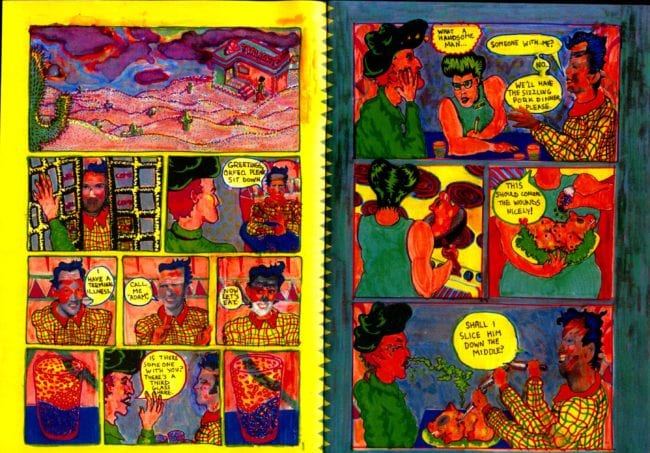
Secret of the Saucers by Char Esme, 2013
Pages from Secret of the Saucers by Char Esme, 2013

I'm always surprised that we so rarely see comics like this one, works where total expression is attempted without much concern for the trouble the reader will go through to grasp what's being communicated, but instead with a desire for the audience to catch up. Underground/art comics is a small world, with (it varies year to year) virtually no industry. Experimental works often allow themselves to fall into trends of the day, allowing their truly groundbreaking qualities to be go through a twisty straw constructed with of-the-moment popular aesthetic tropes to make the enterprise more palatable. Not so with this comic by Esme. A comic based on the life of Orfeo Angelucci, a man who claimed to be in contact with extraterrestrials, this is an uncompromising work: the characters change appearance from panel to panel, there is no visual relief in the form of negative space, facial expressions often clash with what is being expressed verbally and the subject matter itself makes one uneasy. I don't believe any work of art is made up solely of intentional choices and I don't believe in a 'gotcha' critique in which a nontraditional work is shown to be doing things exactly as it set out to do. And yet... with this comic, all of Esme's choices are thrilling, all add up to an experience that has no peers elsewhere, in a way I've never had (and I'm sure never will have) elsewhere. I believe Esme once expressed that she liked reading 'any comic' that was put in front of her, and this work, in spite of its seeming opposition to what cartooning is, can only be a comic. It presents us with an experience using images, text, and characters that is entirely its own, and rewards, both in feeling and intellect, the challenge it presents.

Meanwhile, elsewhere:

—News. Marvel Comics is relaunching its entire line, always a good sign of a healthy brand. This is probably just the lingering virus in my system that had me out of commission for the entire three-day weekend, but I'm getting less and less confident about the near-term survival of comics stores as we know them...

A GoFundMe fundraiser is very close to raising the money necessary to publish the last comic by Mark Campos.


—Reviews & Commentary.
Charles Hatfield writes about Ezra Claytan Daniels & Ben Passmore's BTTM FDRS.

Creepy and charming, it mashes up oozy, sick horror and dark, politically barbed comedy. The story satirizes racism, structural and environmental, via a blighted Chicago neighborhood and an imposing, temple-like block of an apartment building there that serves as the setting. A hyperbolic SF riff on urban decay, BTTM FDRS also skewers the kind of White hipster hypocrisy that extols urban decay for its authenticity. It does all this with a cast of distinctive characters, funny, stinging dialogue, and moments of queasiness built around a body horror conceit: that of a building that literally gets inside your guts. It’s one of a kind.

Michael Dooley looks at Paul Gravett's Mangasia.

[John] Lent investigates comics cultures and changes regionally, from East to Southeast to South Asia, while Gravett explores its subject thematically within a loose chronological timeline. Visually, Asian Comics has a textbook vibe, with its university press-style workmanlike cover and amateurish layout, while Mangasia comes across as an eye-popping coffee-table book, from its screaming cover starring Star Punch Girl to pictures on every single page, beckoning you to keep flipping through. And while Asian Comics has less than 200 images, all in black and white, Mangasia is in full color and packed with more than a thousand. And while there are a few by familiar names like Osamu Tezuka, Sonny Liew, and Nestor Redondo, many are wildly experimental and most have rarely, if ever, been seen in the U.S. However, in this case less images would have been more, inasmuch as a handful are either undersized or unsharp.

Brian Nicholson looks at Adam Warren's Gen13.

“Everybody’s talking about Riverdale and the Archie who fucks,” I texted a friend. “But the original Archie that fucks is Burnout from Gen13.” The sad truth that led to me having Gen13 on the brain was that I had recently purchased the last few issues of Adam Warren’s run on the title. Not the issues drawn by Ed Benes, whose figures have the expressiveness of mannequins, but whose proportions make it clear you’re supposed to jack off to them, but those drawn by Rick Mays. Mays’ manga-influenced style is close to Warren’s own drawings, though its less maniacally cartooned, a little closer to mainstream superhero comics notions of detail. He illustrated the Kabuki spin-off miniseries Scarab. The first issue has its main character on the toilet, flipping through comics and talking about an earlier Adam Warren Gen13 comic. It’s a weird scene. Not just the page, but the subculture of comics that produced it. That’s not to place any value judgment on the work. I’m not necessarily in love with Rick Mays’ art, but it’s a good match for comics I feel conflicted about.

—Misc. Daniel Clowes as a category on Mastermind.

Eddie Campbell is publishing new webcomics.

Know When To Fold Them

Today at The Journal, the indefatigable Rachel Davies returns with a review of Anneli Furmark's Red Winter

While many comic books involving tense political climates announce it clearly, or feature the political climate as the meaning for the book, Red Winter’s 1970’s Sweden, following the fall of the social-democratic party, isn’t so much important on its own, but in the way that it affects our protagonist, secondary to the romantic emotional tether of the book. Books like Art Spiegelman’s infamous Maus or Sarah Glidden’s How To Understand Israel in 60 Days or Less grapple with the way politics affect our lives in a very head-on way––the central tension of these books is parsing through a problematic history, and using politics as a lens on love, and other emotions. Furmark has strayed from that route, and uses love as a means to view politics, commenting on almost exclusively the ways that a political affiliation problematizes a relationship between two people.

It must be Drawn & Quarterly day here at TCJ, because that's not all-we've also got a visit from Robert "Bobbie" Sikoryak, who documented his most recent book tour for you, the Journal reader. As is his wont, said documentation comes in comic form, and features a loving tribute to the "other" Robert in comics--sweet Liefeld. Before agreeing to run the piece, I extensively confirmed with D&Q and Sikoryak that Liefeld's work would be treated with the utmost respect, and they assured me that was the case. It's not so much that I'm a super huge Liefeld fan, although I do have a lot of fondness for the way Matt wrote about him, but that I'm not a super huge fan of that thing where 80% of the comics internet started talking about the feet thing all the time. Same thing with the tv show 24--for the entire time it was running, every guy and their best guy friend had the same joke, asking about when Kiefer went to the bathroom, and everyone always asked it with the same gee-golly tone of voice that made it clear they believed they were the first person to ever make that observation. Liefeld was/is the same way--he's the guy that turns every pencildick into Manny Farber with the fucking feet comments. It doesn't matter that there's like 800 zillion super-hero artists who couldn't draw a flatscreen television set without lightboxing an IKEA catalog, all of whom have completely escaped criticism since the dawn of their miserable, dull-ass careers, Rob Liefeld is somehow the exemplification of the failing of modern illustration because of some affectation that had absolutely zero bearing on his job, which was to draw giant steroid cases with guns shooting at Spider-man rip-offs while women with the most insane hair you've ever seen screamed so big you could trace their gumline with a cricket bat. Until I started reading the comments section to Rob Liefeld articles, my opinion on the guy was that I had zero interest in reading any of his comics ever again, but ever since he became the target joke for people who call themselves intellectuals while also calling Saga an "indie" comic, I sort of fell in love with him. That being said, I've met him a few times and he always seemed deliriously happy with his station in life, so maybe I should just let it go, it's not a battle that needs fighting. I also did try to read some X-Force a few years ago and it was an impossible slog. I guess the whole point of this complaint is: sharpen your knives?

Feed Zone Portugals

Today at The Journal, we've got dw on Yuichi Yokoyama's Iceland, which was released by Retrofit Comics last year. It's an excellent comic, and dw's review gets right into the meat.

Elements of his aesthetic - acutely distinctive character designs, aggressive contrast between black and white (with artfully-deployed dots and grays), busy layouts that bulge uncomfortably against the edges of the claustrophobic pages - push any given narrative moment or representational image distressingly close to the point of abstraction. Trying to grasp the deceptively simple narrative induces tension and unease, reflecting emotions that afflict the characters to varying degrees.

A solidly influential comics figure sent a list of demands for coverage within days of me taking on this little role here, and one of those was that The Journal get around to talking in more detail about Retrofit's development over the last few years--it's not a bad idea, and maybe by outing it here I'll move it to the top of my to-do list, placing it one spot above "convince my wife to go see that Clint Eastwood movie with me."

It didn't seem right to ignore the release of Black Panther this weekend, considering how much I've been enjoying that Kendrick Lamar album. Don't get me wrong--it's still a Marvel movie that includes a slow motion flip over a car and a speaking role for that ridiculous ham they usually cover with motion capture dots, so I'm not holding out a lot of hope. But it's also absolutely plausible that Ryan Coogler--the man who realized that the beating heart of a sports movie is the workout montage, so why not include one that is 45 minutes long--has come up with something that even Chadwick Boseman, an actor whose ambitions don't seem to extend beyond the heroes of his 9th grade social studies class, can't turn into another leaden monologue on truth & justice. But hey: this is the COMICS Journal, we're not part of the Disney Marketing Arm quite yet.

SO: Back in 2010, Marvel Comics released an overpriced hardcover collection of Don McGregor's run on Black Panther, which contained the story "Panther's Rage". At that time, comics critic David Brothers and I teamed up to write about that story, why we liked it, what we thought it said about super-heroes, and Black Panther in general. We've repurposed those pieces into one article, which you can read on your phone while you wait in the line to watch Michael B. Jordan convince you to renew your gym membership. Ladies and gentleman: Fear of A Black Panther.