

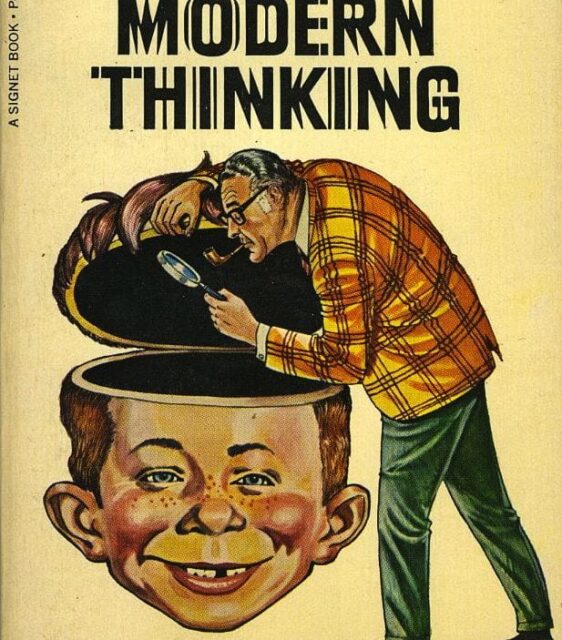
Modern Thinking

It's been a good week for alumni of The Panelists; first, we posted Charles Hatfield's very nice review of Battling Boy on Monday, and now Craig Fischer hits it out of the park with a piece you could call twenty-six short essays on Dave Berg. Dave Berg, of course, is the cartoonist behind Mad magazine's time-defying "The Lighter Side of..." feature, and Fischer's article examines him from multiple angles, in fact one angle each for every letter of the alphabet:

Happiness

The characters in a typical “Lighter Side” strip believe themselves to be normal and well-adjusted, with personalities and behaviors that remind me of Eric Wilson’s description of Americans in his book Against Happiness (2008): “They tilt their heads to the side, feign amusement, and nod knowingly. They clinch their eyes in looks of concern. They blink a lot, bewildered. They murmur truisms about overcoming adversity. They say that they love their parents and puppies and all babies. They devour bestsellers about the wisdom of children or coaches. They can be smarmy war-mongering conservatives or passive-aggressive peace-loving liberals. They can be Christians hiding their meanness or New Agers hungry for power. They adore the Lifetime channel. They are happy campers. They want God to bless the world. They want us to ask them about their children. They believe that a hug is an ideal gift; one size fits all. They think that kind words make good echoes. They join Book-of-the-Month clubs and identify with sympathetic characters. They sign their e-mails with chirpy icons. They swear by the power of prayer. They swear by the power of positive thinking. They dream of having Norman Vincent Peale as a dinner guest. They would eat Jell-O and Cool Whip. They would eat turkey too and make an endless Thanksgiving.”

And they are, of course, all hypocrites. “The Lighter Side” was a central reason why teenagers love MAD: teens realize that all adults are two-faced, and saw that fundamental truth in Berg’s cartoons.

Elsewhere:

—Talk. The latest guest on Inkstuds is Jim Woodring. Alex Deuben has an interesting report from a panel featuring Jules Feiffer and Darwyn Cooke at NYCC. Michelle Pauli interviews Jean-Yves Ferri and Didier Conrad, the creative team behind the relaunched Asterix series. And talking to the New York Times about books, J.J. Abrams elaborates on his enthusiasm for Chris Ware (and Mo Willems).

—Criticism. Ware gets the academic treatment as Paul Williams at Comics Forum compares his work to literary modernism. Rob Clough briefly reviews three independent adventure comics.

—News. The CBLDF blog reports on a Kickstarter-funded anti-military comic book being refused by multiple UK printers. I missed this Jonathan Guyer piece on "blasphemous" cartoons in Egypt.

—Misc. J.J. Sedelmaier shares a huge gallery of Mad paperback images. Herb Trimpe on 9/11. And finally, I didn't realize this Osamu Tezuka documentary was online. It's well worth watching. (via)

Views

Today we re-present Gary Groth's 1998 interview with Peter Bagge.

GROTH: Well, we don’t know for sure what the demographics of people reading alternative comics are. I mean, we’re guessing between 18 and 25 predominantly, but it’s hard to say with any certainty.

BAGGE: I would say with considerable certainty that our readership drops off fast once you get beyond age 25. But I have some ideas of how we could at least try to reach older readers. One idea is to format it like the [Fantagraphics Books] catalogue, and I wanted to do everything that we can to sell as many via mail order, and really play it up on the Net, which is something that we haven’t really tried yet. I’ve been intending for like a year to get a web site going, that’s where people do a lot of their “shopping and strolling” these days, on the Internet. The Journal and the Fantagraphics web sites haven’t been up that long, but it’s a pretty sizable number of people who have at least checked it out. So as long as it’s on there, there are people who would still be buying our comics, except for the fact that they’ve got families and careers. They can’t be bothered to go all the way down to the “hip” comic shop and pay for parking, or find a parking space, but if they see the stuff on the Net, or get it into their hands somehow, maybe even sending it out mail order. You know, like maybe putting out one, a test one, that is most like a catalogue. Or we could take one issue of the Fantagraphics catalogue and kind of introduce “Let’s Get It On!” within the pages of that, because the problem of why people buy comic books, and why they don’t is logistical. I think it’s a geographic problem, as well as a cultural one.

GROTH: Is it your opinion that people drop off from reading alternative comics at a certain age, that they just move into other things at a certain point of their lives —

BAGGE: Yeah, I think that what’s going on in their lives has a lot to do with it, then it just carries on physically and time-wise. Takes them away where they just can’t afford to invest the time and money —

GROTH: But they don’t stop watching movies, or stop watching TV —

BAGGE: No, that’s right, because you can do that without leaving your home.

And elsewhere, the world spins 'round:

Tom Spurgeon has commentary on the latest Kirby estate legal go around. And more commentary is at The Beat.

Peter Bagge's Woman Rebel: The Margaret Sanger Story, excerpted on Flavorwire.

I missed this Brendan McCarthy interview last month. Here it is.

Robert Boyd writes about Zinefest Houston 2013.

Robert Stanley Martin has published the second part of his examination of his Jim Shooter: A Second Opinion.

Matt Madden spends a week in Helsinki.

Yet more of an interview with Alan Moore on Miracleman.


Hello, Dear

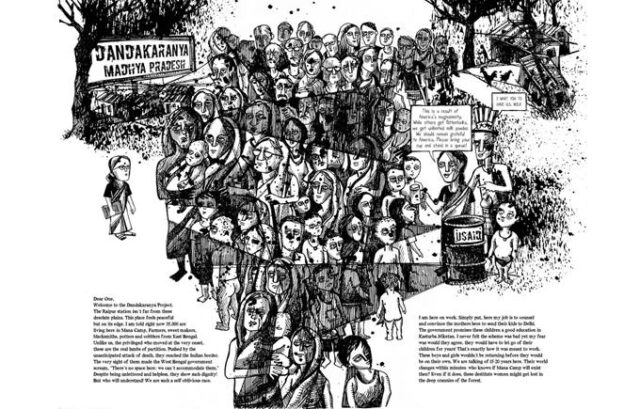
It's an unplanned theme, but today appears to be all about political activism on TCJ.com. First, Ryan Holmberg has an interview with Vishwajyoti Ghosh, the cartoonist behind Delhi Calm, set during India's "Emergency" of 1975 to 1977. Here's an excerpt:

It seems like you have always been interested in political topics.

I just find myself drawn to them. I don’t claim that I have a particular interest in politics, but I find myself very drawn to discussing issues in a visual framework. I have never been a big fan of speculative fiction or science fiction. Most of my comics haven’t moved beyond the twenty meters of my own universe. I find that universe itself quite enough to deal with.

If that’s true, your personal universe includes more political and historical issues than most other cartoonists. One could say that a lot of people who draw graphic novels or manga-style comics are focused on their immediate universe, their everyday life, but devoid of politics and history.

Well, in my case, even when I do something not political it gets perceived as political. The moment I open my mouth, everyone thinks it’s political. But that might not necessarily be the case. I did a comic two years back for Time Out, a special issue on food. I did a piece about an Iraqi restaurant in Delhi, just a nice conversation piece with the Iraqi manager of the restaurant. The way the magazine put it out made it sound like it had less to do with food and more with politics.

Rob Kirby is also on the site today, with a review of John Lewis, Andrew Aydin, & Nate Powell's March.

Presenting the story in the form of a graphic novel makes it that much more accessible and immediate for the targeted YA audience; March is a showcase example of the power of the comics medium as an educational tool. As a teenager himself, Lewis drew great inspiration from a ten-cent comic book called Martin Luther King and the Montgomery Story, published in 1956. He recently told an interviewer that this humble comic was “like a Bible” for him and his fellow activists back then, an indispensable tool for learning how to implement non-violent activism and protest techniques such as passive resistance and sit-ins. Though March deals with important, weighty themes, it never feels didactic, remaining immediate and engrossing throughout. Lewis and his co-writer, congressional staffer Andrew Aydin (who convinced Lewis to present his narrative in the comics format), keep the proceedings simple and linear.

Elsewhere:

—Criticism. Joe McCulloch and Janean Patience finally present the fourth and final part of their long, fascinating dialogue on Mills & O'Neill's neglected Marshal Law. Tom Gill writes about a hard-to-find collection of newly translated Tatsumi stories.

—History & Background. Neil Gaiman & Dave McKean tell The Guardian how they made Sandman. A selection of New Yorker cartoonists reveal the autobiographical basis of some of their cartoons. MLive has a short profile of Randy Scott, the man who oversees the largest library comic-book collection in the world.

Accounts

It's that time in the week when we break and say hello to Joe McCulloch.

Elsewhere:

Hey, Bob Fingerman is bringing back Minimum Wage through Image. Here's an interview.

Johnny Ryan has Ten Rules for Drawing Comics he'd like to share with you.

Reprints of Miracleman are coming to Marvel, sans Alan Moore's credit (at his request), so here's Moore on his history with the character at The Beat.

And finally, Tom Spurgeon comments on his group-think list of under-appreciated 2013 releases.

Capitale

Today, Charles Hatfield tells readers about Paul Pope's long-awaited Battling Boy:

I’ve always enjoyed Pope’s cartooning (his series THB was one of my happier comic shop discoveries of the nineties), but haven’t always been on the side of Pope the writer, who has sometimes succumbed to dithering or affectation. Reading Pope has been a matter of seesawing between grateful wonder and head-scratching befuddlement. I confess I’ve often thought that his writing couldn’t keep up with his drawing: his habit of lovely, obsessive, kinetic mark-making, all swoops, flecks and spatters, whirling, febrile, alive. Often I’ve enjoyed the voluptuous style, the grotty worlds and gorgeous characters, without liking the ways the stories turned, or sputtered, or collapsed. I’ve dug his wild flights without thinking he had a solid book-length story in him. Battling Boy promises to prove me wrong.

Elsewhere:

—Interviews. Xavier Guilbert at du9 talks to Jaime Hernandez. Michael Cavna talks briefly to Bill Watterson and Richard Thompson about their upcoming show. Steven Heller talks to Seymour Chwast. And Will Self (!) interviews David Shrigley:

At art school, the stuff I was excited about was by Duchamp, Warhol and many others, but it was ideas-based art, and that's where you find my form of ideas-based art. When I left, I didn't have a studio, and it was just a practical thing: I thought: "Maybe I should just focus on these drawings, because I actually like doing these a lot more than trying to make the difficult sculptures and doing the large-format photography that I'd made at college." I felt I could say what I wanted to on a sheet of paper, sitting in my shared flat. And I thought: I'll make a book, so I just made the book on a Xerox machine and gave it out at the pub, and that's how it all started.


—Reviews & Criticism.
Rob Clough reviews groups of new minicomics here and here. Qiana Whitted has an interesting post and inspired an good comments discussion on race & cartooning at the Hooded Utilitarian.

—Miscellaneous. As many of you probably know, Marvel has finally decided to start re-releasing the Alan Moore-written Miracleman comics, and are honoring his apparent request to keep his name off the books. But a credit for "The Original Writer" isn't all that's strange about the reprints, and retailer Mike Sterling ponders other aspects here. Luke Pearson shares info & art from his participation in a Hari Kunzru-inspired group show at the Victoria and Albert Museum. Yesterday's Papers has a nice selection of Frans Masereel. And finally, I know Dan already linked to this Jeet Heer profile on Friday, but he neglected to mention the writer's wonderful headline calling him "the Derek 'Jeet'er of comics", and I think it is important that we recognize that happened and hold it close to our hearts.

The Light

Tucker Stone returns to our little web site today, and not a moment too soon. He's retitled his column. Let it now be known as "The Corrections."

Elsewhere online there's all sorts of stuff percolating:

The big comics story of the day is a new interview with Bill Watterson, previewed over here.

The full programming slate for Comic Arts Brooklyn has been announced, and it's a doozy.

TCJ-contributor Jeet Heer's In Love With Art is profiled.

Chris Randle on Battling Boy.

Peter Bagge gets the local-paper treatment.

Comics Alternative looks at Comics and Narration by  Thierry Groensteen.

I always love a Dan Zettwoch process post.

And in business news, the publisher IDW is expanding into television and movies.

Mm

Frank Santoro's on deck today, with another diary from the road of his Pompeii tour. This week, he visits the legendary Fantagraphics office in Seattle, and then heads up to Vancouver. Here's a sample:

Then we drove up I-5, got off at exit 171, made a couple turns...and thar she blows! Ye olde warship known as the Fantagraphics office. There is an "art installation" next door - and I mean that respectfully (seriously). There is this awesome older woman who has decked out her house and yard in a way that makes it a very satisfying "art experience" (below):

DSCN1619

And then we have Rob Clough's review of the anthology Black Eye 2:

Black Eye 2 is an almost painfully personal statement by its editor, Ryan Standfest, despite the fact that very few of the pieces present in the book are his. The first volume of this anthology was outstanding in a number of ways, but it also felt flabby and self-indulgent at times. In some ways, that first volume was Standfest's personal manifesto regarding Black Humor and comics in general, and his desire to draw a line between EC horror comics, Black Humor, and today's cartoonists saw him tenuously stretch those connections. The second volume feels tighter and sharper. There's less of an editorial preoccupation on telling the reader what Black Humor is and more of an interest in actually showing them.


Elsewhere:

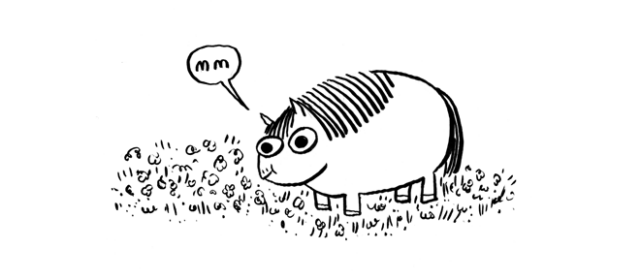
—Interviews. The latest guest on Inkstuds is Paul Pope on the occasion of his new Battling Boy. Bleeding Cool talks to Nobrow co-founder Alex Spiro after they opened up their New York office. Laura Hudson talks to Kate Beaton about her new fat pony project.

—News. PRI reports on Syrian cartoonist Akam Raslan, who was recently reported dead by other outlets. PRI says that his death is currently impossible to verify.

—Reviews & Comment. Probably the must-read for today is Charles Hatfield's very disappointed take on the bad history in PBS's Superheroes documentary. Mike Rhode also writes about the documentary, in three parts. Then, Rob Clough reviews Ulli Lust, Sean T. Collins reviews Cameron Hawkey's Nux Yorica, and Neil Cohn reviews Hannah Miodrag's Comics and Language.

—Finally.
A newish site called 10 Rules for Drawing Comics collects cartooning codes from cartoonists like Mike Allred and Lucy Knisley.

Touch the Sky

Today on the site: Part two of Paul Tumey's epic exploration of the life and work of George Carlson.

George Carlson’s sensibility comes not from comic books, nor from newspaper comics – but instead from a rich mix of early 20th century commercial art, book/magazine illustration, game design, and advertising. Much of Carlson’s work is primarily concerned with appealing to and nurturing the minds of children with an emphasis on stimulating the imagination.

Generally, when we read golden age comic book stories, we have – I think – a predisposition toward a certain context that one could say mainly revolves around the myth of the hero’s journey, issues of morality and justice, and the shadow side of sexuality – a context that is very much alive and well in current American culture.

This 1917 war-time poster by George Carlson shows a mastery of early twentieth century graphic design styles

The “quirky” Carlson’s “genyoowine” sensibility emerges from a completely different context, one that is grounded both in early twentieth century graphic design and in classic children’s literature from Lewis Carroll to Edward Lear to Mark Twain (all of whom Carlson illustrated). What seems quirky in the world of comics is utterly mainstream in the larger world of classic children’s literature. It makes perfect sense, then, that Art Spiegelman said that Carlson’s work was one of the raisons d’etre for the creation of the TOON Treasury, a book that is intended to frame kid’s comics as part of the continuum of “classic” children’s literature.

The only other early comics work I know of that shares Carlson’s grounding in children’s classics is the late 1930’s comics published by David McKay, who published such literary giants as Shakespeare, Walt Whitman, and Beatrix Potter. Founded in 1882, David McKay’s Philadelphia-based publishing house was rooted in a different context than most comic book publishers based in New York.

Elsewhere:

Forbidden Planet reviews Love & Rockets: The Covers.

Gil Roth interviews Peter Bagge. Brian Heater interviews Kim Deitch.

A nice photoset from last weekend's APE.

Two reports on NYCC. One from The Beat and one from Wired. And further reporting on harassment incidents at NYCC from The Beat and commentary from Tom Spurgeon.

Chris Mautner reviews three recent books.

And here's a video of the Jeff Smith Q&A from this year's SPX.


I Awaken to Darkness

Joe McCulloch is back with the Week in Comics column, in which he highlights the week's most interesting-sounding new releases, and this time, he warms up by putting on his movie-reviewer hat (and shoes and cape):

Contrary to popular belief, I don't just sit around watching cartoons all day; sometimes, I watch live-action films that are sort of about cartoons. You may have heard of writer/director Randy Moore's Escape from Tomorrow - it was a *huge* thing in movie critic circles at the Sundance Film Festival, insofar as much of the film was shot in secret at Walt Disney World in Orlando and Disneyland Park in Anaheim via actors performing their scenes in the midst of actual crowds, filmed with concealed cameras at certain preplanned times of the day to ensure adequate lighting. Nothing quite aggravates the hothouse scene of a film fest like a movie that looks like it might find itself suppressed outside of Park City, and hype built accordingly. However, Disney has not made any legal challenge to the film, which seems to have performed rather poorly on its formal release this past weekend, grossing less than 1/10th of its $650,000 production budget.


Elsewhere:

—Interviews. Chris Ware talks to The Guardian, and Maria Scrivan talks to Mike Lynch.

—Reviews. Abhay Khosla doesn't like Greg Rucka and Michael Lark's Lazarus. Rachel Cooke loves Isabel Greenberg's Encyclopedia of Early Earth. Amelia Moulis reviews Rutu Modan's The Property. Chris Mautner mini-reviews Ed Piskor, A Treasury of Mini-Comics, and Bill Everett. Rob Clough reviews so many comics. Cefn Ridout reviews Ben Katchor and Gilbert Hernandez.

—Misc. Jason T. Miles shares many things.

And finally, Dash Shaw:

Cloistered

Today on the site it's R.C. Harvey profiling the great Sergio Aragones.

Astonishingly, he draws directly on the paper with a pen, relying upon barely penciled roughs for only the vaguest guidance. And he seldom re-draws anything: “I see the gag in my head and it goes directly to the finished drawing stage.”

Again and again he successfully pulls the same stunt: he presents a puzzle, often building it in a succession of pictures in strip form, and then, in the last picture, he “explains” the puzzle. And we laugh at the ingenuity of the contrivance.

Sometimes though, he draws a picture that is, simply, in-and-of-itself, funny. The people in the picture look funny: Sergio’s typical humanoid begins with a big-nose visage and doodles down through a squat body to the stilt-like legs that seem grafted on at the bottom of the body, all balanced on flat not necessarily large feet. His anatomy is cartoon anatomy, but his cartoony people are doing ordinary human things, and they are being forever fooled and flummoxed by their fellow creatures or by circumstances over which they have absolutely no control. And we laugh at their endless frustrations. And then, a second or so later, we realize that we’re laughing at ourselves.

Syrian cartoonist Akram Raslan has been reported killed.

Anya Davidson interviewed at Bad at Sports.

Tom Spurgeon interviews Ben Catmull.

Paul Gravett interviews Enki Bilal.

A Joe Sacco primer.

And a fascinating glimpse at the problems entailed in writing about Shel Silverstein for an academic press.


@#$%&!

Today, for any of you tired of the Lee/Kirby debate that continues to rage, Rob Kirby (no relation, I assume) tells us all about the Latvian comics anthology, š! #14. Here's a sample of his presentation:

The theme for this latest issue is sports, which at first seems surprisingly conventional, coming from an anthology with past themes such as “Female Secrets” and “Midnight Sun.” Happily, the comics inside are anything but ordinary. Many of the š! creators seem to delight in presenting warped or heightened realities that veer from lighthearted whimsy to dark and downbeat.

I’ve slowly become familiar with the work of many of the contributing artists, some of whom have become favorites. It’s a treat to see König Lü. Q. and Lai Tat Tat Wing included here (I believe the former is in every edition), two artists who couldn’t be more dissimilar in style and content. Lü. Q. traffics in silly or non sequitur one-page strips with simple, childlike drawings, a type of comics I’ve always found irresistible. His “Real Quidditch” strip is a deadpan take on the Harry Potter series sans the “magic.” Meanwhile, “Taken” by Lai Tat Tat Wing, features another of the artist’s delightfully trippy identity-swapping, reality-changing narratives, drawn with a playful rather than stuffy formalism. His work would have fit neatly in RAW back in the day, no problem.

Elsewhere:

—Interviews. Jeet Heer appears on Inkstuds to discuss his monograph on Françoise Mouly. The Guardian interviews Joe Sacco about his new WWI book, The Great War. (They have a preview of the book, too.) And Michael Cavna at the Washington Post asks Jeff Smith about his new place on the CBLDF board.

—History & Profiles. BK Munn writes an obituary for the Canadian editorial cartoonist Roy Peterson. Mike Lynch has a few links regarding a new book on Archie cartoonist Bob Montana. Daily Ink has a short post on Mandrake artist Phil Davis. And I don't know why, but I'm getting major deja vu vibes off this Slate article on the history of swearing in comic strips.

—Other Stuff. Tom Spurgeon reviews the new Bill Everett collection. It is fun to read an article in mainstream media going on and on about how well comic books handle ethnic and sexual diversity compared to movies. If true, this is kinda hilarious, too, though in a different way. Finally, Rob Kirby, today's reviewer, is trying to fund a new LGBT-themed anthology via Kickstarter.

Admit It

Frank Santoro files his column from the road.

And James Romberger reviews In the Days of the Mob.

Elsewhere:

A new book on Bob Montana outside of Archie. Mike Lynch's announcement of the book includes this quote, which is the best I've read about comics in a long while:

"Bob didn't want his friends to think he was all about the comic strip," said Anderson. "One of his friends told me that he used to say, 'What kind of person would you think I was if my ego and self worth were wrapped up in a comic strip?'"

What kind of person indeed?

Comics repression in Egypt.

Writer-about-comics Gene Kannenberg, Jr. podcasts.

A preview of Brandon Graham's new Multiple Warheads rarities collection.

Darryl Ayo Brathwaite on cartoonists as human beings.

Rob Liefeld on the halcyon days of the X-Men.

More love for Ed Piskor from his hometown paper.

Not comics: The great film critic Stanley Kauffmann passed away and James Wolcott and David Denby pay tribute to him.


Big Books

Paul Tumey is back today with a new column trying to make sense of the long and varied career of George Carlson. Here's a snippet:

In the year 8113 A.D., the most remembered cartoonist of our time may not be any of our currently revered comics creators. Not Winsor McCay, George Herriman, Jack Kirby, Robert Crumb, Art Spiegelman, or Chris Ware. As incredible as it may seem, long after the last comic books of our time have crumpled into dust, the cartoonist of our era that People of The Future will dig (perhaps literally) could be a guy named George Carlson -- an under-appreciated, largely overlooked cartoonist, illustrator, game designer, and graphic artist extraordinaire who will finally get his due with the forthcoming release of Perfect Nonsense: The Chaotic Comics and Goofy Games of George Carlson by Daniel Yezbick. The spirit of George Carlson's playful, surreal world can be seen in everything from Pee-wee's Playhouse to 24-hour comics.

People of the distant future may know about Carlson not because of Yezbick’s book (although it’d be nice to think so), but more likely because of the Crypt of Civilization, a room-sized time capsule that lies underneath what is currently known as Oglethorpe University, in Atlanta, Georgia.

When future human beings pry open the rusty door of the Crypt, they will see plaques on the walls created by George Carlson. The bold, Art Deco graphics on the plaques, barely visible in the photograph of the Crypt’s interior, are presented in a manner that looks back in time to the hieroglyphs seen on the walls of ancient Egyptian burial chambers. In 1940, the Crypt’s creator, Oglethorpe University president Dr. Thornwell Jacobs set the year for the time capsule’s opening at 8113 A.D. - exactly the same amount of years into the future as the number of years spanning backwards in time from 1940 to the oldest known Egyptian tomb.

Elsewhere:

—Profiles & Interviews. Steven Heller profiles Sunday Press publisher Peter Maresca. Rebecca Meiser at Cleveland magazine profiles Joyce Brabner about her handling of Harvey Pekar's legacy, her sometimes prickly relationships with collaborators, and her own upcoming work. I can't wait to listen to Gil Roth's interview with Drew Friedman. Missed this earlier, but Last Gasp has begun a series of Weirdo: Where Are They Now? mini-profiles of Weirdo contributors.

Fangoria's Philip Nutman, who also worked as a comics writer and editor, has passed away.

—JC Menu has sent in his tribute to Kim Thompson. We've added it to the Thompson tributes page here on the site.

—Anime News Network reports on the cancellation of Barefoot Gen translator Alan Gleason's appearance at a Japanese school, apparently partially due to ongoing political controversy over Keiji Nakazawa's work.

—Jessica Abel & Matt Madden have released the longlist of Notable Comics for Houghton Mifflin's Best American Comics of 2013.

—The Columbus Dispatch reports on the expansion of the Billy Ireland museum.

—Tom Spurgeon has posted an early review of Joe Sacco's The Great War.

—And finally, Peggy Burns and the D&Q store appear briefly in this video:

Contradictory Impulses

It's Tuesday, so Joe McCulloch is here to give you the goods on the week's more interesting releases.

Guess who has a Tumblr? The aforementioned Mr. McCulloch, that's who.

I didn't know about the YouTube channel for the forthcoming book The Secret History of Marvel Comics.

The great Al Jaffee's archives are going to Columbia University.

Tom Spurgeon reviews The Best of EC volume 1, Artist's Edition. And Treasury of Mini-Comics, reviewed.

Finally, we've all felt this way.

Surprise

Today our webcomics columnist Shaenon Garrity writes about a new favorite of hers, Dana Simpson's Heavenly Nostrils.

Elsewhere, the comics internet is filled almost entirely with interviews.

Prairie Dog talks to Jeet Heer about his new book on Françoise Mouly:

I wrote an article for the National Post about 10 years ago where I was trying to describe Art Spiegelman’s career as an editor. I had written: ‘Leaving Françoise Mouly aside for a moment, Art Spiegelman’s achievements are blah, blah blah’. My partner, quite rightly, called me on that, and asked ‘Why are you leaving Françoise Mouly aside? She was as important at RAW magazine as Art Spiegelman.’ And that really got me thinking because I had been aware of Françoise my whole life, and respected her and the magazine that she did, but I’d never written about her. For every one article that anyone has ever written about Francoise, there are at least 500 to 1,000 articles written about her husband.

Alex Deuben at CBR talks to Rutu Modan and Ramona Fradon.

Here's Fradon:

I believe that Marie Severin and I were the only women drawing superheroes at the time. It's funny that she was drawing Sub-Mariner while I was drawing Aquaman. People always used to ask me if I knew her, but I didn't meet her until years later, at a convention. I didn't work in a bullpen like Marie did so, aside from being uncomfortable with male fantasies and the violent subject matter. I never really experienced what it was like being the only woman working in a man's world.

The School Library Journal talks to Hope Larson. And CBC talks to Miriam Katin.

And Michael May at Robot 6 had the bright idea of talking to retailer Mike Sterling in the aftermath to DC's Villains Month:

I was generally okay with it, with my reaction split between the comic fan in me (“Oh, those sound like fun!”) and the retailer in me (“Gee, great, can’t wait to figure out my order numbers on these”). That latter reaction sounds more serious than I actually felt. It’s more like, well, there go the publishers, making my life more difficult again! Whaddaya gonna do?

Pun Intended

Dan is out of town, so I'm filling in today. Rob Kirby is here with a review of Brendan Leach's Iron Bound:

On a rainy night, two young gang members in black leather jackets, Eddie and Bento (aka Benny), are arguing on a bus traveling from Asbury Park to their hometown of Newark, New Jersey. Another young man seated in front of them unwisely asks them to "speak more softly." This prompts a vicious attack from the hair-trigger-tempered Benny, despite Eddie's attempts to rein him in. Blood is shed; Eddie and Benny are thrown off the bus and beat a hasty retreat. With this prologue, Brendan Leach ushers us back to 1961 and the criminal underworld of Newark's Iron Bound section. In this pitiless arena, any attempt to get ahead faces obstacle after obstacle, trust comes at a premium, and good intentions are likely not good enough. Iron Bound reads like a delicious amalgam of a vintage Jim Thompson crime noir novel with illustrations reminiscent of (mutant) Ben Katchor fused with a hint of Lynda Barry’s early punky-scrawly-scratchy style.

Elsewhere:

—Interviews. Whenever you start to think that mainstream media coverage of comics has greatly improved, you come across something like Metro's interview with Isabel Greenberg. Veteran newspaperman Chris Mautner shows how it's done talking to Brian Ralph. And Inkstuds plays host to Jess Johnson.

—Reviews & Commentary. Sean T. Collins writes about Sophie Franz's "Andy". Sean Kleefeld speculates on the first black comic-book hero.

—"News." Ulli Lust has a huge photo-blog post of her recent trip to the United States, in which many other cartoonists are featured. Rob Clough writes about the new comics show in Durham he's helping to set up. The Archie Comics/Nancy Silberkleit legal drama continues to provide copy for the New York tabloids. Jason T. Miles has revamped his Profanity Hill online store. MoCCA has announced their 2014 special guests, including Howard Cruse, Alison Bechdel, Fiona Staples, and Robert Williams.

—Misc. I love that Sean Howe's Marvel Comics Tumblr is still churning out great curiosities like this. Mike Lynch writes about the big comics movie of 1948.

Landscape

Today Frank Santoro takes a look at comics press history by way of three magazines from the mid-1990s: Indy, Feature, and Destroy All Comics.

Elsewhere:

—News. Pioneering comics scholar Sol Davidson has passed away. Jeff Smith has joined the CBLDF's Board of Directors. In a move that tempts bloggers to make statements on what it means for the direct market's future, Dark Horse has dropped its distributor Diamond for Random House. In a move that tempts bloggers to resurrect old posts, after 63 years, the military newspaper Stars & Stripes has dropped Beetle Bailey, apparently for budgetary reasons.

—Reviews & Commentary. James Romberger reviews Dash Shaw's New School. Derek Royal and Tof Eklund discuss Dash Shaw's comics career to date. Kevin Huizenga reviews Seth's new Palookaville. Sarah Horrocks discusses the coloring of Brendan McCarthy. Rob Clough reviews the Chris Duffy-edited Fairy Tale Comics. And in The Caravan, Rakesh Khanna discusses Vishwajyoti Ghosh's This Side, That Side: Restorying Partition, as well as graphic novels in India more generally.

—Misc. Mark Waid gives advice to comic-book freelancers. Jim Rugg remixes Dan Clowes. And Time talks to Ed Piskor:

New Titles

Dominic Umile reviews Ramsey Beyer's Little Fish.

Ramsey Beyer's spirited, often warm chronicling of her real-life journey through her freshman year at college is as much driven by the familiar trappings of teenagedom as it is punk rock, against-the-grain sensibility. Little Fish: A Memoir From a Different Kind of Year is a mixed media affair, with Beyer employing an intimate DIY approach honed in her adolescent zine-making days as often as she does black and white comics art, melding list- and poetry-driven prose with personal comics. Humble as it may seem, Beyer's blend of rough, zine patchwork-styled pages and graphic memoir is marked by a bold perspective on diary comics and the graphic storytelling medium.

Elsewhere:

Tom Spurgeon briefly on health insurance.

Lovely sequence by Leslie Stein.

Tom Scioli talks to Ed Piskor.

CNN on Archie.

Craig Thompson on his contribution to Fairy Tale Comics

And Gary Panter at CCAD


Rocktober

Joe McCulloch is here on This Week in Comics!

Elsewhere:

—Interviews. The London Telegraph talks to Joe Sacco. USA Today talks to Ed Brubaker. Agenda talks to the KutiKuti collective. Bleeding Cool translates a Brazilian interview with Chris Ware.

—Reviews & Criticism. Paul Gravett writes about Marc-Antoine Mathieu. Brian Cremins writes about Bill Mauldin's Back Home. Rob Clough recounts Karl Stevens's Failure. Sarah Horrocks looks at Kyoko Okazaki's Helter Skelter.

—News. Stephen Bissette explains on Facebook about compensation (or the lack thereof) going to the creators of John Constantine from the new television series. An exchange between Darryl Ayo and Ormes Society founder Cheryl Lynn on the small number of black female cartoonists.

—Misc. Forbidden Planet has a gallery of new BCA Hall of Famer Leo Baxendale. Bully has begun a month-long celebration of Dell/Gold Key horror comics.

Gym Time

Robert Steibel is back with another installment of his column about Jack Kirby: Behind the Lines. Here he looks at pencils from Fantastic Four # 61.

I’d like to do a little group participation experiment with you first. Let’s go ahead and look at an enlarged scan of each Kirby penciled panel one-by-one in sequence (I broke one horizontal panel in half so each image has the same size). When Stan Lee received this entire 20-page story (plus the cover) this is how the art would have looked to him before he added text to Jack’s story – first Stan would read Jack’s entire book (looking at Jack’s art and referring to Jack’s directions in the margins to get the gist of the entire book) then in the next phase Lee would go back and add his own text to Kirby’s story. You can see when these photostats were made Lee had already completed that phase of the process – notice where Lee added empty word balloons. The letterer would have worked off a Lee type-written script and filled in those spots.

I encourage you to look at Jack’s artwork and read Jack’s notes for yourself; think about how you would add text to this imagery if you were the “Guest Editor of the Week” when this book was published in 1967. Or better yet, imagine Marvel is reprinting this material in 2014 and you won a contest and have been selected to add the captions to the story for a nice pile of money. Reflect on how long it takes you to come up with the captions for each panel, and you can compare your own ideas to Lee’s text later.

Elsewhere:

Tom Spurgeon on MIX 2013.

A good "where are they now" blog on the great Weirdo magazine.

Two from Chris Randle. First on Co-Mix by Art Spiegelman and then on the anniversary of Comic Book Confidential.

Denis Kitchen on Gweek.

Nobrow is opening a US office and has a mission statement.

And MTV Geek, which covered a good amount of comics, has closed its doors.


Gonna Get Better Some Time

Ryan Holmberg attempts to uncover the roots of the word "Garo", the title of perhaps the most important underground manga anthology:

Not ten years ago, manga and film scholar Yomota Inuhiko noted that it was regional dialect for kappa, a water imp who abducts children and horses and drowns them in the river.

Speaking with Japanese fans and scholars, it seems that many accept Yomota’s theory. I’m not sure why. While indeed “garo” can be found in books dealing with the kappa – it is derived from “kawa tarō,” River Tarō, the latter half a generic boy’s name – none such that I have seen were published prior to the naming of Garo in 1964. Of the major sources on the Japanese supernatural that would have been available to Shirato at the time – the writings of Inoue Enryō, Yanagita Kunio, Ishida Ei’ichirō – in none of them is that specific pronunciation for kappa to be found. Of course, it is always possible that Shirato heard it directly from someone from the countryside. Or perhaps from a colleague more versed in Japanese folklore, like Mizuki Shigeru. After all, Mizuki did publish an eight-volume rental kashihon series between 1961 and 1962 titled Sanpei the Kappa (Kappa no sanpei), about a human boy that looks like a kappa and as a result has serial run-ins with yōkai. Towards the end, his kappa stand-in is named “Kawa Tarō,” but no “garo.” The title of the manga might seem suggestive, but Sanpei is a common enough name for it to have nothing to do here with Shirato. And since Garo was Shirato’s magazine, not Mizuki’s, it seems to me highly unlikely that the former would title his greatest publishing venture after a creature that has (as far as I can recall) never made an appearance in his work. Shirato was greatly indebted to Japanese myth and folklore. But the cosmologies of ghosts and monsters are at best minor ones in his pantheon.

Elsewhere:

—As you're probably noticed from links on this blog and elsewhere, this week is "Banned Books Week". The CBLDF's Charles Brownstein talked about it with a radio show called Project Censored. And here is a map of post-war comic-book burnings in the United States.

—Reviews & Criticism. Comics of the Weak may be on a short hiatus, but Abhay Khosla's still thinking comics, and reviews a slew of them over at Savage Critics. Dave Coates has a profusely illustrated post on Pat Oliphant. Rob Clough takes on Jim Rugg and Supermag. Tom Spurgeon reviews Sam Gaskin's Goblins. This guy loves the Fantastic Four.

—Interviews. Dan Wagstaff talks to Luke Pearson. J. Caleb Mozzocco talks to Chris Duffy about his new fairy-tales anthology.

—Fantagraphics unearths an unmissable note from Kim Thompson to a printer.

—Sean Howe puts some recent Rob Liefeld tweets about Marvel in context.

—It's the last day of the Top Shelf $3 sale.

Head Full of Snot

Today, we bring you Gary Groth's 1991 interview with with one of the truly great raconteur cartoonists, Arnold Roth. Here's one of many excellent exchanges:

ROTH: I wanted to do humor. I was frothing at the mouth to get in The New Yorker and they were very interested in what I had. An editor there went through my stuff, sort of giving me a critique. Finally, he said, “You know you keep making wise cracks. Are you sure you understand what I’m telling you?” I said, “Well, I think you’re telling me I should draw more like Cobean.” Sam Cobean was a terrific New Yorker cartoonist who had recently died in a car crash. He said, “You have to make up your mind if you want more than anything in the world to be a New Yorker cartoonist.” I said, “No, I want to screw and drink and smoke and cock around.” He looked at me and he was really serious. He repeated the question. I told him no and I never went back. That was the end of me, there.

GROTH: Why did you do that instead of giving him the “right” answer which would have been, “Yes, sir.”?

ROTH: I knew what their system was and I knew it was a system I didn’t like. I don’t like to do sketches. I don’t like to do things over and over. I don’t like it when they say things like, “If this guy’s finger was a little blunter, or this eye was straight …” I don’t work well under those circumstances. That doesn’t mean that I’m always right and they’re always wrong — but it’s my work. I have to make my mistakes my way, and when I make it good, make it good my way. Other people can work that system and they do terrific work. I would be miserable. I’d rather work in a grocery store — but I’d like to say where the cans go. [Laughter.]

Elsewhere:

—Lots of great-talker cartoonist interviews out right now, actually. Los Bros Hernandez talked to Bleeding Cool. Evan Dorkin & Peter Bagge talk to TMSIDK. I haven't read it yet, but Colleen Coover talked to Toucan.

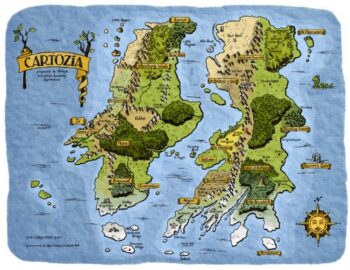
—A truly enthusiastic Charles Hatfield is something to see. Here he enthuses about the upcoming anthology Cartozia Tales.

—Bart Croonenborghs compares Judge Dredd to Lt. Blueberry. Tom Spurgeon reviews Monster 2013 and Ullman & Brown's Old-Timey Hockey Tales.

—Only Tangentially Comics. The idea of "geek" or "nerd culture" may be the most purely corrosive force posed against us in the battle for truly relevant comics. Though their argument doesn't approach the idea from that angle, on the leftist journal Jacobin two writers are having a debate on the larger politics of geek culture.

—Not Comics. I missed this, but Lynda Barry reviewed Kathryn Davis's Duplex for The New York Times Book Review. She is as individual a critic as she is a cartoonist.

Docs

Today on the site Joe McCulloch will lead the way with a discussion of this week's funny book delights.

Elsewhere:

Plug alert: Tonight I'm interview Art Spiegelman live on stage at Housing Works in downtown NYC. It kicks off at 7 pm and Art will be signing books afterwards.

A report from the Jeff Smith/Paul Pope/Faith Erin Hicks panel at the Brooklyn Book Festival.

Michael Dooley on Frederic Wertham's source material.

Heidi MacDonald and Calvin Reid's latest More To Come podcast is up, this time from SPX.