

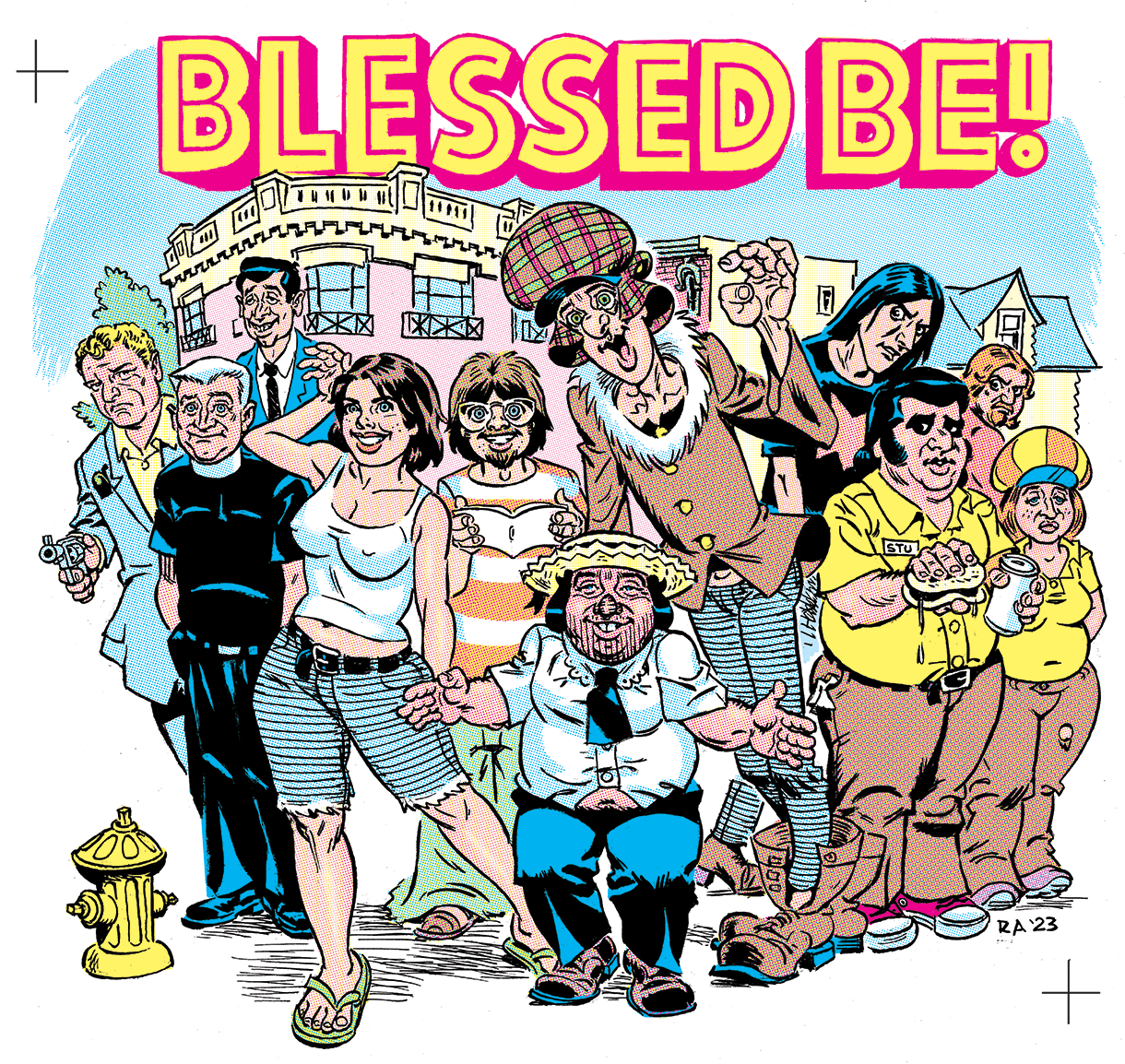
There has been a lot of anticipation for Blessed Be, Rick Altergott's first graphic novel, which, of course, stars his comical goofballs Doofus and Henry Hotchkiss. I am typing this in early May 2024 and over the past few days my social media posts have lit up with joyous images of people who have received copies of the book. I got my copy a while back and it sure was a hoot to read and pleasure to look at.
With strong ties to two of indy comics earliest and biggest stars--Daniel Clowes and Peter Bagge--Altergott had been working on finishing Blessed Be for many years. Altergott has known Clowes since art school (Pratt) and Doofus made his first comic book appearance in Eightball #8 way back in 1992. Later that decade, Doofus was a regular backup in Bagge's Hate. Doofus has also appeared in issues of Heavy Metal, Kramers Ergot and in a weekly strip for Vice online. It's about time he had his own book and Blessed Be will make many fans happy indeed.
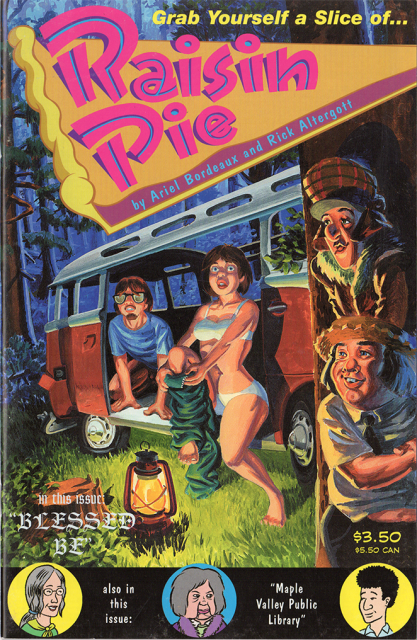
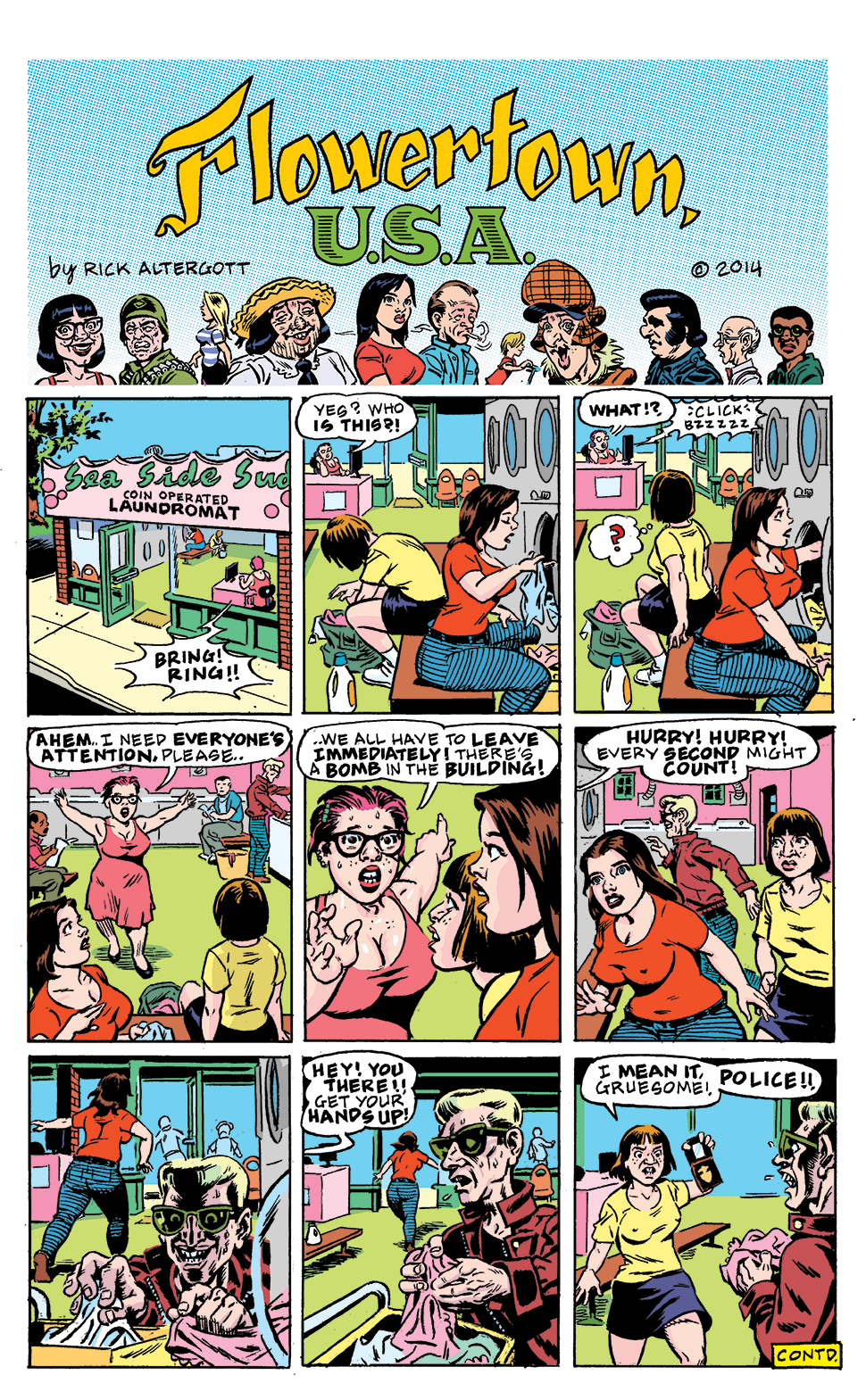
Blessed Be got its starts as chapters in Raisin Pie (Fantagraphics, 2002-07), the five issue series Altergott produced with his wife, the cartoonist Ariel Bordeaux. Set in the fictional village of Flowertown, U.S.A., the story takes place in what could be described as a typical "anytown". If, you know, "anytown" was completely...unlike any other "anytown" that you've ever encountered. "Bizarre" might be the best term I'm searching for. Yeah, it's a very odd book. Which is a very good thing.
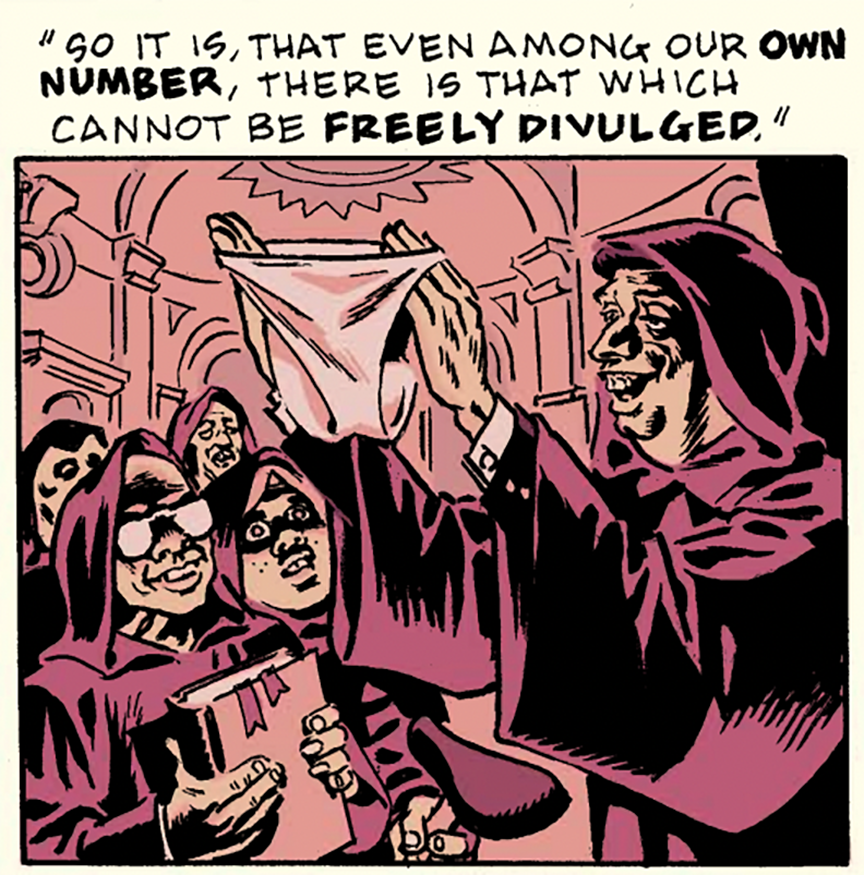
Gorgeously rendered in a '70s MAD magazine style, Blessed Be is a visual treat. Its overlapping storylines involve sex, drugs and a satanist cult. And lots of other stuff. There's an elitist social club whose members take an initiation pledge of chastity and, instead of bragging about their golf scores or Wall Street conquests, they boast about their masturbation skills. Most puzzling (and charming) is the enthusiastic crew of "Naked Fishermen"; as the name flatly suggests, they are men who fish, while...naked. How did Altergott come up with the Naked Fishermen? "No idea," he says in his afterword to the book.
How did Altergott come up with this crazed tale?
No idea. But as I told Altergott in our interview, we're all the better for it. Blessed Be was well worth the wait.
This interview was conducted via Zoom in early April 2024. It was transcribed by Tammi Kelly and edited for clarity and length by myself and Altergott. – John Kelly
JOHN KELLY: So, you've lived in various places…New York, L.A., Seattle and now Rhode Island. You're originally from Delaware, right?
RICK ALTERGOTT: Yup, I'm from Wilmington, Delaware.
When did you start drawing? When did you get into comics?
I guess I would have been into comics from a pretty early age, but buying them and collecting them probably by the time I was 13 or 14. I would go to different shops and local bookstores, and newsstands. I discovered MAD around that time, and I would kind of buy every issue of MAD from then on, and I developed a kind of a radar for when a new issue was out. It was always exciting to see the new issue of MAD. And it was really uncanny. It was like I could almost tell that there would be a new issue out before I even walked into the store where I'd usually buy them.
I had a couple of other places I would go to. I'd do this little circuit all on foot, too, because I was trying to keep them away from my parents. So I'd go around to the back of the house. There was a bulkhead and I would open the bulkhead and put all my comics there and then go into the front of the house and come back down into the basement later on and get the comics and bring them up. My mom actually ripped up my comics part one time, 'cause, you know, bad grades and stuff. But I really caught the MAD bug. I would never miss an issue, including the specials with the reprints, and then I'd search for back issues. As a collector type, I would buy two issues – so that [Al Jaffee's] fold-in could be done in one issue and the other kept in pristine condition. Later, I discovered the National Lampoon and once you're involved with collecting and back issues, you get a better overview of the whole world of comics. My Dad was a kind of collector, too, but not a serious one. He always insisted he had bought the first issue of Playboy, but later, my mother had tossed it out.
All during this time in Wilmington, a guy named Tom Watkins and his friend, Craig Dawson, had a store called Xanadu and they would sell comics. Joyce Brabner was also involved earlier; before she moved to Cleveland to join Harvey Pekar.
Tom kind of single handedly strived to bring underground culture to the town. He had worked on John Waters' first two features and brought him to his store one time to screen "Pink Flamingos". Tom also would carry mags like Weirdo and other offbeat stuff. It was a little further of a walk into downtown Wilmington, which was kind of dicey at the time. I remember, I bought a Jack Davis original there, in fact. It's a really great illustration from TV Guide. It's a beauty; and at the same time Tom Watson also had another Davis of the show, Hullabaloo, another single image kind of illustration. This was many years later, after I'd met Dan Clowes, and he was visiting from NYC. He and I visited Xanadu, and I bought the Jack Davis and he passed on the Hullabaloo illiustration, which I bet he probably wishes he had bought that day because it was 50 bucks. Back then, 50 bucks was 50 bucks, you know.
Oh, I remember as a kid going to the comic conventions in New York City at the hotels and stuff and they'd have–
The Phil Seuling ones?
Yeah, and they'd have Nancys there for $25 or $15 or something like that, a big pile of them. I was like, I can't afford it....you know, I didn't have any money.
Yeah. I would take the train up to Philadelphia on Saturdays to go to an art class at PCA, and before I came back on the train I bought back issues of MAD at Fat Jack's Comic Crypt. And I was getting into the older, Silver Age comics, too. I started buying newer issues went when you could get five comics for a dollar. So, you know, the DC comics, I was reading Kamandi...that was one of my favorites. And I loved the old mystery comics, too. I mean, since I was buying DC stuff, I probably missed some valuable Marvel stuff, but I just wasn't really that into the superheroes. But had I been, I would probably have a much more valuable collection. Instead I’ve got like, you know, House of Mystery and House of Secrets.

I had all those too. But do you still have your comics that you had as a kid?
I still have a lot of them. A lot of them were in storage for many years, in my parents' house and eventually, they insisted that I take them back, so I reconnected with my collection. When I lived on the West Coast, there were many years when they were all just in boxes. But yeah, I never really threw them out and they were always in pretty good condition, but you know I'd buy older ones and then when I met Dan Clowes [at the Pratt Institute, where they were both students] and guys like Mort Todd, we were all into collecting comics and buying back issues, which weren't that expensive back then. We were all mining the past as well as new stuff.
Dan was the first person I knew who had original comic art. He has a standout Steve Ditko page from Eerie or Creepy done in ink wash that's amazing, and I was floored when I first saw it hanging in his dorm room. At that point, I'd never seen any original comic art before. He was really in tune with it. I think he knew that he was going to be a comic artist because he really knew everything. He was the first person who alerted me about RAW, like there was this new magazine coming out, and you have to buy multiple issues of the first issue. He was really serious about it. He'd buy the Comic Buyers Guide too. When I lived briefly with him in Chicago in 1987, he showed me his own circuit of stores that he'd visit. He'd get on the Loop, and visit all these different places. So he took it a lot more seriously than anyone I knew. I think he had a pretty serious intention of becoming a cartoonist even from early on. This was after our college days, and he in particular was getting really good and working on Lloyd Llewellyn and Eightball. I was inking Steve Ditko pencils which was exciting, and both of us were still doing stuff for Cracked. Dan was doing The Uggly Family with Mort.
Back to college days; I was still buying MAD, but I was hiding it from my peers instead of my parents because it was sort of embarrassing…like you're still reading MAD? But I was getting it mostly for Mort Drucker's artwork, which I've always loved.
Besides Drucker, were there particular MAD artists who you're drawn to more than others?
Oh, there definitely were. I kind of think that the 40 cent MAD era was the era that I kind of plugged into as a kid and I learned a lot about pop culture through MAD too. Mort Drucker was my favorite. I discovered Wally Wood. I think that the Ballantine paperbacks were my first exposure to Wood. I was with my parents at Allmart, but couldn’t steal away to buy a copy of The Mad Reader. I was only able to browse in the store. The paperback reprints were cool, but the printing was so tiny and the detail was so intense; it wasn’t the best way to see Wood's artwork. It took a while for him to be raised to the same pinnacle as Mort Drucker in my view. And then Jack Davis of course. And I liked George Woodbridge. He's so solid throughout. I mean, he's always thought his misanthropic sense of humor is really funny. And his early work looks a lot like Drucker may have been influenced by him, I liked Al Jaffee and Don Martin too. I mean, all of them are good. There weren't any terrible artists in that roster.
And when you were reading Lampoon, same question. Who were your favorite artists?
I loved Shary Flenniken. Her style grabbed me as a young person. It made an impression, it was kinda dirty and forbidden... and I always loved Bruce McCall. I loved his Bulgemobiles and his whole retro vibe thing really was appealing to me too. I was sort of into advertising and loved seeing the spoofs of old ads and stuff that he would do. So those resonated with me. And Frank Springer, I liked him a lot. But their spoofs weren't really like the MAD ones. Lampoon for me was hit or miss, but there's a couple of issues that are just the funniest. I can visualize the covers, but there's about 10 issues that I think are just the greatest, and I have them all sequestered together down in my basement where they won't get water damage.
What about any of the MAD rip offs? Were you reading Cracked?
Yeah, I was because I was into the movie spoofs, so if MAD did the "Towering Inferno", Cracked did it too, or "Earthquake". And it was kind of fun to see side by side. But I wasn't as grabbed by John Severin's artwork in Cracked. It was a little too meat and potatoes for me. But he is absolutely a fantastic cartoonist. I just don't know if they were using him the way he was meant to be used with those spoofs because he could certainly copy a photograph. It just didn't have the same appeal as one of Drucker's caricatures. Cracked's "Mission Impossible" spoof just doesn't compare to MAD's; either artwise or storywise, as one example.
And then Crazy when that came out, I liked that. I think I was reading that from the first issue. There was some fun stuff in there. In fact, issue number two was the comic that my mom tore to pieces in anger when she was mad about my grades. I was on a diet of humor magazines and mystery magazines. That was my main thing. And then I did graduate to Rolling Stone magazine as I got older and High Times, and Lampoon. So I'm sure it's pretty typical of a lot of kids. You know, graduating from the comic books into the magazines stuff.
But you later did work for Cracked. Not just you, but a bunch of you guys, right?
Yeah, somehow Mort Todd got hired as the editor. And it was pretty exciting when we first heard he was like, "Yeah you guys are going to be working for Cracked", and it was like wow. At first, Pete Bagge started doing some stuff, and then Dan and then me and then Cliff Mott, all our cartooning gang. Although at Pratt, we didn't really know Pete until a little later. He was–I think he might have been SVA or something like that. We met him through Phil Seuling comic events. He did Stop magazine. But he knew John Holmstrom and Mort because I think Mort was at SVA too. But anyway, it was pretty exciting to be working for Cracked. I wish I was a better artist back then. I was doing the best I could, but I really didn't really hit a stride until years after. And then Bob Fingerman was doing stuff that Cracked too and I didn’t meet him until a couple of years ago really, although we've been contributors to lots of publications together.
So at Pratt, what were you hoping to get out of art school?
I was actually a film major, so I did the four year degree, but I was always drawing cartoons and comics because I had a friendship with Dan that introduced me to that, and another friend, Charles Schneider who transferred to Pratt from Wesleyan, I think as a Sophomore in the film program, and we’re still all pals all these years later.
In fact, my film project was kind of a disaster. I did finish it, but it's sat in boxes for like 30 years and now I'm finally getting it transferred and hopefully within a week or so I'll be able to see the film again. It's weird, like a time capsule from back in those days, it'll have Charles in it, since he was the star of my film; probably Dan is in some scenes because I shot a big scene that had lots of the whole gang in it.
What is the film about?
It's like a beatnik movie so I did a coffee house scene, a crowd scene, and Pratt had a pretty small campus, but I managed to find a large building that was being used for storage and I found other weird spots on campus to film. I haven't seen the film in probably three decades at least. It's being scanned and they're supposed to send me all the digitized transfers and with sound and everything soon. That was my major. I was a film major, and so was Charles. And Dan was involved in some film projects, but that wasn't his major. He was illustration. He was smart and stayed with visual arts.
Yeah, well, he certainly knows a lot about movies too.
Yeah, probably knows more than most filmmakers know about and he's turned into a filmmaker and screenwriter. He's totally mastered that one. But I guess you could say I had a split major because I was taking a lot of other drawing classes too.
And then at what point at Pratt did you meet these guys?
Well, Dan I met as we had our freshman foundation classes together. So I met him first, and then Charles, the next year. He is from Chicago, like Dan and they had a lot in common from the very beginning. And then there was Pete Friedrich from SVA who went to school with Dan in Chicago, as well as Gene Fama who also was from Chicago. And, Mort Todd/Mike Delle-Femine, who was originally from Maine, but they were all from Parsons and SVA. So by the time we were all sophomores, we were all together, all collaborating. Dan and I and Mort–and I guess Pete–had come up with Psycho Comics at the end of our first year. That was our first self-published thing. I don't know if that's worth some money now.

It definitely is. The Cartoonist Kayfabe guys did an episode on Psycho Comics, didn't they?
Yeah. I think they probably did. I know they talked to Dan about it and he might have. He's even more tight lipped than I am about it. We did two issues, and I have one copy or two of each one. It doesn't matter to me if they ever see the light of day. I should see if my mini comics are worth something though, because I do have copies of those. Those are ones I care more about.
Of mini comics that you did yourself?
Yeah, I self published two issues of Doofus. One in Wilmington and the other in LA. A lot of that material has been reprinted, which is kind of cool. I did a collection years ago, but it's been out of print for a long time.
How did you come up with the characters of Doofus and Henry Hotchkiss?
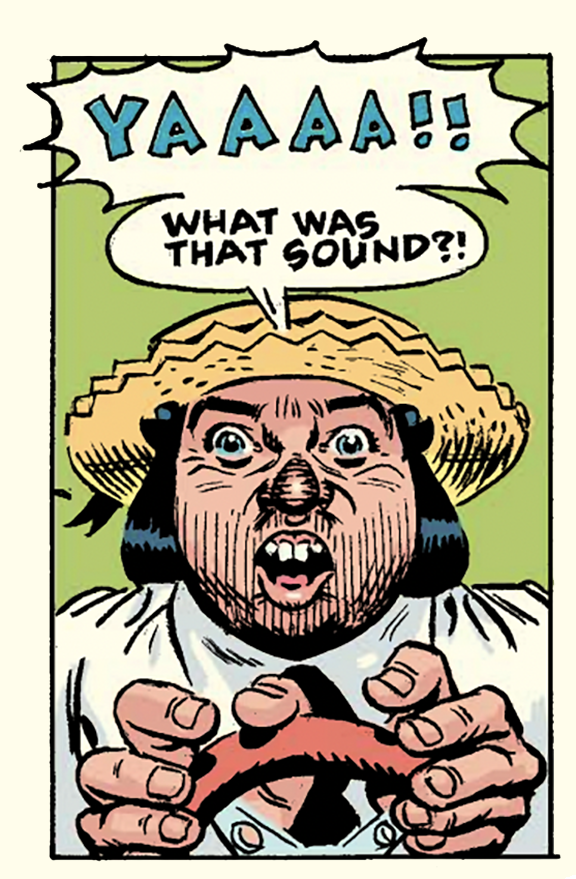
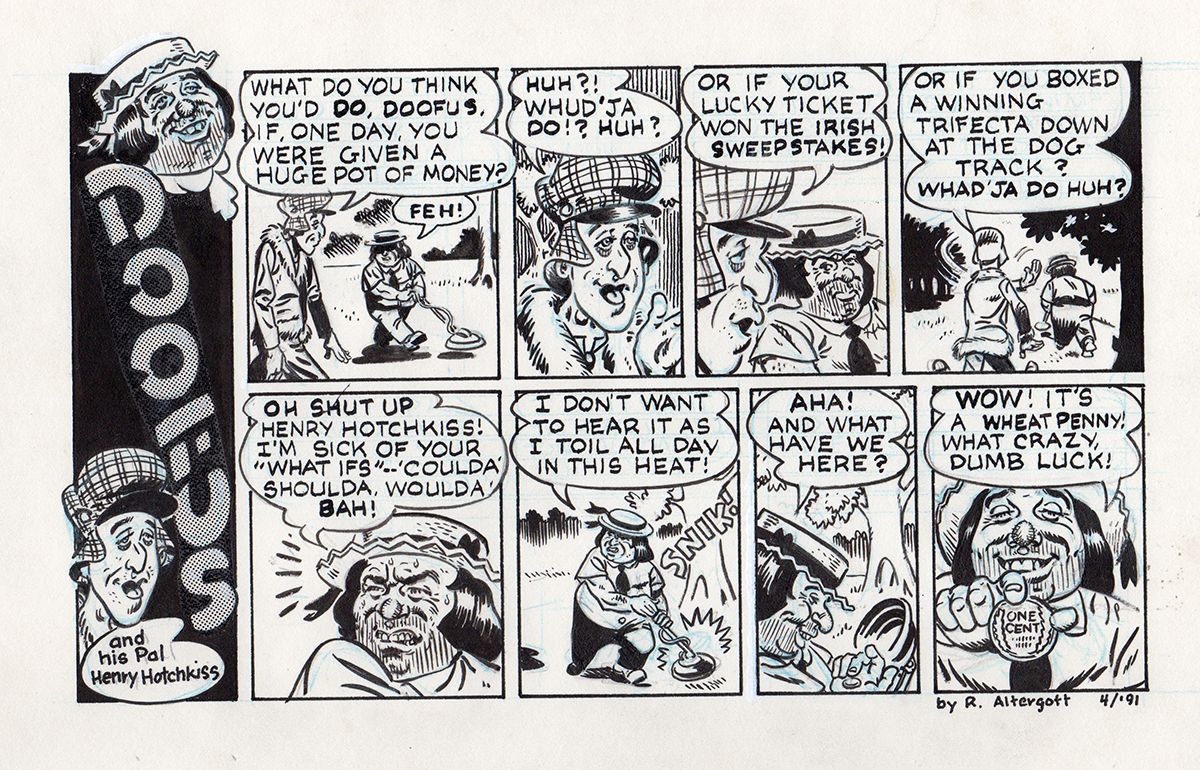
Henry was this goofy, lanky guy who wore a weird Deerstalker type hat and a woman's coat with a fur collar. I don't know how he developed much beyond that. With Doofus, I had been reading the Fantagraphics Prince Valiant reprints, and I liked the glossy pageboy haircut on Val. It looked silly on a male, and even more so on a guy with a perpetual five o'clock shadow. The straw boater was probably there to make him look like more of a "cartoon character" in the timeless sense. Doofus and Henry Hotchkiss had a kind of "Honeymooners", "Flintstones" kind of vibe; a bossy jerk and his clueless sidekick. Certain themes developed over time, including the recurring gag of Henry having a "secret job" that Doofus is annoyed by and sometimes discovers as the punchline. One ground rule I had was, that no matter what joke I came up with, I would be able to use it with my characters. One I left in the layout stage was an elaborate two page story that existed only to deliver a lame pun, which became the joke itself– the elaborate setup. I will probably bring that one to a finish some day.
I first started seeing your stuff in Hate, back in the '90s.
Yeah, we definitely were in the nineties.
And then I knew you had a connection with Dan too, so it was an interesting time when both Dan and Pete were on the HateBall tour. The tour was happening and it was just like both of those titles sort of elevated all of the comics world. And you were somebody, at least in my mind, who was connected with both of them.
Yeah, actually Ariel went to the HateBall event in Boston. She went there and that was the first time she'd ever met Dan or Pete. She didn't know me at the time, but she remembers going to the shop in the Fenway that hosted them. It’s still there, actually. Those two titles really put comics on the map in a cool way and they're both really great titles too. Nobody could argue that this was something that really deserved the kind of buzz it was getting. Fantagraphics was genius in putting the tour together and taking it on the road. I think that was a smart move.
I was always honored that Pete decided to have me become the first contributor to Hate. I was like, wow, that's an honor. I don't know why he chose me, but I try to always do my best stuff and come up with some good jokes and things.
How did it come about? He just asked you one day?
Pretty much. I don't know how he singled me out for that honor, but he did.
That was a good choice.
Yeah, I mean I never had that kind of exposure, and that was amazing. I've always thought Peter Bagge was amazing. He was always ahead of everybody else in the cartooning world because we were trying to be bad boys, and here he was, a parent, and like doing a comic strip about taking his daughter to the playground where kids had sprayed graffiti. And it was like such a different topic for a comic strip. He was able to really skewer mainstream stuff because he had a foot in that world being, you know, a married person and a parent, which was so different from all the rest of us like bachelor types. He probably actually experienced the inside of a Walmart, and could riff on it with some authority.
And he used everything he had in his life to make comics with, you know, which is perfectly natural. He pulled it off in a way that was kind of a revelation to me. I was like, wow. But I guess when you think about it, Crumb has done that too. You know, people draw from their life experiences. It seemed weird for one of the main guys of the alternative comics world like Pete to start doing stuff that was so mainstream like parenting comics, but he made it his own, and I think he thought it was kind of his job to confound people's expectations. I've always thought that was pretty cool how he did that.
When I first started doing strips for Hate, I was living in LA at the time and everybody loved Hate. I was working at Spumco, and there would be meetings that would take place in John K's office, and we would just shoot the shit. John K was a fan of Pete's too. He really did like him a lot. And so they all knew that I was sort of involved in that world. So that was kind of nice. Although I must have just started my association at that point, maybe not appearing in the issues, but they knew that I knew that members of the Fantagraphics stable were friends of mine and whatnot. I had also become acquainted with the Hernandez brothers, Jaime and Gilbert, by then, so it was nice for me to have something to add to that animation studio, you know, cause I didn't really have a lot of animation experience like the rest of them did.
And so what were you doing there?
I was hired to color. They had a comic book deal with Marvel where Spumco would create...It was after the split up with Nickelodeon, and they lost the rights to do Ren and Stimpy but they had other characters John K wanted to do with and Mort Todd was involved too. He was working at Marvel so he worked as a liaison to make the deal happen, and they needed somebody to color the comic. I knew some people who worked there tangentially and they got me in. Nothing of the real nuts and bolts jobs of TV animation. You're either a storyboard artist, you're a background painter, or you're a layout artist. Those are really the only three domestic jobs that are done in animation. You can write the stories too, which I didn't have any experience with. So it was always interesting that there was a little crossover between the comics world and this particular animation studio.
What was it like working with those guys?
There were some fun projects. They had a tie-in with a company called Palmer Paint that was doing paint by numbers sets and stuff and trying to repackage some of their stuff with Spumco branding to make it a little more exciting, and that was a fun thing because Spumco started out as an ad agency more than an animation studio, so they they kind of had that all along.
And what year would this have been?
Oh my god, that would have been like the mid '90s maybe? '96 perhaps? They were interested in digital painting. That's how I first did some digital painting. John trusted me enough to actually do some of the final covers based on his color scheme because he was very, very into color. He was one of the best color guys I've ever worked with. The processor speed of the computers was such that, if you used a big brush, you would get lag as the stroke developed on the screen. I also developed the font the comic used, which was also digital.
Sure. Now this is before or after you were living in Seattle.
This is before. Yeah, I lived in LA for probably two or three years maybe, maybe not even that long. And then I met Ariel and she was living in San Francisco.
How did you guys meet?
We met through Dan and Adrian Tomine. They set us up.
Well, it worked.
Just kinda cool. I know. And so I would visit, I would take the train up from LA to visit Berkeley where Dan and [his wife] Erika were. And then eventually we both decided to move to Seattle. That’s the time I've mentioned in my book in the back section. The cartooning scene that I just kind of fell into was amazing there, and it was the golden era for cartooning. Everybody had their own book. It was a really robust illustration friendly place, and Denny Eichhorn was there. He gave me some freelance jobs from Loompanics, where he was an editor. So I went up there just randomly, never thinking I'd work in animation again, and then I eventually worked in another animation studio that was doing children's games. I had that as a full time job, I had illustration, and I was doing comics. I was working for the New York Press every weekend. Every weekend I'd have at least one illustration I had to do. Sometimes two.
Ariel would be doing the same thing so we really locked into a pretty unique scene when we moved up there.
And you were doing some work for Fantagraphics though too, right?
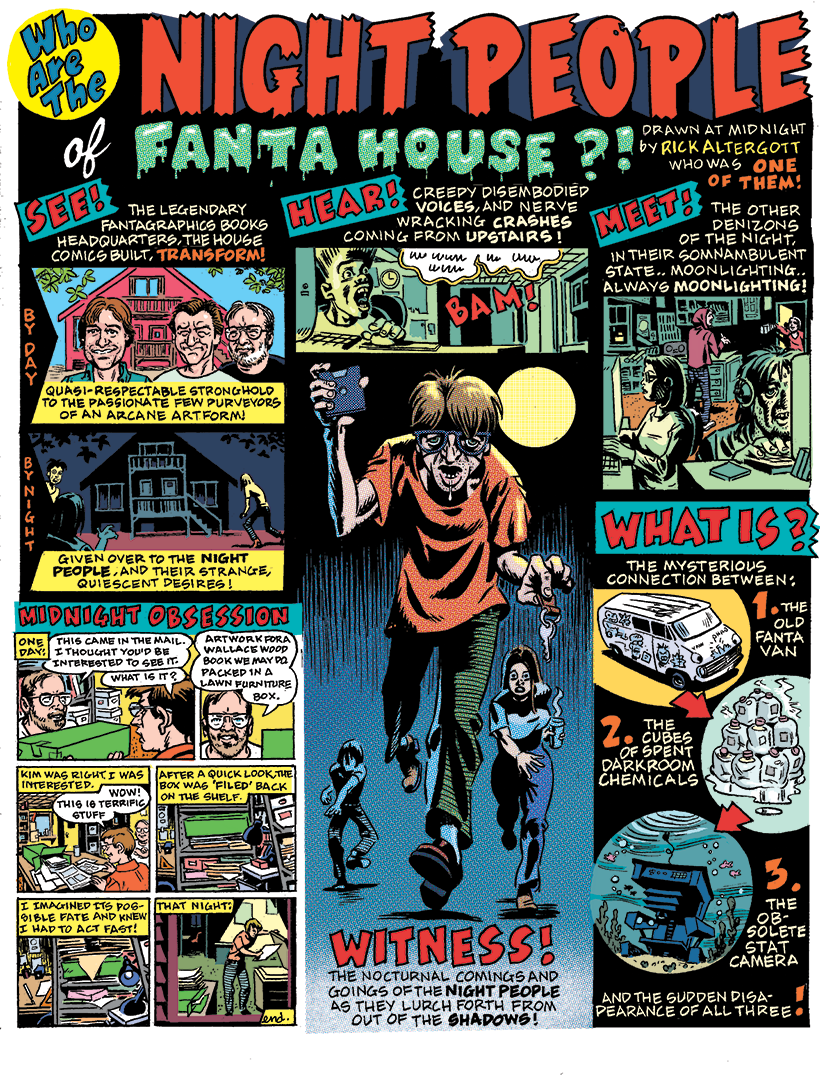
Yep, I was. Kim Thompson gave me some work doing white out issues of Xeroxes of Pogo because they were reprinting Pogo at the time. And that was the tryout job everybody got. Fantagraphics. If you talk to anybody, it's like, oh yeah, I've done the Pogo thing. I think both Dave Lasky and Jeremy Eaton had that job before me. But anyway, that was nice, and I would do illustrations. I was doing stuff for Hate, so that was pretty cool. And I, somehow I had a key to the place too, so you know, you could come in. A lot of people would go to Fantagraphics at night and use their equipment and stuff.
What's life like in Rhode Island?
The art scene here is weird because there was a group called Fort Thunder who were younger cartoonists still going when we moved here, I thought maybe I'd luck out again and meet a bunch of cool cartoonists like I had in Seattle. But the Fort Thunder artists were much younger and they were much more of a movement kind of thing than someone like me was going to connect to. I was probably seen as an old fogey or something. Like, "the enemy". I don't know. They were all squatting and doing pretty renegade stuff. I never really clicked with that crew. They probably don't even know who I am. There’s nothing wrong with that…like I'm not a big name or anything, but I didn't really follow their comics either. It was more art comics and I kind of came from more of a background of storytelling comics and things like that. Humor, you know, the kind of stuff I like. I have befriended a couple of them, like Paul Lyons who lived in Providence up until a couple of years ago.
So, it's been hard making friends here. There isn't really a scene like there was in Seattle. I was OK with that though, I had a big project I had just started.
Well, how did you end up there?
We kind of just did. Ariel has family here, and , there were a lot of people talking about the "Renaissance of Providence," like, wow, it's a really up and coming place. So we were getting a good buzz from it. And 20 years before, if you read Doug Allen's Steven comics, which you know, presented Providence as the armpit of New England. And that's what Gary Lieb would always say too, because he and Doug were Rhode Island School of Design students, and also bandmates (Rubber Rodeo). They lived here at a time when Providence was kind of like squalor–all the bars that you see in Steven–the kind of depressing, really downtrodden population. But anyway, that's changed. Now it's more upscale and, you know, all the colleges, Brown and RISD are here. It's really popular. And at the time, people were talking about Providence as up and coming calling it literally the "Renaissance City". You want to get in here now while you still can.
So anyway, that's sort of why we chose it, and we've liked it here. We've been here for like 20 years. We must like it for some reason.
How did you get involved with Owen Kline’s movie Funny Pages?
He was another Pratt student, and he and his friend, Charlie Judkins, worked together on an animated film project, called, Ziggy Gigglepuss, I think. That kind of reminded them of Doofus. So at one of those Comic Arts Brooklyn events, Owen knew I was going to be there and he came up to me and gave me one of the press kits for it. It was something that he was trying to pitch, but it was a film, an animated project. It wasn't live action.
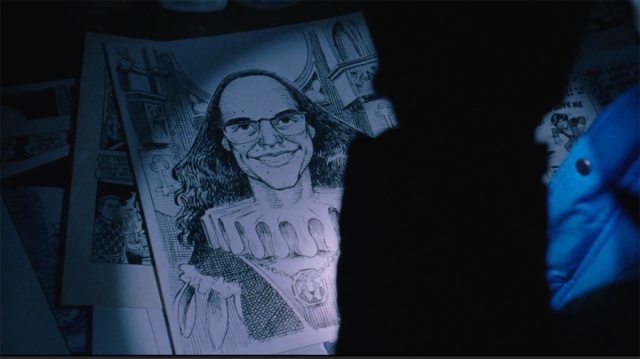
Yeah, I think it was a funny character that they had come up with. And, you know, we got to talking and you know we got a lot of mutual friends and a lot of admiration for each other's stuff, I guess. But he was, you know, we had the same film background from being at Pratt. But then somehow he got me involved as being one of the artists representing one of the characters in his movie. And it turned out I was supposed to be the young student, the star of the movie, but Johnny Ryan’s artwork is what is actually represented in the film.
Your work was too polished for a teenager.
Well, they, yeah, they thought that there was too much polish to my work. So they decided to make mine the teacher who gets killed in the early scenes of the movie. But the thing is for that movie–he went through torture making that movie…I mean, it just went through so many permutations.The original title was "2 Against Nature". I think he was almost ready to just throw in the towel because of all the revisions. But I really admire him for persevering and just pushing through. It's kind of how I felt, because I was doing my graphic novel at the same time. I was like, am I ever gonna finish this thing? Got to get it done or else all that time I spent on it is wasted. And you know, I wanna make it the way I want it to be and I kinda just stuck with it and continued with it. And at the same time he was doing similar kinds of things with his movie with it being kind of changed and focus grouped to whatever was different. Whatever the development life cycle of the movie happens to be. And then nothing happened.
I didn't hear from him for a while. And then all of a sudden, He asked me out of the blue if I wanted to do the title lettering for the movie and I never thought the movie was even going to see the light of day. I thought maybe it just got to the point where it wore him out and he had just given up, but he never did. So I really admire him a lot for that. He definitely pushed through and got the movie that he wanted to make, you know, as much as you can with a movie. And I think it turned out to be a really cool movie too.
Yeah, we just watched it again the other night and it's great. I think it's just a really terrific movie.
Yeah, I mean it just shows that sometimes you just really have to, you're up against a force and you start to keep beating away at it and he did and look what happened. I'm sure he'll get another feature because I think the movie did pretty well. If he wants to make another movie, I'm pretty sure he's gonna have a chance to do that.
With me though, my project just took so long to complete. I mean, there's good and bad to that. You know, the way things usually work in the publishing world is you write a script and then you execute it. And there's a time frame and…it's treated like more of a commodity, you know. And I know that's how Peter Bagge would work when he was working on the next issue of Hate. First, he's going to write it. He's probably going to do breakdowns, you know. Pencil it, and whatever the process is…there's a finite group of steps that you work through to arrive at the final product. And adhere to an established production schedule.
But with mine, it was like a comic book that me and Ariel did together, where each of us would have half of a book. And I had the idea that I would do each chapter as a cliffhanger. And that just turned out to be really limiting, just having half of a book. That book we were doing together, our Raisin Pie comic. But for me to conceive and try to do a graphic novel within those confines…at the time I thought it would work, but it just didn't. So, we did five issues of Raisin Pie. And Ariel finished her continuing story, much to her credit. She got that done. I don't think she's reprinted it yet, but she's working now with a publisher doing a comprehensive collection of all of her stuff, a career retrospective.
But we wanted other things to be in the book too. We just didn't want it to be like, here it is, here’s the next chapter of our continuing series. You want other little features and things to be in there too. The Eightball model.
So anyway, what happened was I tried to tell the story that was kind of...I did not work from a full script, but I knew what was going to happen next. And I tried to format each chapter into that half floppy book format. And end with a cliffhanger that would kind of create interest for the next issue. But then when the next issue comes out almost a year later, you know, the interest has dropped off. And the editors are getting upset that you haven't put out a new issue and after a while the thing kind of dies a slow death.
So, my story after five issues…I was just gonna do one more issue of all my stuff and finish the story that way. But as it turned out, that was five years into it at that point. And then we moved, we had a child, we bought a house, different jobs—all simultaneously. So what happened with me is I decided that I'd just do it as a graphic novel and then I wouldn't have the page constraint that was a difficult thing for me, even in the very beginning. So I blew it out to a whole graphic novel and ended up redrawing a lot of it. And then finishing the rest of it and making it much more detailed and more leisurely told than it would have been normally.
And I like the way it came out. And the thing is that If I had been working from a full script and just had to commit to that script, a lot of the things that I put in the book never would have made it in there. And some of my favorite things in there are things that just came about just by, you know, living my life and working on it in the background. Adding stuff here and there and coming up with jokes that I wouldn't have thought of. So I mean, I like the idea of doing it this way, but it's not very practical.
I don't know if very many people do a graphic novel the way I did this one. Maybe some do.
Yeah, you mean just like making it completely organic, where it's just like you're doing it as it goes along.
Right, and that's a good way to put it. It was organic, cause there were certain times when I didn't even work on it for six months because I was actually doing some other things, paying gigs. I was doing other comics, because I probably created a whole book's worth of new comic material at the same time I did freelance work and Raisin Pie. And I was working a job, that I still work at, and so it's kind of in the background for a lot of time. But it was always kind of like hanging over my head. I have to finish this and I want to finish this thing. And I spent a year anticipating the finished final scene, like "oh I can't wait to be working on this". So when I finally got there, it was pretty exciting.
And then I had some other ideas that I kind of shoehorned in there at the same time. So. It was very organic, I would say. It was an interesting way to do a book, but ultimately, not the way you want it to do a book. I guess I don't know if people still get advances or anything like that or if there's a publishing date that has a hard set date and you have to stick to it. So that's probably more normal.
I think it's more normal than you would think. You can plot things out to a certain degree, but, as things change, you adjust. Things are always in flux. I'm changing things constantly. It's hard to know sometimes. In your book, you created a whole world, a distinct and unusual world—even with maps—and at a certain point, you had to plan out how all of this community existed, right?
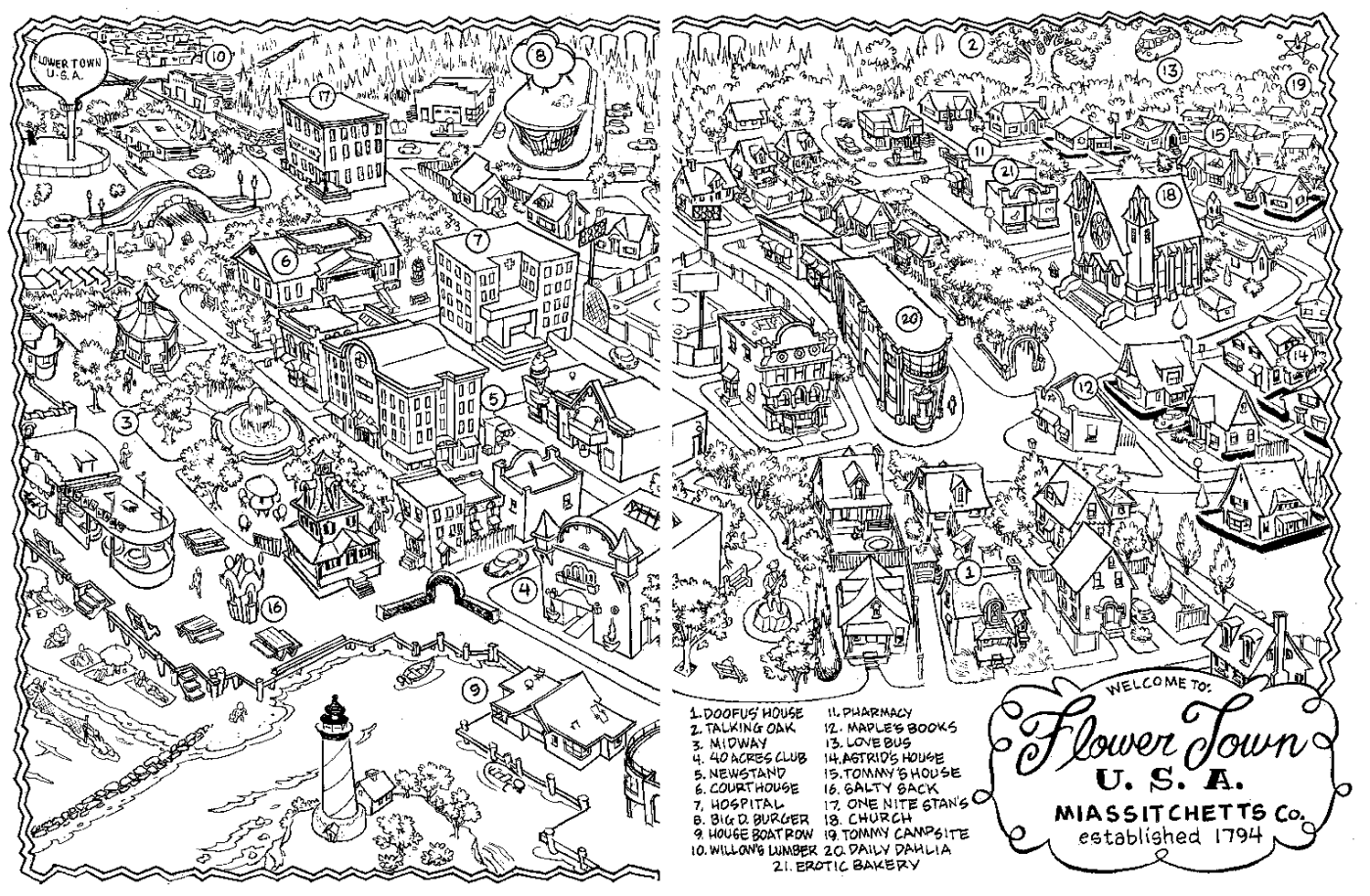
Actually, that was when I decided I wanted to do a map because I had people tell me that they actually liked the characters and the town seemed like a character itself, and a friend, Nick Gazin, told me that he wanted to live in Flowertown. And that was like, wow, that's really a compliment! That's really nice of him to say. And then other people along the way have said that they felt kind of like, yeah, it really almost feels like a real place. So I figured for the end papers of this book I'd actually create a map so I kind of laid it out.
And I remember one time during my time in LA, I was visiting Century City where The Simpsons are made. I was interviewing for Bongo Comics and the person who interviewed me showed me that The Simpsons had a whole town for Springfield mapped out to everywhere. Here's where the railroad tracks are. Here's where the school is. Like they've developed it to the point where the whole town has been. It exists basically if you wanted to do a story and you wanted a character to go from point A to point B. You could say, oh no, you couldn't get there in this amount of time. They've worked it out. So when I saw that I was like, wow, it's Springfield. Yeah, they've got Springfield down.
Flowertown was sort of my idea of that same kind of concept, and I identified enough places that I thought would work and really laid it out, and I was like, "Wow this is working out better than I ever thought it would". So it was a hard drawing to do, but it also gave me an opportunity to do something like–one of the end papers is light and the other one's in dark at night time. And I kind of tried to make that one of the focuses of the book. Is that there's a lot of daytime and night time scenes that kind of overlap each other a little bit to get the kind of the good/evil tone in a visual way. I don't know if that came across in any way when you were reading.
Oh yeah, it does, totally. It is and it's a distinct, real place. I mean, there's a lot going on here. It's quite an unusual book. It's unique in a great way.
Oh, cool, thanks. Yeah, one of the things I did is I kind of get a little bit of self sabotage because I would always say like, should I throw this scene in? Yeah, I'll throw it in…why not? And I did a lot of sight gags and weird little things, whatever I could think of. I tried to make it like that because I was thinking that this is probably gonna be the only graphic novel I ever do. I'll just throw everything I've got into it.
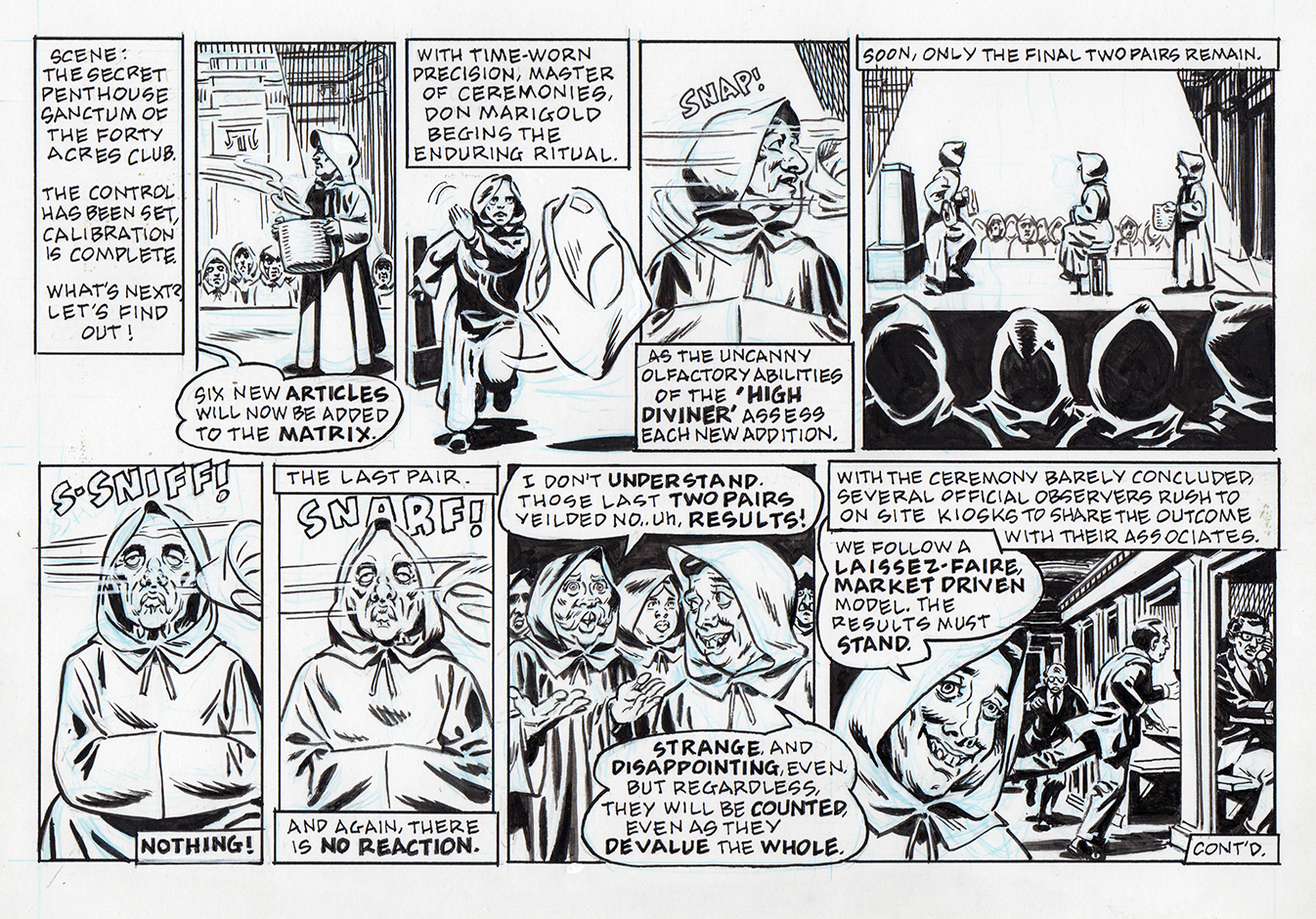
Well, it's just filled with all kinds of stuff like that that are just so funny. And…weird. But, they're like dropped in such a deadpan way…the whole thing is not judgmental. If that makes any sense. It's just like, oh, it's just the most natural thing in the world to have an exclusive men's club devoted to chronic masturbators, right? Or, there they are—the naked fishermen. What's more normal than a group of naked fisherman?
Yeah, that kind of set the tone for it. I don't know where that idea came from, but it's kind of central to your understanding of Flowertown. And another weird thing in Flowertown is toilet paper is a pretty new invention because I've got this scene at the end with us a billboard where it's like, Here's how you deal with needing to wipe your butt on a hot summer day, you use this new invention. I just tried to make it the repository of every weird thing like that, but that's Flowertown. That's the way it is there. Maybe that's like that in every town, but–
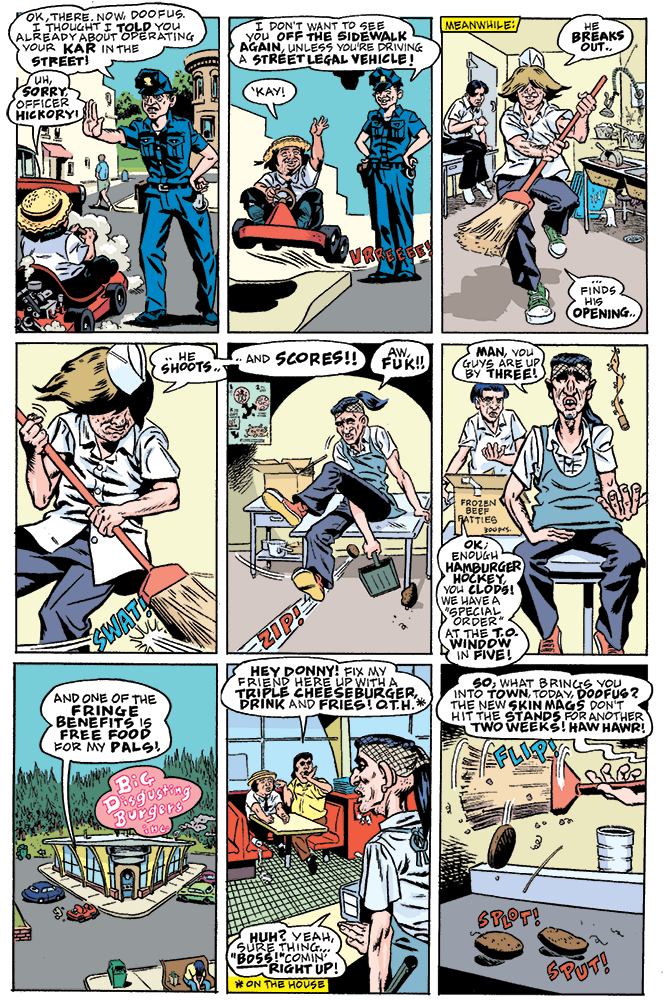
Or it's just a given that the most disgusting fast food restaurant you can imagine–not that it's probably any worse than any other actual fast food restaurant–but it's like the most popular place. It's just like, well, yeah, of course it is, right?
Yeah, I had to go full bore on the restaurant, because that was a lot of fun. And I came up with gags for that one that I never would have come up with if I had been working from a full script. I mean, It just sort of just snowballed as the story came along. So I decided, yeah, I'm gonna make it so raunchy that it is that gross. Yeah, there's like a plunger stuck in the toilet in the background, baby diapers on the floor. There's a picture of the World Trade towers that they haven't bothered to take down in the background. Weird shit like that.
Right, right. Well, it's in a way reminiscent of some of the early MAD magazine things that would be in the background scenes.
Yeah, that Will Elder "chicken fat". I was definitely trying to go for that. I had a lot of fun with the book that way. Eric Reynolds told me he liked those Easter eggs too. So he was like, that's one of the fun things that people will like about it. It was hard to draw that stuff, but when I kind of conceive of a scene, and I kind of have to, I can't cheat on it once I think of something I have to kind of do it. And my layout skills are such that I never learned how to do the worm's eye view, so I have to do all these backgrounds that go on into infinity. I'm like, oh shit I have to draw this stuff now? I'm my own worst enemy in a lot of ways. I never really learned the good cartoon cheats that would save me from having to draw all that sidewalk and backgrounds and trees, classic cars and stuff. I enjoy drawing them too, so–
Well, you know, you're an extraordinary artist though too. I mean, your skills are just absolutely superb. Your drawing style is unique to yourself but it's also universal in a certain way too and it's just—
Yeah, I try to make it like that which is why the next comic project I might do is gonna be one that's like spoofs of mystery comic boilerplate situations. And those comics are really just…kind of like what comic book art should look like, you know. I like how Charles Burns does that a lot too, but he makes it his own in a way that I can't. He really likes John Romita. Who doesn't? You know, what an amazing artist. How many artists wanted to try to imitate him? I mean, I would. That's what I'm going to try to do in my next project.
There's just a lot of weird-ass shit going on in your book, and it’s just presented so matter of fact… There's like no judgment of any of the many strange events in the book and that's one of my favorite things about it. But I also want to remark on just how funny this book is, too. It really is. There are scenes in it that are just absolutely hilarious. And it's also a thriller/mystery story. Kind of a straightforward genre thing, but it's in such a bizarre setting. That just elevates it into something else.
Well, I wanted it to…it sort of reminded me of "Blue Velvet" a little bit, because there's a little mystery. And I also wanted to make it a spiritual thing too. There is good and evil playing out…like the forces of good and evil in this little, small town context. I had the priest character, and that would be a way of manifesting good. And then drugs seem to be the manifestation of evil and so there's actually supposed to be a kind of like a give and take of good and evil there. That's kind of my conception of it. Hopefully it's a little deeper in some ways…for people who want to read into it some deeper meanings. I think they're there. Because you know, I didn't want to do an entire 170 page book of toilet paper. Not that I wouldn't at some point, but I wanted to make it have some substance too. So that's how I did it.
Maybe it wasn't the greatest idea to keep Henry Hodgkins and Doofus apart from each other for so long in the book, because I've always liked their dynamic together. And there's people who enjoy that and they might feel a little cheated by the book. But I think a lot of people aren't going to be aware of their dynamic anyway, and they might just like the book just for what it is.
I think when you're doing something that's a break from the past, from what you've been doing with your shorter pieces. You know, it’s an actual "novel", graphic or otherwise. This is its own work, right? This is a thing in itself. If there is historical work that you've done in the past that is present here, that's great. But assume that a book like this…for a lot of the people picking it up, this is going to be the first thing of yours that they've ever seen.
Yeah, I agree. So I wanted it to have some a little more depth than that, you know, and it's a narrative and considering that I worked on it over such a large period of time my biggest fear was that if it would hold together as something and not just be like this disjointed thing that looks like it was put down and picked up and put down and picked up. I really struggle to try to make it look, make it be cohesive as best as I could.
No, not at all. And I think the art is what drives that too because it's consistently great like throughout the entire book.
Thanks, because I did redraw a lot of the beginning because it was… that's the other danger of working on a project for so long…you start out and then you get to the end of it and you look at the first pages and you're like, oh my god, this doesn't look good. So you're in this endless cycle, a loop of having to redraw the whole thing. Over and over. It can be a hellish kind of limbo that way. So I did have to say, no, I can't redraw everything, but I did redraw quite a bit. You know, the earlier pages, the characters…I changed the names of a couple of characters. Like I said, this is not the way to do a graphic novel, but there are certain good things that come about from working in this kind of organic way too.
Yeah. I don't know if there's any way to do anything. You just do it however you do it. If you want to intentionally make a bad novel or film, there are plenty of ways to do that. If you want to make a good work of art, there are any number of ways to do that too. It's just that most people are better at making bad art. Or it’s just another job, or assignment, to them. They just want to finish it and move on to the next bad thing. If you're making something for yourself, you just do the best job you can, at the time, and adapt to changing circumstances.
Yeah, I mean, like Owen's film…he set out to write a screenplay and the final shooting script was probably a lot different than his original conception. But that was the process, you know. You have to work within that framework. I like the idea of being able to edit something… there should always be a chance for you to say, "I'd like to redo this part". Graphic novels are so much work, usually done by just one person. That can be pretty daunting, but if something's not working, it's nice to be able to say, "I'd like to take a look at this and see if I could try a different approach that doesn't destroy the whole thing". So, I wouldn't try to do another graphic novel like this. Having a really good idea of what you're doing before you set out is good. You should have a beginning, middle, and end and don't deviate drastically from those goals. Those are the guideposts that you set within that framework, but you should also be able to take some side trips and go down some blind alleys a little bit.
Yeah, well, only you will really know what the process was for this book, right? Because you're the person who did it. I just read it. As somebody who didn't live through that whole process, as someone who just read the final product, it makes perfect sense to me. And I think it's wonderful and I think people are gonna love it when they have a chance to read it too.
In a similar vein, when you look at a painting that you love, you have no idea what the early stages of that were. All you're seeing is the final thing. You don't know what kind of struggles the artist went through to arrive at that final canvas. I mean, nowadays they can do x-rays and they can see, oh, there was another figure over here. This whole thing has been moved over to this side of us…but mostly, you just see the final product. You don't see the processes. So that's kind of what the graphic novels are. I guess that's how they work. This is the only one I've ever done. This is the only one I can talk about with any authority.
So, think about a movie. A movie is an hour and a half, two hours long when it’s finished and you see it. But how much went into that final product that you don’t see? Most of it. You see a fraction of the overall effort. How many hours of film were shot to get it to that finished point? How many scenes were cut? How many takes of each scene—that makes it in—were taken? Five takes? Twenty takes? How many times did they decide to use this music here or not to use that music there? Every single cut and edit that took place? It's all a million different moving parts, right? And in the end, most people are just gonna be…well, these days, sitting in their living room, not even in the theater, watching something and deciding within six minutes whether or not they like it, right?
Yep, there's a lot of contributors and you'll never know all the decisions that were made by somebody who had to make those decisions…and then you make so many decisions, whether you realize it or not. Every time you put your pencil down, you're making a decision. Every time you put a scene here or shift something around, it’s a decision. And you're never gonna make all the right decisions.
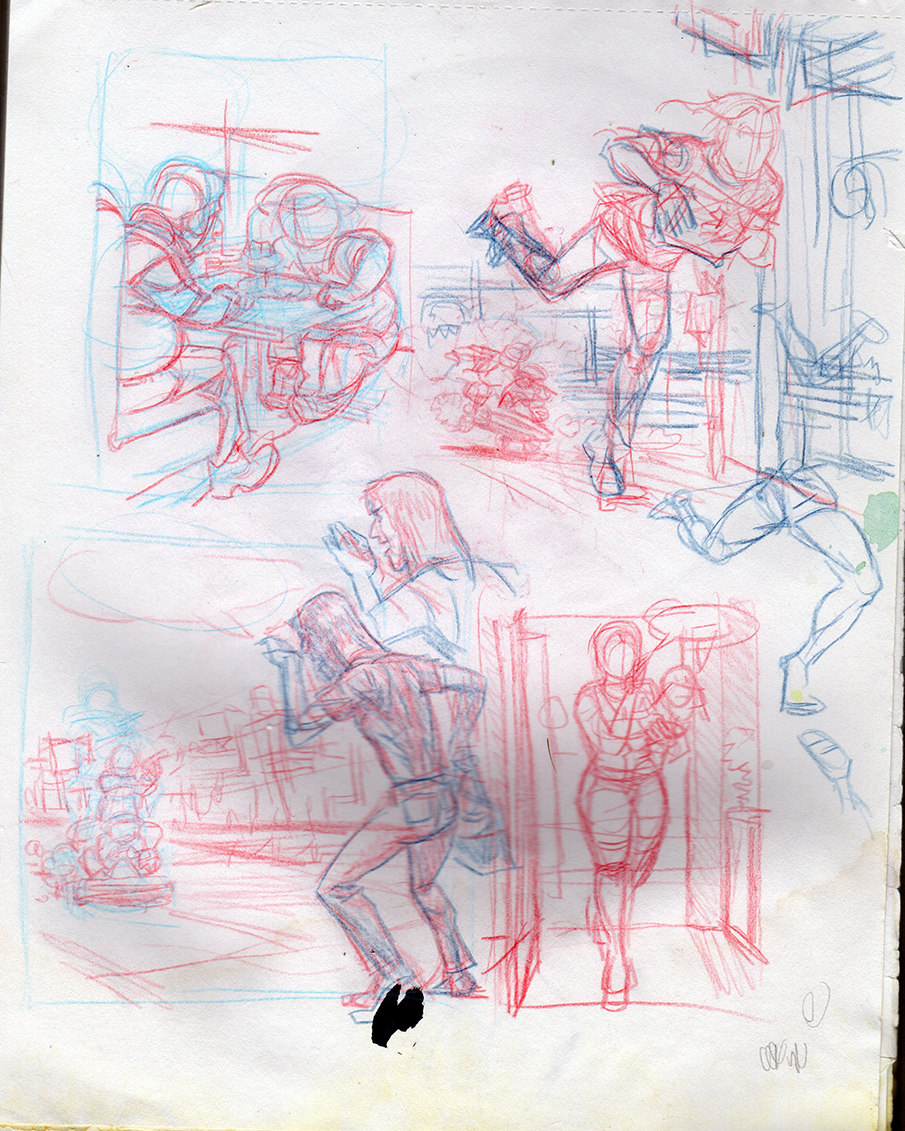
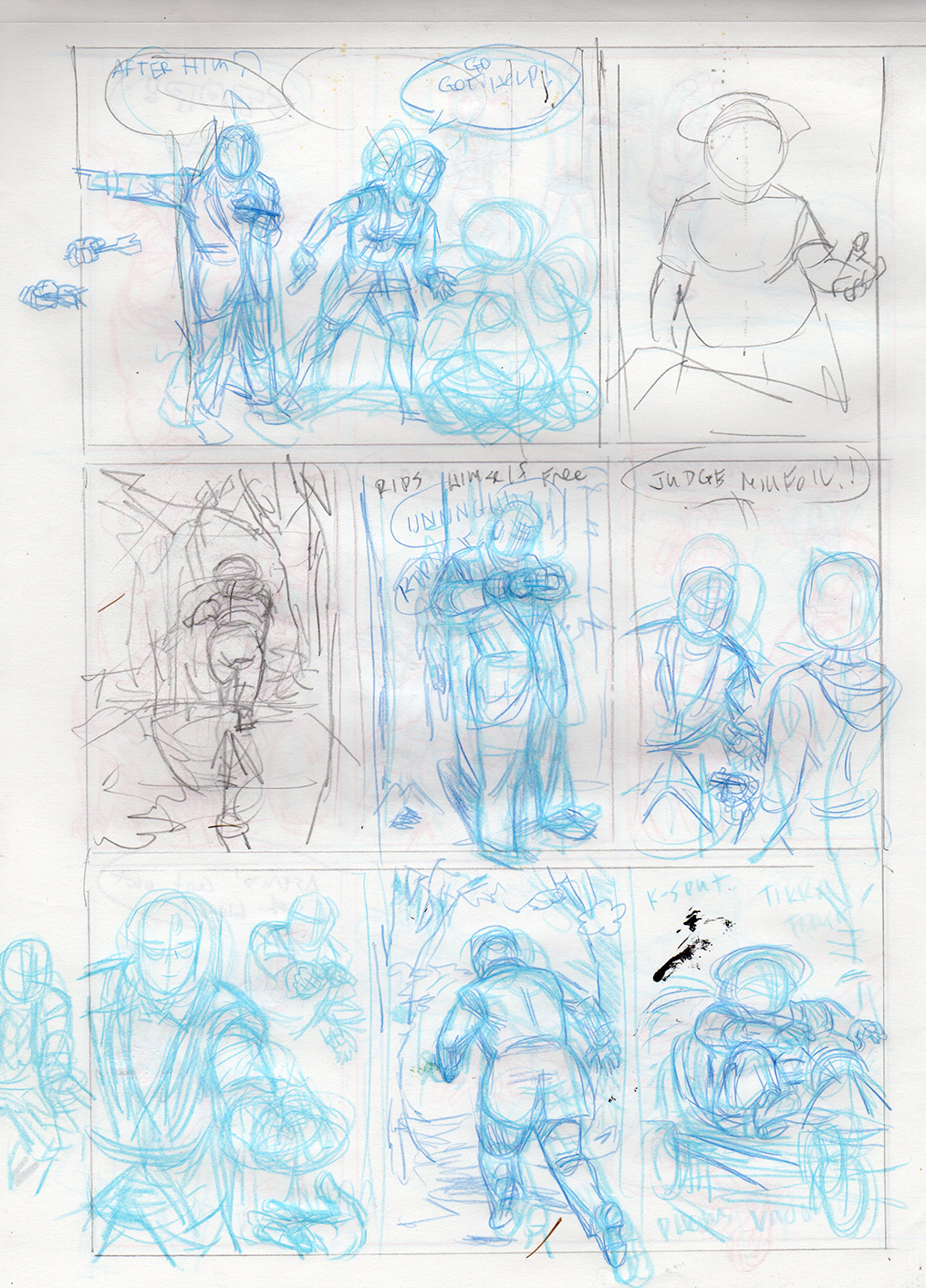
For some artists like Gilbert Hernandez who lives and breathes comics. He never makes the wrong decision. He always knows exactly how to present a story in the perfect, best way, but there aren't very many people like that. But he is one of them. He has an innate ability to know how to tell a story graphically and what works like it’s in his DNA. But people like me…I struggle, I think layout is the hardest part of drawing comics. It's really hard because so many times I'll draw the layout and it doesn't work and it's like you're right back where you got to redo it. You try not to go too far into it before you realize that this doesn't work. Drawing sketches and breakdowns is fun though, because that's the first time you get to see the words and pictures merge together and see what the potential might be. But there's a lot of important decisions to make at the layout stage. And I know from experience I've made the wrong decisions a bunch of times and I'm like, this just doesn't work. The sooner you realize that and try a different approach, the better. I have a mountain of sketches, page breakdowns tracing paper overlays, thousands of drawings that support the final pages of the book.
Well, I think everybody needs an editor. Or someone in their life that they can trust, who will serve as their baseline for what's working and what's not. Someone who won't bullshit them with unhelpful platitudes.
Yeah, I know from doing comics, I've worked in a vacuum a lot of the time and I think a lot of other comic creators do too. Where they don't have anybody to bounce the right stuff off of. So you're like, just hoping that people are gonna like this, you know. You just have to ultimately trust yourself…I always liked the way that Chester Brown and Seth would review each other's work. There's an issue of Palookaville where Chester's bringing his new pages over to Seth and the two of them are going over them. I've always thought that was so cool. I wonder how true to life that was as portrayed in the story. To have somebody who could be a sounding board for you. Like Chester Brown would paste the panels on the page so he could easily switch them around based on Seth's advice. I always thought that was such a cool, healthy way of working, but It doesn't happen very often in the comics world. I'm flying blind a lot of the time. And I'm just hoping, boy, I hope this is gonna appeal to someone else.
So, what's next for you?
Well, if this book is popular, I have a follow up that has as its storyline the details of "The Forty Acres Club", which I have two false starts on already. I came up with a pretty airtight outline that I could work through, probably as a novella and the anchor for a book of mostly unseen Doofus cartoons that I’ve completed over the years. I could also be done with Doofus. I put in an "epilogue" in my book to show the default situation between Doofus and Henry Hotchkiss. Maybe it was a hokey move, but it gave some closure.
But what I'm starting to work on now…the one I'm thinking about doing, anyway; is a standalone mystery comic with four stories where the standard mystery plotlines are kind of like, deflated and they don't work out the normal way. It's kind of like a tweak on the standard boilerplate endings. So, I still have to work within that accepted framework to make it work. I guess you could call it a "satirical" approach.
You have to know exactly where you can take liberties. Or that's how I like to do it. Your experience tells you that this scene should be here or this should work here, even when you're tweaking a genre…maybe I learned that from Mad and Kurtzman that, you know, when you're doing a spoof of Terry and the Pirates you have to have Dragon Lady here and there and you change the ending, but people expect when they're reading a spoof of Terry and the Pirates that there's going to be certain ground rules that will be followed. That was the Kurtzman way with the spoofs he created. Although Mad created a kind of a weird hybrid of satire…I wouldn't know if it's exactly what you'd call satire, the Mad version of Welcome Back Kotter for example. That's what it’s become to be known as, it seems, thanks to Mad, kind of shopworn. It kind of corrupted the idea of what a satire was initially, like "A Modest Proposal" or Candide. I don't even know if satire even happens anymore in today's writing.
I mean, my book is sort of a satire, but…I'm not sure if it really is a satire. I wouldn't say it's a satire. And if it is, it's a hybrid, And of what? I just think it's unusual. A self-contained story. And its own world with some social commentary thrown in.
Yeah, I think so too. It's its own thing, completely unique to its own world. And it's a great accomplishment.
Oh, thank you. I'm so glad I finished it. I wasn't sure if I'd ever complete it and it would ever see the light of day, but now it has. I've got some nice comments on it from people whose opinion I trust.
Well, we're all the better for it.