
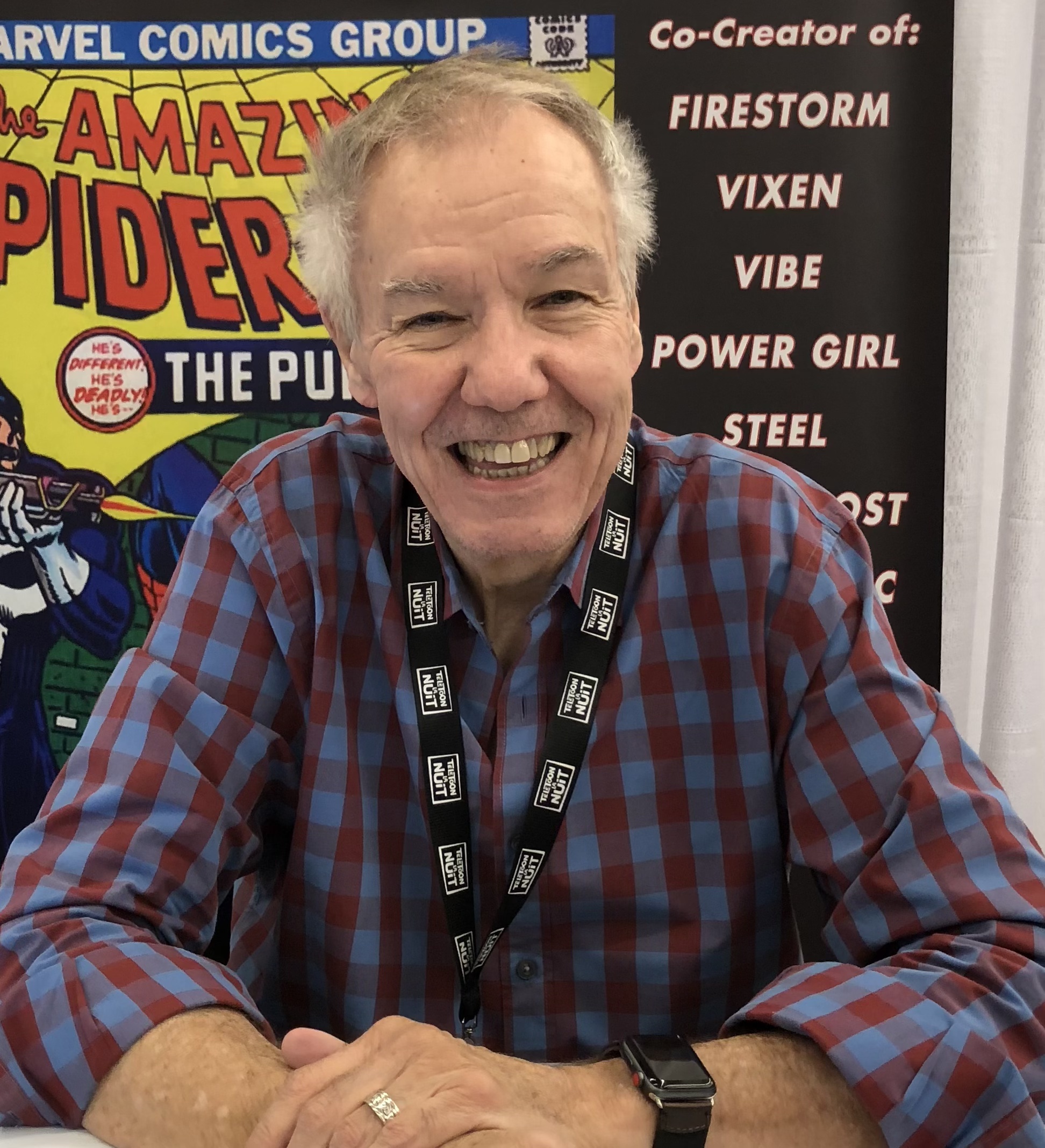
He grew up: that’s the important thing to remember. He had swaggered into the lecture hall in Bloomington that morning with the same confidence he swaggered into Marvel Comics two years earlier: with the assurance of a pro. Gerry Conway had come to Indiana in September 1972 to deliver a guest lecture at Indiana University’s first-of-its-kind “The Comic In Society” course (instigated at the school by future Swamp Thing and Batman film producer Michael Uslan). Conway was, to be sure, a high-profile get for the course’s lecture series: four months earlier, he had taken over from Stan Lee as scripter on Marvel’s Amazing Spider-Man, the first writer to be permanently assigned to Marvel’s flagship title apart from Stan himself.
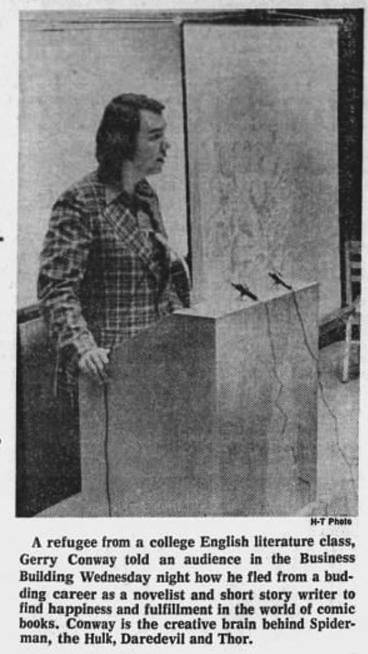
Still, it must be admitted, the article in the Herald-Times might have oversold him. “Gerry Conway, a New York City writer who created Spiderman [sic], Daredevil, Thor and the Hulk for Marvel Comics assured some 50 members of an Indiana University class Wednesday night they are not looney if they like comic books,” ran the lede, underneath the headline, “Spiderman Creator Says Comic Lovers Not Looney.”
But if Conway himself made no claims to displace Steve Ditko or Stan Lee, what he had to say that morning was just as ambitious as the headline implied. “We are not hacks,” he told the Indiana students. “We are professional writers and artists who have chosen, for a variety of reasons, to work in the comics.” If the medium of their art was perhaps more populist than those in the rest of the university curricula, well, so much the better. “The purpose of art is first to entertain and second to uplift,” he said. “Harold Robbins may not uplift like James Joyce, but I’ll be damned if Joyce interests the masses.” Gerry Conway was at that time 20 years old, and himself a college dropout. He was younger than many of the students in the room.
Conway was young, but he had come from a background not altogether unlike the generation of comic creators before him: the working class, Irish world of Bay Ridge Brooklyn, where he was born the first of two children in 1952. Escape for Gerry meant science-fiction stories and postwar comic books, and it was clear from his infrequent recollections that his parents did not approve. “My parents, I think, were in complete denial about most of the things that I did, because they came from a lower blue collar background,” Conway said in 2019. “My dad once said to me, ‘You really need to get a good job. You shouldn't be a bum like a writer.’ In his mind, writers were bums because they didn't go in for nine to five jobs somewhere.”
But from early on, it was clear that Conway was set on escaping to someplace better. As a teen, he toured the offices of DC Comics (meeting, through his visits, several other budding fan-professionals who would remain among the key figures in his career: Len Wein, Marv Wolfman, Mark Hanerfeld), and wrote repeatedly into the letter pages of Marvel books. At age 16, he told his parents he was going over to Len Wein’s house, then secretly bought a ticket to St. Louis so he could be at the Gateway Comics Convention that year. He became a fixture at “Friday gatherings” of science-fiction fans and writers, and it was through one of those groups that he published his first science-fiction short story, “Through the Dark Glass,” in Ted White’s Amazing Stories in 1970. It was the moment Conway broke through the wall and into the world of professional writing, and after that the ascent was swift: his first novel, The Midnight Dancers, was published in paperback by Ace less than a year later.
Not long after The Midnight Dancers was released, the novel and Conway were featured in a New Yorker article on the new wave of science fiction, and the assessment was, alas, brutal. Tellingly, the most savage brutality was delivered by Conway himself:
Conway, who says that the structure of ‘The Midnight Dancers’ is based on James Joyce’s ‘Portrait of the Artist as a Young Man’ admits that he may have tried something a little too ambitious for a first novel. For one thing, he says, ‘the book definitely goes downhill toward the end’ — a flaw that he attributes to the fact that the last fifty pages were written in a single day.
No matter. Conway was young, and the fact that he had a novel under his belt at all became a part of his legend early on — at least as far as Conway was concerned. When he attended the Clarion Workshop soon afterward, his classmate Mel Gilden remembers Conway as having an aura of minor celebrity about him already. “He was the only guy in the room who had actually sold something by then,” Gilden said. “The rest of us were just kind of amateurs.”
By then, though, it wasn’t science fiction that was paying the bills. In 1969, he had sold his first comic story to DC’s House of Mystery, and by 1970 he had become a fixture in the wave of mystery and horror anthologies coming out of both DC and Marvel. Conway was at the vanguard of something significant: a new generation of writers and artists who had grown up with the comics themselves. For the older generation of creators, comics were, at heart, an economic necessity. For kids like Conway, they were a vocation.
“The ‘60s were a kind of transitional period where a number of writers and artists were desperate to get out to either become illustrators or work as newspaper strip artists,” Conway told me in 2024. “They saw the business as a way to earn a living, but not a reputable living. But by the ‘60s, we started having this transition where people who were fans of the material, or respected the material, started like me or [Conway’s friend and writer] Denny [O’Neil] started to see some worthwhile aspects in it, and would actually turn down other work to continue working there.”
In 1970, Conway convinced Roy Thomas, then an associate editor to Stan Lee at Marvel Comics, to give him a shot at a dialogue tryout for the company, which Thomas considered impressive enough to show to Lee. “This is pretty good for a 17-year-old,” Thomas told him. “Yeah, but couldn’t we get someone who’s pretty good for a 21-year-old?” Lee replied.
Still, he was willing to give him a shot, and Conway was determined to make the most of it. “I could tell that he was kind of cultivating me,” Thomas said. “I remember one Saturday morning, [then-wife] Jeanie and I were just lounging around our apartment, which was on the opposite side of where [Conway] lived in Manhattan — we were on East 86th Street, he was on the West Side. And suddenly the doorman tells us this guy is here to see us, and [Conway] says he was just walking around, taking a walking tour of New York, and he just showed up.”
The two became fast friends and frequent collaborators: when Thomas and then Conway moved from New York to Los Angeles toward the end of the ‘70s, they would become a screenwriting duo, collaborating on a number of films (including the future cult favorite Fire and Ice and several drafts of the screenplay for Conan the Destroyer) before breaking up with mild acrimony at the end of the '80s. “He and I spent a lot of time together,” Thomas says. “And later, when he started dating Carla Joseph [later Conway’s first wife], the four of us hung out a lot together. It’s just one of those things: you never know why something like that happens, but it happens. But it did become one of the two or three closer male friendships in my life, probably.”
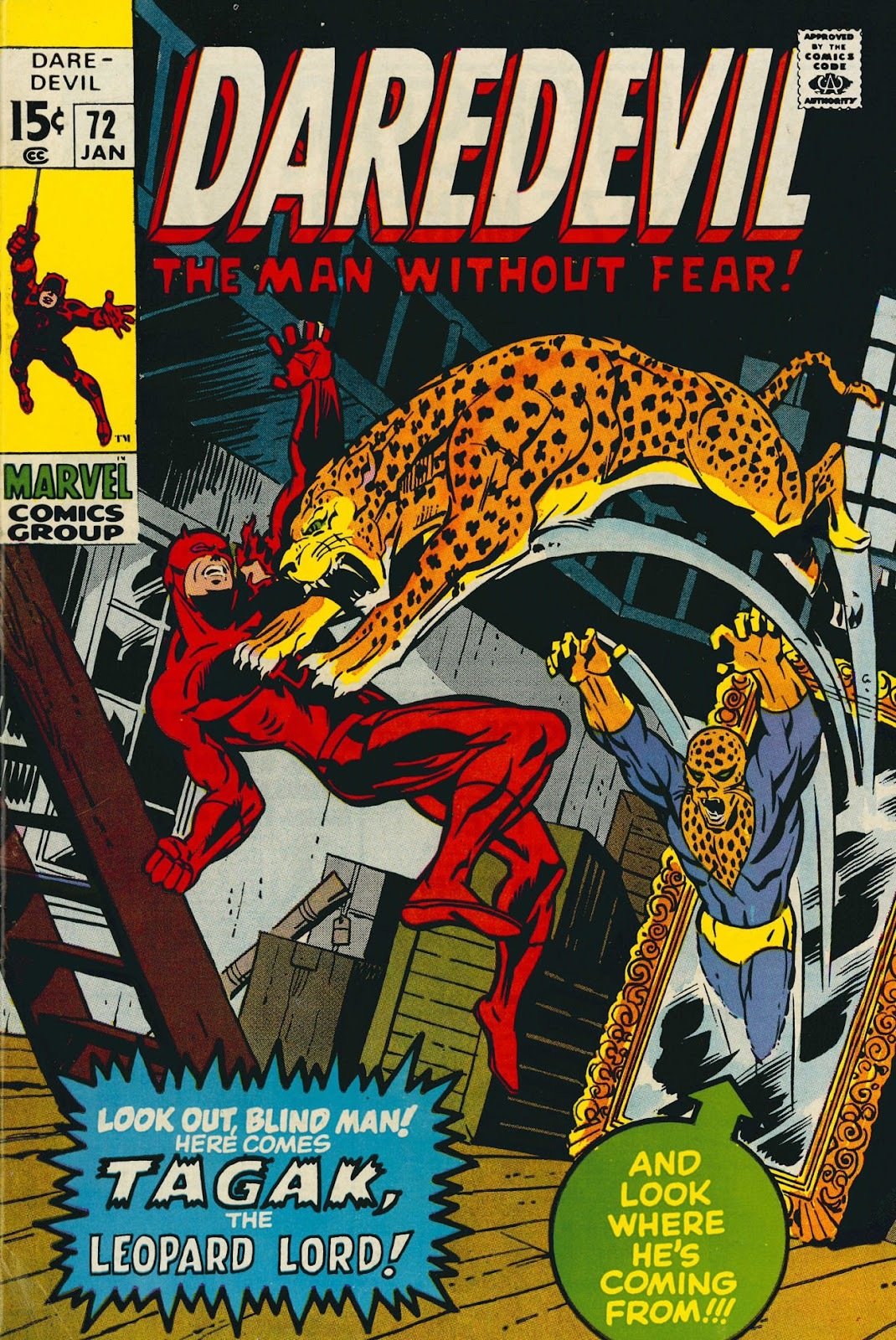
Meanwhile, as a comic writer, Conway was coming into his own. His first major, ongoing assignment at Marvel was for the reliably third-tier Daredevil title. His early stories were rough, but damned if they weren’t ambitious: by the end of his stint, Conway had dispensed with Daredevil’s longtime supporting cast, hooked him up with the leather-bedecked Russian spy Black Widow, and moved the couple 3,000 miles west to San Francisco (the better for artist Gene Colan to deliver moody and scenic action shots). In the 1970s Stan Lee was reported to describe the Marvel editorial ethos as “the illusion of change,” but for Conway there was nothing illusory about it: his characters were all about change and growth; reflections of a young man who was growing up right alongside them.
More than anything, that tendency was at the heart of what became his most celebrated and memorable work at Marvel, as the writer of the company’s highest-selling book Amazing Spider-Man. All of the book’s previous stewards — Steve Ditko, Stan Lee, John Romita — had felt some autobiographical affinity for Peter Parker to one degree or another, but all of them were grown men looking backward. For Conway, consciously or not, the young, flawed, bookish hero imperfectly finding his footing in adulthood was like looking into the mirror.
“I was 17 when I first came over to Marvel, and 19 when I took over Spider-Man,” Conway told me. “And I think it really gave me an advantage others didn’t have. I could relate to him in a fairly fulfilling way.” There was a raw, sincere urgency to Conway’s depiction of Peter Parker’s loves and failures that went well beyond the trademark soap operatics of Spider-Man before him.
Today, Nick Lowe is the editor of the Spider-Man line at Marvel, but in the early 1970s he was just a fan. “Gerry comes in, and immediately not only does it feel like Peter, but it feels even more real somehow,” Lowe said. “He took it more seriously, maybe, than anyone since Steve Ditko. Obviously it’s still fun, it’s still funny … but he’s also like, ‘Let’s push this.’ It almost feels like a more adult comic pretty much as soon as Gerry steps in.”
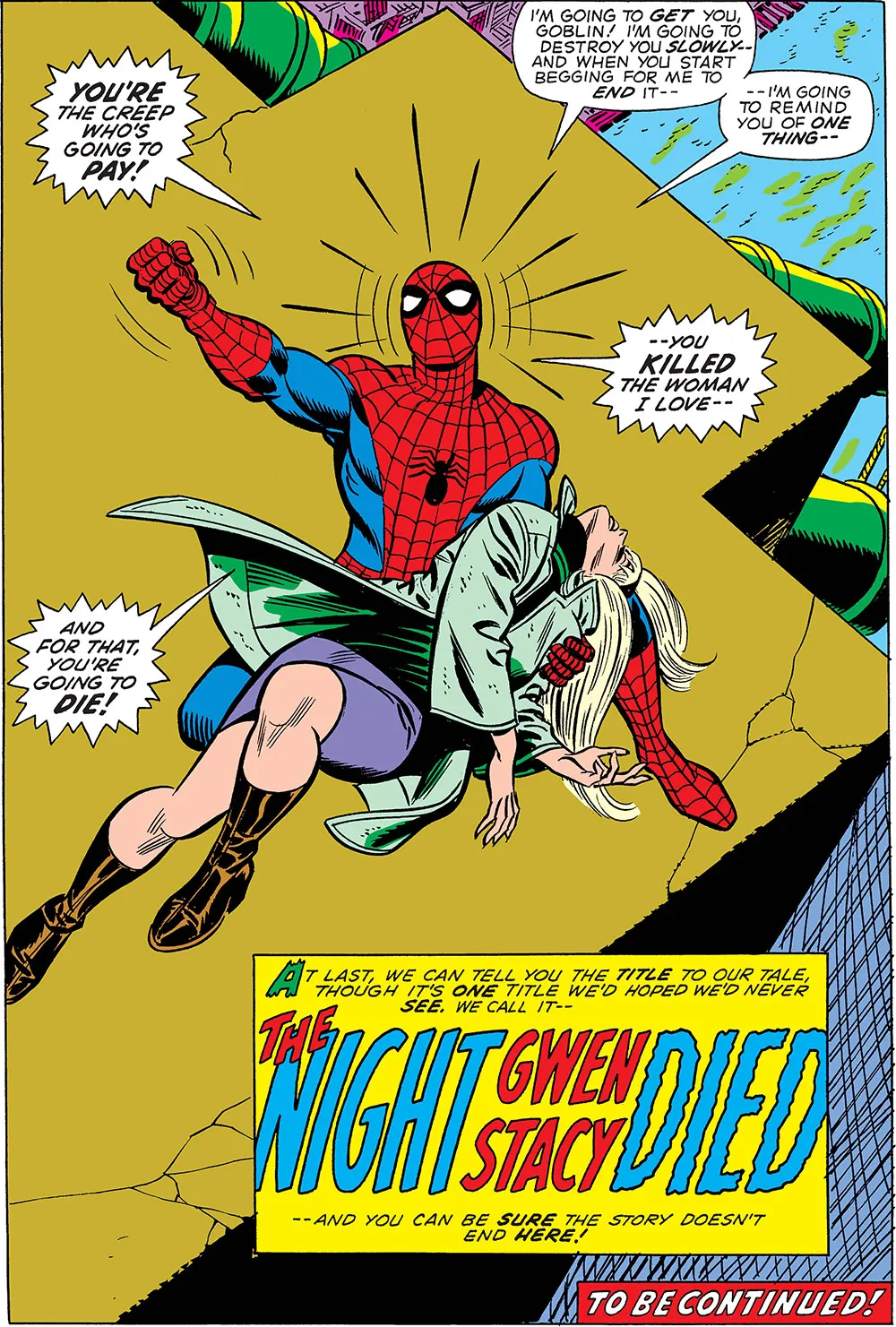
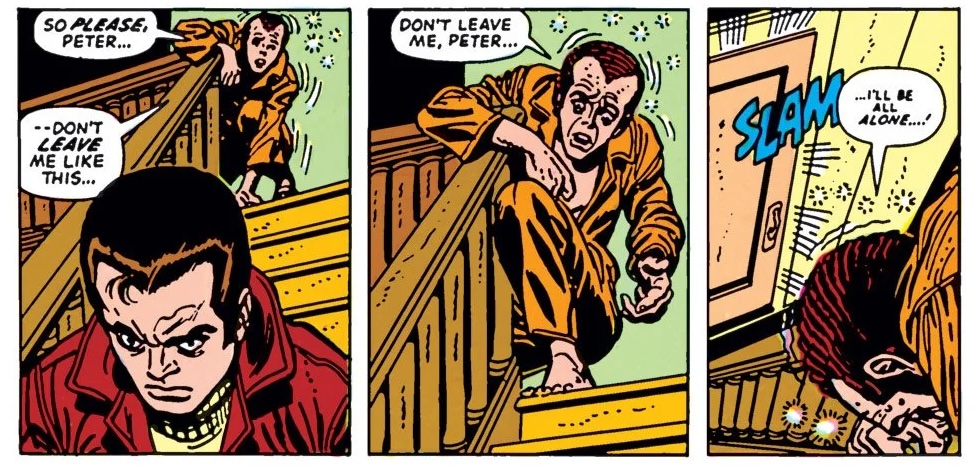
A year into Conway’s run, that push toward adulthood took its most celebrated and controversial form with “The Night Gwen Stacy Died,” in which Conway and co-conspirator John Romita killed both Peter Parker’s long-running love interest Gwen Stacy and longtime arch-nemesis Norman Osborne. The book became an immediate sensation: so shocked and distressed was the fan response that Stan Lee would briefly demand Conway bring back the character from death immediately (he did, kind of, in the form of a clone), and decades later it was still being used as a kind of critical shorthand for the moment Silver Age innocence in comics gave way to 1970s angst. But the scene that has always haunted me from that story isn’t about Gwen Stacy or the Green Goblin at all: it’s of Peter’s roommate Harry Osborne, delirious and desperate as he recovers from a drug overdose, begging his best friend not to walk away.
I don’t think it’s a scene Stan Lee would have written, or even Steve Ditko. It required someone more vulnerable, and more honest, than that, and in that act of honesty Gerry Conway really did achieve something like art.
Conway’s Spider-Man was, above all, a story about growing up. In the final sequence of the Gwen Stacy story, an angry, failed, self-loathing Peter petulantly orders his erstwhile girlfriend Mary Jane out of his apartment. In a single, silent row of panels (redrawn by John Romita to his own exacting specifications), Mary Jane opens the door to leave, pauses, and shuts the door again. Three years later, Conway concluded his run with a visual quote of that sequence, this time with Peter himself, in love, closing the door with the two of them inside. If an intrinsically immortal piece of company-owned IP can be said to have a narrative ending, this remains as good a choice for Spider-Man as any.
Peter Parker may have grown up a little bit faster than his writer. While rooming with Len Wein during the '70s, Conway at one point packed a suitcase and announced that he was taking an impromptu vacation to Florida for two weeks. The next day, Wein (armed with a baseball bat against intruders) was startled to find Conway back at their door again, looking ashen-faced and shell-shocked: “Old,” he said. “They’re all old.”
There were also moments when Conway’s budding, youthful celebrity may have gotten ahead of him. “There was somebody who was my secretary at the time, and Gerry just kind of took over her desk right outside my little office,” Roy Thomas said. “Basically saying he outranked her, which was hardly true as a freelance writer. He could be a little pushy in those days, but he was basically a pretty nice guy.”
Not long after Conway was written up in the New Yorker, an anonymous former colleague recalls, the young writer got a phone call from a man with a thick Greek accent. “Is this Mr. Gerard Conway?” he asked. “Are you the author of The Midnight Dancers? I am a Konstantinos Costa-Gavras. I am a filmmaker, and I would like to make a movie of The Midnight Dancers.”
The next day, Conway walked on air into the Marvel office, crowing that the maker of Z would be buying his novel, when he was intercepted by Harlan Ellison. “Costa-Gavras, Mr. Gerard Conway” Ellison asked, putting on a Greek accent. “Did he sound a little like this?”
In 1974, Roy Thomas stepped down as Marvel’s editor, and was replaced — much to Conway’s surprise — by the duo of Marv Wolfman and Len Wein. Conway had been tacitly promised (or, in any case, thought he had been promised) the job by Stan Lee, and when it failed to materialize, Conway was off in a flash to DC as a writer-editor.
What followed was one of the bizarre and farcical episodes of Conway’s career. Wein and Wolfman together lasted about a year as editors-in-chief at Marvel, after which the job was set to be returned to Roy Thomas. When Thomas decided at the last minute to turn down the position so he could move to Los Angeles, Conway belatedly ascended to the throne. He lasted a grand total of three weeks, completing his entire editorial tenure in between announcements in the “Bullpen Bulletins.”
“He told me that within a couple of weeks he was drinking his lunch, he was just feeling so oppressed” Thomas said. “He tried to get rid of somebody [from the staff], and then someone came in and said he couldn’t fire her because she was a member of his girlfriend’s coven.”
Briefly, Conway considered bringing over some of his friends from DC to try and bring Marvel in line. “He was going to bring over two of us and basically take over the Marvel line,” his friend and editor Jack C. Harris said. “And I was mixed about that — I was very on the fence. And then of course he came back in the end, and I was like, ‘Well, I don’t have to worry about that anymore.’”
The episode was a learning experience. The Conway who returned to DC was, to those around him, a less incendiary personality than the one who left. As a writer, he was as prolific as he had ever been — moreso, even. But the drive and the bullishness that had been with him since he entered the industry had been replaced by something more placid and measured. “I think he mellowed a lot as he got older,” Thomas said.
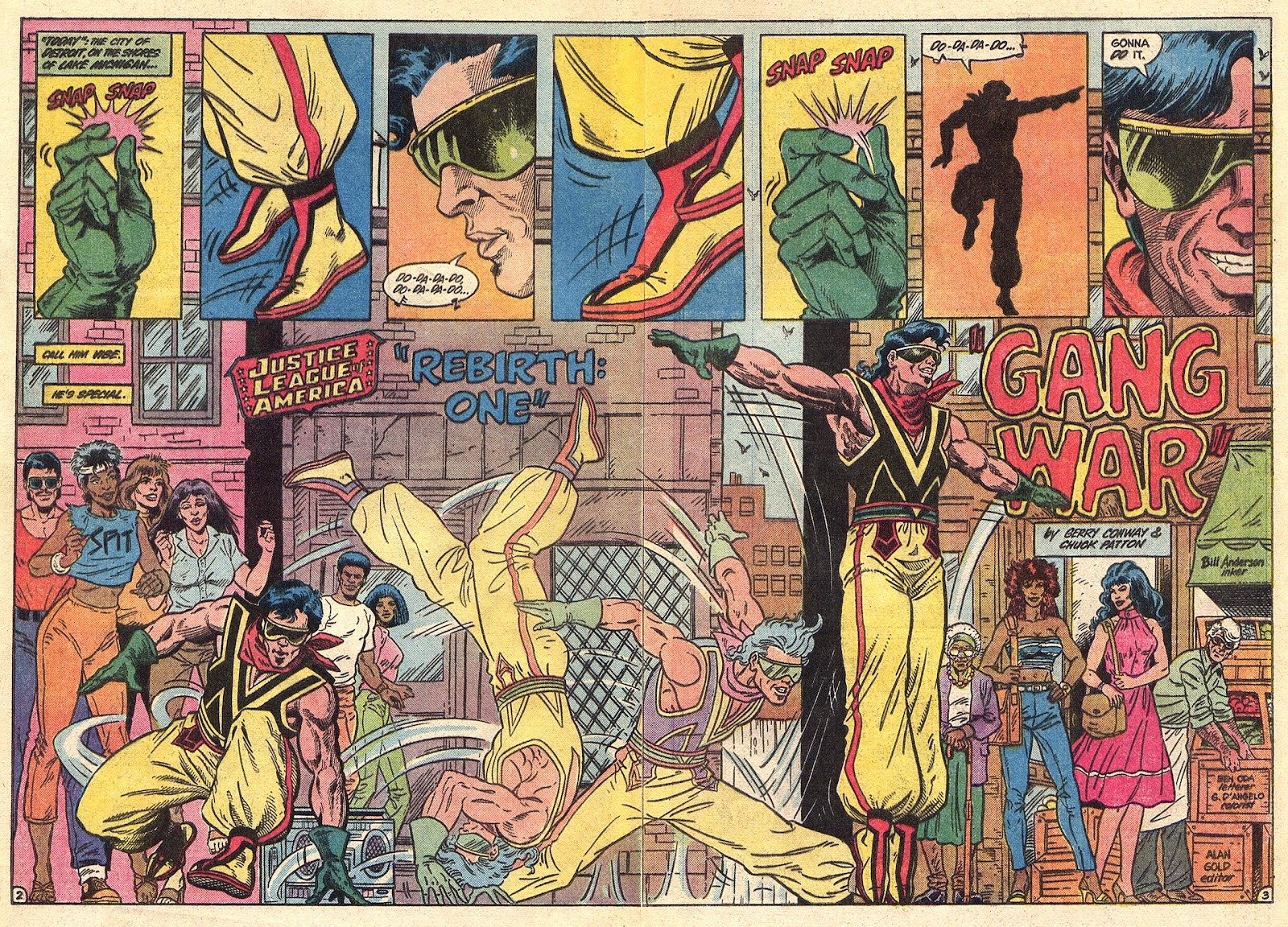
His output at DC was vast, peppered with an endless supply of new characters, from the successful (Firestorm, of TV’s Super Friends fame) to the less so (the streetwise era of the Justice League Detroit). “He was just always creative,” Harris said. “I remember in our plotting sessions, he would say, ‘Well, we could introduce a new character at this point.’ And he always had something in mind. I don't know if he had a backlog of them in his head, or if he created them on the spot. But it was fun to watch him come up with something.”
Paul Levitz, who initially worked as an assistant editor under Conway at DC before holding a series of senior editorial and publishing positions at the company, remembers Conway bringing a deliberate Marvel-esque style and methodology to the DC line. “The Marvel-style approach — plot, then dialogue — [was something] I had never had the chance to do previously,” Levitz said. “And I watched how Gerry did it, and learned from that, and adopted that as my preferred methodology of working with artists for many years after that.”
Still, just the same, you could sense a kind of exhaustion creeping in around the edges. “I don’t know how to put this, but there was something in the air that was causing Gerry to write less exciting material,” Levitz said. “Just kind of writing down to the excitement level that DC typically had at that time.”
Ironically, by the end of the '70s, Conway was himself becoming seen as a member of the old guard, not quite in step with the new wave of comic writers earnestly focused on proving that comics weren’t just for kids. In his interview with the Comics Journal in 1979, Harlan Ellison twisted the knife, declaring in passing that Conway had “single-handedly ruin[ed] the entire comics industry.” Conway remained with DC for the next decade, but in the end his departure was on less than ideal terms. As he said in an interview years later, “I felt I had been scapegoated for policy changes that hadn't anything to do with me. I had been hired to put out a lot of writing — you know, that was what they wanted when they brought me on. And then I became criticized for ... putting out a lot of writing.”
In truth, just like the generation of journeyman cartoonists who preceded him, Conway had learned the hard way that comics wasn’t a business that paid the mortgage. He called the industry his “golden handcuffs” — it paid just enough to keep him bound to it. His move to had been made with at least one eye on world of TV and movies, and his screenwriting partnership with Thomas has earned the two of them a coveted prize outside the bounds of comics freelancers: a Writers Guild healthcare plan. After the partnership broke up, Conway pulled off an even rarer feat for anyone in Hollywood: he got a steady job.
As it turned out, those same traits that had begun to make Conway look old-fashioned in the world of comic fans — his dependability, his copious output, his craftsmanlike facility with the basics of dramatic structure — made him a natural for the world of network television. Through an old colleague, Dean Hargrove, he became a staple in genre television twice over: first in old-school “cozy” mysteries like Father Dowling, and then its more modern successor, the police procedural. In 2006, he drew the golden ticket for a Hollywood TV writer: a writer and producer credit on a Dick Wolf drama, Law and Order: Criminal Intent.
René Balcer, the showrunner on Criminal Intent, remembers the “devious mind” that could lead to unexpected twists and turns even in plots that Conway wasn’t credited for. “One episode in particular was based on Gerry’s experience working at Marvel and DC,” Balcer said. “It was called “FPS”, first-person shooter, and it was about a tech company where the three partners basically self-destruct. Intra-office politics was a subject Gerry was very familiar with, obviously.”
Yet the Conway Balcer remembers was a world apart from the brash, ambitious hotshot of his early Marvel days. “Gerry was a very sweet, kind person — no big ego,” Balcer said. “His door was always open, especially for young writers to come in and pick his brain, or just talk about his experiences, or commiserate about this or that problem. He started writing professionally in his early teens, so he had a lot of accumulated wisdom.”
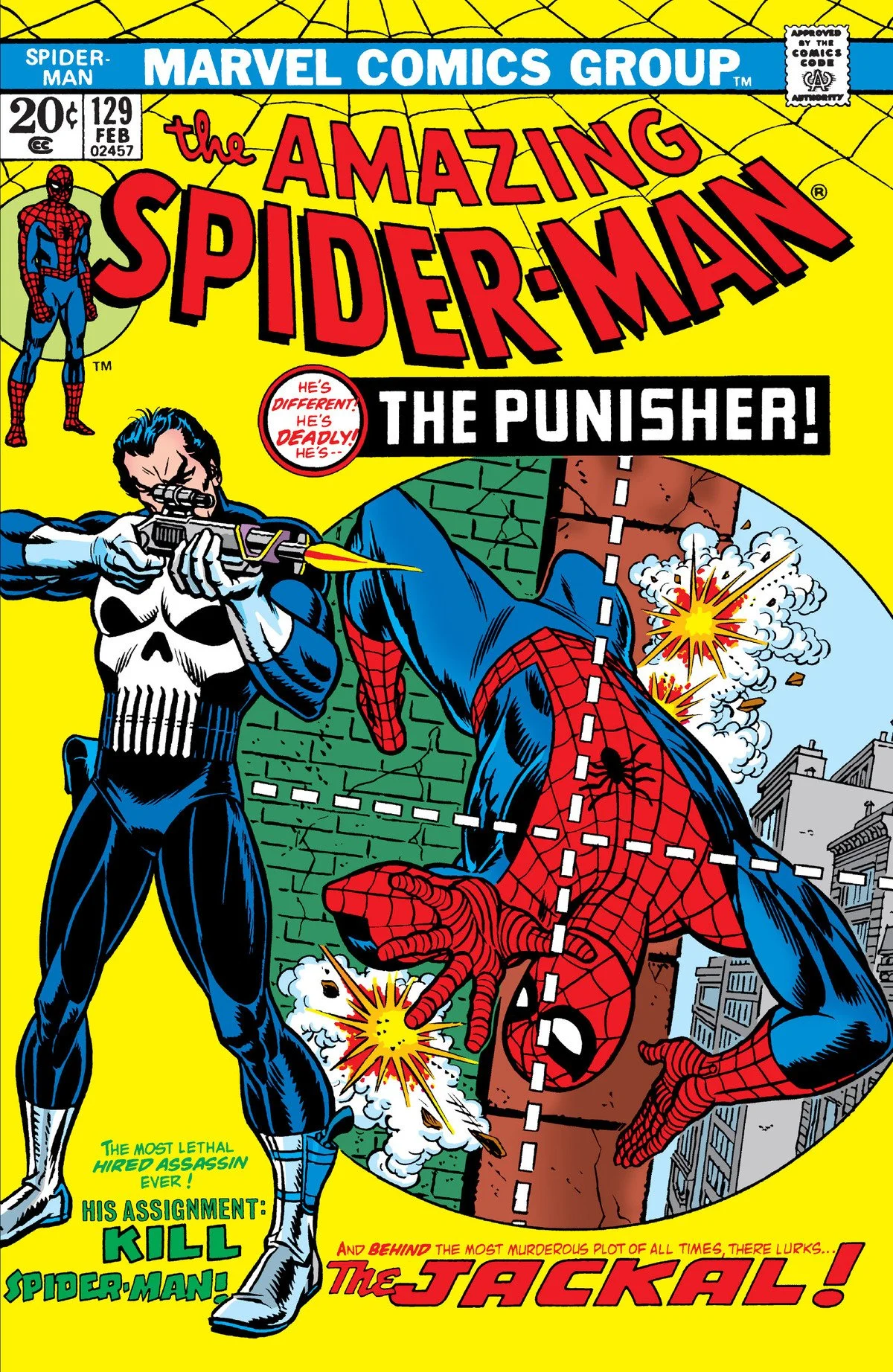
Oddly enough, the Hollywood caste system being what it is, Conway was seldom involved with movie and TV projects based on his own comic book creations — one of whom in particular had been growing up without him. In 1974, Conway, along with artist John Romita, had created the Punisher as a vigilante antihero in the model of Don Pendleton’s Executioner novels. The Punisher appeared initially as a recurring foil for Spider-Man, and in later years Conway would maintain that the character was imagined as a one-off villain, and certainly not a hero in his own right.
To be sure, this wasn’t entirely ingenuous. The Punisher as originally conceived wasn’t a moral paragon, but he wasn’t a villain either, and when the character showed enough success to warrant a spinoff stories in Marvel’s black-and-white magazines, Conway obliged by writing him with the kind of hard-bitten grittiness that had made Dirty Harry a hit at the box office.
But during the early 2000s, the Punisher took on a second life of his own, becoming a kind of mascot for the American far right: “American Sniper” Chris Kyle boasted of putting the Punisher’s skull logo on his unit’s gear during the Iraq War, and by the time Donald Trump was in office, the image and character had become a meme on military and police-centric kitsch. By 2025, Kash Patel was putting the logo on challenge coins handed out to agents at the FBI.
Conway, whose own politics by then skewed toward the left, wanted none of it. “It’s as offensive as putting a Confederate flag on a government building,” he said. In 2020, amid the wave of protests following the murder of George Floyd, he decided, vigilante-style, to take matters into his own hands, selling a line of shirts bearing the logo with all proceeds donated to Black Lives Matter. A few decades earlier, it might have been different. Roy Thomas recalled that in the early ‘80s, Conway was something of a “definite Reaganite, not unlike myself.” In a field not always known for the capacity of its creators to grow and change with the times, Conway was a model of graceful evolution.
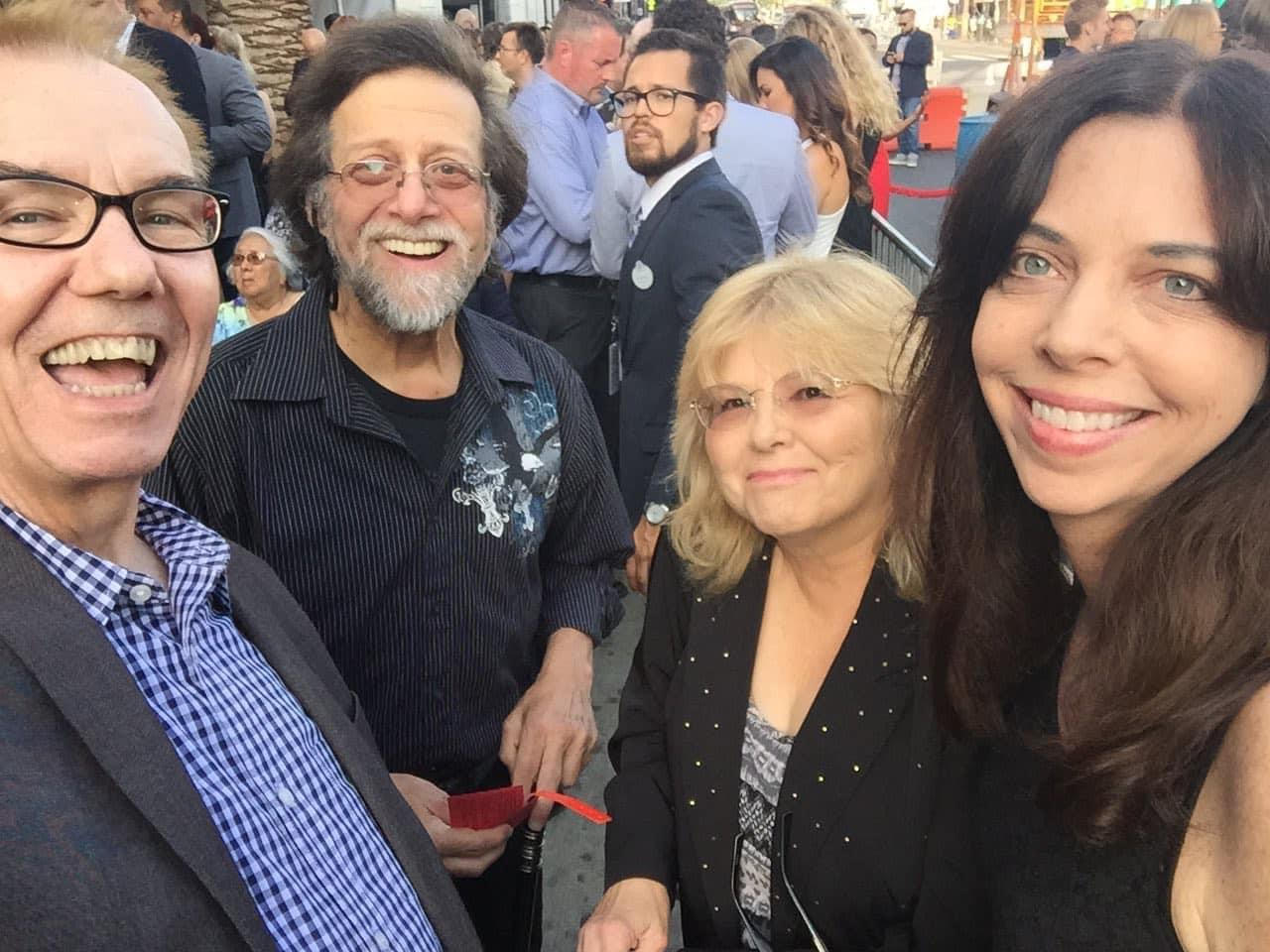
Conway would return to comics several times after establishing himself in TV, most often working on the character with whom he was most identified, Spider-Man. In the 1980s, he caught up with the faltering college student of his earlier run, now finding his footing as a husband, journalist, and grownup. In 2016, Nick Lowe tapped him to take over Amazing Spider-Man: Renew Your Vows, an alternate-reality series that took Peter Parker to his logical conclusion, fighting crime alongside his wife, son, and daughter, spider-powered all.
He was, by then, the seasoned wise man in a company full of writers, artists, and editors who had grown up reading him, and he took easily to the role. “He would talk often with young creators, writers, artists, and try to help them and make advancements in their careers,” Lowe said. "He'd come in, and he never made it feel like he was teaching us, but he'd teach us.”
He was the same way with other fans and professionals. The journalist Josie Riesman remembers the unexpected Instagram message she received from Conway in 2024 — an unprompted gesture of kindness out of the blue. “I think we all need to be reminded sometimes of what’s truly important in life,” Conway wrote to her. “Living in the now is the only way.”
He’d found happiness in his family life in his later years. After two previous marriages, and two daughters with whom he remained close throughout his life, Conway married again, to Laura Conway, who would become the center of his life. “He was a family man first and foremost,” Lowe said.
In 2023, Conway, who had been a regular presence interacting with fans on social media, suddenly disappeared from it. When he returned to it that August, he revealed the reason: he had been diagnosed with pancreatic cancer the previous year, and complications during surgery for it had been severe — three hospitalizations, time spent in the ICU, and a period in an induced coma.
“I witnessed years of pain and suffering that Gerry endured, at times pushing him to the brink of death, but he never gave up,” Laura Conway said. “Always bouncing back from whatever ailment was next in line to try and take him down. And there were many. He never complained. He just kept going and doing his thing the best he could. He never let the pain or disability stop him, even when it was a real struggle.”
It was on the week that he returned home from the hospital that I first interviewed him. He was, understandably, in a reflective mood about his past, but as talkative and self-deprecating as ever. We remained in touch after that, through phone calls and emails when his health allowed for it.
From time to time, when I found myself wrestling with a particularly difficult story, unsure whether I was being fair to everyone about whom I was writing, I would write to Gerry and he would reply, not as a source but as a counselor. Inevitably, he would tell me the advice I needed to hear. In late April, when it was clear that his health was failing, I asked if I could interview him at length again. To my surprise, he replied instantly in the affirmative: “My favorite hobby is talking about myself,” he said. He wasn’t at our appointment the following Wednesday, and I wasn’t able to reach him after. On Sunday, April 26, he was gone at the age of 73.
“At his last signing he was tired and in a lot of pain, but he stayed two extra hours to make sure every fan in line could get their book signed and have a moment to talk with him about comics,” Laura Conway said. “That's the kind of person he was. The thing he cared about most was that I was ok. He was a real life superhero.”
Christine Valada was friends with Conway through her marriage to the late Len Wein. Near the end, she said, Conway hatched a plan to hold a wake for himself while he was still alive. “There was going to be a contest, and there was going to be a reward … some little containers with the Punisher on them.” Conway had just received the urn he had purchased for himself. It, too, had a Punisher logo prominently displayed.
For my own part, I will say this: Conway was as decent and humane a man as I’ve gotten to know in this field. In comics or outside of it, that is no small thing. Once, while working on Law and Order, René Balcer came across a script he had written some 20 years earlier. “I came into Gerry’s office, and I said, ‘I just read this thing and I can’t believe I wrote it,’” Balcer said. “I was appalled at how bad it sounded, and I just said, ‘Oh my God!’
“And Gerry said, ‘Well, René, just be kind to that young writer. I’m sure that at the time he did the best he could. So just be kind.’”