
“I don’t know if Kraft is the enemy, but they make a fine macaroni and cheese.”
-Jess Johnson, from The Comics Journal #194 (March 1997)
In the far flung past when written arguments took place through mailed correspondence over months and the online forums which corporate-hosted microblogging (social media) has replaced were still newborn, The Comics Journal had a letters column. That column was known as Blood and Thunder, and fittingly it was home to many a legendary row, of the sort that bring a nervous chuckle to even the most battle-scarred warrior of the livejournal-tumblr era. In the early 2010s, the editorial of TCJ compiled three of its iconic bloody and thunderous debates for online reading convenience, a boon to latter day millennials (or early zoomers, take your pick) such as myself who were perhaps a little too newborn in the late 90s to follow in real time. I, for one, ate these reprints up. I was fascinated by Harvey Pekar’s ill-advised but principled crusade against Maus’ anthropomorphism, tickled by the roast of Terry Beatty and his girlfriend (although the bit was definitely sexist and Wild Dog is honestly not that bad), but the finest of Blood and Thunder, at least as seen through this retrospective lens, was absolutely James Kolchalka’s infamous August 1996 letter “Craft Is The Enemy,” printed in issue 189 of the Journal, and the truly wild discourse it wrought.
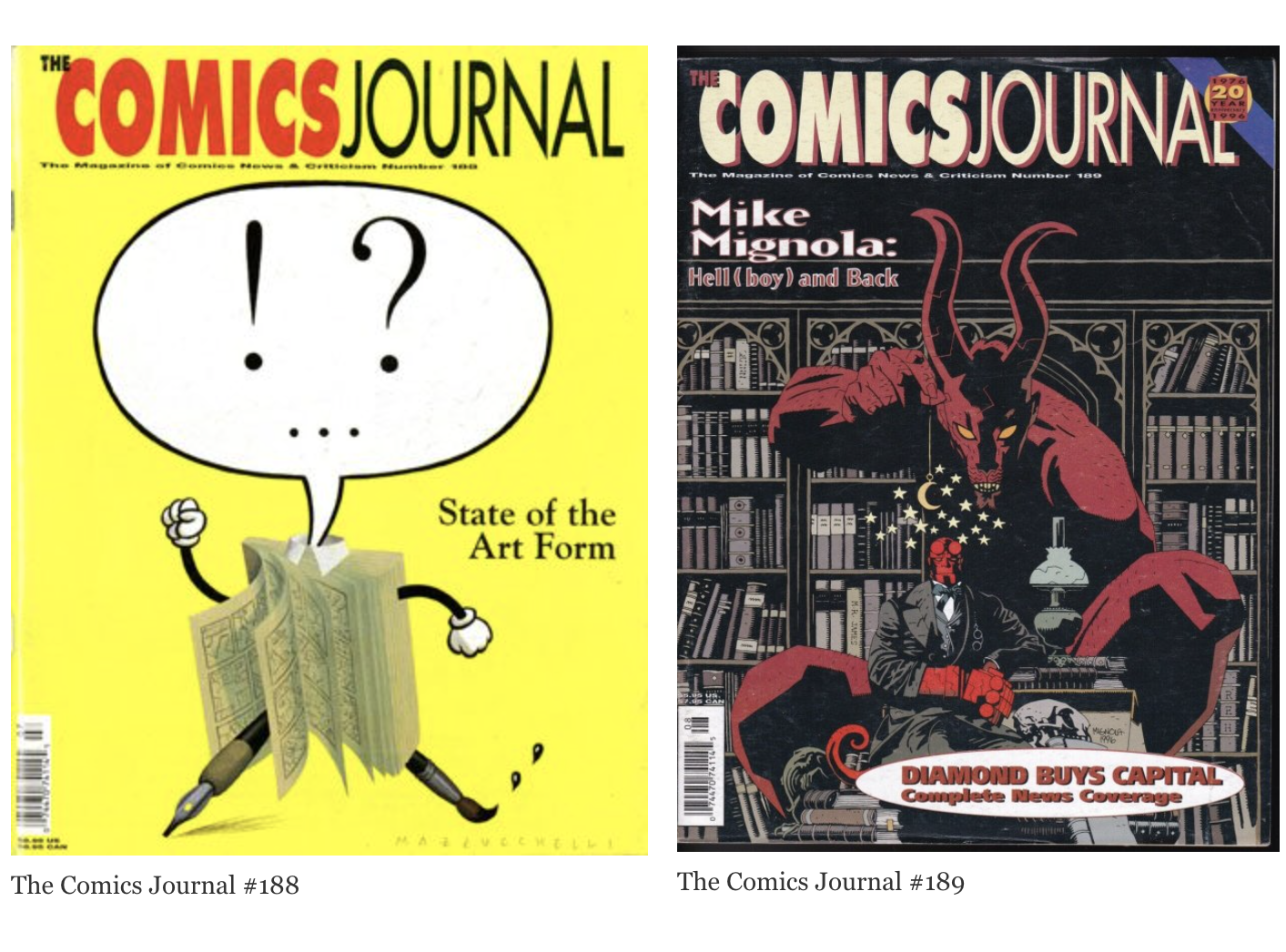 It begins innocently enough. Kolchalka had read issue #188 of The Comics Journal, a “State Of the Art Forum” featuring interviews and roundtables with the medium’s luminaries on the future of comics, his “mind [...] racing and blood pounding.” It was time to write a little manifesto, a very punk rock, zinemaker thing to do, and make no mistake, Kochalka was - and is - a consummate zinemaker. Alongside peers like John Porcellino and Jeffrey Brown, Kolchalka’s comics were made in a diaristic, direct pen-to-paper fashion, a clear personality and voice that served him well in future years as both a memoirist and a prolific children’s cartoonist. His next words could have very well been “go out and create,” which is something he has admirably done and continued to do for the past thirty years.1 However, what he arrived at instead was a call to arms against craft:
I just felt suddenly like I had to write and say craft is the enemy! You could labor your whole life perfecting your "craft," struggling to draw better, hoping one day to have the skills to produce a truly great comic. If this is how you're thinking, you will never produce this great comic, this powerful work of art, that you dream of. There's nothing wrong with trying to draw well, but that is not of primary importance.
What every creator should do, must do, is use the skills they have right now. [...] Just look within yourself and say what you have to say. Cezanne and Jackson Pollock (and many other great painters) were horrible draughtsmen! It was only through sheer will power to be great that they were great. [...] This letter is not for the established creators... they're hopeless. This letter is for the young bucks and does... let's kick some fucking ass!
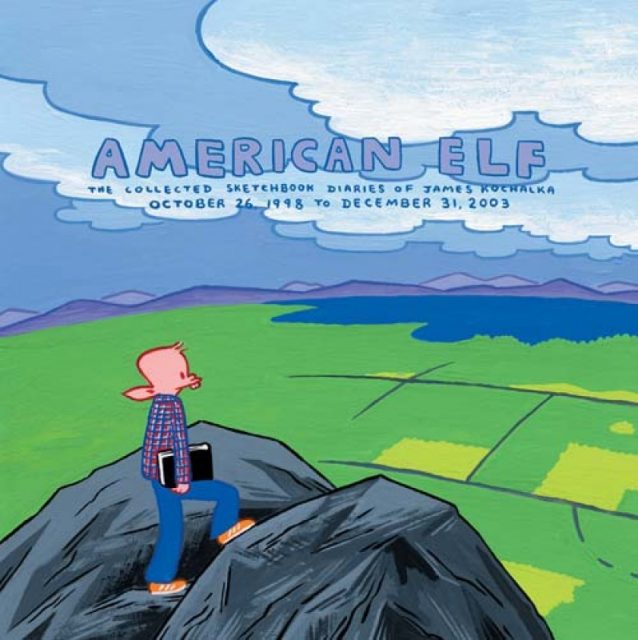
The first time I read this article, it really, truly puzzled me why this letter immediately provoked outrage from readers of The Comics Journal. The core of his letter seemed clear to me, a call to get out and make art, and not to worry about being compared to a technically skilled peer. In my time as a zinemaker, learning to go ahead and create anyway has been the clarion call, to know that your voice is worth sharing no matter what. However, it’s that thorny little phrase “enemy” where we run into a problem. By sheer force of naive excitement, Kochalka did not create a call to make art, but a declaration of war against skilled creation. If “craft” is the enemy, where does that leave the craft of the artist?
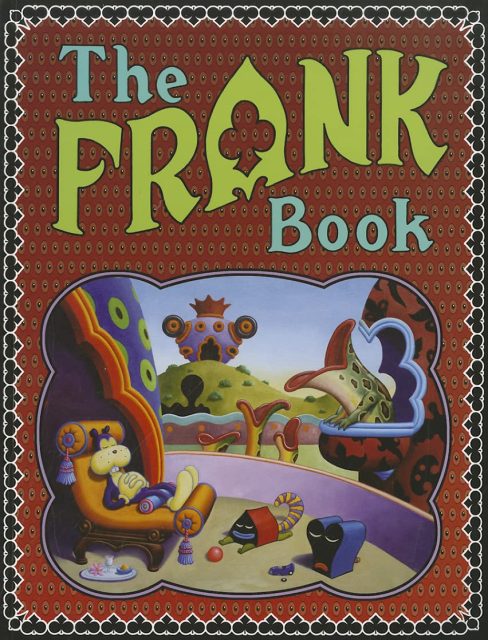
Ever bullish to such things, many readers of the Journal wrote in to express their dismay at Kochalka’s anti-craft equation. The anger in these letters takes me aback at times, but all of them are interesting, most of all Jim Woodring’s from TCJ #192 (December 1996):
Kochalka, you are wrong. Craft is control; it is the ability to create according to one's intentions, not in spite of one's limitations. Imagine saying that a writer doesn't need to know how to write, or that an architect need not be concerned with "craft." Well, I can imagine you saying it.
To describe Pollock and de Kooning as artists who were great despite a lack of craft is absurd. They may not have been great draughtsmen but they both had oodles of craft as painters, which is after all what they're known for. Both men were obsessed with getting exactly the effects they wanted and they worked like demons to develop their particular crafts.
Now, to say that Woodring is a more technically skilled artist than Kochalka is both self-evident and irrelevant to the argument at hand. The thoughtfulness which Woodring brings to this conversation, ad hominem attacks on Kochalka’s character aside, is more important. “Craft is control,” says Woodring. He does not concern himself with whatever complexity or realism that Kochalka’s “young bucks” might mistake for craft, but one’s capacity to create intentional, fully realized works – ironically, a capacity, indeed a craft, that Kochalka’s comics generally demonstrate.
Kochalka’s further replies, wherein painted into a corner he tries to redefine craft in purely negative terms as the mundane and repetitive, are embarrassing – with sympathy as someone who has been painted into a corner in Twitter dogpiles more than a few times, I won’t be engaging with those here. Much of what remains can be gobbled up like so much of the macaroni and cheese to which Jess Johnson's very funny comment cheekily alludes, and has about as much substance (but make no mistake, dear reader-- we're eating well!). However, a letter from Scott McCloud in TCJ #195 (April 1997) towards the end of the row is also worth attention, for attempting to clarify Kochalka’s initial target in a more sympathetic light:
There are a significant number of young artists who believe that great work is just the inevitable result of the gradual accumulation of skills and those are the artists J.K. said he was talking to. [...] I'm on the record saying that craft is an inseparable part of the creative process. But in the real world, a lot of comics artists really do put cold skill on a pedestal, and never make those great intuitive leaps that put those skills in perspective.
There's no way to skip the hard work of learning our craft. But I hope we haven't given anyone the impression that hard work is all it's going to take. Getting from poor to fair to good to great isn't some kind of straight path of incremental steps. If you're working on your skills every day and just assuming that inspiration will come if you work long enough, you could be waiting for the rest of your life.
McCloud, our great comics understander, has, I believe, correctly identified the target of Kochalka’s call to action, a group that Kochalka seemed to have lost track of in his own enthusiasm for an attack on his “enemy.” It is for the young artist who, whether staggered by the beauty of works which inspire her or faced by a technical barrier of entry to the conventional comics world, chooses not to create rather than create imperfect or inaccessible work. In no small part this is why Craft Is The Enemy remains the most interesting Blood and Thunder argument to me – it is not merely a series of letters in which artists and enthusiasts humiliate one another, but a debate, albeit a rather silly one, from which one might glean an artistic philosophy. Craft is not the enemy as Kochalka claims, but both Woodring’s objection and McCloud’s refinement reveal that craft is the iterative work, making art and then making more art, that through which we overcome Kochalka’s real enemy, the aesthetic elitism which many a young artist internalizes as a reason not to pursue sequential art.
Today, I am reminded of the spectre of Kochalka’s enemy in the face of AI “Art.” It is ironically pretty easy to imagine an AI bro declaring that craft is the enemy between chortling about robbing artists and everyone else of our incomes for the zillionth time, and yet machine learning’s artless theft of creative works venerates the boring and technically competent that Kochalka rightly rallied against. While craftless, the AI art image is superficially fine, and no observation of wonky fingers and hallucinatory glitches changes that the real purpose of generated artwork is to create work that looks better or as good as you can do. But AI artwork is terrible – it lacks humanity, it lacks voice, and most of all, it lacks craft. On the other hand, I fear our need of the handmade will lead to the superficial privileging some styles over others. Already, human artists working in digital media are battling spurious AI allegations, and artists working in naive idioms or analog media are being praised for not being AI more than they are seen on their own merits. Is craft the enemy, or have we forgotten what craft really is?
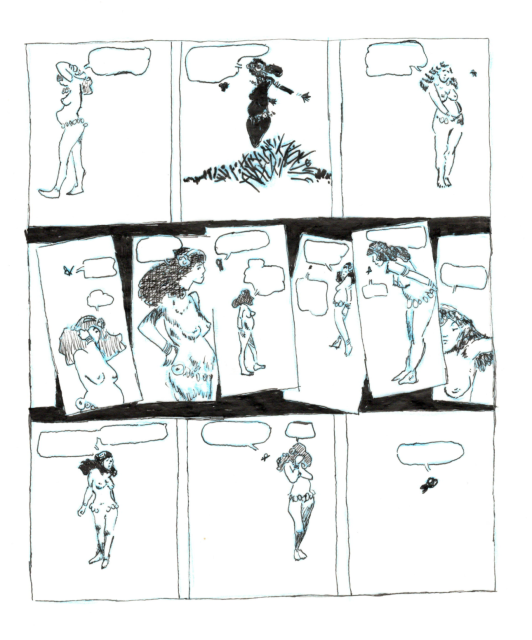
What does craft mean to a young buck like myself? After years of feeling inadequate as an artist, I started drawing again during the turmoil of lockdown and my gender transition. For a long time, it was a private, therapeutic practice – little avant garde comics for myself, the odd script and poem dashed off alongside during a panic. Eventually, I made a few zines, weird personal projects where I traced favorite artworks – Catharine Jones’ Idyl in Idyl Traces, Yui Toshiki’s Hot Tails in Finders Keepers, production stills from the fourth Urusei Yatsura movie in Lum The Forever Zine – to explore my relationship to these works as a trans woman. Working by hand with tracing paper, my own frantic line – and, by extension, my voice, my personality – is all over these zines, but on some level the choice to trace was a crutch. I didn’t feel that my art measured up to the stories I wanted to tell, and I wanted to get there by the close observation that tracing required. I learned a lot doing these. I came to really appreciate Catharine Jones’ economy of line, how often her delicately rendered figures were really just two carefully applied brush strokes. While working on Finders Keepers, I came to admire the absurd attention to detail that 80s and 90s eromanga artists like Yui Toshiki paid to drawing hair – so many finely lined strands! Of course, I was observing an end point, not their process – but through observation, I developed some practices of my own, not their skill, but my craft.
I’ve made a couple original comics since then, one of which appeared in the anthology Pulping II: Reality. I bring a lot of formal comics knowledge to my work, particularly in layouts and panel structure, but my grasp of art fundamentals is shaky; I use a lot of photo reference, albeit generally of myself. I still don’t really think of myself as an artist. But a little earlier this year, I was telling my friend Lisa Marshall, a brilliant artist whose comics have graced the pages of my Afternoon Affair anthology’s latest issue, about a couple ideas I had for stories that I was looking for an artist for. Skimming the pages of my Pulping contribution, Lisa turned to me, and deadpan observed, “Helen, it sounds like these are comics you want to draw.” I reiterated that I couldn’t do it myself, but she didn’t let up, and finally, I had to admit, she was right.
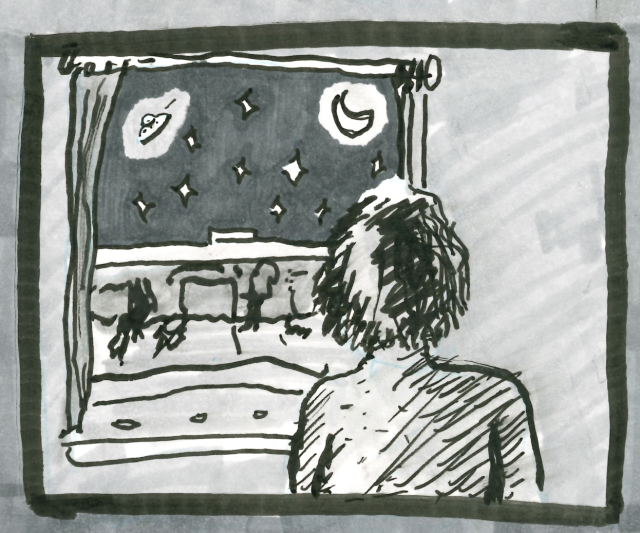
One of those comics, “Reification,” is now done, and will appear in an anthology edited by Lisa next year. It was my first time drawing an original comic where I was not the main character. To say the artwork is cruder than my last few pieces is putting it lightly – I had to draw a lot of objects and angles I had no prior experience depicting, and the whole piece looks quite similar to the art I made as a teenager. What was funny about the whole process, though, is that every time I sent a finished page to Lisa, she would invariably point to whichever illustration I found the shakiest or most rushed and identify it as her favorite part. Somewhere in those drawings that made me cringe was my artistic voice, that very loveable thing that I want to cultivate moving forward
So here I am, a young buck-to-doe cartoonist, albeit one with a unique platform as a critic, asking myself before you all, my audience: is craft my enemy? The answer to this is a resounding “no.” But the more interesting dilemma is what craft is, what craft is for me, and to that I see not the dazzling technical skill that my friends in comics have developed on their own path, but the way that I want to do comics, the way that I will do comics, and how I am going to become able to make those comics. Like Woodring said, I want to create according to my own intentions, and like McCloud suggests, I will not put cold skill on a pedestal. Kochalka was right about at least one thing – I’m going to kick some ass!
- I want to assert that my intention in revisiting this argument, which is slightly older than I am, is not to tear down or freshly embarrass James Kochalka. The latter may be unavoidable, particularly as I was unable to find a reading copy of his more carefully considered comic book continuation of his thoughts, The Cute Manifesto. My heartfelt apologies to Mr. Kochalka who has done a lot more in his time than write letters.