
Harvey Kurtzman became part of the world of Entertaining Comics as an illustrator and writer of science-fiction, adventure and war stories, along with a handful of horror and crime pieces. It was an about-face for the artist, who had honed his delightful humorous style — cartoon modern with a sense of antic exaggeration worthy of a Tex Avery — on a series of ground-breaking single-page strips called Hey Look!
Kurtzman’s progression in the three-year arc of that series is breathtaking; read in order, they show a cartoonist embracing his unique sense of comedy, absurdity and self-reflective antics that erase the wall between reader and character. His graphic style becomes bolder and more fluent with each strip. The episodes of 1949, drawn months before his first EC work, and their brief newspaper equivalent in the New York Herald-Tribune’s Silver Linings strip, are pinnacles of cartoon art: vivid, fierce slashes of living lines, brilliant concepts and tight execution. They reveal in Kurtzman a linguist on par with John Stanley, whose contemporary work on Dell’s Little Lulu series rivals this work in its brilliance.
Why would such a gifted comical-type cartoonist choose to abandon this approach to draw serious genre stories? Money. A steady gig doing comic-book work for publishers who valued him and didn’t hamper his creative impulses. EC was a heady draw after suffering the rocky road of Stan Lee at Timely Comics, where he’d done a passel of fine humorous work, Hey Look! included. To prove to EC’s brain trust of William Gaines and Al Feldstein that he could do serious comics, Kurtzman illustrated a giveaway comic on VD prevention called “Lucky Fights it Through!” This 1949 effort was the artist’s first non-humor work since his handful of wartime superhero stories done while he was the assistant of Louis Ferstadt.
The detailed images of that 16-page pamphlet show a variant on the general Milton Caniff style that permeated comic books in the 1940s and ‘50s. Bold lines define people and objects; wispy pen strokes give fine details a crisp visual contrast. This work was a thoughtful revision of his earlier realistic comic-book material, and the delicacy shown human anatomy is impressive. It achieved its purpose: Kurtzman was in at EC.
Unlike most EC artists content to illustrate the pleonastic scripts Gaines and Feldstein gave them, on Bristol boards with panel layouts and mechanical lettering in place, Kurtzman had ambitions to do his own thing — to flower within the perimeters of the house style. The 13 stories Kurtzman drew, wrote and designed for EC’s Weird Fantasy and Weird Science titles from 1949 to 1951 clash with everything else within their comic books; their lines shimmer with energy alongside the yet-amateurish work of Wally Wood and Harry Harrison, the woodcut look of editor Feldstein and the slick-yet-abnormal efforts of Jack Kamen. This core group defines the first year of EC’s science-fiction titles. Kurtzman’s work looks professional, ambitious and risk-taking—despite its being far-removed from his natural sensibilities as a humorous cartoonist.
The result of these stories is like seeing warring blood cells through a microscope. It’s no surprise that, panel by panel, page by page, Harvey Kurtzman sheds the Caniff affect and, by the final works in this small suite, has regained his cartooning mojo and allowed his satirical bent to inform stories that are more about human foibles and whimsy than spaceships, H-bombs or time-warps. They remain among Kurtzman’s most overlooked work, but when read in the order they were created, they reveal an odyssey of self-discovery.
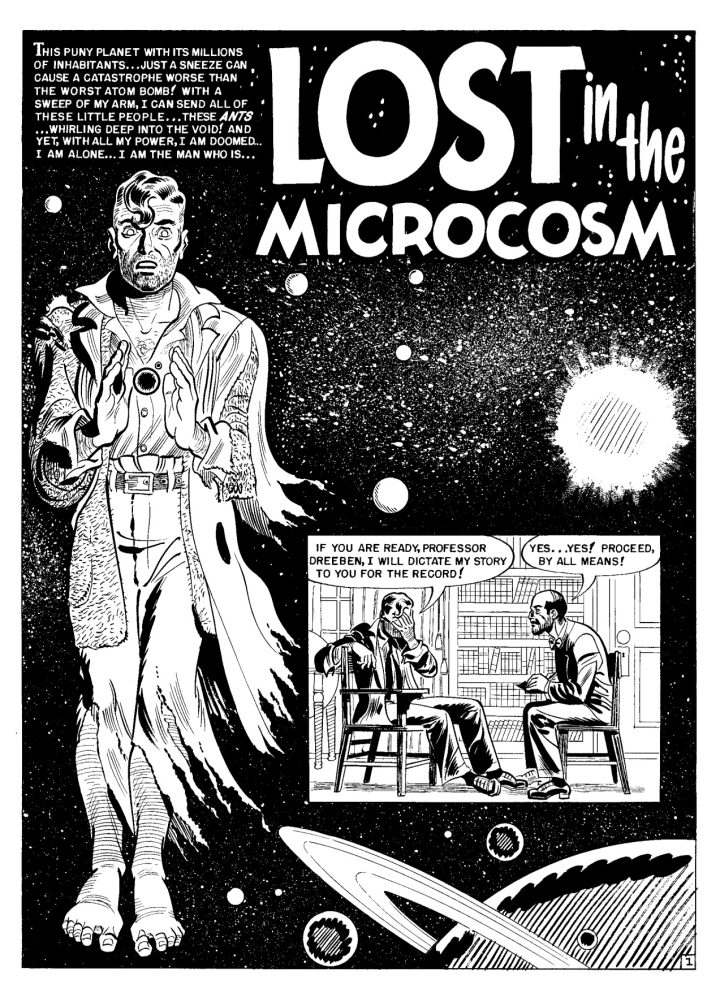
Though the debut issues of both science-fiction comics are cover-dated May/June 1950, I believe Kurtzman's story for the first Weird Science was his first completed work. “Lost in the Microcosm” was the cover-featured lead story, with a loquacious tableau drawn by editor Feldstein. Kurtzman’s splash page is a gripping design. Every time I’ve read this story, since I first encountered it in the 1970s, I’ve spent at least a minute fixated by the figure of its tragic hero, Karl, and his relationship to the star-spattered black that surrounds him. Kurtzman works hard here at playing it straight, and the attention to detail reminds us that behind every great comical cartoonist is an artist who understands realism. The wrinkles, tears and textures in his clothes! Those meticulously rendered bare feet! The way the fabric on his pants bunches under the constriction of his belt! This is one of comics’ great opening pages.
The story that follows, written by Gaines and Feldstein (though obviously inspired by someone else’s sci-fi concept), is haunting, ambitious and open-ended. Kurtzman overdoes the detail in spots, but the effort you feel him put into every line is almost moving. And look at the hands he draws! So many elegant, animated-but-correct poses and positions, all done with grace and with minimal exaggeration. After the splash, Kurtzman feels hemmed in by the pre-arranged panel grids (and their redundant caption boxes) but does his best to make every image worth seeing. Gaines and Feldstein knew that “Lost…” was the story to lead off this new title.
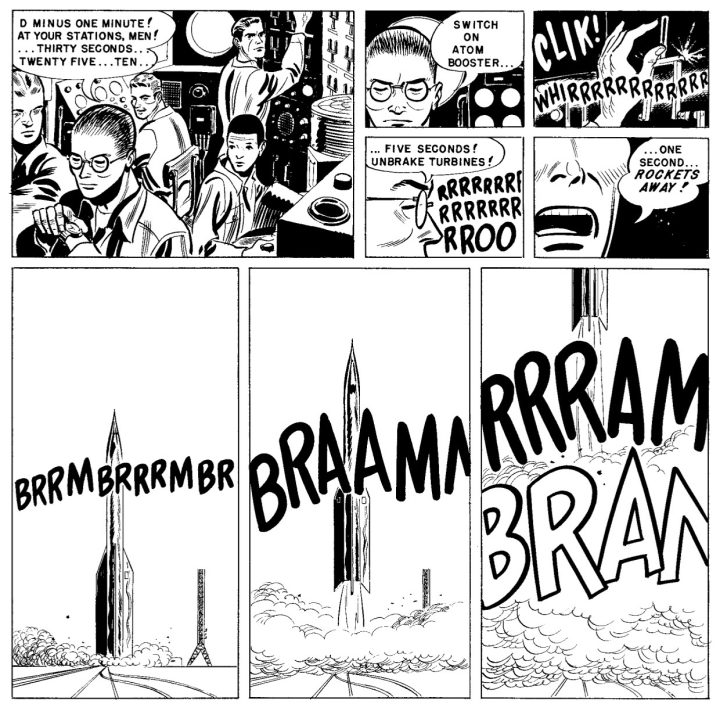
“Trip into the Unknown!”, its companion in the first Weird Fantasy, was demoted to the last story in that issue — again to good effect. Its cynical ending closes the book with a wallop. Like Johnny Craig, the other writer-artist-editor in EC’s stable, Kurtzman uses his opening page to make a stand-out moment in a visually-crowded comic book. Gleaming metal surfaces dealt in deft brushstrokes, pen cross-hatching that reminds of Chester Gould’s contemporary work on Dick Tracy, delicate lines for detailed equipment inside the spacecraft: each panel rewards our having spent time assessing it.
Though both stories endeavor to tell a serious story with sincerity, Kurtzman’s verbal wit sneaks through. Characters exclaim “So!” as they take steps in achieving a task. And while he is careful to render human anatomy in solid, Caniff-style terms, the faces of his characters reveal a glimmer of mischief. This thoughtful blend results in figures, objects and setting with an illusion of life, wit and humanity.
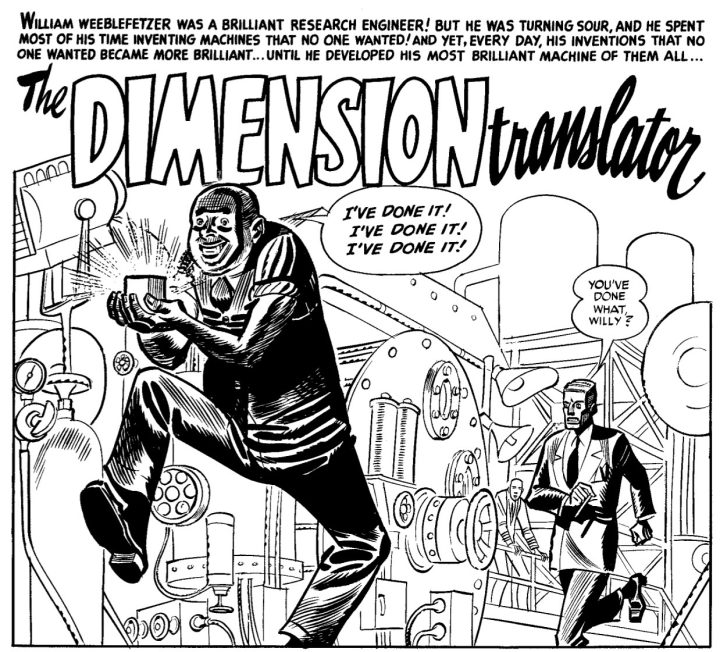
Let’s jump ahead to the final two stories Kurtzman did for these books. “The Dimension Translator!” (Weird Fantasy #6, March/April 1951) is a typical revenge story using science-fiction concepts. But what a difference! The story is hand-lettered by Kurtzman’s favorite Ben Oda — a major breath of life in itself — and garnished with Kurtzman’s love of ludicrous-on-purpose sound effects (soon to be a staple in the yet-created Mad comic-book). Its characters are caricatures, shot through with life and verve, their limbs loosey-goosey and their gestures and expressions larger than life.
Kurtzman’s comedic voice bubbles over; he relishes the horrific, selfish behavior of his anti-hero, William Weeblefetzer, whose very being is abhorrent. The story’s fifth page is a trove of Borscht-belt humor, as the mad inventor uses a reproduction ray to copy totems of wealth and a pint-sized simulacrum of his overbearing boss, Bankbuck. The tongue-in-cheek approach intensifies the wrongness of Weeblefetzer’s mental state; on the next page, in a classic example of a Kurtzman “tell” (a four-panel sequence that ups the ante of an event in a humorous impact that reminds me of filmmaker Billy Wilder’s comedies of the era), the inventor makes a replica of a woman who scorns his affections. His all-caps, bold-face response is disturbing yet amusing: “You are only three-dimensional because of me!”
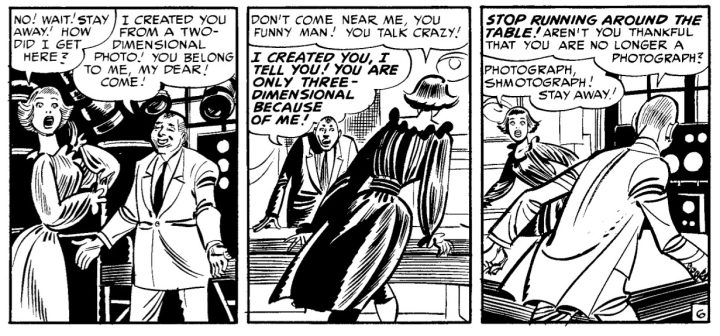
The story achieves the desired “EC ending” — but its ironic twist is far wryer than anything Gaines or Feldstein could achieve. The lack of irrelevant captions (descriptions of what is illustrated and a totem of editorial insecurity) allows Kurtzman to imbue the pages with a rhythm. Until the story’s final two pages, there’s one caption. No more. The use of captions towards the finale are necessary and well-worded, with an authorial voice missing from Feldstein’s work. This story suggests a what-if: a whimsical, humor-infused take on science fiction that gets its points across and is … dare I say it … fun to read! Most EC stories can’t be described thus. They are well-intentioned and sometimes effective, but the logorrheic blather of writer Feldstein’s captions and the dogged pursuit of the all-important twist ending results in a formula that proves hard to overcome.
Kurtzman’s final SF story, “…Gregory Had a Model-T!” (Weird Science #7, May/June 1951) is among his great achievements in comics. It is an ideal mix of whimsy, melancholy and fantasy. It might have made an excellent episode of Rod Serling’s TV series The Twilight Zone, but it belongs to the comics format and lives and breathes in its six pages.
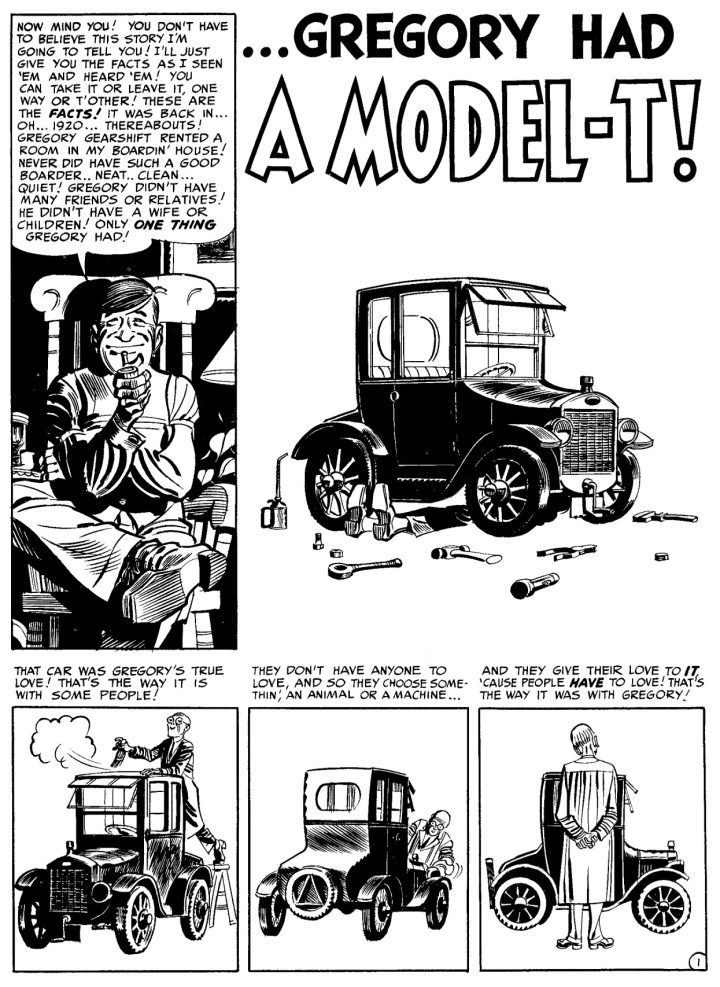
This story of an elderly bachelor who babies his vintage Ford car through three decades and the start of a fourth, is told by Clem, a Will Rogers-esque small town landlord who has borne warm witness to Gregory Gearshift’s devotion. He offers all sorts of disclaimers at story’s start but lets the events speak for themselves. By not judging Gregory’s eccentricities, he (and Kurtzman) allow us to be touched by the story’s events. A sense of the passing of time, and of man’s fatality, brings poignance without working hard to get it — something the other EC stories often failed to do. The betrayal of Gregory’s lifetime of TLC by a collegiate who represents the hard-shelled, cynical now of the story, is genuinely moving—all given the grace and life of Kurtzman’s stylized, energetic images.
By this time, Kurtzman was editing and writing the stories for EC’s war comic Two-Fisted Tales, where he created a series of bleak, powerful stories that ruminate on the futility of violence and conflict. “The Big If!” (Frontline Combat #5, 1952) is his finest achievement as a serious storyteller and cartoonist. “Gregory” strikes a similar note with its small-town elegy for a misunderstood soul whose whimsy turns out to have been reality.
We celebrate Harvey Kurtzman’s satirical wit, social commentary and informed skepticism — the elements that make his Mad comic-book series a great body of work. These comics had a major impact on American life and continue to inspire cartoonists, filmmakers and authors. Beside his best efforts for Mad (“Starchie,” “Mickey Rodent,” “Book! Movie!”) the early science fiction material might seem quaint, but it is fascinating to see this future icon of satire work hard to fit in with the dramatic goals of the serious EC titles and, story by story, bend their framework to best suit his inimitable vision of the world.
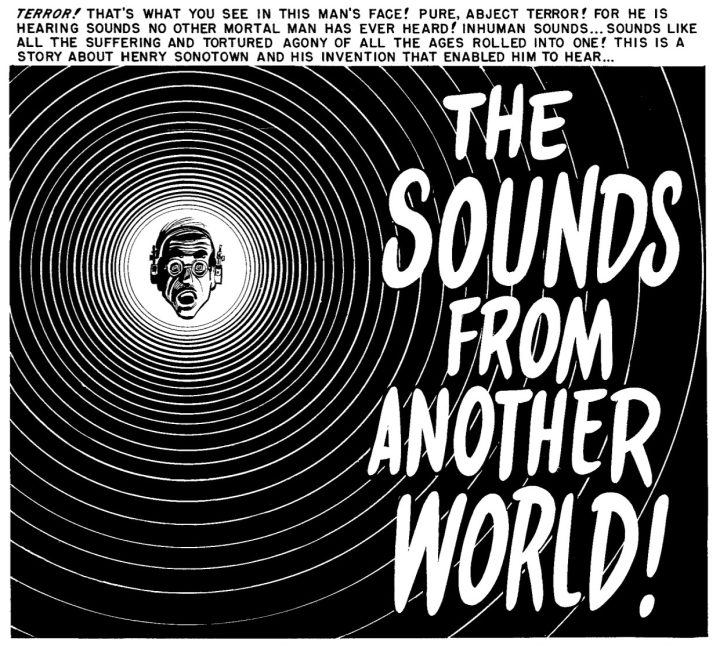
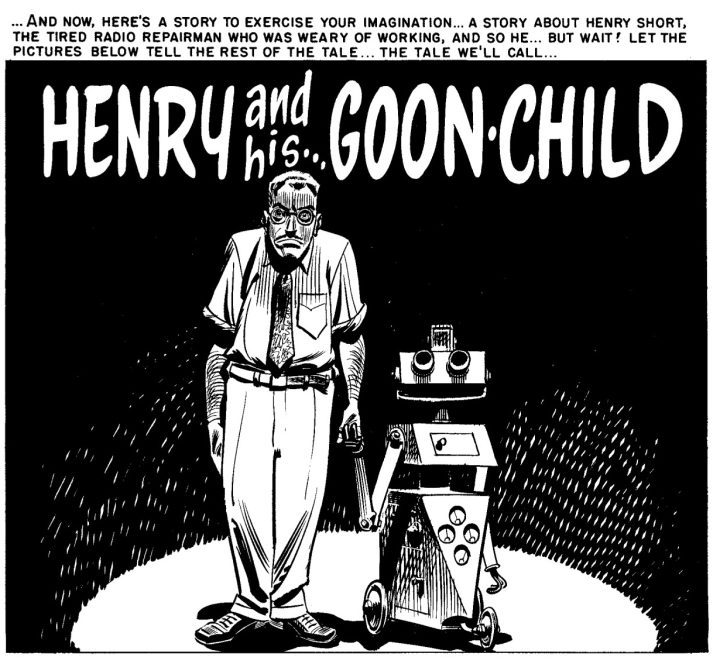
I’m remiss not to mention “The Sounds from Another World!” (Weird Science #14, September/October 1950), “Man and Superman!” (WS #6, March/April 1951) and “Henry and His Goon-Child!” (Weird Fantasy #15, September/October 1950) — all excellent stories that push the artist’s natural inclinations as a social humorist to the fore. There are a few weaker pieces; “Atom Bomb Thief!” (WF #14) and “The Last War on Earth!” (WS #5). But the lesser stories still have sequences and graphics that make them the best thing in each issue. These 13 stories were collected in a now out-of-print Fantagraphics volume titled Man and Superman, which is, next to the original Russ Cochran boxed sets of hardcovers, the best way to experience these stories. You might still find that volume in libraries or on the shelves of comic book shops where it’s sat for years. It’s worth trying to track down.
In summation, I was reminded by my friend Barry Deutsch of a couplet from Steven Sondheim’s musical version of the play Merrily We Roll Along. These lyrics from its song “Franklin Shephard Inc.” might put these science-fiction stories in perspective. They’re about a composer who decided a better life awaited him as a Hollywood film producer, and whose efforts are summarized by a colleague:
“Listen, he does the money thing very well, but you know what?
Other people do it better. And he does the music thing very well.
And you know what? No one does it better.”
These stories were Kurtzman’s “money thing;” they earned him a living and brought him to an understanding that his talents were best served elsewhere. It doesn’t devalue them; they’re a delightful body of work. The world is a much better place for his “music thing,” Mad, having existed; these science fiction pieces reward the informed reader and are a warm-up act for greater things to come.