
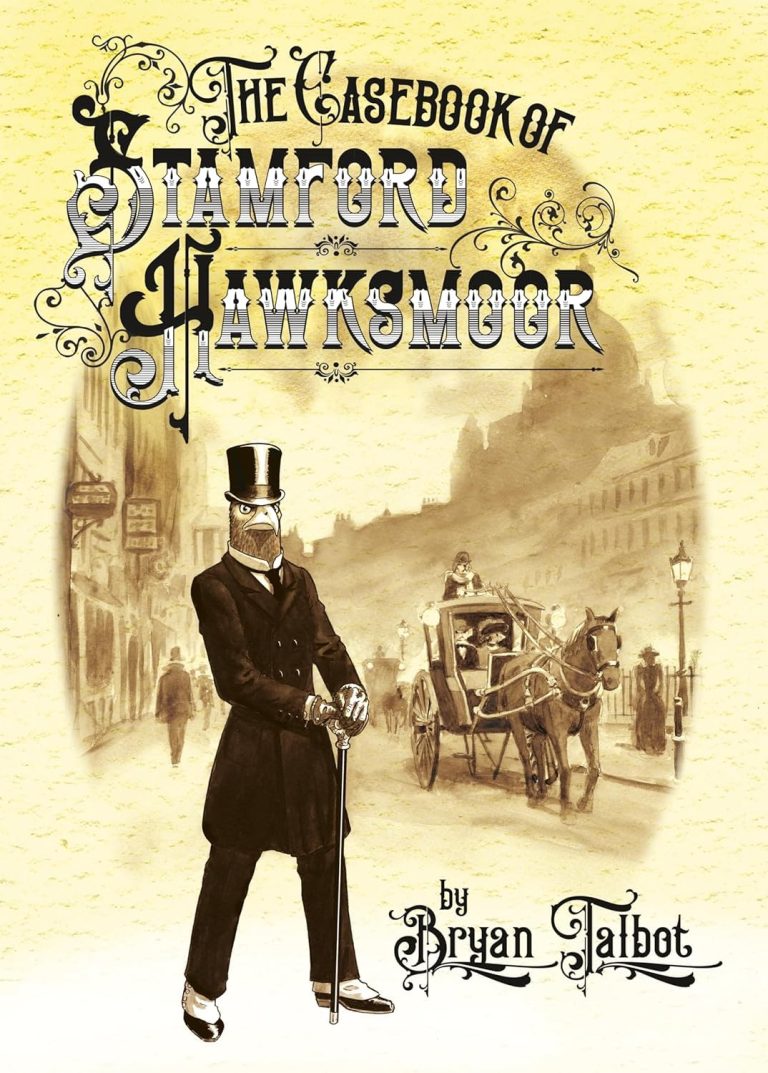
At first glance Bryan Talbot’s long-running Grandville series isn’t very promising. Why yes, it is yet another historical detective drama set in the world of anthropomorphized animals – another stuffed head to hang on the wall alongside Inspector Canardo, Animal Noir and (of course) Blacksad. Yet it takes no more than a few pages into any volume to see that Talbot is playing things differently. Talbot doesn’t treat his animal-people as mere humans drawn with feathers and scales (as Carl Barks would). Questions of biology, of relations between different species, constantly arise. Regular human beings (‘doughfaces’ in local parlance) exist as an underclass, with even the more ‘progressive’ characters treating them as obviously inferior. One book opens with an expensive restaurant in which (regular sized) lobsters are boiled by other, anthropomorphized, sea-life. There are many questions about this world, not all of them answered, but it is clear that Talbot (raised in the trenches of science fiction comics) sees anthropomorphizing as something more than visual ornament over a familiar story. 1 These unique elements rear their heads once more in Talbot’s new prequel story The Casebook of Stamford Hawksmoor.
Like previous albums in the series, Stamford Hawksmoor aims to strike a delicate balance in its depiction of animal-people. It's not cartooning in that old sense of the word. From early-on in his career (think Nemesis the Warlock or Luther Arkwright), Talbot had shown that no matter how outré the ideas, he had the ability to keep the drawings represented in that solid British comics tradition – each muscle and seam on a coat had to be exact. He could make the impossible appear plausible2. Yet he’s not aiming at ‘realism’ in either the Alex Raymond or Neil Adams sense of the word; you can never forget that you are reading a ‘comics’ with Grnadville – Talbot never does the cowardly (or lazy) choice of making some characters more human-looking than others. He has committed to a fantastic animal world and by God he will give you one. And you will believe it.
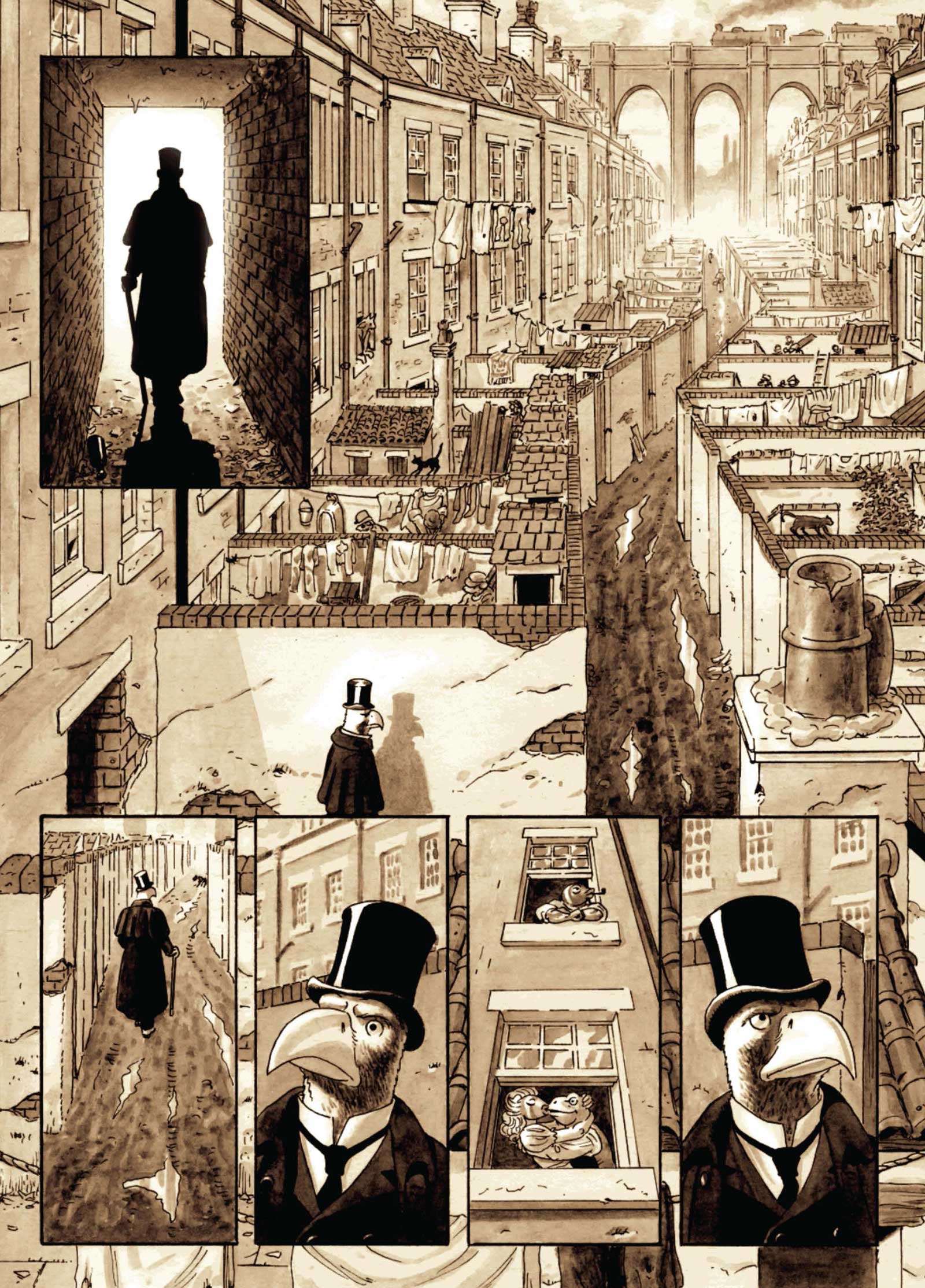
Speaking of vaunted British comics traditions – I find, to fully appreciate his attention to detail, Talbot is one of these artists that looks better in black and white. The Grandville series chose to go with strong colors, which at least allowed him to play-up the contrasts between various characters and their environments; The Casebook of Stamford Hawksmoor goes for a mix of brown hues, which I guess meant to evoke the famous pea-souper environment of historical London, but instead bring to mind that period of Vertigo comics in which everything was painted in the same dull manner. It’s not a bad look, because it is drawn by Talbot, but it is a bad choice.
The other notable thing about the Grandville setting is its treatment of history. The series doesn’t merely takes place in an historical setting as set-dressing (I’ve written previously about how Blacksad fails to treat its historical setting as anything but a series of recognizable visual cues); Grandville gives its readers a fully-flashed alternative history, a world in which Napoleon managed to conquer Britain and put the royal line to the sword; two centuries later Britain is finally freed from the French yoke3 and set about trying to establish itself as a social democracy.
The first five Grandville books feature Archibald "Archie" LeBrock, a badger Scotland Yard inspector who is a bit in the mold of the hardboiled detective (while much is made of his deductive skills his main assets appear to be his large muscles and propensity for violence); book five introduces Archie’s mentor, an obvious Sherlock Holmes pastiche called Stamford Hawksmoor (yes, he’s a hawk), as a bit player. And that was that for Grandville for eight years. Which was a pretty decent choice all considered. Archie wasn’t deep enough to spend more time with and the setting (for all its unanswered questions) was getting a bit tired; it seemed Talbot said all he had say about this world… until now.
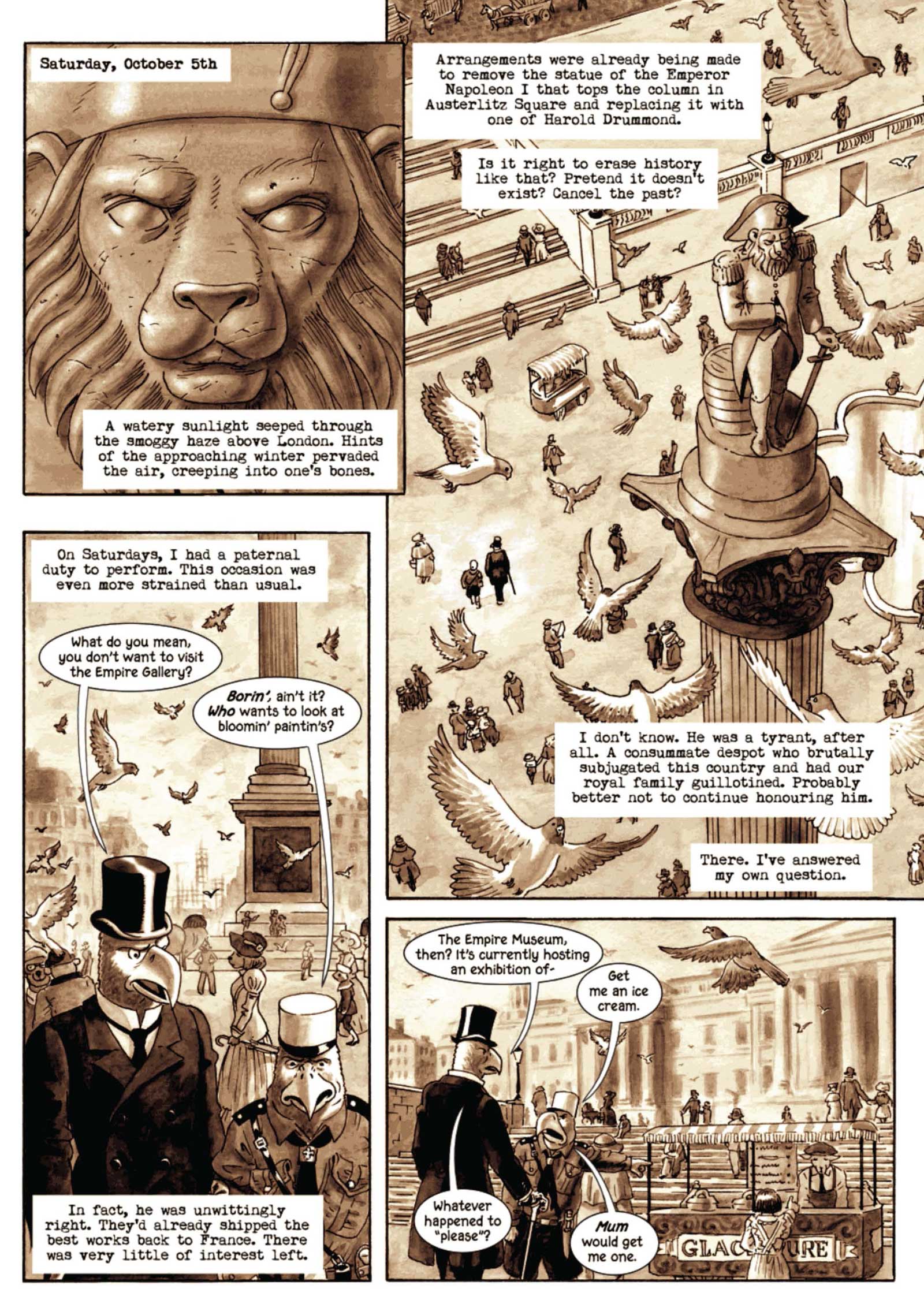
The Casebook of Stamford Hawksmoor is a prequel, taking place when the French are still occupying Britain (but have already decided to leave after a prolonged campaign of terror attacks and public upheaval). This set-up allows Talbot to play with notions that were only hinted at in previous novels – we see an angry mob set upon on a woman in the street in a charge of collaborating with the foreign occupation, Hawksmoor’s wife and son are pro-French and have no intention to stay in a ‘backwater province,’ some former terrorists / freedom fighters are now respected political figures while others are determined to keep fighting… Turns out nation-building is a messy affair, especially when the former occupier is still an existing world power. In the midst of this political turmoil Hawksmoor is keen, possibly too keen, to keep his head down and keep with the work of detection. But when the bodies pile up, several of them with clear relation to the new power structures in Britain, he has no choice but to get involved.
I was a former fan of Grandville, but felt the air has long left the balloon by the fifth volume. This new album might not be as fresh as the first Grandville story, as I still wish Talbot would try something new with his considerable skill, but it is certainly a step in the right direction. Hawksmoor is a better protagonist for his obvious faults. A brilliant detective that is utterly clueless in both social and political worlds; many Holmes pastiches play-up these elements4, Talbot wisely avoids making them into virtues. A man, a hawk, more in touch with both his politics and his social circle, would have solved this mystery much faster. Not that mystery is much to write about, for all its many false leads, red herrings, convoluted connections and conspiratorial tones it ends-up being the weakest part of book. It needs to be there, because being a detective story is the raison d'être of Stamford Hawksmoor, but it ends-up feeling like a distraction from the more vital parts of the narrative.
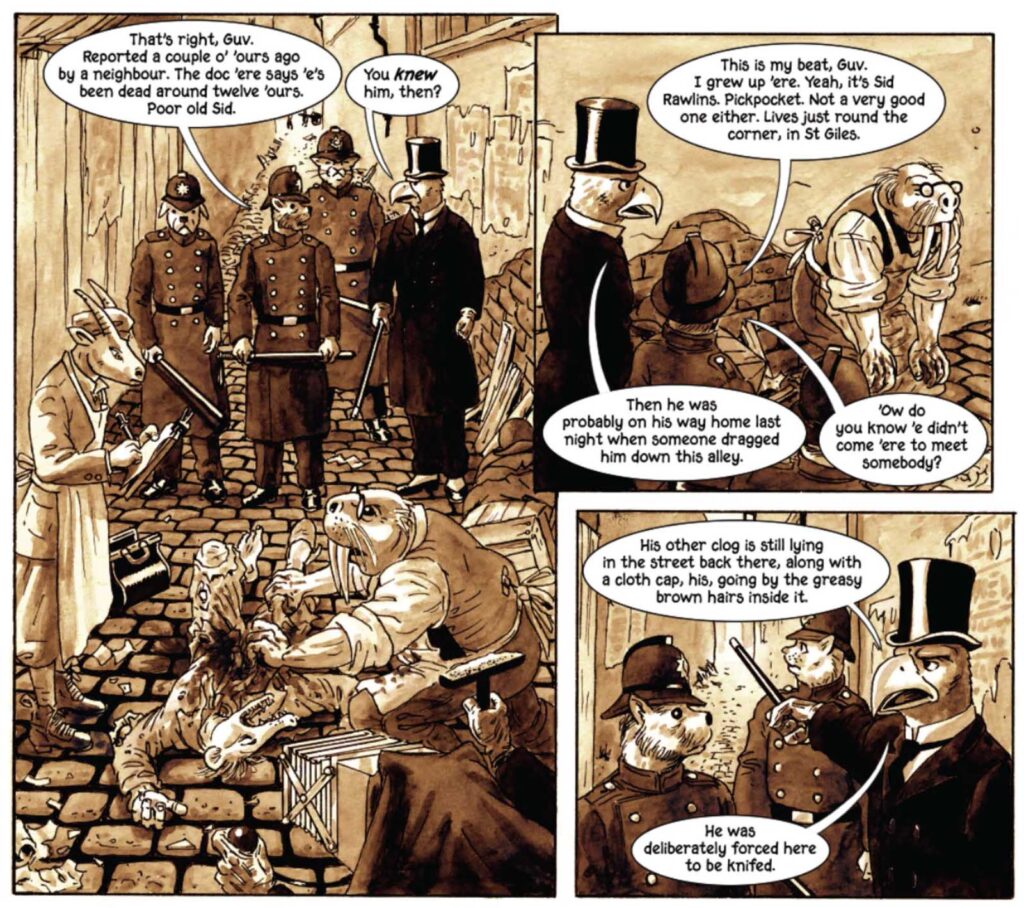
One could certainly compare this book to From Hell, the presence of a Jack The Ripper-esq killer in the background 5 is an obvious connection. Yet the difference between the two is vast: when Moore and Campbell set-out to integrate their social critique into the format of a mystery, Moore’s dictum that the in order to solve the case one must first solve the society in which it occurred, they succeed magnificently. Talbot is not quite there. As if the pastiche overwhelms his more curious science-fiction writing side, the side that wishes to observe society as it unravels and reforms
Not that ‘not as good as From Hell’ is much of a slander. You can point to most comic books and say the same thing. Yet here I am frustrated because Talbot seems so near greatness without achieving it, retreating to the comfort of familiarity and formalist cleverness when he could offer something more audacious. Like that lesser Moore creation, League of Extraordinary Gentlemen, every page is crammed with historical and literary allusions that would fly-over most readers’ heads, there is a sense that this cleverness becomes a point in itself. The more the story goes the further it gets from the real world into its own constructed reality.
The Casebook of Stamford Hawksmoor is a pleasurable read throughout, and a reminder that in his seventies Talbot has more visual inventiveness than artists half his age, and willingness to think big. But he isn’t willing, or able, to think things to their end. As long as he remains indebted to Sherlock Holmes, to the need to color within the lines of genre, this hawk wouldn’t fly far.
- The closest comparison would be something like District 14, a great book masquerading as something lesser.
- to see a radically different approach view Kevin O’Neill’s work on Nemesis the Warlock, which approached the material from a more comedic approach, even his grotesques had element of Mad Magazine to them.
- The first graphic novel in the series was published in 2009, a pre-Brexit period in which the whole notion appeared like an amusing counterfactual rather than a serious representation of British populist anger at the continent. Not that Talbot appears to be the reactionary type, the series yearns for a socialist society, but what was written with a grin in 2009 now reads with a grimace
- While much is made of Holmes detachment from anything not related to crime in the first novel, The Sign of Four, the figure emerging in the following stories is far more human and humane – he has emotions and interests, quotes philosophy, shows care and consideration for his partner etc. Far from the cold fish we see in modern tv shows such as Sherlock or House.
- That figure’s fate would probably be baffling to folks who hadn’t read the first Grandville book, as presented here it is nothing short of anti-climax