
Evan Dorkin has been making comics in one form or another for the better part of the past 40 years. Any career in comics that long is going to have its ups and downs, but Dorkin has been candid about his health issues, both physical and mental (most recently here when he talked to Robert Newsome in 2021). But he’s still around, as his frequently updated Patreon will attest. In April Dark Horse released Nerd Inferno: The Essential Evan Dorkin, a mammoth omnibus collecting three of his best known works: Milk and Cheese, Dork, and The Eltingville Club. In honor of this occasion I caught up with Dorkin on Zoom to talk about each of the major sections of the book, his misadventures in Hollywood, toxic fandom, and much, much more. — Jason Bergman
JASON BERGMAN: So the reason we're talking today is because you have a new book called Nerd Inferno. Subtitled “The Essential Evan Dorkin.”
EVAN DORKIN: I put it in quotes, too.
[Laughs]
Yeah, it's a new book of old stuff.
It's huge!
It is. I know this isn't a video thing, but I have it hidden behind stuff. [Holds up book].
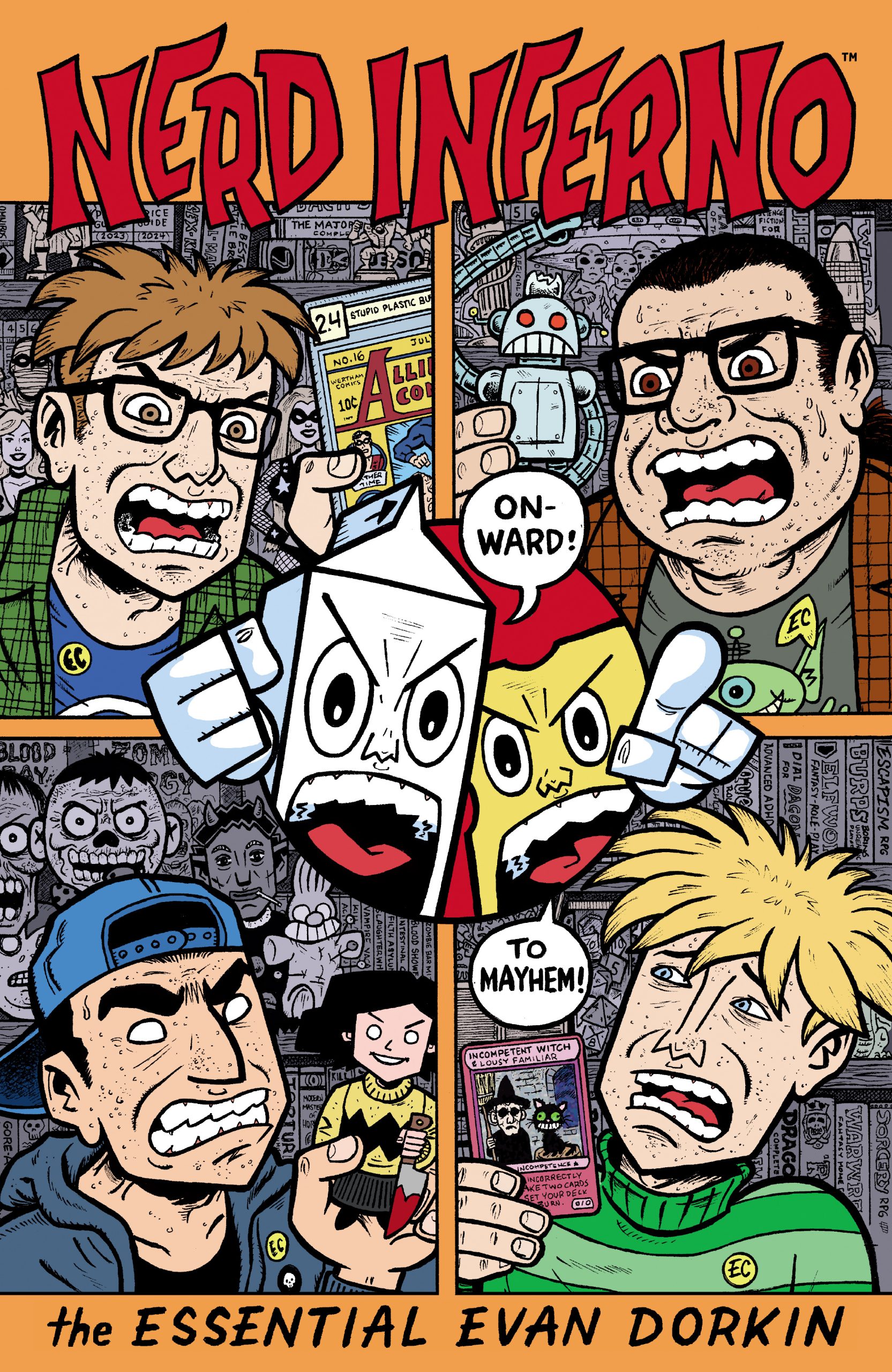
How does that feel to hold that thing?
Heavy. And I really haven't gone through it. I've been so busy lately, it hasn't really struck yet that this is my life in a book. I mean, I don't like “The Essential Evan Dorkin” tagline, but I let it go because I guess it is what it is. It's what it says on the tin. I couldn't come up with a name for it. I could call it the “Evan Dorkin Omnibus,” like it's an old Nero Wolfe omnibus or something. But I wanted my name as small as possible with it [laughs]. The hardcover collection of Dork has my name very large on the spine. And even though I'm in therapy, I still can't stand looking at it. My self-loathing has pretty much been eroded these last six, seven years, but I still write my name very small when I sign my art or comics or things like that. Nerd Inferno was just a title that popped up. I think it's jerky. It's certainly not a classy name. But you know, it's not the classiest work. It's not New Yorker material we're talking about here.
Well, it does represent 40-something years in comics.
Yeah, and it's super pop culture-based between Milk and Cheese, Eltingville, and much of Dork.
So I just felt the name clicked. We had put out the Beasts of Burden omnibus last February, two Februarys ago. And that summed up everything that me and Jill [Thompson] and Benjamin [Dewey] have done on Beasts of Burden at this point — we are going to return to it. So this was suggested as a companion book by Daniel Chabon at Dark Horse when we started to realize — this is about three years ago, I guess — that there was interest in Eltingville brewing online, on social media. And it was not in print, it was running out of print. Daniel was like, “Why don't we do a companion omnibus of it?” They look nice together. They're kind of like the sublime and the ridiculous of my career, I guess.
Well, I do want to go through the three, I guess, pillars of the book.
[Laughs]. Yeah, okay.
So going in order, the first section is Milk and Cheese. Which right from the start was pretty much defined and never changed.
Yeah, the main thing that really changed on Milk and Cheese was I got better at drawing it.
[Laughs]
Because it was an absolutely awfully drawn comic. It wasn't supposed to be a comic. I mean, I'll run through the story because, not that I'm interviewed all the time, but in comics, you could do three interviews, and everybody who likes you has seen it. And they don't want to hear the same story again. But Milk and Cheese was a drunken drawing done at a Mexican restaurant at about two in the morning with my friends. I was there, I was drunk. We were all drunk. It was after a ska show at CBGB. We were waiting for food, and back then, I used to carry a pen and draw on napkins. You know, nervous habit. And I drew Milk and Cheese saying, “We're from New Jersey, no cracks.” Hilarious. And they looked like crap. My friend took the napkin, I would have thrown it out. I still ask him to burn it because I hate the way it looks, and it's also got stains on it from the table.
But the characters just became a signature for me. I would write them on envelopes that I sent. I remember sending them on packages to Fantagraphics, to Kim Thompson when I did a couple of drawings for Amazing Heroes, or tried to get work with people. I submitted [to publishers] when Pirate Corp$! was canceled, and I would just draw the little characters on the envelopes and at the end of letters. At San Diego Comic Con, I think 1988, I'd like to say, the second year I went, either '87 or '88, I was drawing Milk and Cheese on backing boards that kids would bring me because they were getting a drawing from everyone. Back then, you could have a table for free as a fan, practically. It was a much smaller convention. These were the last conventions that were done at the convention hall across from the Westgate before they went to the giant Logan's Run set by the bay. And I didn't have anybody to draw, I didn't have characters anybody knew. I would draw Wolverine and stuff like that for $10 at conventions. So I would just draw Milk and Cheese. And because I was bored and nervous, I would write jokes. I would make fun of the kids. I'd make fun of the people. “Burn your comics.” “Comics will rot your brain.” “You're a moron for wanting this bad drawing.”
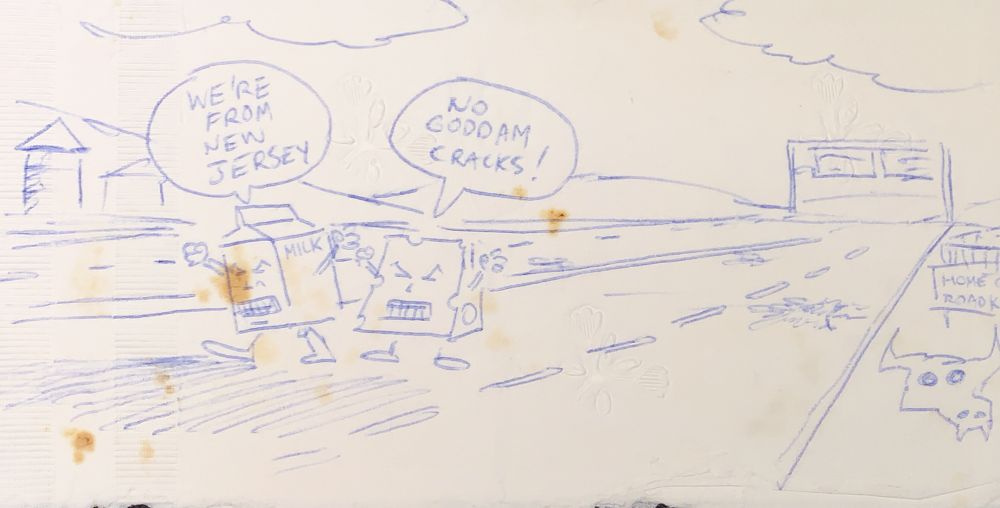
Back then, if you wore a shirt with a band that nobody had heard of at the time, or you had funny hair, you ended up talking to other people who had band shirts and funny hair. And I ended up meeting Kurt Sayenga and Steve Niles. Kurt Sayenga was doing design work for Dischord Records. And Steve Niles was probably still in Gray Matter, the band. He eventually ended up doing Fly in My Eye, and writing comics, you know, 30 Days of Night. But at that time, we were just three guys with band shirts. We got to talking, and I was drawing the Milk and Cheese characters for people. They told me, “We have this magazine called Greed that we do. It's about comics and music.” And Kurt was like, “If you want to do a comic with these guys, we'll print it.” So I did. And of course, Greed folded right after that printed. I killed a lot of things in the late '80s and '90s. I was in Centrifugal Bumble-Puppy, I was in all these magazines that were doomed or died.
What happened was it ran in Greed, people liked them, liked this first strip, even though it looked like garbage. And I got asked to do some more strips with them. Most of my career has been unplanned stuff. Milk and Cheese, Eltingville, Beasts of Burden were all supposed to be one shots. I had no plans for them past what I first did with them. So I did about eight pages for something called Asylum and some other things, and they all folded before they even printed anything. They were collapsing left and right. I guess the bust was coming in, the black and white boom and bust. So I had all these pages sitting around. By that time, I met Dan Vado and Scott Saavedra and a bunch of the other artists and people working at SLG.1 And I got to know them from the San Diego con. I ended up getting my book Pirate Corp$! picked up by them, which later became Hectic Planet. And while I was doing Pirate Corp$!, in '91, I guess, I asked Dan, I said, “I've got like 14 pages of these guys. Do you want to do a book with them?” And he said, “Oh, sure. Why not?” Literally, probably sure why not, because you print the cover and hope people order it. And then you do it. So I filled out the book, and it did well. And that's where Milk and Cheese came from.
A lot of those early strips have some super local humor in them.
Wo Hop.
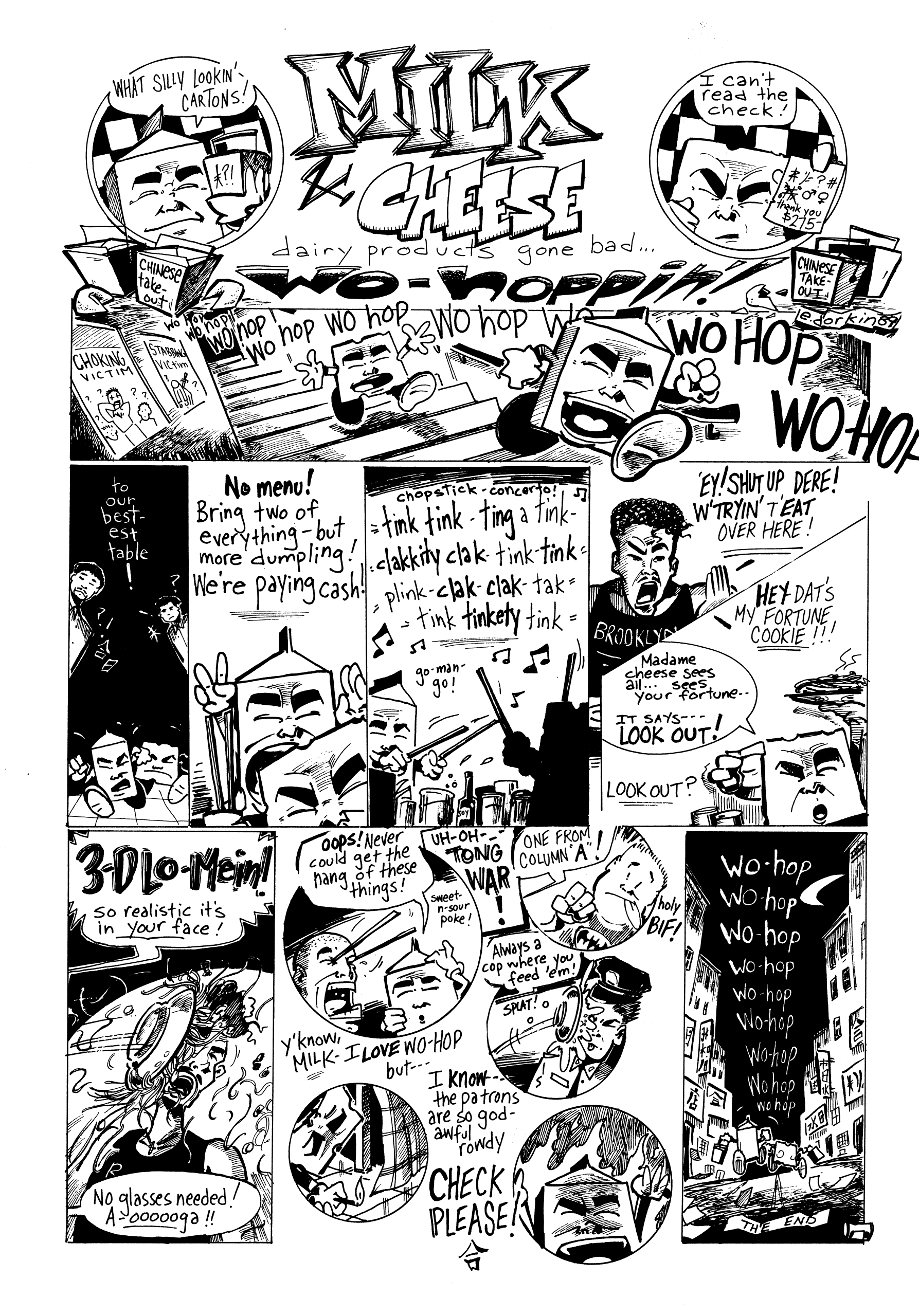
I was just going to say! I didn’t think anybody, even within New York, had ever heard of Wo Hop. It was just the place me and my friends would stumble into at three in the morning. I remember picking up Milk and Cheese and wondering who the hell is this guy?
I was working in the comic store, probably then at Jim Haley's Universe in Eltingville — you can make the connections there — on Staten Island. We were a Bad News Bears misfit team of guys and a few gals, the store was like our club. And we'd go to movies, we would go to the Thalia a lot, uptown, there were a lot more revival houses and art houses back then. We'd go to see movies, and then we'd go to Wo Hop. It was 24 hours, they had three restaurants at that time, the famous downstairs, and they had one on the left and one on the right upstairs. We'd all get a round table, there was a guy named Steve who worked there, I think his name was Steve, we'd see every day, every time we went. Sometimes we would just go into the city and go to Wo Hop. The city was open back then. The city sleeps these days. It's really kind of depressing.
Re-reading those strips now, you had all these local references. Stuff like Gray’s Papaya and Wo Hop.
Gray’s Papaya on 8th Street! I miss that. I mean, they were vandalizing Trump Tower in 1988, I think.
Right, yeah. From the very beginning.
Oh, I've always hated him.
Well, everybody did.
Some New Yorkers still voted for that piece of shit. But they burned down Trump Tower sometime in the '90s, I think.
The very first one has Trump references.
I think it's the second one with the cops. But yeah, I mean, this wasn't pointed satire. You threw in things that you liked and threw in things that you didn't like. It was very off the cuff. I didn't lay these things out. I didn't plan them. I would do a panel, then do another panel. And you can tell that there's no real structure to those early strips.
Right, so did you just pick something to be mad about, and then —
Yeah. It was, pick something to be mad about, or pick a sitcom-style situation, like jury duty. I don't know where “No-Talent Celebrity Tag” came from. That was an entire strip of just them playing. But from the beginning, they've always been children. I always thought of them as American children, now adults, I guess, because they're just egotistical and narcissistic, hypocritical, and selfish. And they're knowingly stupid. Sometimes they're stupid and they know it. So it's weird because sometimes they're smart for a panel or two and they kind of wipe it off, brush it off. It's a very show business kind of thing. There's a lot of old show business. There's a lot of old television shows, sketch comedy. The pop culture references became a big thing pretty quick. They were just throwing out the names of obscure and semi-obscure sitcom people, borscht-belt comedians. It's a very New York strip, just New York as a media city with all the TV channels and all the old movies. Growing up, I would watch Ernie Kovacs and I would watch You Bet Your Life and The Burns and Allen Show. I really, really immersed myself in showbiz as a kid.
You fought all the advice to give them any meaning, to create any sort of character or world. Like, there's no world building or anything like that.
There's nothing.
There's nothing!
No, it's nothing. It's the same strip. It's a giant wheel with different topics, and you just spin it. I mean, to me, even the topic doesn't matter. It's the journey. The funny thing is nobody has ever asked me to do that, to give them a story. That's the nice thing. The only people who have ever come to me with that sort of mindset have been Hollywood people. I have something called File 13. It's old, because people used to actually have to write you a letter. And it's full of producers and production companies, and channels, cable channels, people from those places, writing me saying, we think that Milk and Cheese could be this and that, and we have ideas. And these ideas always went against the strip entirely.
Is there a part of you that kind of wishes you just had one of them write you a check to see what would come out of it? Not only for the money, but for the sheer absurdity of seeing someone try and turn Milk and Cheese into something mainstream.
There was a guy from Comedy Central who wrote and basically said, “Milk and Cheese are stars.” And I appreciated that, because he understood exactly what they are. They're a comedy team, first and foremost. There is a back and forth, vaudevillian pattern to their dialogue and to the fact that they act out something that they know is in a script or that they know that they are acting out these roles. They know that their dialogue is dialogue. They know that they are telling jokes sometimes. And then sometimes they act like little children, because I just like throwing things off. It didn't work out, but I ended up working for a week at Comedy Central as part of a program where they brought in funny people. I could talk about that for ages [about] how comedy worked at that channel. It was not funny [laughs].
But the two that I will always remember is, one, I got a call from Jeph Loeb's manager. I detest Jeph Loeb's work, but I did know he liked Milk and Cheese. He said something about it to me at a convention. I got into an hour-long conversation on the phone with his manager. I was working throughout the whole thing. And I kept this guy on the line just because I was working, I was drawing, and he was hilarious. He was such a stereotypical schmuck, Hollywood flack. And I made him crazy. I tried to, because I kept saying no to everything. And eventually he just yelled at me at one point, “Don't you like money?” I'm not making this up.
What was his pitch? What was he trying to get you to do?
They wanted to do a show, or I don't remember the pitch, because it was mostly about the nonsense. It was mostly about buttering me up and talking big about what could be done, but nothing substantive.
But what could be done with Milk and Cheese? [Laughs]
I'll tell you, he was great. I wish that I had that on record. It was just the most ridiculous Hollywood type conversation I've ever had. But the other one that points to what this industry is like is when I got a call from Nelvana Animation. And the woman was very nice, but she was just making the calls. She was not a decision maker. I was an animation junkie as a kid, so Nelvana was a big deal to me, so I got very excited when they first called. New York got all those specials back in the '80s that they were doing Romie-O and Julie-8 and all that stuff. I was all excited for a second. And then she says, “We'd like to do something with Milk and Cheese.” So my heart falls right then and there, because the biggest problem is everybody wanted to buy the characters and wouldn't let me own them. That was the main thing. So I said okay. And she goes, “Well, here's what we were thinking. We're doing a children's show, and we thought that we could use them as puppets that would host the show.” Right, let that sink in. And for about that much time I sat there and I finally said, “You do know they're alcoholics” [laughs]. And she says, no, and starts laughing. We had a good laugh over that. It was a very short conversation after that. She just said, “Thank you very much.” She was very polite, and she meant it. She was like, thanks very much, because she was like, “I just got fed garbage by these people.” But yeah, they weren't even reading it. This was back in the '90s. It was just the way the comics now pass on desks. You can always tell when your book has been thrown on some desks in a pile. Maybe we can buy this and not let anybody else make it, or we can exploit it. And you just start getting a couple of emails from people.
So those two were funny. I did get a call from Mike Judge's agent or manager, and he was interesting because he was respectful. Because he was cool. But I told him, “I don't see Milk and Cheese as Mike Judge's next project. I see them as my comic book.” And he was like, “I got it.” But I appreciated that. And I'm not saying that Mike Judge would have made it. He might not have even known that this guy was talking to me. But I did get a letter from — I am trying to remember — some production company. “We see Milk and Cheese as.” They saw them as being in a movie.
[Laughs]
First of all, that's insane. They can barely fill six pages of comics before people get sick of it. And they said they could have a … I’m trying to remember exactly how they put this. But basically, they have a funny adversary, like a funny next door neighbor, like a Chris Farley type. Because they always have to put a person's name in the pitch. I was like, “You are out of your fucking minds.” I mean, at least read the stuff. I'm like, “Did you look at this?” It doesn't take long to read a Milk and Cheese strip, at least not the early ones.
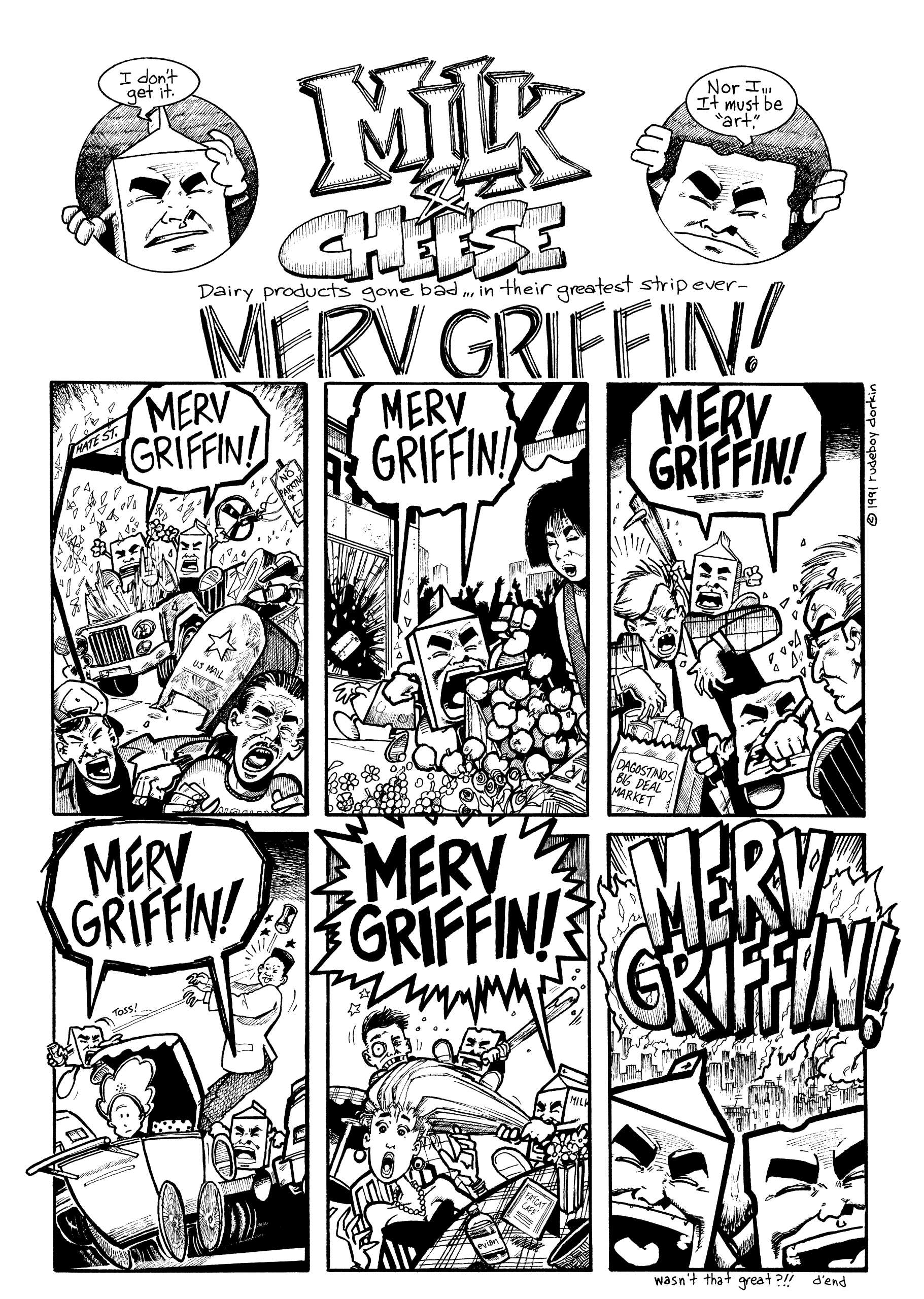
Send them the one page, “Merv Griffin” strip.
Cartoonists weren't mailing anything to anybody unless they had to [laughs]. I'll use that postage to send something to Factsheet Five or Maximum Rocknroll. To hell with these people. I was like, “You've got to be kidding me.” Scene one, Chris Farley opens his mouth. Scene two, he gets a gin bottle across his face. He's done. Thank you for coming. I mean, the only way that I could see Milk and Cheese working is in shorts.
Yeah, I was going to say, like, in the Liquid Television2 days.
Exactly. The only thing that I could have seen them working in back then, in the days that there was more interest, was as bumpers, interstitials on MTV, because they were doing some weird short animation back then. Or something on Liquid Television. But it would have to be 30 seconds to a minute long. In and out, it's just search and destroy, get your jokes in, boom, boom, violence, done. I think it would work. But there's really no market for that. We can't make them into Beavis and Butt-Head. We can't make them into Ren and Stimpy. They just don't sustain that. They're small time.
But they have lasted for almost 40 years now.
Yeah, they've had a weird trajectory. On my Patreon, I've been going through some of my old files. The Onion used to reprint them, when The Onion was just a Wisconsin newspaper. Of course, they didn't stick around long enough for them to go to the web and become huge.
They're back in print again!
I know, I know. But nobody seems to really want a lot of cartoonists. My dream back then, I would have loved to have done an alt-weekly strip. I don't think I had the chops for it. I don't think I was funny enough, as good a writer. I certainly wasn't as good an artist. But every once in a while, they'd have a contest. If you have a contest or a call for material, then I felt okay sending stuff out. I sent stuff out to the New York Press. Drawn & Quarterly actually had an ad for their first issue of the anthology in the New York Press, or the Village Voice, I can't remember which. And I sent them a strip, which actually they were interested in. It was an atypical piece of mine. But it had already run. It got picked up by Joe Sacco for Centrifugal Bumble-Puppy. And they said, “Oh, we don't do reprints, but thanks.” And then they reprinted a Pete Bagge strip. It's funny I remember these things [laughs]. I love Drawn & Quarterly, I'm not knocking them. But I get it. Pete Bagge was a get. I was not. But anyway, yeah, Milk and Cheese, they ended up in Deadline. I was the only American in Deadline for a long time. I was the token yank. And Deadline's where I think most people knew me from. I still get people who think that I'm from Wisconsin because of The Onion. This is all pre-internet. And they would get run in fanzines, I got really good support from a lot of punk zines, from comic zines back in the day. It was a smaller industry, smaller field, smaller medium, so guys like me could get noticed. And I'm an open interview. I'm a dancing monkey, I say silly stuff. I was a fun interview for a lot of people. So yeah, Milk and Cheese broke through. I mean, Milk and Cheese made my career.
I know from your Patreon, you said you're doing a new Milk and Cheese page now?
Yes. Thanks for being on the Patreon. I'm going to be doing Milk and Cheese for the Deadline Kickstarter.
How does that feel?
Um, I'm nervous. Isn't that weird? I mean, I know it sounds stupid. It's not like I'm going on stage or I'm putting out a new album after ten years, but to me, it is like that. I don't want it to suck. This is a big problem I have when we talk about Eltingville. Eltingville #2 took me a year to do instead of two months like it was supposed to because I totally choked. And I keep choosing a different Milk and Cheese strip to do because the thing is I have to just chuck it all and go with it and not worry about it. I mean, I'm not scripting it. I'm going to do it the way I always did it. Start with the logo. See what bleeds out onto the page.
I imagine you have no lack of things to be angry about.
I also don't want to go full bore into that because I want to put my toes in the water, as it were, and see how a new strip goes. Maybe touch on something about today's times. But I mean, the internet has just eaten up comedy. It's like you're going to be the two millionth person to make a joke about the Trump administration and how horrible everything is. So either it's got to be a good joke or you just do it in passing so it's in there. But the main thing is I make some bullet points. I write a bunch of things down on a piece of paper. I draw a couple of houses with faces on them and it's Milk and Cheese. A Monopoly house and a postage stamp, as I've always said. And you put eyes on them and that's them. I just wing it. Sometimes I'll have a definite joke that I want in there. I mean, I had an idea for a Tesla strip, but Teslas are old news now. And I still like it, it's a terrible joke, but it's dumb funny, of them singing the Spider-Man theme about Teslas. Cybertruck, Cybertruck [sung to the theme of the Spider-Man television theme song]. You can take it from there. But they're doing stuff to Cybertrucks and to Cybertruck owners and to Teslas. It's like a children's show almost [laughs]. Two puppet alcoholics doing a kids show for Canada. But yeah, I am nervous about doing it. I want it to be good. The first Deadline funded and I did a pinup. I took an obscure piece that hasn't been published and they're using that. And they colored a couple of old Milk and Cheese strips. So they're alive and Deadlined again, technically. And the next one, when Dave Elliott starts that up, I have two pieces of Bristol board on my table to draw little circles of mayhem and little boxes with faces, little talking food, brothers from different udders and all that crap. Yeah, I'm going to bring them back. The thing is, if I bring them back in Deadline, it doesn't look like a cash grab because it's not. I don't even know if we're making anything on these [laughs]. But it generates work. Everything that I do for the Patreon, that's kind of like Dork comics, for lack of a better term, that could be in a Dork #12. If I do these Milk and Cheese strips, I'll do what I did back in the '90s. I'll make a Dork #12, and Milk and Cheese will be in there and other stuff.
Well, that's a good transition to talk about Dork. So yeah, so Dork started as mostly reprints?
Yeah, Dork started the way that Milk and Cheese started. I had material that fell through. I just thought, well, I can't put this in Milk and Cheese. Milk and Cheese was doing okay. Things were very loose at SLG. “Dan, you want to do a comic with all this stuff?” If you know the Instant Piano comic, Instant Piano was Kyle Baker, Mark Badger, Stephen DeStefano, Robbie Busch and me kicking ideas around in New York City, let's make a comic book. I was getting to know them, and the first attempt basically got stalled. I won't go into why, but one of us was stalling it. We all had 10 pages, and I'm like, I don't want to sit on 10 pages for how many years. So it looked like Instant Piano wasn't happening, or at least wasn't going to happen anytime soon. So I said, “Hey, Dan, I've got all these pages. Let's do something else.” And he said sure, and that's where Dork came from. Dork was basically a catch-all for non-Milk and Cheese material. I was reprinting stuff all the time back then. I was able to survive by doing all these little one and two pagers, and then I owned them, so they all got funneled into Milk and Cheese, Dork. I mean, Eltingville started in Instant Piano later, when Instant Piano finally got going. But yeah, I took my 10 pages and a bunch of other things that I had, that Centrifugal Bumble-Puppy page, and a couple of things from zines that nobody had seen. I did a couple of new pages, I did a cover. And that's Dork #1.
And a lot of gag strips, just like–
I think I started the gag strips in Dork #1 because I put them in the indica page. I just had some dead space. And I think that's the first Myron the Living Voodoo Doll. These are all my one-joke concepts. Myron, the Broken Robot, Milk and Cheese, Eltingville, it's just spinning the wheel and coming up with a new idea for a one note concept. Sometimes they grow legs..
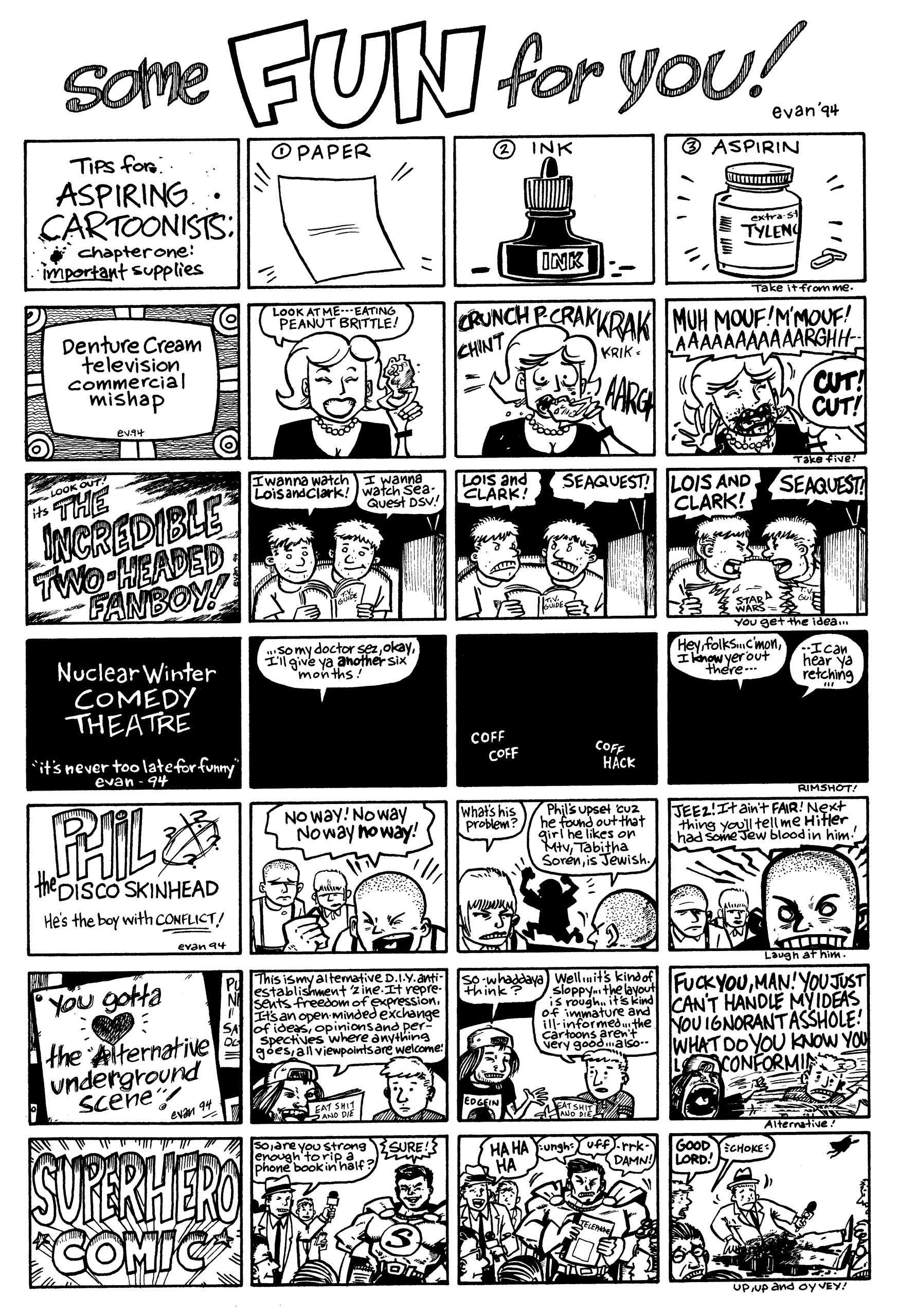
When you read Dork all together like this, it is just joke, joke, joke, joke, joke, joke.
It's me tap dancing as fast as I can. It's just me trying hard, very hard. Dork ended up stalling because … we should probably talk about this at one point, because why I stopped working for SLG has a lot to do with why Dork and Eltingville stalled out. And I stopped doing those kinds of comics on the whole. We had a lot of one-creator anthologies back then. And obviously, I like the idea of that. We had Eightball, we had Hate. A lot of cartoonists had their venue, Roberta Gregory. A lot of these, “Here's what I did recently,” in staples. And it was a great period, because it was like painters and stand-up comedians in one person. Most of it was humorous. I miss that. So I was very happy to have my stupidly titled [anthology]. I just think Dork is still a dumb name. And when I did strips later, like 10 years ago for Dark Horse, we put them together. But instead of making it Dork #12, I made it House of Fun. I kind of regret that. I should have just embraced my dorkiness. I mean, it's my dumb name, and it's what I am. But back then, you had Hate. You had Dork. I'm trying to think of some of the other ones.
There were so many.
Just lots of one-name books. Sin, Jay Stephens.
A lot of these guys are still around! Jay's still around, too. He's doing the best work of his career.
Oh, and I love Jay very, very much. I was glad that I got to work with Jay once on World's Funnest. I was the first person who bought art from Jay. I still have it. I have the first page of The Land of Nod. I was working in the comic store then. But yeah, I was just so happy to have that venue. Dork is the one I liked the best because it was my stand-up routine while I sat down and did sketch comedy. I always wanted to do sketch comedy. I loved SCTV. I loved reading about old showbiz. I loved the idea of being funny in front of people. I had a screwed-up notion of what improv was at the time, just like I didn't know how to make comics when I grew up. I thought that comic art had to be the same size that you printed them, which is one of the reasons my comics are so dense, because I would put all that detail in at the size of the comic page. I was into Kirby, I was into Will Elder, and I was into George Perez. So I just crammed everything in with chicken fat and extra soldiers like they would. I still have that problem. But I didn't know how comedy worked, how improv worked, I still don't. I didn't know that you had fallback lines and things for when you get stuck. And the reason I bring this up is because I always thought everybody wrote their own stuff. I thought Hank Ketchum wrote Dennis the Menace. Other than Schulz and some oddballs who did their own work. But I didn't know about ghost writers, and I didn't know about ghost artists. I didn't know about joke writers. I didn't know that Bob Hope and Jack Benny were paying somebody. I thought you were funny. I thought when David Letterman did a monologue, he wrote all that, just like when he was ... well, he may not have written all his jokes as a standup. I didn't know that there were people feeding jokes to New Yorker cartoonists. Which to me is like, I'm sorry. If you can't write your own fucking wine joke, come on. Come on. I learned that in improv, they're not making it all up all the time. I always thought that you've got to make it up all the time, but there's techniques for when you're lost, because you can't make everything up on a whim. To be honest, it’s hard to make up new jokes. I mean, you can when you're sitting down and there's no audience there. I try to always write new jokes for stuff. When I do sketches for people, I try to come up with a new punch line or a new tagline. I try to come up with a new shtick based on the conversation we had or maybe what they're wearing or what they've said. That's just the way I grew up and that's the way I work. Improv doesn't work that way, at least not entirely. But yeah, I always saw these comics as your comedy vehicle or short story vehicle, which is what happened to a lot of the books and to Dork to a degree too. Because I started adding longer page stories and then I did some autobiographical stuff.
Right, I do want to talk about the story in Dork #7.
Oh boy, great. Yeah.
I mean, we don't have to dwell too much on it.
No, that's all right.
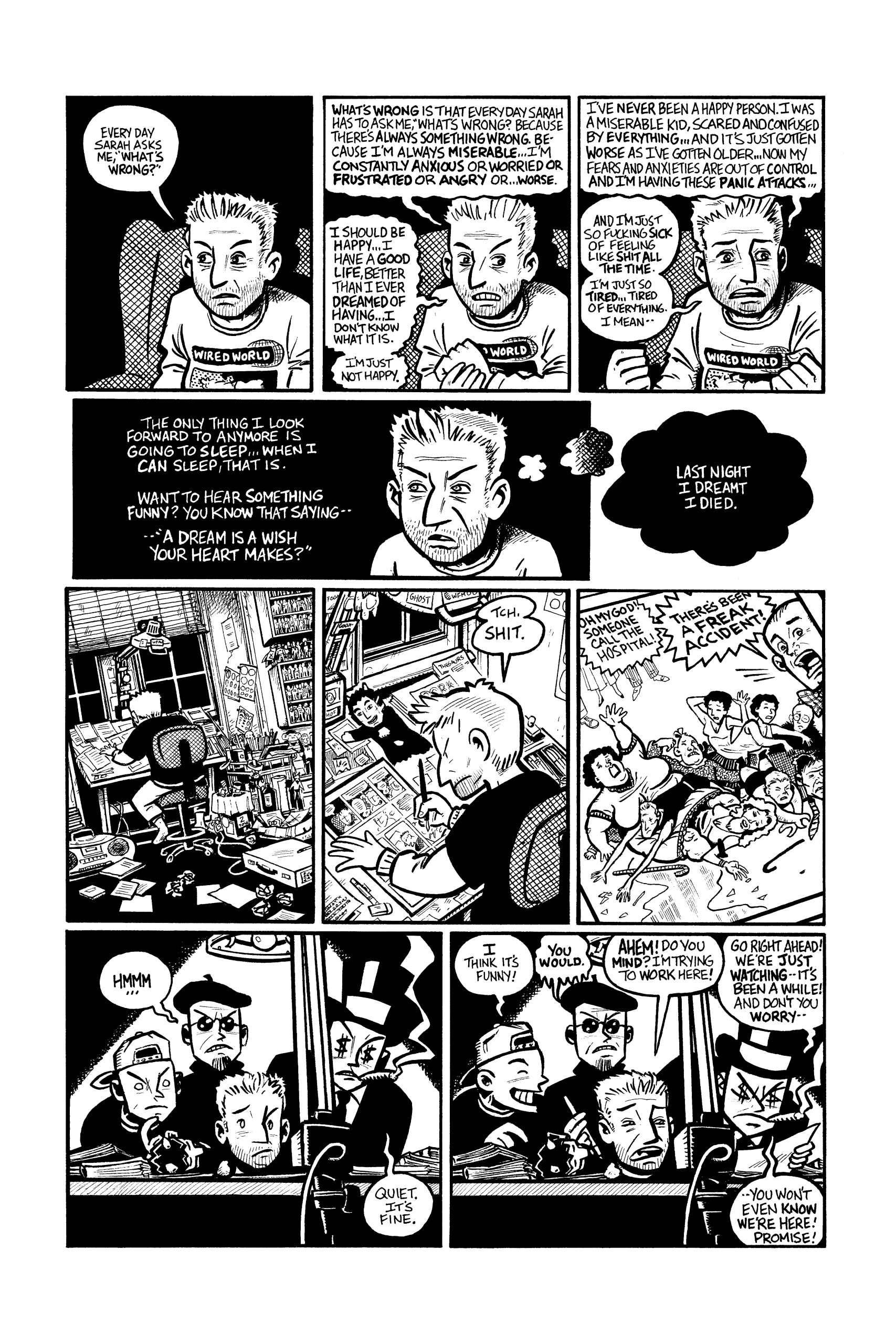
It is a bit of whiplash because you go from gag, gag, gag, to very serious.
You know, I feel like I failed in some ways on Dork #7 because people will talk to me about it and they never say it's funny.
[Laughs].
Because yeah, I'm talking about my having emotional and mental issues and making my life hard, and I'm in therapy and I'm fearful. And I have not defeated a lot of the things there. I was just talking earlier about how I'm really, really nervous about doing this new Milk and Cheese strip. Whereas I used to just do those in two days, get them to FedEx, over to Deadline. They had to get done, so they were just a stream of consciousness, a stream of dopiness. And I would bat them out and didn't worry so much. But then later as they became more popular, you can see — Tom [Spurgeon] asked me in the interview3 about how I started spending more time designing the pages. And it's true. You can see the art tightening up. You can see the logos and the titles getting much more intricate. Some strips were a fully-designed page, with the panels floating and things like that. I wanted to try to add something new to each comic because Milk and Cheese were so one note in general. I'm still nervous from the Dork #7 days. I'm in therapy again. I'm with my third therapist, finally one that I actually feel like I've made progress with. I wish that I had found somebody like this in my 30s, my 20s. I needed to go back years earlier. I needed to be going years before I finally went because I was, for lack of a better way of putting it, going Dork #7 again. I was off my nut and an emotional wreck. And I wasn't able to work. I was second guessing everything. It was like Dork #7 except worse because now we have a kid. Whatever dumb decisions I make in comics or whatever, however long it takes me to do something like Eltingville #2 and it gets pushed, Sarah came in for this ride. She's an adult. Your kid doesn't make decisions to have a cartoonist dad having a day where he doesn't feel like working because he's under the covers. So yeah, Dork #7 is hard because I never wanted to do another Dork #7. I don't think I ever will do another Dork #7. But I could have done another Dork #7, 10 years ago. And so Dork #7 is hard for me now because I didn't get better. I got better, but then I got worse again. And who wants to slide back in life?
Is it weird for you that this, I don't want to say it's the darkest point in your life, but it's certainly a very dark point in your life, but here it is. It is right smack in the middle of The Essential Evan Dorkin.
Yeah. I'm curious as to how the young Eltingville fans are going to take something like that. But you put yourself out [there]. I don't know if it was a cry for help, because I was going to a therapist. I really did feel like I had to vomit up a lot of what was going on in my head. But Dan Vado, he didn't like the issue. He says, “I thought it was self-indulgent.” And I'm like, well, all my comics are. The idea of putting out a bunch of talking food and jokes about Hank Jenkins: Chronic Masturbator, whatever the hell that one is. All these comics are self-indulgent. I don't do them necessarily thinking, well, this thing's going to sell a ton of $2.75 copies. I do them because that's what I felt like doing at the time. I think most of the good cartoonists are doing the work primarily for themselves. In every job, you're doing what you want to do. Your concerns, your sense of humor, your personality, your fetishes, they all end up on the page. And it's all self-indulgent. But yeah, he didn't dig it. And a lot of people didn't dig it. Even though I had the best reaction to an issue. I got like 200 pieces of mail back in the day.
From people going through similar things, I assume?
And a lot of them cartoonists, which was fascinating.
Sure.
So I do have a blackmail file. I do have a blackmail file of all the cartoonists who wrote me in the early days of Milk and Cheese and Dork, a lot of them became very well known and work for very prestigious publishers. I have contacted several of them that unless they want their lousy taste to be known, they have to send me either original art or money. Preferably money [laughs]. Or I will release the letters. Several of them are in academia. I will start releasing names, possibly, the day after Nerd Inferno comes out. Or if I get a heroin addiction or something like that. Or if I need to buy more comics, because I've been on a comics tear. But yeah, Dork #7, I thought it was funny, I guess that’s what I'm trying to say. I think I've very consciously tried to balance the, “boo hoo my life is a mess” bullshit, as some people saw it. I tried to sidestep that autobiography ditch that I think a lot of people fell into, where a lot of crying boys use their comics to complain about, oh, woe is me. Yeah, I did it once. And I think I did it in a way that was very open and honest. I also took myself to task for not only my behavior, but the need to share the behavior, to share this with people.
Right. I mean, you literally put yourself on a stage in the strip, right?
Yes. There's one point where I'm walking, and it turns out to be a film backdrop with a revolving [scene]. I was trying to come up with ways to make the autobiographical elements interesting without turning it into a whine fest or just 20 pages of young moron walking through the city streets. “Oh, I can't get into clubs. Nobody will fuck me.” That wasn't my problem at the time. I was losing my mind. I was losing my mind. I was dealing with a lot of fear and unhappiness. And some of it came from my work getting noticed because I worked in a bubble. You never knew much about the reception your work was getting, really. Sales were never amazing. Milk and Cheese sold okay. But nothing sold so well that you actually knew anything definitely, and you didn't get that much mail. But when I started going to conventions, when I started going to San Diego and I started winning some awards and got some attention, I felt the need to produce, and I felt the need to entertain. I felt the need to get better at what I did. And this was all put on me by myself. This was my self-loathing and my lack of self-confidence. When I work on a strip now, I try not to think about the audience. The good thing is, if anybody cares, I'm in a much, much better place than I think I've ever been in my life.
That's great.
Yeah, but it's late in life. I would have liked to have been there before 60.
Sure.
I screwed up my career again. Well, not again, but yeah. The fear of rejection and the fear of responsibility became a real problem for me in my animation work when we were working on shows. I basically torpedoed a pilot at the Cartoon Network for Adult Swim that rose out of the ashes of the Eltingville pilot. I cost myself a very good job. I cost Sarah a job. I wasted the money the Cartoon Network spent on me for the development. And it was just [that] I wouldn't change a sentence. I couldn't change one or two sentences in the [show] bible. It had nothing to do with me fighting for the bible or for the preeminence of my work. It was that I just ... I froze. I froze for months. And finally, they just quietly shelved it. This pilot was called Tyrone's Inferno, which had all the characters that were created for Welcome to Eltingville, the side characters, and some new characters. I actually thought it was a better script, a better pilot. Everything was already accepted. Sarah and I were co-producing. We had the characters designed, the bible. I just had to say the character was literally not from hell, because they were developing another show that had a character from hell. Lucyfir, Daughter of Satan, or something like that, I think it was called.4 All I had to do was say this main character is from another dimension, or something like that. And I just basically totally froze, and I ghosted them. And they weren't mad. They didn't hate me for it. I avoided them for years, but they actually got us work years later. They had us on the Shinchan show. They wanted some people that they knew as writers to be part of that development working on the scripts. And then I screwed up there, too, and I didn't finish a script. I just couldn't figure out how to finish a script. I froze again, and I just torpedoed things. I mean, this is going back, I guess, 20 years now, god. But when you're self-destructive … I always see it as those old Warner Brothers cartoons where a very heavy object would fall into the floor. And the carpet would start pulling everything in the room down into that hole. That's what being self-destructive is like. You're not the only one going down into the hole. You're pulling your friends, your family, your coworkers. But you don't just sink yourself. Everybody who cares about you or interacts with you gets splattered with your self-destructive behavior. Yeah, I should have learned that when I was young rather than old. There's story material in there, but I feel like I already did it.
Dork #7?
Yeah. It's almost like going back to … like, I'm done with Eltingville. I don't want to do another Eltingville story.
Well, I do want to talk about Eltingville.
I will say that one of the reasons that Dork ended up folding was because by the time I was doing issues like 9, 10, and 11, I had to mostly create them whole cloth. The anthologies died. The anthologies dying killed me. There was no more Dark Horse Presents, Dark Horse Comics, Oni Double Feature. Deadline was gone. Zines and alt-weeklies were dead or dying. Magazines weren’t hiring cartoonists. All the places that I had done a Milk and Cheese strip, or a strip that ended up in Dork were dead. And when the phone stopped ringing, the email stopped coming, I was lost. So I ended up doing most of issues 9, 10, and 11 on my own, and there was no upfront money from SLG. That was always hard. But while I was funneling all this pre-existing material with maybe 4 to 10 pages of new material, there was always something on the back end, especially Milk and Cheese. And Dork always made a couple of bucks. Milk and Cheese always did well. It was reprinted like crazy, the first book collection was reprinted. But while working on the material, there was nothing. There was nothing upfront. Even most small publishers would have something, so you can pay some bills, buy some groceries, or just buy ramen even. But Dan didn't pay upfront. We talked about finishing Eltingville up, because I wanted to finish Eltingville back in 2000. But I could not work on 48 pages of comics upfront with no money, which is why that stalled out. I did two pages and I stopped.
And Dork #11 was insane. That's the issue that's nothing but gag panels and gag strips. I think it's 26 pages, if you count the covers and everything, and it's something like 500 panels or something. There might even be more, because the fun pages, I used to do seven strips per page. So it was 29 panels per page, including the title panel. Dork #11 broke me. I just was like, I can't do this anymore. I was hoping that people would like it so much because of how much work I put into it. I was like a six-year-old, trying to please his parents. And I was like, nobody cares. I mean, your readers will. But it's not like anybody's going to look at that and go, “Wow, look at the amount of work there.” Because as far as I know, they could hate it. And then it's burnt fries and plenty of it. It's a mess. It's a white elephant spread across 26 pages. Who needs it? That's in Dork #7, if I make comics and people like them, they'll like me. Which is a fucked up way to go through life, especially when you're antagonizing half of your readership and the people that you deal with by being a jerk to them and trying to be a stand-up comedian because you don't have social skills and you’re pissing everyone off.
So yeah, that's what all that work was. And I had to stop. Eltingville had this same problem. I did the first two pages of what became issue one from Dark Horse, the next to last comic. And it was the first full-length comic with Eltingville I ever did. I did one page in 2001 and one page in 2002, and then I gave up because I was working on the pilot and we did an episode of Batman Beyond, Sarah and I. And then we spent a lot of time on the Eltingville pilot, which is where I brought my weirdness to the project. Because they gave me free hand, I decided to try to do everything on my own except the storyboards. I was at least smart enough to pass those off to Stephen DeStefano, who did a fantastic job on them. But I did all the character designs. I did all the background designs. I did all the prop designs, except for two things. I couldn't figure out how to draw a motorcycle and a vulture. And I was like, why the hell am I doing this? I should have relegated all of that, backgrounds and props, to other artists. I was new to all this and I treated it like a comic. I wanted to control as much of it as I could. So of course, once again, I took the money that we were paid and I spread it as thin as possible, because you don't get paid for all those individual drawings. You get a lump of money for the job I was doing, props, backgrounds, character designs. But I'm very good at taking a paycheck or page rate and making that into a penny because of all the time I put into it. So yeah, that was all very, very hard for me.
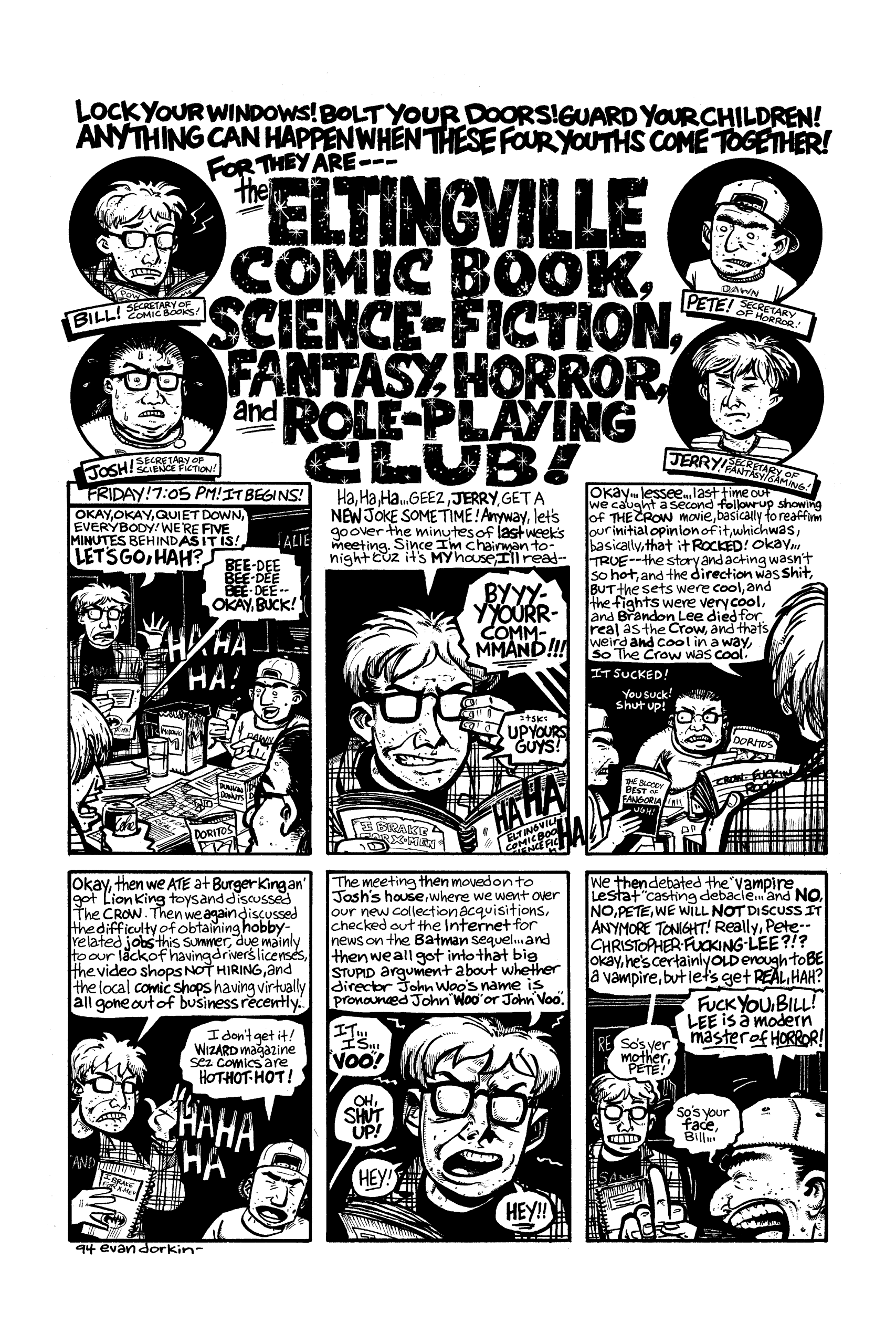
When was the last time you looked through all the Eltingville stories?
I actually have to look through the Eltingville stuff lately pretty often, because the Club Kids, as I call them, have a lot of questions. This amazing but strange resurgence of interest in The Eltingville Club over the last couple of years. My message requests were open on all my social media, and I try to answer everyone. So I have to go through the Eltingville collection a lot.
Looking back on Eltingville, there's a lot of anger in that book.
Yeah.
There's a lot of anger and pain.
I used to call it a love note to comics wrapped around a pipe bomb. But it was a very angry strip. It was a retaliatory comic. That first five pager was just a response to hate mail that Dan Vado was getting. This is pre-internet, he was working at DC Comics. He was freelancing for DC while he was running SLG and doing his own books as well. And he wrote a story for a Justice League comic and a secondary character, Ice, I think. She died in the story. And he was, I won't say stunned, but he was affected by the rancor in the hate mail that he got. I remember talking on the phone with him one day, he called me up from San Jose. And he's like, “You wouldn't believe this hate mail.” And you know, death threats. I mean, really, angry, nasty Eltingville-type stuff. I mean, Eltingville has become an adjective for me. Eltingville-style hatred and anger. And it was all nonsense, because one: Ice is a fictional character. Two: fictional characters die all the time. Three: fictional characters in comics come back all the time. Four: you can't kill a character in comics and never use them again, because you'll lose your copyright or your trademark or whatever. So Ice, DC's Ice, has to come back at some point. So shut up, kids. You know, actually, that's the problem. They weren't kids. They were adults. I was really angry after this phone conversation. And coming back to Instant Piano, Instant Piano had gotten revved up for the second time after we failed to launch on the first issue. Somewhere, somebody has a dummy of the original cover that Kyle [Baker] did in the first 50 pages. But I had taken my stuff and used it for Dork. And some people still had their old material for the comic. So I had to come up with another 10 pages now that Dark Horse picked them up. I had 10 pages to play with, and that's where Eltingville came from. I ate five of them up with the first Eltingville story. And that was supposed to be the last Eltingville story. The first one isn't as angry, I think,.
It's pretty angry!
It is pretty angry. But it got angrier.
It got angrier, no question [laughs]. Were you surprised that people responded positively to it?
Of course. I mean, first of all, Instant Piano, who the hell read it? You know?
I did!
I mean, thank you. I appreciate that. You're one [laughs]. I can start making a list right now. It did not do well. We were given the option of not doing the work for issue four. Dark Horse was like, “Look, no one's going to make a dime, if you guys want to bail.” And we were like, no, fuck it. I mean, Instant Piano was basically Dork for the five of us. The unfortunate thing was we were all supposed to work together more. But by the time Instant Piano finally happened, I was the only one in New York. It was supposed to be much more freewheeling than it ended up. It wasn't supposed to just be five of us turning in 10 pages. We're still disappointed that that never came out the way it was supposed to. But yeah, so Instant Piano, five pages. Who the hell is going to read it? It's an oddball book from Dark Horse. It's kind of halfway between a Dark Horse book and a Fantagraphics book. It's in that weird middle that creators like myself and, not that I'm speaking for them, but you think of people like Jay Stephens and Roger Langridge, where we have an affinity for mainstream genre work. We have an affinity for oddball work. We're kind of like, I don't know, mid-brow alternative artistes. You know what I mean? You won't find us in RAW. We're not going to be called up for Zero Zero or anything like that. I don't think Zero Zero even exists anymore. But we're too weird for the mainstream. And we're too mainstream for the art crowd. So Dark Horse readers were like, what is this? And art readers were like, well, I'm never going to look at a Dark Horse book. But what happened was the interest was from the comics industry itself, I found. I mean, the people who read Instant Piano were other creators and editors and people who got freebies [laughs]. I didn't do it thinking this at the time, but you look back on it, people like songs that are about the music industry. They like movies that are about the movie industry. Whether they're angry or celebratory. People love behind the scenes type stuff or digging the ground up beneath something.
But Eltingville isn't about comics from the perspective of people who make them, it's about the people who buy them.
It is. And the same way that I was angry about the worst fans out there, there were a lot of people angry about these things, about toxic fandom. We didn't have the phrase at the time. But here's the thing. The reason that I am saying it's about the industry is that later on, I made a conscious choice to make it about the industry. Because at a certain point, I realized The Eltingville Club is a terrible group of fans. Terrible fans move into the industry. We get these people as professionals. And while The Eltingville Club are not the horror shows that Neil Gaiman turned out to be, people who prey on others — allegedly. Let me say that for you folks. Allegedly prey on others. Personally, I wouldn't use the word. But the predators, the horrors, and just the shitty people who fuck people's careers up for various reasons. Racism, sexism, exploitation, or just being an asshole to people. There are a lot of people who don't like me from the way I acted back in the day, because I was always being a loudmouth and said inappropriate shit. But I don't think anybody hates that they worked with me. The people that you're not safe around in this industry, they came from fandom. From just being people who scream at interns at DC Comics, to acting like some of the ways Jim Shooter acted with older professionals and whatnot. To the way that people act on panels or in the offices. We are they and they are us. We all come from fandom. Almost nobody comes to this industry accidentally. There are very few people who come into comics like Jhonen Vasquez.5 Jhonen did not know a damn thing about comics. You don't get people coming into comics in their own little vacuum. They come into comics because they love comics. You know what I mean? They fuck their back up. They fuck their neck up. They fuck their eyes up. And they fuck their hand up like I have with carpal tunnel because they love making comics. These days, we have more people coming in because of non-superhero comics. And that's why I think this is, in some ways, the golden age of comics, because there are so many people making comics now. There are so many people making comics outside of the industry and don't care what the industry says.
So yeah, I mean, I'm off topic, as I always am, but Eltingville is us. The whole point of Jerry breaking away for me, it's not a moral lesson that I'm trying to shove down people's throats, but I am obviously trying to say, don't make your hobby your life. Don't live for your hobby. A hobby is part of your life. Even if you're making comics, it's still only part of your life. Eltingville is super exaggerated. When I used to work with crowquills, I was busting a couple on every page, because I would press down really, really hard to get some of that ragged, angry line for the characters and for the lettering in some places. It was almost a physical strip to work on. I don't know much about painting or action painting or anything like that, but I was really putting my arm into those strips, into those comics.
The two things by the end of it that I wanted to say was one, that you don't have to be like this. And two, there's nothing wrong with fandom in and of itself. There's nothing wrong with being a geek or a nerd. There's nothing wrong with enjoying this stuff. My life is based around a lot of this stuff. But you can walk away from things and not become a lunatic because you're yelling at somebody because they killed a superhero in a comic. Or I mean, the extreme things we have now. You hired a black person to play somebody from some book or whatever, and the racist knives come out. And the misogyny knives come out. And then you get comicsgate and all that. I’ve had Eltingville readers say, “Oh, you saw a lot of this coming.” I was like, no, I didn't. I had no idea that you'd have a KISS Army of scumbags in comics like this. The weird thing about Eltingville, was nerds were always portrayed in media as these hapless goofs, the meek who will inherit the earth. The slide rule and the glasses, and they're too skinny, or they're too fat. I held to some of those tropes. But anybody who grew up working in a comic store, going to conventions, you knew that there were troublesome, angry, bad fans. I mean, really, just rotten people. That’s what I wanted to write about.
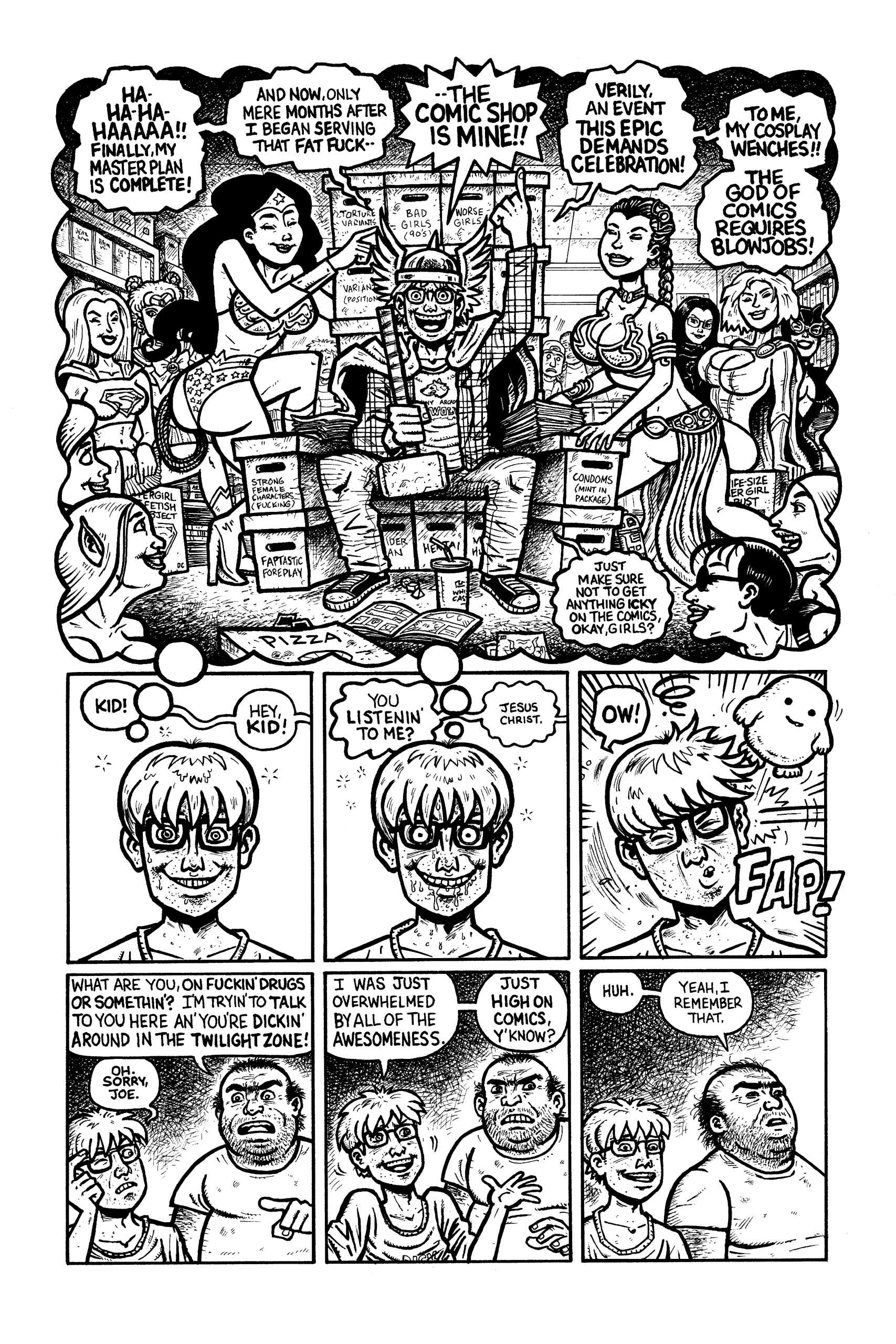
Well, I do have to ask: were you one of them?
Yes, to a degree. Bill eventually became based on me. But I never did the things that they did. I was a rotten, snotty comic shop clerk to people. I was a real asshole to people in that regard. I was more like the Northwest guys, to be honest.6 When I was working at Hanley's, I'd be like, "Oh, man, Green Arrow, come on. Look what they're doing to women in this fucking book." A lot of the things that happened in the next to last Eltingville story, “This Fan, This Monster,” the comic shop issue, a number of the jokes in there and situations are real. With Eltingville, it was like, don't be like this. Don't make this your life. Bad fans make for bad people, bad professionals.
That's the last story, right?
That runs through the epilogue. But you can see seeds of it being laid in with Josh. And his writing, I think, is mentioned earlier on or something like that. But yeah, the last issue I needed to get into everything that I wanted to get in. I still had Eltingville stories. Sometimes I regret not doing a couple of them because I think they would have been interesting comics. The book is pretty thin, and I'm a maximalist. I'd like to do as many pages and as many stories for a project as I can.
I mean, you could still revisit it.
No, I've mentioned multiple times that it's done. I think that it's healthy to have something finished like that. So many things I work on are open-ended, and I believe in finishing something. I think that in a perfect world, you give the Joker a rest for a few years or something, Kingpin and Dr. Doom and Galactus. But nobody's creating new characters for those franchises because who wants to give people your babies these days? You want your characters for yourself more and more. So Marvel and DC are stuck. And that's another thing. People really want to own their work these days as much as possible, which is great. It makes it harder to do this for a living. But it also means that you don't end up feeling ripped off when you see your character as an action figure that accounting says never made any money for Marvel or DC, and you don't get a dime, that type of thing. It's frustrating.
Does that mean you're working on new stuff?
Sort of. Cartoonists, I don't think, are ever retired until like, they can't do it, you know what I mean? Your hands are crabbed up or something happens where you make enough money where you don't have to do it. But I mean, it's hard. How do you stop being creative unless it was always a means to an end? Somebody like Todd McFarlane, I don't know if he wakes up and goes, “Man, I could have been making pages.” I mean, he wants to make hockey action figures and shit. He just wants to make money. Hey, he's honest about it. I'm not forced to look at his stuff. I'm sure money takes some of the urgency out of creating for a lot of us. I know that if a dump truck came here and dumped money on me and the family I'd be like, “You know, I don't know how I feel about working on Dork #12.” “I don't know how I feel about doing these fun strips for the Patreon.” But you're always thinking of new ideas.
Life has gotten in the way of my work for a number of years, but I'm never blocked for ideas. I've talked to my therapist about this, because what I try to do for myself now, is that you just have to make that first step. You have to break a project up into small bits, not just the way that you're breaking a script up or outlining or structuring a drawing. You have to make that first step. Pull out that piece of paper, put that piece of paper on the board, make some marks. Look, I'm not the only one. The internet brings you in touch with many people with stories about how they just can't get out of bed, or they can't clean something up, or they can't fix something, or they know they should go to the doctor. I mean, we're all broken robots to some degree. We all have some bad wiring, some of us more than others.
But it's funny, because Jerry's character arc — he's the only one who really has a character arc in Eltingville — definitely comes from my situation over the last 10 [years]. Wanting to do better and recognizing what's wrong, but needing help, needing community. I needed a therapist. It's stated right in the comic, Jerry is in therapy. And I also wanted to make it clear that Jerry is not fixed. He's not whole. That doesn't happen. We all slide back. We all fall down, and we're never perfect. I mean, he's still in therapy. Because people [say to me], “Oh, I'm so glad Jerry's okay.” He’s okay, but he's not cured. He's introspective, he's aware, and he was willing to take steps to make his life better and to make a go of things. I very consciously did not pull him out of fandom. There's no magic bullet. Leaving fandom is not the point. It's how we change our attitudes about things, how we think about things, how we think about ourselves, and how we behave. I did this with the intervention story. I had two guys who got out of fandom, but they're still absolute emotional wrecks, and they fall back into it. I mean, they're still insane, they just started this crazy intervention program for fans. "Mandom," I think it was called. But the thing is, they're not better. They didn't really get help. They just went to the gym, and they got buff, and they got girlfriends. That's surface.
A lot of people are like, “Oh, so Jerry gets a hot girlfriend.” I didn't mean to draw her hot. I don't think I draw hot women, as the industry calls for it. But her character was not just there for Jerry. She has her own agency. And in the storyline, she brings out things in Bill. People are always asking me if the club members have autism or if they are on the spectrum. And sometimes the kids will ask me about very specific mental issues. I write them from an emotional point of view. There's a hazy idea in my head of what their home lives were like. The four of them are based loosely on me and my friends, not because we acted that way — because we didn't — but I used them as templates. Bill is sort of me, Pete is sort of my friend Rob. Jerry is the odd man out. I don't know if I based him on anybody. But Josh is two people. His coat comes from one friend who always wore a coat like that, and some other things come from another person. We didn't beat each other up in basements. We didn't harass people. We were nerdy, but I basically used us for physical and personality templates. And I was able to write Bill by exaggerating some of my issues. His relationship with his mom is a very exaggerated version of my situation with my mom when I was a teenager. Same thing with Josh's parents. Pete is basically an evocation of a stereotypical Staten Islander. I drew from a lot of people for Pete. For looks, for family life, for the way he acts.
So the kids ask me questions about them, like what their favorite food is, what height they are, what their birthdays are, and I tell them that's not necessary to know all that for a story. A guy online was like, “How do you not know these things? How do you not know your own characters?” And I'm like, “They're not real.” No, I don't know how they smell. I don't know what their favorite food is. It's fascinating that people care about that sort of thing. Look, I get fandom sometimes means you're super, super intense about things. I was nuts about Hawkeye and the Beast when I was a kid. I loved these outsider guys who couldn't get a date. I collected all that stuff, and I wished they would do more with them. But I never wrote the company saying, “You guys are assholes for the way you treat Hawkeye. You should die.” You know what I mean? [Laughs] I don't harangue artists at their tables saying, “Why did you do X, Y, and Z?” And I didn't fight with other fans about fan shit. We fought because of the way people fight when you're kids. I mean, D&D brings out the worst in some people. That's true. That's why I was going to do more with D&D because I had one friend wig out. His character got killed, and he absolutely melted down, throwing shit, freaking out. He stormed out of the house. So you exaggerate that kind of material. I worked in a comic store for six years, off and on. I got fired from a comic store multiple times. It only stuck once. It was because of my attitude. My whole thing was attitude, bad attitude, and being rude. I did not burn any stores down. I did not trash stores. I did not banish people from stores. None of that stuff. You get to know fans. Nerd stuff was kind of my fiefdom back then, especially.
So yeah, it's all based on real people and real things. There's a lot of real activity. The comic shop issue, there really was a shop that had a kiddie pool in the drop ceiling to catch rainwater, and they forgot about it. It crashed through and fucked up the inventory, and they had insurance, so they took a hose and they hosed down more of their inventory, because that's how you make money in comics. I didn't even get into the comics-as-cocaine front of one store that a friend told me about who worked there.
Here's the thing: a lot of people who are in comics and came from fandom are perfectly A-OK. A lot of them worked in comic shops, so you hear a lot of horror stories. And you use that for material. The laser pointer, the scene where the guy laser points to somebody because he won't get out from behind the counter, that's from a shop that was on Staten Island. Krypton Comics. If the pilot got picked up, we were going to have a second shop that was going to be run by-- I can't remember the guy's name now. He doesn't appear in the comics. He's mentioned once. But he was going to have a laser pointer, and his assistant was a spider monkey. And what he would do is he'd point the laser pointer or he'd throw a peanut, and the monkey would eventually scrabble on things and knock down the item that the customer wanted. And this guy would drive around in a Shoppers cart that he stole and bang into all of his fixtures. He would make K-turns and smash into stuff. I wanted to have a comic shop that was even worse than Joe's where I can put the absolute worst, most exaggerated stuff. Sal, that was Sal, his comic shop. Because he had to have a war between the comic shops at some point. Anyway, ask me questions. I'll never answer [laughs].
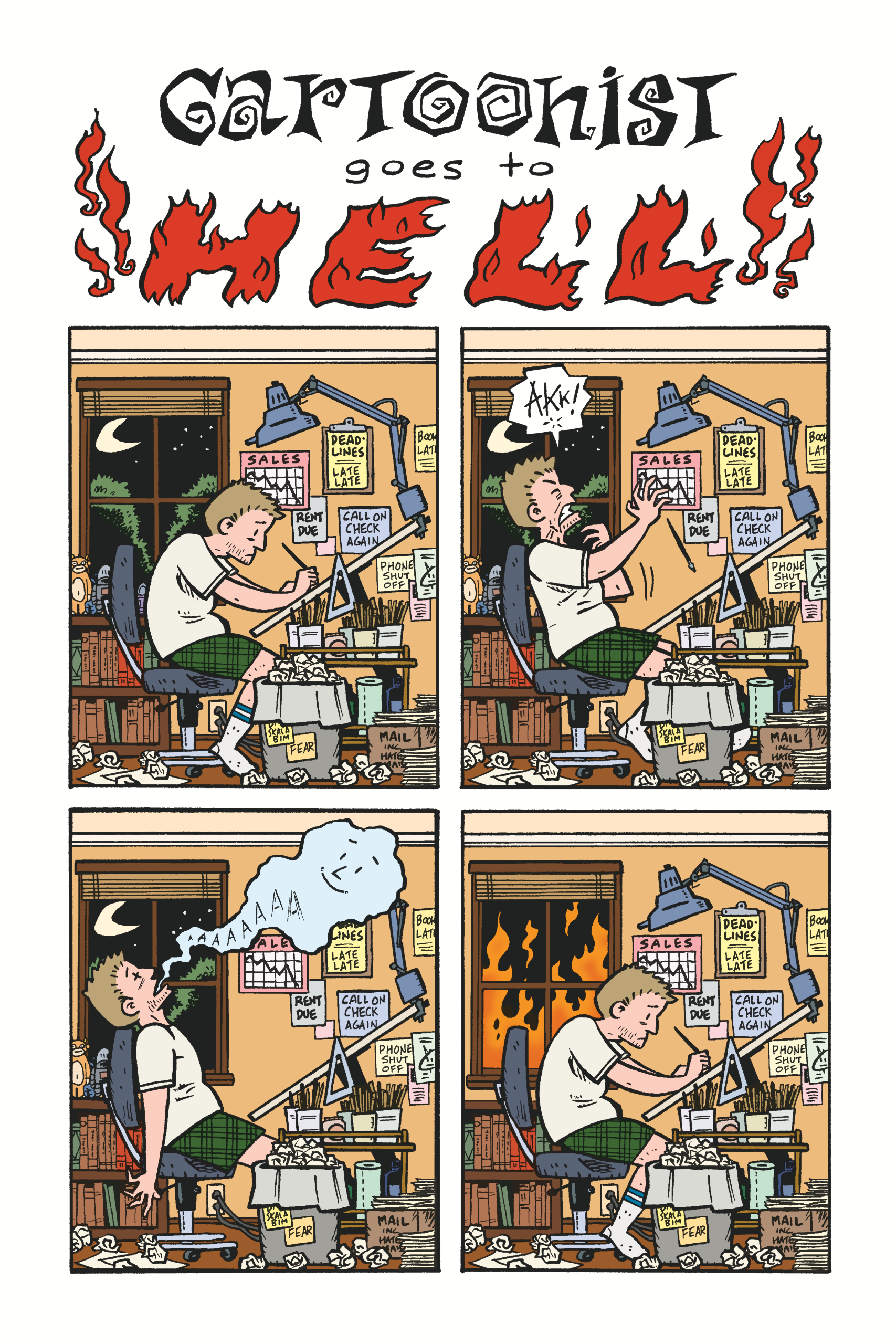
Well, I do want to touch on one final thing. When you look at this book, there's a lot of anger. There's obviously Dork #7. There's a lot of dark stuff in here. But you seem to be in a pretty good place these days. Is that accurate?
Yeah, I mean, I've had three therapists. And therapy is, again, not a magic bullet either. It's not a magic wand. You can't just yell at people, “Go to therapy!” and it's going to be fixed. My first therapist was too much of a friend. He didn't push me. And my second therapist turned out to be a bit too religious and conservative as it came out. We got to a point where he was helpful, but then we reached the point where I felt like I was going to be in arguments with him. You shouldn't be arguing with your therapists. But my therapist that I have now, everything works right. I feel like I'm going through an atonement period in my life right now, where I recognize a lot of the things that I did when I was being a jerk to people. Or sometimes not trying to be a jerk to people, but my lack of social skills combined with an attempt to be funny, to break the ice or get people to like me, turns into I'm attacking this person. I'm doing Don Rickles here. And that's not what anybody fucking wants. Every once in a while I run into somebody who met me back in the day, or I’m reading some thread, and it's like, “Hey, you know who is an asshole?” And I'm like, “Ohhhh, me.” Yes, I was. Eltingville is about trying to get past being an asshole in every way in any kind of fandom. I always said Eltingville could have been about cars, car fans. Could have been about barbed wire collectors. It couldn’t have been about vinyl collectors, because they're uninteresting.
But yeah, we had some tough sledding here. COVID was horrific. But we had the privilege of being able to stay at home and keep working that a lot of people did not have. But it was terrifying, and projects were canceled. Hundreds of thousands of people died. A lot of people just want to sweep that under the rug. We're not that far out from it. It was horrific. And then, people know about it, so I'm not going to get into it, but then we had a very serious situation with Sarah's cancer. And it was very serious. She is cancer free now. I'm usually very glib, and I can talk. But that was very, very bad and tough. It was very, very bad. And so yeah, you know, like time disappeared. A couple of years just kind of went and we hung on by our fingertips with the Patreon, started selling a lot of art. As fucked up as the internet is, and as fucked up as tech is, Patreon saved us in many ways. A lot of people were helping us. There were a lot of people who were picking up art and helping us out with things. But we never wanted to do a fundraiser or anything like that. We never asked anybody.
I feel like, I don't even know if I could do an Eltingville comic right now, because I'm not angry like that. I'm not angry in that way. In fact, in some ways, maybe my sense of humor is one of the reasons I got more into horror writing with Beasts of Burden. Because it's hard for me to draw these days because of my carpal tunnel. And I do still have issues with work. I feel better emotionally, but it doesn't always connect to work. I still have trouble working on things. But I don't have the anger in me. It doesn't burn the same way. I have a lot of anger, like most sane people, towards our government and the system and late stage capitalism and the world at large, et cetera, and the horrors that are being perpetrated and sanewashed and allowed. And I feel helpless and angry and stupid. But I’m not really turning it into comics. It almost seems pointless. There's so much satire online and whatnot. I feel like if you want to make jokes about something, it's kind of like, do you want to be the thousandth person that day to make that same damn joke? It's very hard to be a humor cartoonist, at least the way that I work. When I was working on targeting things and on satirizing certain things in the past, you had a window. News of the day is not open to me anymore, or even recent news is not open to somebody like me anymore, unless I dash something out super quick. And to me, it's like, good jokes aren't just, oh, take Milk and Cheese and have them say something like, “AI sucks.” I mean, I did that once because I wanted people to know how I felt about it. And I know that they like Milk and Cheese, so some people would pay attention to it. But that's not sharp. That's not incisive. That's just planting a flag. It's hard these days because the jokes that I tend toward are not coming to me because I'm not fast anymore. So I feel like I'm always going to miss the boat when it comes to a topic. I think more about horror than humor these days.
I don't know how Eltingville is relating to young people because I felt that my work wasn’t relatable to young people at all anymore. It's been a very, very strange situation having this, for lack of a better word, resurgence of interest in a dead comic. When Eltingville was a '90s comic, people liked the material, but after that it wasn't well regarded. It wasn't being reviewed. It wasn't being written up. It wasn't being posted around. Nobody gave a shit about Eltingville #1 and #2 from Dark Horse. The collection was a flop. Dark Horse did actually spend money on a PR package. It was an embroidered bag with a pair of dice that had "Lose, Fail" and an Eltingville symbol and a fake, slabbed press release that said “You can keep this. It'll be worth money.” It made fun of comics collecting and speculating, it was handwritten and they ran off copies of it. And a lanyard for DorkCon, a fake convention. And nobody responded to that. We couldn't even get people to look at the book. I mean, it won three Eisners back in the day. But Eltingville was dead in the water by the time the book came out in 2016. It was in the red for a couple of thousand dollars. Nobody cared. I was really bummed out, especially since I worked so hard on #1 and #2, all to Chuck Jones crickets on the stage. So it's really, really insane that 10 years later, there's kids dressing up as the characters. There's memes from the comic and the pilot. I'm getting all this interaction and followers. And they're all kids. It's kind of unheard of. Having been in comics all this long, being in retail and working on mainstream comics and my own stuff, I'm trying to think of a comic that had a resurgence as a comic of any kind without a media tie-in.
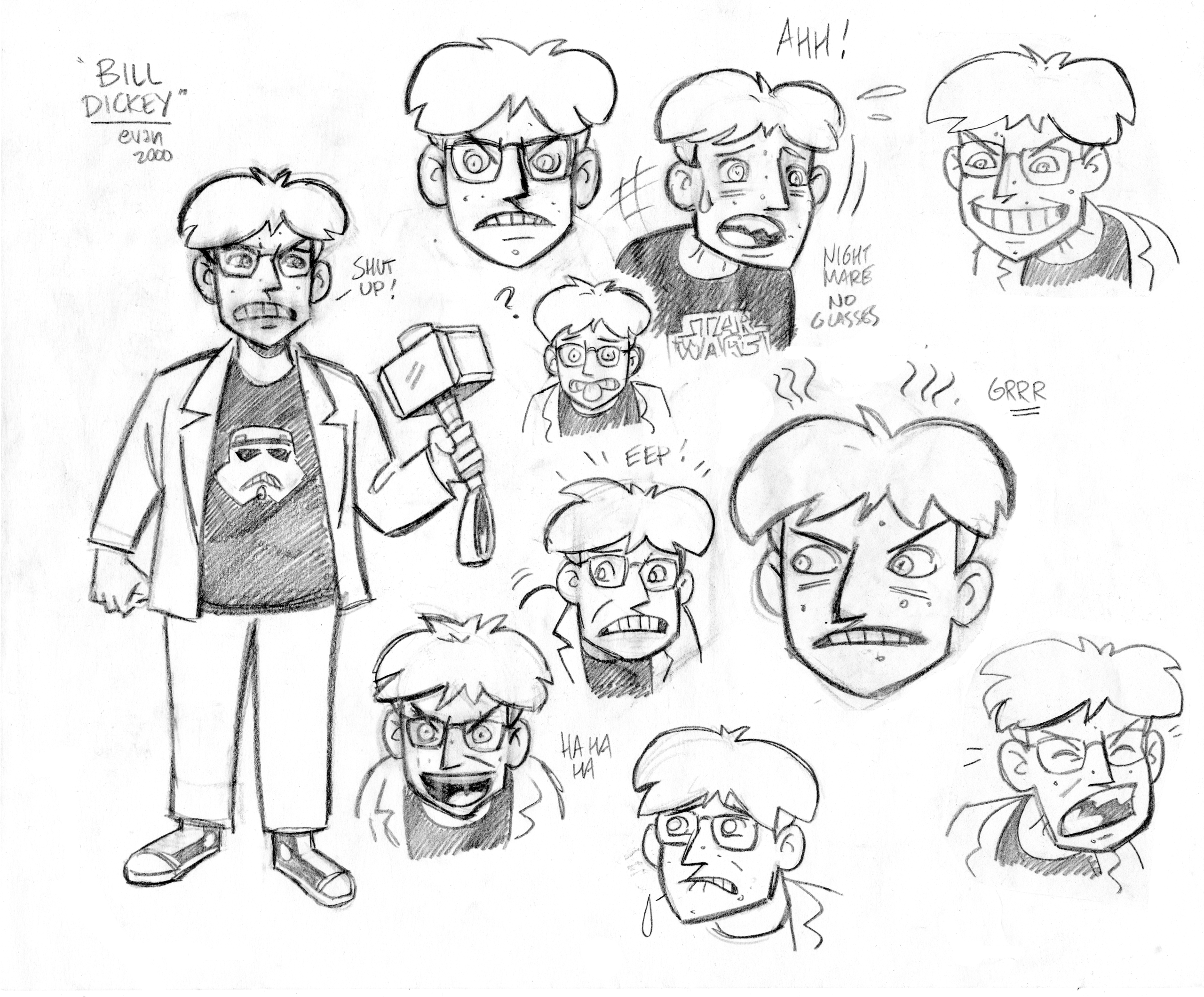
I certainly can’t think of one.
It's like, yes, there's a pilot, but the pilot's from 2002.
It's on YouTube!
Well, yes. And TikTok is where apparently everything happened. I mean, I knew that there were some people who picked up on it. But Dark Horse was putting money into this stuff and it didn’t fly. The Dork collection bombed, The Eltingville Club bombed. Beasts of Burden is not selling what it was, so I felt bad about that. Your publisher doesn’t owe you a place if you’re putting books out constantly that fail. So I appreciate that Dark Horse has had my back. I've been working with them since '91. And Eltingville was created at Dark Horse, first published there. The nice thing is now with the resurgence of interest in my work we've got Nerd Inferno coming out and it's kind of the summation of my solo career. This is like my autobiography through comics, where my head was at for 30-something years. It's hard to put that out there and I hope people don't hate it. It doesn't sound like I'm better when I say something like that [laughs]. Who knows? Check back with me in 10 years to see if I’ve gone loopy again.
- While generally known as SLG Publishing now, in those days, the company was known as Slave Labor Graphics.
- Liquid Television was a series that showcased animation shorts and aired on MTV in the early ‘90s. It featured contributions from many popular alternative cartoonists of the day, including Charles Burns, Richard Sala, and Pete Bagge. Of course today it’s probably best known as the show that spawned Beavis and Butt-Head.
- TCJ 214, July 1999
- Evan is most likely thinking of Lucy: The Daughter of the Devil, which ran on Cartoon Network from 2005-07.
- Vasquez is the creator of the highly influential Johnny the Homicidal Maniac comics and cartoon series like Invader Zim for Nickelodeon.
- Because no fandom is safe from satire, Dorkin created a one-off strip called “The Northwest Comix Collective!” which is The Eltingville Club for the Fantagraphics set. It is, of course, included in Nerd Inferno.