
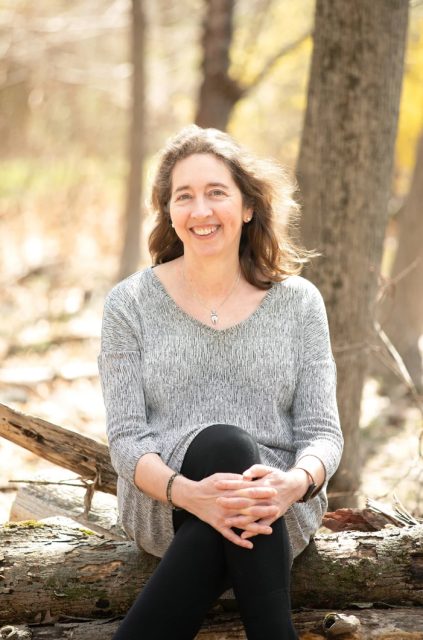
Jennifer Hayden admits that she came to comics late in life. Much of that story can be found in her graphic memoir The Story of My Tits, which was much more than a cancer memoir. It was a story of her life, a book about seeing things differently on the other side of illness, and part of what that required was a new medium and approach. In her first book Underwire, which Hayden made while working on the memoir, it’s possible to see her voice and her style emerge by the end of that book. The four panel comics she did in Underwire showed off her style as an artist but it took her some time to find her way to making comics, to trusting her art, and to finding a way and style of not just making comics, but using comics to tell the story.
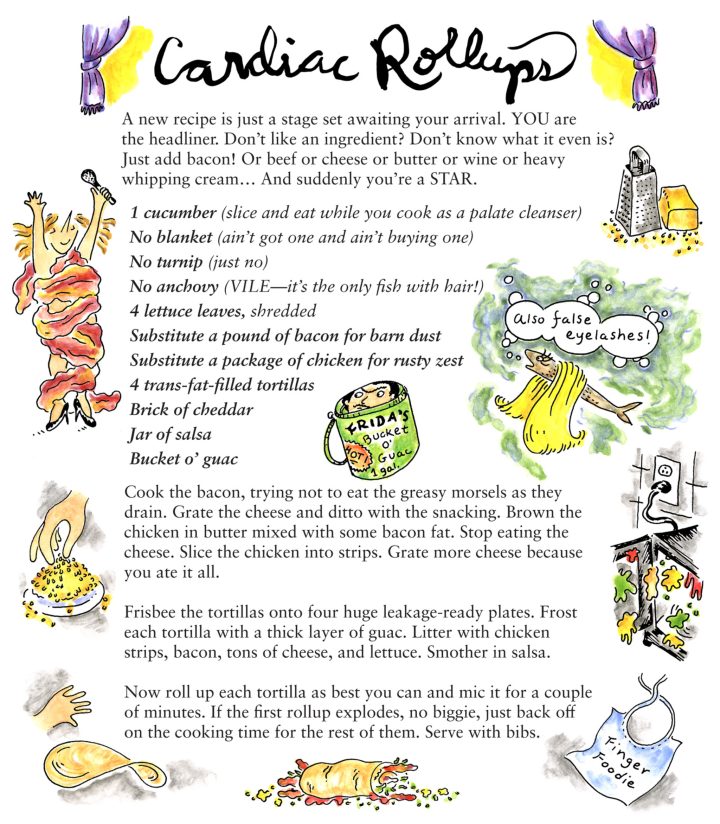
The first chapter of her most recent book Where There’s Smoke, There’s Dinner: Confessions of a Cartoonist Cook brought this into focus. Opening with her and her daughter talking, the story unfolds in a meandering but deliberately paced manner, using the entire page in a way that Hayden hadn’t previously. Like her earlier book, which was far more than a cancer memoir, this book is more than a story about food or just funny anecdotes around cooking but using this as a way to think about her life, to understand how she thinks and lives, and how that has changed over time.
I continue to think of Hayden as a cartoonist in conversation with many others who similarly have adapted the techniques of memoir and creative nonfiction to comics and leveraged them to tell stories in ways that reject traditional narratives. Something that her new book solidifies. Hayden and I have seen one another regularly at conventions and events since I first interviewed her a decade ago. We had the chance to sit down recently to talk about her new book, the way that her process continues to change for each project, and what art can do.
-Alex Dueben
I really enjoyed the new book, and this is a smaller book than The Story of My Tits– though everything is going to be smaller and lighter than that, which you likely needed. What is the origin of this anti-cookbook?
It is not what people would expect from me. I did an interview, I think it was with Brian Heater, when The Story of My Tits came out, I said something like, "this is my life's work." He said, "oh, isn't it awful to have already done your life's work?" I said, "no, actually. Now I get to play". I meant it. You know how you don't know things until you say them? That happens to me a lot. I thought, I can do whatever I want now. Having slogged through this endless book that meant so much to me– and worked in the end– but it was a lot to process and a lot to get through. But hardy har-har, is not easier to write a funny, silly book. Not easier at all.
I was in Toronto, with Top Shelf for The Story of My Tits in 2016. So the spring after the fall that it came out. I was in a spotlight at TCAF, and I had run out of stuff to say about The Story of My Tits. [laughs] I was digging the bottom of the barrel. I started, for some reason, telling stories about things blowing up in my kitchen. I was tired. I don't know. The audience and I were having so much fun with this. As we left, Leigh Walton said, "have you ever thought of doing a book about that?" I literally said, "I have, but I forgot about it. Thank you for reminding me". I found an old t-shirt recently that I had saved that actually had a drawing on it that was the origin of the book. I'd done it like two years earlier. It said something like, vinegar is always the secret ingredient. I'm there with a cat and I'm screwing something up at the stove. It really had been percolating. Everything I do is a book about healing. Here's how I screwed it up. Here's the awful shit that happened. Here's how I survived. And you can too. That’s my shtick. I realized that it's no less important to do this with something as light as food. Once I dove in, it still took me years and years to finish this because food– the way tits are– is seriously charged for most of us. The book couldn't just be about cooking. It had to be about me.
I had to dive into the deep end and it became all about problems with food growing up and all the different ramifications of that. Then because it took so long, I had a chance to look at making dinner from feeding small kids to being an empty nester, and how poignant that is when you no longer really have to cook, but you still want to eat something good. And I didn't feel like the cancer lady anymore either. I've been a survivor for over twenty years. The breast cancer was a chapter. In the book, it felt like the whole thing was leading up to cancer, but if you're lucky, it's just a chapter and there are later chapters.
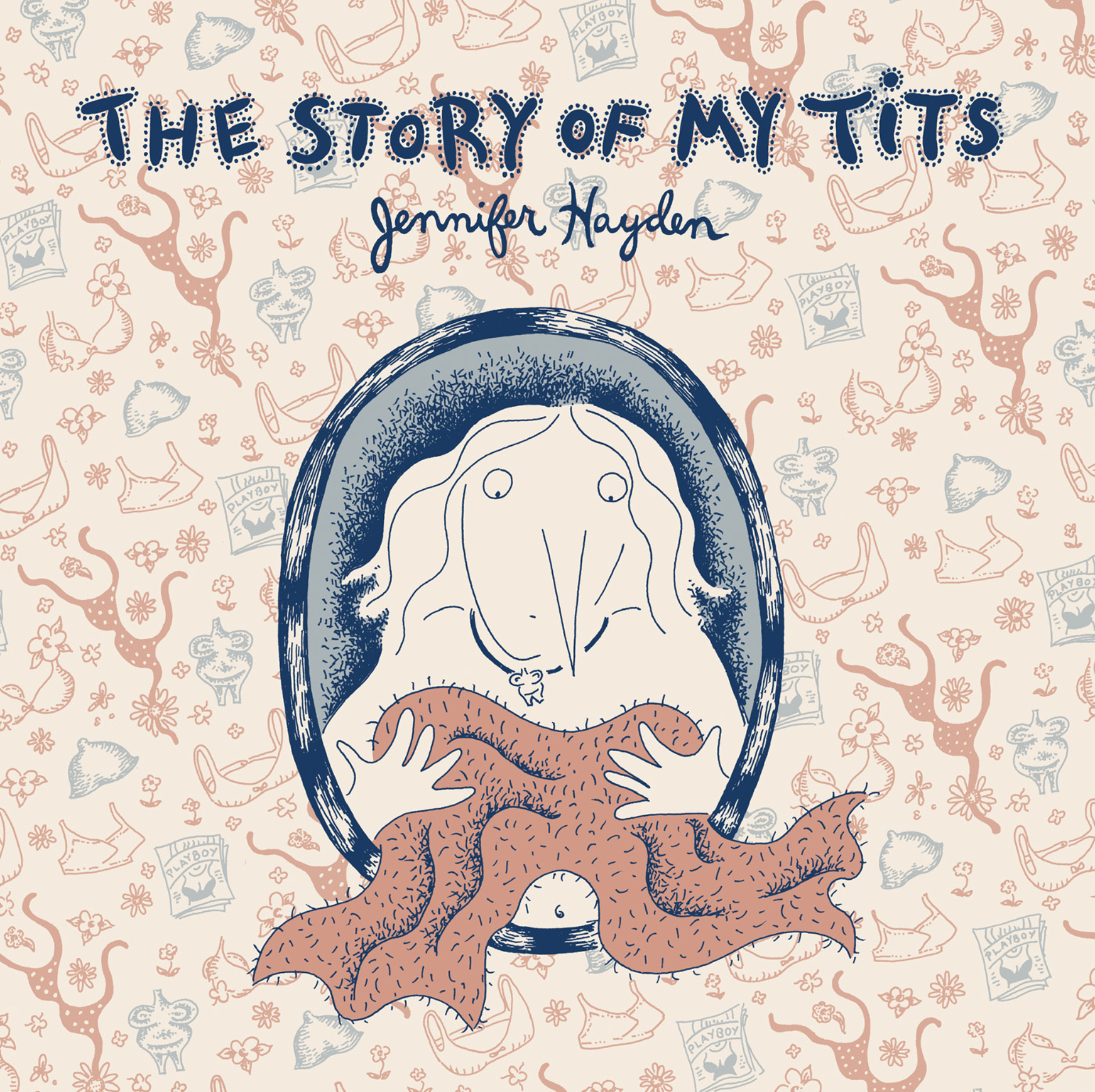
It's interesting you say that because I think one of the reasons The Story of My Tits succeeded was because you made it about everything in your life. The story of having cancer was a chapter in the story of your life, very consciously, in a way that really worked effectively.
Thank you. Yeah, this one was different. This was much more episodic. It was really more formulaic. Actually that was the most exhausting thing about it. There's this rule in art that my watercolor teacher taught me years ago. She said, we're going to do an exercise in variety and repetition. We had to paint these trees. They were all the same, but each one had to be just a bit different from the others. Humans love repetition, a pattern that repeats, but because we're humans, we get instantly bored if it's too repetitive. We want to have variety within it.
What I kept doing in the cookbook was, each chapter had to have a story. It had to have a reason for being, and then it had to have a problem to solve. It had to have herbs that shed light on that. What were the core emotions in this food incident? Then it had to have a recipe with a narrative in it, which made me have to get my writing chops together, as well as my art chops to draw all the food. I was also alternating present tense and past tense, but I didn't want to do any of it too strictly. I don't know if anybody's going to notice, but I tried so hard to make it formulaic in the way a cookbook is, but never dull in the way that hopefully a novel isn't.
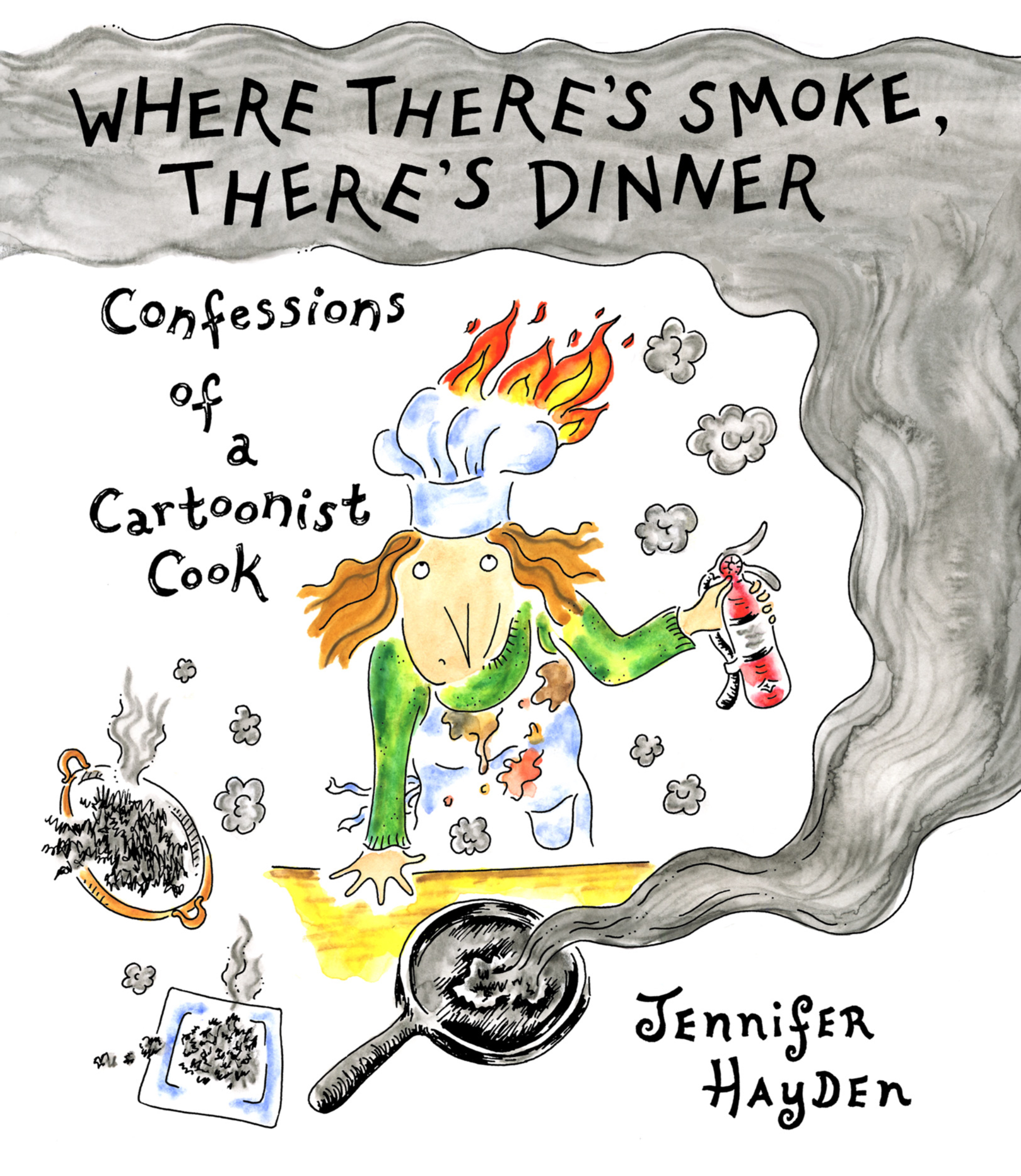
Like a cookbook, like a cooking show, there’s a rhythm and pattern to how cooks present things, how they describe what they’re doing, and did something similar here.
That's interesting, because the one thing I never watch is cooking shows. I realized partway through this book, people are going to think that it's crazy that I'm talking about cookbooks, because all they're doing is plugging into TikTok or something. All they have to do is dial up somebody else making this recipe and they're fine. Whereas I was learning to cook in the nineties when my kids were little, I would buy a cookbook and I would spend a couple of weeks reading it from cover to cover. I think in the end, what I ended up appreciating was the cookbook format, rather than the food I was supposed to make with the cookbook. [laughs] But I always, I always loved the black and white illustrations.
That’s interesting- reading it cover to cover like that is a very different experience of the book than most people have, and I think different from what the authors intend.
I have a friend who’s an incredible cook and she has this almost biblical wooden support for a cookbook in her kitchen. There's always something amazing on it by some California restauranteur. I thought, is that what you're supposed to do with these things? I just have a stack of them on my bedside table. [laughs]
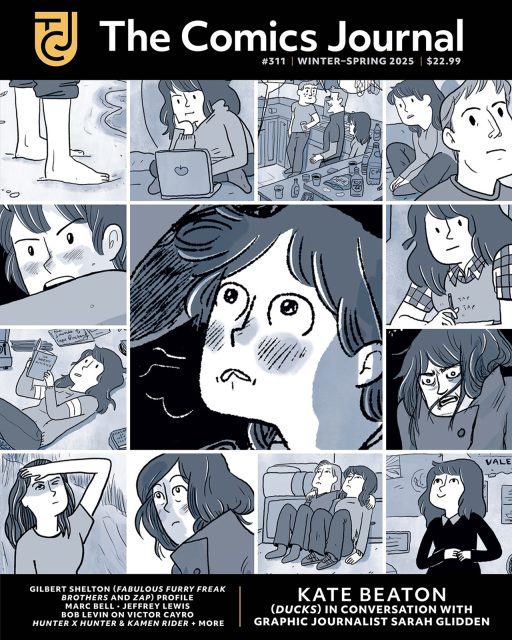
You made a comment about your shtick and how you work. Underwire has you working very tentatively in a lot of ways. That’s you going, "here's how other people make comics. I can make them in that style". By the end of that book, your voice and style really start to come out.
Very interesting observation because I did Underwire as a webcomic. Dean Haspiel had started his website Act-i-vate and he invited me to contribute. He wanted me to contribute The Story of My Tits. My very first comix drawings were in that book. You can see how my style changes in the course of the story. So I told Dean, no, I don't want to give you The Story of My Tits, because I was too afraid that a publisher wouldn't take it. Even though lots of books started on Act-i-vate and ended up being published later and none of those publishers had a problem with it, I just didn't want to give it up. I said, I'll come up with another thing for you.
In my ADD way, I started thinking, sure, I'll do a monthly webcomic. It'll be great. And I'll also get the book done in record time. [laughs] This'll work fine. When I picked the name Underwire, that was another huge problem, because everybody thought that was going to be the breast cancer book. Either that or I must be breast obsessed because everything has to do with bras or what we're putting in them. When I did the very first comic for Underwire, which is called “Watercress”, about my daughter dropping the contents of the sandwich and me relating that to death, I very much was doing it with a sense of, I have to know if I can draw and write about something other than breast cancer. I have to be sure that I have a voice. That it's not just this one book. It almost felt like bad luck to just do one book.
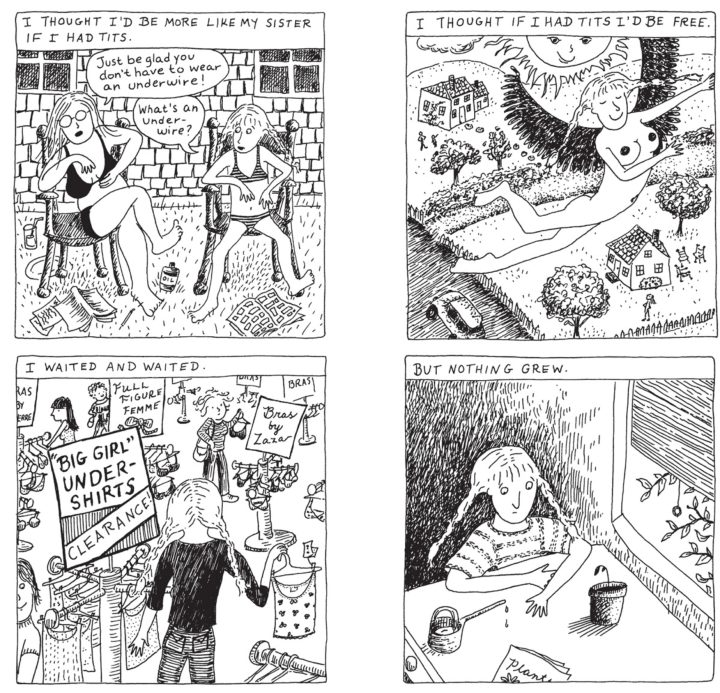
I had to take my talent out for a walk with a couple of other things. Underwire let me do that with stuff that was less heavy hitting. Even though the beginning of The Story of My Tits is not that heavy hitting, the stuff is pretty deeply rooted. When I was doing these riffs about my family in Underwire, it was also giving me a chance to take a break from the seriousness of The Story of My Tits. Psychologically it was like, I'll have a palate cleanser this week, and then I'll go back to the salt mines. But you're right, it does show me taking those baby steps. I'll also draw your attention to the insane amount of cross hatching in that book. I will tell you that is me tap dancing as fast as I can for the audience in case they get bored with my story. [laughs] Stay tuned for the cross hatching! That hurt my hand and I had to get rid of that pronto. It starts to go away in The Story of My Tits, and it really has gone away in the work I've done after that.
You've also replaced it by using color and other techniques.
That was a big uphill battle for the cookbook, because I had to learn how to color something and how I wanted to color it. It was laborious. It was two layers because you can't get a good scan of color if there's black and white in it. Scan the black and white, paint on a piece of paper on top of that on a light tablet, and then join them in Photoshop. Oh my god, oh my god, five files for every image. Five. Five! But when I screwed the color up, I was glad that I did it that way. I have another project on the horizon. It's not going to be in color, I’m going to have to recover from that experience.
Going back to your voice, rereading Underwire and the opening story there with your daughter and then coming back to your new book, there are years and experience, but it felt like you finding your voice and style, and trusting your art.
That's nice of you to see that. Those of us who do graphic novel work, we have to grow into the pace and the compression. All those techniques. It’s like playing an instrument. When you hear a seasoned player, when they get to the end, and they slow down, it’s so sweet. They know just how to draw it out and when to stop. There's a world of confidence in that. I play the violin and fiddle, and one of the things I love is the tone of the violin. I don't have speed, my technique is not terrific. I never practice, I don't have a lot of things, but I always loved the tone. So having the patience on paper to let the expressions on the faces tell a lot of your story, to let the white space between the panels tell your story, that comes with experience and confidence.
Interestingly, over the last year, I took a break from comics, and I ended up doing a lot of writing. I was just tired. I had done so much careful drawing for the cookbook. What I missed were stories I could do quickly, like Underwire. I ended up doing spoken word stories at an open mic near me. Monthly, I would do a new story. It was eye opening to do stories with no drawings at all, and find out what my voice really was. It had changed over all these years. I mean, Underwire is fifteen years old.
I was getting was this sense of how to play an audience. How am I going to get them to hear this? I would rewrite and rewrite and rewrite and rewrite and pace my studio and speak it and speak it and speak it and speak it. And then going out to perform it, I would hear what they were getting. There’s all this stuff to work on within a graphic novel. That storytelling form is like opera. It’s got all of these facets, and I'm really, really interested, unfortunately, in all of them. I was so champing to get back to comics at the end of a year. I was so hoping I would become some sort of a novelist. [laughs]
What made you go, "I should do color, that'll be fun"?
Well, you take a look at gray food and realize that your audience is not going to find this appetizing. I did a proposal for Top Shelf that was in black and white, and I think they would have been okay with it, because when I was proposing it to them back in 2017, not everybody was doing color books. More people were doing it, though, and it was more normal on the web. But I don't like Photoshop color. My line is hand done, so my color needs to be hand done.
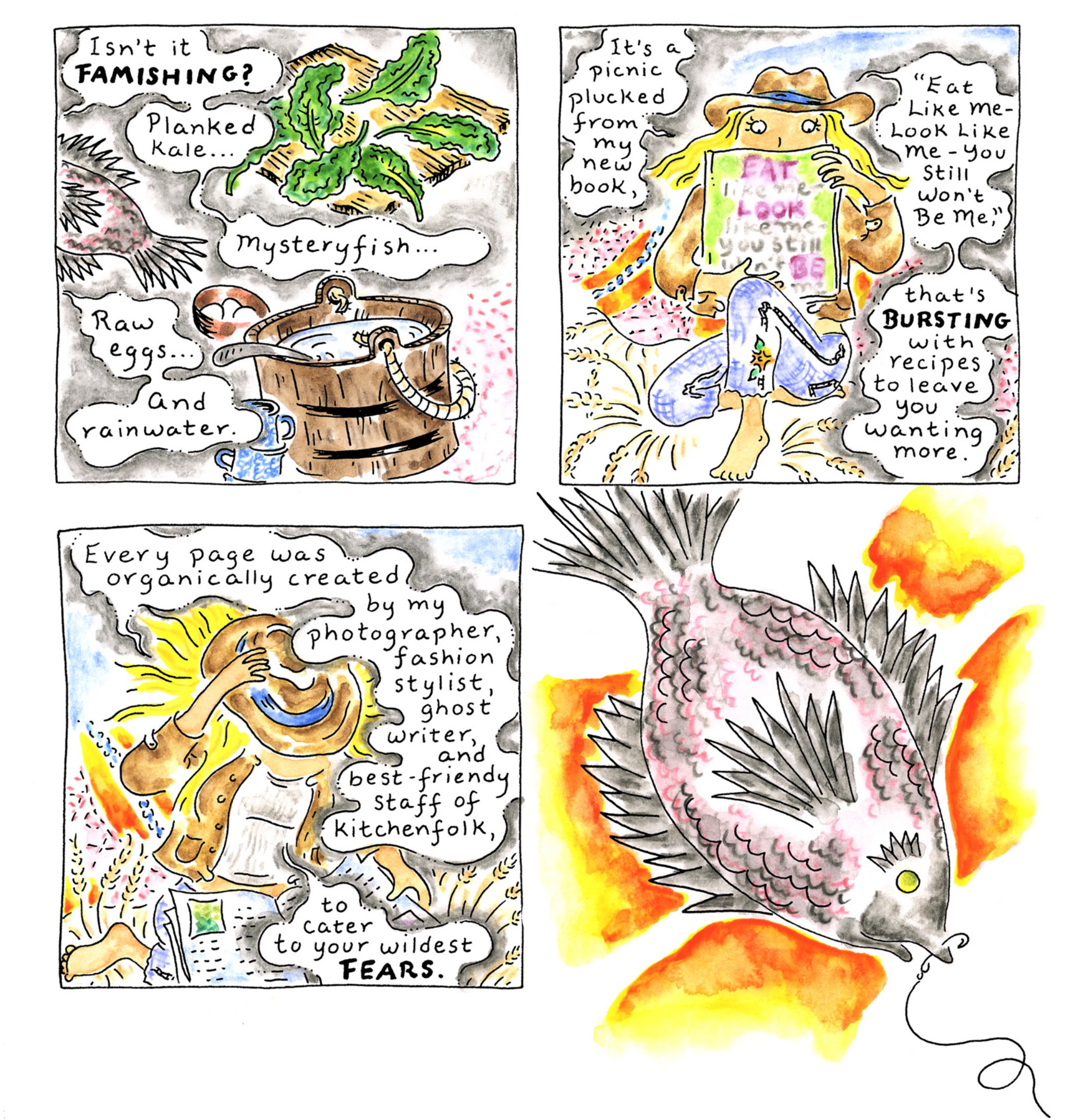
I had loved black and white cookbook illustrations back when that was more usual. But now it's usually photography, so it has to be in color. My dream is to accidentally have my cookbook show up on the cookbook shelf in a bookstore and somebody pick it up and go, “Oh, what's this?” Suddenly I'll be ripping into all their sacred cows. I realized that to compete with the photographs, if I really wanted it to look competitive, I was going to have to get into the food. And once I did, I realized how hilarious it is to do a gorgeous, realistic picture of a disgusting mess. That's funny. My favorite picture in this book is the pizza that I exploded, along with the pizza stone under it. I took hours on that picture. I wanted the dust to show up.
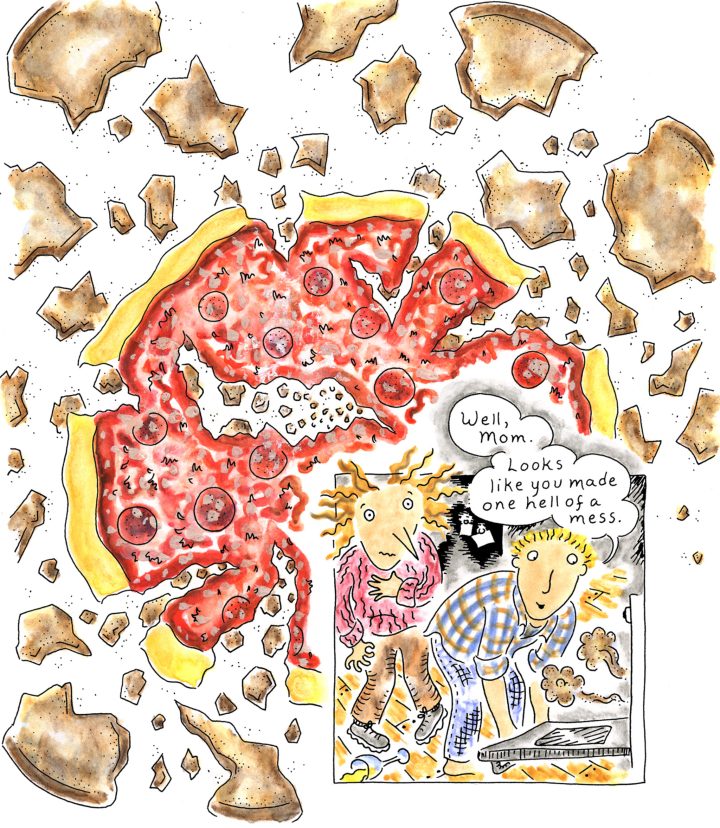
The “Eat my Dust” chapter was fabulous and the color adds a lot to it.
That's my little letter to Gwyneth Paltrow.
I was thinking of her, though there's a few other possibilities.
That's why I didn't put a face on her, but that's an interesting case because that personality and that delivery and idea came from a book, not from a cooking show. It would have been easier, probably, if I had watched her doing something. I’m glad. That chapter took a huge risk and could have been very weird.
It could have been. There's a certain tonal balance and how it ties in with the other chapters.
That again is that confidence you were talking about. I’ve allowed myself to go into some very spiritual, very surreal places. I plan to do a whole lot more of that. I've realized that I can do it without losing the reader. That's been part of working on narrative. I've got the plane all set, now we're going to take off.
As you were thinking about color, you said that you were looking at and thinking about cookbooks. Did you have a model or a way of approaching color that you were looking at for how you wanted it to look?
Years ago I did children's books, and could never find a way to color them that I liked. I had hoped that I could just be Maurice Sendak and just do black and white, which he did in the beginning. Then I realized, with the printing the way it is now, everybody's doing very flashy color for kids. I tried all these different methods. I took a watercolor class. Then I gave up and I went on and did some other stuff.
With this book, I told myself, okay, you hate wet media. That's where it started. Not only do I hate food, but I hate wet media. I am a pen and ink girl. The ink is wet, of course when it comes out. I use a rapidograph and I love that, it's like ice skating across the page. But I don't want to have amorphous painting with no lines. That made me insane. Past tense. I now enjoy the shit out of that. So what I did was, I told myself, there are these things called watercolor pencils, use them as training wheels. I got a batch of watercolor pencils. Someone said, get a very small outdoor watercolor set. They make these light things you can carry out for plein air painting. I bought one and they said, the colors will be pre-balanced. Which I don't understand, but these colors will already look good together. When I was in watercolor class, you know, we had to squirt out like 48 different colors and balance them ourselves. It's a nightmare.
So, using the watercolor pencils first, I would draw on a piece of paper on top of my ink drawing. That gave me a certain feeling of security. I could just throw that out if I screwed it up. I would start with texturing, as if I was using maybe a pencil. It just had a little color to it. Then I could get those wet. And then if I wanted it to get more intense color, I would bring in some color from my little field kit. Pretty soon I was up and running and really getting into it. Going from dry media to wet media was my big growing up process in this book. And finally I did achieve that.
Now you want to keep pushing it in different ways, it sounds like?
If I have a subject that needs color, then I will use color again and have fun with it. But right now, I've got two projects in the wind and I'll use a style for them that will be a compromise between pen and ink and color. Instead of all the crosshatching, I'll add black watercolor pencil to the ink. So I can do a little bit of what I was doing with the color, add some texture and some washes, but they're gray. But it's still very satisfying.
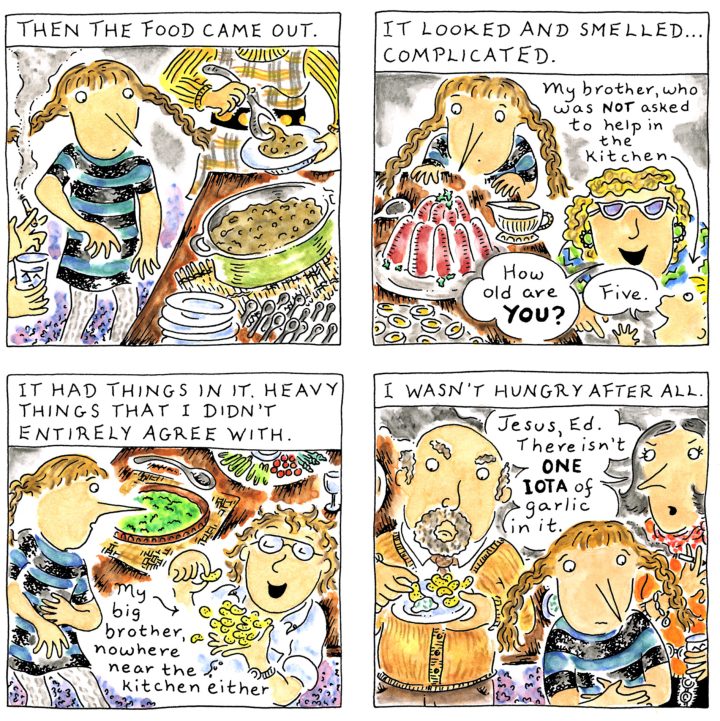
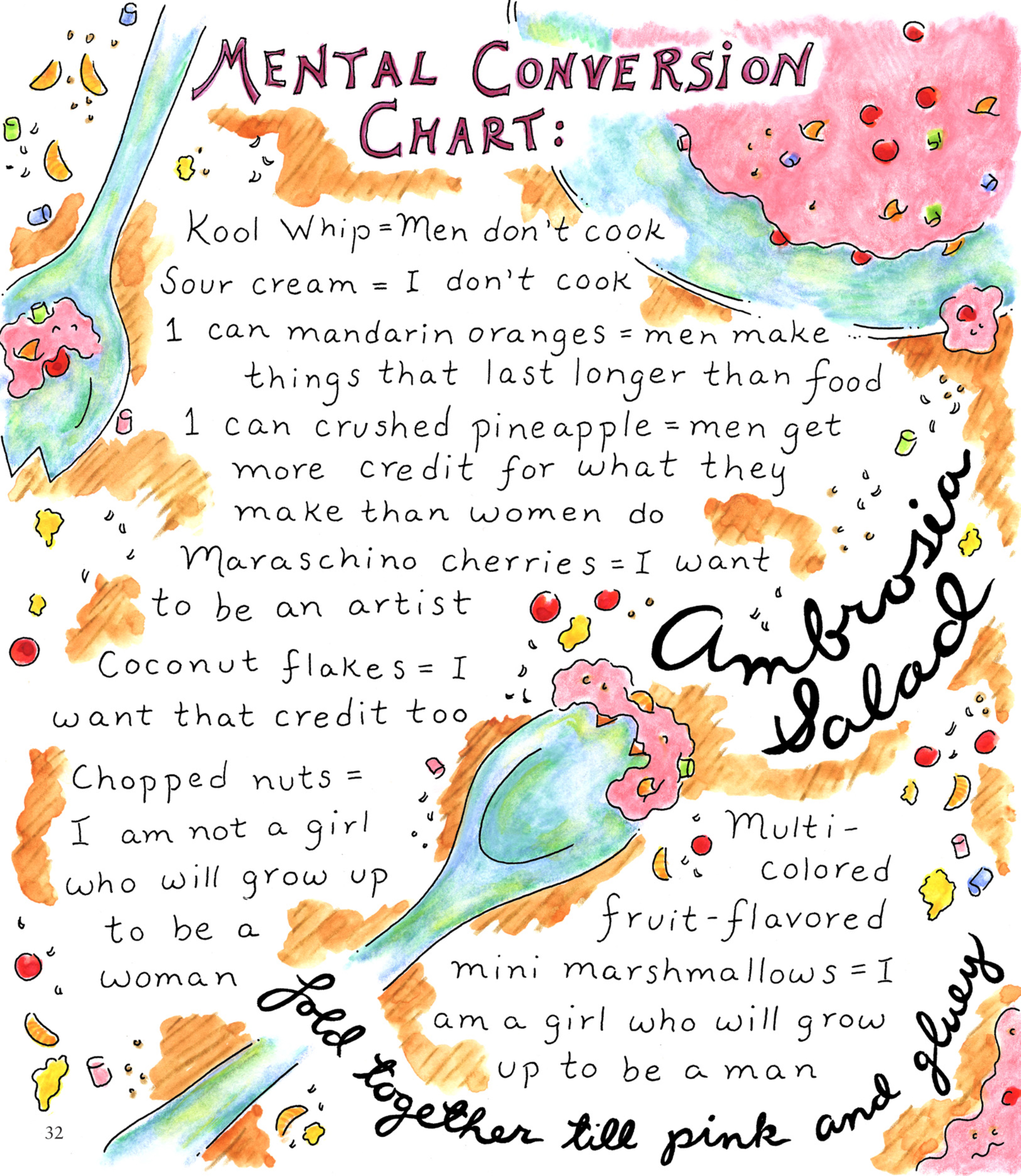
The book is funny food stories, it’s deep insights into your life and how you think about food, it’s disgusting food your parents had at parties.
I had to check with my older sister. I was like, "what did they eat at those parties?" All I know is I thought all of it was gross. She was like, "this is what they made". I thought, "I wasn't wrong!" [laughs]
That childhood memory was dead on.
Yeah. Disgusting. I mean, my mother was a great cook, but a party was a party. That was stuff you expected to have.
All of that food looks probably better in your drawings than it did in real life.
Thank you- I guess that's flattery? [laughs] It wouldn't be too hard for it to look better. But I did realize that this was a way to tell a life. I mean, let's face it, it’s my story. It's the story of my food, as opposed to the story of my tits. Everything is “the story of my…”
Creative memoir has taken off. Not just in graphic novels. I read all kinds of books and all kinds of memoir and I love nothing more than somebody saying, this is a memoir of all the trees that I have loved. I'm like, sign me up. I'm buying this book. I can't wait to hear about you and trees. I think that all books should be like that. It's so revealing to take a subject and then find out how you feel about it. It's to me, more personal than a love story. More personal than all of these tropes that we have in entertainment that are accepted genres. This idea of, what does this flower mean to you. I mean, I think I'm a bit of a mystic. It's kind of its own mysticism. You can stare at that and all of these things will occur to you and become clear and you'll realize what life is.
Did you come to realize anything while you were making this book?
Yeah. Although I think some of it came after I made the book, which was weird. You do these things not because you know what you're going to put in them, you do it because you can't wait to see what you're going to put in them. You know you're going to learn from whatever you put in them. I found out all this stuff about why I was so upset by food when I was young. I found out why I associated dinner time with obligation and suffering and repressed frustration and disappointment. I realized that I had really felt this coming off my mother when she was making dinner.
My father would come home and she was moody anyway. I understand that. As my friend has said, "our mothers were in trauma after having four children". My father would come home and he very well might have come from somebody he was having an affair with. There was an emotional residue, which I did visually portray in the book. Recently I was saying to my husband, I figured out that what I've been doing a lot of is acting out my mother's behavior at dinner. Thinking that this is what dinner time causes to happen. I just wasn't really clear on it.
Another little side note, I will say, is that my husband, upon reading this book (he doesn't get very involved in my work. He finds it very hard to read comics, didn't grow up reading them), gave me a hug. He said, I just had no idea that it was so much trouble for you. He said, I knew it was bad, but I didn't know it was this bad. He has been volunteering to make dinner more evenings. So I’m very happy. So there is healing happening.
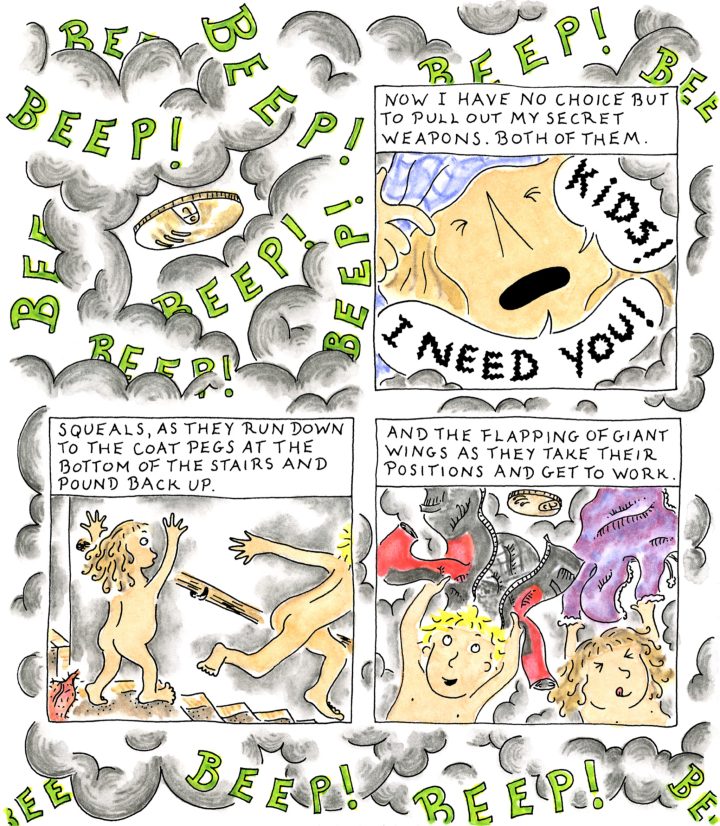
I enjoyed the second chapter where you burn dinner, but your mom is impressed you have the kids so well-trained that they're waving their jackets at the smoke detector when it goes off.
I loved in that in that chapter how pleasant she is, and how much of a pain in the ass I am. It’s just great to be able to look at this through the lens of time. Also in a graphic novel, you can have stuff on people's faces, and in their words that you're not saying anything about. The person telling the story has a totally different approach, but the person they're telling it about can still look right at the reader with their own truth. That was fun. But that was a very real story.
There’s also a sense of, she knows dinner will go badly and is a pain, but she’s impressed with how you’ve raised the kids.
[laughs] That’s true. She was very practical.
That gets at how the book is very light and fun, but also goes deep in how we’re shaped by so many unconscious, learned behaviors.
I think that's a great thing that comics can look at, because you can get so into gesture and expression. When I say that dinner is ruined at the end of one chapter, I put my mother in the panel, because I was doing exactly what she had done in a previous chapter. That repetition, I will say as an artist, sometimes you put something into something because it just feels right, because you're just in the zone. You artistically know stuff before you really know stuff, if you're in the zone. By the time I was done, I think that's when I started really digesting, so to speak, all the stuff that I had learned in the book.
Now I realized– I do this whenever I open my old work– I'm like, "I knew that then?" I didn't really consciously know that for like ten years later. Good for me. It's very weird. I think I've accepted that comics are my way of channeling whatever wisdom is coming in. I don't always get it consciously, I don't necessarily get it in in conversations with people. But when I’m creating, recreating a story, then it comes through.
You may not realize because you're so busy dealing with the actual work of it. It may take a little while before you go, oh, that's what it means.
Yes, I think that's right.
I think also that that's probably the distraction and the feeling of safety and control that makes that stuff able to come in. Because you're sitting there going, I'm just making this panel. I'm choosing red. That's what I'm doing right now. [laughs] But actually, all this wisdom is choosing you and choosing to come in through your fingers. If you knew it, you'd probably keep it out.
The repetition of the chapters and you and your mother having similar responses, well, that's just good writing. These are just elements of well-crafted art. Then you step back and go, wait, that's what it means.
I have a strong background with incredible English teachers and great art history teachers. I have talked about stories in art and picked apart a lot of great books. You can't unlearn that stuff if you do it when you're young. It’s a language. Nothing makes me happier than putting a tight book together and having all the pieces work. I don't really like to be edited. That's horrible, but true. One of the things I don't like about editing is because they're Frankenstein-ing my book. I don't want anybody to remove anything. I think I'm economical and everything needs to be there. What I try to do is make everything dependent on everything else. So that the editor can't possibly remove anything without screwing something else up. [laughs] That’s my secret.
You covered a lot of ground in a very short book.
When your first book is 350 pages, everything is going to look like a floppy 24 pager. [laughs]
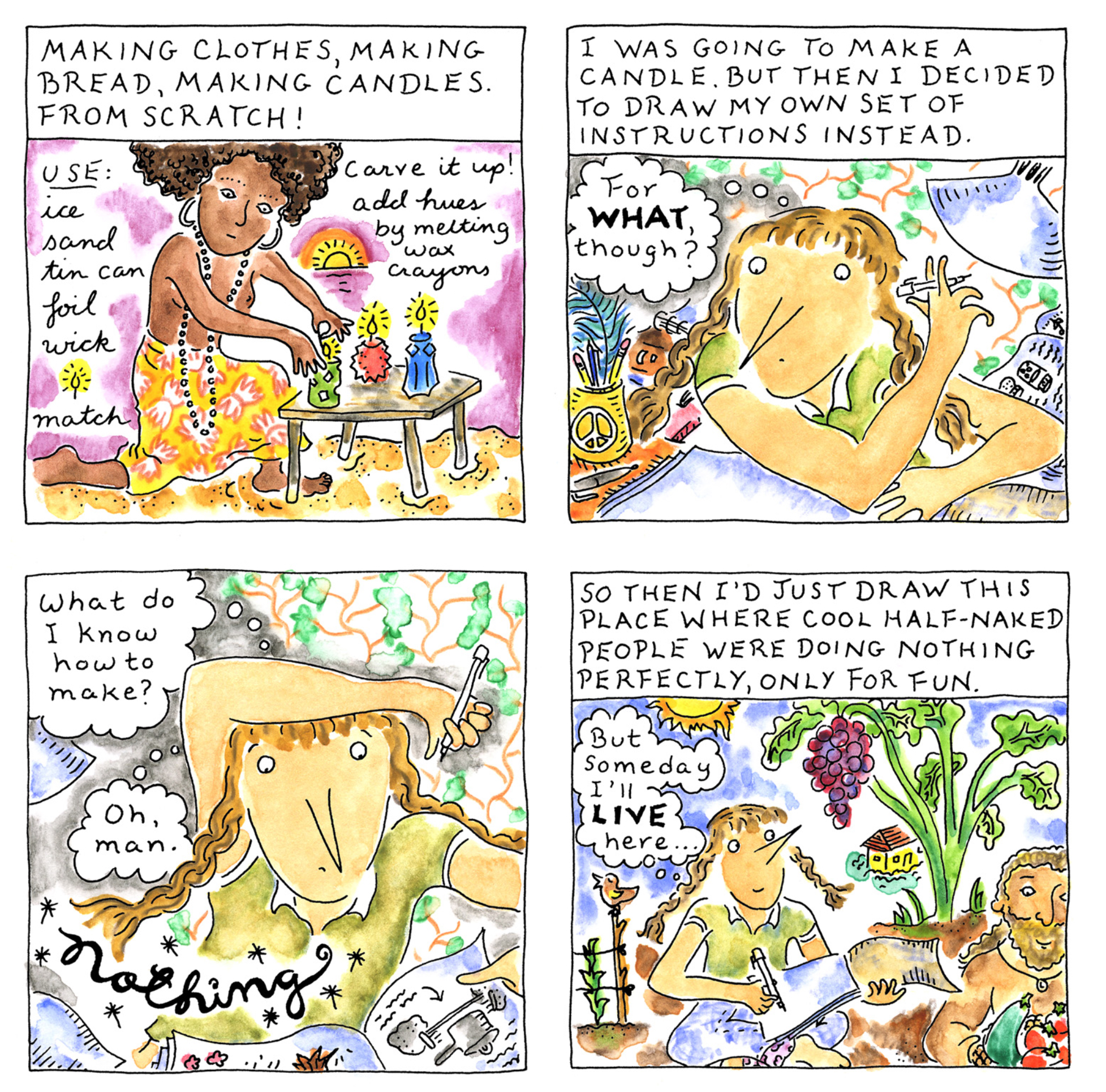
I did want to mention this scene on page 67. “I was going to make a candle, but then I decided to draw my own set of instructions instead. For what, though? What do I know how to make?” It captures that feeling of being young and that mindset, but as an adult, you made this book.
[laughs] Yeah, and I wasn't talking about food. I was talking about crafts, but yeah. There's something fabulous about childhood ignorance, and what it leads us to do. And boredom! All of the chapters that are about my childhood really are a hymn to boredom. Boredom is the best. It's the best thing. It's so good for kids. It is the home of all kinds of creative fertility. Without boredom, you don't get art. In that chapter I'm imagining a world where hippies are making everything. I just found it hysterical that when I had two little naked kids tearing around my house, that's what I was living. [laughs] We were making everything. We were cheap, and we were scrappy. It's not in the story, but I made all kinds of things for my kids that were crafts, like a dollhouse out of garbage. I did these things. But making food from scratch, I still could not get behind that. Not as a child and not as a grown-up.
I think my favorite image is the one in that where I'm helping myself to some bulk food at the food store, and it's pouring all over me. [laughs] That, again, is very real. I start to feel like Woody Allen in Sleeper going through the world, where very time he interacts with a machine, he gets completely destroyed and destroys the machine in the process. That is how I have felt going through the world. Whatever it is, I'll fuck it up. I'll do it. [laughs] But I think that that moment with me saying, what do I know how to do? First of all, I remember it so clearly, but also, it is the beginning of caring about learning how to do something. But the interesting thing is, I end up not caring about adult things like cooking. I care about making art. From an early time, I was drawing and gluing and cutting and pasting. My older sister was incredible in the kitchen, and the idea of making food to share with others, forget it. I'll draw a picture of food. I'm always better in 2D than 3D, is what I like to say to people. I can do anything in two dimensions!
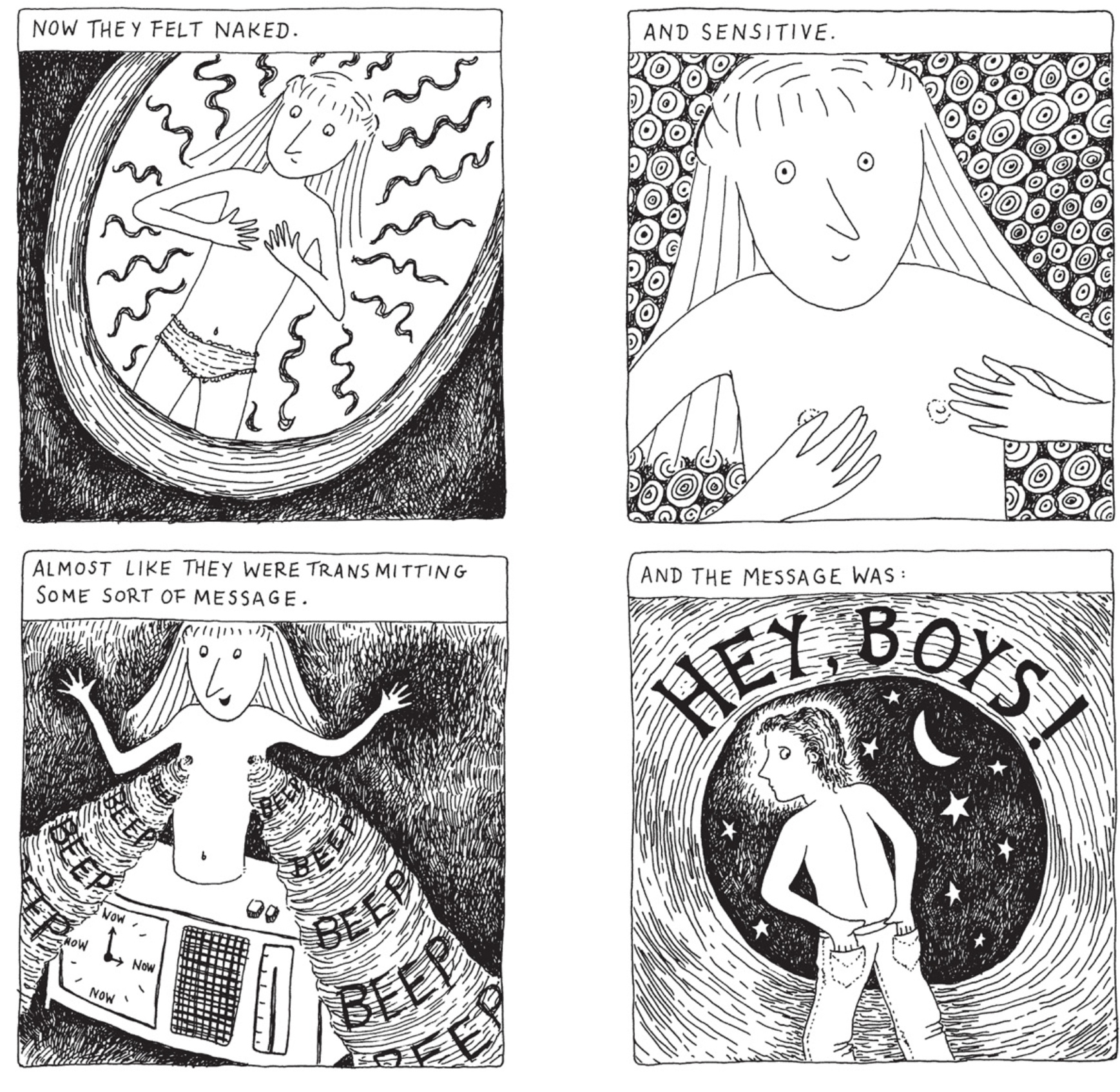
I mentioned your style before, and I think of it as having this conversational, associative quality. You're not alone in this approach, that there is a plot, but you’re going to take us through it in this meandering but deliberate way.
I was doing a spoken word piece, and a friend of mine said, I felt as if you were leading us through a labyrinth. I knew that we were going to get somewhere great in the end. I now am realizing that what I consider myself more than an artist or writer or graphic novelist or comics artist, is a storyteller. I'm going to tell a story as if I'm standing at the bus stop talking to somebody, whether I’m writing prose, or if I'm standing up doing spoken word, or if I'm doing a comic or a graphic novel. The techniques of storytelling, the physical technique changes, but the way of bringing the story to life for another person and making them experience what you experienced so that you don't have to tell them what you experienced, they just experience it, is the magic that happens. That's what you're trying to make happen.
I try to be as non-unpredictable as possible. I was online, and I saw that somebody had written like a cue card for somebody who wanted to do stand up. It said, your first sentence has to grab people, has to wake your audience up. You have to propose something outrageous or ask a question. I thought, this is basic storytelling. You start somewhere outrageous, and then you keep going to more outrageous places, and then you drop your audience right in it at the end, when you're ready and they're ready. Then they've had a ride. It's not just, I washed my socks on Tuesday, and I hung them up on Wednesday, and the wind blew them away. That's not what I want to experience. So I am very picky about the story itself. It has to make me feel a certain way. I have to be tickled by it. I think that people don't always pay attention to how you build it brick by brick. Each brick matters, you know?
This is what you were saying before about telling the story very tightly. You might be jumping around to get to the end point, but you’re very precise in how all these connections are made.
I don't like wasted time. I like that idea of unity. What are the three unities? Unity of time, unity of space, unity of something else. The idea is that with every sentence, with every image, you're keeping in mind how it's functioning within the whole. You're very careful about making everything speak to everything else. You’re pulling away more and more of the onion. How to do that is fascinating to me. Because that's where your power lies. If you just start with, and then we sank, what are you gonna do after that? You have to get there. So I do love that.
Just to get into the craft side, how did you actually make it? How were you working on the book?
This was torture. It was torture because with The Story of My Tits, I had a chronology and I had a chapter outline. I knew the stories because I'd been telling a lot of them for years. This time, I wrote down on note cards, the funny stories I wanted to include that had actually happened in my kitchen. Then I laid them out on a desk and I realized I didn't have enough. If each was a chapter, I didn't have enough chapters for a whole book. Then I started adding note cards and taking note cards away. I got halfway through the book and thought, all I've done is tell a bunch of funny stories that are somewhat tied to my past and present, but I don't have any more stories. What am I gonna do?
What I did was I went nuts, like everybody going through quarantine, and I worked on a completely different project for three years. Three years! Top Shelf is very patient. They waited. When I came back, I realized that the narrative was going to go into my older years, past The Story of My Tits, past those years. Into what's different about food and eating and making dinner as we become empty nesters, and as my mother becomes old and I'm looking after her. Then I get into the more spiritual stuff that I've been doing for a while. Feeling a little bit like a witch and feeling a little bit magical. I thought, that stuff has a place here too, because I'd rather do magic than cooking. That's gotta be funny. If you think of Shakespeare's witches and boil, toil, and trouble, that's cooking. That belongs in here. Then I thought, oh, I know what we have to do here. It started to become clear to me how to end the book. At that point, I was able to really redo the outline and give it an overall structure that it hadn't had before. I submitted that to Top Shelf and they were like, this is good, do this. I was able to realize what the last stories are. Which are somewhat fantasy, but heavily researched and actually very rooted in reality, just a very old reality.
When you say outline, like how long and how detailed was it? I'm curious just how much you're writing before you start drawing, how much you’re drawing as you write, and how you worked.
Much too much of the time, I have no idea what I'm going to write. No idea. I have no idea where the story's going. Now I'm trying to make myself plan more. But that's the thrill to me, not knowing what I'm going to be doing, and writing this stuff like poetry. But in this case, I'll do like a few sentences for a chapter. Then when I am taking notes in my little notebook, which is where I decide what the words will be, I might reach a point where I see like the story arc. And so I'll just shorthand the story arc for myself. But I really try to stay away from using English class techniques, because I used to do that when I was trying to be a writer when I was in my twenties and it absolutely squashed anything spontaneous and closed my voice up for a long time.
That's part of why I hate being edited because comics are so alive to me. It's like ivy growing. You can't contain it. You can't control it really. Why would anybody try to make me commit to doing something a certain way when while I was in the midst of it, I realized something else was better. I wanna be free to do the best thing I can with a narrative and a picture. In this book, in each story, each moment in a story, there's always a different thing that I need to nail down. It might be the repetition of an image. I'm using cinnamon again or something and I need to remember how I used it. I need to look at, was it this way or this way? It can't be this way again, it has to be that way this time. If it was on this page, I’ve got to put it on this page. It's a lot to keep track of. It's insane.
Then at a certain point in each chapter, I would have to say, what are the emotions that we're getting into? Because I'm not terrific at really nailing down emotion. I might emote, but really getting to it. Each chapter was so different, and I wanted to make them have equal weight so I would list the emotions that I needed to have in that chapter. There were a lot of different ways that I had to give myself prompts, but it's still pretty seat of the pants. Although before I make mistakes, I hope that now before I go off on a tangent that isn't going to work, I realize it because I'm doing a little bit of note taking along the way. [laughs] The projects I'm doing now, I'm promising myself I will map out more thoroughly.
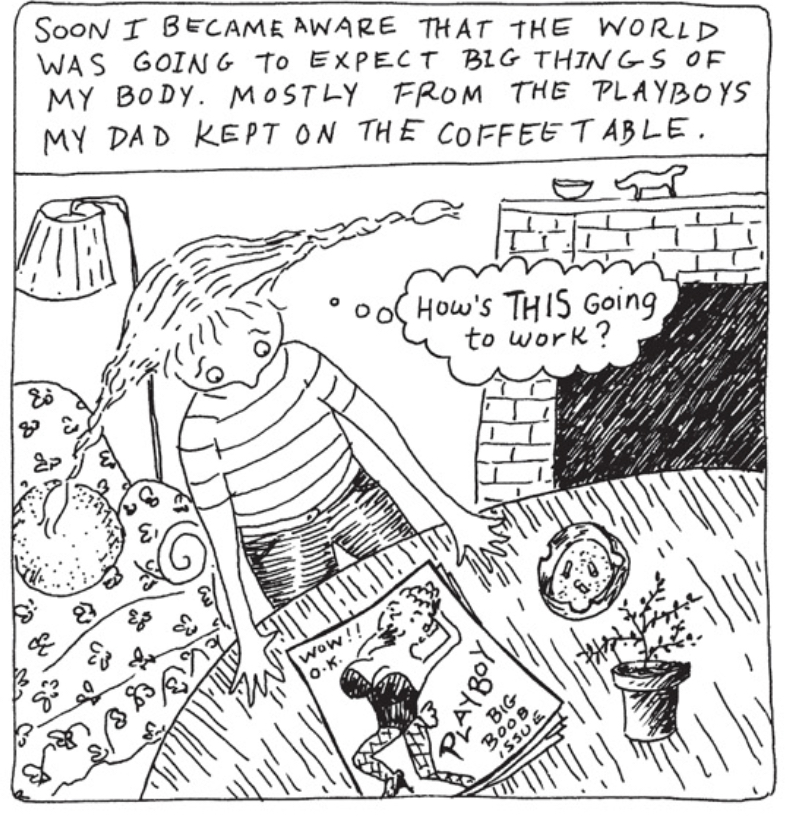
You say that, but it sounds like each project ends up being not just its own thing, but has its own process to get there.
It does. I never did thumbnails for The Story of My Tits. I didn't know what thumbnails were. I started and I just went panel by panel. With the cookbook, I realized at a certain point that because of this variety and repetition thing, I needed to do thumbnails so that I could make sure that I was varying where the spots were and where the comics were and how many panels per page and where the recipes hit and how long and short the chapters were. So that there was perpetual variety. That was very helpful. It was a tool I had never used before. And I wouldn't use it again, unless I felt I had that kind of pressure on. The things I'm working on now, I'm already seeing what they're going to need and they're going to need yet another thing. Another way of putting guardrails up so that I just don't end up in the bushes. [laughs]
Do you ever go, it was so much easier when there was just, there were just four panels like in Underwire.
Well, humans love to learn. Unless we're doing something for money and it's like, I'm going to make 45 of these today, as soon as we're good at something, we want to do something else. As soon as I could play the fiddle in my band and really nail my solos, I was like, guys, I'm going to take singing lessons because I don't see why I shouldn't be able to sing at the same time. Don't you think that's a good idea? [laughs] I have a terrible singing voice. It's in tune, but it doesn't have any anything. My husband was like, do what you want. Our bandmate has a beautiful voice and I wanted to be able to do some duets with him. Anyway, I can't leave well enough alone.
I got through The Story of My Tits and I was like, oh my god, I never again wanna have every panel have a piece of narrative in it. I don't know if you noticed that, but the difference with Underwire was I allowed myself to have panels that didn't say anything. That can be very restful for both the narrator and the audience. Then in the cookbook, I allowed myself to make images that were not surrounded by a box, that were different sizes, and that spoke to each other and made a whole environment. I was like, this is great, but it was a lot of work. Now I'm interested in, can you do a longer narrative with no chapters? How would you organize that? Every time I've figured out how to do something, I want to try something else. But I think that that's growth. It's how you master something. You don't want to stay in the same box because it's boring, and boredom causes us to grow. It really does.
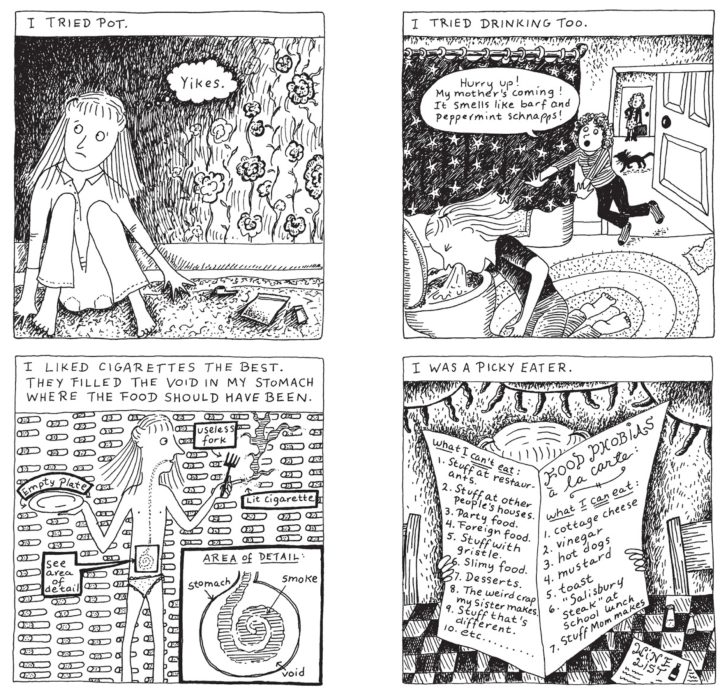
But you enjoyed in this one, playing with the page as a whole and getting to rethink that.
Oh yeah. Dean Haspiel, who was my mentor for years, and is still a mentor in some ways and a good friend. He said to me when I was doing Underwire and The Story of My Tits, you have to do a story with layout. You have to stop these constant boxes. I said, shut up, I don't wanna do layout. It's a whole other beast. It's just a distraction. I don't want it. Well, as soon as I got to the cookbook and I was trying to make delicious looking food, or gross looking food, and also have something that looked like it had photography in it, I wanted just that. I had to open up the page. I had spot illustrations going around the recipes. I needed comics for the narrative. I needed still lifes to convince people that it was real food. All of this meant that I had to explode the page. At that point, I was like, you're right, Dean. I almost sent him the first page to say, here you go. This is for you.
So Dean was helpful, just not in the moment.
Very. He's a little guy in my head who helps me.
It’s been a decade since your last book, and we’re in a very different comics world now than we were then.
Yes. This book has gotten, I think, one and a half reviews. When The Story of My Tits came out, it was everywhere. It was all over the place. I'm not going, boo hoo, I'm being ignored. If I look at the books that have come out this year, and just in the last couple of months, I'm floored. The choice now of what to read in graphic novels is a smorgasbord. The books are amazing. There are a lot of people, you know, jumping into the comics world who aren't making books that I want to read, but there are some absolute masters who are at the height of their powers right now. We are so lucky to have them. I'm looking at my book and just going, when I came up with the idea, I think, if I'd finished it quickly, it would have, you know, been still contributing to the development of this form. Now, this is a book that is strong, but there are so many spectacular books around it that it's just in a field of great books. I don't expect it to get the attention that my other book got, because women, older women, are killing it. They are killing it right now. Oh my god. And the form itself.
All I can say is that I've been around for the explosion of the graphic novel as just a perfect expression of a long form narrative, with no weaknesses compared to novels or other types of long narrative. It has fully come into its own. You realize this in retrospect. I look back and I thought that when The Story of My Tits came out, I was on this stage with these people who had done it just before me and I was on their coattails and I was benefiting from that. But I look back now and realize that all of us were still beginners in some ways. What is happening now is just so sophisticated. The top level is so sophisticated and just marvelous. I'm really happy to be diving back in. This past year, I wondered if I would ever get back to comics. I thought, it's just too time consuming. It's too tiring. Then I've been reading some of these books and just going, oh my god, how could I have been away so long? [laughs] This stuff is just amazing. There are just so many more books now. Also there isn't as much publicity.
I’m honestly not sure how much the attitude towards older women is still there, but right now you and Emil Farris and Mimi Pond and Carol Tyler and other people are putting out amazing books, it’s just incredible.
Labyrinth Books, the bookstore in Princeton where I had one of the talks that I did for this book, the week that I had my talk there, the bookstore person filled the window with graphic novels by women. Filled the window! Mine was kindly in the center, but I was just looking around at it all and just going, oh my god. There's such an emotional sensitivity, a different quality of narrative. It's astounding, the talent.
It’s amazing. The world is hell, but that’s the world’s fault. Comics are amazing.
The world is a horrifying mess, but as some people are saying, one of the protests is to make beauty, and make responsible beauty. Make art that makes people use their hearts and think straight and be truthful, because these things are disappearing. Art is always, I think, trying to save civilization from itself. It's like the mothers on the playground saying, don't hit each other over the head with sticks. They're civilizing the kids for the next generation. Art tries to say, this is what life is. Let’s be good to each other. Let's be real with each other.