

The collaborative nature of Woman, Life, Freedom mirrors the revolution it hopes to explain and amplify. While Marjane Satrapi’s name is the one on the front cover, she’s listed as having created the work, not edited it; Alba Beccaria did that work. They approached several experts on Iran to generate text or scenarios that the various artists then developed. In the same way that the revolution lifts up a variety of voices, so, too, does this work.
If you don’t know anything about the "Woman, Life, Freedom" revolution in Iran, the writers and artists take care of that in the first section of the book, appropriately titled “The Events.” They tell of Mahsa Amini’s death at the hands of the morality police, ostensibly for wearing her veil improperly, and the protests that her death sparked. This section covers a song that became the theme of the demonstrations; the development of the Woman, Life, Freedom slogan; the young people (including men, an aberration in such movements in Iran) leading the rebellion; as well as the tactics, especially surveillance and spying, the government is using in response, among other aspects. Of particular note in this section is a brief history of what woman have already achieved in Iran, in spite of the vast array of restrictions on their lives.
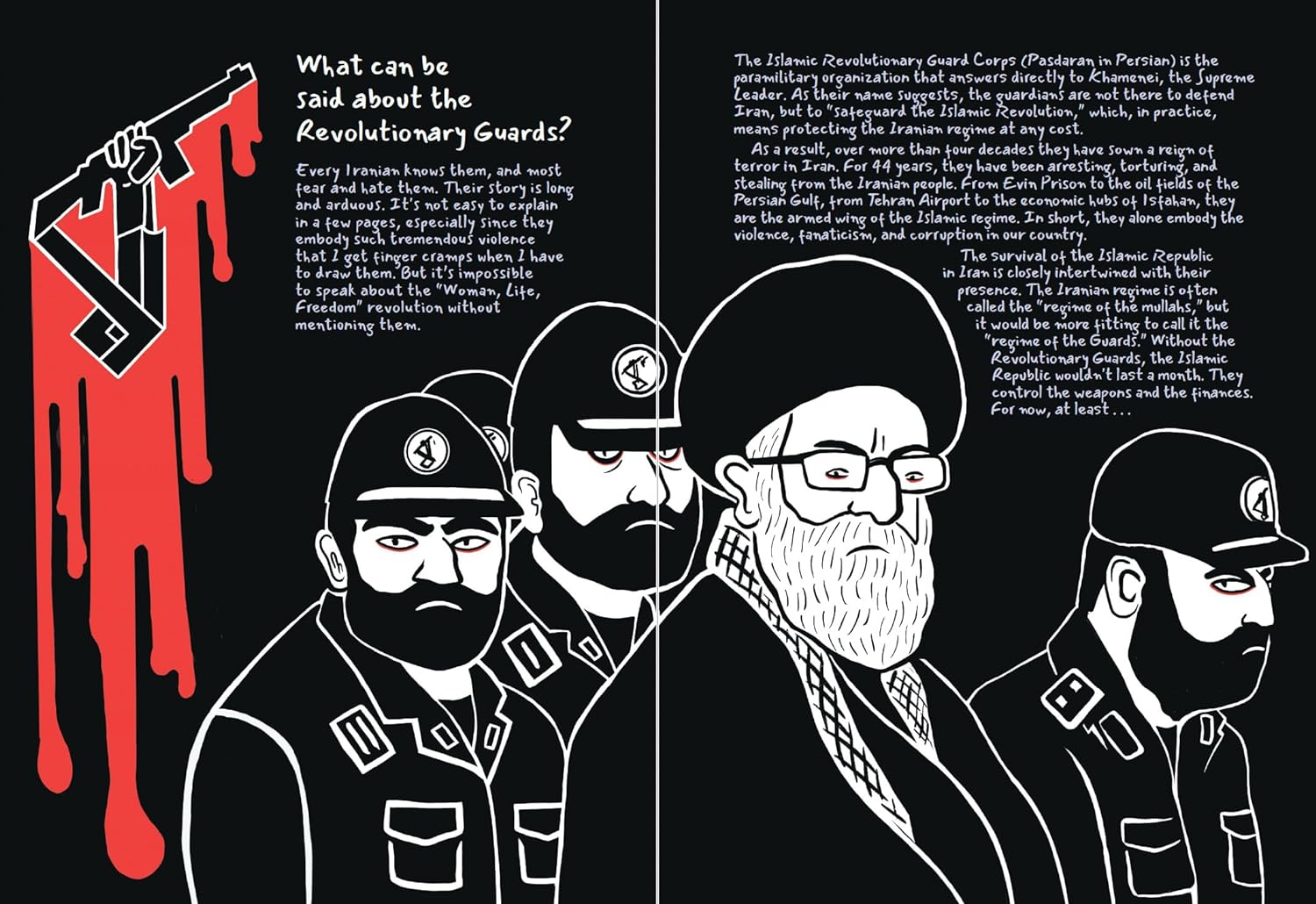
The second section — “A Bit of History” — helps set this current revolution in context with those that have come before and how the government has adapted its means of repression. In “The Three Revolutions,” Hamoun and Abbas Milani instill readers with hope that the protestors will eventually succeed, but they also remind Western readers of the role the UK and USA has played in the development/oppression of the country. This section contains numerous drawings of Seyyed Ali Hosseini Khamenei, the current supreme leader of Iran, including a full-page spread by Touka Neyestani that not only portrays Khamenei as the representative of God on Earth — as opposed to Mohammad — but also as being much larger and more important than God.
In “An Iron Regime … A People Resisting,” the third section, the writers and artists delve into the ways the Iranian people are changing and protesting. For example, in “A Party Frought [sic] With Peril,” Shabnam Adiban and Farid Vahid explain how Iranians are less religious now than they have been at any point in history, despite the way the government portrays them. Bee and Farid Vahid show how those in the Iranian diaspora are more connected to this revolution, working from overseas to pressure Western governments to support the protestors. However, they are clear-eyed and acknowledge that some who have had to leave the country feel guilty or cannot speak up because they will not be able to return.
The final section is a discussion between Satrapi and three of the Iranian experts, illustrated by Joann Sfar. In describing part of the conversation, Sfar writes about this project, “These days they’ve got multiple ‘social science series’ for comics. And academic editors. What the heck?! Geez, get me outta here! Comics might make a difference after all.” Sfar seems to be mocking their entire endeavor, as he talks about how comics have become more serious in the past fifty years. However, he doesn’t stop with that seeming mockery, as everybody involved in this project is counting on using a supposedly more accessible media to communicate about a rebellion most in the West are unaware of. In fact, later in the conversation, Satrapi says, “We’ve urgently got to change the public perception of Iran.” The second and third sections seem devoted to just this goal, especially as they work to present a counter-narrative to that which the Iranian government conveys through their propaganda.
One of the advantages of the collaborative nature of this project is the wide array of artists they’ve found. In “Male Turf,” for example, Coco uses thick black ink and heavy lines to portray the soccer match that a woman, Shakiba, attends while dressed as a man, given that the Iranian government doesn’t allow women to watch men’s sports. Coco shifts to bright colors, still thickly applied, to convey the story of Sahar Khodayari, known as “the Blue Girl,” who was arrested for also sneaking into a men’s match. When she faced extended jail time, she lit herself on fire, which Coco conveys through a woman in blue surrounded by bright red and yellow, then surrounded by solid black.
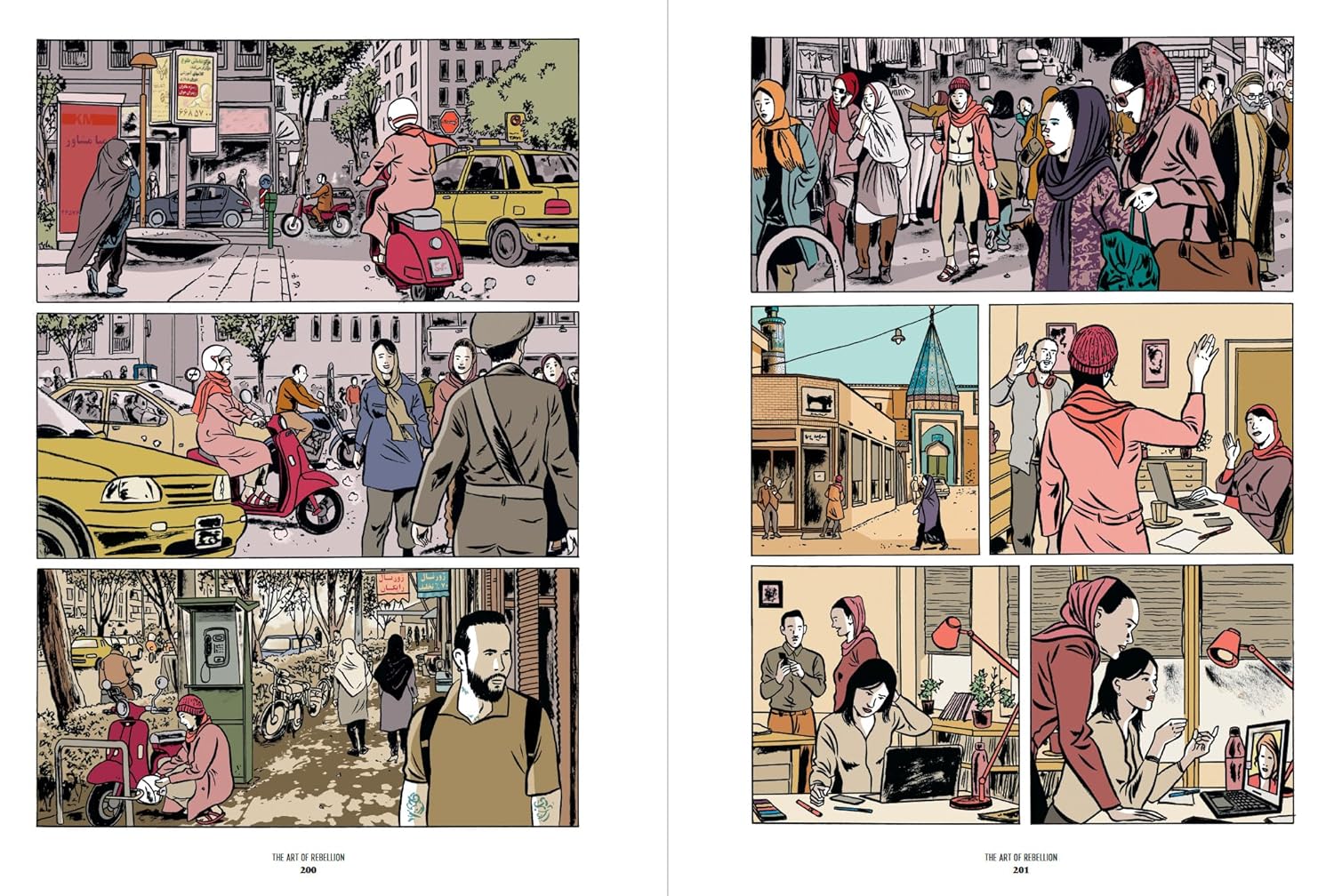
A stark contrast is “ The Art of Rebellion,” drawn by Deloupy, which takes a much more realistic style. Deloupy uses clean lines and backgrounds that are detailed enough to make a reader notice the everyday nature of the nameless protagonist. One can see the steam from her shower, the shadows from the trees she runs between, and the lighter on her pack of cigarettes. She completes a morning run, puts on makeup and gets dressed, rides a Vespa to work, before meeting friends for drinks afterwards, where she might have the beginning of a romantic relationship. The only text comes at the end, where the narrator makes it clear to the reader that every action this woman has taken is rebellion. She lives alone and does not rely on a man; she doesn’t cover her hair; she is independent; she flirts with a man or a woman, as she chooses. Deloupy’s style conveys the everydayness of her life, which makes her rebellion both less and more obvious once one understands the culture.
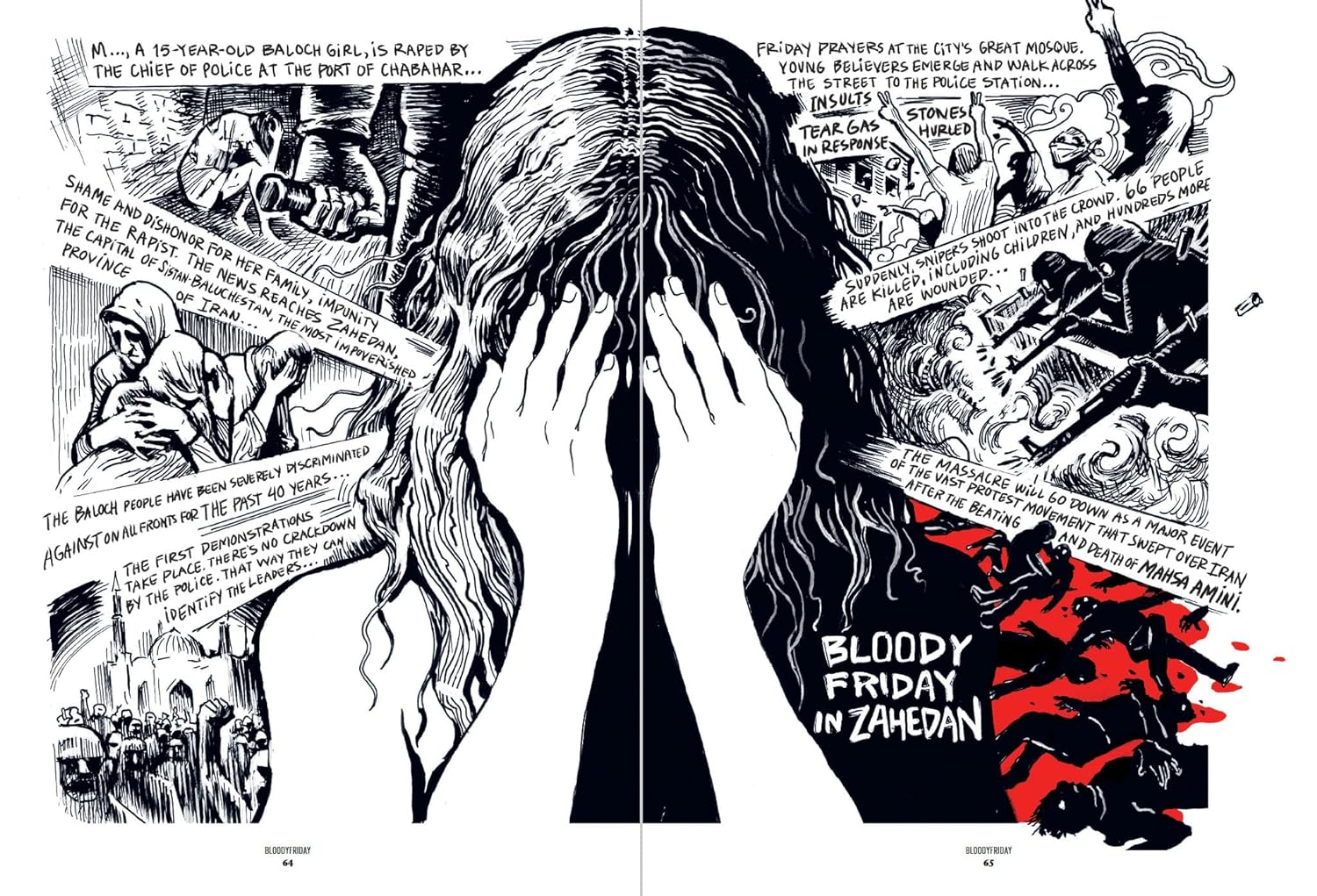
The artistic styles range between those extremes, sometimes mimicking political cartoons, while other times looking like a sketchbook, while yet others seem more like illustrated books, given the emphasis on the text. The artists and editor do a wonderful job of matching the art to the piece, elevating both. For example, “Bloody Friday” combines the chaotic artwork of Winshluss with Jean-Pierre Perrin’s fragmented text to convey the mayhem and horror of Mahsa Amini’s beating and death. Winshluss creates a two-page spread with the face of a woman in the middle with her hands over her face, with Perrin’s text shooting out from that center in multiple directions. Buried between those passages are images from Bloody Friday.
The diversity of styles and text helps keep readers interested, given that most of the pieces are only a few pages long. Thus, if a reader isn’t interested in one particular style or story, they can easily skip to the next. Overall, though, the diversity of artistic styles mimics the variety of voices throughout the book – there is no one way to see the rebellion going on in Iran, so the editor and Satrapi bring together as many voices as possible to give the reader multiple views of it.
One idea that runs throughout the book, no matter the writer or artist, is the importance of names. At times, there are entire pieces devoted to listing several names of people the government tortured and/or killed, with a description of their lives, helping the reader see the humanity the government has snuffed out. There’s even a list of Iranians around the world who have succeeded after leaving the country, revealing the brain drain that several writers comment on. Given that this protest began in the name of Mahsa Amini, such an approach continually reminds the reader of that origin. However, the writers and artists also make sure to mention the names of the guilty, whether that’s the leaders in Khamenei’s government or countries like the US.
Because the writers and artists are diverse geographically, with many coming from the Iranian diaspora, as well as Europe and Canada, the references throughout the work represent a wide variety of stories and knowledge. For example, in “In the Hellhole of Evin Prison,” Mana Neyestani and Farid Vahid tell the story of Satareh Salimi, who is forced to sign a confession stating that she was acting under the influence of the enemy and that she regretted her actions. She tries to take inspiration from Nasrin Sotoudeh, an Iranian lawyer who fights for the rights of political prisoners and activists. However, when Satareh gives in and signs the confession, she draws inspiration from Galileo instead. However, as she leaves the prison it is a stick figure image of Sotoudeh that leads her out. This melding of Iranian and Western inspirations helps guide readers outside of Iran through the cultural differences to find common ground.
That combination sums up the ideas that run throughout this work, as the creators are both optimistic about the future and realistic about the present. They know that many more people will suffer and die under the autocratic regime of Khamenei and possibly even whoever comes after him — there’s even a reference in “Who Rules Iran?” to Majtaba Khamanei, the expected successor. They repeatedly show the power and reach of the government and the Islamic Revolutionary Guard Corps, reflecting the number of ways they can and will monitor, detain, torture, and kill people who stand against them. However, the writers and artists believe this movement and those that follow will eventually lead to an overthrow of the government and freedom for Iran.
In the final conversation, on the final pages of the book, Satrapi says, “But this regime will fail. The next uprising will deal the final blow. It just turned 45, but it won’t make it to 50. Some things can’t be held back. Like an avalanche.” Abbas Milani, a researcher and professor at Stanford University, then responds with an unattributed quote, “Authoritarian regimes fall slowly, then brutally.” Given the suffering and the idealism these artists and writers convey, let us all hope they are right.