
On a November night in 1995, on the steps of city hall in Tel Aviv, two bullets struck Yitzhak Rabin at close range, fatally injuring the sitting Prime Minister of Israel. Rabin had been leaving a peace rally in support of the Oslo Accords, the landmark agreements he had begun brokering with Palestinian leader Yassir Arafat two years earlier to end the 50 year span of occupations and insurgencies that had persisted since the Nakba of 1948. The assassin was an Israeli and an Orthodox Jew; in murdering Rabin, he hoped to deal an equal death blow to the process of peace that the right wing Likud Party had already been opposing. It is to the regret of history that he was correct in this assumption.
Although Rabin’s death sparked a brief but intense period of sympathy for his cause of peace, his absence from politics opened a vacuum that was quickly filled by ultranationalist figures of the Israeli right. A year and a half later, when Israeli voters awoke the morning after their national elections, they learned that Benjamin Netanyahu had won a narrow victory to become their new Prime Minister. Five years later, a new war between Israelis and Palestinians erupted, effectively ending the hopes that had begun at Oslo. Speaking to the Knesset in 2015, Netanyahu offered his judgment on the historical moment: “These days there is talk of what would have happened if this or that man remained…This is irrelevant. We will forever live by the sword.”
This was the future when Joe Sacco released the first issue of his comic Palestine in 1993. Sacco had traveled to the West Bank and Gaza Strip in the closing months of 1991, as the five years of convulsive uprising that are now, dispiritingly, known as the First Intefadah were haltingly coming to a close. The Palestinians Sacco spoke to and portrayed were physically and emotionally scarred; they showed him war wounds and pictures of dead family members, told stories of squalid IDF prison camps (“People…dressed like animals, who, until recently, didn’t have spoons to eat with,” one prisoner recalled), chain-smoked cigarettes as they recalled the detailed of violent, days-long military interrogations. Yet there is, beneath all of this, a persistent hope for the notion of peace, if not for its imminent possibility. Palestine closes on two contrasting images: the first of a Palestinian child being threateningly questioned by Israeli soldiers; the second of an Israeli bus driver nearly driving into a stoning by Palestinian youths before turning back lost. The implication is of two sides both unsure where to go from here, but sure, nonetheless, that they were invariably heading somewhere together.
Sacco’s caused something of a stir, less for what it had to say than for the fact that he had the audacity to say it through comics at all. Journalism told through comics (as opposed to journalism about comics) was nothing new in 1993, but it had been a long time since it had been something vital. As Anya Davidson argued in the Comics Journal last year, the founding father of this genre, as in so much else, was Harvey Kurtzman, whose cartoon dispatches for Esquire, Humbug, and HELP combined the flat, straightforward narrative voice of Kurtman’s own E.C. war comics with the objective first-hand reporting of 1960’s New Journalism with remarkably effective results.
Sacco, like Kurtzman, constructed Palestine out of a series of episodic vignettes, each narrated through the largely narrative voice of Sacco himself as a reporter, literally hovering as disembodied text over each of the panels. The effect is more TV documentary than university lecture hall: if there is an argument at the heart of Palestine, it appears only gradually and implicitly through the accumulation of discrete personal stories over time. This isn’t to say that Sacco avoided using the more manipulative tools from comics toolbox when they suited him. On the contrary, Palestine is full of expressionistic trickery: angled panels, overlapping caption boxes to suggest a cacophony of dialogue, and the like. Sacco played his audience as expertly in images as Tom Wolfe and the New Journalists had done in prose.
But Sacco had one distinct advantage over them. Forty years ago, it was already being argued that television coverage of the Vietnam War tilted the scales of public opinion, less because of any stentorian pronouncements on the part of Walter Cronkite and his peers than because of the immediate, visceral impact of its visual images. Paradoxically, by containing the whole of the war within a single camera’s subjective view, TV seemed more objectively true: how, after all, could viewers argue with their own eyes?
This was Sacco’s most powerful trick. The vignette entitled “Moderate Pressure,” which presents the IDF interrogation of a Palestinian prisoner as though it had been captured by a mounted security camera, succeeds in convincing even savvy readers of its verisimilitude – this despite the fact that we know from the outset that such images are not, and never will be, on public view. In Palestine, Sacco created a synecdoche of a tragedy through the human lives he depicted. It is no failure on his part that the story of the next three decades would be one in which the humanity of those Palestinian subjects would be, first gradually and then with dizzying and relentless speed, stripped away.
********
Here are some numbers, as they are estimated today, relating to the war on Gaza, which began on October 7, 2023. Of something in excess of 49,000 dead, 48,219 Palestinian casualties during Israel’s invasion of the Gaza Strip. Of these, in excess of 80% civilian deaths, and approximately ⅓ children. The number of Palestinians currently being held in Israeli prisons is unknown, though the Palestinian Prisoner Society (a West Bank-based NGO) asserts than more than 9,700 are currently in Israeli custody. An estimated 105,000 Palestinians have been injured in the attacks, and of these 25% are said by the WHO to have suffered “life-changing” wounds. Meanwhile, by the spring of 2024, every major medical facility in Gaza had been destroyed, along with – by the time of a ceasefire in January 2025 – virtually the whole of the region’s essential infrastructure. Much of Gaza, in both physical and human terms, is gone.
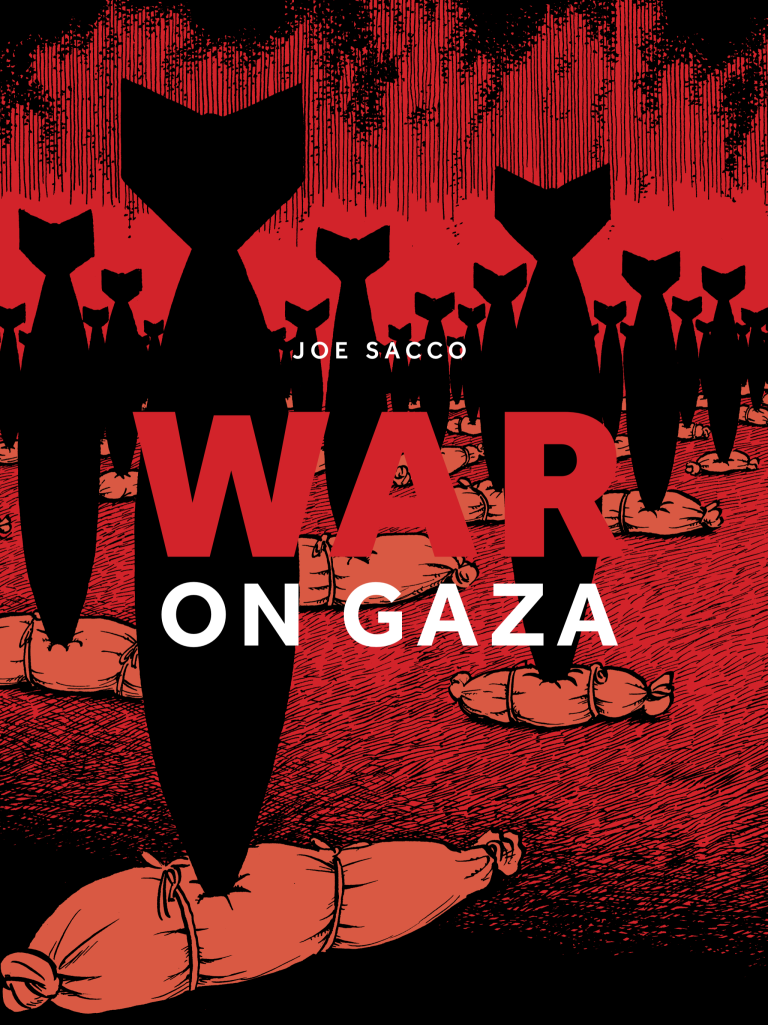
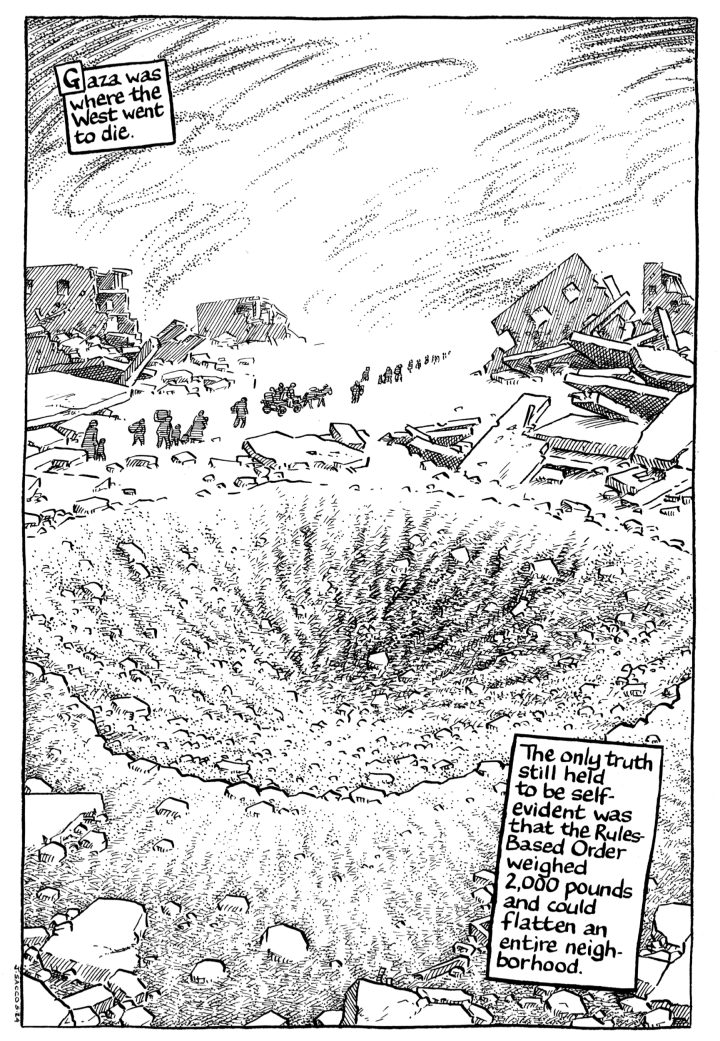
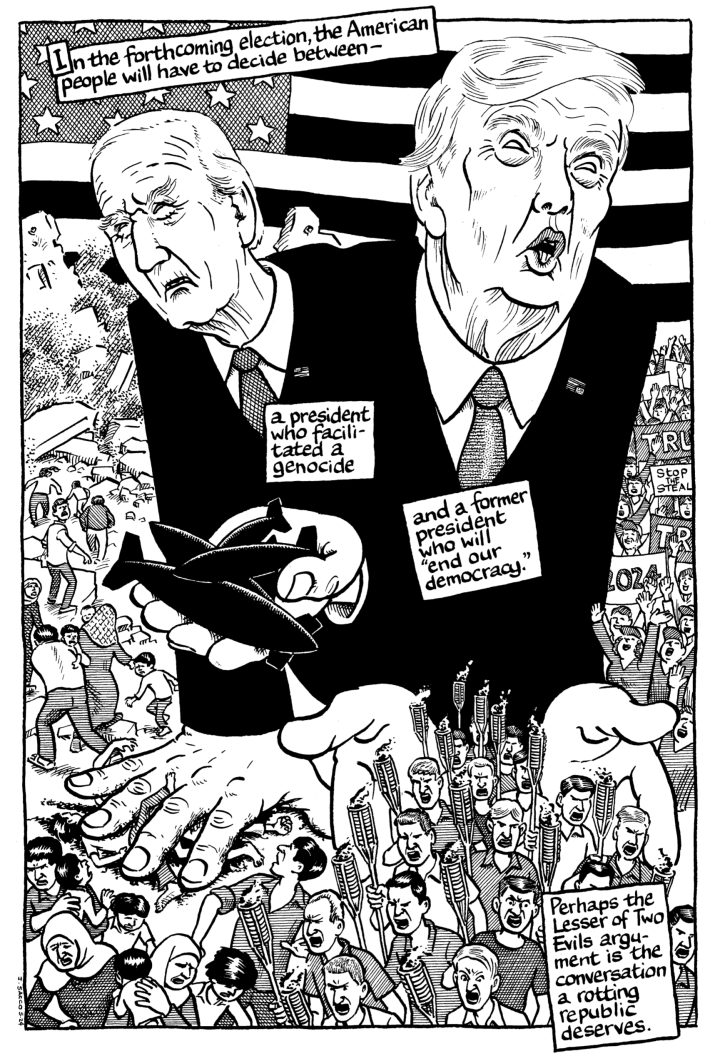 So Joe Sacco has returned after 32 years to have another word. The War on Gaza began as a series of serialized, two-page installments published on TCJ.com in January 2024, and the change in medium is suggestive of larger changes that have taken place since his earlier work. Sacco is now emerging from the world of online information, and a very different world it is from the cold assurances of the printed page. By now, we know what the results of this transformation have meant for us: the decontextualization of images from common sources of reliable truth has meant both that malevolent actors find it much easier to manipulate images for their own ends (as, indeed, disinformation peddlers in and outside of Israel have done), and that the public is less and less likely to agree that truth as such can be reliable in the first place. That this has played into the hands of authoritarian arbiters of their own convenient truths comes as neither a surprise nor a consolation.
It makes a certain amount of sense, then, that Sacco has approached this new project in a manner entirely opposite from his earlier work. The War on Gaza is not the result of particularized first-hand reporting; rather, it is a distillation of facts and figures as they had been assembled over the course of the year the war had been progressing: death counts, vignettes of reported war, images of unfathomable military violence, presented with a drum-beat urgency that rarely pauses for breath over the course of its 32 pages.
To a great extent, Sacco is harkening back here to an entirely separate tradition of nonfiction comics: not the neutral reportage of Kurtzman and co., but the long tradition of didactic propaganda comics that goes back to the Mexican cartoonist Rius and his Cuba for Beginners in 1960. Rius became the model for a generation of nonfiction comic artists, both explicitly political (the For Beginners books became an ongoing series of left-wing informational comics) and more neutrally historical (Larry Gonick was directly inspired by the approach for his Cartoon History of the Universe and Cartoon History of the United States).
To an extent, the approach works. Sacco deploys many of the same narrative tricks he used for Palestine, careening caption boxes and splash pages included, but whereas Sacco himself took the role of a largely disembodied narrator in the earlier work – coolly setting the scene of his vignettes in the manner of a public television documentarian – he periodically inserts himself here to address the reader directly. The War on Gaza doesn’t so much break the fourth wall as eliminate it entirely: this is not a documentary about a war, but an extremely one-sided conversation, in which we must sit still while Sacco tells us brutal facts we might rather not listen to.
It can be terribly effective at times. When Sacco sardonically emphasizes America’s “shared values” with Israel by drawing American troops giving a thumbs-up in front of bodies stacked like cordwood, or when he draws himself awakening in bed from a nightmare of an Israeli bomb falling on a young Palestinian girl, we understand at once why he won’t let us look away. Yet for all its well-earned gravity, there is something about this approach that can be just a bit too abrasive for its own good. It is one thing for an author to show us scenes of carnage, another for him to tell us about them, and still another for him to hector us over them. Sacco, alas, has opted for the third.
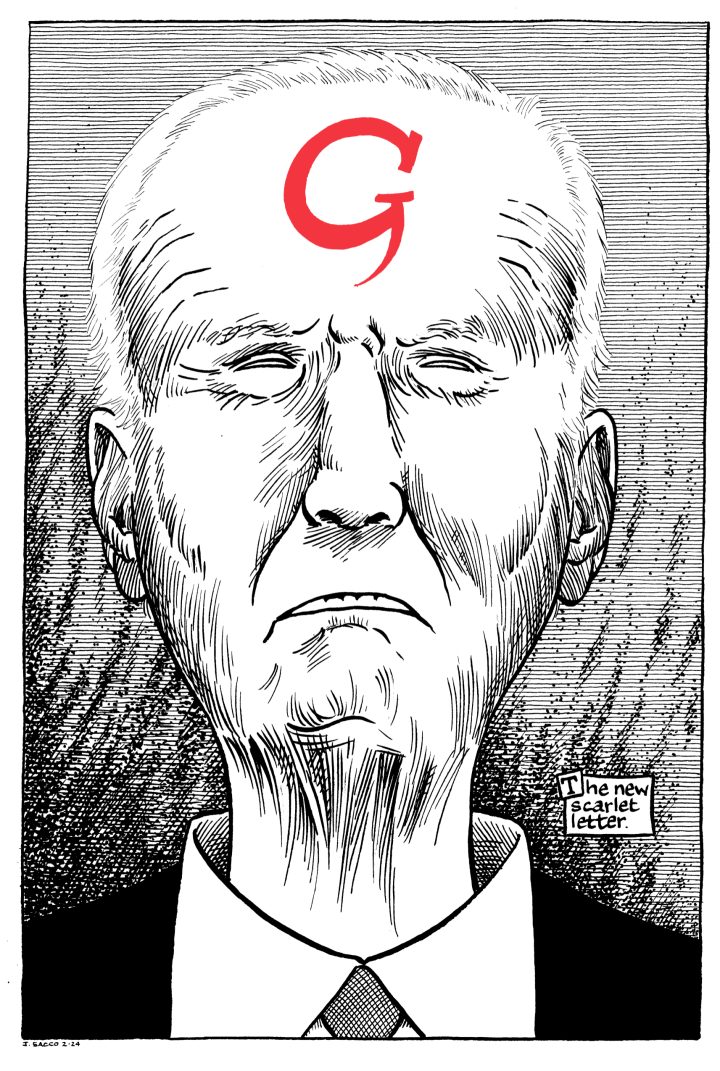 Mind you, he’s hectoring for a worthy cause, but he is hectoring nonetheless, and when he defaults to graffiti-esque images as he does repeatedly throughout the book (a panel of hundreds of baby heads pouring out of Joe Biden’s mouth to represent his unsupported claim that Israeli children had been beheaded, or a full-page image of Biden with a scarlet “G” for “genocide” emblazoned on his forehead), the impact is blunted by his refusal even for a moment to turn the volume dial down from 11. This becomes even more apparent when the comic is transferred from the immediacy of the web to the eternity of the printed page: what must have been intended as a desperate call for action instead looks like a protest flier handed out just a little too late.
Sacco has chosen to deprive himself of the most powerful weapon at his disposal: the impact of understatement that can come from presenting white-hot historical events with cool detachment. This is what he accomplished in Palestine 30 years ago, and the few moments he allows himself to do it here show how effective it can still be. The book’s two most effective moments (a brief conversation between Sacco and his mother who recalls her childhood in wartime Malta, and a fantasy sequence of Biden addressing a godlike Netanyahu in the clouds) accomplish more through narrative in a handful of panels than the artist accomplishes through declamation in 30 pages.
And it’s a shame, really. Sacco said what desperately needed to be said, at perhaps the last viable moment when saying it might have made a difference. Gaza has been more than a war: it has been a permanent stain on the history of Israel, of America, of humanity. It is a blood-soaked proof of the failure of our society to even modestly advance above the criminal savagery of a rock being struck against a human head. We needed to hear the preserved voices and see the live faces of the Palestinians who suffered for that proof while there was still time.
Unlikely as it was, there was at least a notional possibility that the American public at the close of 2024 might have come to a greater understanding of the enormity of the crime at work in Gaza, or that the Democrats then in power and running for office might have given voice to such outrage. Everything since the election of last November has been a postscript. In February, Sacco and Art Spiegelman collaborated on a cartoon “conversation” about Palestine and Israel that reduced the entirety of their modern history to its most anodyne bullet points, ultimately concluding with a “both sides should find a path forward!” conclusion that comes off like a total artistic surrender. Whatever animating fury provoked the War on Gaza has faded in the space of a year into the comfortable tones of cliché.
And meanwhile, Donald Trump, lately having swept aside such outmoded institutions as democratic governance and the rule of law in the United States without the barest hint of establishment opposition, announced to the world either he himself or the U.S.A. (the distinction is always unclear) would “take over the Gaza strip,” following what would amount to a total ethnic cleansing of Palestinians from their homeland. Whether his words have any distant relationship to reality has yet to be seen. The only thing left to be said about the War on Gaza is that it is, and we are, lost.