
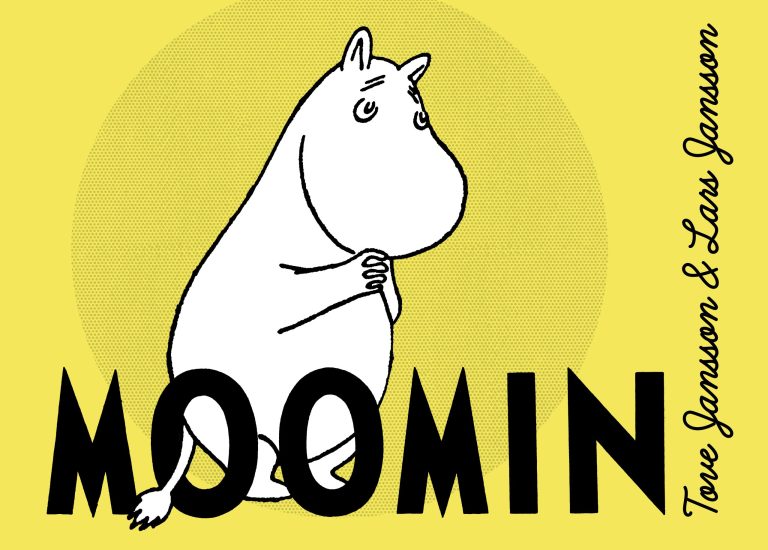
The Moomin comics strip by Tove and Lars Jansson, recently re-released by Drawn and Quarterly as Moomin Adventures Book One, provides quite a challenge to this reviewer; to wit: How does one critique a perfect comic? Because Moomin is perfect. No less nor more.
Now, I have my own definition of a "perfect" comic, which is not necessarily congruent with a "great" comic. A perfect comics is one that manages to achieve success within its own parameters, to be best version of itself – even if its aspirations are rather small. Strontium Dog: Rage is a perfect action serial, Nancy by Bushmiller (in its best moments) is a perfect joke machine, The Calculous Affair is a perfect adventure story, etc. Meanwhile something like From Hell is not perfect, but it has such grand aim, and an ability to translate it to the page, that these faults are swept aside when you consider the work as whole.
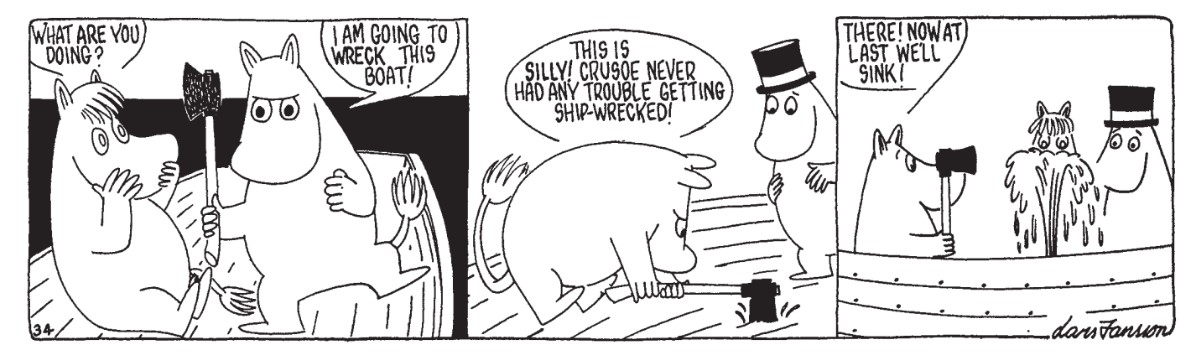
Moomin is the best version of itself, in its humor, in its visual conception, in how clearly defined its characters are. You would not change a line (spoken text) or a line (drawn on page). The latter is the most important. Moomin can be comparable to Peanuts in how well-defined its characters are 1, and how well the creators can wring joy from the simplest interactions between them.
There are many, well, adventures in Moomin Adventures. The characters go about – and sail about – in search of the new and unknown. One time a story even begins with the strip pretty much breaking the fourth wall2 with the characters announcing they are going on adventure because its just the type of story they are in. But these adventures are mere catalysts for allowing the characters to interact in new ways. Consider the pure adolescence of Moomintroll, quickly shifting from self-assurance to anger, constantly jealous for reasons he can never quite articulate; or Moominpapa, a layabout forever in search of a destiny he would just as quickly renounce as soon as rest offered itself; the perpetually relaxed Snufkin; the willful Little My. One appearance of each is enough to define them, everything after is just the sheer joy of watching the Janssons finding new angles and relations to play with.
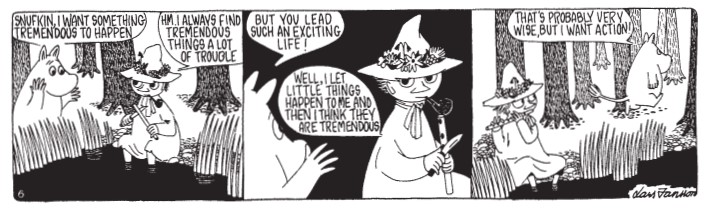
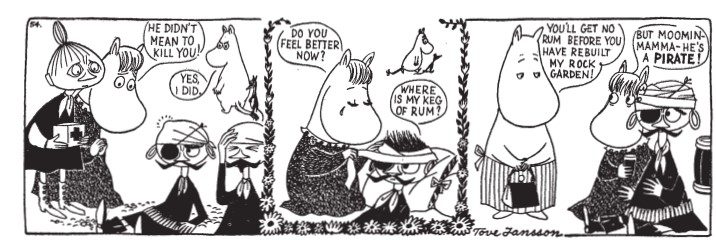
Now, for those more used to the world of Moomin from the books 3 or the various television shows, 4 I should mention that there while the characters are all recognizably the same, there is a quite large tonal gap between the strip and other incarnations. The strip is, first and foremost, a humorous affair – built on the usual four panel gag-format. As such it plays up the negative qualities of the characters: Moomintroll’s boyish infatuation with Snorkmaiden becomes full-on jealousy with him often trying to outright kill any potential other lover. Sniff, usually portrayed as selfish in a childish manner, thinking first of his problems, is transformed into an outright cheater who would do anything for a quick dollar. His main redeeming quality seems to be that he is quite bad at making money off of others.
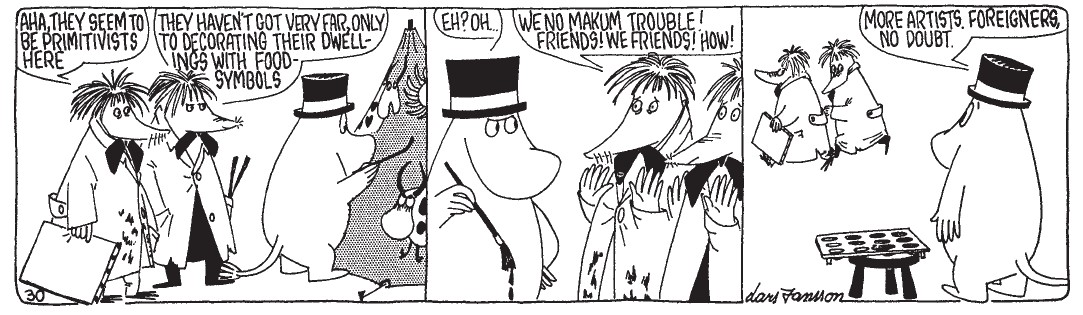
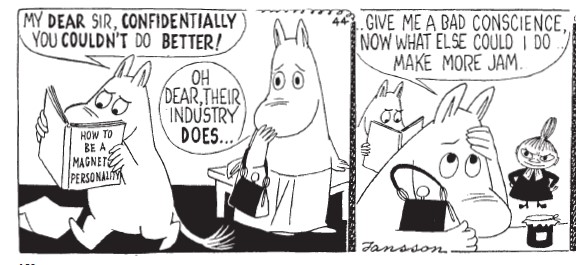
This focus on classic gags also means the strip tends to be more conservative in its approach than other Moomin stories. Not "conservative" in the modern political sense of the term, but in the older meaning – things are to be kept as they are. Throughout the stories in Book One, the Moomin family encounters change, most notably in the “The Conscientious Moomins” and “Artists in Moominvalley,” and rejects it wholeheartedly; there is not even "the illusion of change." This seems to be a natural outgrowth of the strip format, in many ways even more inherently conservative than the comic book, which encourages a constant return to the status quo.
None of which stops the strip from being endearing and funny. The strip’s humor is often dark, with death as a constant presence. In “Moomin’s Desert Island,” the second story in this collection, Moominmama cooks a boar that died while trying to attack her, a few strips later the boar’s mate arrives and converses with the Moomins – which probably means the dead boar was just as sentient. The moment is saved from being completely dark by turning it into a grisly joke, with the boar thinking that it’s not so bad her husband was killed – “Come to think of it he was an awful bore” 5. The fantasy elements are not overpresent, but are established enough for the strip to allow basically every scenario – meeting movie stars, traveling in time, taking a flight in a talking helicopter … as much as the charm of the series is in the interactions within the core cast the Janssons' world is far bigger than that of the competition.
While I have no complaints with the text itself I have some quibbles with the presentation. Specifically, the choice in what stories to include and how to arrange them. It feels like Drawn and Quarterly are aiming for a best-of rather than a complete chronological reprint6, but if so the choice to begin with the story “Moomin on the Riviera” is a baffling one. Its not that the story is bad, it’s a gem amongst gems, but its an odd place to start; throwing the reader into a scenery not usually associated with Moomin, a satire of media and high society, without first establishing this version of the characters. “Moomin on the Riviera” is built on the contrast between the earnestness and straightforward approach of the protagonists and the self-aware and snobbish inhabitants of the hotel they visit. Something that is properly established in previous stories that are just skipped about here.
Now, every Moomin story is good and worth your time; and you could publish them in just about in any order you choose, but since Drawn and Quarterly chose to publish them (this time) in this particular manner I would like a better sense of how this version is different. It’s not arranged by artist, both Tove and Lars are present. It’s not arranged according to a particular theme. There’s no sense of follow-through (some stories do refer, however lightly, to previous stories that do not appear here). The comics works because it is just that good, but curation leaves something to be desired.
Still… right or wrong order, horizontal or vertical, soft or hardcover – Moomin is Moomin. And Moomin is perfect.
- One could make the point that Moomin is better, because Schulz took years, in some cases decades, to properly arrive at the zenith of certain characters, probing new takes and approaches along the way that didn’t really work. The Moomin comics strip knows who its characters are from the start.
- Possibly the one groan-worthy moment in the whole book.
- Of which I have read little, but just enough to understand the general attitude.
- Yours truly, like many others of his generation I assume, grew up with the 1990s Japanese animated version on constant repeat.
- There are aren’t a lot of puns in these stories, but such gems shine occasionally.
- As was the case with their previous hardcover reprints.