
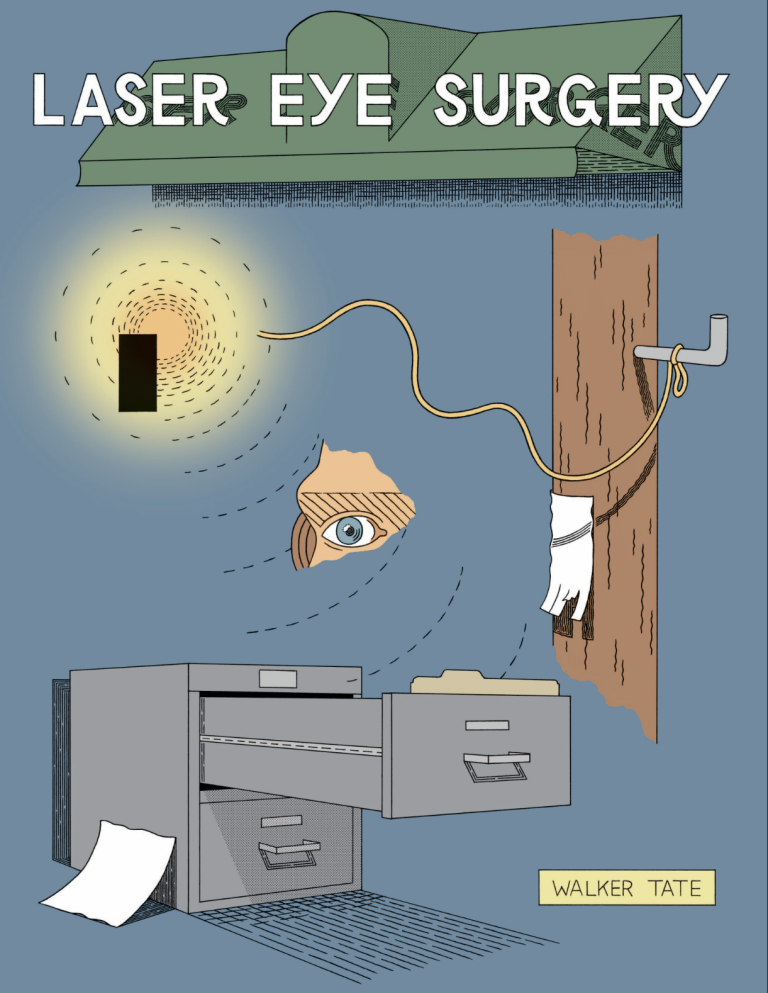
Walker Tate’s worlds fall apart stoically. Works like “Nail Clippers” (Now #5, 2018) or Chattering (self-published, and my personal favorite of his comics) call to mind such favorite artists as John Hankiewicz or Martin Vaughn-James; their stories are circular, disjointed, coming apart at the seams, and more than anything overtaken by noise — and yet their rendering is rigorous, almost nonchalant. The line-weight never varies, and the lines themselves are careful, so straight and considered that you’d have to strain yourself to see a mark of the human hand that drew them. At the same time, where he diverges from Hankiewicz and Vaughn-James is in materiality. Tate, you see, is an artist of omission: with the exception of the occasional shade-line, his forms are unrendered; his surfaces, by and large, are blank and unarticulated. Even the lines themselves often terminate suddenly, in mid-space. In this way, time and time again, the cartoonist denies his forms of heft, leaving structures looking like cardboard façades.
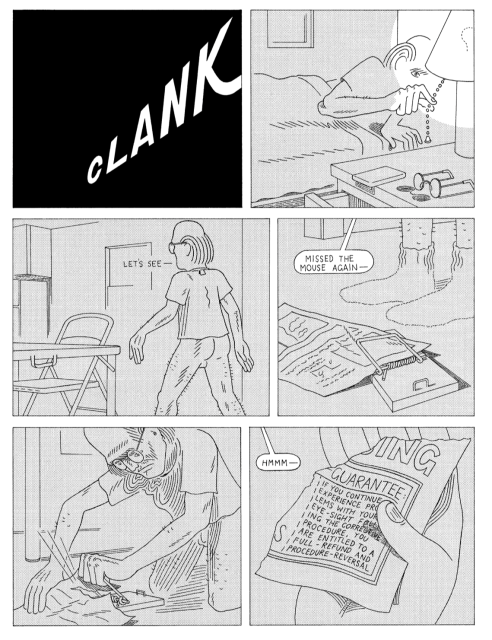 With Laser Eye Surgery, the New York cartoonist’s long-form debut from Fantagraphics Underground, Tate leans into this sleight of physicality by focusing on vision itself. The protagonist, an unnamed middle-aged man, stumbles upon a brochure for vision-correction surgery; easily swayed by both the convenience of the procedure and its evident low-risk nature—If you continue to experience problems with your eye-sight following the corrective procedure, the brochure promises, you are entitled to a full-refund and procedure-reversal—the man quickly sets foot to the medical facility. Naturally, things don’t go as planned — the protagonist’s eyesight, though improved, is frequently obstructed by floaters that won’t go away, and following an offhand encounter on the street he becomes irrationally convinced that his eyes have been hijacked in some fashion.
Many years ago, Scott McCloud argued that “when you look at a photo of a realistic drawing of a face, you see it as the face of another. But when you enter the world of the cartoon, you see yourself.” Many writers before me have remarked on the faults in McCloud’s logic—an author’s perception of societal defaults being pure reflections of bias—but Tate’s comics come closer than most to demonstrating the Comics Understander’s point at its purest form. Tate’s stories generally trend toward the mechanical; his work is often at his best when skirting ‘character’ in the dramatic sense, and even when traditional characters do appear they are largely dry and incidental. Here, having established a distinct visual outline for his protagonist—tall forehead, defined brow, advanced pattern hair loss—Tate frequently goes the extra mile by deferring to the Yamada Murasaki playbook, drawing the protagonist’s head smooth and faceless.
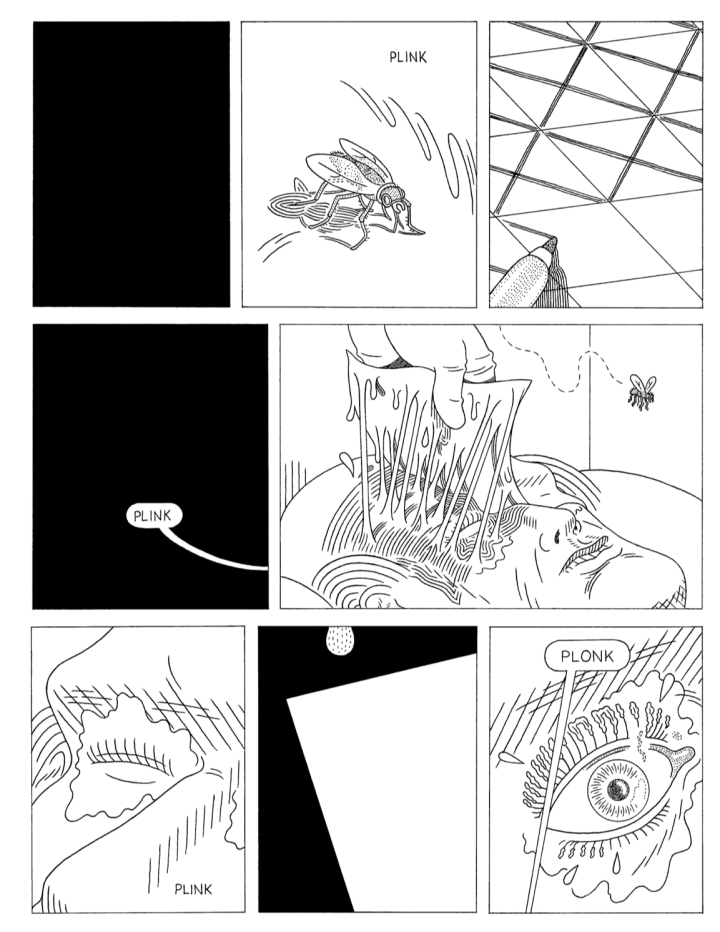
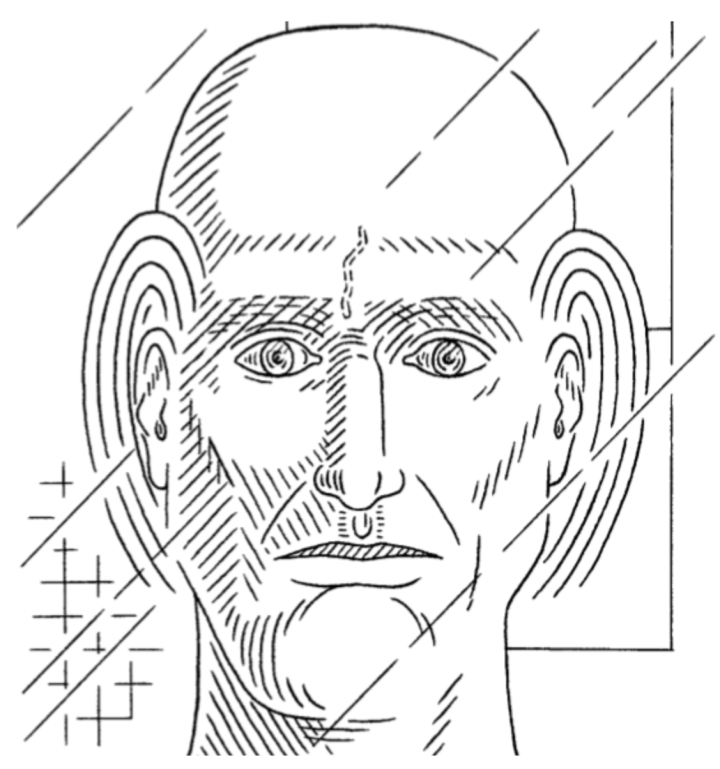
And yet Tate’s protagonist is not a mere everyman, designed for optimal reader projection. Note what little we know about his spartan lifestyle: his diet consists entirely of canned goods bought in bulk, and his apartment is infested with mice; he has no job, no daily preoccupations, no friends or family to speak of — nothing to live for other than to scratch out another day on the calendar. Thus, as the sheer smallness of his life is underscored, he becomes not merely blank but actively vacuous, and for all of the emphasis on paranoia—the back-cover copy describes the book as a “comically unsettling rumination on perception and its trappings”—the book becomes less a thriller than a character piece of the mid-period Eightball mold: a sad-sack defined solely by his life’s indignities. (A rare full view of the protagonist’s face only stands to reinforce the Clowes resemblance: see the careful hatching, the head-on angle, and the deadened expression.)
But this is precisely what nags at me: the seeming incompatibility between Tate’s intents. Between the protagonist’s fear that his eyesight isn’t ‘secure’ and the nightmarish pace of the mice-infestation plotline (the exterminator calls our protagonist from his home before he’s even given his address, let alone scheduled an appointment, and when he comes back home the place is ransacked), there is an obvious attempt at narrative paranoia. But what Tate forgets is how paranoia builds: logic and signs break down, seemingly-unrelated domains flare up concurrently, questions emerge that remain unanswered. By robbing his protagonist of an inner world in advance, the cartoonist gives himself little to work on, setting aside his typical modus operandi—mood-pieces that deprioritize plot in favor of atmosphere—in favor of what is probably his most turgidly linear outing yet; the narrative features little in the way of digression or non sequiturs, each step leading to the next so efficiently as to resemble a flowchart more than a story. Tate tries to obscure the leanness of his narrative—chiefly through the use of prolonged tracking shots, with the protagonist walking from one place to another for pages on end (one readily thinks of Seth, or Lawrence of Arabia)—but ultimately I cannot help but feel that this is not a story rich enough to support its own length.
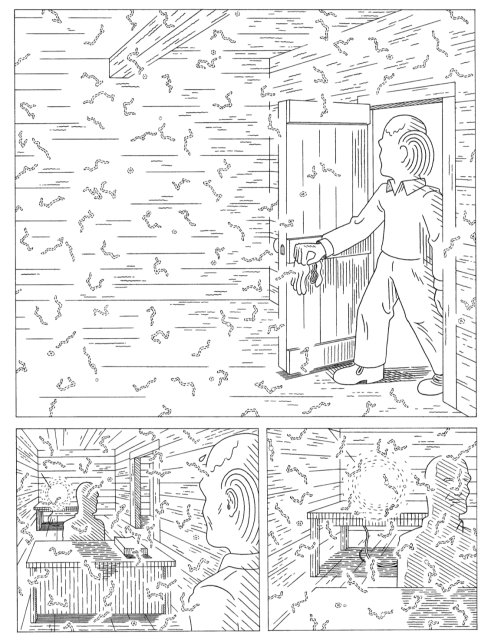 Inevitably, things come to a head. The protagonist, still dissatisfied with the state of his eyesight, visits the medical facility once more, only to find that it has now relocated (to the rural farmhouse that often appears in autorefractor tests, a good gag in itself), where it is revealed that the medical company does seemingly control the floaters that obstruct his vision. Far from the conspiratorial exhilaration of Pynchon or Gombrowicz, however, it doesn’t look like the enterprise uses its power for any aspirations loftier than petty money-grubbing — taking advantage of the protagonist’s visual blind-spots, the receptionist lies and tells him he must have misread the brochure, that there are no refunds, no reversals. The protagonist, either easily swindled or recognizing the risk in further poking the bear, simply backs down and goes home, resigned to his fate.
That, more or less, is where the story ends, though not before Tate deals the protagonist a couple last small humiliations: first he must walk in the pouring rain, then, at the very end, he steps in the mousetrap he himself had set. Though an entertaining ending, in that same Clowesian idiom, at the same time it is an unspoken resignation to thrustlessness: all questions have been more or less answered, and one can imagine the protagonist continuing to check days off his calendar more or less as he did before, nothing to mark the passing days but the empty tins of fish.
With his biggest work to date, Walker Tate seems to feel very strongly that it is a small, small world after all — its small people hatch small schemes, and its smaller people suffer. But whether or not it’s the world that’s small or the imagination behind it is a different question entirely.