
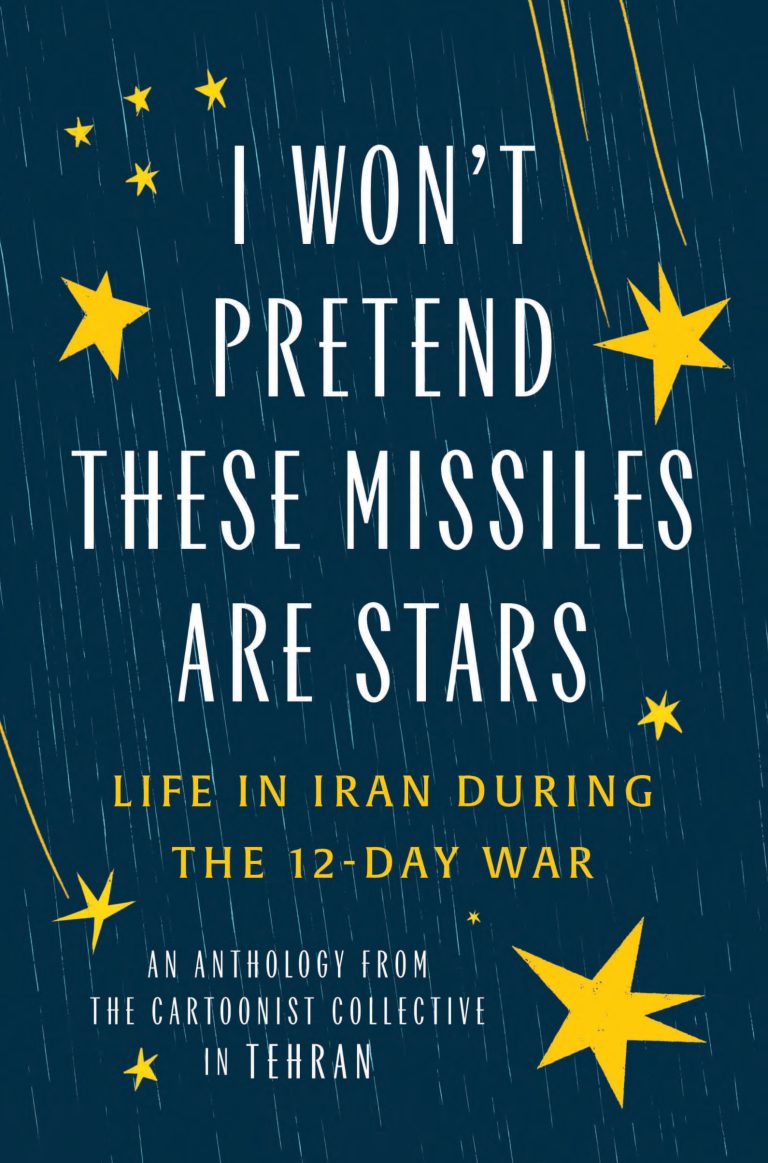
The advantage of a collection such as this is not only the diversity of stories told, but also the wide variety of ways to tell and draw those stories, as they want readers to understand, as much as they can, the suffering that occurred. In this anthology by The Cartoonist Collective in Tehran, they show the readers a multitude of perspectives on the twelve-day war (June 13 to 24, 2025), when Israel bombed Iran’s military and nuclear sites in a surprise attack, killing military personnel, scientists, government officials, and civilians. Iran retaliated, also hitting military, government, healthcare, and civilian sites, killing people in all areas. Near the end of the twelve days, the United States also bombed Iran, which led to Iran’s attacking a U.S. military base in Qatar, before a ceasefire on June 24. Their dedication calls for people to hear their stories and see their lives, as they say they have only one request: “remember us, remember Iran, and speak loudly about it.”
One aspect common through each story is, as one might expect, simply how one functions during a war. While each story presents that reaction differently, all of the narrators spend a good part of their work reflecting on how they are feeling about day-to-day life during this moment in time. In the first story, “12 Days,” the narrator complains about the lack of internet, not because they are unable to obtain any information about the war or their friends and family, but because they have no way to distract themselves from the mundanity of their days. In “Lappe Letters” the narrator seems more concerned about their cat than anything else, even crafting a scene near the end of the story where everybody seems to be bringing their various pets as they flee to what they believe is a safer location. The artists want to bear witness to the realities of life, however minor they may seem, as people’s earthly routines don’t cease to exist simply because Israel and the United States are bombing them.
 In one of the bleakest works in the collection, aptly titled “Memento Mori,” the narrator’s first reaction is to prepare their body—which they refer to as a corpse—as if they’re a mortician. Applying makeup and layering themselves with jewelry from friends and family with the comment that while they might not be able to “choose the ending, but at least [they] can stage the scene.” “My Dream City,” one of the most fearful, heartbreaking stories in the collection, follows: Lyanna, our narrator, an art student about to attend their final, at which, along with their fellows, will present the teachers with a surprise anthology. When she has to abruptly leave due to the war, she reflects, saying, “I’m not mourning what was. I’m mourning what never got to be”, grieving her life before it is even over follows the hopelessness that pervaded Tehran, even among those who ultimately survived the war. The artists try to find ways to wrest control back in the midst of an utter lack of agency.
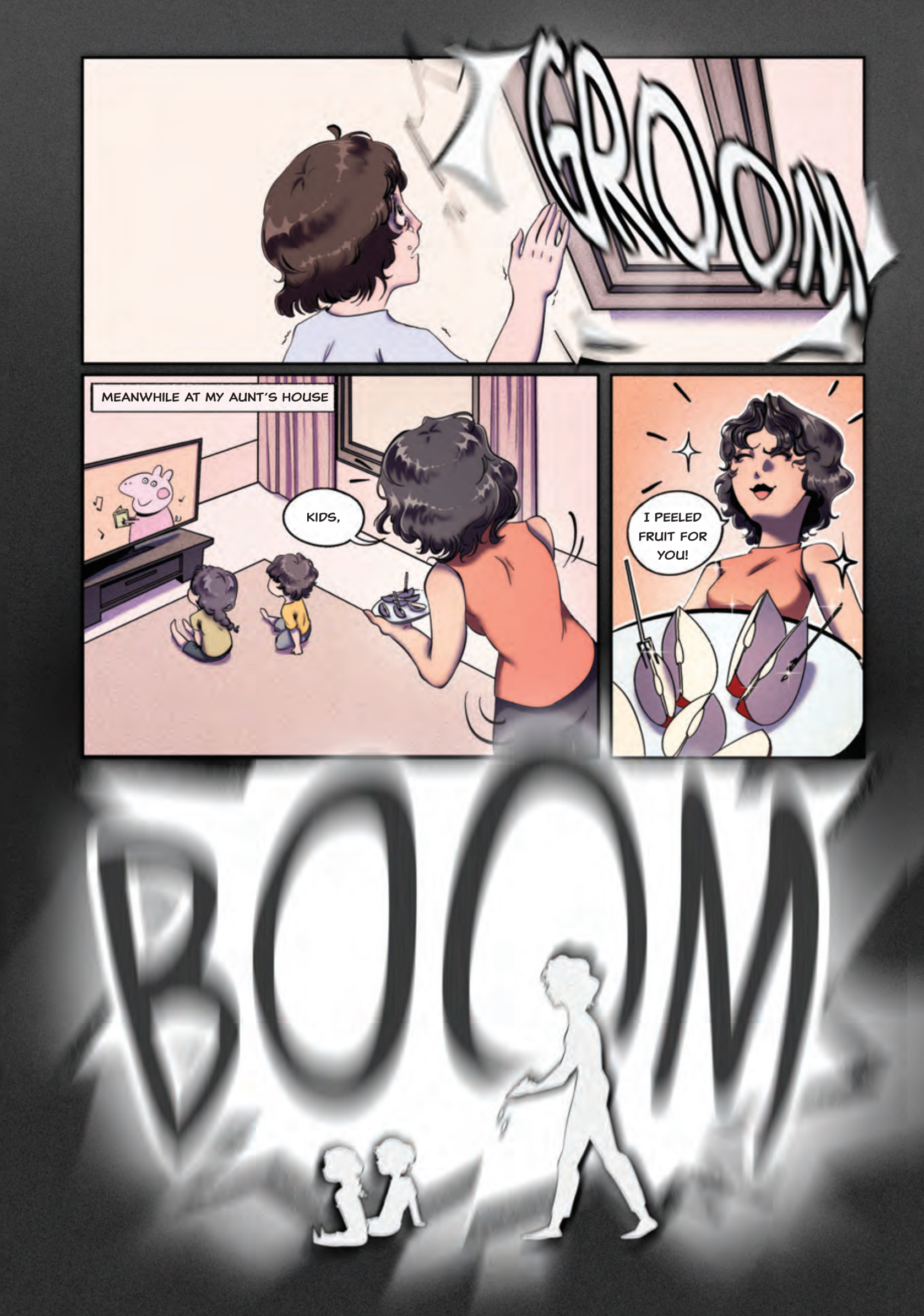
The art throughout the collection is varied and distinct, but with similarities carrying throughout. An odd example of that consistency is that almost every work has to convey the bombing, resulting in a recurring use of the word “BOOM” in the background panels. “The Fireworks,” uses the reverberation, “GROOM,” but ultimately must bring in at least one “BOOM” as well, with an El Greco-like focus on light forming the background. They change the colors, size, and emphasis of that wording, but all use a stereotypical sound for bombs that those readers who have never been near a war zone can identify. The use of such a cartoonish diction would seem to show the bombing as less damaging—emotionally, as well as physically—but it has the opposite effect. When trying to convey the fear those bombs instill, they fall back on a simple portrayal, much as one does when moving to stick figures when drawing characters. The more basic, as Scott McCloud writes in Understanding Comics, the more universal. All readers can understand what’s happening in these scenes, even if they’ve never lived through such an event themselves.
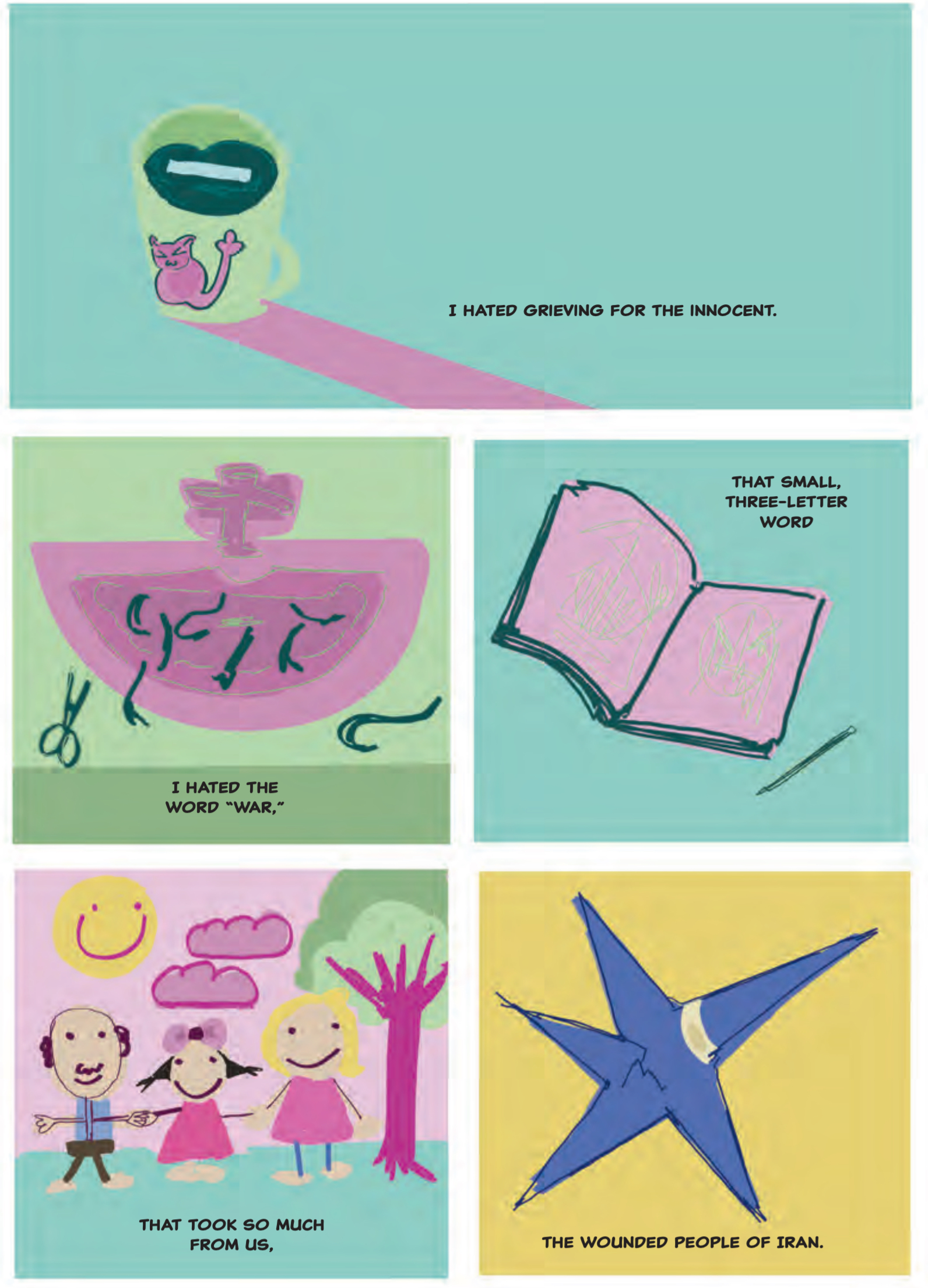 Beyond that similarity, though, the artists largely stick to a cartoon-like style, as the name of their collective implies, that they bring their individual quirks to. Early in the collection, in “I Won’t Pretend,” the artist brings in far more colors than most of the other works and even moves to a more abstract style when conveying more complex ideas. Over the final three pages, the art even becomes almost child-like, especially with a picture of a green, stereotypical alien and a drawing of a family with a smiling sun shining down on them, mirroring the simple ideas the text conveys, with wording such as “I hated the word war,” “that small three-lettered word,” “that took so much from us” (on the page with the family) ending with “the wounded people of Iran.” The picture and text combined read like a children’s book, almost as if the idea of the devastation of war is so simple that even a child could understand it. That child-like approach drives home the idea that the world should be able to understand the bombing and the toll it’s taking on the people of Tehran, criticizing a world, especially the United States, that stands idly by while Iranians die.
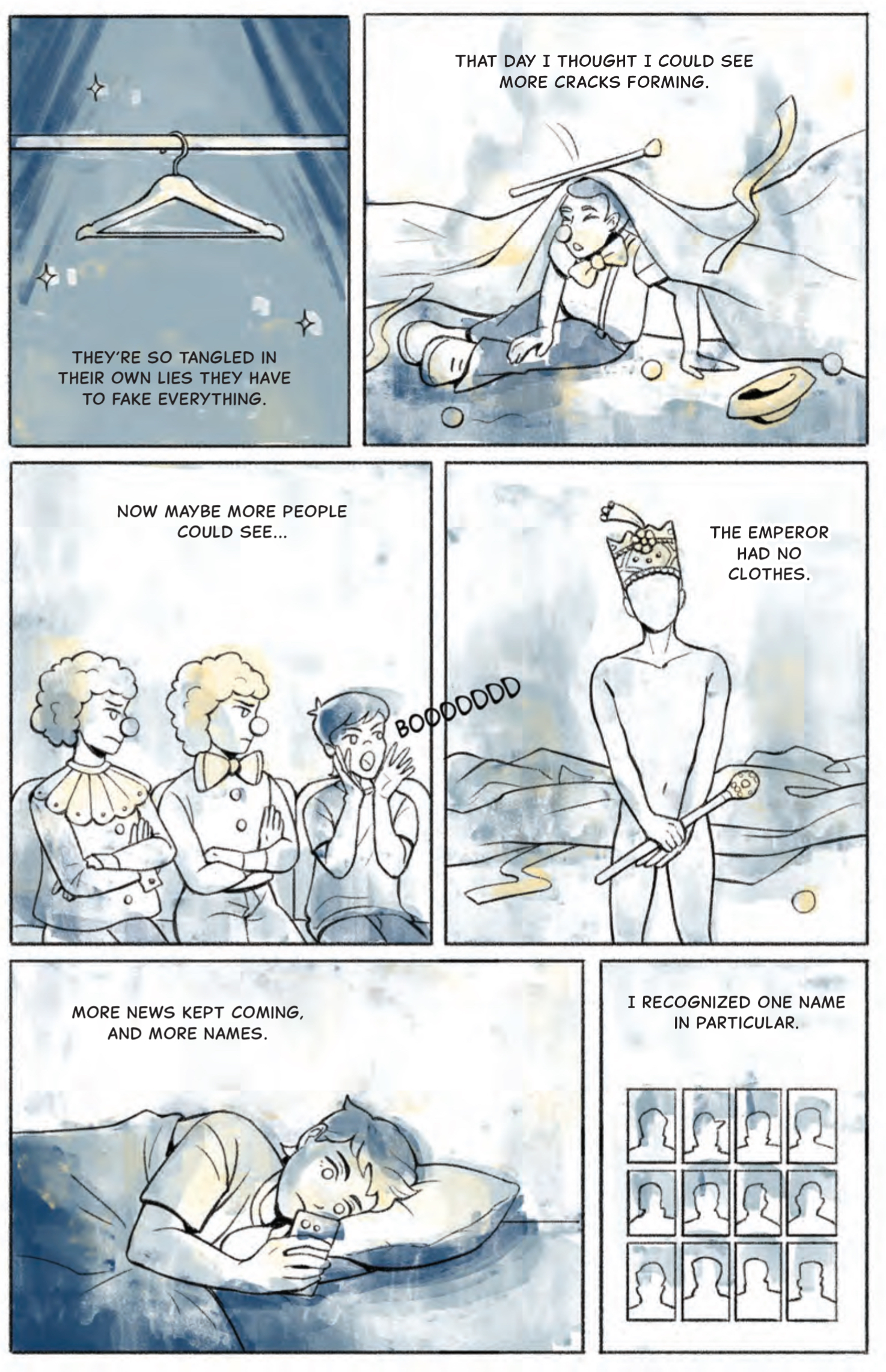
Not surprisingly, given the dark subject matter and how much of the action in these works takes place a night, most stories lean toward a blue or purple palette to represent the sorrow running throughout each of them. In “12 Days,” the artist offsets those blues with reds and oranges to connect to the bombing happening in the background, even when not directly drawing an object or scene related to destruction. Different artists also bring in a variety of imagery to represent how their narrators feel about the war. In “Nothing,” the narrator draws a clown show, in which not only is the performer a clown, but the people the narrator sits beside are as well. Those other clowns cheer on the show, while the narrator boos, knowing that the emperor is naked, as they point out. As with the child-like art at the end of “I Won’t Pretend,” the artist makes it clear that the world should be able to see the suffering of everyday Iranians and, thus, should work to end the war. Using the traditional imagery from Hans Christian Andersen drives home that the Western world should be able to recognize the absurdity of this situation and act accordingly to stop the bombing.
 That range of images echoes the way many of the narrators/main characters feel as the war ends, as well. In “Deadline with Letters,” Mona spends her time during the war focused on work, as she has a lettering and coloring project whose deadline she’s already pushed back. At the end of the piece, she’s happy with the work she did, but frustrated because she never heard back from the editor. Seemingly more concerned about her project than the precarity of life in a war-torn country, she concludes the story by saying, “And to make things worse, our Kickstarter didn’t reach its goal either.” That deadpan response is similar to the narrator in “Lappe Letters,” as her concern for her cat shows up in her inability to find its nametag, eventually embroidering a new one for the cat to make sure people can identify it. As she’s putting the pet back into the carrier at the end, though, she finds the name tag within, and smacks herself on her forehead.
Most reactions to the end of the war are more complicated than these lighter touches. Many characters suffer from survivor’s guilt, knowing that they were safe when so many people weren’t. In “Under the Same Roof,” the narrator hates the propaganda that Iran spins about the war, and she hates Israel for the attack. At the end, she comments, “I felt hopeless, I felt sad, and then I was angry. I hated that we were all being played by people who didn’t care about us, people who made the decisions, but never paid the price.” That anger is a consistent theme, showing up again in “Stay Alive,” a work that is, not surprisingly, about simply trying to stay alive. That idea goes beyond surviving the war to surviving life itself. That narrator ends the piece with a nighttime view of Tehran, as the narrator comments, “It was quite an interesting start to the summer. There’s so much rage inside me, and I’m keeping myself alive by holding on to things that still matter to me. I’m deeply unhappy with the state of my country, and I know I want to leave, maybe then I could have a future…until then…” They know they simply have to stay alive to have any hope of ever leaving. The aftermath of the war seems no more encouraging for the narrator, as staying alive in Tehran isn’t simply surviving this war, but they must also survive their own government. They have no power to withstand the bombs that have fallen, but they also have no agency in their political lives, either. Given the recent attacks from the United States and Israel, the narrator seems prescient, as they must try to stay alive, yet again, even as those people make decisions, but don’t pay any price for them.
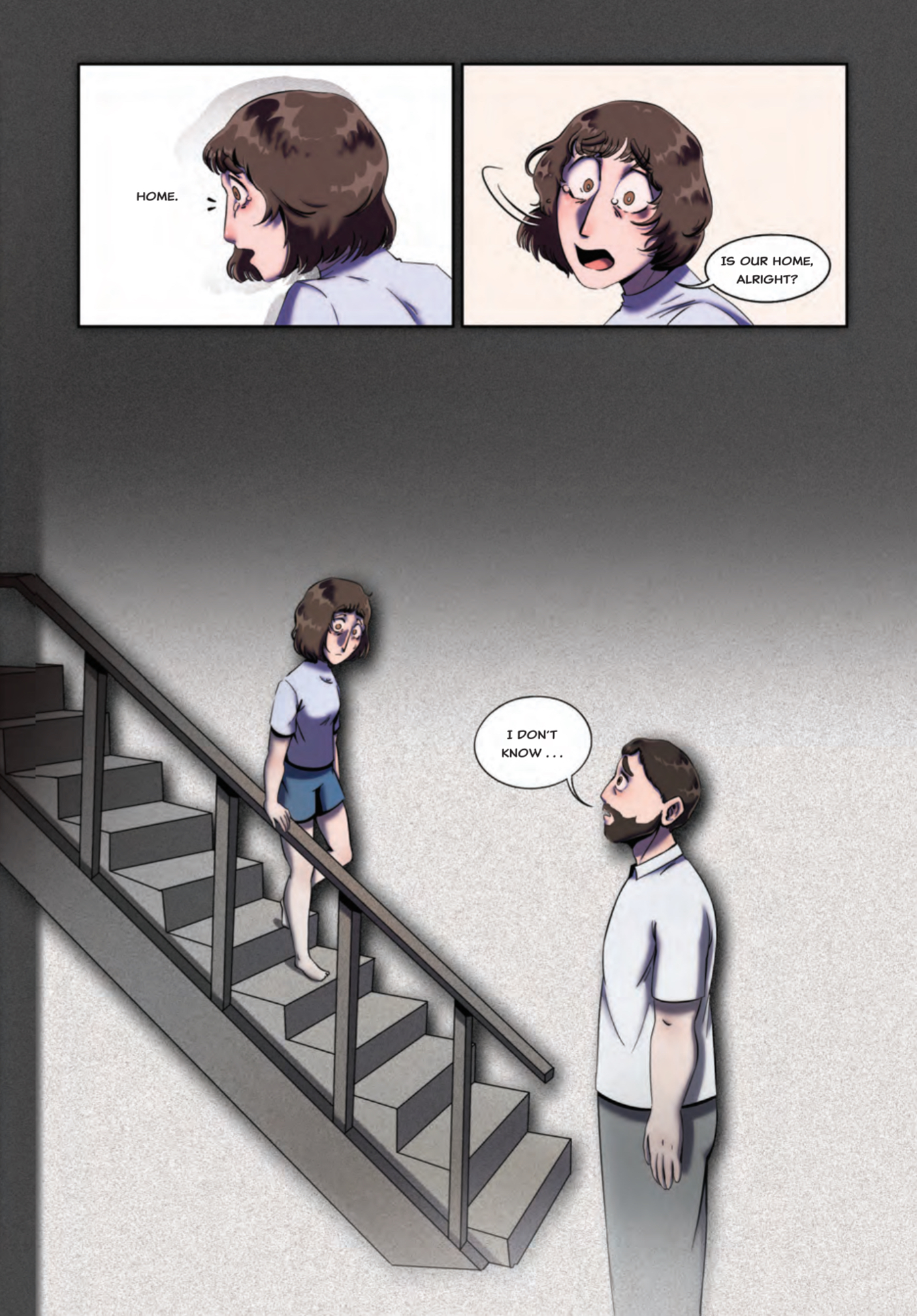 The final story, “The Fireworks,” also has one of the saddest views of life after the war, as it ends with no closure, unlike many of the works. The young protagonist is concerned about her aunt and cousins, finding out out that a bomb has landed near them. They survive, but the narrator doesn’t know about her friends. When she says, “There are homes all over that area…those a**holes!", the word home reminds her that her own house is in that neighborhood, even though they’ve fled to safety. When she asks her father, “Is our home alright?” His response, “I don’t know…” fittingly ends the collection, as nobody knows if Iran will ever be alright, as the recent war with Israel and the United States shows. “Home” here refers to their personal home, and also to the country at large. Even if there were no wars with Israel or the United States, there is still the reality of trying to shape a life in a dictatorial country that oppresses its own population. The war of 2026 has, like the 12-day war, made the lives of civilians that much worse and unstable.
There are moments of hope, though, especially in the act of storytelling itself. In “Until After the War,” the narrator has to flee their dormitory and return home, as do many of the students in this collection. They are still terrified, as they say, “The war outside seems to be over, but not inside me.” However, they focus on the power of stories to help see them through. As they lead up to the end of the piece, the narrator comments, “But at least we still know how to create. We know how to turn death and life, our humiliation and our erasure from history, into stories. And if in the end, anything of us remains, it’ll be these stories.” Though that idea is not explicit in most of these pieces, it is the idea that drives this collection. As the title implies, they will face this war and any other wars to come after it head on, using their art to bear witness to what they have endured and continue to endure. They believe their stories will last, so they keep telling and drawing them, so readers can continue to know what their lives are like. They shine a light on the horrors of living through this war, as well as the wars to come, which have come, and will continue to come. They want readers to remember, but they also want readers to care enough to act.