
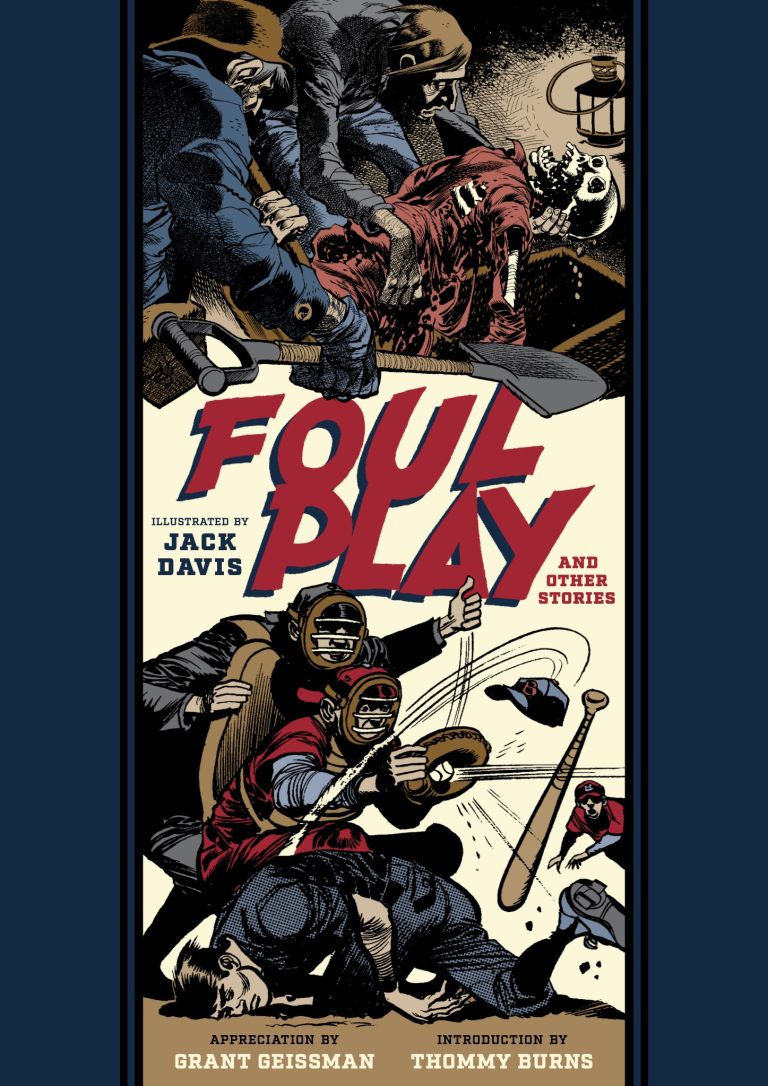
Foul Play and Other Stories is the 37th collection in The EC Artists’ Library series from Fantagraphics. As the 37th book in a series, it is basically critic-proof in the traditional sense of the word. You probably won’t be too surprised that book has all the strengths (excellent drawings, top-notch design and presentation) and weaknesses (overtly-rigid layouts, wordiness) of previous volumes 1. Davis is on the top-end of the EC line-up, a line up with a very high floor mind, and a particular humorous bent to his cartooning that lends itself to some of the nastier stories. The best shorts here don’t seek to present some sort of "message" (the typical EC message – assholes get killed) but to bask in the violence they depict. Not to pull the rug beneath William Gaines’ congressional testimony, seventy years later, but most of the stories here aren’t in good taste, or offer any valuable message. It’s junk. Fun junk.
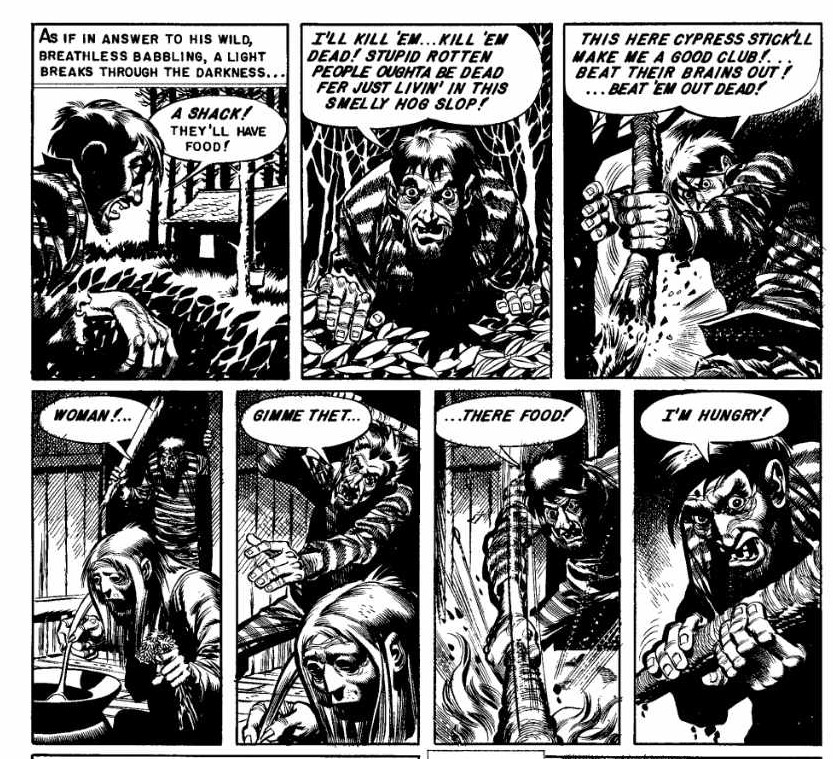
Not so much the title story, much lauded on the back-cover and in the introductory material. “Foul Play” is obviously one of these tales that began with the closing imagery, a baseball game played with human body parts, and built backwards to reach the conclusion. A good idea in theory. The problem is the story is 90% build-up to the scene. There’s quite a lot of hoops to jump through to get us to that scene and provide "moral justification" for that particular form of vengeance. All that work just to end with a single page, teasing you the idea without developing it beyond the original notion. A proper use of Davis’ skill at humor would allow him to depict the game in all its morbid glory. Yet “Foul Play” is neither fish nor fowl2, not meaningful enough to offer any commentary, nor bloody enough to be viscerally pleasurable.
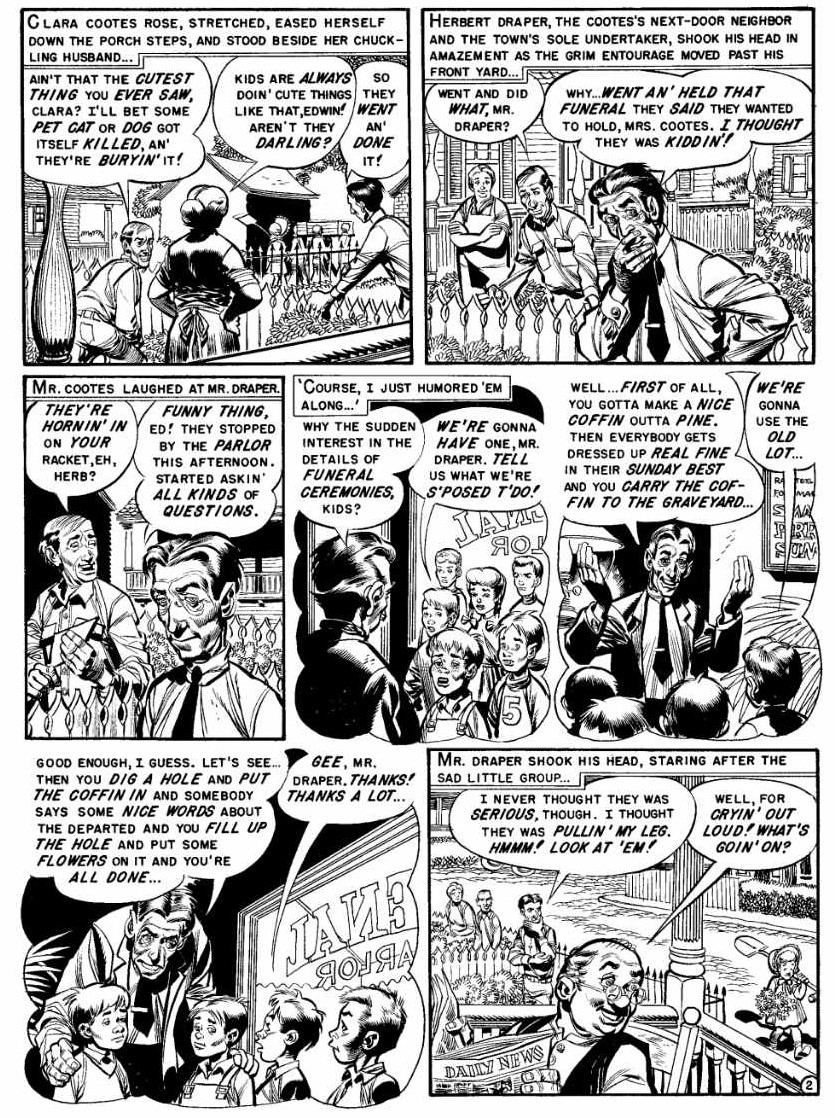
The best stories in the collection are these that utilize the build-up for the "shocker" to create a proper atmosphere. “Let the Punishment Fit the Crime!” (scripted by Al Feldstein) features a group of cute-looking kids digging a grave for a small coffin in the background while various adults speculate on what exactly it is they are burying (a dead pet? A doll?); during the conversation the adults slowly realize what the readers have already grasped. That there’s a human body in the coffin isn’t particularly shocking to the reader, but there’s true pleasure to be found in the charming small-town scenery and the human interactions (Davis’ cartooning is particularly sharp when needing to come up with a dozen distinct faces) while knowing something horrible is going to happen.
Likewise, the dead-serious “Iron Man,” in which a lucky combat pilot grows ever madder when his friends keep dying around him while he survives one mission after another. The ending is good for sure, but the story is not dependent on the success of the ending alone. Too many of the endings in this collection define the whole story, which exists to facilitate the final moment with little care given to the lead-up. Sometimes the ending is strong enough to carry the burden, “The Chips are Down,” with its finale of human beings sliced like salami, strikes the right chord between humor and horror. The penultimate panel, with the two criminals-turned-victims standing stiffly is a masterwork of composition. Only after we see the following panel, with bodies in pieces, we go back and see how oddly they are positioned, we notice the pool of liquid that must be blood at their feet.
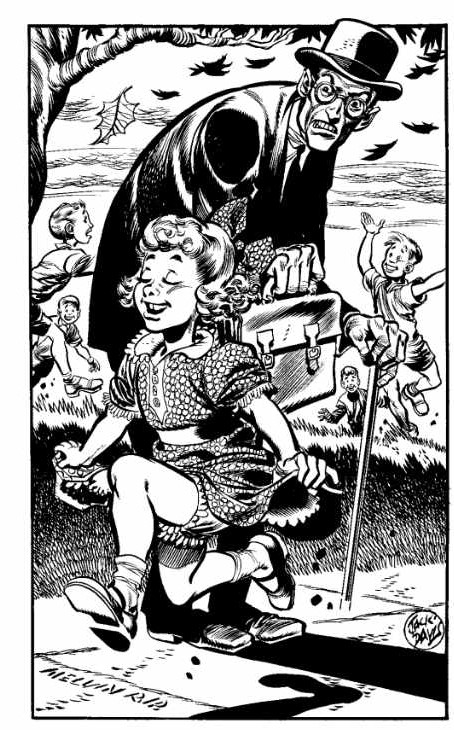
Yet all of Foul Play’s triumphs are small. A good story here, a great panel there3. What stayed with me at the end of the book are questions. The quality of the art and presentation measured against the overall quality of the stories brings up issues with the series as a whole: What is it that we read when we read this collection? Are we reading the comics story or an appreciation of Jack Davis' art? I fear that the story can sometimes get lost; the it becomes not "Foul Play" but "Jack Davis' art of Foul Play," shorn of everything else that made the story what it is.
While it’s probably better to let sleeping dogs lie I cannot help but think back to The Comics Journal review of Donald Duck: Lost in the Andes, and to the endless discussion following on the nature of reprinting and reproducing old comics. Kim Thompson, who knew a thing or two about a thing or two, makes the point that he believes most classic comics art is only encumbered by coloring, and that he vastly preferred to see the EC art in black and white. That is a matter of personal taste, for which little argument can be offered4; though a stern argument can be made for how the current reprint series erases the contributions of Marie Severin – an auteur of comics in her own right.
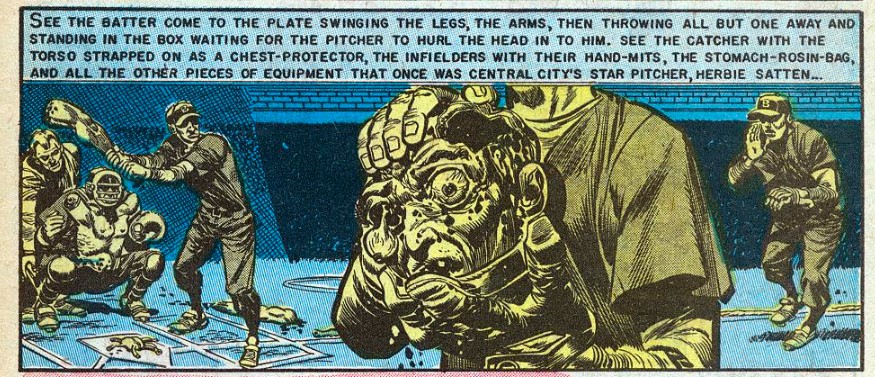
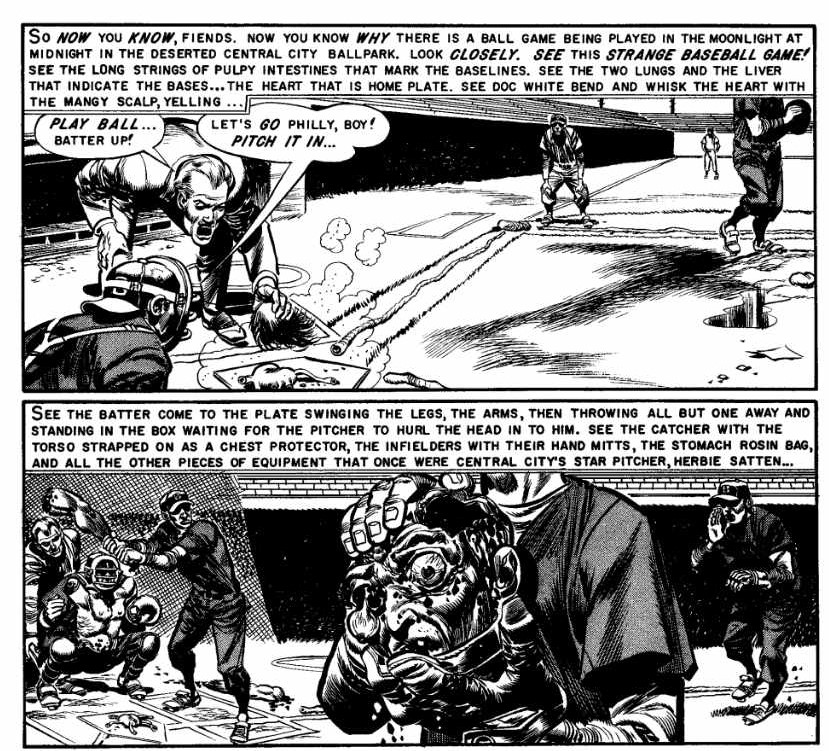
Looking at the black and white version of “Foul Play” and comparing it to the original coloring; the impact, the meaning of the text, is changed entirely. “Foul Play” as originally published, is a gruesome little story about revenge. The lurid coloring is as much a part of it as the crackling sound on old Blues records or the grain in classic noir films – there is only so much you can clean them up before something becomes "lost."5 The effect of the art in Foul Play and Other Stories is completely different – what the eye perceives is not the story but the lines. Whatever mood created by the colors, and Davis and Co. knew their stories would be printed with coloring, is discarded. Therefore, we have two “Foul Play” tales – one is a horror story, and the other a celebration of the artist.
Though far smaller in size, and printing full stories rather than bits and pieces, there’s something here of the IDW Artist Edition line. Something that can be wonderful in its own right, but not a book that you would give to someone seeking to experience the comics for the first time. Foul Play is probably best experienced by someone who had read an older version, and kept the contrast in mind.
The other big difference in the manner in which the stories are collected. Previous (and concurrent) collections of EC material tended to be based on series, such as the Gemstone annual collections from the 1990s, or the Dark Horse Archive series from 2010s; both of which features issues of a particular title (Tales from the Crypt, Two-Fisted Tales, etc.) collected at publishing order. Foul Play features tales from various titles, and while the collection as a whole tends towards horror you still have stories like “Home Again” and “The Case of Champagne” (originally published in the aviation-themed Aces High) that buck the trend. It’s a celebration of one particular aspect of these stories in a manner that overpowers everything else. Foul Play tilts our point of view – these are Jack Davis’ stories, not so much a group effort.
Yet this, also, is a matter of personal taste. As much as I would like to hold a "definitive" answer, reading through Foul Play made me believe there isn’t one. One could make the claim that this isn’t the only edition available of these stories, that a reader could plop down the money for the archival versions or the older Gemstone editions (though surely the supplies of that one are fairly limited by now). The size and scope of the Fantagraphics project seems aimed at posterity – just like their Peanuts and Carl Barks Library collections. Yet unlike these series, there is no attempt to stick to the original presentation. If Foul Play and its ilk are the versions that survives history, history would have a very different notion of what EC was.
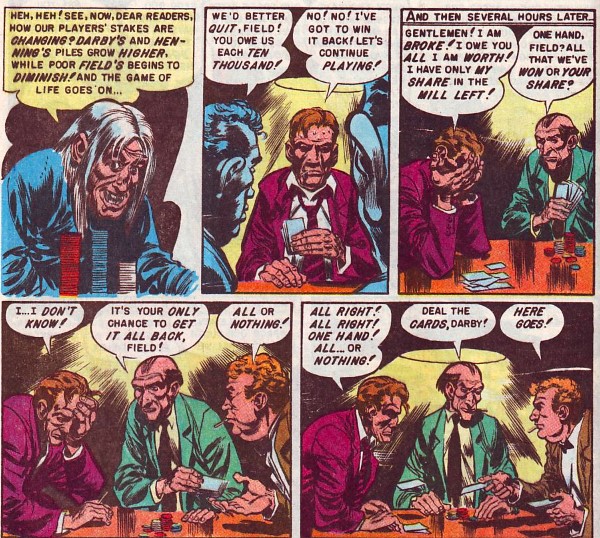
At the same time … Comparing the black and white version of “The Chips are Down” to the colored original I cannot help but feel that effect of dingy lightening in a small room Davis achieved with pencil and brush is superior to any attempt made with colors (a burning lamp in a damp room being prerequisite to any half-decent noir story). For anything that is lost something is gained. What is the "correct" manner of collecting EC Comics? I do not believe it’s this one; yet at the same time I’m not sure there is an answer. There are thousands of ways to be wrong, and possibly zero ways to be right 6.
If one thinks of Foul Play in a different manner, not as an EC comics collection but as a Jack Davis appreciation project, it becomes more agreeable. However, the same appreciation also draws into focus the limitations under which Davis worked. What is the vision of Jack Davis that is provided here – a draftsman extraordinaire whose skills are oft underutilized, or entirely wrongly utilized by the people doing the writing and producing. There's the old interview with Gary Groth, actually cited in the introduction of this book, in which Davis outright says he didn't like "the horror bit" but they kept giving him these scripts and he had to keep doing them. It's easy to see the EC house-style as sort of prison, holding the creativity of the artist in check. Some accept it for what is and play along (George Evans), some rebel and try to go their own way (Krigstein) and some had the luck to be the designers of their own cage (Kurtzman). Davis belongs to the first category; and the black white clarity of this collection not only shows the depth of his artistic power, but also how thick the bars of his cage were7.
- With the exception of the Jack Kamen volumes, which have only weaknesses
- I did not aim for a pun, but I will certainly utilize it.
- The opening panel of “Let's Play Poison” is such a beautiful composition and interplay of facial expressions, it looks like the type of thing Davis would do later, and better, in Mad Magazine.
- Unless your personal opinion is that Jack Kamen is the best EC artist, in which case I would ask you to examine your eyes; and possibly your mind.
- Brian Eno – “Whatever you now find weird, ugly, uncomfortable and nasty about a new medium will surely become its signature. CD distortion, the jitteriness of digital video, the crap sound of 8-bit – all of these will be cherished and emulated as soon as they can be avoided.
- It’s possible to make the point that two versions are necessary, one in color based on title and one in black and white based on artist – but most publishers probably couldn’t afford such ventures, and most readers would probably become confused. One must bow to the demands of reality.
- Jack Kamen is a perfectly fine artist, it's not his fault he got the dullest scripts.