
There is likely no better entry-point to the world of emerging contemporary cartoonists than the anthology Cram. If you find the Tinfoil and Cowlick anthologies of Floyd Tangeman impenetrable, or Rust Belt Review dull as scissors that no longer cut, Cram has included work by Tangeman as well as Rust Belt highlight Audra Stang, a broad spectrum approach to curation. The risograph-printed pages include a great many cartoonists under forty but also several older artists that make the whole thing feel like it isn’t focused on any one scene or cohort. Highlights range from the work of younger artists like Allee Errico and James Collier, to older people whose work hasn’t been seen in a while, like David King, presenting a great strip, to still older cartoonists like Kim Deitch, debuting a short story that has since been collected in How I Make Comics.
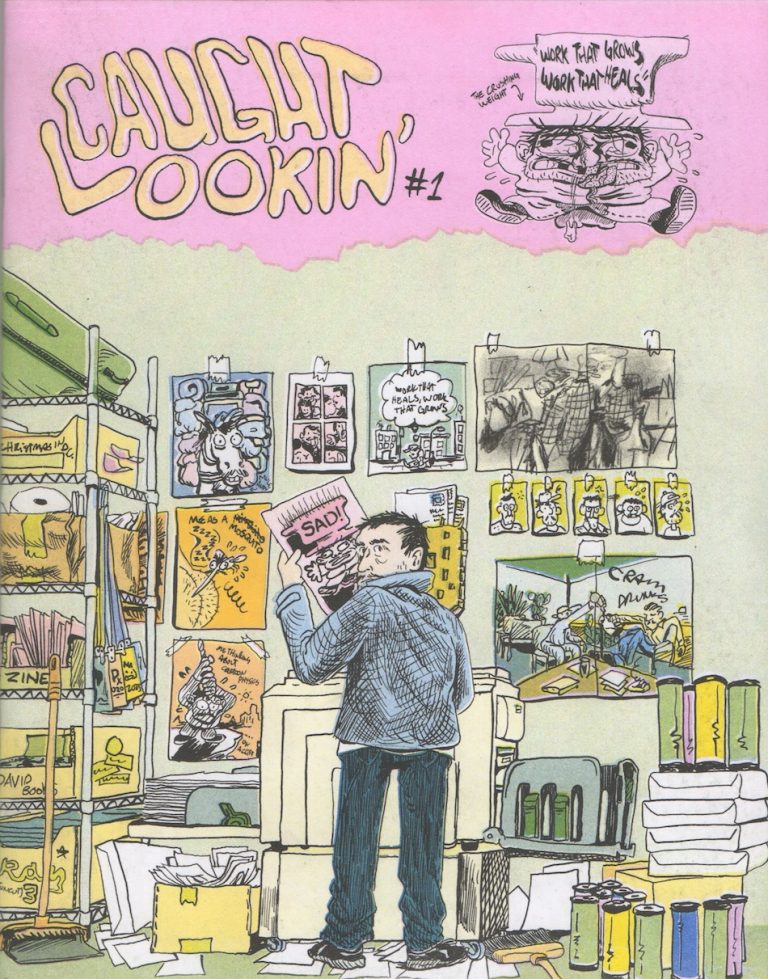
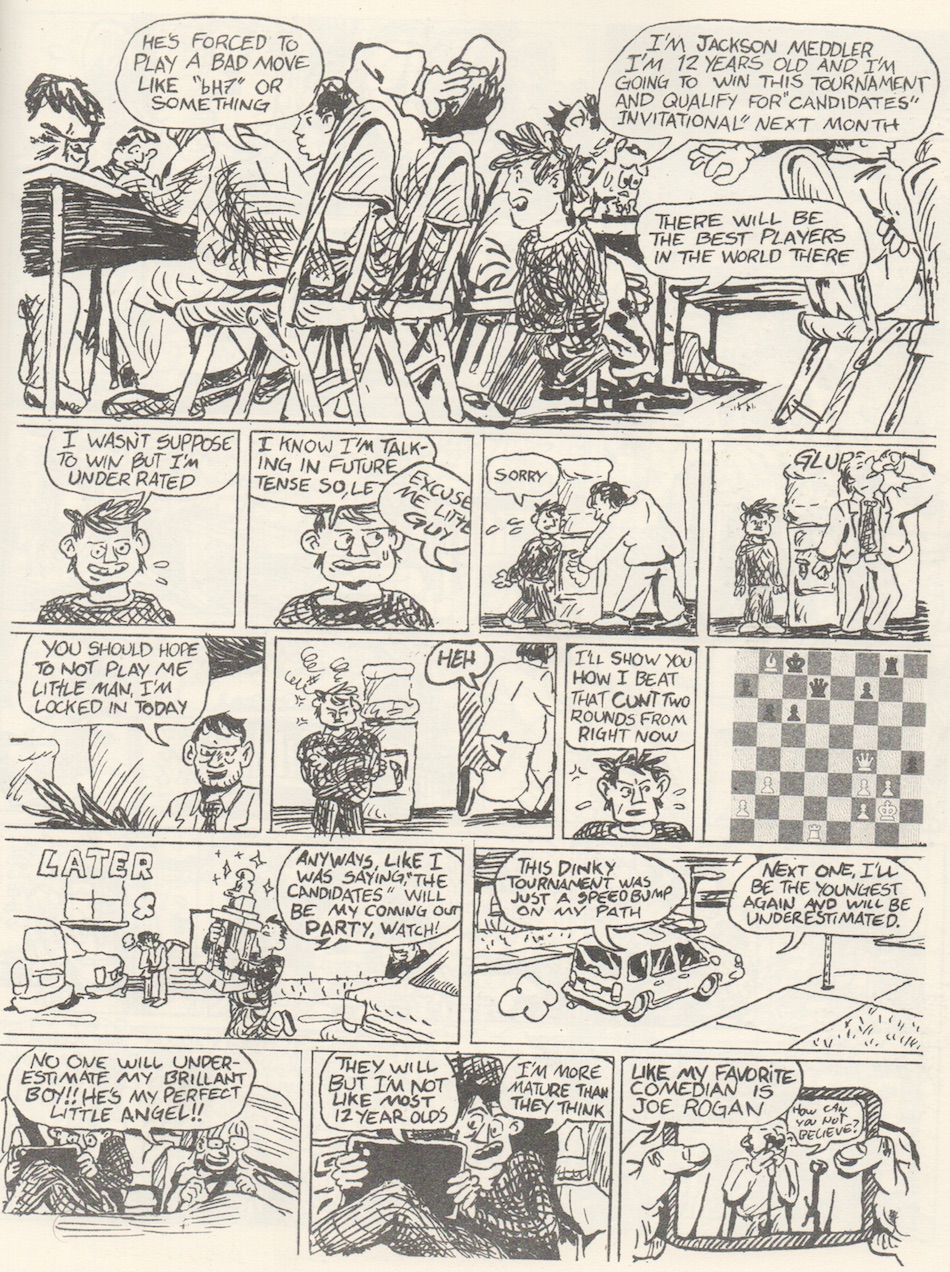
The anthology is the flagship title of Cram Books, edited by publisher Andrew Alexander, who has now released the first issue of his solo one-man anthology, Caught Lookin'. To whatever extent Cram is the new Kramers Ergot, this offering from Alexander contains the initial chapter of a graphic novel which would be the next Blood Of The Virgin. Reading reveals the case for that analogy is made more on the strength of "The Candidates," the serial that kicks off the issue, than it is by Alexander’s anthology-editing acumen.
"The Candidates’" cast of characters includes chess tournament participants and a bevy of narrators/narrative devices to exposit the happenings of that tournament throughout history — the journalist writing a book about something that happened twenty years ago, the commentators describing a match as it occurs, the therapist speaking with a one-time winner. The cartooning makes its moves, forward and backward, diagonally and in knight’s L’s, ensuring we are not tied to any of these voices, or even character designs. Note the moment when a diner waitress, unseen as readers occupy the same space her perspective would be located, takes an order, giving us the insight into character you only learn from a breakfast choice, in as seamless a movement as possible. We do not need the visual spectacle of action sequences to keep our interest: We see a man wearing glasses sit in a chair, then travel back in time to see him in a different chair, wearing a different shirt. We’re existing in a higher state of awareness, taking in and tracking information across dimensionality of time, where we are constantly frazzled. It’s a depiction of chess that feels accurate and knowledgeable, and as a reading experience places you in that current of electricity of firing synapses which is why I read.
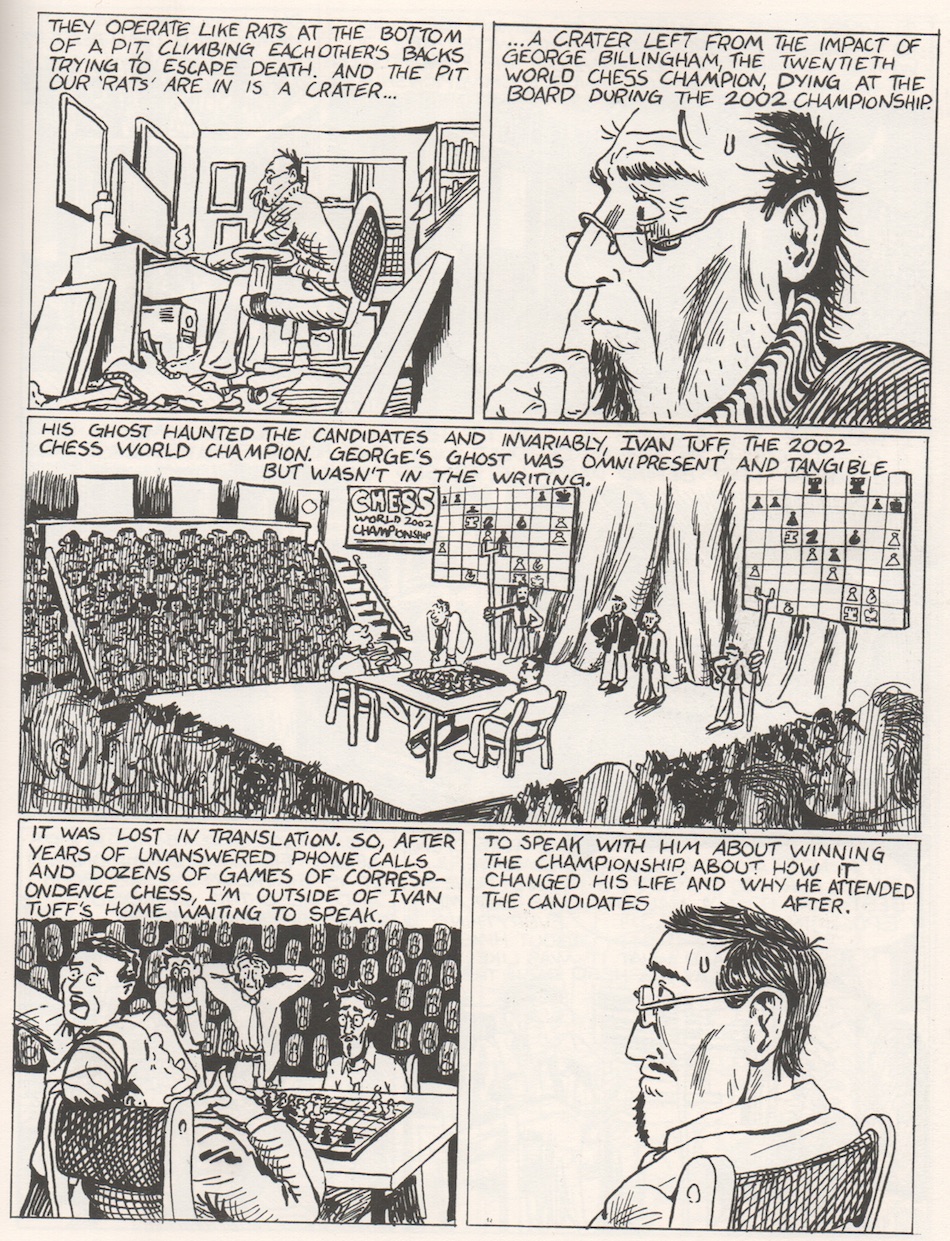
Alexander’s drawing is a flurry of different marks, mirroring this elevated state in lines that evoke the assorted detritus of cigarettes: Ash, smoke, stubbed butts. It’s drawn with the aggressiveness of an incessant compulsion, whether that manifests in a page with a bunch of tiny panels to convey a night out in an autobiographical story, or in a crowd of faces sitting in attendance as a background element of a larger panel. It’s a midpoint between Blutch and Will Elder that feels perfectly organic — buoyant cartooning that retains its readability even as it always feels more messy than clean. It’s for the coffee-drinkers and forehead-sweaters.
Most of the players in the chess tournament fit this description, but not necessarily all. The cast is varied, filled with figures to root for and anticipate spending more time with in future issues. There’s Jackson Meddler, a precocious child of the sort I think many comics readers can relate to, calling a competitor a cunt in a fourth-wall breaking aside. There’s Ivan Hoff, not talking to his therapist about the trauma he preserves on his porch, more occupied by a game of online chess he plays in another window than his zoom appointment. There’s Kayla Agapov, the highly-ranked granddaughter of a Russian chess legend. There’s Manuel Martinez, the son of a political leader targeted by the US in 2023, a separate plot thread from the “the murder, the conspiracy” that befell the tournament in 2003. Keeping track of these characters as they are introduced is a large part of the fun. The kid speaks in future tense to say he’s underestimated, reporter Salazar Berumen writes in past tense to say we all know what happened twenty years ago. Chessboards appear in both three-dimensional form and the two-dimensional shorthand that captures moves on a computer screen or telegraphs them at greater scale for display during tournament play.
The book is filled out with other stories, many of them autobio-adjacent. This autobio material actually contains a fair amount of straightforward biographical information — year of birth, family ethnic background, the author’s childhood interests. A single sketchbook page and a reference to teaching kids alludes to the artist working as a chess tutor, which helps fill in the sense of "The Candidates" coming from an informed perspective. A piece presented as diary comics quickly reveals itself to be fiction from the perspective of a harried comics editor. It seems based on personal experience enough for the gossip-minded to speculate as to what Cram-Books-published artist Alexander is secretly talking about. My guess is Stipan Tadic, painter profiled in Juxtapoz, and author of Christmas In DC.
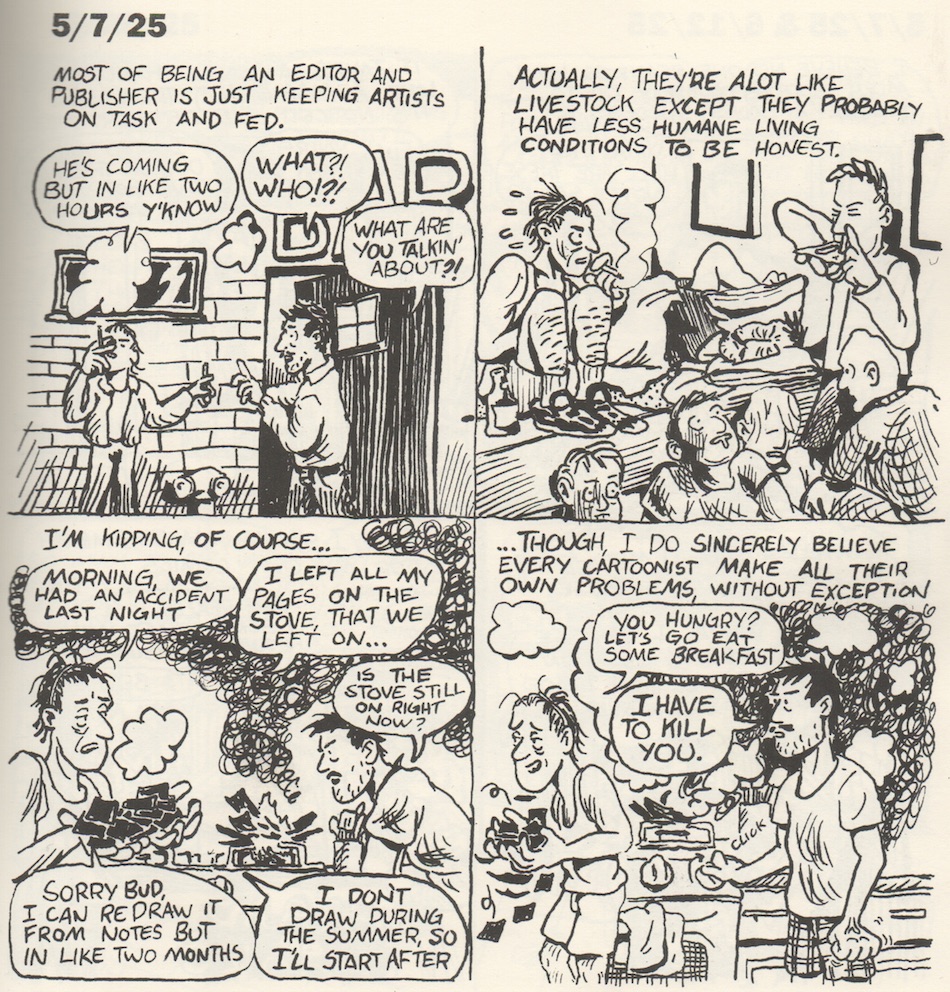
“I do sincerely believe every cartoonist make all their own problems, without exception,” a caption reads, but as an editor, Alexander has some missteps on his ledger: Allee Errico is such a strong storyteller that the themed collection approach taken by “Love Angel Music Bike” handicapped her effectiveness somewhat, and Max Burlingame’s Leone In Blood From The Stone And Other Stories likely should’ve taken the time to have its stories conclude rather than present a series of beginnings without conclusion. In both the Burlingame book and the installment of "The Candidates" here, we find an aversion to ending a story with a note saying “To Be Continued” or “The End” which is potentially confusing or frustrating. A first chapter doesn’t necessarily work as a strong story in its own right, and labeling it as such so a reader doesn’t go “Is that it?” at the end seems a basic standard to ensure the work’s presented properly. Caught Lookin’ also should’ve been proofread, as there are misspellings throughout.
The weakest story in the book is a four-pager in color, "Peter Saul Beckmann's A Hard Day's Night,"' which does drive home that this would likely be a better comic were it a black and white offset-printed thing that laid flat and had a lower price point. The color story is the weakest because it’s where the author feels least present on the page as a thinking presence, and it’s not really clear what is meant to be occupying that absence instead. Some sorta goofy Beatles parody, rendered as largely off-panel background noise? Due to the risograph process, this is where Alexander the publisher was likely most present in post-production, printing multiple passes; a sad irony. I know that the economics being what they are, printing and folding all the copies of these books will likely be the most viable option until demand exceeds Alexander’s capacity to meet it. On the evidence, that’s only a question of how long Cram remains under the larger readership’s radar, as the comics presented here are what fans of alt-comics crave from their periodicals.