
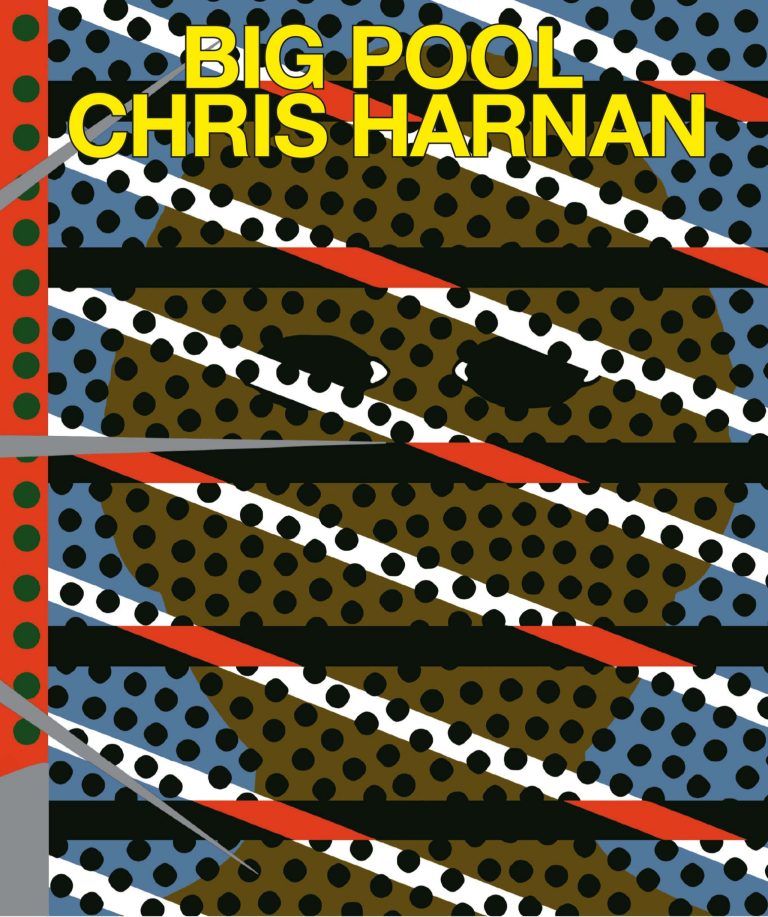
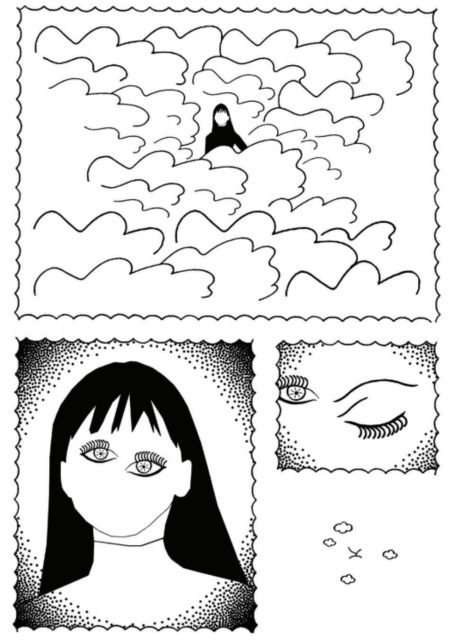
Chris Harnan's debut graphic novel, Big Pool, was released in July of 2025 and was published collaboratively by both Breakdown Press and the risograph-specialized Fidèle Editions. The book contains Harnan's previous work, including Le Casino, originally published by the French publishing collective Lagon Revue's anthology Marécage. Big Pool reads like a series of vignettes, centering around themes of unity and creation, producing meaning through the poetry of form rather than prioritizing a traditional narrative. Although there is text in the novel, it's applied sparingly—the first instance of text is found 22 pages into the novel in an abstracted fashion, its use blurring the lines between the diegetic and extradiegetic—and are just as substantive in communicating its articulated meaning. This diminution of purely diegetic text allows Harnan to create unity in its messaging across all facets of form, colour, symbolism, framing, and, especially, materiality. The title Big Pool, articulates Harnan's approach to page composition and layouts where, much like how every individual molecule of water serves to create a larger body of water, he is acutely aware of how facets of the comics medium like the gutter can act as terra nullius; the space between panels gives readers the capacity to impose their own meaning onto the void.
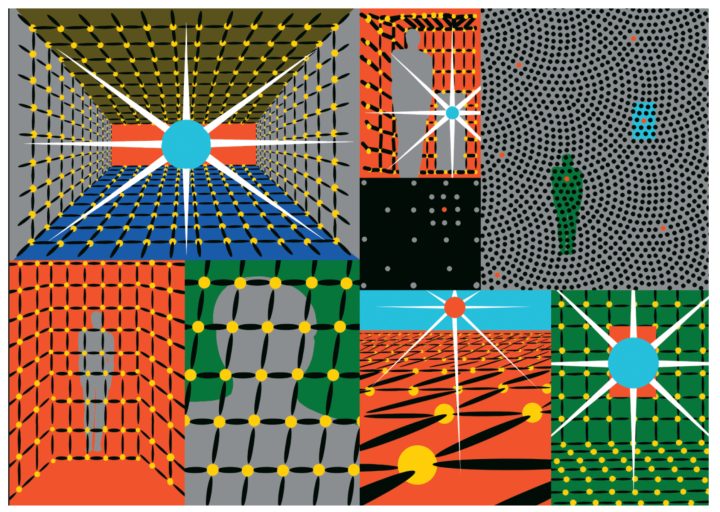
Materiality is of principal significance in the novel, with Harnan switching between collage, offset printing, and digital techniques; each medium constantly recontextualizes Harnan's symbolism while retaining its core meaning, even when physically reconstructed in different substances. Ellipses are present on the majority of the comic's pages as non-static, motivated signs, where the simplicity of their form facilitates a variable signified meaning. These signs fluctuate on the page through optical illusions produced by the novel's printing techniques. Big Pool uses dot-tone patterns and "peripheral flicker illusions"—the overlaying of high-contrast images paired with microsaccades that make the ellipses flicker—bringing the page to life as the reader's gaze works its way across the image. Big Pool exists within an art of tensions, with multimodal codes influencing the textual and visual elements that either work harmoniously or in opposition to convey meaning. Harnan, through these tensions of sequence vs. surface (with sequential dynamism) and experience vs. object (with the optical illusions produced by the material qualities of the novel itself), makes an "obtuse third meaning." Roland Barthes describes this third meaning as a different structuring of art without subverting the story where the filmic appears, which in this context is what the comic can not describe through language and articulated meta-language. The obtuse meaning can only be communicated by active reading of the comic, where written text about the comic can only go as far to describe the articulated meaning of the work, especially with obtuse meaning serving as a signifier without a signified, making it all the more difficult to communicate outside of engaging with the comic itself. The interrogative meaning of these optical illusions exists entirely within the plane of expression of the signifier. Within the context of Big Pool's themes, the flickering effects that accompany the ellipses—signified signs representing atoms in the panels where they appear as yellow circles—communicate that nothing is static, all that exists in the universe is in a state of constant change. This theme is further communicated by the placement of one red ellipse in the centre of a green figure in the shape of a man, with the high contrast of red against green producing a peripheral flicker illusion representative of the soul that, like the atoms, is in a state of constant change. Taking into account the materiality that is needed to produce this obtuse meaning, Harnan comments on how external and material reality impacts the metaphysical, like the soul and the persona; the external physical qualities of the figure's colour, or how they present, directly influence the reader's perception of the figure's inner self.

On the same pages, there is also the repurposing of ellipses to take the form of a sun, and the retention of the ellipses sign communicates that all things are a part of a larger whole, reflexive of the work's title. Harnan, with his extensive use of splash pages and conjoined panelling, also takes a unique approach to "iconic solidarity."
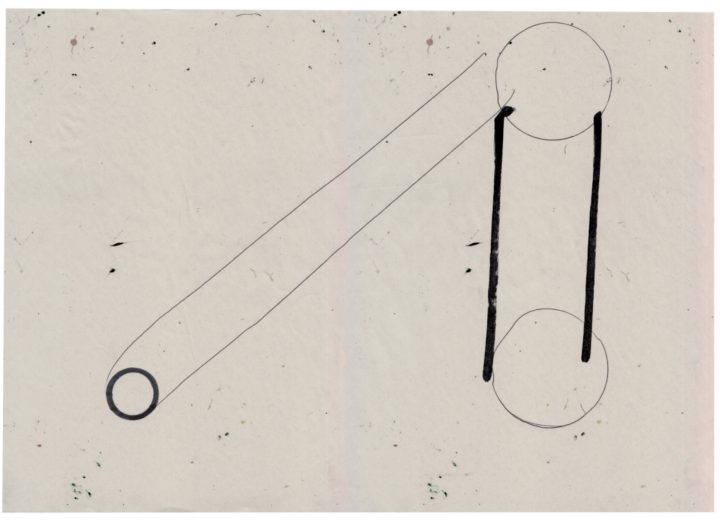
Harnan's repeated use of the ellipsis sign throughout the book and on the same page leads the reader to presuppose meaning, prompting them to probe for the connection between the signs presented and how they re-read in light of others in search of a coherent narrative. Due to the novel's compressed storytelling and limited use of narrative sequencing through the different types of panel-to-panel transitions, readers must find these coherent narratives exclusively through the poetics of form and the iconic solidarity of these signs and their restrained, general arthrological relationships. The novel establishes this from the very first page (which depicts a blank canvas, Fig. 1) followed by ellipses and an accompanying cylindrical figure (Fig. 2). The juxtaposition of a blank canvas with an abstract symbol forces a perception of this symbology as essential to parsing the novel's narrative. Accounting for how panels and their iconic solidarity is affected by re-reads, in conjunction with later information presented on how to interpret these ellipses, along with the novel's jacket opening with "Once upon a time there was nothing…"—an allusion to the book of Genesis and its opening verses—readers can interpret these opening pages as a creation story of sorts. With the later contextualization of the ellipses as atoms and souls, the building blocks to physical and metaphysical life, we can understand these basic shapes found on the comic’s first pages as essential signs to understanding the basic modes of communication of the comic for its narrative and poetics of form.
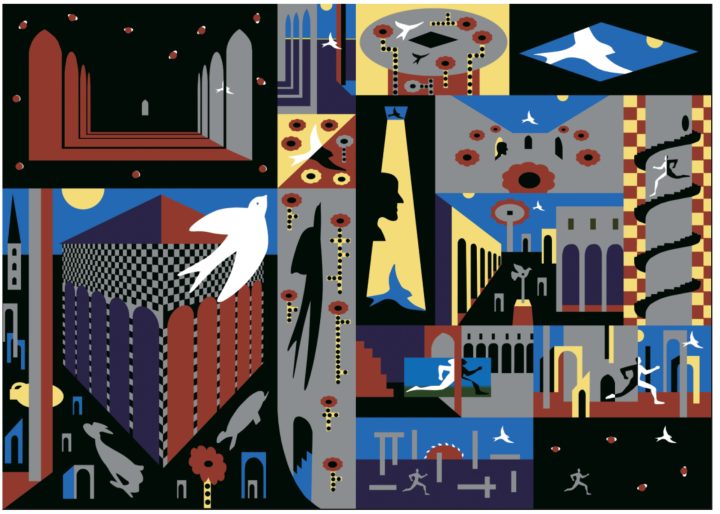
Similar to Michael Nicoll Yahgulanaas' Red: A Haida Manga, where every page is necessary to constructing a larger whole with its gutters coming together to form a much larger picture, Harnan takes into account how the tension of the comic as an object influences the experience. Much like Red: A Haida Manga, an aspect of the materiality of Harnan's comic is its page sequencing, which creates a striped black-and-white pattern along its edges. This binary sequencing of black and white helps establish that the novel engages themes of binary relationships, such as life vs. death and the physical vs. the metaphysical. With all facets of the book working toward the larger whole, it is cogent why Harnan would omit gutters from many of his pages to separate his panels. Although Scott McCloud presupposes that the gutter is an important aspect of comics as they play host to the magic and mystery that are at the very heart of comics, he also posits that it serves as a limbo for the human imagination, antithetical to how Harnan communicates Big Pool's themes to readers. In Yahgulanaas' visual essay, In the Gutter, he views the typical gutter's function and McCloud's perspective on it as colonial, with empty space acting as a vacancy for readers to occupy with their imagination. From Yahgulanaas' perspective, there is no empty space; rather, there is always something there. Harnan makes full use of the page and separates panels with contrasting colours, leaving no limbo for the reader to impose their imagination. This technique of panel separation helps inform the diegesis by the use of colours, the blue and black backgrounds to resembling the horizon of a clear sky and the darkness of space. It is for this same reason that the novel has no pagination: these elements would not serve to convey relevant information about the narrative to readers. The conjoined panelling further helps abstract any sense of time passing between the sequencing of panels, bolstering the sense of frames on the page working in tandem to convey their narrative.
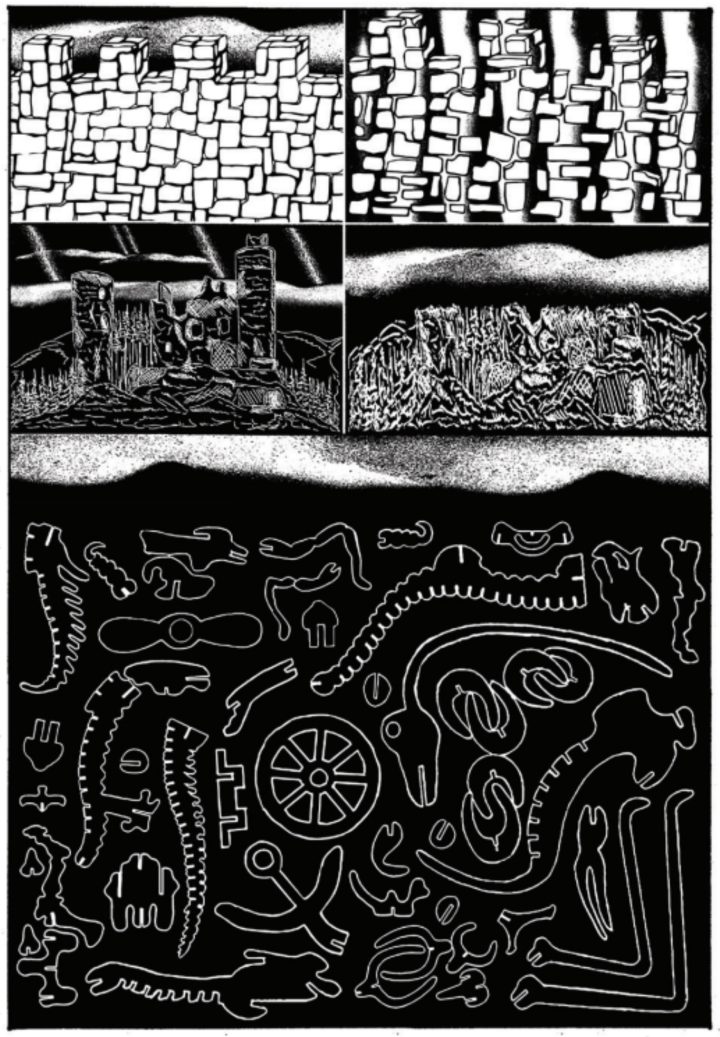
Big Pool stands as a rigorous reimagining of what comics can achieve when they privilege the expressive capacities of form, materiality, and visual logic over dependence of a conventional narrative. Through deliberate minimization of language, Harnan does not diminish meaning but rather redistributes it. Ultimately, Big Pool enacts its own thesis: that all elements, whether visual, material, or conceptual, participate in a unified whole. By eliminating empty spaces traditionally afforded to the reader's imagination and instead saturating every aspect of the page with intentional design, Harnan rejects absence in favour of total interconnectedness. The result is a work that not only communicates its themes of unity and perpetual transformation but also embodies them, inviting readers to experience comics not as a passive act of consumption but as an immersive, interpretive process.