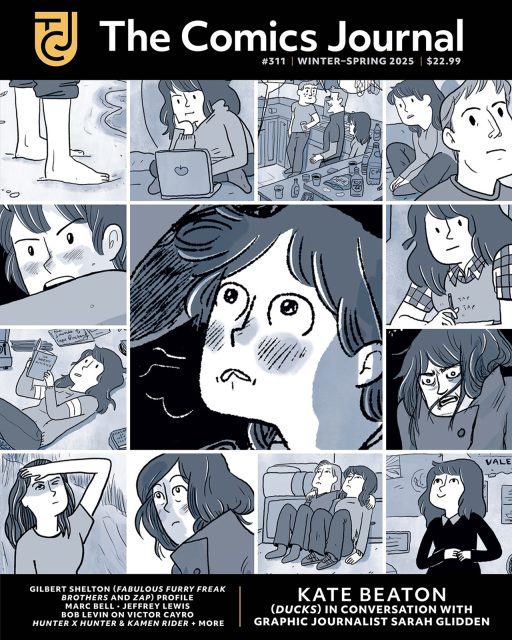

Tokyopop didn’t set out to be the publisher that got America hooked on shojo manga. Once upon a time, in the distant 1990s, it was Mixx Entertainment, an L.A. startup with lofty, if vague, ambitions to become a multimedia portal into Asian pop culture: video games, CD-Roms, even a website! But the project that took off was MixxZine, a manga magazine similar to Viz Media’s house magazine, Manga Vizion. Manga Vizion folded not long after all this, so maybe it wasn’t the best business model to follow. But MixxZine had a secret weapon, and that weapon was Sailor Moon.
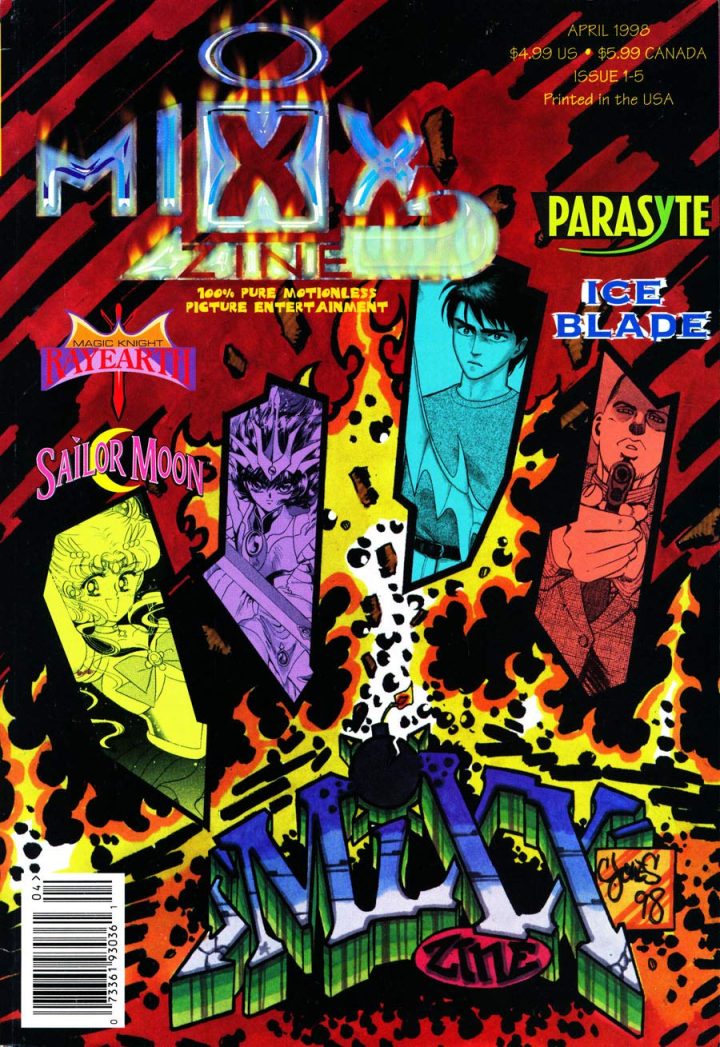
I’m not here to talk about Sailor Moon. I’m here to talk about Fuyumi Soryo’s Mars, one of the great romance comics. But to explain how Mars made it to English translation way back in 2002, only a couple of years after its Japanese serialization ended, I choose to indulge in a few paragraphs of weeb nostalgia for the Willy Wonka laboratory that was North American manga licensing at the turn of the millennium. Manga and anime were starting to catch on in a way they never had before, but no one knew what was going to be big. So why not put out a monthly magazine that was half ultraviolet men’s manga and half fantasy manga for tween girls?
And so MixxZine launched with Tsutomu Takahashi’s gritty cop drama Ice Blade, Hitosi Iwaaki's sci-fi horror classic Parasyte, CLAMP’s portal fantasy Magic Knight Rayearth, and Naoko Takeuchi's Sailor Moon, queen of magical girl manga. If you’re any kind of nerd at all, even if you’re not a manga nerd, you’re probably aware that CLAMP and Sailor Moon went on to become kind of big deals in American fandom. Parasyte has grown a cult following over the years, and Ice Blade…okay, not even I have read Ice Blade. Sorry, Ice Blade.
Mixx and its founder, Stu Levy (who strove to establish himself as manga’s answer to Stan Lee through his alter ego/pen name D.J. Milky–as I said, it was a special time in publishing), soon twigged that the shojo titles were carrying MixxZine and snagged more girls’ manga, mostly from the catalog of Japanese publisher Kodansha. Mixx cast a wide net, selecting not just geek-pleasing genre fiction like Rayearth and Sailor Moon, but the kind of slice-of-life drama not often seen in American comics at the time.
Manga guru Rachel Thorn had been working for years to bring more shojo (girls’) and josei (women’s) manga to English translation, and had convinced Viz to publish a handful of prestige works by artists like Moto Hagio and Keiko Nishi. But these were mostly appreciated by dorks named Shaenon feverishly reading A, A’ in their dorm rooms. All of a sudden, Mixx–now calling itself Tokyopop and moving from magazines to graphic novels–turned on a firehose of mainstream hits.
(This rush to publish had another historic effect: Tokyopop opted not to “flop” its manga from right to left to make it read like an English-language comic, as previous publishers had done. Keeping the manga unaltered saved time and money, but, advertised as “100% Authentic Manga,” it felt like a special favor to the fans. Before long, all of Tokyopop’s competitors followed suit.)
Volume 1 of the Tokyopop edition of Mars opens with a page advertising the publisher’s other 100% Authentic Manga. It’s an eclectic mix, to say the least: Chobits (“In the future, boys will be boys and girls will be…robots?”), Skull Man (“They took his family. They took his face. They took his soul. Now, he’s going to take his revenge”), Dragon Knights (“Part dragon, part knight, ALL glam”). Upcoming shojo titles include Ai Yazawa’s fashion-school soap Paradise Kiss (technically josei, as it ran in a women’s fashion magazine), Masami Tsuda’s high school romcom Kare Kano, and Miho Obana’s Kodocha, a dramedy about a child actress that I really wish somebody would bring back into print.
None of these shojo manga are much like Mars, which has the form of a glittering girls’ romance but the heart of Charles Baudelaire and a surprising amount of motorcycle action. Of the other manga in that Tokyopop lineup, it might be closer to Tōru Fujisawa’s GTO, set in the world of teenage gangs, or Shuichi Shigeno’s street racing manga Initial D. Admittedly, those tough-guy manga probably don’t have lines like, “I sense colors in you. They’re strong and beautiful…and sad.” (Initial D is 48 volumes long; I’m not going to check the whole thing.) On the other hand, I’m pretty sure no one in Kare Kano ever says, ‘The act of killing is a very human, voluntary action.” Mars contains multitudes.
So.
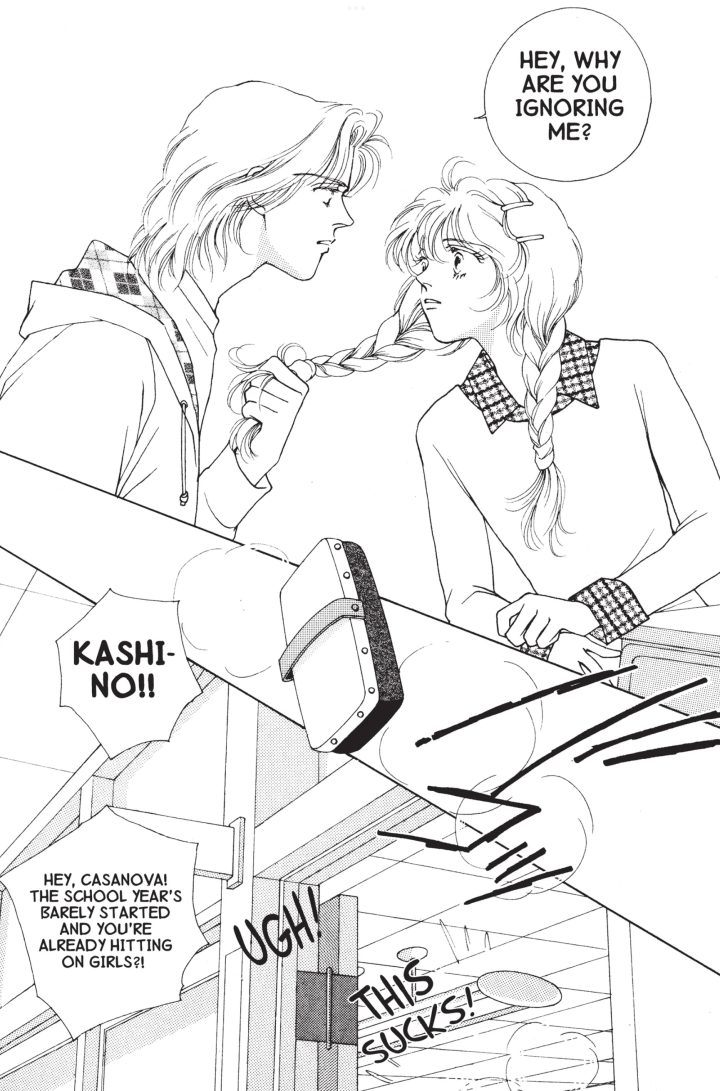
Kira is a shy, wide-eyed artist who hides her face behind thick braids; some of the boys at school have noticed that she’s pretty, but everyone thinks she’s weird, and why is she so uptight about being touched? Rei is the school bad boy who rolls up on his motorcycle, shakes out his golden locks, and rides off with yet another one-night stand. Just to make it clear that he’s trouble, we find out he used to live in the U.S., the most dangerous place a manga character can inhabit. (Fun Rei facts: he’s fluent in English, he’s clumsy with chopsticks, and he leaves his shoes on in the house.)
One day in the park, Kira’s sketch of a mother and child catches Rei’s eye, and the two experience a moment of connection. Back at school, Rei steps in when a teacher sexually harasses Kira in the art studio. Then, in an extremely important moment for heterosexual teenage girl readers, he impulsively kisses a bust of the god Mars. Kira is, as how could she not be, inspired. Overcoming her shyness, she chases Rei down and asks for his body. It’s not what you think: she wants him to be her model. So Rei begins to sit for a portrait that Kira will call Mars, after the god of war.
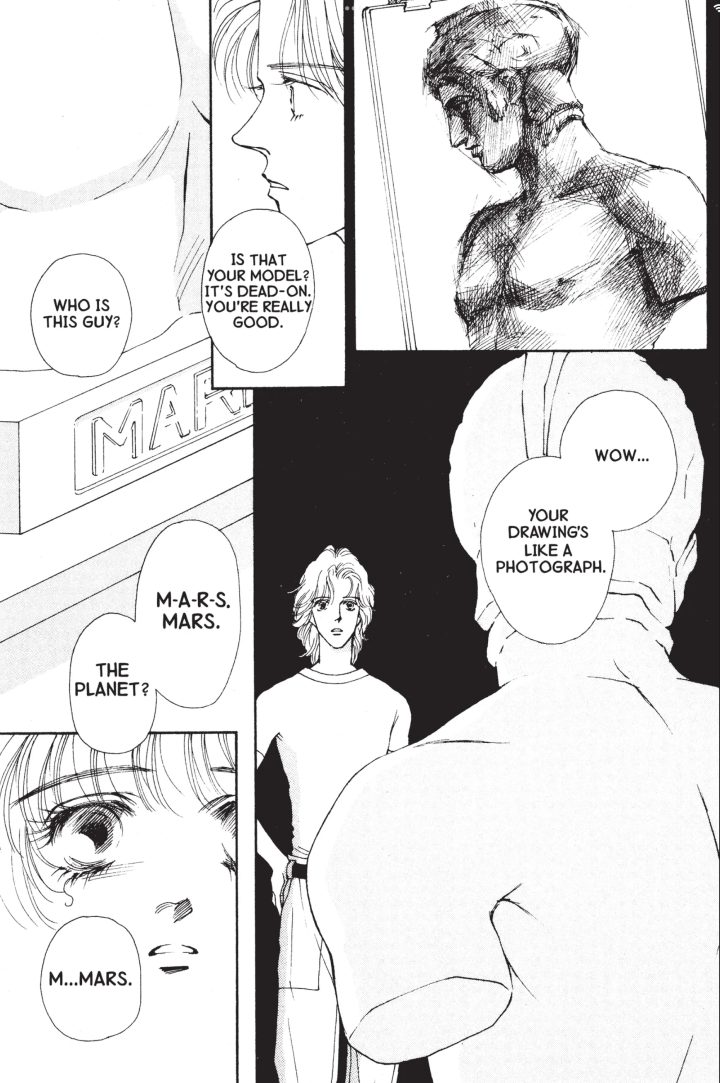
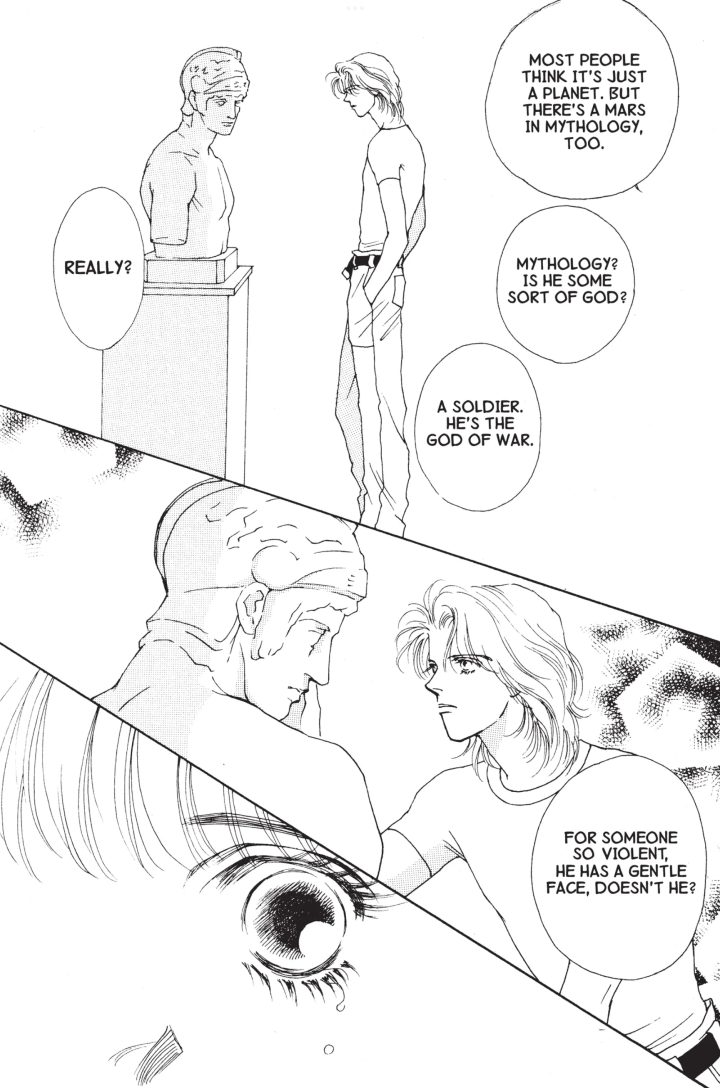
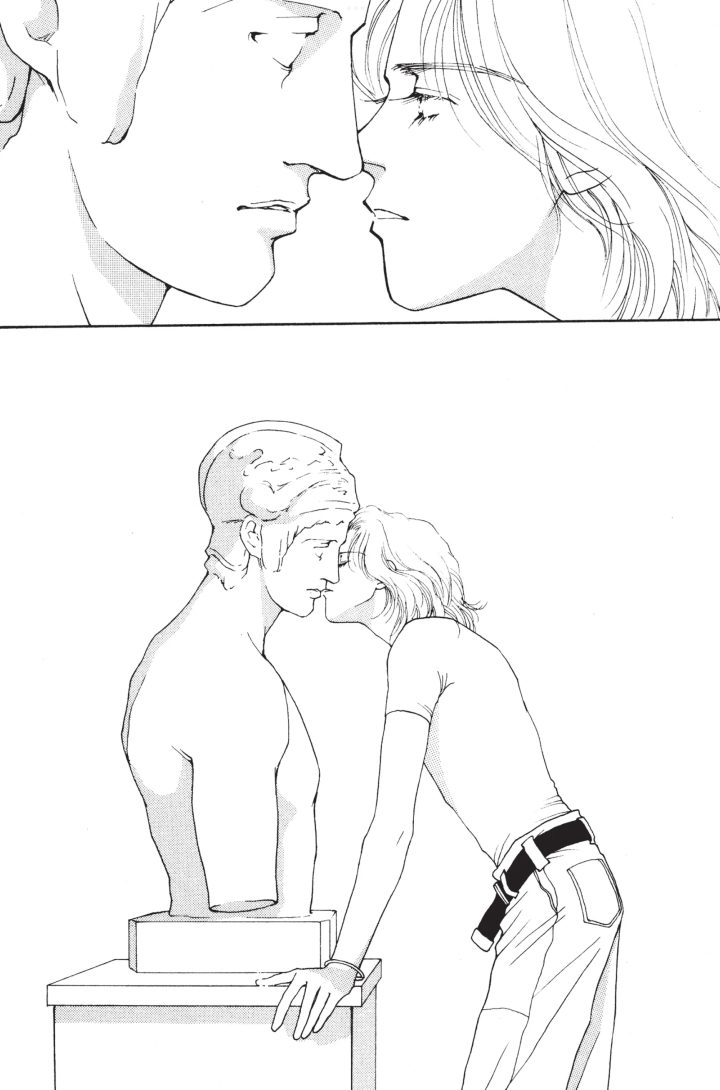
In a lot of love stories, the tension from here on out would come from the clash between these two attractive opposites. Let’s be blunt here, as we are otaku of action and lies do not become us: it would mainly come from Rei being an ass. This formula plays out more conventionally in Kare Kano, a.k.a. His and Her Circumstances, one of the early Tokyopop titles mentioned above. Kare Kano is a romcom about the Sam-and-Diane relationship between the top two students at school, one of whom is secretly a hot mess who struggles to keep up her perfect facade, the other of whom really is a genius and uses his knowledge of his classmate’s weaknesses to one-up her. But it’s okay for him to treat her badly, it turns out, because he has Secret Trauma. Or, as Jason Thompson put it in his review for Manga: The Complete Guide, “As it turns out, ‘her circumstances’ are basically those of a normal person, but ‘his circumstances’ involve child abuse, trauma, and black despair… In place of realistic relationships, we get a melodrama about a girl who soothes the wounds of a tortured genius.”
There’s plenty of Secret Trauma in Mars. In fact, it’s mostly Secret Traumas. It’s one of the darkest 1990s shojo romances short of Banana Fish, which is so bleak it’s named after a Salinger story. Mars has death and murder and motorcycle accidents and school bullying and abuse and mental illness and infidelity. One volume contains three (3) suicides. But most of the conflict isn’t between Rei and Kira, who soon open up to each other and are officially a couple by the second volume. It’s between this couple and the world, a world of cruelty and selfishness, where people hurt each other because they’ve been hurt, or just because they can. Around the time Mars was serialized, Moto Hagio was drawing her psychological drama about child abuse, A Cruel God Reigns. Mars isn’t quite that dark, but the same title would work. The reigning god here is the god of war.
But even in the hands of an angry god, Kira and Rei follow, or try to follow, the god of love. Consumed with artistic fascination, Kira looks through Rei’s Playboys and muses on the beauty of male and female bodies. She starts to come out of her shell and take down her braids. When she and Rei kiss for the first time, their bodies fill with stars. After they sleep together for the first time, they explore one another’s scars.
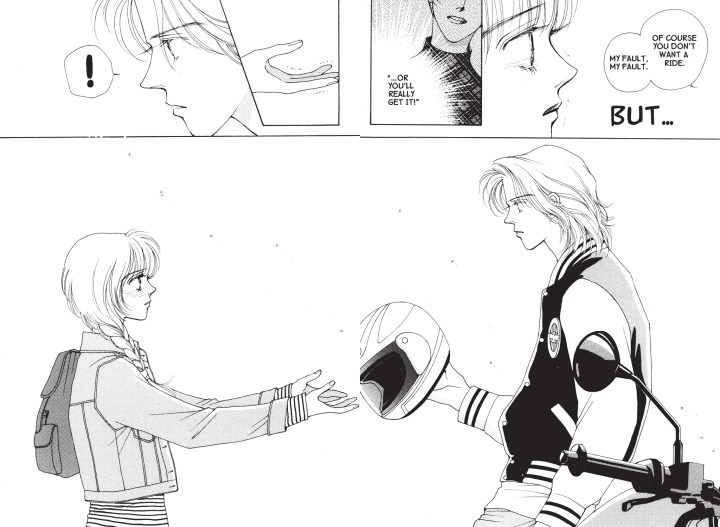
As their romance develops, Kira and Rei develop a circle of friends, including married motorcycle racers Akitaka and Kyoko; Tatsuya, who carries a torch for Kira; Rei’s old junior-high friend Shuichi; and Violet, Rei’s trans neighbor. (In an early volume, Rei reacts with homophobia to a gay character, but later he and other characters treat Violet positively.) You can generally tell whether a character will become an ally or a villain by how they deal with pain: do they get over it, or do they keep lashing out? Harumi, introduced as a mean girl jealous of Kira’s relationship with Rei, at one point threatens to smash Kira’s fingers under a cinderblock, yet later they become best friends. Masao, an abuse victim who lives on the streets, has one of the most sympathetic backstories in the manga but becomes its most chilling and sociopathic antagonist, unable to join the good kids because he can’t discard the bad hand the world has dealt him.
For about the first half of Mars, much of the focus is on Rei’s problems, as Kira uncovers one secret about his past after another, and it looks like things might be developing into a “girl who soothes the wounds” plot. Rei’s delinquent behavior and willingness to risk his life on the racing circuit stem, we learn, from the deaths of his mother and his twin brother Sei. (“The poor guy saw a dead body that looked exactly like himself.”) Each time we return to these tragedies, there’s another twist to the story, another twist of the knife. Eventually his family trauma stretches back through multiple generations.
Then, in Volume 7 (spoilers ahead), we learn why Kira is so uncomfortable with her body: in middle school, she was molested by her stepfather. Kira’s experience, and its aftermath, are handled with painfully matter-of-fact realism. Her stepparents split over the abuse, but she and her mother struggle to get by without a male breadwinner, and eventually her mother takes her abuser back. Kira is torn between pressure to believe her stepfather when he says he’s reformed and her own instincts warning her to stay away. Only Rei seems to take her violation seriously, and he gets confused and frustrated when Kira fails to stand up to her family.
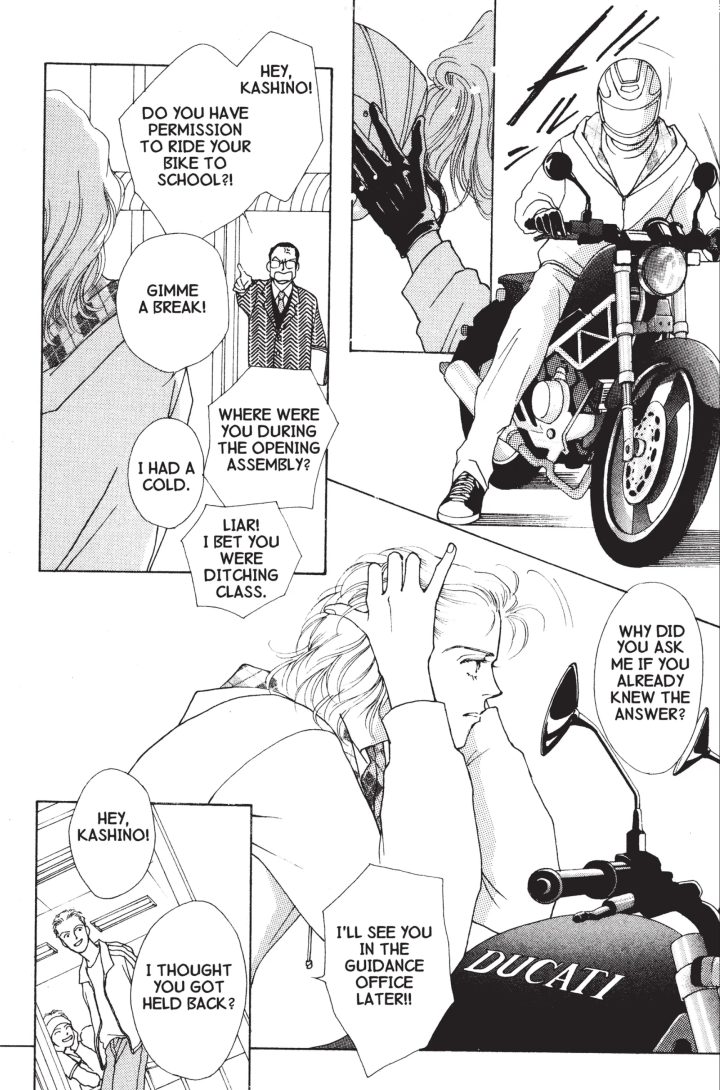
Everyone is wounded. And everyone is angry. Early on, the manga frequently returns to the anger inside Rei, which he channels into motorcycle racing but sometimes releases in disturbing bursts of violence against bullies and abusers–his targets are always asking for trouble, but he always seems ready to deliver worse. Eventually, Kira is forced to deal with the rage she’s been tamping down. At different times, they both come close to killing Kira’s stepfather. Kira and Rei both understand violence; they just deal with it in different ways. Crucially, however, they both understand love as well, and they come to understand that love and hate are choices.
This all unfolds in a fatally good-looking comic. Shojo manga pushes the borders of expressionism in comic art, and Mars uses all the tricks of the trade to pull readers inside Kira’s mind: collage pages, close-ups of eyes and hands, panels that topple into one another. This isn’t the kind of romance manga with showers of flower screentone; Soryo is more inclined to use bursts or bubbles of light, like lens flare. The motorcycle racing is kinetic and exciting, with carefully-drawn bikes and dollops of technical info for the curious. Kira paints Klimt-like patterns wrapping in ribbons around her subjects, and it’s easy to believe she’s a promising young artist.
And good lord can Soryo draw attractive men. Much of the manga is a visual appreciation of Rei, an effortlessly handsome young lion with a lanky silhouette and sun-kissed mane. Soryo has a gift for capturing his charm in poses and expressions that feel like glimpses of a real teenage boy sidling into manhood. She makes it look like fun to draw hot guys riding motorbikes.
Great romance is hard to write. That’s why there’s so much bad romance. It’s even harder to draw. For a couple of generations now, Mars has been passed quietly among readers in the know. It’s a book filled with images of unabashed passion and abject despair, of lovers framed against beach sunsets and shattered on the floor of a shabby apartment. Characters discuss RC4 sportsbike specs, nihilism, and the work of Egon Schiele. It was about “found family” before that was a buzzword.
After getting that miraculously early English publication, Mars fell out of print for many years. Unlike Sailor Moon and Rayearth, it wasn’t picked up by other American publishers after Tokyopop shut down publishing and surrendered its licenses in 2011. (Tokyopop is back now. The manga industry remains a strange place.) But this year, the manga’s 30th anniversary, Kodansha USA is bringing it back in an omnibus series. It’s the right time for a story without an ironic bone in its beautiful body about looking in the face of the god of war, and choosing love.