
Youssef Daoudi worked in advertising for years before he began making comics seriously, but for readers who discovered his work in his books Monk!: Thelonious, Pannonica, and the Friendship Behind a Musical Revolution, or in the Adrian Matejka-scripted Last On His Feet: Jack Johnson and the Battle of the Century, it’s easy to think of Daoudi as a comics natural with a gifted sense of composition and design and a nontraditional approach to storytelling. His new book, The Giant: Orson Welles, the Artist and the Shadow is as the subtitle makes clear, is about Orson Welles.
Less a straight forward biography than a portrait of the filmmaker and creative dynamo, just as the book is an examination and celebration of Welles’ life and work, it offers a showcase for Daoudi’s work, but also his way of thinking. In all his books one can see the ways he plays with design and texture and media. Perhaps the worst thing one can say about a book about a creative person is that it was boring, and Daoudi’s books are anything but. A portrait of an artist but also a book about creativity and a restless mind and imagination, it takes an artist who is playful and disciplined to make sense of it all and find a way to rearrange and present it. As one who has seen all the films, often many times, and read more than one book on the man, I’m not sure what a person who knows little to nothing about Welles would get from the book. But hopefully they and anyone else will be driven to watch his work and try to understand why so many including Daoudi continue to be so enamored and inspired by him.
-Alex Dueben
ALEX DUEBEN: Tell me a little about how you grew up. Were comics a part of your childhood?
YOUSSEF DAOUDI: I can’t remember the first day I started filling up my sketchbooks—really, it was always a mix of writing and drawing, with no clear line between a notebook and a sketchbook. Naturally, books and my notebooks were the center of my world. They were where I gave free rein to my imagination.
I didn’t go out much, because I wanted to spend as much time as possible buried in books—at home or at the local library. I couldn’t fall asleep without a book beside me, like a kind of talisman, something that protected me.
I was lucky to be the youngest; my sisters would constantly give me books—and comics, loads of comics. And of all kinds, since European comics are incredibly diverse. There were Italian fumetti, and magazines like Spirou, Tintin, Pif, À Suivre, Pilote, and Fluide Glacial—magazines that would likely mean nothing to an American audience.
I only discovered superheroes fairly late. I remember having a soft spot for ROM: Spaceknight.

You worked in advertising for fifteen years. Why did you get into it and why did you leave?
It was a job, I was good. The experience was incredibly enriching, as it involved a wide range of technical disciplines, from book layouts to advertising production, including typography and digital tools. But all along, I kept nurturing the same dream. And once I felt I had gone as far as I could in that field, I decided it was time to dedicate myself fully to my books.
How did you come to comics?
I had a bunch of dreams when I was a kid, but the one that stuck with me and lingered in my mind was to become a writer. It represented this incredible freedom and power. In a comic book, an intimate story and a space opera require the same budget! I used to say that during all those years in the corporate world, through the ups and downs of working life, I was biding my time. And then, at 35, I took the leap. But like with any destiny, the stars have to align, and you need to meet the right people at the right time. I was ready to embark on the adventure.
I know that it wasn’t your first comic, but I first discovered your work in Last On His Feet, about Jack Johnson, which was a great book. After you had written and drawn Monk!, why did you want to collaborate with someone else?
I had been wanting to collaborate with someone for awhile. I was getting a bit tired of being alone in my corner, facing doubts and the stress of the blank page. I approached a lot of people, but I couldn’t find the right partner—and especially not the right subject. That’s when I was contacted by Adrian Matejka. He wanted to create a graphic novel about Jack Johnson. He liked the style of storytelling I developed for Monk!. From my point of view, the most exciting part was that Adrian was a poet, not a scriptwriter. I loved his poems about Johnson, The Big Smoke. The idea of creating a hybrid book centered around poetry was a very exciting experiment. That was really what won me over.
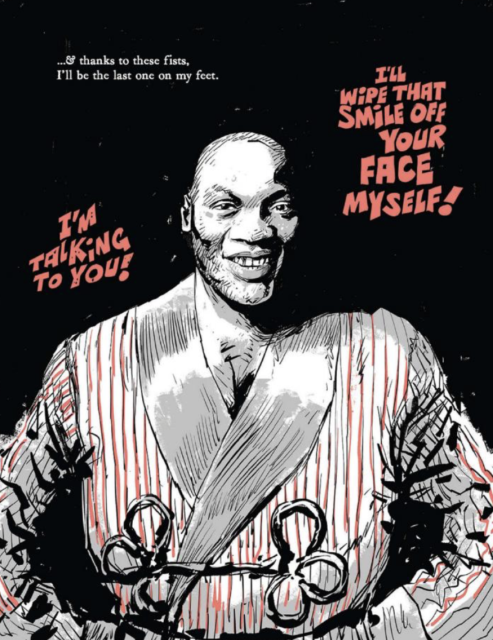
I’m curious about your working relationship with Adrian and putting that book together. Because it very much felt like the product of a close collaboration. He didn’t just write a script and email it to you.
That’s absolutely right. This graphic novel is a seamless collaboration between us, countless hours of passionate conversation and months of work on the structure, where scenes, drawings, dialogues, and poems were all designed in unison, to form a cohesive whole. I reject the notion of “illustration." A true graphic novel isn’t just text accompanied by images—or the other way around. It has to be a complete synergy, if not a single, indistinguishable creative impulse. On thing that was key to keeping all this jigsaw together were the poetry, Jack’s voice. Some poems led to chapters, and some chapters demanded poems that Adrian composed especially for them and so on.
One reason I ask is because Last on his Feet is not a book built around a monologue of Jack Johnson, but the book, and not just the text, but the book as a whole, is really defined and shaped by his voice in interesting ways.
“Voice” was the word that came up most often from the moment we first met in a hotel in Paris. In fact, that voice was meant to be the thread that held the book together. But that alone wouldn’t have been enough. I always say that art—or drawing—is a fully-fledged form of writing, especially in the context of graphic novels. I mean to say that a single drawing, poster, cartoon can lead to an entire sequence and prompt our interest in a given subject.
That was also a book where you were playing with media and texture and form in different ways on the page in ways that really informed the voice and storytelling. Something that has really continued with this new book.
These are experimentations I have been doing when I began to think about Monk! I thought that the medium has a lot to offer beyond the apparatus of panels and balloons. I needed to break some rules, or to question a bunch of canons to be able to not only tell the story, but to set up an atmosphere, an epoch.
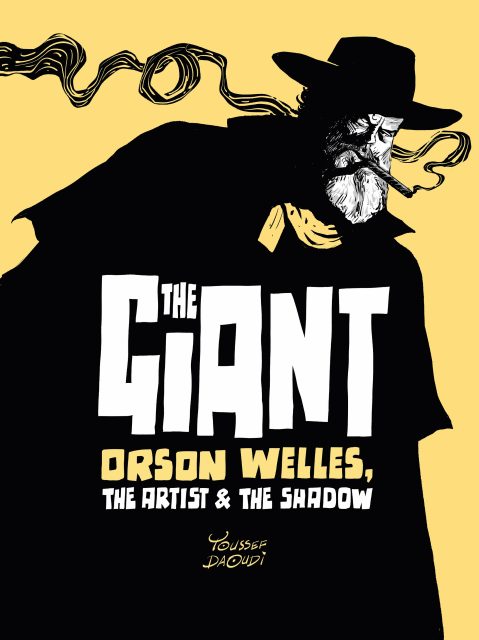
So why Orson Welles? What interested you in looking at his life and work?
I believe That Welles is the embodiment of the complete artist—he reminds me of certain Renaissance figures, with that multidisciplinary spirit. In truth, I wanted to explore creation itself, and the challenges a creator faces both on a personal, inner level, and in relation to the public or the economic environment. Moreover, he perfectly embodies many of my own obsessions. For instance, I share with him a love for language, expression, and theater. There’s also the passage of time, power, aging, and decline. His passion for Shakespeare is no coincidence. Besides, drawing and animating that gargantuan figure was a lot of fun.
Last On His Feet opens with all these other characters and voices defining the world and building this space for Jack Johnson to inhabit before he shows up and the match starts. Which was such an interesting choice. In The Giant you take the opposite approach and begin with Welles’ voice.
These are the kinds of choices that torment me at the start of every project: what is the most effective dramatic device for the subject? It’s so crucial that I often spend a long time holding back before I can really get things moving. With Johnson, it seemed obvious—he was at the center of the changes and contradictions of his era: the modernity with the emergence of cinema, automobiles, and media-driven sports on one hand, and the worst forms of discrimination on the other. With Welles, everything would unfold within his own world—a world he believed he controlled, where he seemed to reign like a king. I chose to begin with a novelistic structure before shifting into a theatrical framework, where Welles’s voice ultimately meets Orson’s in the final confrontation. I wanted also to use his work to make a sort of pastiche.
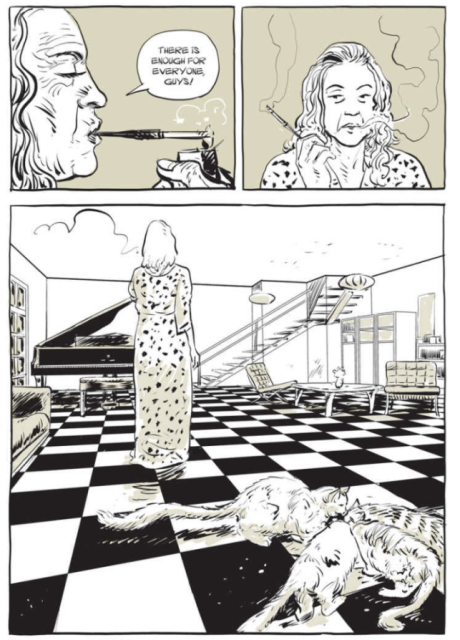
Books like Monk! or Last on his Feet try to look at this large figure through a lens of one person or one event. The Giant does not do that. But at the same time I really think of The Giant as structured like Monk!
I approach each subject using the narrative tools best suited to explore the aspects that interest me most. With Monk!, it was, on one hand, the extraordinary story of his friendship with Pannonica; and on the other, the entire musical dimension. There, I tried to transpose the logic of a jazz musician—combining the science of melody (a visible, rigorous structure) with improvisation (more mysterious and hidden), in its transcendental, almost supernatural aspect. I’m thinking of trance or meditation. I used that energy while setting up the scenes, transitions and the style of artline itself.
For The Giant, I aimed to present a kind of thesis, trying to unpack the complexity of a figure from the world of cinema who never had the career he truly deserved. This time, I was aiming at using Welles’s wit and eloquence to put the right pulse. And wanted also to make each chapter like a standalone story, with a twist ending.
You touch on various moments, from his childhood, his time in the theater and the radio and move to Hollywood, different films. What did you feel you needed to include? What was essential to you in terms of this book and portrait of Welles?
The goal there wasn’t to list everything that the man did. It was essential to show the child he once was, which goes a long way in explaining his precociousness and the maturity that allowed him to break through so quickly and brilliantly in theater and radio. And then, it was absolutely necessary to cover his Hollywood venture in the early 1940s—especially his travels through South America, which would ultimately seal his fate in a definitive way, at least when it came to his Hollywood career.
As for the rest, I chose what to include based on the themes I wanted to explore. It's a rather unusual way of writing—very fragmented, like drawing a portrait using different mediums: watercolor, pencil, or India ink. But that’s my way of writing.
There were a lot of ways that you structured and organized the scenes that were really insightful. I’m thinking about the visit of his daughter during the making of Mr. Arkadin, which offered some insight into the film’s plot. And during the Chimes at Midnight sequence you have Welles in conversation where one person makes the observation, “It seems that to you, the very essence of tragedy is… treason?” Which felt so insightful to who he was.
Like I said, every line I chose to place at the best spot possible to bring up a particular subject; Arkadin was a great opportunity to quote Orson’s story of the frog and the scorpion. In fact, Welles (through Arkadin’s character) is simply talking about himself. Chimes at Midnight is probably his favorite movie, and at the center is the topic of treason, which is also one of Welles’s greatest obsessions. Another line echoes this particular one in the AFI awards scene when somebody in the audience says that “Orson has no friends, only stooges…” It tells a lot about his complicated relationships, his sheer contradictions.
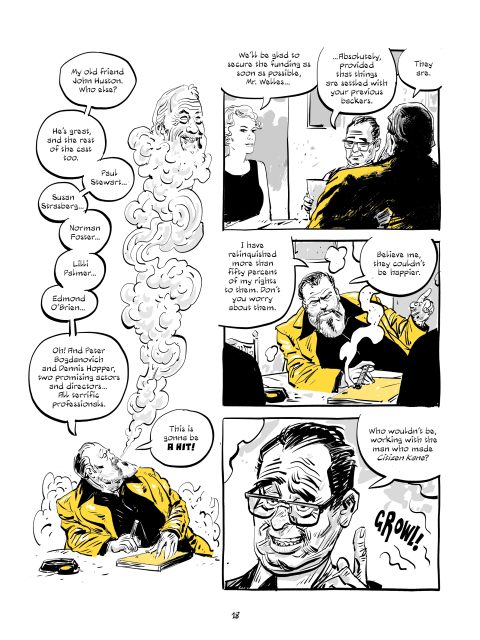
One of the through lines of the book is The Other Side of the Wind, both the shooting and the fundraising for the film, which was finally released in 2018. Why was that an interesting and dramatically rich period to help frame Welles?
The Other Side of the Wind is the film that best encapsulates Welles’s entire artistic journey. Granted, it’s a bit challenging to watch, as it’s packed with references to his other works—but that’s precisely where it becomes a sort of retrospective manifesto. Everything is in there, the old director feeling desperate and irrelevant in today’s cinema (the 1970s), at the time the New Hollywood and how he was trying to keep up with the changing times and the ingratitude of the corporation towards him. On top of that, I thoroughly enjoyed “directing“ Welles and Huston, two aging giants, letting them unleash their wit and biting humor.
The film The Other Side of the Wind was finally completed in 2018. When you saw it, had you begun thinking about this book? How did the film play into your ideas around Welles and how it became central to the book and your idea of Welles?
Every Welles buff will tell you that he saw bits of footage of that film way before it was finished and released by Netflix. Like I said before, this film was very important to him at this point of his life and career. It’s a very strange piece of work. In the early 1970s, he was eager to come with a new form of telling a story. He’s shown that eagerness with F for Fake, his movie/essay, but was very disappointed by the film’s lukewarm reception. It didn’t fare well and the New Hollywood, the studios and the rest kept on ignoring him, or dismissing what he thought as an innovative take. I could’ve centered the action of the graphic novel around the filming of The Other Side of the Wind and it would have worked all the same. It’s a very strange piece of work.
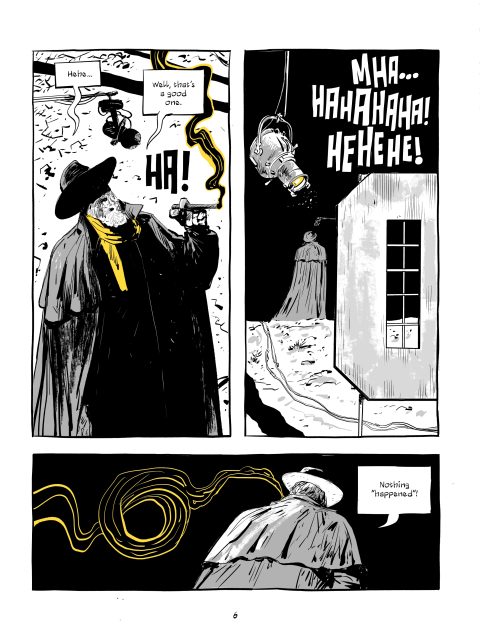
Besides just the story of the making of it, the text of the film is so rich and multilayered. You have to wonder what might have happened if it came out in the 70s and how people would have reacted to Welles skewering old Hollywood and avant garde cinema types. His comments on actors and critics. And skewering himself as well.
In Welles’s own words, the movie he intended to make was a portrait of an old Hollywood dog trying to crawl his way back into the fold, Hollywood fold. We must keep in mind that the artsy movie-in-the movie was allegedly inspired by Oja Kodar, in all its over-the-top caricature of some European arthouse movies. By the way, Welles abhorred Antonioni, so he went, with the outrageous aspect of those works. What he ended up doing was a harsh portrait of himself and a bitter take on Hollywood. He had to smuggle his crew in a studio for some shots. Given his long gone Hollywood career, he was definitely an outcast. Picking Huston for the part was crucial to him. Ironically, Huston succeeded in the Hollywood ecosystem, and Welles didn’t. The scene with Welles and Huston is maybe my favorite in the graphic novel. Not spectacular, but everything about the movie, and Welles, is summarised there.
It also exemplifies how Welles was his own man. Even if that wasn't always appreciated. He wasn't part of a school or a group or a wave. And while he didn't make autobiographical work, you can see him and his concerns in everything he made.
He was his own man, indeed. Apparently, he watched less movies than the average movie goer to avoid, I would imagine, any influence and to do his thing freely. And yes, his works are the best autobiography possible, especially in Chimes and The Other Side. That is what I liked so much about working on this graphic novel, the many facets of the man, the artist and the trove of interests he had in every aspects of the human spirit. I also like, and try to share, the curiosity of that man and his desire to be forever young at heart until the very end.
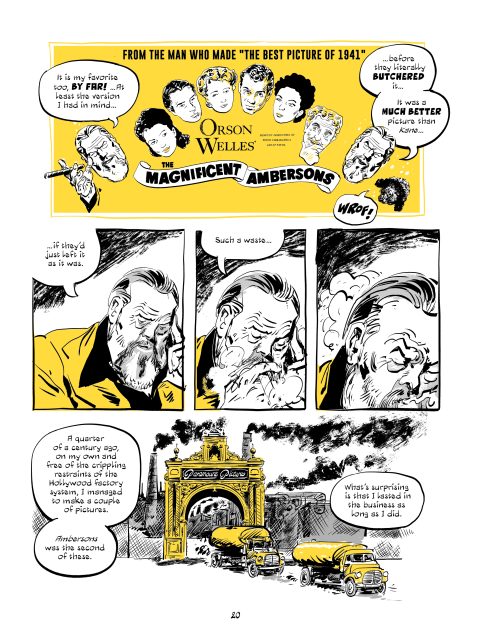
One section of the book, “The Greatest Home Movie Ever Made 1970-1976,” is about the making of the film. I wonder if you could talk about how you researched and wrote and drew the chapter.
For me, everything begins with the word. It’s the words—the dialogues, their humanity, intelligence, and humor—that drive the narrative. I’ve always preferred films adapted from plays (I love the work of Mamet and Shaffer). I try to embody characters through the way they think, speak, and interact with others. That’s what ultimately shapes who they become.
What I also love is blurring the line between fiction and documented reality. With Welles, the filming of The Other Side of the Wind was the central pivot of the book—even if, on the surface, it seemed like just another chapter. I enjoy creating a mise en abyme: the real person versus the mythic figure, or the version the public imagines. Then, there’s the weaving together of factual reality with the artist’s creative work—in this case, that of a man of the theater and film director. This creates a constant echo between the artist’s voice as an individual and his voice through his films.
When adapting Shakespeare, Orson wasn’t merely serving the Bard; he was making him speak for him—expressing his own truths, his thoughts, and revealing his deepest anxieties.
The drawing, the structure, the dialogue—it all happens simultaneously, like a single living entity moving in unison. Sometimes a line or situation will inspire a frame (a panel), but other times it’s the panel itself—the character, a posture—that conjures a particular line, even an entire sequence.
Would you believe me if I told you I have very little control over the characters? They have their own existence, their own will. More often than not, I simply follow where they lead.
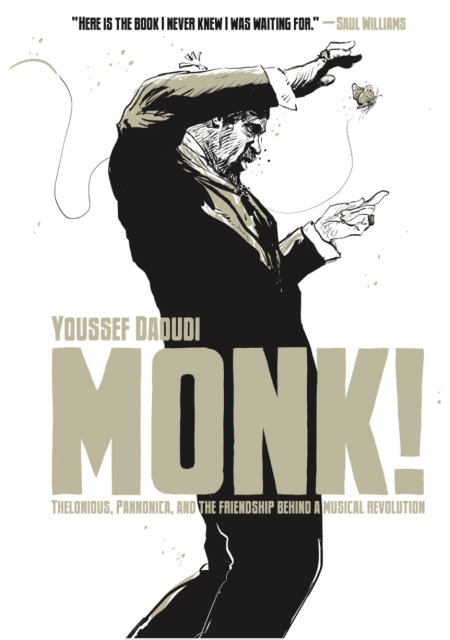
None of the three books we’ve been talking about are biographies really. How do you think of them?
Portraits, maybe? Each shaped by the strong perspective of the painter or portraitist. Not out of bias, nor with the intention of creating a hagiography or an indictment. Of course, it is always exciting to share one’s interest for those figures. Their utmost humanity is all that matters, yet, they’re usually, and finally, a vehicle for expressing my personal interests and obsessions
In the back of the book you mention that besides all the preliminary sketches you drew, you also made a 3d model of Welles. Is this something you've done before? Why was it helpful?
It was the first time actually. I wanted to know the man even more than through the dozens of books I have about him. Besides, I like learning new stuff and that was an opportunity to try out some 3d sculpting software. It was helpful and a ton of fun.With that 3d model, I fiddled with lighting and was able to study and sketch him in various angles and study those harsh shadows that you see in old black and white movies. Today, I’m sculpting oil based clay when I have time, and it’s just fantastic.
You said that you have little control over the characters. which is not an uncommon sentiment among creators. But I'm curious about the process of making a book where that's the case. It also draws attention to your use of Welles' quotation about endings that you have near the end.
Well, the process is very simple: follow the character’s desires. In fact, that’s the driving force behind any good story—every screenwriting theorist will tell you that. But there are limits to this approach if you don’t know the character well; you have to understand their madness or irrationality. You must forbid incoherence and arbitrariness. Since this graphic novel isn’t a biography—we had agreed on that—it still ends with a conclusion. I was relieved after those months of work, but I was overwhelmed by the anxiety of that ending.
First of all, the ending had to be conceived from the very beginning of the writing process—it actually solved the issue of the prologue. I remained in the realm of theater, on a film set. And I believe that what scares a human being the most is not death, but finitude. Especially someone as thirsty for adventure and creation as Welles was. That final quote was a joke, a wink—like he often did. He was a great storyteller, but also quite the fabulist.