
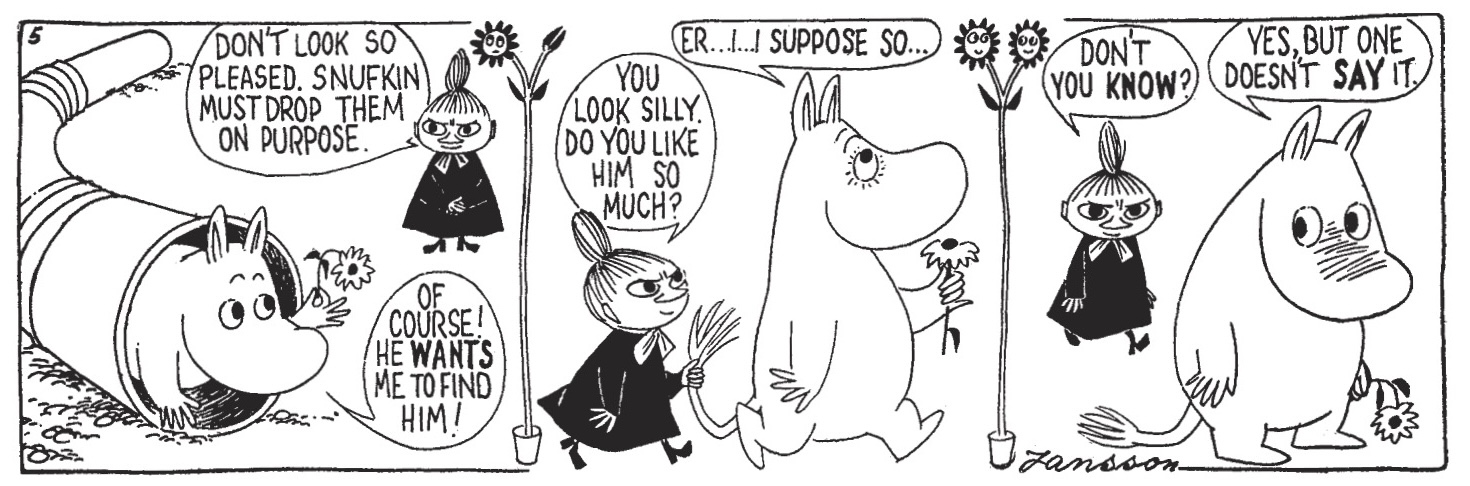
It's been 18 years since Drawn and Quarterly released its first collection of Tove (and later Lars) Jansson's Moomin comic strips. Long-whispered about between aficionados but rarely seen up till that point, that book (plus the several subsequent volumes) proved to be one of the rare occasions where the hype was truly justified – Tove Jansson's adaptations of her popular (at least in Europe) children's novels were charming and funny (with a ever-so-slight hint of depressive darkness) that was unlike anything produced in American newspapers.
Now D&Q are republishing the strips in new, softcover, landscape books, giving those who missed out the first time the chance to become acquainted with these delightful comics all over again. I reached out to Drawn and Quarterly's executive editor Tom Devlin over email to talk about the new editions, his personal history with the strip, and how its popularity has grown in the years since that initial collection.
How did you first become acquainted with Moomin and what was it about the strip that made you ultimately decide to publish it?
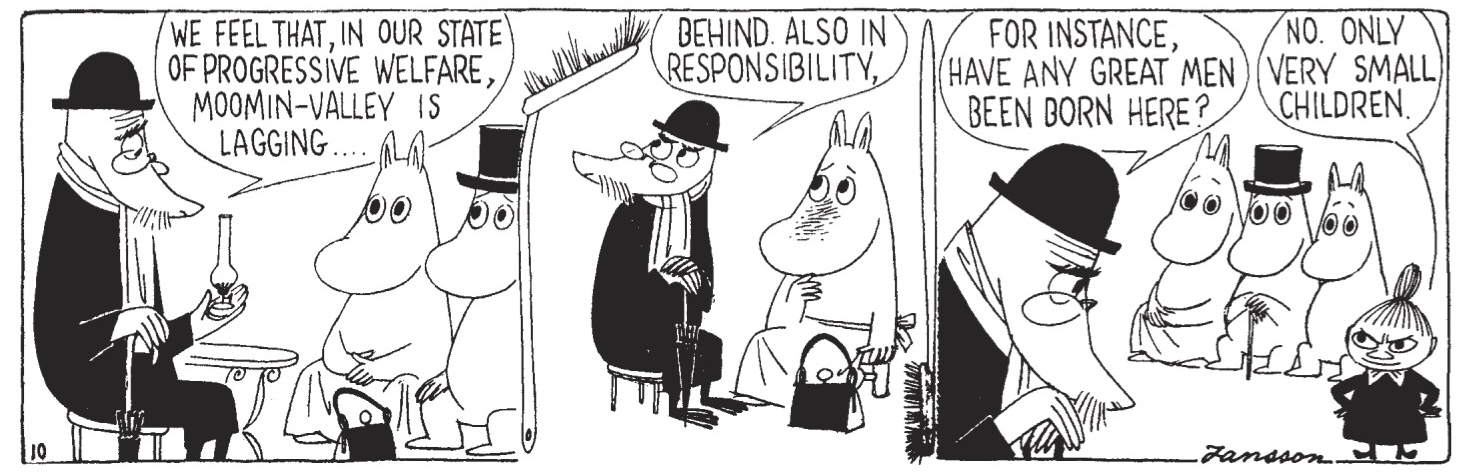
I didn’t grow up with the Moomin chapter books so I knew nothing about Tove Jansson when Tom Hart and Megan Kelso started talking about them. My interest grew directly out of their interest. It was long enough ago that specific details remain fuzzy but I’m pretty sure I first saw a handbound photocopy of the only Moomin comics collection to have ever been published in English on a Highwater/Black Eye tour I organized with Tom, Megan, Dylan Horrocks, and James Kochalka. Dylan had been given a copy of this “book” by Paul Gravett. And like anything else I did then as an editor and as I do now, I was excited about these personal discoveries and wanted to share. I made a few copies myself and hoped to publish the strips someday. What attracted me was both surfacely obvious — her cartooning is immaculate. And then when I read the strips I was astonished by the voice. Funny and humane, a little sour but not nihilistic.
Has your relationship with Jansson's work changed or deepened in the years since you first started publishing the strip?
For sure. Initially Moomin was just another fascinating lost comic to me — like Jack Kent’s King Aroo, or Daniel Pinkwater and Tony Auth’s Norb. But as I slowly accumulated more strips and read the Moomin books and then Tove’s adult novels, I realized Moomin was a particularly rare thing. A world class writer who restlessly tried out different forms and styles of art and writing. There wasn’t a ton of Moomin scholarship in English when D+Q started publishing Moomin but that has grown by leaps and bounds over the years and that excavation of personal history has definitely informed all her work especially the strips.
Can you talk a bit about this new republishing project? What led to the decision to publish the strips in a smaller, landscape, paperback format? Why decide to publish the strips out of chronological order?
Peggy and I were talking about Moomin and what should come next. Obviously there’s a finite amount of Tove material. Our hardcover Moomin books still sell well, as do the smaller color volumes, but we’re very aware that bookstore sales are predicated on newness and it seemed like we needed to introduce something new. It was a chance to experiment with format and price point and find a new way to get these great comics into new reader’s hands.
Do you see any noteworthy differences between Tove and Lars Jansson's work? Both are great, but it seems like the latter tends to aim for the punchline more than Tove did.
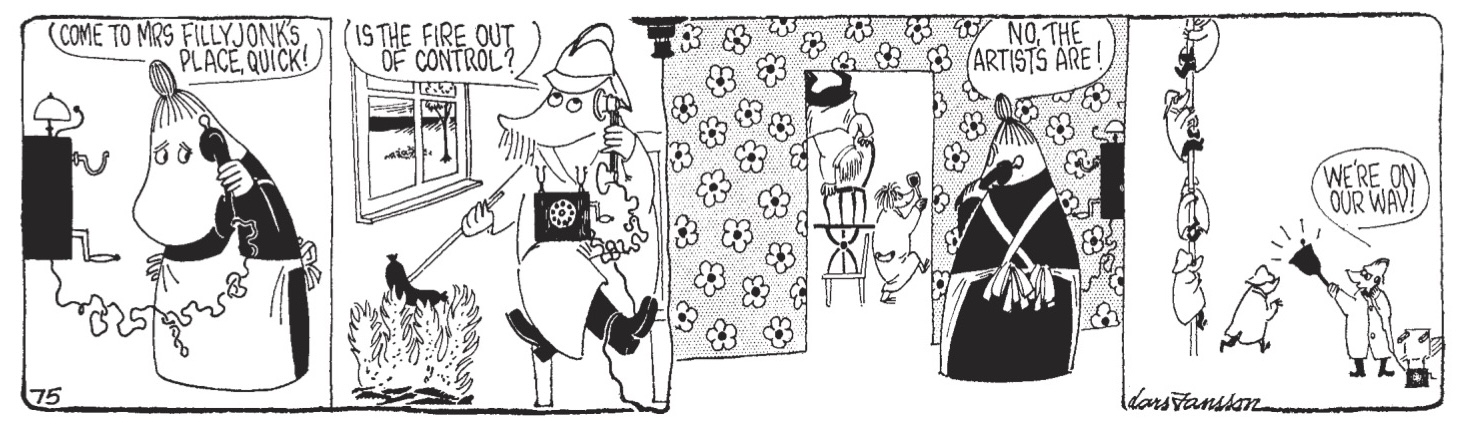
I think Tove was just a more natural storyteller and the jokes would grow out of that. She let the comedy come out of the characters’ interactions. Lars tended to have wackier storylines and really push the punchlines. Tove really worked what we would now call a “vibe.” I always thought Lars had a pretty tough job following Tove but he did deliver.
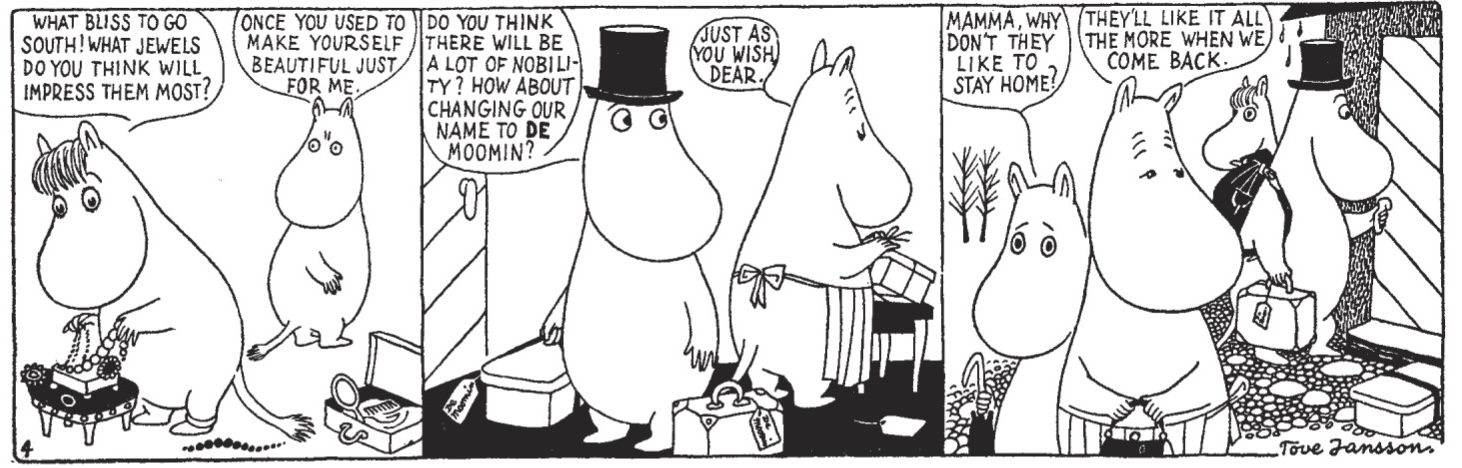
Re-reading the strips, I noted the unique push-pull theme of many of them, where the Moomins, especially Papa and Snorkmaiden, want to seek adventure, status or wealth, but almost always find a life of quiet solitude more preferable. Beyond being a basic device to get the plot moving, how much do you think these "avoid the bright lights" plots reflects Jansson's own personal philosophy? Do you see her as someone who had an ambivalence between making art and achieving notoriety and wanting to just be left alone?
I can’t say I know enough about Tove personally but yeah I think your idea of her ambivalence to fame tracks. Also, if you look at her life, she spent half the year in the city center and half on an isolated island. That dichotomy was there! Also, Tove was “out” as gay but it just wasn’t talked about at all which seems very Moomin.
Since D&Q first published Moomin many years ago, there have been (I believe) a few more cartoon shows and even just a month or so ago a Moomin video game. Has Moomin gained in popularity, particularly in North America, over the last few decades? If so, what do you attribute that to?
There’s no way to know for sure but I think North American interest in the comics really helped bring back attention to the Moomin brand when it had become something that the Finnish kind of took for granted. Sophia Jansson also moved from the U.K. and took a much more active role in the licensing at that time. Probably some nostalgia for the Japanese animation that was enjoying a resurgence due to YouTube. In the last few years, we noticed a new audience for Moomin that has to be because of its meme-able qualities.
I dug up your old TCJ essay on Moomin from 2001, and at one point you write how the Moomin characters aren't just "hollow, smiling idiots." Can you expand on that a little? There is a subcurrent of melancholy that runs through a good deal of Moomin. Do you think that's what attracts readers to the work?
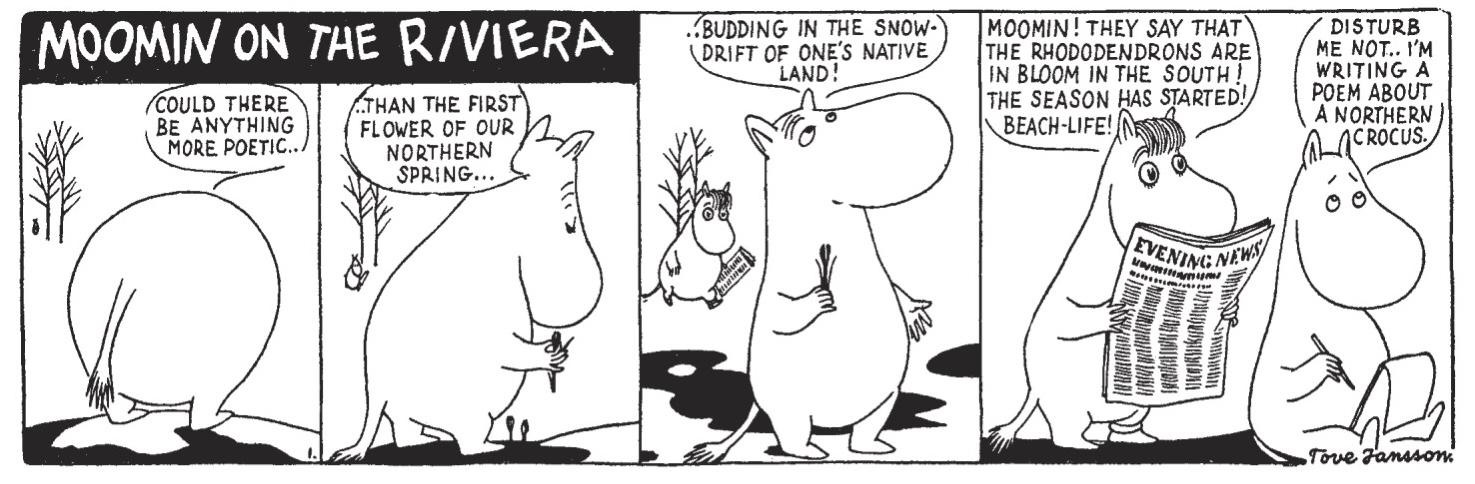
I saw that recently too and cringed at my terrible characterization but I think the characters do come off as more complex than the typical daily comics page fare. But also that melancholy is for sure there too. Without pegging Scandinavians as an entirely depressive lot, I do think it is somewhat of a national characteristic. Similar to Peanuts in that way, it’s reputation is this fun family strip but there is a darkness (although Schulz’s seems more personal.) I do, for sure, think it attracts readers or maybe it’s what keeps them around after the beautiful drawings and funny jokes attract them.
Any plans to publish any more of either Jansson's work?
We did have trouble sourcing quality reproductions of Lars’ work and that kind of ground things to a halt a while back. There’s always the chance better scans will surface. And far as Tove goes, there are some new things that have surfaced due to the amazing historical efforts of the family so I’m hoping we’ll have some surprises for fans soon. Sadly as far as Moomin goes, what we have is what we have. There can’t be any more Tove Moomin stories but she did make a lot of art in her lifetime.