
Before I get into this month’s doozy reviews, I wanted to share something with you. This is a bit of good knowledge I stumbled upon a few years ago and tend to keep hush-hush, only informing other inquiring minds in DMs and dim barrooms. Here it is: In 2020, America’s Showman, David Lee Roth, created an intricate, vertical-scrolling, futurist webcomic. It still works and is still superlative — see for yourself. (Mr. Roth, if you would like your official Comics Journal interview, please get in touch.) Now, in regards to May’s “Arrivals and Departures” write-ups, I know everybody wants some and, yes, I want some too.
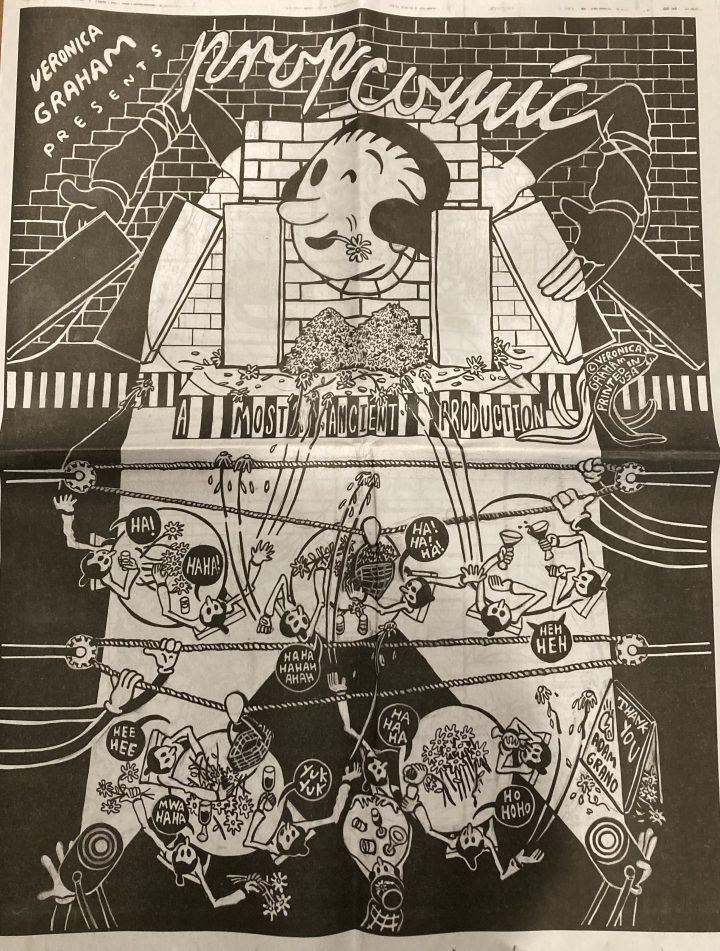
Veronica Graham wears a lot of hats — VR empresario, publisher, conceptual artist, printmaker. But now she puts on the most important hat of all, that of a cartoonist. And what she made is physically imposing. Pages are about 17.5" x 22.5" and I had to spread this thing across the dining room table and hover over it like a vulture. That arduous stance plus the post-modern dizzying momentum of it all had me feeling like I just downed 4 lukewarm Rainiers. After my lament in March where I went on and on about newspaper print, I’m back in, baybeee! I am a comics fan after all, so I hold onto an almost childlike faith in, “You never know…” to fight off the cynicism cherubs floating above my noggin. And would you believe that this is newspaper done right? There’s a variable texture to Graham’s whites which make them seem in some parts like they’ve been done in chalk or Wite-Out. The black ink also holds its tone and doesn’t do a scummy dance smearing all over the massive pages. The printing is relatively impeccable.
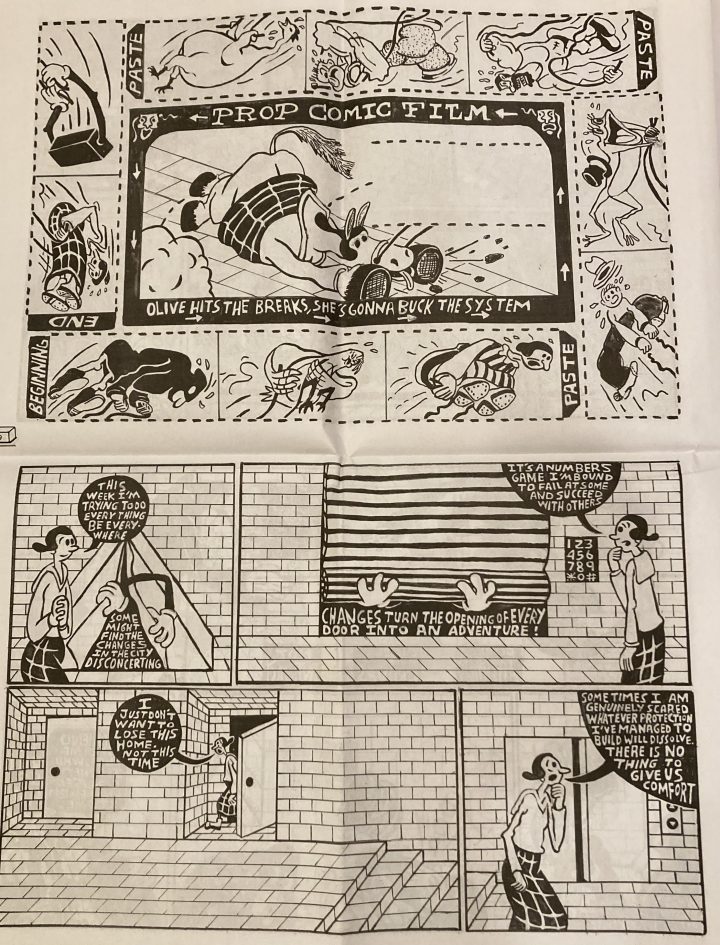
Prop Comic is the premier pondering, aggressively metaphysical take on E.C. Segar’s characters since Tom Neely’s Doppelganger, which I still consider one of the best minicomics of the last 20 years. Here Graham tests the limits of both how much a reader can relate to a public domain character, but also how much of a reader’s own real-world baggage can be hoisted upon their backs. As she frequently is, Olive Oyl is our damsel in distress in Prop Comic, but there’s no anchor-armed hero tootin’ his way to save the day. There’s not even Castor! Oh, and that distress? It seems to be an algorithmically enhanced triple threat of everyday exploitation, nostalgia, and overthinking. Through Olive Oyl and 38 pages of unrelenting turmoil and trap doors, Graham is asking you to squint your eyes and pull deep focus on your own self-definition and the world you’ve created for yourself. Is it structural and systematically fortified scaffolding holding it all up or some frayed rope and rusty pulleys? This discombobulating broadsheet can be read as commentary on the danger of being a woman, the danger of living in an ever-changing city, the danger of looking inward so much you come out the other side of the spinach can. I’m doing my best not to project, but here’s what I think Prop Comic is really about. In our lives — you are Olive Oyl, I am Olive Oyl — we potentially face many deaths: of ego, of ambition, of dreams, of dignity. The work is in mustering up just one more resurrection.
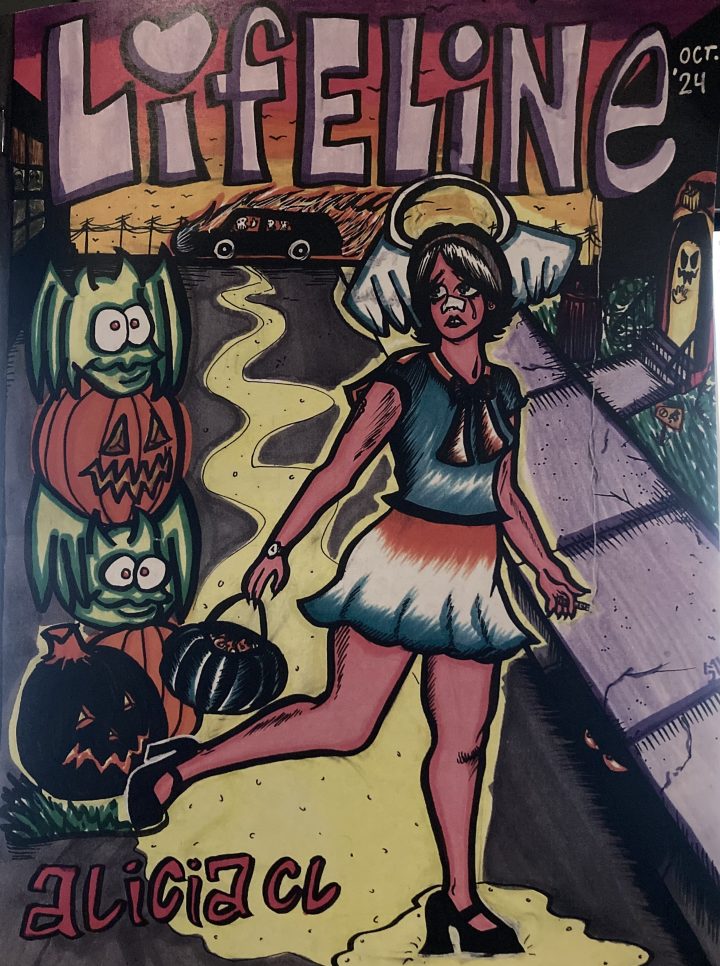
The opening line of this publication is, “Hello! This is my first comic book.” Choosing to include this little hand-written note on the inside front cover can mean several things. My initial thought was that she’s getting out ahead of something — that it’s a preemptive warning about the quality of the comics. Buuuuuut I don’t know Alicia C.L. and who’s to say she isn’t a classic pool-hall hustler. This introduction could all be a feint! Lastly, this minor admission about it being her first comic could just be a request to grant her some grace, which everyone deserves, especially Philadelphians. Well, I’m here to report that Lifeline, Alicia C.L.’s first comic, falls under none of these categories. Or all of them. Choose your own adventure.
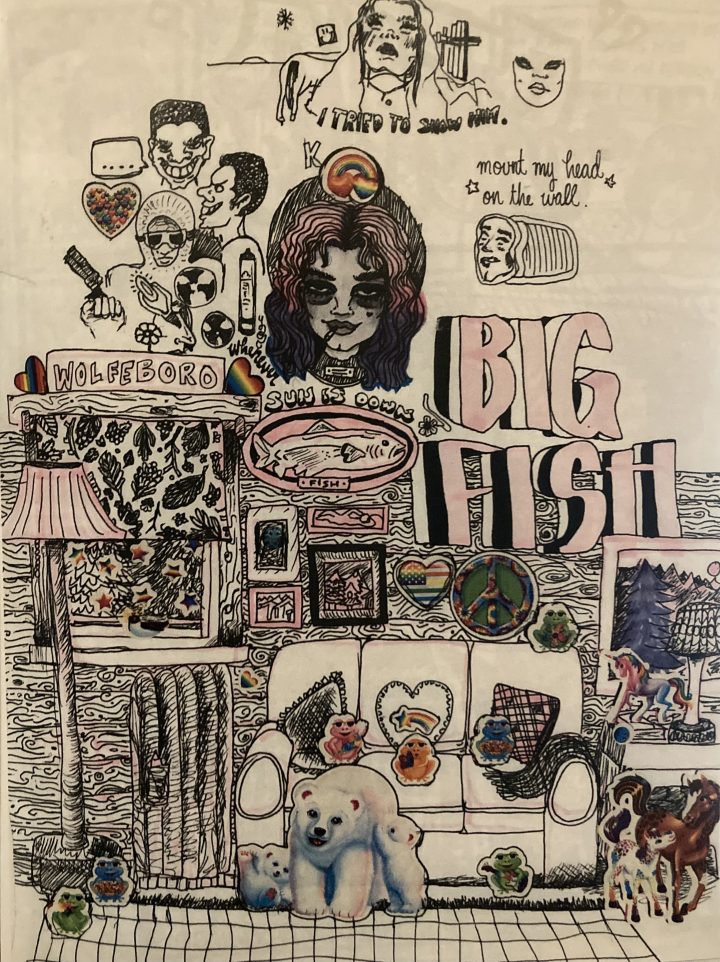
Lifeline is full of doodly notebook interstitials, pages that go heavy on the Copic, and mixed-media collages. There are also stories based on dreams and real events that get in and out real quick. The longest story at two pages is “Way Back When,” done in everyone’s favorite riso shades pink and blue. It’s the strongest in terms of narrative and serves as a better introduction to C.L.’s work than that aforementioned note — I would have put this story first instead because it’s a tone-setter. Here, Alicia recounts how she kept diaries full of secrets as a child and added supplemental sequential drawings and photos to them. During the throes of COVID, she found these old notebooks and us readers are to assume that’s what led her to create this new comic. Lifeline is nothing if not inconsistent, which isn’t necessarily a bad thing. It just is. There is a spread early on in the book that features a page on the left called “Pink Fever” that is absolutely overcooked, full of digital effects. On the right is a marker-straight-to-paper page called “Seal” which should have stayed in the back of a sketchbook. Then you turn the page 3 times and you’re rewarded with a stunning spread that looks like it’s done by a different and more confident artist altogether. Here we have a cover to an unmade EC-esque horror comic and a page full of delicate drawings interspersed with Lisa Frank stickers. And it works! The biggest hurdle for C.L. will be deciding on what to do next. Is she still developing a distinct voice? Does she even want one? Can’t really make that call until the note says, “Welcome back! This is my second comic book.” I guess we’ll see.
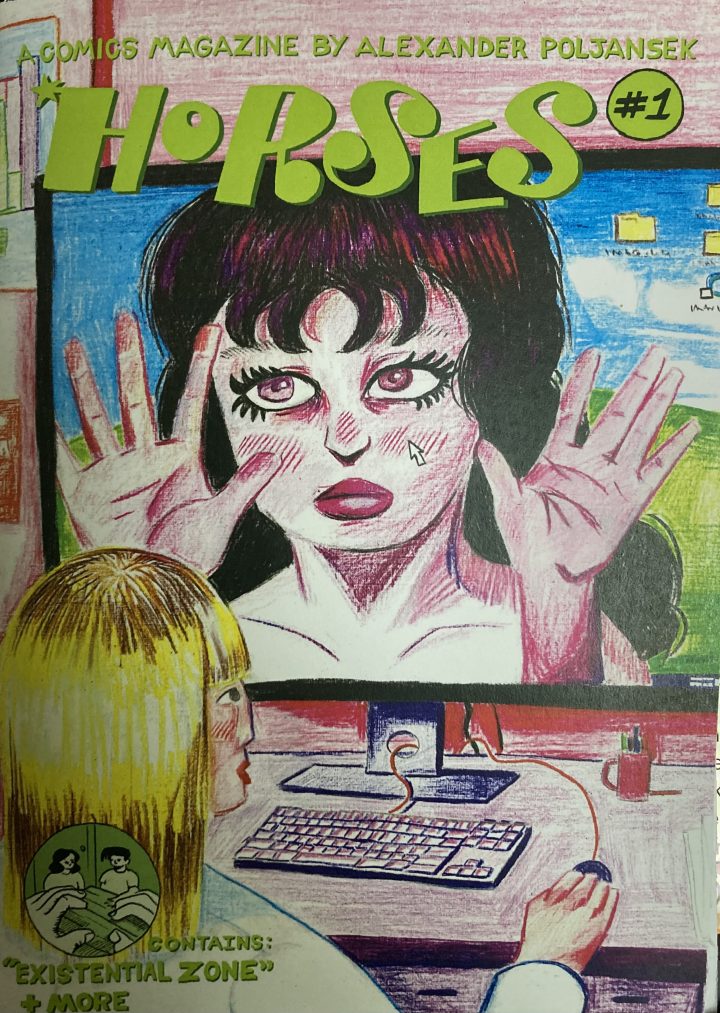
Horses #1 by Alexander Poljansek
This one-man anthology couldn’t be more different from Lifeline, but we’ve come to a similar outcome — a young artist throwing things against the wall to see what sticks with widely fluctuating results. The first story is a twelve-pager about a chart-topping pop star touring her hit album “Hack,” which I think is a joke. We learn that the singer wants to have her entire brain transferred to the cloud in hopes to “make the sort of music that a computer would make on its own.” She knows exactly the right people for the job and the procedure happens immediately. The operation goes dramatically wrong, then it goes dramatically right, and it all ends with a punchline. Poljansek steamrolls story beats without much thought to if they make sense at all. To me, that’s a lot more satisfying and more fun to read than some bogged-down backstory in extended caption boxes. It’s also funny that the scientists and surgeons performing the delicate brainwave extraction are wearing jeans and polo shirts.
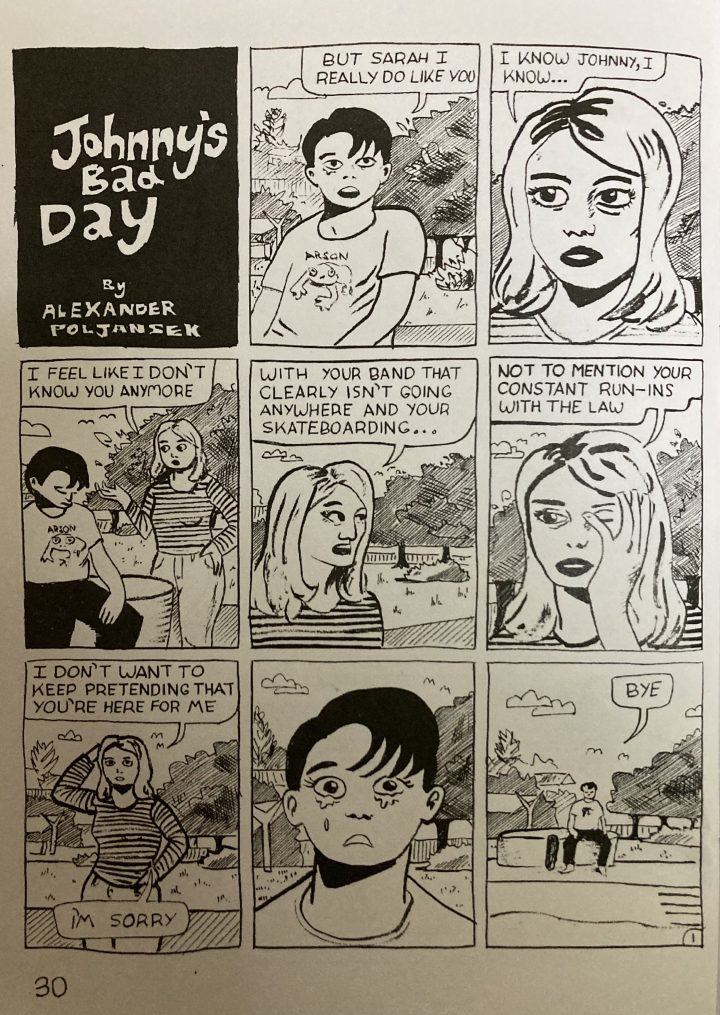
I have a hunch that Poljansek might be working with too much speed. That is leading to hurried looking art and decision making. The main stories in Horses are about a band called the Plymouth Furies. We learn they have a missing bandmate from the very first speech bubble that reads, “Do you guys know where Johnny is?” Four pages later, their manager is driving them to a gig when he gets a call — “Johnny’s been taken by the cops again.” Then the band shows up at the police station to bail him out. I believe he’s the ragtag fellow yelling “Freedom” as he exits, but in case you’re not sure the very next panel has an arrow pointing to that character with a caption “Johnny.” I don’t know why that infuriated me so much, but it did. Serenity now. Anthologies always have some clunkers, but there are a couple single- and two-pagers in this issue that border on juvenilia that I wish one of Poljansek’s close friends told him to cut, at least for the sake of the other narrowly better stories surrounding them. But, but, but, I didn’t dislike everything here. There are many panels throughout with character drawings that have perfect expressions and small details like necklines are rendered flawlessly. Then there are ones where defining character attributes, like noses and hair, are completely rushed and off model. Many of these are even on the same page. I’d rather not relitigate “Craft is the Enemy,” but I will ask you to recall the previous review again when we talked about giving artists understanding and grace. Where I think Alicia C.L. was working at the very top of her current talents, Horses makes me think Poljansek could and should aspire to aim higher. He’s more than capable — look at that alluring cover! In the future, I sincerely hope he finds the time to read a few Liz Suburbia comics, slow everything down, and lock in.

Igor the Assistant by Haus of Decline
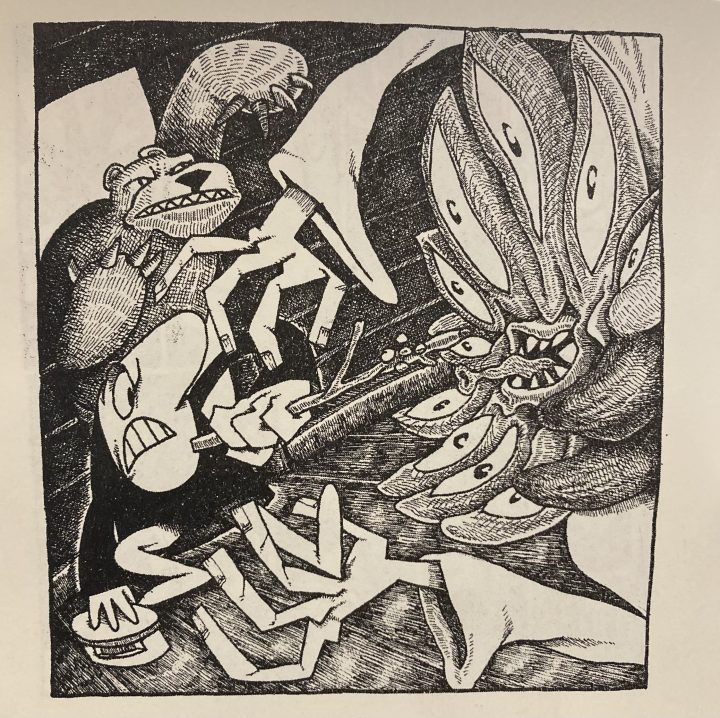
A webcomic that I’ve never heard of made by an artist that I don’t know — had a little inkling that this might make some good “Arrivals and Departures” fodder. Little did I know that I’d be opening myself up some of the best pure cartooning on this blue planet. Igor is a square, risograph-printed black-and-white self-contained story. Its titular star straight away gave me a flashback to a little cheese cowboy that used to appear in a commercial between episodes of The New Adventures of Winnie the Pooh on a taped-from-TV VHS I wore out as a kid. Either that or Ziggy’s Eastern European cousin. Most importantly, to any reader, Igor will be instantly distinctive and schlep along a bushel of joy based on Haus’s clarity of line and design. In fact, everyone and everything in this comic — the animal buddies, the fire in the hearth, the smoke billowing out the chimney — beams with contentment. That is until page 9 when Igor brings his homemade seedling-based cure-all to the house on the hill and knocks on the door. A woman answers and although being the first character to be drawn like a conventional human being, has something alien and very, very sad about her.
Way back in the summer of 2024 I was asked by the Stripburger magazine to write a little about and make a list of three of my favorite wordless comics. Mine were:
Comic Collection Book by Gizem Vural
Age of Reptiles by Ricardo Delgado
H Day by Renee French
I’m sorry Ms. French, but you’ve got to go. Igor the Assistant is now in my top 3, with a bullet. Back to the story, we learn that the medicine Igor and his fauna friends are carrying is for the woman’s lover who is locked in a bedroom and has become a flower-petaled monster. Haus gives us one splash page that’s drawn in an off-kilter action perspective that is tremendous. And there’s something about the monster’s teeth and tongue — again, the overall design — that is reminiscent of the great Gahan Wilson at his most grotesque. Haus’s cross hatching, “camera” angles in each panel, and poised mark making across this entire book add a density to the buoyant storytelling and visuals. It’s absolutely thrilling to read something so well constructed. I hope there’s more of this type of stuff coming from Haus soon because she’s got the juice.
In my real life (not my jet setting comics critic life) I have two sick kids to get to bed so let me let you let me run. See you next month, I hope.
Questions, love letters, and submissions to this column can be directed to @rjcaseywrites on Instagram.