
They think if something happened to them that it's interesting because it happened to them...
-McCandless, on some writers, in William Gaddis’ Carpenter’s Gothic.
That is the challenge for memoirists. Make events from their lives meaningful to others. Wikipedia says about the cartoonist Jesse Reklaw little more than that he was born in Berkeley in 1971, grew up in Sacramento, studied at UC Santa Cruz, received an MS in computer science from Yale, dropped out of a PhD program in AI to draw comics, and lives in Portland with his cat. That would seem to leave Reklaw little with which to satisfy McCandless, especially if it was true, which it isn’t. The cat died six years ago, and Reklaw wasn’t born in 1971; Jesse Walker was, but reversed the spelling of his last name when he turned 20.
A more complete, more complex, more perspicacious biography is rendered by Reklaw through three graphic memoirs: Couch Tag. Fantagraphics Books. 2013; Lovf. Fantagraphics Books. 2016; Keeping Score. FU Press. 2019. Tag covers his life from age 3 until his early 20s; Lovf recounts several months in 2012 when he was in the grips of a mental breakdown; and Score records, diary-like, his life between September 16 and December 15, 2018. The nearly two decades between when Tag ends and Lovf begins are basically unaccounted for, although his author’s bio in Tag mentions a “dream comic strip,” Slow Wave, which ran from 1995 to 2012.
Score is the least likely of the trilogy to avoid McCandless’s scorn.
The Reklaw we meet here shares a house in Portland. (There is another cat.) He is a reasonably successful web designer and cartoonist. He plays guitar and drums in a rock group which practices a lot, gigs a little, and does not record. He babysits and cat sits. Following some failed relationships, he has committed temporarily to celibacy. He has phone conversations with a sister in Tuscon, and his mother, whom he has not seen in six years. (No explanation why is given, and no father is mentioned.) He suffers from degenerative disc disease and PTSD. He has pain in his back and side. He needs a root canal. His modes of “treatment” include pot, alcohol, DMT, Advil, massage, tai chi, saunas, meditation, stool softener. “My bad health,” he tells us, “comes from childhood trauma,” the specifics of which are undisclosed.
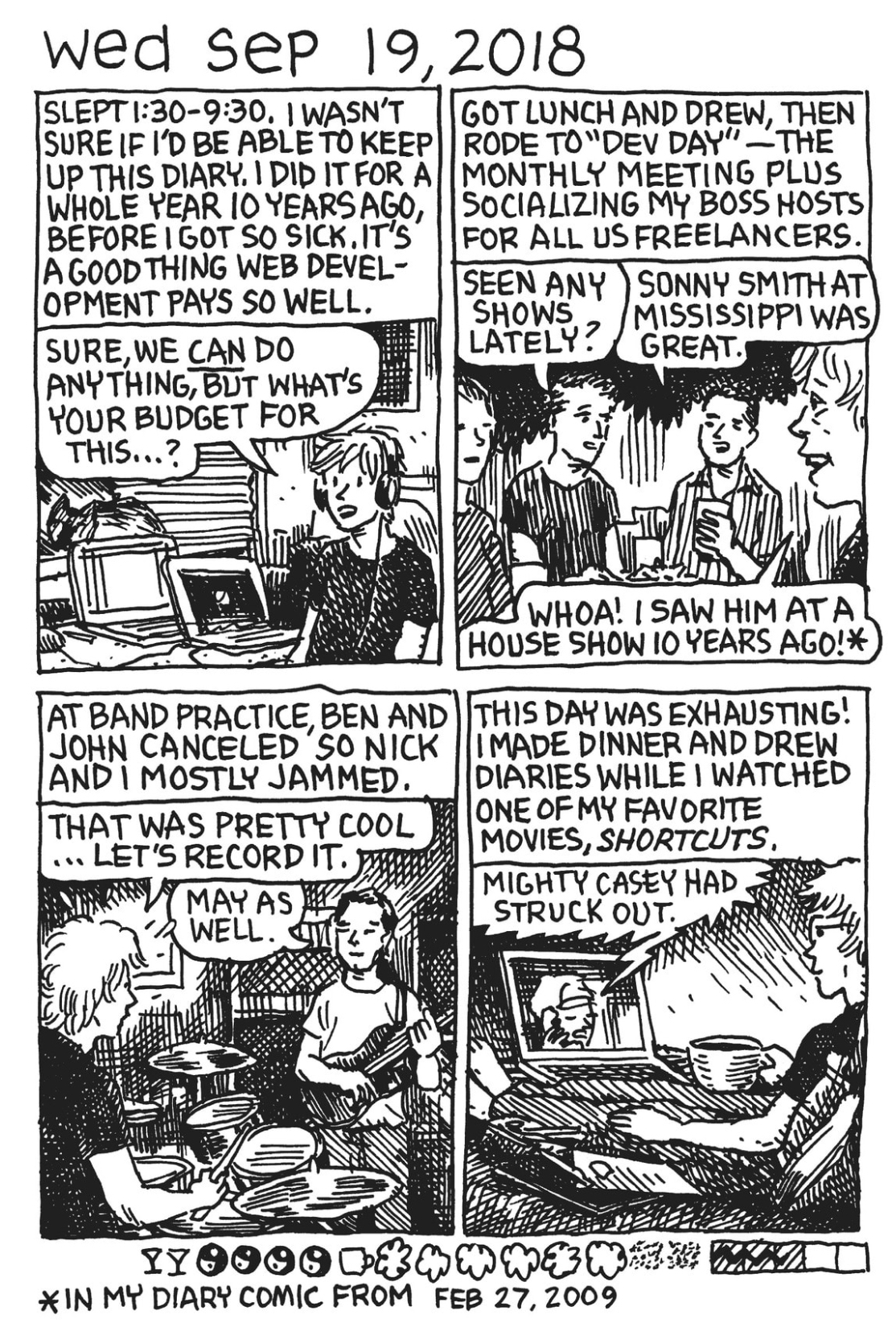
Reklaw meets friends for meals or drinks, comic signings or concerts. These friends seem largely like Reklaw. All appear about the same age; all are white. Many are cartoonists and/or musicians and have day jobs as massage therapists or Uber drivers. They suffer from sciatica, migraines, nausea and anxiety. They seem not to engage with major political, social, artistic, or ideological issues of the day. No conflict engages. Nor any emotion. The visual representation is distanced, restrained, four-panels-a-page. The content is affectionate; but one inescapably feels like a god looking down upon a colony of ants adrift in the inconsequential while the momentous lurks.
Tag’s narrative tone, for the most part, is light enough and its graphic style clear enough to cast a sheen of normality over Reklaw's undeniably abusive childhood and adolescence. The figures are realistic and the objects in their world recognizable. The illustrations are a soothing mix of blacks, off-whites and greys, until the last 27 pages when a wild swarm of colors overload them, capturing the mental disintegration Reklaw is experiencing.
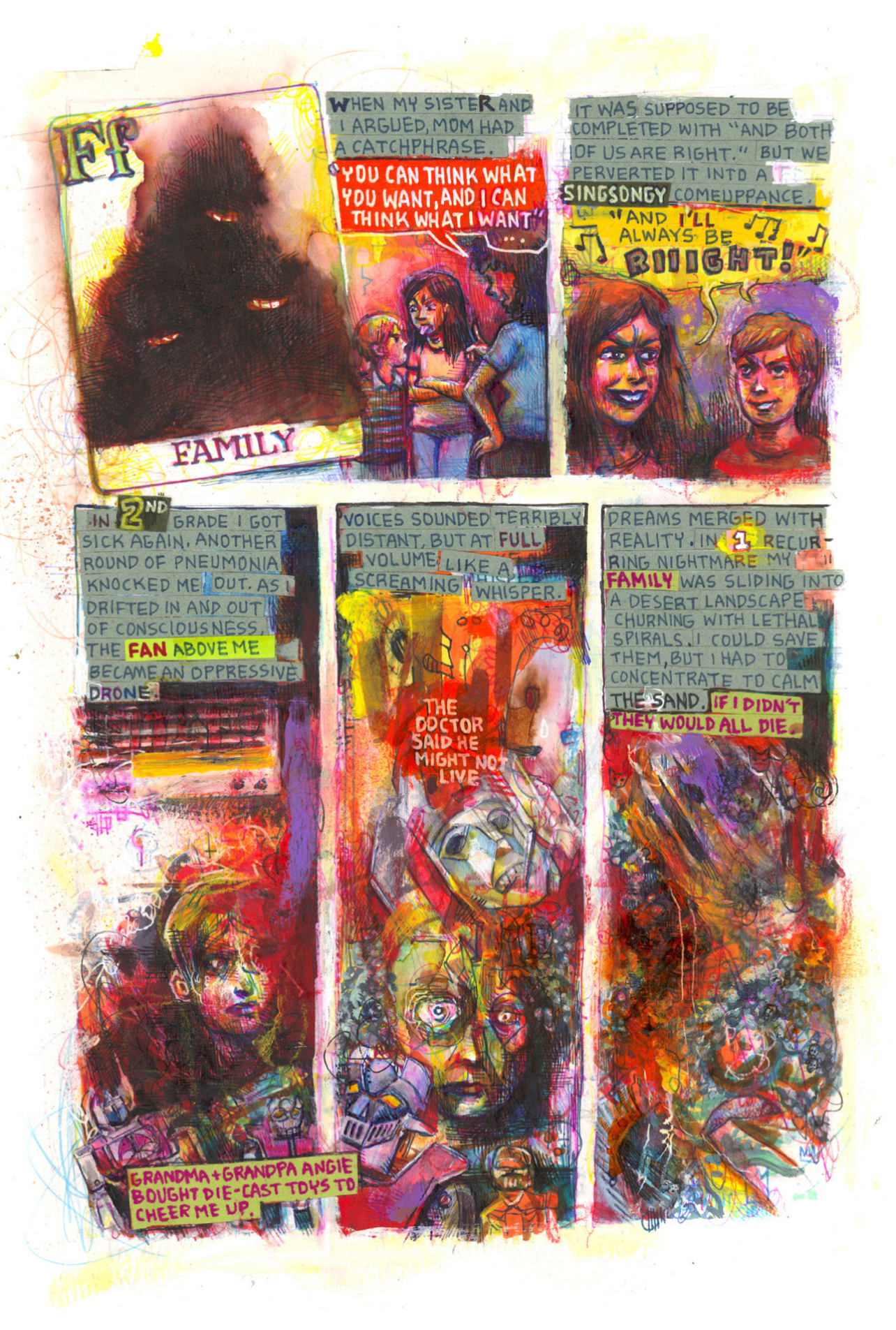
This single story is told through five overlapping ones, all of which are organized around artificially imposed structures: “Thirteen Cats of My Childhood” (in the order Reklaw’s family owned them); “Toys I Loved” (in the order Reklaw owned them); “The Fred Robinson Story” (practical jokes, in the order Reklaw played them); “The Stacked Deck” (card games, in the order Reklaw learned them); and “Lessoned” (an alphabet book, with each letter triggering a recall of events in Reklaw’s life).
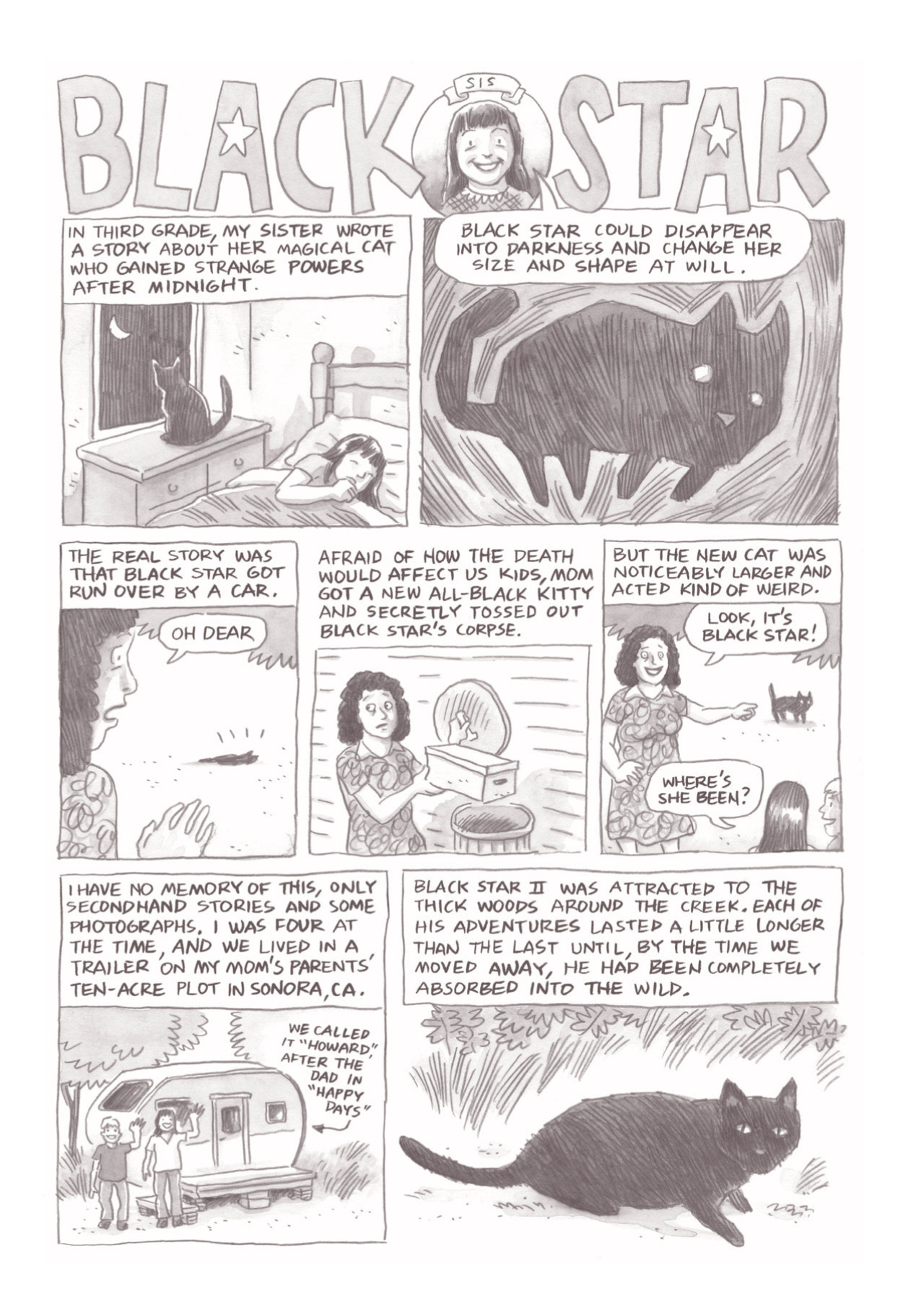
Family is the critical element. We learn little about Reklaw’s mother, but his father was a drinker, pot-smoker, drug dealer, seller of firewood, eventually a carpenter/contractor. He had affairs (male and female), and was rage-prone and physically abusive. Reklaw’s older sister claimed sexual abuse as a child, had an affair with her freshman English teacher, became emancipated, tested out of high school, and went to UC Berkeley, where she came out as bisexual and worked as a stripper. Relatives were institutionalized or became pregnant as teenagers or were hooked by speed or ludes or Reds or crank. When Reklaw was in his teens, his parents divorced.
Oh, and the cats... As omen or stand-in, run over by cars or gone feral or dead of disease or malnutrition or abandoned or shot, they do not offer much.
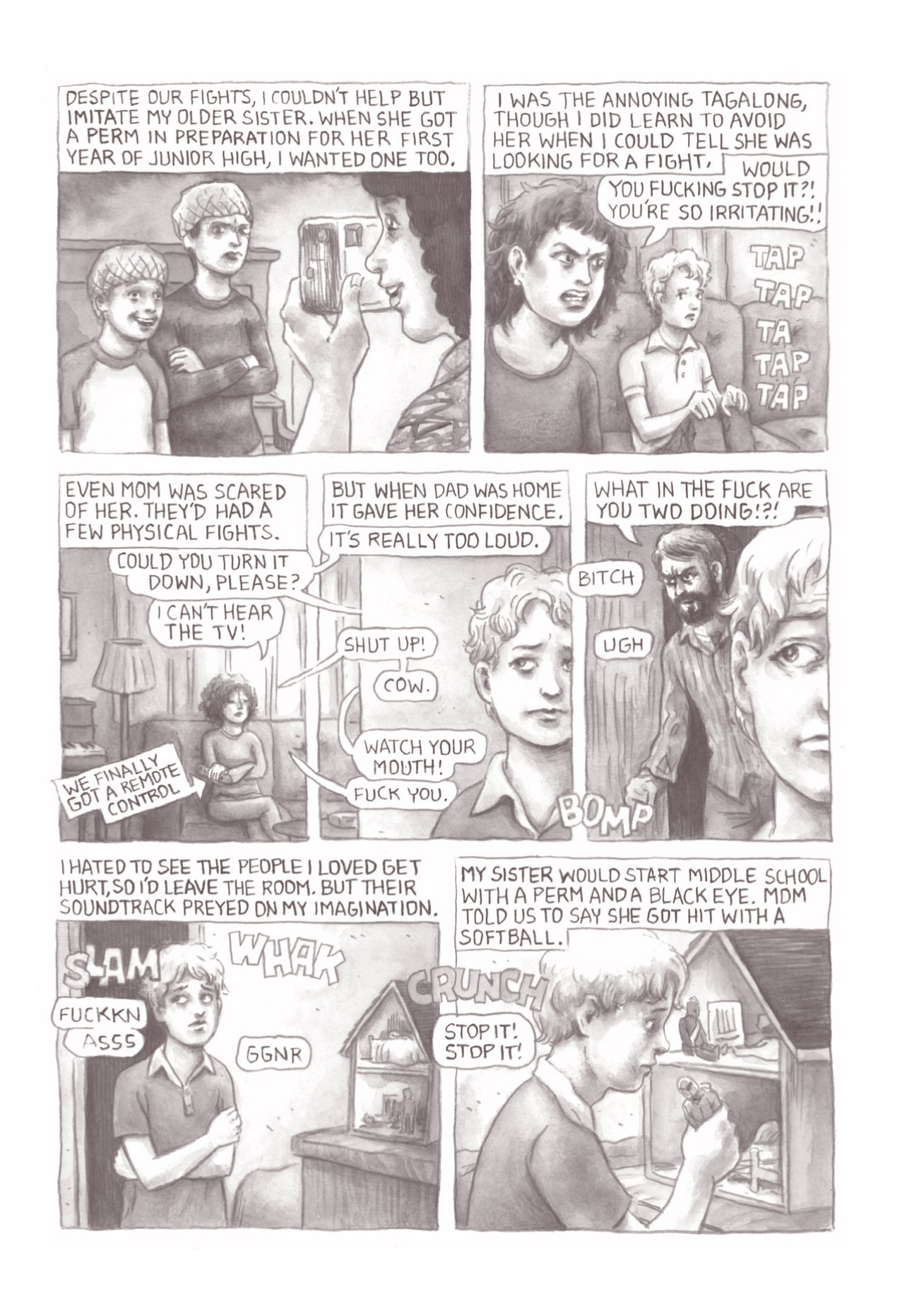
By the time Reklaw was 10, his family had moved half a dozen times. They lived once in a trailer and for a period on food stamps. He had measles, mumps, chicken pox, ear infections, a blood disease, and pneumonia, which gave him auditory and visual hallucinations. He was engaging in oral sex with another boy when he was not much out of kindergarten. Identified as “gifted” while in elementary school, he became his high school class valedictorian, but, outside it, his primary interests were comics and Dungeons & Dragons. Harvard recruited him, but he opted for Sacramento State, which he quit after six weeks to become an artist, specializing in portraits of himself weeping.
Reklaw was consumed by the idea he was nothing. He was obsessed by dreams of violent car crashes. He had visions of demons and believed he had been cursed by witches. He dealt and indiscriminately used LSD until he collapsed in bed for a month with “delerium and nausea.”
Vastly more engagingly detailed than Score, Tag supplies the “trauma” which had shaped the life the Reklaw in that book leads. But it is so damn familiar. It is as if Robert Crumb had established a prototype for future cartoonists to follow. Awful parents, bullying peers, oddball obsessions, off-kilter adolescence - and Bob’s not just your uncle but your father. The ground these memoirs cover is like a drive through Kansas, all flat, unvarying, and, at the end, not a Stuckey’s but a graphic tale.
But Lovf blasts Reklaw’s work to the heights and surrounds it with stars of illuminating originality.
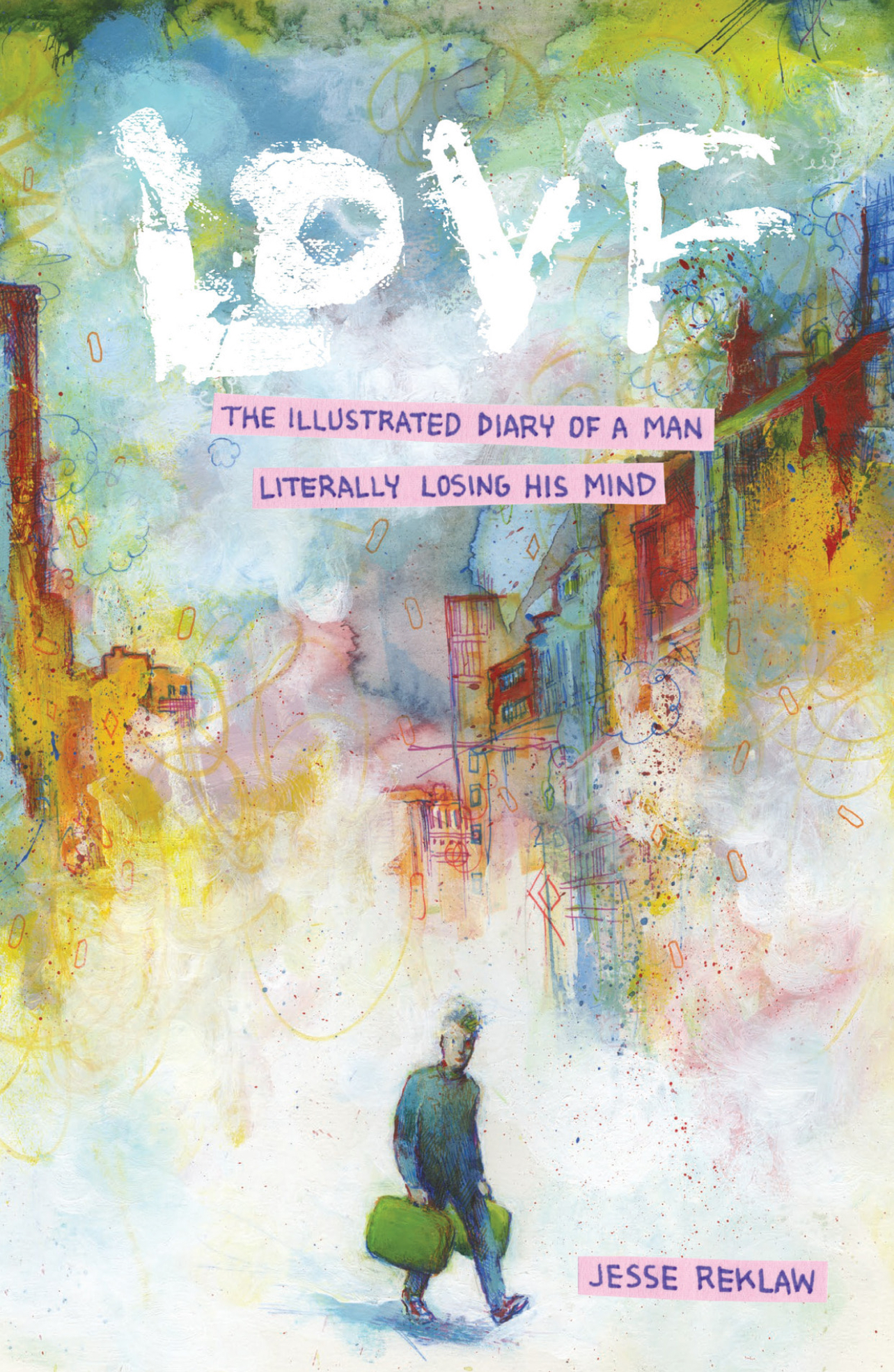
Subtitled "The Illustrated Diary of a Man Literally Losing His Mind," it contains three versions of the same events: first, a summary (pp. 1-11), hereinafter “V1”; second, the bulk of the book (pp. 12-170), “V2”; and, third, inserted toward the end of V2, a timeline (pp. 164-65), “V3,” which I take to be definitive. It is uncontradicted that, in 2011, Reklaw suffered a loss of work hours, the end of a nine-year relationship, and the death of a close friend. He was diagnosed with PTSD, a bipolar mood disorder, and foraminal stenosis, which caused him constant bodily pain and numbness. He seems to have been prescribed amitriptyline, an antidepressant, and lamotrigine, an anti-seizure drug. On February 19, 2012, V3 says that, following an amitriptyline “crash,” he was placed on Wellbutrin.
V1 implies by a date at the top of one page that Reklaw began Lovf on August 15, 2012, when, after a “band tour/ mental crisis” in California, he’d returned to Portland, thrown out most of his possessions, and begun the “quest” which the book will recount. It says he had hooked up with his band after four days in a mental hospital in Medford, Oregon, which V3 puts in mid July. V2 builds upon these events, but is, Reklaw writes, “a lie - its events deconstructed, reverse-engineered, and deliberately obfuscated; its characters compromises of reality, aesthetic expediencies disguised for privacy, then extruded into the symbolic.”
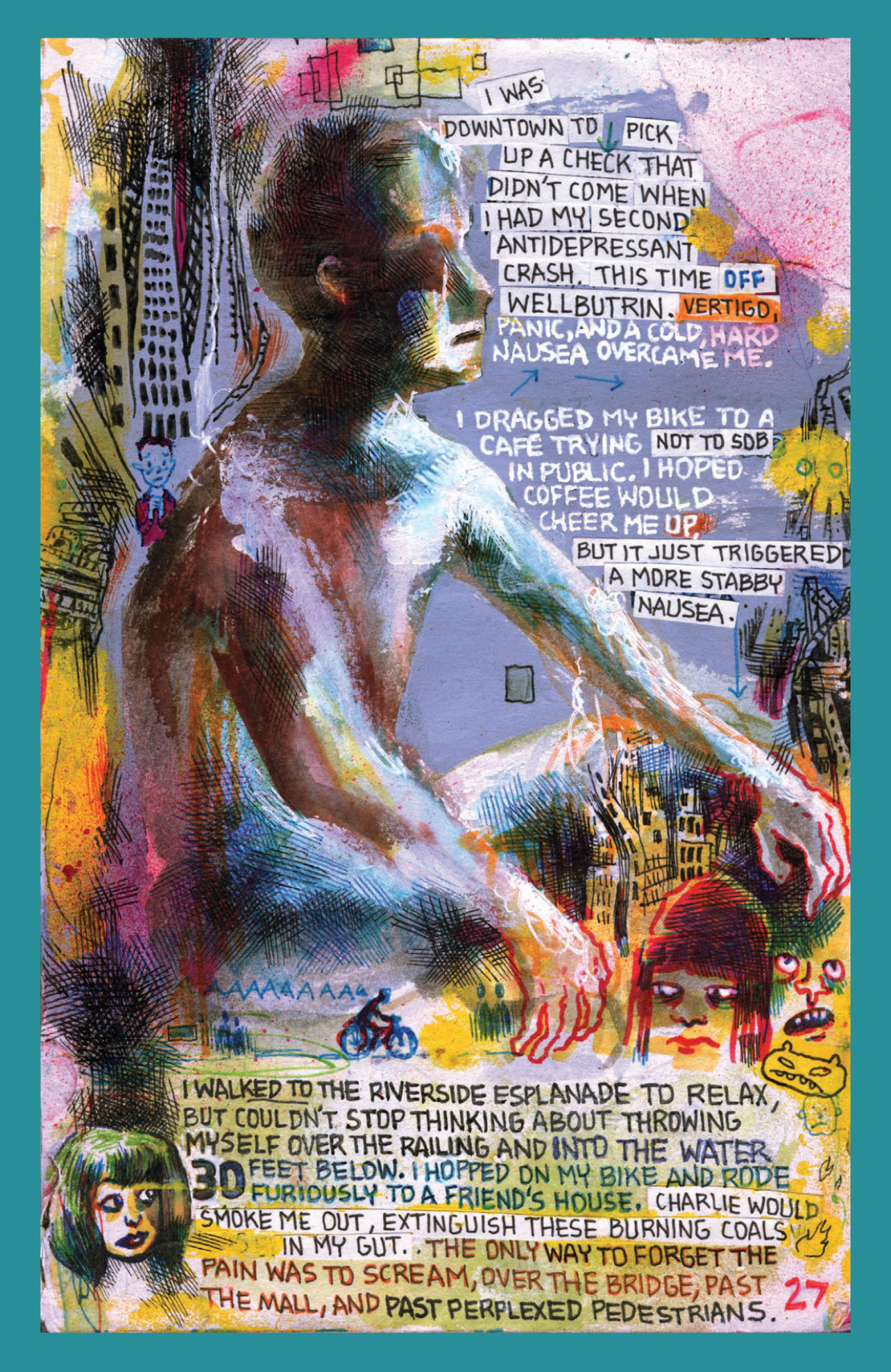
After a few pages of “delusions,” “paranoia,” and “fantasy adventures,” V2 settles into a chronological account. On April 1, Reklaw moves into a “hipster house” - from which he is expelled 25 days later for being “psycho.” (A Wellbutrin crash, on 4/16, which had him wanting to jump off a bridge, may have contributed.) He relocates to a place managed by a heroin dealer, where the rent is so low he can use money his mother sends him exclusively for pot. (The fact that, at 41, he is receiving support from his mother goes uncommented on.) He begins putting pages from Lovf online, well before V1 suggests he began it.
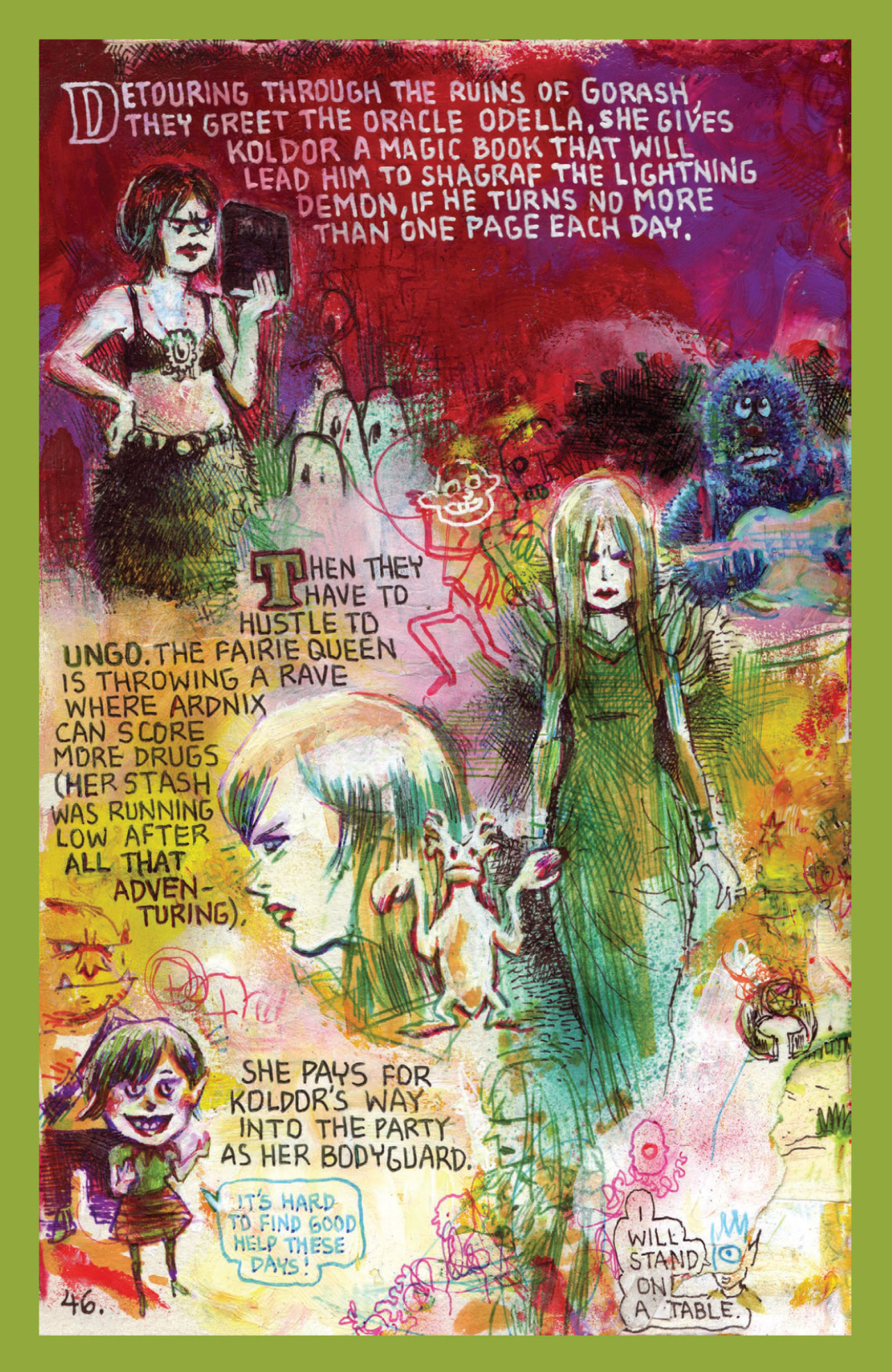
In late June, while scrounging biscuits from a dumpster, Reklaw is badly beaten up, leading to more than a dozen pages where a swords-and-sorcery-like world, involving wizards, dragons, warrior nuns and half-ogres, intermingles with his “real” one. (This intermingling will re-occur throughout the book.) He discards most of his possessions with no mention of an intervening band tour or mental hospital. In late August (date via V3), he goes to New York, where he finds himself with “no job, no home, no family, no purpose,” hoping for a “new beginning.” But because his Medicare is only good in Oregon, he cannot refill his meds, leading to a “mania” that causes the friends with whom he crashes to kick him out. He becomes “destitute and homeless,” shoplifting food and sleeping on park benches, beset by “brain zaps, vertigo, and anxiety.”
Fronted fare to get to L.A. in late September (date via V3 again), he arrives “broke, starved... suffering from a creeping insanity.” He couch surfs with friends, who help him find freelance jobs. He continues work on Lovf, which he sees as “a concretion of all the pigments, ephemera, visions, ideas, and conversation bits that I left behind.” By mid October, he is in the Bay Area, beset by an “aura of burning and stinging,” which he treats with oxycontin and whiskey. He comes down with flu, pops some anti-psychotic pills and takes the train to Portland. (V3 seems to omit this period, but places Reklaw in Seattle on November 3.)
The V2 narrative then circles back to July. The last newspaper still running a comic strip by Reklaw drops it, leaving him totally dependent on his mother. He joins her and his brother (the only time in the three books a brother is mentioned) on a car trip, from which he flees, saying he never wants to see his mother again. Police pull him, partially dressed, from a river on 7/14 (per V3) and place him in a drunk tank from which he escapes, barefoot. He is re-arrested and sent to a psychiatric ward. His father, a lawyer (the only mention of his father being a lawyer), takes him to Sacramento.
Reklaw smokes pot and drinks beer with his dad. He does DMT with some “hipster kids.” He joins his band for the tour mentioned in V1, covered in half a paragraph. We then resume the chronology in November, in Seattle, where Reklaw attends an unproductive comic book show. He returns to Portland, where he resumes Lovf, which he sees now, not as a “quest” but “a failed escape attempt.” By this time he is back on Celexa (V3 shows he’d first begun it after his Wellbutrin crash, then stopped when his meds ran dry out of state), and he also begins lithium, which leaves him in “emotional limbo, soul-less and unchanging” and causes him to stop working on his book. A few months–and a page turn–later, he is back at it, cross-hatching, finger-painting, and adding “a half-forgotten dream-narrative, corroded by madness and shrouded by medication. It’s like I found the sketchbook of a homeless crazy man and made a story out of it, but... I was that homeless crazy man.”
“...most writing now... never takes your breath away... [it’s for] people brought up reading for facts, people who know what’s going to come next and want to know what’s coming next...”
-Wyatt, in William Gaddis’ The Recognitions
Lovf grabs your breath - and throws it off a cliff.
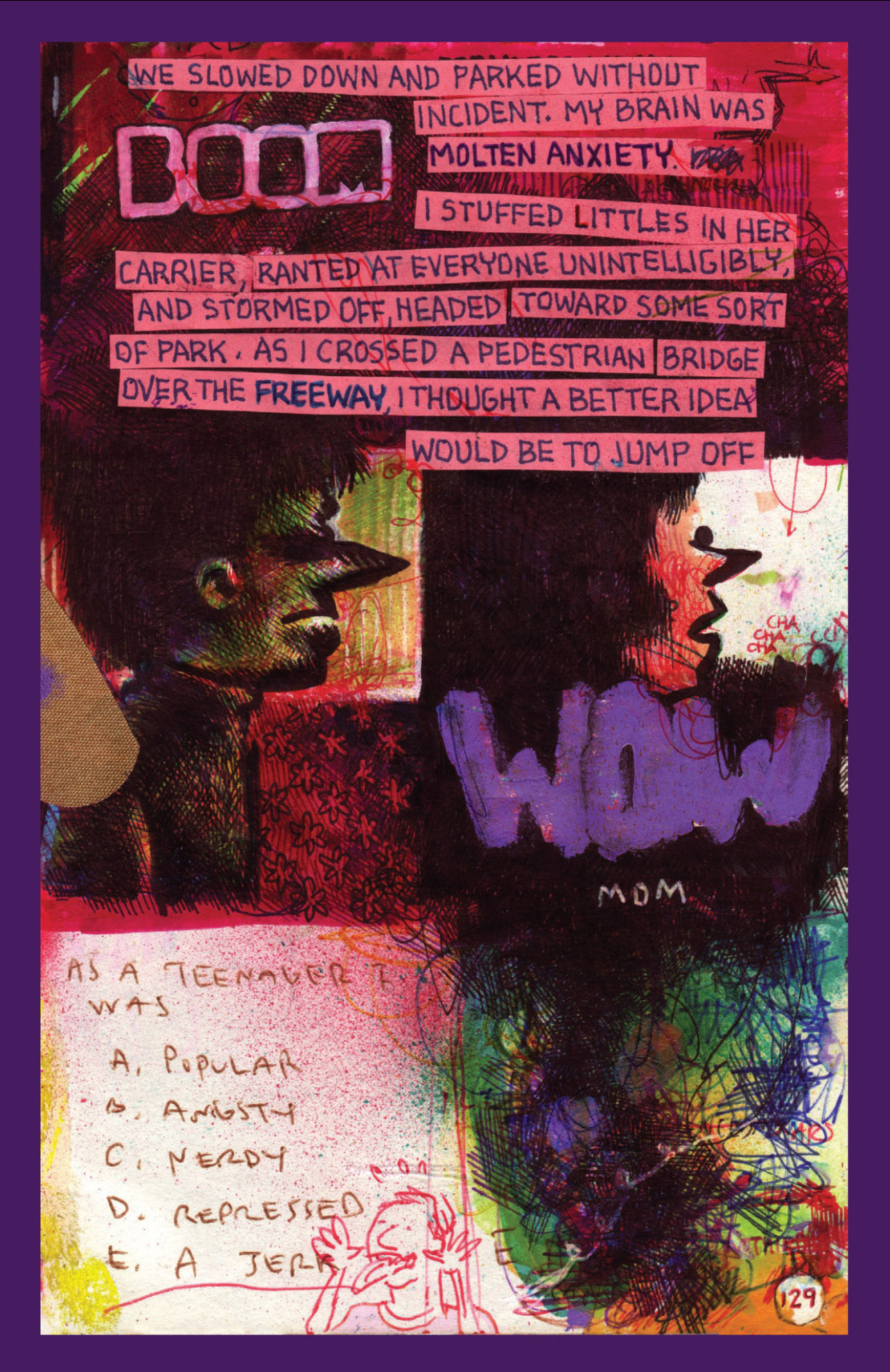
Reklaw’s narrative is related in dialogue-free prose, which alternates between the direct and clear and bruising (“I dragged my bike to a café trying not to sob”) and the intense and challenging and bordering on the mad (“The artist as misanthrope, hermeneutically sealed in a shack, fortress, or shadowy trailer, issuing satiric screeds in the service of societal condemnation...”). The prose that constitutes the direct narrative, like the first quoted sentence, is distinguished from that which is atmospheric, like the second, by being “highlighted” in odd colors (chartreuse, lime, lilac). It conveys the blows Reklaw received without making a reader feel manipulated into sympathy or titillated by a self-indulgent reveling in darkness. The narrative presents as an account of someone being dragged through degrading events beyond his control, as if reporting from a treadmill ride through a carnival Haunted House, where demons pop up on all sides, from walls, ceiling and floor, allowing no hope for escape or refuge. The adeptness of the telling keeps readers turning pages, unable to get someplace else, as Reklaw must have felt compelled to deny himself medication and remain at this universe’s mercy.
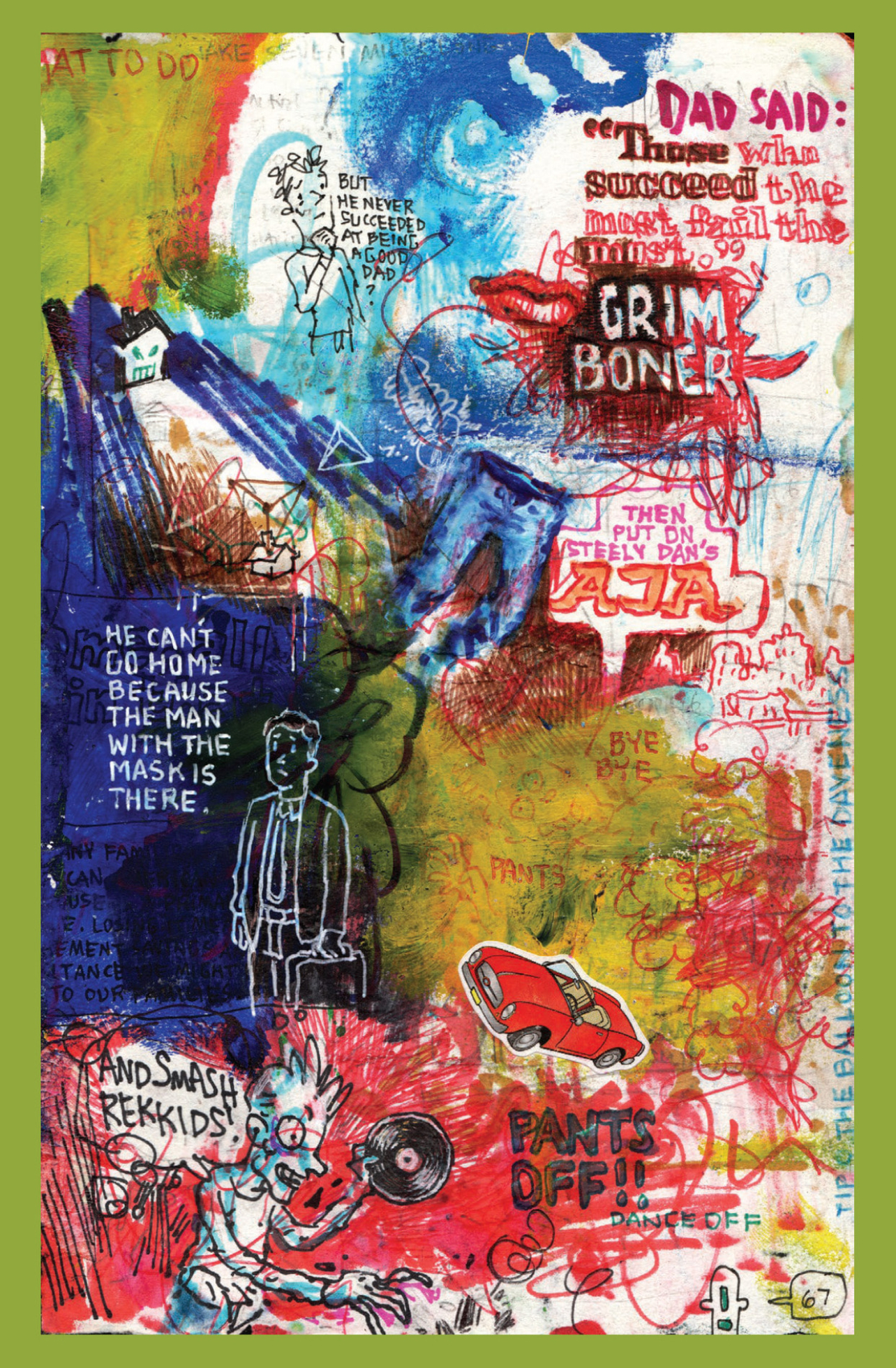
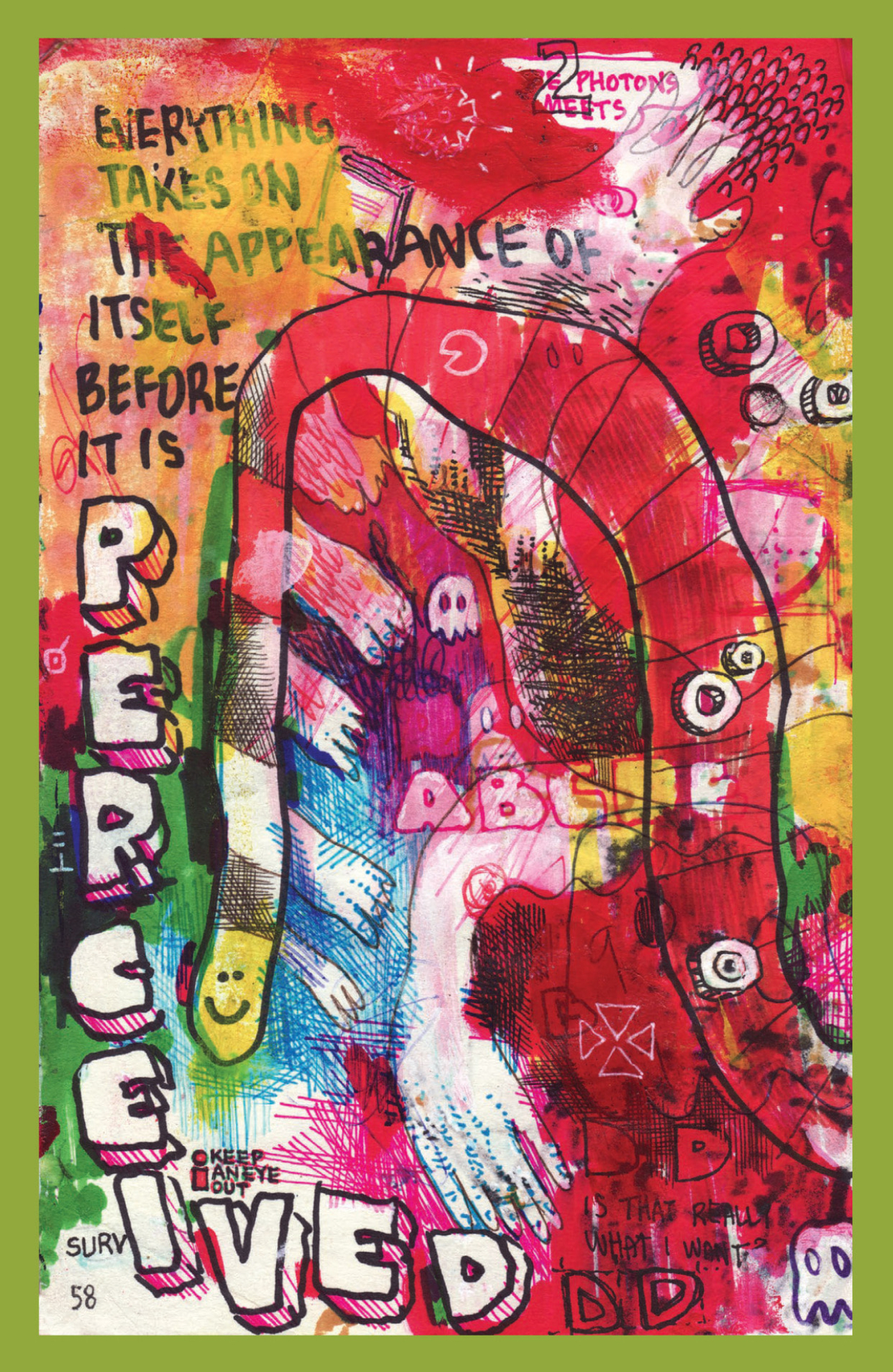
The book’s most throttling grip, though, is visual. Unrestrained by line or panel, swabs of malignant colors–too much black, too bright red–swamp each page. They dunk the eye in shades distilled in a rainbow’s dark alley. They blight the eye like impetigo skin. The variance to the fonts which float in this mash further distort the common. Words are not simply expository but appear seized from snippets of overheard conversation (“Your heart is a lesbian”) or products of clever (stoned) wordplay (“multi-Rachel,” “Manhattanxiety”) or hung in a corner of a page as a jolt to the mind. (For instance, “hamtasm” - which, to my surprise, is not nonsense but refers to a a girl making a guy a sandwich and then giving him a blowjob while he enjoys it. The sandwich, the Urban Dictionary helpfully adds, need not actually contain ham.)
The figures, whether of Reklaw or from his fantasy world or hallucinations, have little truck with representation. They shift between the demonic, the cute, the childlike, the freak. They are wild-, one- and x-ray-eyed; hooded, horned and hairy; skeletal, serpentine and Piscean. All are engulfed in this gumbo of color, along with the words–and non-words–and cats and dogs and diagrams and alphabets. The pages might have come from a Paleolithic cave. They may have been culled from a dozen sketchbooks’ detritus. They may have been influenced by Miró or Kandinsky. They might have been swabbed across flophouse walls in excrement.
The appropriate response is “WOW!”
It may have been unfair of me to have taken Reklaw’s books out of sequence. Certainly when he wrote the second, he was conscious of the first, and when he wrote the third, conscious of the first two. But the second book makes no specific reference to the events related in the first, and the third makes no mention of the events of the first two. So it seems as reasonable to me to treat the books in isolation as it was for Reklaw to write, if he did, as if everyone who read his second book had read the first, and everyone who read his third had read the first two.
Let’s recap. In 2012, Jesse Reklaw, a 41-year old cartoonist, breaks down mentally. In 2013, he publishes Couch Tag, which lays groundwork for this breakdown but, since it takes Reklaw about three years between books, was probably written before and without knowledge of what lay in store for him. Then, in 2016, he publishes Lovf, which makes Tag with its groundwork of more interest than if he had never broken down but had just been one more high school misfit voicing complaints about growing up. Then, three years later, he publishes Score, which, in its innocuousness, would be of zero interest except for the collapse, which makes this compendium of the ordinary into a survivor’s story and admirable, if not courageous, if not inspirational.
Life is an accumulation of stuff piled on-and-into someone over a period of time, over which he has little control. To make art while this is going on is to utilize a portion of this stuff in a way that gratifies some impulse of the maker with neither the portion nor the impulse entirely under the his control either. But when you have done this with intelligence and diligence and honesty, like Reklaw has, the work moves the heart and trembles the mind.