
Problems

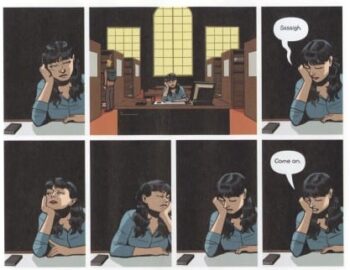
Today on the site, Frank Santoro is here with an old-school riff on Chester Brown’s Yummy Fur, inspired by a recent visit to CCS and discussion with some students there. Here’s a sample:

I think what’s interesting to consider is what Chester may have learned during those grid years and how he applied the skill of balancing the grid to his more organic approach. Ed the Happy Clown was a heroic, action-adventure story and it read like a Kirby monster comic, like a '70s Kirby grid. Quick, like a storyboard almost, but depicting moments a movie would not – it’s all timing – the way all the pieces, moments fit together. The grid accommodates the heroic and the banal moments all the same. It’s like a metronome.

Then, with issue 19 of YF, Chester switches to autobio and he now has the spacing to make the everyday seem heroic – look at the distortion in The Playboy! – it’s like KIRBY - yet Chester manages to be so spare and clear in tone. Chester’s work reduces so beautifully - The Little Man collection is smaller than the original comics but it looks fine (imagine reducing a current Marvel comic to book size) – so while mainstream work has gotten more clogged because of the format, Chester’s 5-inch by 5-inch squares are perfectly phrased notes, simple melodies strung together on a metronome that sound just right at any volume, any size.

And we also have Day 4 of Mike Dawson and his Cartoonist’s Diary. Today, Mike wonders exactly why he’s doing what he’s doing.

Elsewhere:

—News. It has been announced that Robert Kanigher, Bill Mantlo, Jack Mendelsohn will receive the 2014 Bill Finger Award.

Michael Cavna wrote a really nice piece about the Bill Watterson/Richard Thompson exhibits at the Billy Ireland library, with quotes from the artists, one of the curators, and others.

Then Cavna did it again with a story on the changing role of Universal Uclick editor Lee Salem, which includes input from Watterson, Thompson, Garry Trudeau, and Lynn Johnston.

—Misc. Unfinished pages from Jack Kirby’s aborted adaptation of The Prisoner are now online.

The online New Yorker has apparently begun running comic strips. The first one’s from Eleanor Davis.

—Interviews & Profiles. The New Straits Times briefly profiles Lat.

Richmond.com talks to Pearls Before Swine cartoonist Stephan Pastis.

At The Beat, Padraig O Mealoid remembers the late Steve Moore.

Via Mike Lynch, here’s an hour-long Bob Andelman interview with Shannon Wheeler (that I haven’t watched yet myself):

—Reviews. Tom Spurgeon reviews Sascha Hommer’s Frontier #3. Matt Lamothe reviews Patrick Kyle’s Distance Mover.

Just Right

Today on the site:

Mike Dawson rolls in with Day 3 of his diary.

Elsewhere:

Gabe Fowler has announced that the next Comic Arts Brooklyn festival is on November 8th, 2014 at Mt. Carmel Church and a few satellite locations. The application is here.

And, bonus, here is the video from last year's City of Glass panel with Art Spiegelman, Paul Karasik, Paul Auster and David Mazzucchelli, moderated by Bill Kartalopoulos.

Also on the festival train is Secret Acres, with a fine news post.

And here are some fine cartoons by Charles Addams.


Clubbable

Today, Joe McCulloch has your guide to the Week in Comics, with spotlight picks from Bobby London and Alejandro Jodorowsky.

It is also day two of Mike Dawson's tenure at the Cartoonist's Diary column. This time, he tries to go outside.

Elsewhere:

—Commentary. Brigid Alverson noticed something odd about that New York Times story on comics apps that Dan linked to yesterday—it included a strong recommendation of an app that runs on pirated manga. ["There are more digital manga services on the horizon, but as long as serious outlets like The New York Times can’t (or won’t) make the distinction between a legitimate manga app and a bootleg app like Manga Rock, the publishers will continue to have an uphill climb."]

When retailer Brian Hibbs bought a second store, it came with around 75,000 back issues. Now he's making a go at selling them. ["So, my first job was to 'part the Red Sea,' and separate the wheat from the chaff, which meant physically going through all (approximately) 300 long boxes and seeing what was in each one."]

Ben Towle reports from the Bill Watterson/Richard Thompson ehxibition at the Billy Ireland library. ["One of the most interesting displays showed Watterson’s early strips he did for his college newspaper as well as some submissions to newspaper syndicates. Including a rejection letter was a nice touch. I was really, really curious about the middle strip here which appears to have been deliberately obscured with an overlaying piece of bristol board. Did Watterson not want it shown for some reason?"]

—Interviews. CBR talks to Mike Mignola on the 20th anniversary of Hellboy. ["With China, yeah, there's photo reference. But in between those photos, what happens? What goes on? There's nothing worse, for me anyway, than being a slave to photo reference. I did one story set in Japan and I had photo reference for the exterior of a house and for a great little cemetery and things like that, but I didn't know things like how the doors worked. I could've gotten this out of Akira Kurosawa movies. I could've studied the interiors from various films, but that seems like an awful lot of work. I always felt that if I'm drawing the real world, I need to get it right."]

The same site also talks to former DC publisher Paul Levitz. ["Years ago I wrote an article for The Comics Journal titled 'Call for Higher Criticism', and looking back at it I think it was very naïve and immature in many ways. The argument was that there’s more to talk about than if the Thing can beat the Hulk, but there was broader things to talk about. I’ve seen it evolve over the years, with an army of professors now bringing scholarly knowledge and wisdom to the field."]

Kurt Andersen has Gene Luen Yang on as a guest on Studio 360.

—Reviews. Andrew Wilmot reviews Diane Obomsawin's On Loving Women. ["The collected stories feel strangely complete and incomplete at the same time; they’re first paragraphs to larger narratives the author has decided to leave off the table, choosing instead to focus on the discombobulating first steps of girls exploring their sexuality."]

J. Caleb Mozzocco reviews Sam Henderson's Scene But Not Heard. ["Most of the gags revolve around the rule-less physics of comic strips and cartoons, and, read all at once, this book seems like a grand symphonic performance of the unique possibilities for jokes in the comics medium."]

—Misc. This Susie Cagle story is more about freelancing than cartooning, but there's a reason everyone is linking to it. ["Almost eight years ago, a week after my 22nd birthday, I graduated with a master’s degree from Columbia’s journalism school. I didn’t know what having an Ivy League master’s degree in journalism meant, besides an overinflated sense of young self-worth and a collection of very expensive bills. I was about to find out: nothing."]

Comic book club!

—Video. On this weekend's 60 Minutes, Morley Safer profiled The New Yorker's cartoon editor, Bob Mankoff, who has a new book out. A slew of the magazine's cartoonists (Gross, Chast, etc.) are also briefly featured.

Guys with Courage

Today on the site we're joined by Mike Dawson, this week's contributor to our Cartoonist's Diary feature, and the author of Troop 142, Freddie & Me, among other books. Mike was also the man behind TCJ Talkies, and the co-host of the late, great, Ink Panthers.

Ken Parille is also here to discuss innovation at DC Comics. in 1972.

Elsewhere:

TCJ-contributor Nicole Rudick on Matt Kish's illustrated Heart of Darkness.

Tom Spurgeon interviews Mimi Pond.

The NY Times has a fascinating story about the archives of the Famous Artists School.

The Times also covered comics apps.

Bob Andleman talks to Mort Walker.

Gil Roth talks to co-authors Nathan Fox and Sheila Keenan about their graphic novel Dogs of War.

Leon Sadler reminds us of an old way of life.

This Dr. Seuss film adaptation just popped up online:

http://www.dailymotion.com/video/x1gnuyl_the-500-hats-of-bartholomew-cubbins_shortfilms

And this Heinz (Yellow Submarine) Edelmann short remains completely amazing.

Come On

Today, Daniel Kalder is here with a review of Nicolas de Crécy and Alexios Tjoyas's Foligatto. A sample:

The story is set in the city of Eccenihilo, which my half-remembered Latin classes of long ago lead me to roughly translate as “Beholdnothing” (though my grammar is probably ropey). Tjoyas and de Crécy set the mood with a striking wordless sequence in an old cathedral, where a strange trio build a harp from the bones of dead animals, only to flee and hide when a mob arrives to hold a cockfight in the building. A dispute leads to one grotesque little fat man getting his head hacked off. The cops arrive and arrest everybody. Then the mutilated guy picks up his severed head and walks off.

It is about as clear a statement of intent as you can get.

Elsewhere:

—Interviews.
In conjunction with new exhibitions of their work, the Billy Ireland Cartoon Library site has posted interviews with cartoonists Bill Watterson and Richard Thompson. (Watterson: "There’s so much other content available—instantly and all for free—that there’s no reason to stick around if you’re not immediately enthralled. We consume everything like potato chips now. In this environment, I suspect the cartoonist’s connection with readers is likely to be superficial and fleeting, unless he taps into some fervent special interest niche.")

Vulture interviews Ms. Marvel writer G. Willow Wilson. ("Well, I have never, ever before written any comic book where there was fan art before the book was even released. That has never happened to me. That really — that really floored me.")

Brian Cremins talks to academic Shiamin Kwa about Kevin Huizenga's recent visit to Bryn Mawr. ("The question about when did you become interested in comics bothers me, because I do sense that there is sometimes a weird distinction being made about liking comics—like it’s a kind of secret handshake that is indexed by memories of carrying a certain colored bag on Wednesday afternoons.")

The Linework NW Tumblr has recently put up many short interviews with creators, including Ben Marra, Sam Alden, and Farel Dalrymple.

—News. Keiji Nakazawa's four-decade-old Barefoot Gen continues to generate controversy, as the mayor of Izumisano asked for all copies to be removed from elementary and junior-high-school libraries. ("'I regret having cooperated with the collecting of the manga even if it was because of an instruction from the head of the education board,' one principal said. 'Why was only Gen targeted when there are other works that also contain discriminatory terms? I can only believe they were deliberately setting their sights on Gen.'")

—Reviews & Commentary.
Craig Fischer reviews Matt Fraction and Chip Zdarsky's Sex Criminals. ("In 1970s fandom, we used the term 'groundlevels' to describe comics that combined fan genres like science fiction and fantasy with adult visuals and subject matter(s). 'Groundlevel' refers to the middle position these comics occupied between the DC-Marvel 'mainstream' and the excesses of Crumbian undergrounds. Dave Sim’s Cerebus was one early groundlevel comic, Wendy and Richard Pini’s Elfquest another, and nowadays, when I look at the artistic and commercial renaissance at Image Comics, I see the rebirth of the groundlevel aesthetic.")

Edie Fake reviews Emelie Östergren's Runaway Dog. ("...an unexpectedly elegant, sparse narrative with drawings that shimmer with silliness and surrealism.")

Farel Dalrymple shares his recent comics reading. ("I don’t read many mainstream comic series. I usually wait until I hear about something that is good and read the trade when the library gets it.")

—Funnies. Bob Sikoryak mashes up the Hellboy universe with various comic strips, including Thimble Theater, Garfield, and Dilbert.

—Video. And we don't usually promote comic movies very often, at least since the glory days of Dapper Dan's Super-Reviews, but here are two for which I'll break my self-imposed rule. First, Alejandro Jodorowsky's Dune, which is of comics interest because many of the proposed concepts for the film later made their way into Jodorowsky's Incal-verse books.

And then Dark Dungeons, as far as I am aware the first straight cinematic adaptation of one of the works of Jack T. Chick.

Back in Pieces

Today, Robert Kirby reviews the new collection of MK Brown comics, Stranger Than Life. An excerpt:

Brown reveals a more serious side to White Girl in the masterful twelve-page “White Girl Dreams”, where White Girl has bizarre flights of fancy, imagining among other things, “soaring with others in the night, dancing though my face is someone else’s.” In it, Brown blends middle class ennui with surrealist tropes to create an ultimately rather poignant, fragmented portrait of a day-to-day existence suffocated by rules, traditions, and obligations, where the good, pleasurable flights of fancy are shunted off to some forgotten, subterranean part of the brain. White Girl yearns for those good dreams, telling us, “I always get the other kind.” The other kind are the ones in which an annoying “perfect stranger” comes home and regales her with endless obnoxious, husband-to-subservient-wife questions (“What’s for dinner? When do we? Why aren’t there any?” and so forth). She also tells us, understandably, "I hate this dream.” Without making any fuss, a feminist viewpoint clearly surfaces throughout the swirl of fantastical, kaleidoscopic imagery. It may indeed be that the dream White Girl hates is her actual life, a take that gives the piece its particular edge. Exploring the very nature of dreams vs. reality and what one makes of the difference, the story rewards multiple readings.

Elsewhere:

—Interviews & Profiles. Alex Dueben talks to Diane Obomsawin. ("When was it -- before I even knew I was attracted to women -- that I knew, unconsciously. It goes back very far, to the age of six or seven. Also I was curious about my friends and their stories. That was my question for them: What was your very first attraction?")

13th Dimension has a two-part interview with Mike Mignola. ("I was listening to the 8 billionth comment about H.P. Lovecraft and I said, 'Yeah, that stuff is in there, but I think that the bigger, fundamental structure of the Hellboy stuff came from pulp magazine guys like Robert E. Howard and Manly Wade Wellman.'")

Noam Cohen at the New York Times has a brief profile of xkcd's Randall Munroe. ("Though the book won’t appear for six months, What If? quickly reached No. 2 on Amazon’s best-seller list on the strength of pre-orders, trailing only a history book from Rush Limbaugh.")

Whit Taylor interviewed Mike Dawson. ("This was the first time I've ever gone into writing a story with a publisher already in mind. [...] There were pros and cons to it.")

—Reviews & Commentary.
Old TCJ hand Jared Gardner reviews Julia Gfrörer, Isabel Greenberg, and Cole Closser. ("Here I want to focus on the recent debut work of three young cartoonists that are inspired not by the inward gaze but instead by myth, legend, and a pure, unadulterated love of visual storytelling as an end in itself.")

Jacob Covey discusses how his views on S. Clay Wilson changed while he helped design Patrick Rosenkranz's new book on the artist. ("His is not the art of an innocent kindergartner who draws fanciful anatomy in a surreal landscape but that of the self-realizing, hormone-raging, unclean middle-beast that is boys who are becoming men. He still draws like a kid, just not the kid we romanticize about. At a time when most of us become self-conscious and begin self-censoring Wilson did not.")

Illogical Volume reviews Über, Pretty Deadly, Three, and Zero. ("There’s a certain punitive/educational value in amplifying and expanding on the staggering brutality of our recent past, but the danger of reducing it to gory spectacle haunts every page of this comic.")

Richard Bruton reviews Alan Moore and Steve Parkhouse's The Bojeffries Saga. ("Funnier than the hilarious D.R. & Quinch? Definitely. Better than Watchmen? Oh yes. Better than V For Vendetta? Yep. Better than Miracleman? Without question. Better than From Hell? Hmm… depends on my mood, but right up there.")

While writing about the film criticism of Manny Farber, David Bordwell discusses Farber's work on comic strips, too. ("Silly Milly is drawn in typical McGovern style, as though by a wind current, and has a prehistoric animal for a hair-do, a very expressive, giant-size eye, and a perfectly oval profile. It is one of those comics with animated décor, like Smoky Stover, with adjoining family portraits shaking hands, and one that tries for laughs in every part of the box.")

—News. Rich Warren at the Chicago Tribune profiles the Billy Ireland library. ("Veneration isn't stretching it as a term to describe what visitors might feel in these galleries. When they first step inside, most visitors are stunned at the sheer size of the illustrations, which are matted, framed and hung like paintings — like the works of art they are.") Incidentally, I am looking forward to Frank's column this week.

—Funnies. Roz Chast previews her upcoming book in The New Yorker.

—Video. Via Robert Boyd, here's the trailer for a new documentary on the Hairy Who.

That Time of Year

It's National Avoid the Vomit in Midtown Day, which I am planning to celebrate by staying in and reading Paul Tumey's review of the new George Carlson retrospective, Perfect Nonsense. Here's a sample:

Of all the significant comic book artists of the twentieth century, George Carlson has been among the most magical and yet the most mysterious. Accomplished critics and historians including Harlan Ellison, Franklin Rosemont, Bill Blackbeard, Martin Williams, Ron Goulart, Martin Gardner, Gary Groth, Art Spiegelman, and Dan Nadel have championed George Carlson’s comic book stories. He’s been widely regarded as a master of Golden Age comic book art and graphic storytelling.

His imaginative, trippy work has been associated with various art and literary movements, including Surrealism, Dada, Art Deco, and Absurdist. Carlson’s stories have been compared to the works of literary masters Samuel Beckett and Eugène Ionesco. Miscellaneous reprints, all drawn from the 39 extraordinary comic book stories that originally appeared in Jingle Jangle Comics between 1942 and 1949 have kept the flame of interest in Carlson’s work alive over the last three decades.

Despite all this, information about the life and work of George Carlson, as well as any additional art beyond the Jingle Jangle stories, has been frustratingly skimpy.

Elsewhere:

—Lynn Johnston has donated a significant amount of her artwork to the Library and Archives of Canada.

—Andrew White interviews former TCJ podcaster Mike Dawson on the practicalities of being a cartoonist.

—Percy Crosby's 1918 collection, That Rookie from the 13th Squad.

—And Timely-Atlas historian Dr. Michael J. Vassallo on Menace.

Little Fellas

Today:

The tables are turned as Dominic Umile reviews Sam Henderson's most recent book.

Even as Scene But Not Heard is confined to rigid set of what’s usually 16 panels per page in this 6” X 9” book, Sam Henderson’s hilarious strip swirls and sputters uncontrollably, percolating with riotous energy and wordless pandemonium. The 128-page collection mines back issues ofNickelodeon Magazine, to which the New York-based cartoonist began contributing in 1993 under comics editor Anne Bernstein. Henderson’s work ran in the magazine until 2009, when the nationally distributed Viacom-owned kids publication abruptly folded. While he freelanced for Bernstein and subsequently for co-editors Chris Duffy and Dave Roman, the Scene But Not Heardcreator also snagged a full-time day job as a writer and storyboard director on the immensely popular television seriesSpongeBob SquarePants beginning in 2001 (Duffy would go on to helm the print comic property), and earned an Emmy nomination for his efforts. Sandwiched between contributions from Craig Thompson, Art Spiegelman, Ellen Forney, and more, Henderson’s Scene But Not Heard was the longest-running strip in Nickelodeon Magazine’s 159 issues.

Tove Jansson is the subject of a very good BBC profile.

If you're in Toronto this weekend this Seth/DeForge/Smyth/Heer event looks good.

FirstSecond has some advice on submitting manuscripts.

Nobrow, previewed.

Lift Your Head Out of the Muck and Shout Hurrah

Today, the cartoonist Sam Henderson is here with a review of a retrospective of the work of the mid-century gag cartoonist he says he's more often compared to than anyone else, Vip: The Mad World of Virgil Partch. Here's how Sam starts:

A doctor has his nurse hand him instruments to operate on a set of paper dolls. A man working out in a gym crashes through a wall when the springs on his weightlifting machine backfire. A man working in the basement says to his kid, “Run up and ask Mother to turn off the iron”—as a hot iron burns through the ceiling dangling by its cord. None of these descriptions do the work justice, or even make any sense when described. But the work is familiar to you, whether you know it or not.

One of those cartoonists whose works I spent my twenties tracking down in countless dusty old used-book bins, Virgil Franklin Partch a/k/a VIP has now had his work collected in Vip: The Mad World of Virgil Partch. It's one of many coffee-table books being printed now collecting rare out-of-print artifacts which, if I had known back then that they would be reprinted eventually, I might not have wasted all that time trying to find them.

Elsewhere:

—News. The South Carolina House of Representatives doubled down on their decision to cut funding to two colleges for recommending books with gay-themed subject matter (including Fun Home).

—Interviews. CBR talks to John Romita Jr. HuffpostLive talks to New Yorker cartoon editor Bob Mankoff.

—Misc. Michael Dooley at Print revisits the time when a Jonah Hex miniseries prompted Edgar and Johnny Winter to sue DC Comics. Dangerous Minds revisits the illustrations William Steig made for the controversial psychoanalyst Wilhelm Reich. Paolo Patricio explains how to make panel grids fast.

—Reviews & Commentary. Dooley also alerted me to this website hosting a pdf of Ariel Dorfman & Armand Mattelart's classic 1970s critique of imperialistic content in Disney comic books, How to Read Donald Duck. Rob Clough continues his month of daily short reviews, and Tom Spurgeon seems to be similarly inspired lately. MariNaomi sort of reviews Diane Obomsawin's On Loving Women, in comics form.

Complaint Dept.

Today on the site: Shaenon Garrity looks at two web comics about Irish history.

I’ve said this many times before and I’ll say it many times again, but one of the joys of webcomics is their ability to cover every possible subject and fill every conceivable niche. Say, for example, you’re into early Irish literature and you want to read it in comics form. Webcomics are happy to help you out. At this very moment, in fact, there are at least two ongoing webcomics based on the Táin Bó Cúailnge, or Cattle Raid of Cooley, the central epic of the Ulster cycle: Patrick Brown’s The Cattle Raid of Cooley and M.K. Reed’s About a Bull . Thank you, webcomics! You’ve justified the existence of the Internet yet again!

Elsewhere:

This is an excellent profile of the important underground comic Tits & Clits.

David Mamet remembers his friend Shel Silverstein.

Great new R.O. Blechman image over here.

Love these illustrations for various 1960s editions of Don Quixote.

Aaron McGruder, of Boondocks-fame, has a new cartoon on the horizon.

A new director of the Smithsonian has been named, and he has a positive outlook on funding for the arts (scroll down).

Money Is Being Raised

Tuesday is Joe McCulloch day, in which he not only previews the most interesting-sounding new comics releases of hte week, but also writes a short essay on the autobiographical manga of Moyoko Anno:

This is not the Harvey Pekar tradition of American alternative comics, and I doubt it will appeal to those who value autobiographical comics primarily for their arrangements of unvarnished life. On the contrary, this is an extremely varnished life; H. Anno, in an afterword of sorts, advises that M. Anno would rearrange events to make them funnier, even allowing her husband to check the finished pages and suggest additional jokes and references. Indeed, the book’s English-exclusive annotations run a spectacular 30 pages, so dense are these vignettes with geek speak, at times venturing into Poto and Cabengo territory as H. Anno is depicted communicating in verbalized manga sound effects, apart from whole passages consisting of seemingly nothing but quotes and allusions to/from beloved anime and tokusatsu shows.


Elsewhere:

—News. Taiyo Matsumoto and Emily Carroll are the winners of the annual Slate/CCS Cartoonist Studio Prize.

—Giving & Spending Opportunities.
The eBay auction of original art to benefit Stan Sakai and his family's need for medical funds has begun. Lots of interesting artists on board, from Dave Berg to Mike Mignola. New art from additional artists will go up every week. Dave Sim has taken to Patreon to fund his Strange Death of Alex Raymond project. Steve Ditko has a Kickstarter.

—Interviews. The Billfold interviews newish New Yorker cartoonist Tom Toro. Salon briefly interviewed Chris Ware about modern education and Joseph Cornell. And here's Peter Bagge:


—Reviews & Commentary.
Darwyn Cooke suggests eight Will Eisner stories for neophytes. Chris Randle compares True Detective to Kerascoët's Beautiful Darkness. Kristian Williams thinks he sees feminism in Frank Miller comics. Tom Spurgeon reviews Lob & Rochette's Snow Piercer.

Door

Today on the site we have an excerpt from Brian Evenson's forthcoming book on Ed the Happy Clown, to be published this year by Uncivilized Books.

The idea for this book started just a few days after Drawn & Quarterly’s 2012 re-release of Ed the Happy Clown. More specifically, it started when I picked up that book in the bookstore and noticed the subtitle:“a graphic-novel”. Chester Brown’s name was in all-caps, the title too was all-caps, which drew my attention to the fact that the subtitle seemed deliberately lowercase. Part of me felt this was simply just a matter of typography, a choice made to distinguish between title and subtitle. But another part of me believed—and still believes—that there are no accidents, and that it is these small, seemingly random choices that accumulate into the larger distinctions that end up shaping not only a book but an entire genre.

Standing there in Modern Times, I found myself wondering what made a ‘graphic-novel’ different from a ‘Graphic Novel’? It seemed a question of simple arithmetic: the subtraction of capitalization and the addition of a hyphen. The first gesture strips away a level of formatting, going against common title capitalization guidelines. The second adds a piece of formatting we wouldn’t expect to be there, a hyphen, and which isn’t there in any other use of the phrase “graphic novel” that I can remember. Both seem incredibly small things. But it is of such small things that greater effects are both built and sustained.

Elsewhere:

Tom Spurgeon interviews MK Brown about her great new book.

Here's a great chat with Roz Chast.

British comics crew Decadence gets a spotlight.

And Eddie Campbell interviewed over at Robot 6.

The Magic Word

It's always a pleasure to read R.C. Harvey, and today on the site he's here with a column on Playboy cartoonist Eldon Dedini. Here's a brief excerpt:

Gus Arriola, another supreme stylist whose Gordo comic strip was a stunning fiesta of design and color, counted Dedini his closest friend in a friendship of over fifty years that was grounded firmly in their mutual passion and respect for the visual art they practiced and in a unique camaraderie they shared, living in Carmel, California.

“Even his signature was a design,” Arriola once said. “—bold, succinct, an autograph as distinctive as the rich humor it identified. Simply, Dedini —much as one would say Bernini, Modigliani, Dali—Dedini—all those ending in -I appellations signifying high art. Few humorists can draw passably, if at all. Eldon was both an accomplished illustrator and a proven humorist. His pictorial and literary recording of international events and domestic culture through his award-winning years was always timely, always cogent and always remarkably funny.”

Quoted in the Monterey Herald’s front-page obituary for Dedini in January 2006, Lee Lorenz, cartoon editor at The New Yorker for many of the years Dedini’s cartoons were published therein, said: “While a million people can draw, very few can cartoon well. To be a cartoonist you have to be a stylist, and that’s not easy to come by. It transcends technique. And he was an excellent idea man. He had a wide-ranging imagination. He was tough to edit because he didn’t need much editing. I never asked him to redraw, which at The New Yorker is quite unusual. If 20th century cartooning is ever looked at seriously,” he concluded, “Eldon Dedini will be one of the outstanding figures of American comic art.”

We also are posting another of the late great Bhob Stewart's pieces for The Comics Journal, his 1985 appreciation of Howard Nostrand. A sample:

As a humorist working in an Eisneresque mode, Nostrand was obviously given a high-voltage jolt by the early issues of Mad. One can almost see the gears and cogs clicking into place in his 23-year-old head. It was, we might say, good timing. The right talent in the right place at the right time: when Nostrand skipped out of the Powell studio in March 1952, he began his solo career in the very same season Kurtzman was hatching Mad #1 (Oct. 1952–Nov. 1952). Kurtzman’s original idea for Mad was to parody types of comic book stories (horror, SF, romance, sports, crime, etc.); his revamp of that concept into direct satires on specific radio/TV/comics/movies came later, with issues #3 through #8 making this transition throughout 1953. The revolutionary Mad feature of contemporary movie satires with recogniz­able caricatured likenesses, timed to coin­cide with the film’s general release nation­wide, did not happen until Mad #9 (Feb. 1954–March 1954) with “Hah! Noon!” — followed by others in 1954 (“From Eter­nity Back to Here,” “Wild Vi,” “Julius Caesar,” “Stalag 18”). After 30 years of Mad, it becomes almost impossible to explain why it was so exciting and so much fun in 1954. There just had never been anything like it. Opening an issue in a newsstand was like … was like …

Okay. Forget the analogies. Lemme put it this way: You’re in a small American town. Some people there have TV sets. You don’t. So you can’t even see Sid Caesar. Your high school reading assign­ment is deadly — Alexander Pope (1688–1744), right? The teacher calls him a satirist, but no one laughs. School’s out. You buy Mad #12 and read — in color — “From Eternity Back to Here.” You think about the Life photo of James Jones leaning on his manuscript, pages stacked almost to his own height. A month later From Here to Eternity — in black and white — arrives at the town’s only movie theater. After seeing it you reread the Mad parody to relish the specificities. So then you spend part of the summer reading the entire James Jones novel and wind up knowing Prewitt as if he were a personal friend. Then you reread the Mad parody again. See? There was more to Mad than Mad itself. Cultural reverb, that’s what it was. Can you dig it? Well, forget it, man, it can’t be explained. You had to be there.

Elsewhere:

—Interviews. Fader talks to Charles Forsman. Dan Berry interviewed Julia Wertz and Sarah Glidden. Steve Sunu talks to Evan Dorkin. Chris Sims talks to Tom Scioli and John Barber.

—Reviews & Commentary. James Guida at The New Yorker appreciates Tove Jansson. Ana Benaroya reviews Diane Obomsawin's Loving Women. Mike Mignola appreciates Will Eisner. Tom Spurgeon reviews Forever Evil #6. Richard Metzger remembers Sean Kelly and Neal Adams's Son-O'God Comics from National Lampoon.

—Misc. Fantagraphics has announced their fall 2014 books. Whit Taylor gives advice on cartooning while holding a day job.

—Digital. ComiXology announced yesterday that its security was breached, and that they recommend all account holders change their passwords.

Pizza Time

Today on the site:

Sarah Boxer on Woman Rebel.

Who would have thought that Margaret Sanger, the mother of American birth control, would one day have her story told in a drawing style that simultaneously recalls that of Cathy Guisewite (Cathy), R. Crumb (Mr. Natural), and Jack Cole (Plastic Man). Sounds, ungodly, doesn’t it? But such is the hysterical, intense, rubbery look of Woman Rebel: The Margaret Sanger Story, by Peter Bagge, best know for his Hate comics. In Woman Rebel, Sanger, though her story is definitely of the superhero variety, comes across visually as Mary Poppins on a bad day — red-haired, booted, angry, her shoulders stooped, her mouth a weird worm crawling across her face. (I’ve seen pictures of Sanger and this isn’t even close; she’s actually quite fetching.)

Elsewhere:

Francoise Mouly interviewed at Mutha.

Heidi MacDonald on the new Heavy Metal.

Frank's friend Derf reports back from travels abroad.

Some of what's not in the upcoming Alex Toth book.

A cartoon report of Al Jaffee at Columbia.

Mervyn Peake rules.

Sheet Music

Today, Rob Steibel uses his column to explore some of Jack Kirby's '70s pencil work.

And George Elkind reviews Jon Vermilyea's Fata Morgana.

Elsewhere:

—Reviews & Commentary.
Illogical Volume reviews Harvey Pekar & Joseph Remnant, Ulli Lust, and others. Chris Mautner reflects on the scatological in comics from Johnny Ryan and Michael DeForge. Tom Spurgeon reviews the new collection of Henry comic books. In the you'll-know-if-you-want-to-read-it category, Dave Sim responds in his own inimitable way to the misogyny allegations recently laid against Alan Moore.

—Profiles & Interviews.
Daily Life talks to Alison Bechdel. HiLobrow briefly celebrates Ronald Searle.

—News. Jen Sorenson won the Herblock Prize. Former DC publisher Paul Levitz has joined the board at Boom! The playwright Roberto Aguirre-Sacasa is the new chief creative officer at Archie. Image publisher Eric Stephenson won the 2014 appreciation award from retailers' organization ComicsPRO. (If you read a lot of online comics discussion besides this site, you're probably already heard of Stephenson's controversial speech at the annual ComicsPRO meeting. Aaron Kashtan explores the speech in two posts.) Major Japanese publisher Kadokawa plans to introduce a new digital manga reader, including titles in English.

—Misc. Stanley Kubrick's photos of New Yorker cartoonist Peter Arno. Last Gasp is hosting a logo design contest. (Greg Irons drew the original.) A longtime 48-year-old comic-book collector is selling off most of his collection, and started a blog documenting the process.

—Ways to Spend Money. The Yeah Dude subscription drive Kickstarter is almost over, and as of this writing this-close to reaching its main fundraising goal. Space Face has announced a subscription drive. Inkstuds superfans might be interested in their Kickstarter to fund an American interview tour. A new Pigeon Press Gallery site is selling original art from Ivan Brunetti, Charles Burns, Daniel Clowes, and others.

—Historical Link of the Day.
In a 1987 Bullpen Bulletin for the ages, then Marvel editor-in-chief Jim Shooter stands up for what he really believes in.

Family Tradition

Today on the site, Joe McCulloch brings it all back home.

Elsewhere in this world:

After reading Joe the most important thing for you to do is watch this (NSFW) Throbbing Gristle video made a long ago by the great and under-appreciated French artists Bruno Richard and Pascal Doury (seen in the US mostly in RAW).

Still have time? Fine. Here:

This guy's view of contemporary comics is profoundly limited, but I like his analysis of mid-century realist comics technique.

Robert Boyd reminds us that great Canadian picture story The Cage has been reissued.

There's lots of movement at Archie Comics.

This is a slightly random look at Charlton Comics.

There's going to be a Frank Quitely documentary episode.

These images of Otomo posters installed for show are fantastic.

Our own Jacq Cohen enjoys a puff.

When I was a kid I used to be thrilled that Stan Lee was seemingly always meeting with a groovy French movie director named Alain Renais. Yeah baby. Alain Renais is dead now, but paper lives on.

If I was a cartoonist I'd be very very reluctant to publish in the same book as Ronald Searle. Anyway, here are images from a recent Searle exhibition and accompanying catalog.

Powwow

Today Rob Clough reviews the hard-to-describe comics project, Dog City #2:

Dog City is part anthology, part art object, part stunt, part value-added merchandise, and all comics. What makes it more than a stunt is the overall quality of the comics within, which range from good to excellent. The concept behind Dog City is to put a lot of different comics and art objects into the hands of readers without simply jamming them all into a single anthology. So it begins with a screenprinted box that has a couple of comics on it and inside of it, and tissue paper used for packing that also has images on it. There are beautiful, dog-related "art cards" (small prints) by Caitlin Rose Boyle, as well as a poster by Christina Lee and patches by Ian Richardson. While these are not relevant to the project's status relating to comics, they are part of the overall aesthetic of hand-printed, tactile objects.

Editors Juan Fernandez, Luke Healy, and Simon Reinhardt are all students at the Center for Cartoon Studies who extended their reach a bit for this project. In addition to the above items, there are also eight minicomics, a minicomics anthology, and a magazine about comics. CCS is certainly represented, but not just by current students. Faculty member Steve Bissette, for example, reprinted and reformatted "Sand Papel", a story he did for another CCS anthology called Tales of San Papel. Bissette hasn't done many comics in recent years, but this one is very much in line with the sort of scratchy, gritty horror comics he did so well in the past. Reformatting the comic to landscape and keeping it to just two panels per page allowed the story to breathe a bit more and creep into the reader's consciousness.

Elsewhere:

—Reviews & Commentary.
Rob Clough has also begun one of his occasional one-review-a-day months on his blog. Matt Leines reviews some vintage Paper Rad. Sarah Horrocks begins a multi-part essay on Inio Asano's Nijigahara Holograph. Abhay Khosla writes about several newish releases. Then he looks into my brain.

—Interviews & Profiles. James Sturm celebrates Ed Koren. Xavier Guilbert has posted his TCAF interview with Tagame Gengoroh. I always enjoy the mini-biographies on HiLobrow. Here they tackle Milton Caniff. Dennis Kitchen talks Will Eisner.

—News. The National Cartoonists Society has announced its Cartoonist of the Year Reuben Award nominees.

—Misc. Gary Tyrrell writes about former web cartoonist John Campbell's controversial Kickstarter essay (for lack of a better way to describe it). Jim McLaughlin writes about the financial side of the comics convention business.

Looking

Frank Santoro's back from France, and sharing the comics he got over there.

Elsewhere:

—Sean Howe has posted three snapshots (1, 2, 3) from what was reportedly the first museum exhibition of underground comic art, curated by Bhob Stewart. Michael Dooley at Print has a short appreciation of Stewart.

—Chris Butcher of TCAF and The Beguiling has a two-part interview at Guys With Pencils.

—Kristy Valenti found a great old Kim Thompson quote on what's-wrong-with-comics, published in a 1983 issue of Heavy Metal.

—Rich Tommaso is selling original art.

—Bill Watterson drew a movie poster.

Alfred Le Petit caricatures.

Hoovers

Today on the site Bill Pearson remembers Bhob Stewart. And we've posted Bhob's classic obituary of Wally Wood.

Elsewhere:

Michael Dooley on Bhob Stewart at Print Magazine.

This new book on anime history sounds great.

Gerry Giovinco on Dark Horse Comics history.

Not comics: TCJ-contributor Naomi Fry has an excellent review of The Wolf of Wall Street over at the LARB.

Ron Rege is opening an exhibition in LA this weekend. Looks great.

I didn't know about the Bosko comic strip.

Mimi Pond is going on tour for her forthcoming book.

Hey, excellent Lane Milburn comic strip over here.

Skippy

Joe McCulloch is here to help, with his weekly guide to the most interesting sounding new comics releases, and an essay on pre-Tezuka manga by Henry (Yoshitaka) Kiyama.

Elsewhere:


—News.
R.I.P. historian/writer/cartoonist/editor/filmmaker/etc. Bhob Stewart. Expect more coverage at this site soon. In the meantime, Potrzrebie, his long-running blog, is a treasure trove of the kind of cultural information most readers of this site would be interested in, and gives a hint at his wide-ranging interests.

Kevin Melrose writes about some of the reaction to South Carolina lawmakers' efforts to withdraw funding from two colleges for including gay-themed books in their curricula (one of the books is Alison Bechdel's Fun Home.) Heidi MacDonald writes about fundraising efforts for Bill Mantlo, spurred on partially by the upcoming Guardians of the Galaxy movie. The Hollywood Reporter writes about the legal conflict between Disney and Stan Lee Media. Robyn Chapman has launched The Tiny Report, a site/blog devoted to "micropress" comics.

—Interviews & Profiles.
BuzzFeed talks to Hayao Miyazaki. Brigid Alverson talks to Charles Forsman about the new Oily Comics Spring Bundle offer. Heidi MacDonald interviews scholar Paul Gravett. Tell Me Something I Don't Know interviews Copacetic Comics owner Bill Boichel.

—Digital. Diamond Digital is shutting down, and Brigid Alverson provides analysis. Ryan Estrada sold his comics through comiXology Submit, and shares the economics of it. Bruce Lidl talks to Chris Ross of Top Shelf about their decision to offer DRM-free graphic novels.

—Reviews & Commentary. Noah Berlatsky and Shaenon Garrity write about Bloom County. At Flavorwire, Kevin Nguyen tries to pick what comics he'd add to the literary canon.

—Giving Opportunities. Worthy comics bloggers Rob Clough and Mike Lynch are both asking for financial help.

—Funnies. John Porcellino shares some old sketchbooks.

Roof Damage

Well, it's Monday and so I'm back. Hi. Today we have the indefatigable Paul Tumey on one slice of the giant cake that is all things Rube Goldberg.

The current dusty, dim current understanding of Rube Goldberg and his work is evident in the comics history books and websites that mention him. Sadly, many of these are riddled with errors. Peter Marzio’s 1973 biography, Rube Goldberg: His Life and Work contains a error-filled list of his cartoon series that has led subsequent scholars into fields of confusion.1 Marzio’s book also asserts that the first full-fledged Goldberg invention cartoon was published November 10, 1914, an incorrect statement that has been repeated in numerous articles, books, and websites for the last 40 years. In actuality, it appears that Goldberg published his first invention cartoon July 17, 1912 — more than two years earlier.

The first known Rube Goldberg invention cartoon, originally published July 7, 1912

The first known Rube Goldberg invention cartoon, originally published July 7, 1912

The errors about Goldberg’s work have, on occasion, been off not just by a couple of years, but entire decades. For instance, Brian Walker’s comprehensive and authoritative survey of the history of the American newspaper comic strip The Comics: The Complete Collection (Abrams ComicArts 2011), reprints a Goldberg invention cartoon from 1930 with the dating “c.1910s.” It’s also identified as a “daily panel,” when it actually was from a biweekly series that appeared in a nationally distributed magazine, Collier’s Weekly.

In all fairness to hard-working cultural historians, getting one’s arms around the scope and particulars of Rube Goldberg’s career is no easy task. Rube, that cartoonist with the mind of an engineer, was more interested in the next idea than he was in drawing a concept out, exploring every nook and cranny. Thus, for most of of his career as a newspaper humor comic strip creator from 1909 to about 1938, Rube made a new and different comic strip every day. He had several series, like Foolish QuestionsSilly Sonnets, and I’m The Guy which he randomly returned to as he pleased.

Elsewhere:

The great Anya Davidson has a new ongoing comic over at Vice.

Tom Spurgeon on the recently deceased writer-about-comics Bill Baker.

Paul Pope talks about his forthcoming Escapo reprint.

Nice Lynch art, Tom K.

I used to like to collect issues of Ballyhoo. Here's a particularly racy edition.