
What Did He Say

Today on the site, we have Day Three of the Cartoonist's Diary of Vassilis Gogtzilas.

Brian Nicholson is here, too, with a very unimpressed review of the Brazilian cartoonist Daniel Semanas's Roly Poly: Phanta's Story.

Ours is a culture that is both deeply sexist and increasingly shallow, where a widely-held prejudice assumes any woman of a certain level of attractiveness to be the most shallow of all. Impressively stylish yet bereft of meaning, Daniel Semana’s Roly Poly embodies this worldview more readily than any other entertainment I can recall: So much of its style is based around signifiers of femininity, and the only way I can imagine an argument justifying its ridiculous vacuity would be on the grounds that it is somehow satirical. I know there are plenty of people who object to Bret Easton Ellis and the like on the basis that replicating shallowness for supposedly satirical ends is inherently unsatisfying as literature, but let me make it clear that Roly Poly doesn’t read like a postmodern novel where the characters are bereft of depth. It reads like the storyboards for a soda commercial that’s inexplicably ten minutes long.

If you haven’t read the book, you’re probably wondering how literally I mean that. Well, it begins with a woman buying soda. This is Phanta. That’s presumably pronounced like Fanta, which you probably know is indeed a soda brand. It has no relation to Fantagraphics, the publisher of this book, that I know of. Phanta’s who the book will follow for the rest of its pages, after she is asked if she wants “grape or orange,” two of the fruit flavors the real Fanta brand offers, and responds, “Guess.” The fictional soda she’s purchasing is also called Phanta, and their corporate logo is also the icon on her Instagram profile. So it’s kind of like the book is about the personification of soda. What is the personality of a human soda? Well, the back cover copy, reprised inside the book so it’s canon, says, “Phanta is fearless and persistent. She says life should be played on hard mode.” This is more like the sort of ad copy that would be used for an energy drink, but there you go.

Meanwhile, elsewhere:

—Reviews & Commentary. At the New York Times, Hillary Chute reviews new comics from Riad Sattouf, Molly Crabapple, and Don Brown.

It’s as if violence is its own country, free-floating and borderless, which Riad ends up visiting more and more. In one of the book’s strangest, most ingenious sequences, Sattouf dedicates four and a half red-and-black saturated pages to a detailed comics-form rendition — like a mini-“Classics Illustrated” — of the 1982 film “Conan the Barbarian,” in which Conan ultimately beheads a man who claims to be his father. Riad and his cousins watch on television, rapt. Later we see — in the icy blue tones of France — how this connects to Riad’s love of cartooning, and even his talent: A panel shows him drawing Conan amid lopped-off body parts, as the book foregrounds his burgeoning artistic ability. “I drew lots of scenes of barbarism,” the narration reads. “I enjoyed the savagery.” If Sattouf grew up inspired to draw versions of violent fantasy movies, eventually he came to draw the violence of his own childhood.

At Your Chicken Enemy, Rob Clough writes about Keiler Roberts' Chlorine Gardens.

...because Roberts' work is predicated upon small, subtle changes over time introduced with little fanfare, it requires a careful look at her comics in order to see precisely how she's evolved as an artist since her early days. The key to understanding her work is that though she talks about subjects that are sometimes quotidian and sometimes deeply personal and serious, Roberts always thinks like a performer. However deadpan she might be on a page, she tends to think of whether or not an audience might find this interesting or funny. I recently interviewed her as part of a panel at SPX on writing about having bipolar disorder, and when she really went off on a subject, she was hilarious. Her success as a humorist is a reflection of her overall wit and ability to think on her feet, combined with a sense later of how to capture moments like that on the page. She's not flashy as a performer or cartoonist and reminds me a great deal of Gabrielle Bell in that regard, only Roberts' perspective and subject matter is completely different. That said, they both seek to entertain their audiences.

That's why Roberts was initially reluctant to talk about having bipolar: she thought it might bore her audience. Powdered Milk was initially built on the wacky things that her young daughter Xia said and did, giving her an incredible amount of cute-kid material. However, Keiler's depression couldn't help but bleed through in her early work as she frequently drew herself crying without any context. Ultimately, she decided it was an important thing to share and naturally found ways to draw humor from depressive episodes later, as she was able to think about them from a different perspective. At that SPX panel, she joked that she made sure to develop a new disease or condition for each new book. Miseryland introduced bipolar, while Sunburning explored that further and introduced a host of neurological problems. Her new book, Chlorine Gardens (Koyama Press) introduced Multiple Sclerosis to the mix, and she joked that her next book will be about ringworm.

—Interviews. The latest guest on Inkstuds is Keren Katz.

Out of the Water

Today on the site, Alex Dueben returns with an interview with the New Yorker and CBS News cartoonist Liza Donnelly, who curated a current exhibit at the Society of Illustrators.

You did a panel a few weeks ago at the Society of Illustrators and it was you and Roz Chast and Emma Allen and Liana Finck and Carolita Johnson, and you have different styles and approaches, but you’re also from different generations. What was that conversation like?

The other thing about the exhibit that speaks to that a little bit was that when I wrote the book it was received well and it’s still in print, but I didn’t get any real attention. That’s fine, it happens. When I started putting out a call for cartoons from new cartoonists, I half expected a blasé response and some people not wanting to be in the show because it was feminism and maybe a tired subject or they didn’t want to be only with other women. But I got a very positive enthusiastic responses from pretty much everybody. That was great. I felt that there was a new sense with this younger generation that yes we want to talk about it, yes we want to write about it, yes we want to draw about it. It’s important to us and it’s something we want to do. That was great.

For the panel I chose people who had some experience at the magazine so I didn’t bring in any of the brand new people. Although we’re going to do another panel October 11th, and I might select some newer voices. I like to pick people that I know, that I’ve done panels with before, because I know how they operate and it’s more comfortable. Roz and I have known each other since the late seventies. Carolita I’ve known a long time too and she’s sort of a middle generation cartoonist. She started in 2003 or so. Liana is new, but not that new. I know Liana very well. We’ve become friends and I interviewed her when her book came out at a book event. They all had great stories and are good at telling stories. Liana is very funny but she can get deep quickly. Carolita I know can be an angry and vocal feminist so I thought she could bring a great perspective. Emma was great. The whole thing is on Facebook Live. It went really well. The cartoons I selected for the exhibit were a nice representation of the cartoonists and I actually asked the cartoonists what they would like to be in the show. There were some feminist cartoons in the show but not even close to all of them. But for the panel I thought I would pick cartoons about women’s rights or the woman’s perspective on a relationship or equal rights or work quality. That made for a very funny and interesting panel.

We also have day two of the Cartoonist's Diary of Vassilis Gogtzilas.

And Mel Schuit is with a review of Lorenzo Mattotti and Jerry Kramsky’s Garlandia.

This is Mattotti and Kramsky’s second collaboration, and it’s worth noting that Mattotti, the illustrator, gets top billing. That says a lot about what you need to know about the book from the get-go: it’s going to be illustration-driven, not text-driven. The textual plot is entirely coincidence-driven and there is no doubt that it’s because the text is simply a backdrop for the illustrations in this book. In fact, without Kramsky’s words the story would probably convey much of the same thing: text only appears when a character is speaking aloud and there are very few onomatopoeic sound noises. Rather, the purpose of the book is to provide Mattotti with a platform to build and subsequently explore an intricate, curious world full of imaginative creatures with exaggerated sexual organs and nonsensical actions. The presence of the text, therefore, merely provides readers with opportunities to connect to the characters and their experiences. The fact that Hippolytes is a parent trying to do the right thing for his child, or Zachariah’s concerns that he is letting down his family give readers touchpoints to relate to and reasons to invest in Mattotti and Kramsy’s journey. After all, it’s hard to invest time in a 400-page book if you can’t connect to a single experience in it.

Meanwhile, elsewhere:

—Kate Beaton, who recently announced she has decided to retire her incredibly popular Hark! A Vagrant site and turn it into an archival resource, shared a long thread of advice for cartoonists on Twitter.

—Paul Karasik posted a picture on Facebook of the successful relocation of the Charles Addams mural he wrote about for The New Yorker last summer.

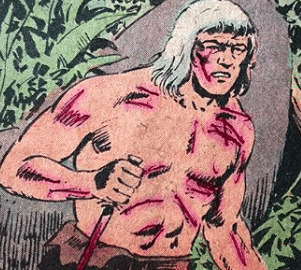
—Abhay Khosla compares a 2009 Marvel page with the 1968 Jim Steranko page it attempts to homage.

There’s no shame to getting smoked by Steranko. But it’s just neat seeing all the different ways he’s smoking somebody, though.

—Diana Swain at the CBC interviews Bruce MacKinnon about the controversial political cartoon he recently drew about the Brett Kavanaugh confirmation. (It's short, and they don't get into detail about the criticisms of the cartoon, either the partisan ones or those from some feminist critics.)

VG+

Tucker's taking the week off, but his presence on the site will still be much felt, as today's TCJ attests. First, Michel Fiffe is here with the second installment of his column. This time, it's Fiffe on Vince Giarrano.

Vince Giarrano was a cartoonist who made a stylistic shift so dramatically that you would swear it was two different people. I always find myself thinking about Giarrano's sudden left turn, and I very much like both extremes of his spectrum.

You might know him as the artist on Haywire, from 1988, written by Michael Fleisher.

And we also have the first day in a new artist's Cartoonist's Diary. This week's Cartoonist is Greek cartoonist Vassilis Gogtzilas.

And finally, we have Sara McHenry's review of That Night a Monster.

Tommy wakes up early one Saturday morning. He goes into his parents’ room to see if they’re up, and is shocked and terrified to see a giant black fern in his mother’s place in bed. His father, still asleep, isn’t having any of Tommy’s fear and questions. Go back to sleep, he says. Prrrrr, the fern says.

Tommy spirals into anxiety. What does this fern want? Will it eat me next? Who will take care of me if my mother is gone forever? His little white dog, Moomin, follows him around the house and is equally troubled: we see in Moomin’s wordless thought bubbles that he is concerned with who will feed him and pet him now.

Meanwhile, elsewhere:

—Interviews & Profiles. Alex Dueben interviews L. Nichols on Flocks.

I would draw these doll figures doing whatever we were doing. They weren’t comics they were just drawings, but at some point I realized that I was giving them my hairdo and my piercings and I went, oh. I was drawing myself. At that point I thought, I can use this as a way to sort through feelings in a more distanced way where it’s easier for me to figure out what’s going on. I think with the gender thing – this was before I transitioned – there’s a certain amount of that in there unconsciously. I didn’t really identify portraying myself in a physical body, so this was a way for me to do it. I don’t know. It’s cute. I like drawing the little button eyes.

The Something About the Beatles podcast interviews Carol Tyler, and the Virtual Memories podcast interviews David Small.

—Reviews & Commentary. Paul Morton reviews the latest volume of Jules Feiffer's noir trilogy.

It may be obnoxious this late in its history to use any review of a graphic novel as an opportunity to meditate on the form, its purpose and its function. Does anyone need to talk about the purpose of the novel when they review the latest Zadie Smith? But it’s hard to avoid such a mediation in the case of Feiffer’s work. Feiffer spent a 70-year-long career reinventing the supposedly low forms of the comics medium in an effort to make the comic strip literary. His decision to approach the graphic novel so late in his career is momentous.

—News. Two comics-related controversies struck late last week, both of which require more sustained attention than a short blog post can bear. We may revisit one or both of them at greater length soon. First, the writer Chuck Wendig announced on Twitter that he has been fired from his work writing Star Wars comics for Marvel, claiming he was told his termination was due to his social-media presence.

Second, the comics gossip site Bleeding Cool published a poorly written, edited, and conceived interview with a known far-right extremist activist, which led to outrage from readers, an apology from the site, and the announcement of a new editor-in-chief.

Nothing, Butt Trouble

Today at the Comics Journal, we're proud to share Oliver Ristau's insightful and impossibly open interview with Catherine Meurisse, the Charlie Hebdo cartoonist whose memoir, Lightness, was translated into English and released by Europe Comics earlier this year. The book, a graphic novel where Meurisse processes the murders of her colleagues and the upheaval of her own life in the aftermath, is one that has gone somewhat unacknowledged in the US so far. Thankfully, Oliver's interview--which has made its way through multiple languages to even exist--begins the journey of remedying that situation.

There were no selection criteria, because the whole book was made by instinct. As I was saying earlier on, the shock of the attack made me lose my intellectual faculties for a few months. I was unable to think, to form sentences, my imagination was totally blocked, as if some of the parts of my brain had been unplugged. My memories and my culture had disappeared, but drawing and comics require a solid culture. I was terrified by the idea that I might never be able to draw again. I started to write and draw in a large sketchbook in order to not become crazy, to try gathering fragments of myself, emotions in particular. I did not want to let any part of me escape. Colors came to me because they had to: In the opening scene, in front of the ocean, I chose dry pastels because it couldn’t be anything else. For the pond scene, it couldn’t be anything else than watercolor. I opened up some color boxes randomly, instinctively. This graphic disorder at the time matched my inner disorder. La Légèreté is a huge gathering: There are the dead and the living, black and color, writing and drawing, sadness and humor.

Today's review comes to us from Tegan O'Neil, who dug into a black and white comic about a vigilante that seems to have very little in common with the majority of things that could share that description: it's Bald Knobber, by Robert Sergal.

Bald Knobber distinguishes itself for being a narrative about masked vigilantism in comic book form that avoids any clear parallels to super hero material. There’s one reference to his mask being “Janky Batman,” which is fairly descriptive, but also a telling anachronism. The fact that Bald Knobber is about a disgruntled kid who puts on a mask and sets about to beat up a bully without echoing any spandex tropes is impressive. That’s the point of the book, really – there’s nothing at all good about vigilantism, no nostalgia to be mined, just weird and shady shit from dark chapters of the nation’s history. The point isn’t particularly subtle but it’s not particularly trying to be: Cole puts on a mask and acts out, and this acting out earns him scorn and distrust.

Last week's Jog review, like many Jog reviews before it, had me jumping to pick up my own copy of a book that had gotten him so pumped. Along with my shipping confirmation, I got a linked to a whole mess of Lale Westvind animations I'd either never seen or not seen in years. That's where I'm at, and now, you can be too.

It’s, Like, Excruciating

We've got two reviews for you today. First, Greg Hunter on Tadao Tsuge’s Slum Wolf.

Shaded faces are a fixture of Tadao Tsuge’s Slum Wolf. From the collection’s opening piece, “Sentimental Melody”, and throughout the book, figures come into view with their features obscured. “Melody” begins with a man visiting a sex worker; Tadao shows him in near-silhouette several times before revealing the man’s face. In the story that follows, “The Flight of Ryokichi Aogishi”, Tadao at first renders a man’s head in spot blacks, despite drawing the man's overcoat and the space around him in fine detail. He continues this approach in several of the book’s other stories, encouraging readers to understand his characters in terms of a figurative (and sometimes literal) facelessness. With some artists, an obscured face—and the repetition of that motif across stories and years—might connote a character’s universal experiences. With Tadao's pieces in Slum Wolf, that’s not exactly the case.

The book is translator Ryan Holmberg’s second compilation of Tadao’s work, after Trash Market in 2015. The comics in both volumes reveal similar concerns, though Slum Wolf is an even more affecting, cohesive set of stories. Tadao’s cartooning first appeared in manga periodicals such as Garo and Yagyō, with Wolf collecting select pieces from the late '60s and '70s. Tadao’s subjects in these stories are fairly specific: men who fought for Japan during World War II and/or men who found themselves left behind after Japan’s post-war economic recovery, as well as where these men find themselves a few decades onward.

The spaces these stories explore aren’t always exclusively male, but the stories’ lead characters tend to be. And the men’s discarding of or failure to fulfill the roles and responsibilities of their era often provide the stories’ subtext. They are the type of people Tadao would have seen daily, growing up in a Tokyo red-light district amidst post-war poverty. So why—with such familiar subjects—the shadowy faces?

Rob Clough is here, too, with a review of Luke Healy's Permanent Press.

Luke Healy's Permanent Press is a book so meta (and so self-deprecatory) that I almost expected it to disappear after I read it. Ostensibly, it's a volume that collects two longish stories from Healy, "The Unofficial Cuckoo's Nest Study Companion" and "The Big And Small". The former story was previously published in minicomics form, and an extremely clever, original achievement. The latter story was previously unpublished, and in this book it's often interrupted by the metanarrative of Healy and his shadow. That shadow is part conscience, part Greek chorus, and part therapeutic wise mind to the Healy character's constant and depressive self-deprecation.

That self-deprecation is more than just the sort of funny-sad window dressing that's at the heart of so many autobiographical comics. Indeed, Healy is brutally sending up that entire sub-genre of comics at his own expense, as is made clear by the hilariously melodramatic quality of these interludes. For example, after a horrible experience at a local comics show, his shadow suggests that he go outside and get some "fresh air." That turns into a two-month sojourn in the wilderness (complete with poop jokes) that frees Healy from thinking about comics... until he does so again immediately upon coming home.

Meanwhile, elsewhere:

—Angelica Frey talks to Matthew Thurber on the release of Artcomic.

Matthew Thurber’s new graphic novel, Art Comic, is absurdist, surreal and a little bit slapstick. After all, it follows a group of Cooper Union graduates— and their professor, and a group of idealistic pigs, and some aliens, and two procreating sex robots— as they try to master the whole “how to be an artist” thing. At the author’s request, though, please don’t call it satire.

“A satire felt too light to explain how upset I am about a lot of these tendencies in art, about how serious the book is for me,” he told Bedford + Bowery the day after Thursday’s book launch at Desert Island Comics in Williamsburg. “This is beyond poking fun, this is a systematic problem.” While satire is cathartic, there’s no release for Thurber after he’s done explaining himself in the book.

—The Edward Gorey parody in the latest Mad doesn't seem as out-of-character or noteworthy to me as it apparently does for most people, but it's interesting to see any comics story receive the kind of viral attention it has. Sridhar Pappu writes about the reaction at the NY Times.

Mad Magazine, the 66-year-old humor publication, has been in free fall for years — in terms of both circulation and cultural relevance.

This month, however, people as varied as the comedians John Hodgman and Patton Oswalt, as well as Lee Unkrich, a co-director of “Coco,” were heaping unlikely praise on the magazine known for anarchic satire aimed at the rich and powerful. The reason? A four-page comic strip appearing in the Halloween issue depicting 26 children, one for each letter of the alphabet, who were or would soon become victims of a school shooting.

—Jules Feiffer has begun a new monthly strip at Tablet.

That’s What I Thought

Today at The Comics Journal, we're roaring into Wednesday with a full satchel of comics content. First up, it's the latest installment of Retail Therapy, our recurring interview series with those individuals who have chosen comics retail as a career. This time around, it's Gabe Fowler from Desert Island in the hot seat. And he's got some things on his mind, the rascal!

What do you wish more customers knew about comics retail?

Retail stores are not a photo opportunity to improve your Instagram feed. If you like a store, if they offer you anything in the way of discovery or entertainment, even if it's just a cute place to meet up with your tinder date, lay down your hard-earned cash and contribute to their existence.  

Our comics excerpt train also stops in with a look at another Koyama title--Nathan Gelgud's House In The Jungle

And of course, there's a review. Today's comes from Josh Kramer, and he's turned his eagle eye to Tillie Walden, who just released On A Sunbeam through First Second & Avery Hill, depending on which country you're in, following the book's serialization online.

Mostly, dear reader, you want to find out. OAS features some genuine, interesting sci-fi world-building that sparkles and intrigues, like the deep space planet called The Staircase. Different readers value different aspects of stories, and I know that some readers care about characters above everything else. But I do enjoy the small details, and in some parts of OAS they fell flat for me. We never really get a good look or understand any of the work anyone is doing, despite a lot of talk about it. Desirable resources are described as “healing rock.” That's not terrible, but it's not terribly interesting.

Over at The Comics Reporter, you'll find that Tom Spurgeon is the latest to praise Lauren Weinstein's tremendous Frontier #17. I'm with Tom--I spoke to a class of seniors at MCAD yesterday and Lauren's work in that issue was my go to example for why 32 page bangers have nothing to be ashamed of in the face of the onslaught of heavy tomes. While I respect Tim's desire to keep some semblance of professionalism around here, I'm under no such obligation: it's the best thing I've read this year.

Deal

Today on the site, cartoonist/scholar Mark Newgarden returns to interview another great cartoonist/scholar, Eddie Campbell. Campbell's latest book, The Goat Getters, is a uniquely innovative history of the hidden origins of newspaper comics.

I’ve been collecting all kinds of stuff for years and have developed my own concept of the history of cartooning, of which "comics" is just one aspect. In my head I have always had a sense of the story in it, but I tend to groan when all those "History of Comics" come out and as time has moved along they have got narrower in their focus. I felt it was time to get back and look at the actual material and not just all the history books that have accumulated, in which more often than not the writer is reiterating the conventional old narrative of the previous one. Also, when some of these histories get to joining up the dots, they are seeing only the dots in a narrow window and thus missing the real connections that are invisible to them. So there was a pressing need to see the old comics and cartoons in their context, to see the newspaper as a holistic environment in which cartoonists could be moving this way and that and working in several sections of the paper at the same time and not just the comics pages. If you go at it all without the usual prejudices, a quite different story can be drawn out. Indeed many different stories present themselves.
at love-making, meaning courtship back then, should be taught in schools.

Meanwhile, elsewhere:

—Interviews & Profiles. The Daily Beast has a deeply sad interview with the 95-year-old Stan Lee and his daughter J.C., regarding the many allegations against various figures surrounding the man.

I’m not sure if you’re aware of this or not, but there have been stories out, and at least one upcoming story with allegations of elder abuse on you by your daughter.

STAN: I wish that everyone would be as abusive to me as JC.

J.C. LEE: [Interjecting] He wishes everyone was so abusive.

STAN: She is a wonderful daughter. I like her. We have occasional spats. But I have occasional spats with everyone. I’ll probably have one with you, where I’ll be saying, “I didn’t say that!” But, that’s life.

Keya Morgan has been going on to me, and other reporters, about how abusive J.C. is to you. I know he was with you up here for a good amount of time. He claims he was with you for ten years.

J.C.: No. He was with him for six months—that period of time. And a year or two before.

STAN: As Joanie says, he was with me for about six months. I found out that he wasn’t really what I signed on for. So, I let him go.

Does it surprise you that, now that he’s banished from your life, he’s leveling all these accusations at your daughter?

STAN: I don’t know that he was. But it wouldn’t surprise me, no.

The most recent guest on the Virtual Memories podcast is Jason Lutes. Lutes was also interviewed on Vermont Public Radio.

I believe we may have mentioned this before, but it's worth reiterating that SPX has posted video from many of this year's panels.

—News. This year's Harvey Award winners have been announced. Marjorie Liu and Sana Takeda's Monstress was the winner of the biggest prize.

—Reviews & Commentary. Ariel Dorfman writes about co-authoring the Marxist comics-crit classic How to Read Donald Duck, which is being newly republished.

I should not have been entirely surprised when I saw How to Read Donald Duck, a book I had written with the Belgian sociologist Armand Mattelart, being burned on TV by Chilean soldiers. It was mid-September 1973 and a military coup had just toppled Salvador Allende, the country’s president, terminating his remarkable experiment of building socialism through peaceful means.

I was in a safe house when I witnessed my book – along with hundreds of other subversive volumes – being consigned to the inquisitorial pyre. One of the reasons I had gone into hiding, besides my fervent participation in the revolutionary government that had just been overthrown, was the hatred the Donald Duck book had elicited among the new authorities of Chile and their rightwing civilian accomplices.

We had received death threats, an irate woman had tried to run me over and neighbours – accompanied by their children – had stoned the house where my wife, Angélica, and I lived in Santiago, shouting: “Long live Donald Duck!” It was later discovered that the 5,000 copies of the third printing of the book had been taken from a warehouse by the Chilean navy and cast into the bay of Valparaíso.

Permanent Emergency

Today at The Comics Journal, we're ready to turn the spotlight on Frank Miller and Dave Gibbons. Finally! It's Marc Sobel with that long look back at Give Me Liberty.

Despite its long gestation period, Give Me Liberty was actually conceived in the summer of 1988 at the height of the Watchmen and Dark Knight hysteria. As Miller explained, “Dave and I were at the San Diego convention, walking around the San Diego Zoo, and we started talking about working together. He had just finished Watchmen, I had just finished Dark Knight—I suspect we were both taking our press awfully seriously and had yet to calm down.”

But despite their initial enthusiasm, the series was shelved for a couple years. Miller recalled that he was “just writing scenes at random” without a clear idea of what he wanted to say and, eventually “Dave quit.” “It was originally going to be a huge portentous series of 150-page graphic novels, the first of which I scripted (but) the wind just went right out of our sails. We lost interest.”  

Our review for today comes from Patrick Dunn, and he came away pretty pleased with the recent Image Comics horror book Infidel, from Pornsak Pichetshote and Aaron Campbell.

Infidel’s plot revolves around two lifelong friends and women of color, Aisha and Medina, who both live in an apartment building where a mysterious bomb blast recently killed several people. Both grew up in the Muslim faith, but have taken different paths in adult life. Aisha still dons a hijab, takes comfort in prayer, and makes excuses for the casually racist opinions espoused by Leslie, her boyfriend Tom’s mother. Medina is more overtly radical. “Racism’s a cancer that doesn’t get cured,” she tells Aisha. “The best you get is remission.”

This past weekend saw a healthy percentage of the comics world descend upon New York City's Jacob Javits Center for New York Comic Con, and multiple announcements regarding the next batch of DC, Marvel & Image Comics were announced. For more detailed coverage of that show, I'd recommend Bleeding Cool's coverage. Over the weekend, I received multiple texts from people attending the show, none of which were positive.

Prior to the show, Oni Press launched a free all-ages webcomics site. At this point, the site has a small number of books, but multiple titles are planned for later release on the site. It's an interesting venture, and part of what looks to be a continued redefinition of the Oni brand.


Speed Round

Today on the site, Alex Dueben interviews New Yorker cartoonist Liana Finck about her new memoir.

At what point did you start to write about your parents because the book is about you, but it’s also about the context of your life, in a sense.

It started out about me. I think the first fully formed part that I wrote was about me being a weird kid. After that I wrote the part about my parents. I don’t remember why I brought them into it. I feel like a shadowy echo of my mom sometimes.

Honestly, I wrote the part about me being a weird kid before I had a feminist awakening and then I wrote the mom part while I was having the awakening. I didn’t see my story as being a feminist story until I realized how women’s lives are shaped by being female. Then I started to feel how my mom’s story was really similar to my story. My mom’s story was of quitting her career to not have a career and have her art in the context of being a wife and mother and what it meant to pour all her art into not professionally ambitious things. How it succeeded for a while, but then didn’t have enough roots to sustain her for a long time.

You said that you had a feminist awakening. Could you talk about that and what that meant for you?

I think it happened the moment I stopped having writers block, which at least in my case was extreme self-consciousness about making things that other people would see. I would draw the same thing over and over and over again so at the end of a year I would have one drawing done a million times instead of a million drawings, or a hundred drawings. I think all the anger and scrutiny I had been putting on myself I started putting on other people. [laughs] It coincided with a breakup that made me remember past breakups. It coincided with me finally realizing how much I hated being catcalled and things like that. All the unfairness that I’d been living with for so long but I was so busy feeling like I wasn’t good or human and that I couldn’t be angry at the world for anything suddenly left. It was very freeing.

We also have Tegan O'Neil's review of the book in question.

Liana Finck draws like someone who has spent a great deal of time unlearning how to draw. She describes the process herself while watching on & off boyfriend Mr. Neutral at work: “When I watch you draw, I get a glimpse of what it would be like – if I could still draw the way I was a kid. If I’d met you when I was younger, I bet I wouldn’t have stopped drawing.” Situated at the beginning of the narrative, that statement lays out a map for much of the territory that follows in Passing for Human, Finck’s memoir of her and her family’s history of strangeness.

“Strangeness” is her word, not mine, used to describe what she refers to a variety of terms. In a section on her father, who seems to have shared a similar or related strangeness, she states, “nowadays, if you don’t know how to act around people, you might be labeled ‘mildly autistic.’” But the book isn’t about labels, and there’s really only one part it’s even mentioned. As she states: “The labels set you apart from the world, but they also give you a place in it. They make you feel more different, but less alone. In those days, though [her father’s youth] there were no labels.”

Meanwhile, elsewhere:

Three straight days stranded for hours on NJ Transit have conspired against my usual thoroughness, but I still have a few links, and will catch up next week.

—News. Jillian Tamaki has been nominated for another Governor General's Literary Award.

—Reviews & Commentary. Charles Hatfield enthuses over L. Nichols' Flocks.

Nichols creates his own vocabulary of visual metaphors and devices even as he traces the story of finding, and declaring, his own best, truest self. His story explores and celebrates the paradoxes of self-in-community, the complex comforts of faith, and what it means to be alienated from the very things that support you, or supported by the very things that alienate you—that is, what it’s like to live a tangled human life among distinct, and in some ways opposed, communities, and how to find grace in that most delicate, ever-shifting position.

Dominic Umile writes about David Sandlin.

Artist David Sandlin had only been in New York City for a couple of years when he was plastering downtown Manhattan’s concrete building facades with graphic silkscreened posters to promote his solo exhibition at Kwok Gallery in 1982. But at that point he’d already won five hundred bucks in an art contest, played a role in a wholly rambunctious countercultural art collective, and worked as a studio hand for Robert Rauschenberg, Buckminster Fuller, and others.

—Interviews & Profiles. The editors of the new print TCJ, Kristy Valenti and RJ Casey, are the latest guests on Inkstuds.

He Has Nothing You’ll Want

Today at TCJ, we're pleased to bring you Joe McCulloch, who has returned from SPX with a frenzy in his heart. That frenzy has a cause:

While ostensibly the first part of a continuing series -- published as a slightly-taller-than-square softcover by Chicago's Perfectly Acceptable Press, which excels at daredevil feats of very fancy risograph printing -- Grip stands alone as a remarkable statement, one in which the artist's own hands seem to hold the entirety of American comic book history. If Westvind's Kramers story was wordy, sunburnt and hungover like a horror short running unsupervised off the Charlton press, Grip hearkens back to an even earlier time: it's like a Golden Age comic, its hero manifesting fabulous powers seemingly at random and immediately going about accomplishing mighty feats, because that's what you ought to do. It's a comic that feels like it was born unconcerned with the schematics and the expectations of comics, and therefore occupies itself with demonstrations of bravura sensation - Pure Comics Power.

The Guardian goes long on Berlin, Anne Frank and Nora Krug's new one. It's Ger-mania!

Berlin isn’t the only new comic to take on Germany and its wartime politics. This autumn also sees the publication of a graphic novel version of Anne Frank’s Diary adapted by Ari Folman and illustrated by David Polonsky, the Israeli pair best known for the 2008 Oscar-nominated film, Waltz With Bashir; of the remarkable Heimat, a memoir by Nora Krug, a German-American illustrator who teaches at the Parsons School of Design in New York; and of The Three Escapes of Hannah Arendt, a biography of the German-born Jewish philosopher by Ken Krimstein, a Chicago academic whose cartoons have appeared in the New Yorker. Is this a coincidence or does it have a wider significance? Though he has not yet read the other books, Lutes believes it does. “It’s so interesting,” he tells me. “On some profound level, we are all connected to this deeper thing. We are all processing, consciously or subconsciously, our world and having tapped into something that’s in the air, our books have bloomed simultaneously.”

Julia Alekseyeva also goes long, but her focus is on Tom Kacyznski's Cartoon Dialectics series.

In the volumes, Kaczynski frequently returns to a critique of modern life. In the tradition of theorists such as aesthetic philosopher Walter Benjamin and cultural theorist Jean Baudrillard, Kaczynski considers both the wonders of modernity and the despair of late capitalism. Subjects in Cartoon Dialectics are frequently isolated from others, trapped in a metaphorical (or literal) dystopia. It takes a glitch in the system—an ecological catastrophe, a blackout—for them to find meaning.

Rocko Jerome has that Olivia Jaimes coverage you need regarding the cartoonist recent panel at CXC

Olivia spoke about how the function of Nancy as a comic is problem solving. There’s a challenge of some kind, and Nancy has to find a way to overcome it. She said that one of her favorite Bushmiller strips was the one where Nancy shifts the whole panel to straighten a picture on the wall (Which I know that I’ve seen, but now can’t find to show you).

-She’s into Sudoku and said that a lot of the same principles of that applied to the layouts of Nancy.

-She mentioned that Nancy and Sluggo’s relationship is quite platonic. Words to the effect of “People ship them hard…they’re eight.”

Better Jokes Than These

Today on the site, R. C. Harvey retells the story of underground comics, to mark their fiftieth anniversary.

This year is the 50th anniversary of underground comix. The official beginning was the publication in February 1968 of Zap Comix No. 1, which was sold out of a baby carriage on the streets of Haight Ashbury in San Francisco. But the underground was surfacing elsewhere—in Greenwich Village, in Chicago, in Milwaukee, Wisconsin, and in the unlikeliest of places, Austin, Texas. America culture as a whole was experiencing events as upending and disruptive as anything in revolutionary comic book format, whether ending with an x or not.

The ongoing Vietnam War-inspired protests that spread beyond the campuses where they started into politics and the wider society. As Jackson Lears outlined in The New York Review of Books (September 27), 1968 was the year of “the tormented Lyndon Johnson, enmeshed in an unpopular, unwinnable war and choosing to withdraw from the presidential stage; the anti-war candidacies of Eugene McCarthy and Robert Kennedy; the intensifying moral challenges posed by Martin Luther King, the assassinations of King and Kennedy; the racially charged violence in most major cities; the police riot against antiwar protesters (and anyone else who got in their way) at the Democratic National Convention in Chicago; the emergence of right-wing candidates— George Wallace, Richard Nixon—appealing to a ‘silent majority’ whose silence was somehow construed as civic virtue. ...”

The radical protests featured unknown entities who soon became famous—Tom Hayden, Mark Rudd, Abbie Hoffman, the Students for a Democratic Society (SDS), the Black Panthers, the Maoists, the Yippies, the devotees of Che.

In the midst of this surging social disruption, underground comix were a logical development—however illogical (even demented) and anti-social their content seemed. And they were cropping up everywhere in and around 1968.

Courtesy of NBM, we also have an excerpt from Michael Cherkas and Larry Hancock's new Silent Invasion: Red Shadows.

Meanwhile, elsewhere:

—News. Series editor Bill Kartalopolous has posted the contents to this year's Best American Comics, guest edited by Phoebe Gloeckner. He also includes a linked list of Notable Comics that weren't included.

—Reviews & Commentary. Over at The Guardian, Ian Dunt pays tribute to Carlos Ezquerra.

Ezquerra started his career drawing war comics in Barcelona before moving to the UK and working for the anthology 2000AD and others. He brought the iconography of fascist Spain to Dredd’s extremely weird and vivid design and combined it with his experiences of living in Croydon through the 70s and 80s: the punk movement on his doorstep and TV images of policemen charging striking miners.

The eagle motif and helmet were drawn from fascism, the permanently drawn truncheon from police on the picket line, the zips, chains and knee pads from punk. “I was living in Franco’s Spain,” he told an interviewer last year, “but also I was living in Mrs Thatcher’s England.”

Over at Print, Michael Dooley looks back at the time Blazing Combat was banned from U.S. Army bases.

Each of the seven or so Blazing Combat depicted a variety of clashes from the battle of Thermopalye through the American Revolution to the Korean conflict, with one always set in present-day Vietnam. “Conflict,” with art by Colan, is a compelling examination of discrimination against Asians and blacks. The others were drawn by Joe Orlando, who’d worked on EC’s science fiction and horror titles and eventually rose to become Vice President of DC Comics. His “Viet Cong,” the lead story in the very first issue, depicted barbarous atrocities being committed by the South Vietnamese army, who were our allies. Sales of that issue were decent, but some began to resent what they perceived as the comic’s dangerously incendiary anti-American attitudes.

Karen Berger writes about publishing Anthony Bourdain's comics.

Tony’s early connection to comics goes back to the glory days of Marvel. Like many boys growing up at that time, he was enthralled by the creative genius of Jack “The King of Comics” Kirby. And though he was too young to have read 1950s EC horror comics in their prime—he devoured the visceral, over-the-top gore and violence when he was a little older. He also discovered the work of R. Crumb and the underground comics scene of the 1960s. The raw, druggy, satirical, socially and politically rebellious material, I’m sure in part, helped inform his outlier sensibility. It certainly motivated his desire to become a comics artist, which he pursued for a while, but was told by several people that his art wasn’t good enough.

—Misc. R. Sikoryak sketched the CXC Olivia Jaimes panel.

Blue Flowers

Today at TCJ, we'll turn the reins over to Daniel Best, who has delivered an extensive obituary on his friend, the comic book artist Norm Breyfogle.

Norm always had a temper. He was passionate about social justice and hated the way the Right would look down upon the Left, and the poor, with disdain and disgust. Norm would engage in debate with anyone and everyone, debates that turned into on-line fights. Norm couldn’t allow anyone to get the last word and it was one night when, while arguing yet again, he smashed his fist into his computer monitor. Instantly he felt a searing jolt up his arm and believed he’d been electrocuted. He could barely move and speak. He managed to call for an ambulance and was taken to the hospital where it was discovered that he’d suffered a serious stroke. Only the fact that he was in peak physical condition had saved him from being a fatality. But survival came at a cost – his left side was now paralyzed.

Today's review comes to us from Shea Hennum, who is here to talk Jesse McManus' most recent release, The Whistling Factory.

Jesse McManus comics are like a fever dream. That is, they are at once grotesque and lucid, operating with a world that exists in the coherent (if disorienting) shadow of our own. Combing the cutesy-macabre aesthetic of Al Columbia with the frenetic grotesquerie of a Ren & Stimpy close-up, The Whistling Factory is no different. Composed of stories of varying lengths, and brief, punchy interstices, the collection resists the coherence of something like a short story cycle without diffusing into the incoherence of the anthology format. Generically, it rejects comporting with anything that might be familiar, but it isn’t so scattershot that it cannot be encountered as a unified thing.

The latest defamation lawsuit: Richard Meyer, a youtuber behind the Diversity & Comics channel, has sued Mark Waid for defamation and tortious interference regarding incidents surrounding the cancellation of a graphic novel Meyer was working on with the publisher Antarctic Press. While Gina Gershon dominates the term "tortious interference", nobody has seen fit to put her explanation of that term from The Insider on Youtube. So here's the guy from Last Boy Scout showing you how to wait for it.


Late Day

Today, on the site, Mark Newgarden returns with his second photo tour to the old days of cartooning legend at The Inkwell in New York City.

Open for business at number 693 (between 43rd and 44th Streets) The Inkwell catered to an elite clientele of cartoonists, newspapermen, photographers, models, actors and all manner of other 20th-century media workers (plus thirsty curiosity seekers.) It was celebrated in its heyday for its pork chops, raucous Thursday night theme parties, and after hours jam sessions — but above for all its unique décor, courtesy of some of the greatest cartoonists of the era.

Robert Kirby is here, too, with a review of the most recent slate of Kuš! comics.

Portugal-based [Mariana] Pita delivers this funny tale featuring a childlike protagonist and her acerbic dog, presented in a dreamy mix of watercolors and colored pencils. Things begin with the girl seeing an online plea for giving blood: "Be a hero." This sounds like just the thing to her, so she leashes up her dog (though he tells her he has a game that night and needs to be home by a specific time) and sets out on the journey to the donor offices. Along the way, they stop and let the dog take care of his business (he helpfully cleans up after himself), figure out the subway route, observe the people around them (“So many thrashy people,” she comments), and stop for a snack. The amusing and occasionally snarky interplay between the two feels authentic (despite the fact that one of them is, you know, a dog). When they finally reach their destination, things don't go quite as planned, but the girl remains philosophical: “It’s ok, being a hero isn’t easy.” Pita judiciously anchors her very watery watercolors with colored pencils, with red (especially for the blood) being particularly effective. Her visuals, including the hand-drawn, cursive text, have a fresh, freewheeling feel, happily taking readers along with the protagonists on their journey. Day Tour could have come off as overly twee, but in Pita’s deft hands it’s an oddball charmer from start to finish.

Meanwhile, elsewhere:

—News. The 2000AD stalwart and Judge Dredd co-creator Carlos Ezquerra has died of cancer.

Ezquerra, who lived in Andorra, began his career in British comics in 1973, after initially working on Spanish war and western comics. He found work on the war comic Battle Picture Weekly, drawing the adventures of the Dirty Dozen-inspired Rat Pack and later the strip Major Eazy, before editor and writer Pat Mills, who launched 2000AD in 1977, asked Ezquerra to come up with character designs for Judge Dredd.

Dredd’s helmet, knee-pads and eagle-motif shoulder decoration were instantly iconic, as were the cityscapes Ezquerra developed for Dredd’s beat, the sprawling, dystopian Mega-City One. Dredd debuted in the second issue of 2000AD, but was not drawn by Ezquerra, despite his crucial role in the character’s design. Ezquerra returned to drawing for Battle for a few months, then teamed up with original Dredd writer John Wagner to create what many fans consider the quintessential period of the character.

Archaeologists in Jordan have found ancient art that some scholars say resemble an early form of comics.

Painted on the walls inside a 2,000-year-old Roman-era tomb, Ariel David at Haaretz reports that there are nearly 260 figures featured in narrative scenes, with many speaking via comic-style speech bubbles.

—Reviews & Commentary. Chris Mautner reviews new books by Edie Fake and L. Nichols.

While at the Small Press Expo in Bethesda, Md., earlier this month, I attended a panel entitled “Trans Memoir.” During the program, a small group of transgender cartoonists talked about how comics provided them with a mode of self-expression in which they could delineate their best, ideal selves and talk about issues and emotions — often difficult to articulate — that come with being trans.

Two recent books from the small press publisher Secret Acres — Flocks by L. Nichols and Little Stranger by Edie Fake — underscore what those cartoonists were saying. Both books examine the struggles of being transgender and dealing with dysphoria, albeit from very different perspectives and sense of aesthetics.

—Interviews. The most recent guest on the Virtual Memories podcast is Nora Krug.

The Exhausted Core

It's Friday at The Comics Journal, which means it's Friday everywhere: enjoy it. We're launching ourselves into the weekend with a nice long conversation with some folks who know how to have such things: Joe Casey and Ian MacEwan. They both got on the horn with Sean Witzke to talk about their new Image Comics collaboration, the action comic MCMLXXV. Take a look at the art heavy post, but drink in the words as well--after all, when's the last time you caught a conversation about Jademan?

Jademan feels like it's completely been forgotten as a type of comic, they're really unlike any other mode of comics storytelling. It's one of those things that feels like someone came up with it independent of influence.

MacEwan: Those art teams put so much effort into the smallest details, and in so many styles. It's bewildering how panels switch from line art to fully painted to elaborate color holds that turn into abstract color explosions. I love the use of speed lines as active foreground elements. And blending that with all the phantom strikes, it loses any sense of space but makes up for it in sheer roller coaster ride. It's really effective at capturing a martial arts fight a the way that interprets long-take kung fu film fights. And wuxia is such a distinct fantasy genre, with each move having a name and discipline and celestial correspondence.

The production of those books too are just nuts, I loved how the back of each issue were full of pictures of artists working in the Jademan "bullpen" at their super specific art jobs. And above it all there's "Tony" Wong Fuk-Long always posing in expensive suits in front of his lamborghini. He's more Hong Kong comics' answer to Phil Spector than Stan Lee. He's written multiple books about his own greatness, and gone to prison more than once for defrauding his company and his employees. And he's spent the last few years trying to build a billion dollar Hong Kong Comics amusement park!

That's not all, of course--today also sees the conclusion of L. Nichols week of Diary comics. Kids and the Santa Cruz boardwalk. What's not to love? 

And then there's today's Review, courtesy of Ryan Carey. This time around, Ryan is taking a look at Retrofit's The Prince, by Liam Cobb--and he cracked this one with some expectations. Were they met? Find out now.

The just-referenced cover sets the tone for the interior contents quite nicely, as Cobb employs a vaguely Mad Men-esque sensibility that could possibly best be described as “retro-futurism” to convey a briskly-told, emotionally-distant, decidedly vengeful version of an ostensibly simple yarn. His conceit of making the frog a mysterious, and possibly duplicitous, sudden arrival into the life of May, a neglected, financially well-to-do wife trapped in a loveless marriage with a typically philandering scoundrel of a husband adding a frisson of tension and unease to one of the most shop-worn plot skeletons you’d care to mention. It’s an intriguing enough wrinkle to keep you turning the pages, to be sure, but is it actually innovative?

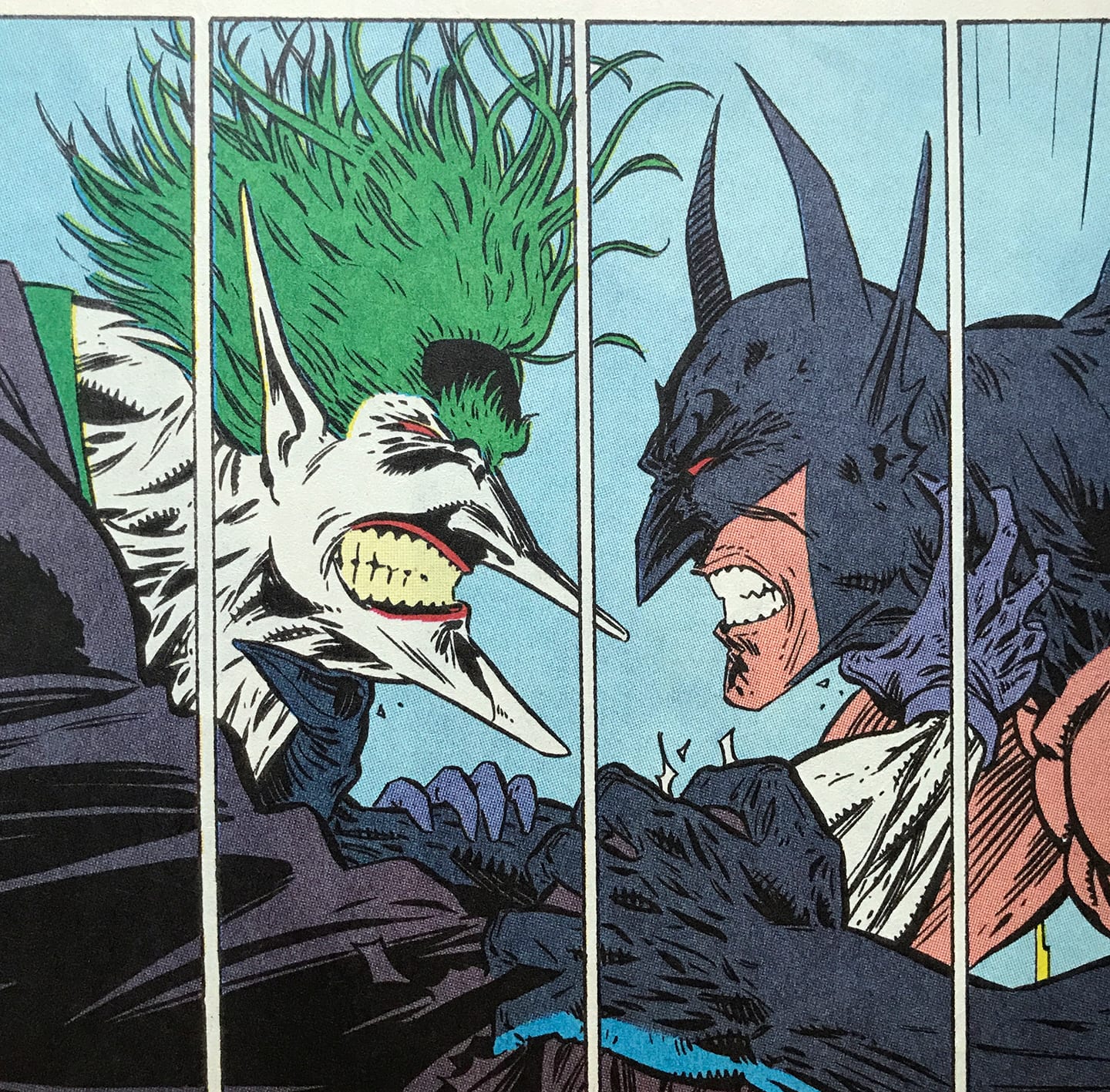
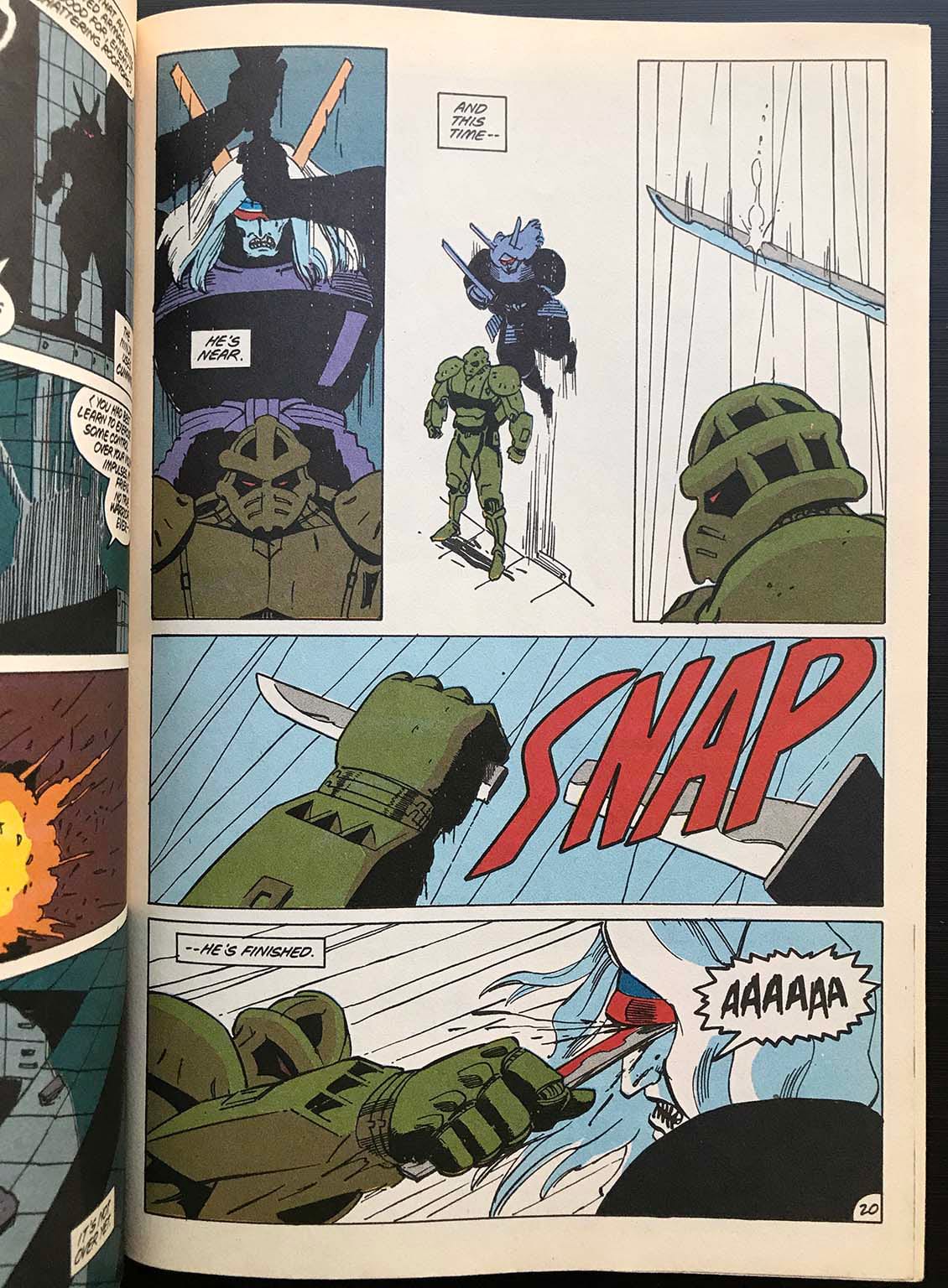
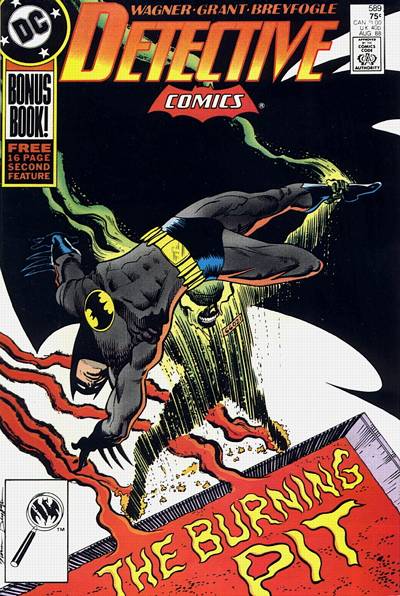
And now you'll have to indulge me--or click away, I won't know the difference. This, right here, is one of the first two comic books I ever purchased with my own money--the conclusion of a three parter featuring "The Corrosive Man", a plot to steal an inheritance involving hobo murders, an evil criminal named "Kadaver" who wears a devil mask, and a rare panel of Batman shown bantering with cops after dawn at the site of a car accident. The comic was written by John Wagner & Alan Grant, although those names meant nothing to me at the time. The name that did mean something was Norm Breyfogle. Along with Jim Aparo, Breyfogle's work on Batman defined my understanding of comics for a healthy period of my initial reading simply because Norm Breyfogle and Jim Aparo were my complete understanding of comics. Things like The Far Side and Calvin & Hobbes (and Garfield & Heathcliff) existed alongside them, but when it came to extended narrative reading, the art of those two individuals defined the bulk of the medium. Even when other DC comics of the time--always featuring Batman--appeared, none appeared as frequently, or as consistently. If I were to actually research Breyfogle--something I've thought of doing, but honestly never expected the question to arise so tragically early--I think that what I would find is that his most conspicuous images are the ones were he went off model, if only because it was so incredibly, fantastically rare to see him break his pattern. Unlike Aparo, whose work was full of a constant, meaty heaviness and beautiful symmetry, Breyfogle's Batman was an acrobatic creation, a thing forever in motion, and it was that from the very beginning. He drew characters intoxicated with the possibility of grace and the body's movement--if one were to strip them of their clothes, they'd be the bodies of contortionists, gymnasts, figure skaters. His Commissioner Gordon was one whose mustache always seemed intent on eating his mouth, and there was no emotion more happily drawn than when a character could excitedly recognize something--a friend, a fact, a lesson, a thing. In Breyfogle comics, things happened that were sad--the death of Tim Drake's mother, delivered in flashback by a sorrowful Bruce Wayne--but it was always the moments of joy and excitement in between the heroics that resonated with the most emotion and reverence. The electricity of his style disguised their content--in anyone else's hands, Wagner & Grant's script for Detective Comics #589 would have been a bloody, dismal affair--but in Breyfogle's hands, danger feels a bit playful, death a giant misunderstanding. His passing was too soon, anyone's passing is. Worser still is the fashion in which he was treated on his way towards it. He deserved better, and the universality of that sentiment in no way lessens its validity.

One Question

It's a weird day out there, but if you're looking to hide from the world, we have some comics-related content to help with your denial.

First, Mark Newgarden is here with a photo tour of The Inkwell, a postwar NYC bar where everyone from Milton Caniff to Milt Gross to Otto Soglow drew on the walls.

Part of the mythos of the 20th-century newspaper cartoonist was the role of the deadline- haunted hollow-legged libertine, part workhorse/part fraternal drinking machine. Big-city newspaper art departments were notorious for their in-house tippling and impromptu frescoes. In a 1979 oral history, the radio producer Himan Brown (desperately seeking an audience with cartoonist Milt Gross) recalled his teenage impression of the New York World art department of the 1920s: “For me to describe the place these cartoonists worked in, in the old World building down on Park Row in Lower Manhattan, is really a nightmare in itself. These were tough hard-bitten men, an elite unto themselves. They sat side by side, doing the cartoons and comic strips that were so familiar, in this one smoke-ridden room, with spittoons and filthy dirty pictures on the wall. Pornography was invented by these guys.” These dual impulses naturally migrated to the local saloons after office hours.

Among these was The Inkwell, a now-forgotten postwar establishment that once catered to this particular elite. Located at 693 Third Avenue between 43rd and 44th Streets on the East Side, “a few doors south” of the original Costello’s (which occupied number 699 until it relocated to East 44th street in 1973), The Inkwell was christened with a moist nod to the high-hat steak row eatery, The Pen and Pencil. Esquire described it as “a hangout for cartoonists and writers, actors and musicians, models and magazine editors.” Knife and Fork in New York, a period guidebook, described it as a “boothed gossipry for folk from near-by newspaper offices ” and went on to praise both the steaks and “big luscious porkchops, Southern-style.”

We also have Day Four of L. Nichols' Cartoonist's Diary. Today, it's camping in Big Sur.

Meanwhile, elsewhere:

—News. Longtime Batman artist Norm Breyfogle has died. Anyone between, say, 30 and 45 who read superhero comics in their youth probably has fond memories of his work. The details of his death are still private, but he suffered a stroke in 2015, and used crowdfunding at the time to help pay his medical bills.

—Interviews & Profiles. Rolling Stone talks to Garry Trudeau.

Are you more concerned about the country than you were when you started Doonesbury, during the height of Vietnam and the Nixon administration?
It’s hard to measure degrees of concern. The country’s been at war for roughly half the 50 years I’ve been doing this. We’ve had endless scandals, crises. I can’t think of a year when I wasn’t concerned. My hair’s always on fire about some damn thing.

The Guardian profiles Liana Finck.

She may feel that her constant existential terror makes her a bit weird, but it seems there are enough like-minded souls out there to make her quite normal. (Her 200,000 followers on Instagram are devout enough that her biography states: “You may tattoo.”)

“All my weirdness around people is just weirdness about myself. I’ve always been self-conscious and shy, but I wonder if that can be your whole life. I might get used to all the things in the world and stop being anxious about them,” she says. She doesn’t sound very sure.

The most recent guest on Process Party is Josh Cotter, and the most recent guest on Comics Alternative is Tillie Walden.

—Reviews. Jenny Lawson at The New York Times reviews Finck's latest.

“Passing for Human” is a graphic work — Finck’s second, after her earlier “A Bintel Brief.” It is drawn in a straightforward pen-and-ink style but each simple drawing captures such raw emotion. It’s wonderfully intimate, like reading someone’s diary. And in a way that’s what it is. It tells the story of the artist’s search for her lost shadow. The first time I flipped through the book I wasn’t sure what that shadow represented: alienation, regret, creative angst, self-doubt? I read it again.

Dead Lies On Target

Today at The Comics Journal, we've got another early look at one of the fall's more anticipated titles: Britt Wilson's latest with Koyama, Ghost Queen. Get in on the hotness now, otherwise you can't condescend to latecomers.

If you'd been wondering why L. Nichols was putting himself through cross-country flights with small children, today you'll get your answer, the best answer of all: love. The latest chapter in his Cartoonist Diary awaits!

Today's Comics Journal review sees Martyn Pedler reviewing a hardcover comic release from a major comics publisher about Nazi Germany in the days prior to World War II, but no, it's not Berlin by Jason Lutes, which we reviewed yesterday. Instead, this is John Hendrix The Faithful Spy: Dietrich Bonhoeffer and the Plot to Kill Hitler, which has been collecting a whole laundry list of the kinds of pre-release accolades that make a big difference to traditional bookstores and libraries. It's an interesting prospect, the thought that this book--an easy on the eyes, sub-200 page hardcover pulsing with the simple stylistic constructs that often appeals to readers new to comics in part because they aren't really comics--has every potential of being talked about in the same breath with Lutes' massive, career-defining and defiant magnum opus despite the vast chasm of aesthetic weight and obvious bone-in effort that differentiates them, simply because of the timing of release and the ease of their pairing. Pedler gives it a fair assessment, at least.

In fact, the only real sense that The Faithful Spy is a book for young readers comes with Hendrix’s editorializing – like that word “chillingly”, above. After explaining Hitler’s plan to take over Germany and eradicate the Jewish people, Hendrix gives over a whole page to explain “These were horrid ideas.” Does he not trust his audience to see how horrific the Nazi regime was? Or is this just how we have to talk today when the fact that Nazis are bad seems distressingly up for debate once more? I’m not sure.

While i'm on the subject of Berlin, here's the ultimate throwback: our original review of the first issue, published back in 1996. (I was but a boy at the time, and my knowledge of comics geography went no further than Blüdhaven.) Written by Christopher Brayshaw, it includes choice bits of we'll-see-how-this-goes, but more than that, it's a beautiful snapshot of Jason's subtle experiments, and reading it again--knowing that neither critic nor creator would know how long the road had begun--is a real treat.

I find myself less interested in the story's characters than in Lutes' thoughtful play with different kinds of pacing. Coming after Jar of Fools' bravura pacing, this can't help but feel like a bit of a letdown. But Lutes' commitment to experimentation and to refining his storytelling techniques bodes well for his continued development as a cartoonist. I'm consequently willing to accept my minor reservations about Berlin for now, in return for the more innovative work that Lutes' present experiments promise in the future.

Over at Hyperallergic, Dominic Umile takes a look at Oliver Kugler's Escaping Wars and Waves, a collection of his illustrated profiles subtitled "Encounters with Syrian Refugees"

Kugler’s process yields peripheral cartoon-like spot illustrations, like those supporting street vendor Claudia’s story on Greece’s Kos Island, where tourism declines and refugees sleep on trashed cardboard. For Vian, whose imprisoned activist husband hasn’t met his infant son yet and whose glassy doll-eyes are trained on the reader, Kugler utilizes captions, oversized header type, and word balloons, too. While the work isn’t always labeled as such and is far more venturesome than what is being produced at mainstream comics publishers, Escapingowes as much to the tradition of comics and sequential art as it does to journalism.

Over at WWAC, Tony Wei Ling goes long on Carta Monir's Secure Connect. 

Monir is an amazing talent. As a cartoonist, she’s developed an instantly recognizable conceit that’s way more versatile than it seems on first blush. Her work is always, it seems, about how video games and computers work their way into you. But what each comic is about emotionally feels particular, never rehashed. In her body of published short works, she’s nailed the sweet, the grotesque, the bitter, and the mournful.

Over at The Nerdist, Michel Fiffe's latest experiment with getting that money intersected with getting that GI Joe. Click and ye shalt be found.


Ixnay

Irene Velentzas is here with a review of one of the most long-awaited conclusions in comics, the complete Berlin from Jason Lutes.

The inside cover of Jason Lutes’ compiled Berlin depicts a sprawling map of the city. The map underlies not only the crossroads Berlin and her peoples are certain to face over the course of this text, but also the entangled matrix of lives, political movements, class conflicts, and private struggles that form the living heartbeat of the multifaceted and ever-changing organism that is Berlin. Lute’s Berlin is a painstakingly made masterpiece, and its twenty-two-year construction has outlasted even the rise and fall of the Weimar Republic which it depicts. This carefully crafted omnibus is not only a fabricated nexus of interwoven lives – both historical and fictional – but a masterclass in the complexity of comics symbolism and composition. Lutes’ thoughtful and impactful storytelling is symbolically dense from the outset as a steam train chugs along the first three panels of the book. The train not only foreshadows the horrors of the Holocaust to come, but also the inevitable intertwined destinies of a progress-driven, war-torn nation and its citizens.

We also have Day Two of L. Nichols' Cartoonist's Diary.

Meanwhile, elsewhere:

—News. Abrams is starting a new imprint, Megascope, dedicated to science fiction comics focused on people of color.

The name of the imprint is taken from a work of speculative fiction written in 1908 by the celebrated African American sociologist and NAACP founder W.E.B. Dubois. Dubois's Megascope, [director John] Jennings explained, is a fictional instrument that allows its viewers to see “undiscovered stories from our past. It’s a really interesting allegorical device.”

—Interviews & Profiles. Brett Sokol at the New York Times profiles the great Richard McGuire.

Mr. McGuire’s wheatpasting days are four decades behind him, well before he became known for creating magazine covers for The New Yorker, award-winning animation for PBS Kids, and “Here,” a graphic novel saluted by the New York Times critic Dwight Garner as one of the “very best” ever published. But for the first time in nearly 40 years, his handmade posters are receiving a loving excavation in “Art for the Street — New York 1978-1982,” two new solo exhibitions of his work, opening this weekend at the New York Art Book Fair at MoMA PS1 in Queens and on Sept. 27 at Alden Projects in Manhattan.

Gwynne Watkins at Vulture profiles Ramona Fradon.

Fradon couldn’t be nicer, but she has the canniness of a woman who survived the some of the nation’s hardest decades — and the pressures of an all-male industry — by her own wits. I confess to her that I’m only a casual comics reader; my husband is the one with a passion for superhero stories. “Could you explain that to me?” she asks with a smile. “I just do not understand the grown men who are so into comics.”

Surface has a very brief interview with Daniel Clowes.

Many were exultant when Sabrina, a graphic novel by 29-year-old cartoonist Nick Drnaso, made the longlist for this year’s Man Booker Prize for fiction, Britain’s most prestigious literary award. Daniel Clowes was not one of them.

“It seems like a strange leap to me,” he says. It’s not because he didn’t love the book—he thought it was great. He just thinks we’re talking apples and oranges. “[A graphic novel] is a whole different thing,” he says. “It feels uncomfortable as a form of recognition.”

The Daily Beast profiles Chelsea Cain.

For a short time, Cain became a symbol of the erupting culture wars in geek spaces—the kind that have since yielded the amorphous, anti-diversity harassment campaign known as “Comicsgate.”

At the time, however, the campaign against Cain had no name. And deleting her Twitter only seemed to make it worse. “There’s this really interesting misconception that misogynists have about free speech,” Cain recalls now. “They really were mad that I had left the conversation, because apparently if I were a real feminist, if I were really a strong woman, I would have stayed and let them shout at me. So that’s when it really escalated.”

Cain stayed off Twitter for three months, only once checking in on the hysteria. “I’ve seen some really terrible things,” she remembers. “The thing that really will always haunt me is this illustration of Mockingbird—and this was somebody with talent, like, it was drawn and inked, it looked professional: Mockingbird brutalized and raped, dead. Her costume all torn off, bloody, really violent. And she’s laying there, horribly murdered and bruised and it said, ‘Ask me about my feminist agenda.’”

The most recent guest on the Comics Alternative podcast is Jason Lutes, and the most recent guest on the Virtual Memories podcast is Ken Krimstein.

—Reviews & Commentary. For Bomb, Austin English raves about Julie Doucet's Dirty Plotte.

Doucet engaged comics as a place to think graphically, without triage of explanation. Familiar shapes and images (the human body, cluttered apartments) provide the theater for these clipped statements, a less austere setting than, say, poetry. In her early work, this nontraditional approach to comics (a medium often synonymous with narrative) feels rooted not in anger at the confines of cartooning but in an understanding of how powerful it can be on its own legs, no apologetic sprucing required. If cartooning is simply words and images, the artistic brazenness of early Dirty Plotte shows you can dispense with narrative and the three-act structure and what remains needn’t wear a cold and formalist mask.

Paul Buhle reviews Bill Schelly's memoir, Sense of Wonder.

Schelly is a self-described fan extraordinaire. Like hundreds of others, he began self-publishing as a teen, sending out his own mimeographed or, later, offset zines to others in the fold, mainly exchanging copies until he had built up enough readers to sell them. Some of those others, those whose names we are likely to recognize — Crumb springs to mind — went on from collecting, publishing, and distributing fan mags to becoming artists themselves. Schelly, who did plenty of his own drawing along the way, and at one point actually considered a comic-art career, decided that he had reached a dead end along those lines. Sagely, he turned to a series of jobs for various entities, including the federal government and the Seattle Counseling Service, an institution serving the city’s LGBT community. But he continued to write about comic books and film, and became a prolific and respected independent scholar.

Finally, the famously irascible Portuguese critic Domingos Isabelinho has published a list of his favorite 34 comics.

Strangers Can’t Be Disappointed

Today at The Comics Journal, we're launching our latest installment of Cartoonist's Diary--with L. Nichols, the cartoonist behind Flocks, a graphic memoir just published by Secret Acres. In his initial installment, L. gets on a cross country flight...with small children.

We've also got a return to these pages by the indefatigable Alex Dueben, who spoke with Eisner Award winning writer and editor Frederik Aldama about the work he's been doing over the last few years.

You’re a tenured professor and you have a lot of scholarly credentials; what has it been like watching comics studies be embraced by academia over the course of your career?

In 2000, I was hired by the University of Colorado, Boulder, as my first job. I knew for a fact that the books that were going to get me where I needed to go – associate and then full professor – would have to be pretty recognizable by senior scholars. That is, they would have to be on literature for the most part. So that’s what I did. I wrote those books. But I knew in the back of my mind that I wanted to write books on comics. That’s something that I’d always wanted to do, even as a graduate student. Once I was a full professor, I started writing these books. There are many other of my colleagues – usually senior scholars – across the country who are building comics studies into the robust discipline it is today.

As a result of all this work, we’re starting to see our PhD students and more junior colleagues writing dissertations as well as publishing articles and books on comics. While it’s a very different scene than the early 2000s, I still advise my PhD students to write a chapter on straight alphabetic literature to present when they give their job talk. Why? There will still people in the room who don’t think comics are worthy of study – and they will be voting on whether or not to give my student the job.

We’re in a transition moment. On the one hand, in our scholarship we have arrived. I just published an edited volume that I titled, Comics Studies Here and Now, to celebrate this arrival in terms of scholarship. At the same time that we’ve “arrived” there’s still some old guard scholars out there gatekeeping this scholarship. There’s a lot of anxiety among colleagues about our arrival, so our younger colleagues and students still need to tread carefully.

Our review for today is of Peter Kuper's recently published collection of Franz Kafka stories, Kafkaesque. Rich Barrett has the mic:

Usually, when adapting literary prose, comic creators are too slavish to the source material, unsure of what to cut from the sacred original text, resulting in paragraphs of narration that overpower the art. Kuper’s greatest feat here is how heroically he edits Kafka down, using just the right amount of words as captions to accompany his visuals. In being so concise, he stays true to form as a cartoonist without losing anything vital from the source material and keeping Kafka’s “voice” intact.

While linking to Batman Penis related content should have probably been just the once, Stephen Colbert's take on the situation includes criticism of DC's business practices and that dumb "for mature readers" tag they use, so whateves, let's keep this train rolling.


New Shoes

Greg Hunter's here today with the 32nd episode of his Comic Book Decalogue podcast. This month, he's talking to cartoonist and former TCJ podcaster Mike Dawson. They discuss discusses Boogie Nights, Oor Wullie, Eleanor Davis, and more.

We also have a review of Zep's Strange and Beautiful Sound, written by Helen Chazan.

If a cartoonist strives to tell a mediocre story and is very successful in doing so, is the result of their labor a mediocre comic? This is a question I found myself returning to time and time again when reading A Strange and Beautiful Sound, a thoroughly unsurprising exercise in what might be called summer literature that nevertheless was pleasant to read. The artist, Zep, well known in Francophone Europe for his bestselling children’s serial Titeuf, has more recently taken to doing more mature graphic novels, and you can tell he means business...because all the colors are a muted monochrome and feature grown ups having conversations at tables. As an artist moving into his “please take me seriously” period, Zep’s interests are more low key than, say, a Craig Thompson behemoth, but then the Franco-Belgian comics scene has always been a little more chilled out than the American on the whole.[1] The tone that Zep strikes is pleasurable, yet it is an attitude that would occupy an entire shelf at Barnes & Noble if big bookstores actually sorted their comics section by tone.

Meanwhile, elsewhere:

—News. I rarely share news of comics convention guests, but this is different enough to be worth pointing out. The cartoonist behind the new Nancy, who uses the pseudonym Olivia Jaimes, is going to be at CXC.

“The CXC organizers went to great lengths so I’d feel comfortable at the event,” Jaimes told The Washington Post’s Comic Riffs about her festival session. “The panel’s happening in a room that seats only about 40 people, and they’re coat-checking all phones and recording devices at the door.

“What I’m saying is: If you aren’t one of those 40 people and don’t want to be separated from your phone just to see me, don’t stress about it — I’m pretty boring in person,” she adds wryly. “But if you do jump through the hoops, I’ll be touched and honored to answer your questions [in this format]. As always, the right balance between connecting with fans and maintaining personal boundaries is my lodestar.”

—Interviews & Profiles. Alex Dueben talks to Summer Pierre.

It wasn’t until I returned to comics that poetry returned to its place. Poetry is a HUGE influence on my comics. It’s a brief and distilled form of life – something I try very hard to get right in my comics. I think cartoonists and poets have a lot in common and every time I get very ego driven and scared about “what it all means” all I have to do is read or listen to a poem and it drops me down to the small and immediate things of life. Music is more emotive to me – I am more taken away by music. Poetry keeps me in the present moment. It’s the red arrow I need on the map when I feel lost to tell me, “You are Here.”

Comics Workbook talks to Hannah K. Lee.

I like looking at packaging (fruit boxes and crates, foreign candy), flags, old and ornate rugs/textiles, pop music ephemera, Tumblr teens, fashion, clever logos, bad logos, old calligraphy, illuminated manuscripts, those kids’ Golden Books, I like to absorb and/or pick apart everything. When it comes to certain jobs that require a lot of research, I look at the design and illustration of that particular era and let that inform how it’ll turn out. For example, I just did a piece about the origins of ska, so I looked at a lot of 60’s album art coming out of Kingston.

The most recent guest on the Virtual Memories podcast is Audrey Niffenegger.

Nice Beard, Creep

Today at The Comics Journal, we're pleased to welcome Ardo Omer back. In her latest interview, Ardo spoke with cartoonist Ming Doyle, who recently took on the unusual gig of stepping into Batman's shoes. 

First of all, I have to give complete credit to S.D. Perry and Matthew Manning who wrote and pitched it completely to Insight Editions. I was brought on after the fact and I agree, it’s a really interesting concept. It’s so fun to think—perhaps fun is the wrong word—but it makes a certain amount of sense to think that Bruce Wayne would be the kind of nerd who would just go so overboard on the idea of wanting to know all about his friends and their innards. That he would go to the lengths of keeping a hard copy of a Leonardo Da Vinci-esque art journal and even develop his skill of drawing to this point where he could illustrate it so intensely which I believe is the conceit of the entire endeavor. 

Personally, I was never necessarily interested in the anatomy of metahumans or superheroes per se because it hadn’t occurred to me. And again, that’s why the concept of the book is so striking to people. But in terms of just general anatomy, I went to art school and I think most artists struggle with anatomy at some point in their careers which is why when I took this job on, I was like, “challenge finally accepted.” I will do nothing but try and draw anatomy, and whether or not it’s bounded in reality, it has to look good or make sense. [Laughter] It was daunting but that’s what made me want to sign on to the book in the first place. I had absolutely never seen a project like this represented in the comics sphere before, you know?

Today's review comes to us from Jake Murel, and it's of Santiago García and David Rubin's take on Beowulf, which was brought to English readers via Image Comics. While Jake has kind words for much of the book, he was definitely stuck on one particular segment.

The sexual addition is not a problem in itself. The problem is that this addition is never made a part of the story in any way. If García and Rubin want to add this sexual nuance to the Grendel-Beowulf battle, that’s all well and good. But in taking creative liberties with an adaptation, any alteration should be justified, meaning it should be significant to the adaptation in some way. As it stands, Grendel climaxes onto Beowulf and the story moves on. Beowulf shares no similar sexual encounter with either monster or human, and the sexual occurrence never develops into any larger motif or theme. Grendel’s sexuality could be removed, and the story would not change. It’s an irrelevant addition.

And while that's all for us today, I'd be remiss if I didn't point out the unusual connection to anatomy and penis drawings in another comic book related story, which you can find out more about at Bleeding Cool. Basically, they decided that yesterday, Wednesday July 19th in the year 2018, was the date when the world should see Bruce Wayne's penis, and see it they have, in multiple panels. As the comic is written by Brian Azzarello and features Batman, and these are two subjects that I've extensively written about in this thing that I now have to call a career, I feel that I should probably express more of a position on Batman's penis than my immediate reaction, which was to say "uhhh" and then go ask the guy in the office who likes Star Wars if he'd heard the news, and what did he think? He hadn't though. I was going to ask my wife what she thought but it didn't seem like proper Yom Kippur conversation. So--i'll report back. 

Over at Vogue--that's the first time I've linked to them, I believe--there's an extensive profile of Liana Finck, a cartoonist whose popularity has risen almost as exponentially as her talent over the last few years. We'll be speaking with her soon too, as part of the Passing For Human internet takeover.

If any of this seems strange, you're probably not among Finck's nearly 200,000 followers on Instagram, where a couple times a day she posts drawings that raise a magnifying glass to a culture roiling with toxic masculinity, misogynistic microaggressions, and boorish self-regard, all filtered through her own churning self-doubt and anxiety. Her style is spare beyond sketchy: naive stick figures that illustrate sharp social observations in just a few wiggly lines, simplistic charts and graphs that map out complex emotional states (she has a knack for seeing words and concepts in two-dimensional space, a byproduct, she says, of her synesthesia). If something is happening in Finck's life, there's a good chance she's working it out via cartoon—scroll through her feed and you'll notice a recent obsession with the politics of public seating areas—and doing so while parked at a cafe like the one where we've set up shop. (Why? "I really, really like people, and I'm also stressed out by people, so I think being around people who aren't talking to me is just ideal.") Her work trades less on humor—though sometimes she's very funny—than on a sort of existential gothic terror. Take, for example, one of my favorite posts, captioned "A Man Who Walked Around Me in a Circle," and depicting just that: in four slides, a menacing male stick figure circumrotates a wide-eyed, frozen female one, her unease escalating, until finally he barks: "Relax!"

And finally, here's a phenomenally art packed odyssey through drawings of machines by Jack Kirby and Geof Darrow. You can keep your Gerhard Richter in that fancy museum all to yourself. I got my huckleberry right here.

Adult Westerns

Today on the site, we have an excerpt from The Vagabond Valise, a new book from the Quebec-based cartoonist Siris.

We also have Edwin Turner's review of the first two issues of Anders Nilsen's Tongues.

There's a lot going on in the first two issues of Anders Nilsen's new graphic novel-in-progress Tongues. A black eagle plays chess with Prometheus before tearing out the chained god's liver. A young American ambles aimlessly through a Central Asian desert, a teddy bear strapped to his back. Stealing away from his lover's tower window, a youth morphs into a black swan and flies into the desert, where he consumes the tongue and throat of a murder victim sprawled in the sand. A little girl chats in Swahili about her assassination plans with a black chicken. (There are lots of black birds in Tongues). There's also some literal monkey business. It's all really beautiful stuff.

Like I said, there's a lot going on, but the comic never feels cramped nor frenetic. Nilsen's pace and perspective have a cinematic quality. Wide lens opening shots offer panorama views of a slightly surreal world. Tinged with a touch of mythic magic, Nilsen's mountains, deserts, and cities are a sliver removed from our own reality. Nilsen gives us bird's-eye views of this world, but we also get to see it from the ground up: a mercenary army on the move, a boy tripping and falling, lizards scuttling across the desert floor. Nilsen's clean, clear style depicts movement and perspective with a filmic quality that absorbs the reader's attention.

Meanwhile, elsewhere:

—Alex Dueben talks to Ivan Brunetti at Smash Pages about his new children's book.

I didn’t have a definite plan to begin a second book when Wordplay came out, but I enjoyed the process of creating the first one, and Françoise encouraged me to submit another idea. I think I came up with the idea for 3×4 a couple of months after Wordplay came out. I figured that a book about numbers might make a fitting complement to a book about words, so that was the genesis of the idea, trying to make a logical pair. After an initial conversation with Françoise, I sketched out the book in very rough thumbnail form (this is what I do for pretty much every project), and then the process of editing began. As you might guess, this is something at which Françoise excels, so through a fair amount of back-and-forth, with her guidance I somehow got to a tighter thumbnail—not in terms of drawing, necessarily, but in terms of structure and flow. I like to have a solid skeleton to build upon, although I’m aware that projects inevitably morph and mutate as they progress (and this was no exception). It’s sort of a very slow coming into focus, refining it while drawing it.

At the New York Times, Ed Park reviews the third book in Jules Feiffer's noir trilogy, as well as Young Frances by Hartley Lin (Ethan Rilly).

The new American disorder is enough to make some of us contemplate Canadian citizenship, which might partly explain the shameless crush I have on the debut of the Montreal-based artist Hartley Lin. Funny and generous, YOUNG FRANCES (AdHouse, $19.95) is half coming-of-age story (female-friendship variety), half office novel. Lin’s line is both romantic and scrupulously composed, with precise framing that can recall a Wes Anderson tableau. The dialogue ranges from deadly accurate corporate jargon (“How long do you think you can survive without deliverables?”) to the kind of stuff you’d utter only to your closest friend (“People can get tapeworms in their brain, right?”). And Lin knows precisely when to let a few panels of premium Canadian silence sink in. (One character is shown reading — wait for it — Alice Munro.)

Burn or Jump

Today at The Comics Journal, we've got a couple of throwbacks for you. The first is the newest installment of Ice Cream For Bedwetters,  Tegan O'Neil's super-hero focused column, which takes a look at some old Wolverine comics from a very particular era in that character's history. Like that character (who is currently returning to the dead, thanks to Charles "A Lawyer" Soule), Tegan's got some changes planned.

I’m also inching closer to an end for what I’m doing here. Not this column, hopefully, but the specific project of this first year, a set of pieces written in a reflective mood, big on first-person pronouns and belly-button lint. The second year will be completely different. I get restless if I do the same thing for too long, I learned that from teaching.

This style has come in handy, however. You see, I underwent a change recently. It doesn’t really matter for the present purposes what that change was – we all change, after all, the experience of change is what’s universal. (Even if my change was a bit more drastic than most.) We’re all changing just by being alive and breathing the same blessed atmosphere. Not a novel observation but nonetheless a true one.

Our next throwback is to 2002--and to be more specific, to Ron Evry's original Comics Journal review of Jason Lutes' first collection of Berlin stories. In recognition of the recent conclusion of Jason's 20 year series (and to whet your appetite for our review of the now complete edition), we'll be pulling Berlin content from the archives for the next few weeks. In no small part, it will be because of paragraphs like these:

It seems a shame that an artist such as Jason Lutes cannot sell enough copies of this masterpiece to make producing it his full-time profession. It is obviously a life’s work, and hopefully will be enough of a commercial success for him to produce it for many more issues. The eighth issue of the comic book came out in December of 2000, and there hasn’t been another new one since. He has drawn an Ed Brubaker-written comic book called The Fall, also published by D&Q, which is diverting and intelligently done, but it isn’t Berlin. There are a projected 400 more pages to go in the series. If readers have to wait eight or nine more years to get them, then that is testimony to the fact that something is terribly wrong with the comic industry and needs fixing.

It can't all be old school material though, I hear you. And is there anything more 2018 than a hugely popular manga series spawning a tie-in series? If there is, I haven't heard of it! Thankfully, we've got just the cat for that bucket of slop: Alex Hoffman, who is here to pass judgment on My Hero Academia: Vigilantes #1. Today's Comics Journal review, now:

The premise of the comic is that the world is super powered - over time, humans started developing "Quirks" that give them unique powers, and these "Quirks" have become more and more common. Due to the rise of superpowers, superpowered crime is a major concern, and so the government has created a “Hero Licensing System” that allows people with Quirks to register with the government and fight crime as a job.

If you’re not completely immersed in Japanese comics, you’re probably thinking “Quirks sound a lot like the mutants in X-Men,” and you'd be right. The My Hero Academia universe is deeply indebted to modern American superhero comics, and it is clear that the series’ creator Kohei Horikoshi holds American superhero comics in high regard. But those influences are a sort of subtext for the original comic; the structure of My Hero Academia is based around the traditional Japanese school year and other Japanese constructs that make the series unique and not just a New Mutants knockoff.

We've got an interview with editor Frederick Luis Aldama coming to these digital pages very soon, but if you're in the mood for pregaming, head over to Comicosity for their dive into Tales From La Vida: A Latinx Comics Anthology.

As a whole, Latinx are a mix of bloodlines, religions, foods and more. This, sometimes discordant, mixture becomes more evident as you “zoom in” oo the country, family and finally individual. It is the internal and external culmination of years of forced and chosen assimilation. As diverse as we are, though, many of our stories share common themes, emotions, and life events. This commonality of experiences and diversity of being is laid bare in the pages of Tales from La Vida: A Latinx Comics Anthology. This new anthology is a collection of 80 comic book shorts by Latinx creators that visually share defining moments in their lives as a Latinx.

Didn't make it to SPX? Nor did I, friend. But never fear, they've already started uploading videos, and the first one is a 50 minute panel with Rebecca Sugar. You can keep this page bookmarked (if you didn't already bookmark it back in 2011) to get all the latest updates.

How much should I pay for a cassette tape of New Order's Power, Corruption & Lies? I'm having a hell of a time deciding.

Nap Time

Today on the site, TCJ legend Joe McCulloch returns with an interview with one of the greatest living cartoonists, Jim Woodring. As usual with Woodring, things get into deep water pretty quickly.

Virtually every other thing I've done besides Frank has been consciously constructed, but with Frank, it was a matter of listening to this silent voice and writing down the scenarios it fed me. I mean, I know the Unifactor is a part of me, but it really seems to me to be a separate entity that provides concepts, characters and events which I write down as they come. The important ideas, the ones essential to the story, have a kind of charge to them-- I usually say they "fluoresce” as a simile, because they seem to me to be lit by an invisible source. I would compile these glowing ideas as they came and when that was done I had a bare-bones storyline that I just needed to flesh out and draw, the meaning of which was as mysterious to me as it was to anyone else. It was the easiest work I ever did.

After I had gotten a few pages into Poochytown, I had a really terrible idea which I mistook for a really great one, which is that Frank ought to have a life partner, a mate. The Poochytown story had come so easily that I was a little suspicious of it. It all just came in two or three sittings without any major structural editing required. I was looking at the prospect of drawing 100 pages of a comic which looked kind of weak and tedious to me, and I just persuaded myself that I should drop the original storyline and have Frank find true love.

And so I broke with precedent and started writing that story, and the Unifactor stopped cooperating with me. It took me almost a year to hammer out even a workable story, and I should have grabbed the old clue train and gone back to the original story; but I stubbornly forged ahead. When I had that finally worked out and was preparing to draw it, the Unifactor came back into my life and made some heavy modifications to the storyline, all of which I liked better than what I had come up with.

Shea Hennum is here, too, with a review of Flocks by L. Nichols.

A memoir, Flocks emphasizes Nichols’ relationships with various flocks—communities of people that share some moral scheme and attempt to impose it on even the most reluctant of members. These include the religious communities of his youth, the secular communities of his college years, and the queer communities that he moves in and out of throughout his life. Nichols is a trans man assigned female at birth—a fact that motivates a lot of the tension in his life. At first, he is confused about his sexuality, attracted, as he is, to both men and women. He isn’t sure what to make of these desires—where they come from or what to do about them. For a time, he believes himself to be a lesbian, which causes some internal friction when his desire and the moral beliefs he has been inculcated into are at odds. This friction is exacerbated by his fellow congregates’ stances on homosexuality, and ultimately his religious community ends up causing him a great deal of turmoil. This turmoil is quelled somewhat by the community he finds at M.I.T., but those communities come with baggage of their own, moral prescriptions of their own. Nichols seeks some resolution in these seemingly-open secular communities, but they cannot give him the answers he longs for. This results in an inward turn, a search for the problematic kernel within himself that he can excise and feel better. This takes the form of periods of deep depression, of self-medication and self-harm. By the book’s end, however, Nichols has come to understand himself better and his conclusion to this story gestures towards a happier, more fruitful future.

Meanwhile, elsewhere:

—News. This weekend's SPX brought with it the announcement of this year's Ignatz Award winners. Richie Pope, Eleanor Davis, and Sophia Foster-Dimino took three of the top prizes.

The first trial date for Pepe the Frog creator Matt Furie's lawsuit against Infowars and Free Speech Systems has been set for next July.

Furie sued [Alex] Jones’ two companies in March, alleging copyright infringement and seeking unspecified damages. He also seeks a permanent injunction barring unauthorized use of the image by assorted factions of the racist “alt-right.”

Furie has said he sued because he’s “dismayed by Pepe’s association with white supremacy, anti-Semitism, and the alt-right,” including unauthorized use of the image by President Donald Trump and his supporters, including Alex Jones.

—Interviews & Profiles. Over at Paste, Hillary Brown also talks to Woodring.

The Los Angeles of my youth was a confluence of post-war triumphalism, a tech boom, the ascendency of youth culture, television, transistor radios, beatniks, surfers, hotrodders, air travel in jets, MAD, Muhammad Ali, The Beatles, going to the moon, optimism and exuberance. Gas was cheap, like 17 cents a gallon; for a dollar you and your pals could hop into the old Dodge and drive to the beach, the mountains, the desert, Hollywood. So there was this tremendous atmosphere of freedom, and plenty, and the clear understanding that you were living in a golden age of music, humor and culture in general. I grew up seeing the world through that lens.

Of course it was also a horrible time in many ways. The Cold War paranoia thing was really awful…it bent me for life. I grew up in Burbank and Glendale. Both were lily-white at the time, especially Glendale, which at one point had a sundown law. If I saw a Black person on the streets of Glendale I knew they worked for someone there or were just passing through. Institutionalized racism was a relentless sour note that contaminated everything.

At Smash Pages, Alex Dueben talks to Carol Tyler.

The last section of the book, in red ink on notebook paper, is a reproduction of the booklet you made in 1965.

Exactly. I couldn’t just make a copy cause I had written back to back and the ink showed through from the front to the back, so I just wrote it over. It was great because I started thinking about the concert. I read it over and over I was playing all kinds of Beatles songs. I was a nutcase. I was in my 13-year-old mind, and I just banged that out. It was so much fun. [laughs]

You did those pages on notebook paper, but the rest of the book is on your dad’s old stationary.

From their old plumbing business. [laughs] My mom was not going to allow us to buy new stuff. Ever. We had to reuse and reuse.

Adrian Tomine drew the latest New Yorker cover, and talked briefly to Françoise Mouly about it.

Sometimes a cover image will just appear in my mind, fully formed. In other cases, I’ll have the vaguest semblance of an idea but no sense of how to turn it into a cover. Those movie-set trailers are a good example of this. I’d drawn them in my sketchbook a long time ago, and I knew they were an ubiquitous, specific part of New York life, but I didn't have a story beyond that. Then, a few years ago, I decided to try my hand at screenwriting, and in a particular moment of frustration and despair this image popped into my mind. The apron on the back of the chair was a spur-of-the-moment addition while I was sketching, and I think that was the last piece I was looking for.

The latest guest on the Comics Alternative podcast is Summer Pierre.

The Phase

Today at the Comics Journal, Alec Berry has everything you need to know about what went into the $20,000 fund created by SPX to assist the 11 comic book professionals named in the Cody Pickrodt defamation lawsuit we covered a few weeks ago.

On Monday, August 27 Warren Bernard, executive director of the Small Press Expo, emailed a receipt to 11 different inboxes. A retainer of $4,750 was paid to the New York law firm C.A. Goldberg, PLLC — the same firm that represented actress Paz de la Huerta in 2017 after she accused Harvey Weinstein of rape. He wanted the recipients to know. The responses arrived soon after. They conveyed relief and thanks. It had been understood this assistance was coming, yet it was a different thing when it actually arrived. The receipt meant the matter was no longer insurmountable.

The retainer was the first expense made from a $20,000 special fund created and administered by SPX with consultation from the Comic Book Legal Defense Fund. The aim of it is to help 11 members of the comic book community mount a legal reply to a $2.5 million defamation lawsuit filed in early August by small-press comics publisher Cody Pickrodt. In October 2017, he was accused of rape, sexual harassment, anti-Semitic remarks, and withholding royalty payments by cartoonists Whit Taylor, Laura Knetzger, Emma Louthan and Emi Gennis. Their stories were shared online via a Google Document, and the remaining defendants - cartoonists Ben Passmore, Hazel Newlevant, Tom Kaczynski, Jordan Shiveley, and Morgan Pielli; publisher Josh O’Neill; and comics critic Rob Clough - used social media to voice support for those coming forward and to denounce Pickrodt. Kaczynski’s business, Uncivilized Books, is also listed in Pickrodt’s complaint.

Following the announcement of the lawsuit, multiple parties linked to a partially truncated TCJ story from 2006 about the CBLDF's Executive Director, Charles Brownstein. We have republished the article in full, along with a new introduction by the author, Michael Dean.

Today's review is by Jason Michelitch. He's here to take a look at Perdy, the new graphic novel from Kickily and Image Comics.

Image now appears to be trying to make European comics art a more integral part of their publishing identity -- a recent promotional article on their website touts an Image-published "European Art Invasion," and while anyone not in Image's marketing department might crinkle their nose at the subtitle, "Channeling New Aesthetics Across the Atlantic," to say nothing of the article's clear implication that Image is on the cutting edge of integrating the legacy of Moebius et al. into the fabric of American comics, it's nevertheless a net positive for Image to be providing a new outlet for both original work and translations from abroad.